Please Forgive the Error Made in Order Template

Free Word download • Edit online • Save & share with Drive • Export to PDF

1 page20–30 min to fillDifficulty: StandardSignature requiredLegal review recommended
Learn more ↓
FreePlease Forgive the Error Made in Order Template

At a glance

What it is
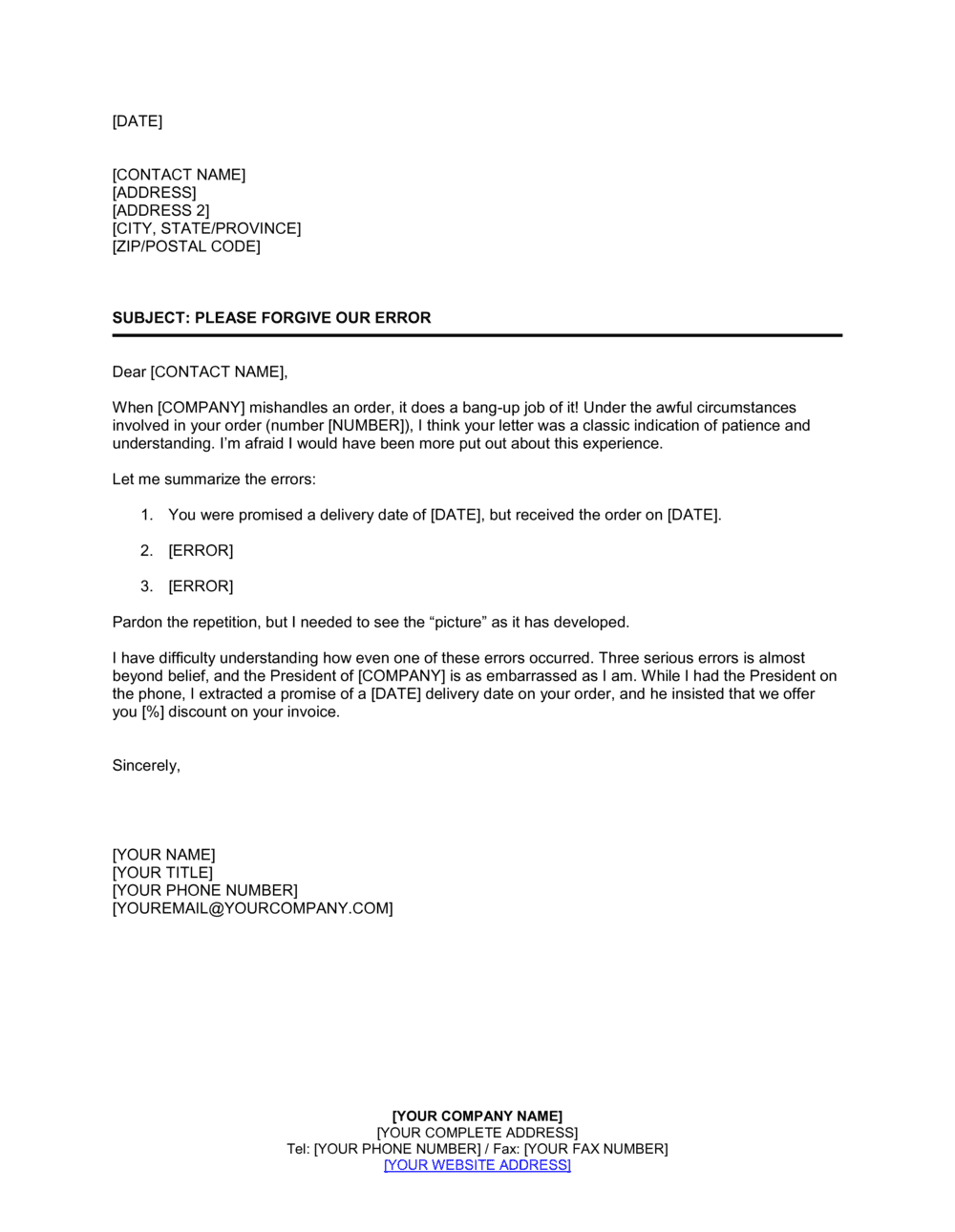
A "Please Forgive The Error Made In Order" letter is a formal written document used by a business to acknowledge a specific mistake in a previously issued order — whether a billing discrepancy, incorrect quantity, wrong product, or pricing error — and to request the recipient's understanding and formal acknowledgment of the correction. This template is a free Word download you can edit online, customize with your specific error details, and export as PDF for immediate delivery to clients, suppliers, or counterparties.
When you need it
Use it immediately after discovering a material error in a purchase order, sales order, invoice, or shipping document that has already been sent to another party. It is especially important when the error affects price, quantity, product specification, or delivery terms — details that could lead to a contractual dispute if not formally corrected in writing.
What's inside
The letter includes identification of both parties, a reference to the original order number and date, a precise description of the error and the corrected information, an apology and explanation, a request for written acknowledgment, and a signature block with authority confirmation. It may also include a corrected order attachment and a proposed resolution timeline.

What is a "Please Forgive The Error Made In Order" Letter?

A "Please Forgive The Error Made In Order" letter is a formal written document issued by a business to acknowledge a specific mistake in a previously sent commercial order — such as an incorrect unit price, wrong quantity, erroneous product specification, or inaccurate delivery date — and to formally request the counterparty's understanding and written acknowledgment of the corrected terms. It functions simultaneously as a professional apology, a precise record of the error, and a legally meaningful amendment to the original order. Unlike an informal email correction, a properly executed letter creates a documented evidentiary record that both parties agreed to the corrected terms, which is critical if the error leads to a downstream billing dispute, fulfillment discrepancy, or contractual disagreement.

Why You Need This Document

Failing to correct an order error in writing — promptly and formally — leaves the erroneous original as the operative document governing the transaction. This means a supplier may lawfully fulfill at the wrong price or quantity, a buyer may process payment for the incorrect amount, and your organization loses the clean paper trail needed to resolve any resulting dispute. In high-volume procurement environments, uncorrected order errors compound: a $5-per-unit price error on a 10,000-unit order becomes a $50,000 exposure that is far harder to recover once goods have shipped and payment has been processed. A formal correction letter stops this chain, protects both parties from acting in good faith on wrong information, and demonstrates the internal controls and professional standards that commercial counterparties and auditors expect. This template gives you the structure to issue a legally sound, professionally worded correction in under 30 minutes — reducing your exposure from the moment it is sent.

Which variant fits your situation?

If your situation is…Use this template
Correcting a billing or invoice amount already sent to a clientBilling Error Correction Letter
Reversing or reducing a prior invoice due to an overchargeCredit Note
Formally apologizing for a delayed shipment or missed deliveryApology Letter for Delay in Delivery
Notifying a supplier of an incorrect purchase order before fulfillmentPurchase Order Amendment
Disputing a charge on a received invoiceInvoice Dispute Letter
Cancelling an order placed in error entirelyOrder Cancellation Letter
Correcting an error in a formal contract rather than an order documentContract Amendment Agreement

Common mistakes to avoid

❌ Vague error description

Why it matters: A letter that says 'an error was made' without specifying what was wrong gives the counterparty grounds to dispute which term was incorrect and what the corrected version should be.

Fix: State the exact incorrect figure and the exact correct figure in a clearly formatted 'was / should be' structure with reference to supporting documentation such as the original quotation.

❌ No acknowledgment deadline

Why it matters: Without a deadline, the correction is open-ended and the counterparty may proceed on original erroneous terms or delay response indefinitely while your exposure grows.

Fix: Always specify a response deadline — typically 3–7 business days — and state what action you will take if no acknowledgment is received by that date.

❌ Overly broad admission of liability in the apology clause

Why it matters: Language such as 'we accept full responsibility for all losses arising from this error' can be used against the sender in a subsequent claim for consequential damages far exceeding the value of the original error.

Fix: Limit the acknowledgment to the specific clerical or administrative error. Use language such as 'we regret the administrative error' rather than admissions of broader fault or consequential liability.

❌ Failing to address the practical status of the order

Why it matters: If the letter corrects terms but does not address whether fulfillment should continue or pause, the supplier or buyer may proceed under the wrong terms — making the error harder and more expensive to unwind.

Fix: Include an explicit instruction on the order status during the correction period — hold, continue, or cancel — and confirm payment treatment for any amounts already processed under the incorrect terms.

❌ Signed by someone without authority

Why it matters: A correction letter signed by a person without actual or apparent authority to bind the company may be challenged as ineffective, leaving the original erroneous order as the operative document.

Fix: Confirm the signatory's authority against your organization's signing authority policy before execution. For high-value orders, obtain dual authorization.

❌ No attachment of the corrected order document

Why it matters: A letter describing corrections in prose without attaching the revised order document creates ambiguity about the exact corrected terms, especially for orders with multiple line items.

Fix: Always attach a revised, clearly marked 'CORRECTED ORDER' document to the letter, referencing the original order number and marked with the correction date.

The 9 key clauses, explained

Parties and order reference

In plain language: Identifies the sending party, the recipient, and the specific order being corrected — including order number, original date, and subject matter.

Sample language
This letter is issued by [SENDER COMPANY NAME] ('Sender') to [RECIPIENT COMPANY NAME] ('Recipient') in connection with Purchase Order No. [ORDER NUMBER] dated [ORIGINAL DATE] for the supply of [GOODS/SERVICES DESCRIPTION] ('Original Order').

Common mistake: Referencing the order by description only without including the order number or date. Without a unique identifier, the recipient's accounting or procurement system cannot match the correction to the correct record, causing processing delays.

Description of the error

In plain language: States precisely what the error was — the incorrect figure, term, or detail — in plain, specific language that leaves no room for misinterpretation.

Sample language
The Original Order incorrectly stated a unit price of $[INCORRECT AMOUNT] for [ITEM DESCRIPTION]. The correct agreed unit price is $[CORRECT AMOUNT] as confirmed in our quotation dated [QUOTATION DATE].

Common mistake: Using vague language such as 'an error was made in the above order' without specifying exactly what was wrong. Vague descriptions can create disputes about which term was erroneous and what the agreed correction should be.

Corrected terms

In plain language: States the accurate, corrected information that should replace the erroneous terms in the original order.

Sample language
The correct terms for the Order are as follows: Item: [ITEM DESCRIPTION] | Quantity: [CORRECT QUANTITY] | Unit Price: $[CORRECT PRICE] | Total Value: $[CORRECT TOTAL] | Delivery Date: [CORRECT DATE].

Common mistake: Only describing what was wrong without clearly restating all corrected terms in one place. The recipient should be able to identify the accurate order terms from this letter alone without cross-referencing multiple documents.

Apology and acknowledgment of responsibility

In plain language: Formally acknowledges that the error originated with the sending party and expresses regret for any inconvenience caused, without admitting broader legal liability.

Sample language
We sincerely apologize for the error in the Original Order. The mistake was the result of [BRIEF EXPLANATION — e.g., a data entry oversight] and we acknowledge the inconvenience this may have caused [RECIPIENT COMPANY NAME].

Common mistake: Using overly broad admissions of fault — for example, 'we accept full responsibility for all consequences arising from this error.' Limit the acknowledgment to the specific error; do not create unintended admissions of broader liability.

Effect on the original order

In plain language: Clarifies whether the corrected terms supersede the original order entirely, amend specific provisions only, or require a new order to be issued.

Sample language
Except as corrected herein, all other terms and conditions of the Original Order remain in full force and effect. This letter, once acknowledged by [RECIPIENT COMPANY NAME], constitutes a formal amendment to the Original Order.

Common mistake: Leaving the status of the original order ambiguous. If the letter does not clearly state whether the original is superseded or only partially amended, both parties may proceed on different assumptions about which version governs.

Request for written acknowledgment

In plain language: Asks the recipient to formally confirm in writing that they have received the correction and agree to the corrected terms within a defined timeframe.

Sample language
We respectfully request that [RECIPIENT COMPANY NAME] confirm its acceptance of the corrected terms by signing and returning this letter, or by issuing a written acknowledgment, no later than [ACKNOWLEDGMENT DEADLINE DATE].

Common mistake: Not specifying an acknowledgment deadline. Without a deadline, the recipient has no defined obligation to respond, and the sending party has no clear point at which to escalate or issue a revised order.

Impact on fulfillment, shipment, or payment

In plain language: Addresses any practical consequences of the error — whether shipment should be held, payment should be revised, or the delivery schedule needs adjustment pending acknowledgment.

Sample language
We request that [RECIPIENT COMPANY NAME] / [SUPPLIER NAME] hold fulfillment of the Original Order pending acknowledgment of the corrected terms. Any payment already issued based on the incorrect amount will be [adjusted by credit note / invoiced for the difference] within [X] business days.

Common mistake: Failing to address the practical status of the order while correction is pending. If fulfillment continues under erroneous terms, the error becomes harder to unwind and may be treated as acceptance of the original incorrect terms.

Governing law and dispute resolution

In plain language: States which jurisdiction's law governs interpretation of the correction and how any resulting disputes will be resolved.

Sample language
This correction and any disputes arising from it shall be governed by the laws of [STATE / PROVINCE / COUNTRY]. Any dispute that cannot be resolved by mutual agreement shall be submitted to [arbitration / mediation / the courts of JURISDICTION].

Common mistake: Omitting governing law in a letter sent to an international counterparty. Without it, a dispute about whether the correction was accepted could be litigated in an unexpected jurisdiction under unfamiliar rules.

Sender authorization and signature block

In plain language: Identifies the individual signing on behalf of the sending organization, their title, and their authority to bind the company to the corrected terms.

Sample language
Signed on behalf of [SENDER COMPANY NAME] by: [AUTHORIZED SIGNATORY NAME], [TITLE], duly authorized. Date: [SIGNATURE DATE]. Counterparty acknowledgment: [RECIPIENT AUTHORIZED SIGNATORY NAME], [TITLE], [DATE].

Common mistake: Having a junior employee or clerk sign the correction without authority to bind the company. If the signatory lacks actual or apparent authority, the correction may be unenforceable against the sending party in a subsequent dispute.

How to fill it out

  1. 1

    Identify and document the original order

    Locate the original order document and record its number, date, and the names of both parties exactly as they appear in your systems. Attach a copy of the original order to the correction letter.

    💡 Pull the order from your accounting or ERP system to ensure the reference number matches what the recipient has on file — discrepancies in order numbers cause processing delays.

  2. 2

    Describe the error precisely

    State the incorrect information in specific, numerical terms — the wrong price, wrong quantity, wrong product code, or wrong delivery date. Do not describe the error in general terms.

    💡 Side-by-side formatting — 'Stated: X / Correct: Y' — makes the error and correction immediately scannable for the recipient's procurement or AP team.

  3. 3

    State all corrected terms clearly

    List every term that changes as a result of the correction: item description, quantity, unit price, total value, and delivery date. Ensure the corrected total is arithmetically consistent with the corrected line items.

    💡 Restate unchanged terms as 'unchanged' rather than omitting them — this prevents any argument that silence on a term means it was also corrected.

  4. 4

    Draft the apology clause carefully

    Acknowledge the error and apologize for the inconvenience without using language that admits broad legal liability. Explain the cause briefly — data entry error, system issue, human oversight — without over-explaining.

    💡 Have legal counsel review the apology clause if the error caused the counterparty a measurable financial loss — even a well-intentioned apology can be used as an admission in dispute proceedings.

  5. 5

    Clarify the effect on the original order

    State explicitly whether this letter amends the original order, supersedes it entirely, or triggers a new order number. Include language confirming that all other terms remain in effect.

    💡 If your organization requires a new purchase order number for any amended order, issue the corrected order as a replacement PO and reference both numbers in the letter.

  6. 6

    Set a clear acknowledgment deadline

    Specify the date by which the recipient must respond — typically 3–7 business days for routine corrections, shorter if fulfillment is time-sensitive. State the consequence of non-response: fulfillment hold, escalation, or reissuance.

    💡 Send the letter by email with read-receipt enabled and follow up by phone the same day for high-value orders. A paper trail of delivery is essential if the correction is later disputed.

  7. 7

    Have an authorized signatory execute the letter

    Ensure the letter is signed by someone with documented authority to bind your organization — procurement manager, CFO, or a director with signing authority for orders of this value.

    💡 Match the signatory level to the value of the order. A correction on a $500K order signed by a junior buyer raises counterparty concerns about internal controls.

  8. 8

    Retain a signed copy and update your records

    Once the counterparty returns a signed acknowledgment, file both the original letter and the acknowledgment against the order record in your accounting and procurement systems.

    💡 Immediately update the order in your ERP or accounting software to reflect the corrected terms — do not rely solely on the paper trail without correcting the system record.

Frequently asked questions

What is a 'Please Forgive The Error Made In Order' letter?

It is a formal business letter issued by one party to another to acknowledge a specific mistake in a previously sent order — such as an incorrect price, wrong quantity, or erroneous product specification — and to formally request the recipient's understanding and written acceptance of the corrected terms. It serves both as an apology and as a legally meaningful amendment to the original order document.

When should I send an error correction letter for an order?

Send it as soon as you discover the error, before fulfillment proceeds under the incorrect terms. The longer you wait, the more likely the counterparty will have acted on the erroneous order — accepting a delivery, processing a payment, or committing resources — which makes correction more complex and potentially costly. For billing errors, send the correction before the payment due date if possible.

Does an order error correction letter need to be signed?

Yes. Because the letter effectively amends an existing commercial order, it should be signed by an authorized representative of the sending organization and returned with a signature of acknowledgment from the recipient. An unsigned correction letter may not constitute a binding amendment to the original order and could leave the erroneous terms in force.

What if the recipient refuses to acknowledge the correction?

If the counterparty refuses to accept the corrected terms, the original order may govern the transaction — depending on the jurisdiction and whether the error was mutual or unilateral. In most jurisdictions, a unilateral mistake does not automatically entitle the mistaken party to rescind or amend the contract. You should consult a lawyer before withholding fulfillment or payment if the counterparty insists on the original erroneous terms.

Can I send this letter by email, or does it need to be a physical letter?

Email is acceptable and legally effective in most jurisdictions for commercial correspondence of this type, provided the email contains or attaches the complete signed letter and the recipient's email acknowledgment is retained. Physical delivery by courier is preferable for very high-value orders or when your original order was issued as a formal paper document. Always retain proof of delivery regardless of medium.

What is the difference between an error correction letter and a credit note?

An error correction letter addresses the order itself — correcting the terms before or independent of payment. A credit note is an accounting document issued after an invoice has been sent or paid, reducing or reversing the amount owed. If the error resulted in an overcharge on an invoice, you will typically need both: the correction letter to amend the order terms and a credit note to adjust the accounting record.

Should I include an explanation of why the error occurred?

A brief, factual explanation — for example, a data entry error or a system migration issue — is professional and reassures the counterparty that the error was isolated. However, keep the explanation concise and factual. Avoid detailed explanations that could suggest systemic problems, and avoid language that could be read as an admission of negligence beyond the specific error.

Do I need a lawyer to draft an order error correction letter?

For routine errors on standard commercial orders, a well-drafted template is typically sufficient. Legal review is recommended when the error involves a significant financial amount, when the counterparty has already acted in reliance on the erroneous terms, when the error is disputed, or when the correction involves cross-border transactions subject to multiple jurisdictions. A lawyer can also advise on whether the error gives either party the right to rescind the order entirely.

How this compares to alternatives

vs Order Cancellation Letter

An order cancellation letter terminates the original order entirely, whereas an error correction letter amends and preserves it. Use cancellation when the error is so material that the order cannot be salvaged on corrected terms, or when both parties agree the transaction should not proceed. Use the correction letter when the underlying agreement remains valid and only specific terms need to be fixed.

vs Credit Note

A credit note is an accounting document that reduces or reverses a previously issued invoice amount — it operates at the payment level. An error correction letter operates at the order level, amending the terms of the order itself. When a pricing error leads to an overcharge, you typically need both: the correction letter to fix the order and a credit note to adjust the invoice.

vs Contract Amendment Agreement

A contract amendment formally modifies a signed contract and requires mutual execution with the same formality as the original agreement. An error correction letter is appropriate for order-level mistakes in purchase orders, sales orders, or shipping documents that do not rise to the level of a full contractual amendment. Use the amendment agreement when the underlying document is a signed contract rather than a commercial order.

vs Invoice Dispute Letter

An invoice dispute letter is sent by the recipient of an invoice to challenge a charge they believe is incorrect — it is a reactive document from the buyer's perspective. An error correction letter for an order is proactive, sent by the party who made the error to acknowledge and correct it before a dispute arises. The correction letter aims to prevent the dispute that an invoice dispute letter is used to resolve.

Industry-specific considerations

Manufacturing and wholesale

High-volume purchase orders with complex line items make pricing and quantity errors common; a formal written correction protects against fulfillment of the wrong goods at the wrong price.

Retail and e-commerce

Order errors affecting unit prices, SKUs, or delivery addresses require prompt written correction to avoid customer disputes, inventory discrepancies, and incorrect shipments.

Construction and contracting

Material specification or quantity errors on construction orders can have significant cost and scheduling consequences; a formal correction letter documents the agreed amendment for lien and payment purposes.

Professional services and consulting

Service order errors involving incorrect fee amounts, scope of work, or billing rates are formally corrected to maintain client trust and preserve the integrity of the engagement letter.

Jurisdictional notes

United States

Under the UCC (Uniform Commercial Code), which governs most US commercial goods transactions, a contract may be modified by mutual agreement without additional consideration. A signed correction letter and acknowledgment typically satisfies this requirement. Some states require modifications to written contracts to also be in writing — check the governing law clause of the original order. For service orders, common-law contract principles apply and may vary by state.

Canada

Canadian commercial law is largely provincial. In common-law provinces, contract amendments generally require consideration or must be in a deed — a signed correction letter accepted by both parties typically satisfies this. Quebec's Civil Code permits correction of clerical errors (erreur matérielle) by agreement of the parties without the same consideration requirement. Bilingual documentation may be required for Quebec-based counterparties under the Charter of the French Language.

United Kingdom

Under English law, a unilateral mistake in a contract may permit rectification or rescission in limited circumstances — but only if the mistake is about the terms themselves, not a bad bargain. A prompt written correction acknowledged by both parties avoids the need for court-ordered rectification and is the preferred commercial approach. The Sale of Goods Act 1979 and Consumer Rights Act 2015 may impose additional obligations depending on whether the counterparty is a business or consumer.

European Union

EU member states generally permit correction of clerical errors in commercial contracts by mutual written agreement, though the formality required varies. France, Germany, and the Netherlands each have civil code provisions on error (erreur, Irrtum, dwaling) that may permit rescission for certain types of material mistakes if uncorrected. GDPR considerations apply if the correction letter references or is sent alongside personal data. Cross-border EU transactions should specify governing law explicitly to avoid ambiguity across member state courts.

Template vs lawyer — what fits your deal?

PathBest forCostTime
Use the templateRoutine order errors involving a single clerical mistake — wrong price, quantity, or product code — on standard commercial orders below $50,000Free15–30 minutes
Template + legal reviewErrors on high-value orders, cross-border transactions, or situations where the counterparty has already acted in reliance on the erroneous terms$200–$500 for a lawyer review of the correction letter and apology clause1–2 business days
Custom draftedDisputed corrections, errors involving consequential loss claims, or order errors embedded in complex multi-party supply contracts$500–$2,000+3–7 business days

Glossary

Purchase Order (PO)
A buyer-issued commercial document authorizing a seller to supply specific goods or services at agreed prices and quantities.
Order Acknowledgment
A formal confirmation from the receiving party that they have received, reviewed, and accepted the terms of a corrected order.
Material Error
A mistake significant enough to affect the core terms of an agreement — such as price, quantity, product identity, or delivery date — as opposed to a minor typographical error.
Corrected Order
A revised version of the original order document that supersedes the erroneous version and reflects the accurate, agreed terms.
Counterparty
The other party in a commercial transaction — the buyer when you are the seller, or the supplier when you are the buyer.
Mutual Assent
The shared agreement of both parties to the same terms, required for a binding contract — a correction letter helps restore mutual assent after an error disrupts it.
Written Acknowledgment
A signed or formally issued response confirming the counterparty has received and accepted the corrected terms.
Rescission
The cancellation of a contract or order as if it never existed — a remedy available when a material error cannot be corrected by amendment.
Good Faith
The obligation to deal honestly and without deceptive intent — promptly disclosing and correcting an order error is a standard expression of good-faith commercial dealing.
Estoppel
A legal principle preventing a party from acting inconsistently with a prior representation — relevant when a party relies on an erroneous order before being notified of the correction.
Amendment
A formal change to an existing document or agreement, modifying specific terms while leaving the rest of the original intact.

Part of your Business Operating System

This document is one of 3,000+ business & legal templates included in Business in a Box.

  • Fill-in-the-blanks — ready in minutes
  • 100% customizable Word document
  • Compatible with all office suites
  • Export to PDF and share electronically

Create your document in 3 simple steps.

From template to signed document — all inside one Business Operating System.
1
Download or open template

Access over 3,000+ business and legal templates for any business task, project or initiative.

2
Edit and fill in the blanks with AI

Customize your ready-made business document template and save it in the cloud.

3
Save, Share, Send, Sign

Share your files and folders with your team. Create a space of seamless collaboration.

Save time, save money, and create top-quality documents.

★★★★★

"Fantastic value! I'm not sure how I'd do without it. It's worth its weight in gold and paid back for itself many times."

Managing Director · Mall Farm
Robert Whalley
Managing Director, Mall Farm Proprietary Limited
★★★★★

"I have been using Business in a Box for years. It has been the most useful source of templates I have encountered. I recommend it to anyone."

Business Owner · 4+ years
Dr Michael John Freestone
Business Owner
★★★★★

"It has been a life saver so many times I have lost count. Business in a Box has saved me so much time and as you know, time is money."

Owner · Upstate Web
David G. Moore Jr.
Owner, Upstate Web

Run your business with a system — not scattered tools

Stop downloading documents. Start operating with clarity. Business in a Box gives you the Business Operating System used by over 250,000 companies worldwide to structure, run, and grow their business.

Start free · No credit card required