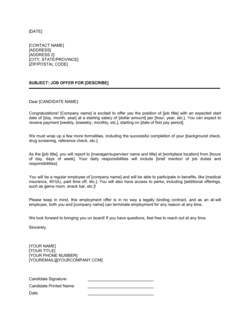
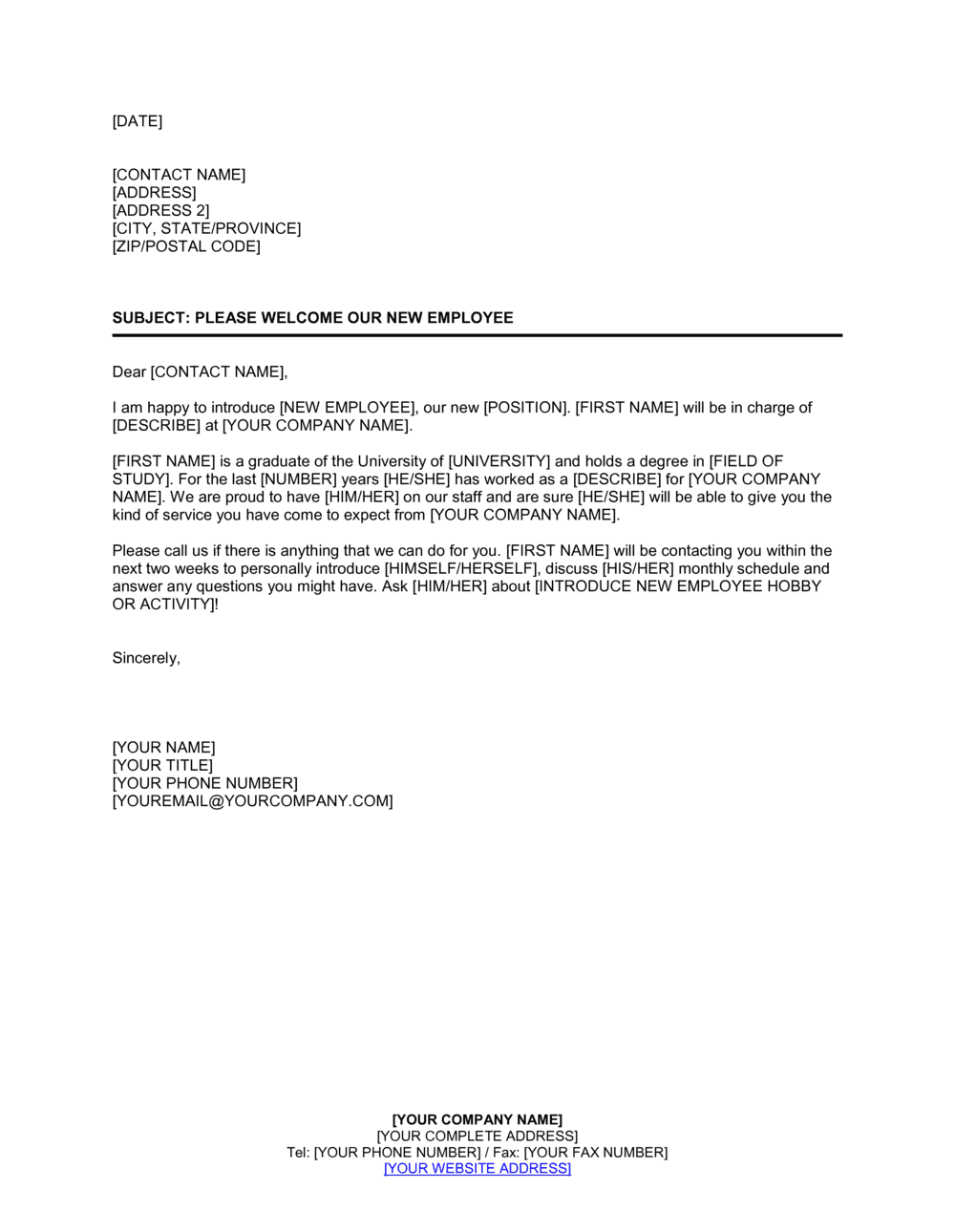
Please Welcome New Employee Template

Free Word download β€’ Edit online β€’ Save & share with Drive β€’ Export to PDF

1 pageβ€’20–30 min to fillβ€’Difficulty: Standardβ€’Signature requiredβ€’Legal review recommended
Learn more ↓
FreePlease Welcome New Employee Template

At a glance

What it is
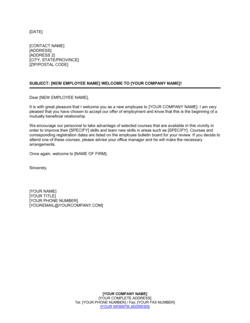
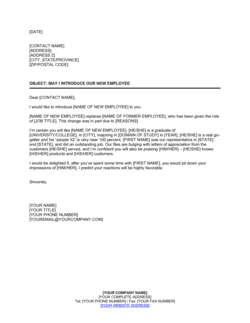
A Please Welcome New Employee announcement is a formal internal communication document issued by HR or a hiring manager to introduce a new hire to the broader organization. This free Word download provides a structured, professional template that covers the new employee's role, start date, background, reporting relationships, and contact information β€” ready to edit online and distribute via email or company intranet.
When you need it
Use it on or just before a new employee's first day to notify colleagues, direct reports, and cross-functional partners of the new hire's arrival, responsibilities, and how to reach them. It is equally useful when announcing an internal promotion or a lateral transfer that changes an employee's team or title.
What's inside
Sender and date details, new employee's full name and job title, department and reporting structure, start date, a brief professional background summary, key responsibilities, contact information, and a welcoming call to action that encourages colleagues to introduce themselves.

What is a Please Welcome New Employee Announcement?

A Please Welcome New Employee announcement is a formal internal communication document issued by HR or a hiring manager to introduce a new hire to the existing team before or on their first day. It provides colleagues with the essential context they need to work effectively alongside the new employee from day one: full name, official job title, department, reporting structure, start date, a concise professional background, key responsibilities, and contact details. Beyond the practical information transfer, the announcement functions as the organization's first public signal of how it treats new arrivals β€” a well-crafted, timely announcement sets a tone of inclusion, preparation, and professionalism that shapes the new hire's initial experience and the team's readiness to collaborate.

Why You Need This Document

Without a structured new employee announcement, colleagues encounter new hires without context β€” leading to awkward first interactions, duplicated introductions, and confusion about who owns what responsibilities. Work requests get routed incorrectly, system access provisioning stalls when IT has no official title to reference, and the new hire is left to explain their own role repeatedly in their first week instead of focusing on productive onboarding. The reputational cost is real: a disorganized introduction signals to the new employee that the company is unprepared, increasing early-tenure disengagement at the exact moment when first impressions set long-term retention trajectories. This template eliminates that friction by giving HR and hiring managers a consistent, professional structure they can complete in under fifteen minutes β€” ensuring every new hire arrives to a team that knows who they are, what they do, and how to reach them.

Which variant fits your situation?

If your situation is…Use this template
Announcing a new full-time employee to the entire organizationPlease Welcome New Employee
Sending a personal welcome directly to the new hire before day oneWelcome Letter to New Employee
Announcing a new executive or C-suite hire to the companyExecutive New Hire Announcement
Introducing a new employee to an external client or partnerNew Employee Introduction Letter (External)
Announcing an internal promotion or role changePromotion Announcement Letter
Notifying staff of a new remote or hybrid team memberRemote Employee Onboarding Announcement
Formally documenting the new hire's employment terms before announcementEmployment Contract

Common mistakes to avoid

❌ Sending the announcement after the employee's first day

Why it matters: Colleagues who encounter the new hire without any prior introduction experience an awkward first interaction, and the new employee may feel the company was unprepared for their arrival.

Fix: Schedule the announcement to reach all relevant recipients the business day before or the morning of the first day, so the team is primed to give a warm welcome.

❌ Using an inconsistent or unofficial job title

Why it matters: A title in the announcement that differs from the employment contract triggers confusion in IT provisioning, org chart updates, payroll records, and benefits enrollment.

Fix: Pull the exact job title from the signed employment agreement and use it verbatim across every piece of onboarding communication.

❌ Omitting the reporting structure

Why it matters: Without knowing who the new hire reports to, colleagues cannot correctly route work requests, approvals, or escalations β€” creating process gaps from day one.

Fix: Always include the direct manager's full name and title, and for senior hires, the broader leadership layer the role sits within.

❌ Distributing the announcement before the new hire has reviewed their background summary

Why it matters: Factual errors in the bio β€” wrong previous employer, incorrect degree, or misattributed achievements β€” embarrass the new employee and undermine trust in the announcement's accuracy.

Fix: Send a draft to the new hire during the offer-acceptance or pre-boarding phase and request written confirmation of the background section before finalizing.

❌ Sending from a generic or no-reply email address

Why it matters: Recipients cannot reply to ask questions or express congratulations, and the announcement feels impersonal β€” reducing the likelihood of proactive colleague engagement.

Fix: Send from the hiring manager's or HR manager's named email address, or from a monitored team address, with a clear invitation for colleagues to reply.

❌ Including no contact information for the new hire

Why it matters: Without an email address or messaging handle, colleagues who want to introduce themselves have no frictionless way to do so, and early relationship-building stalls.

Fix: Confirm with IT that the new hire's email and collaboration platform accounts are active before the announcement goes out, then include all relevant contact details in the announcement.

The 9 key clauses, explained

Sender identification and date

In plain language: Names the person or team issuing the announcement (HR department, hiring manager, or CEO) and the date of distribution.

Sample language
From: [SENDER NAME / HR DEPARTMENT] | Date: [DATE] | To: [DISTRIBUTION LIST β€” All Staff / Department Name]

Common mistake: Sending the announcement from a generic 'noreply' address with no named sender. Recipients are less likely to engage with an introduction when there is no accountable person behind it.

New employee's name and job title

In plain language: States the new hire's full legal name and their official job title exactly as it appears in HR records and the employment contract.

Sample language
We are pleased to welcome [EMPLOYEE FULL NAME] to [COMPANY NAME] as our new [JOB TITLE].

Common mistake: Using a working title or nickname instead of the official title on record. Inconsistency between the announcement and HR systems creates confusion for IT provisioning, org chart updates, and payroll.

Department and reporting structure

In plain language: Identifies the department the new hire joins and the name and title of their direct manager, making the org chart relationship immediately clear.

Sample language
[EMPLOYEE NAME] will be joining the [DEPARTMENT NAME] team and will report directly to [MANAGER NAME], [MANAGER TITLE].

Common mistake: Omitting the manager's name. Without it, colleagues who need to route work or questions have no clear escalation path and default to guessing.

Start date

In plain language: States the new employee's official first day of work so colleagues know when to expect them and when system access and introductions should begin.

Sample language
[EMPLOYEE NAME] joins us on [START DATE β€” e.g., Monday, June 2, 2026].

Common mistake: Sending the announcement after the employee has already started. Pre-arrival announcements give teams time to prepare workspace, access, and a warm welcome.

Professional background summary

In plain language: Provides 2–4 sentences on the new hire's relevant work history, education, or notable achievements β€” enough context for colleagues to understand what the person brings to the role.

Sample language
[EMPLOYEE NAME] brings [X] years of experience in [FIELD / INDUSTRY]. Most recently, [he/she/they] served as [PREVIOUS TITLE] at [PREVIOUS COMPANY], where [BRIEF ACHIEVEMENT]. [EMPLOYEE NAME] holds a [DEGREE] from [INSTITUTION].

Common mistake: Pasting the employee's full LinkedIn biography verbatim. A 600-word career history overwhelms recipients β€” trim to the two or three details most relevant to the new role.

Key responsibilities and scope of role

In plain language: Summarizes what the new employee will own β€” their primary function, key projects, and the teams or systems they will interact with β€” so colleagues understand how to collaborate with them.

Sample language
In this role, [EMPLOYEE NAME] will be responsible for [PRIMARY RESPONSIBILITY], [SECONDARY RESPONSIBILITY], and working closely with [TEAM / STAKEHOLDERS] to [BUSINESS OBJECTIVE].

Common mistake: Describing responsibilities so broadly that no one knows when to involve the new hire. 'Supporting business goals across multiple functions' tells colleagues nothing actionable about when to loop in the new employee.

Contact information

In plain language: Provides the new hire's company email address and, where appropriate, phone number or Slack/Teams handle, so colleagues can reach out immediately.

Sample language
You can reach [EMPLOYEE NAME] at [COMPANY EMAIL ADDRESS] or by phone at [PHONE NUMBER β€” optional]. [He/She/They] will also be available on [SLACK / TEAMS] at @[HANDLE].

Common mistake: Omitting contact details entirely and expecting colleagues to search the company directory. Friction at this step delays the introductions the announcement is designed to facilitate.

Welcoming call to action

In plain language: Explicitly invites colleagues to introduce themselves, reach out, or stop by β€” setting a cultural tone of inclusion and signaling that the organization values relationship-building.

Sample language
Please join us in welcoming [EMPLOYEE NAME] to the team. We encourage you to reach out and introduce yourself β€” [he/she/they] would love to connect with everyone as [he/she/they] settles in.

Common mistake: Ending the announcement without any call to action. A passive sign-off like 'We wish [EMPLOYEE NAME] success' generates no interpersonal engagement and leaves the new hire waiting for colleagues to make the first move.

Sender sign-off and authorization

In plain language: Closes the announcement with the sender's name, title, and a signature block β€” establishing that the communication is official and authorized by management or HR.

Sample language
Warm regards, [SENDER NAME] | [SENDER TITLE] | [COMPANY NAME] | [DATE]

Common mistake: No sign-off at all, or a sign-off that lacks the sender's title. An unsigned or untitled announcement reads as informal and can be mistaken for an unofficial message.

How to fill it out

  1. 1

    Confirm the official job title and start date with HR

    Before drafting, verify the new hire's exact job title as it appears in the signed employment contract, the confirmed start date, and the distribution list scope β€” all-staff, department, or selective.

    πŸ’‘ Lock in these details at least three business days before the intended send date so you have time for manager review without rushing.

  2. 2

    Enter the sender's name, title, and announcement date

    Fill in the sender block with the name and title of the person authorizing the announcement β€” typically the HR manager, direct supervisor, or CEO for senior hires. Set the date to the intended distribution date, not today's draft date.

    πŸ’‘ For company-wide announcements, sending from the CEO or a senior leader increases open rates and signals organizational priority.

  3. 3

    Write the new employee's introduction line

    State the employee's full legal name and official job title exactly as recorded in your HR system. Include the department and the name and title of their direct manager.

    πŸ’‘ Use the same job title across the announcement, the employment contract, and the org chart β€” inconsistency causes IT provisioning delays and payroll mismatches.

  4. 4

    Draft the professional background summary

    Write 2–4 sentences covering the most relevant prior experience, one notable achievement from a previous role, and educational credentials if directly relevant. Ask the new hire to review this section for accuracy before sending.

    πŸ’‘ Request a short written bio from the new hire during the offer-acceptance stage so you have source material ready well before day one.

  5. 5

    Define key responsibilities in plain language

    Summarize the new hire's two or three primary responsibilities and the main teams or stakeholders they will work with. Keep this section to three to five sentences β€” enough for colleagues to know when to involve this person.

    πŸ’‘ Avoid jargon or internal project codenames that external departments won't recognize. Write for the broadest recipient on the distribution list.

  6. 6

    Add contact details and collaboration channels

    Enter the new hire's company email address, phone number if applicable, and their handle on any internal messaging platform (Slack, Microsoft Teams). Confirm with IT that these accounts are active before the announcement goes out.

    πŸ’‘ If the new hire's email is not yet active at send time, include the hiring manager's contact as an interim point of contact.

  7. 7

    Write a specific welcoming call to action

    Close the announcement with a direct invitation for colleagues to reach out. Mention any planned introduction events β€” a welcome lunch, a virtual coffee session, or a team meeting where the new hire will be introduced.

    πŸ’‘ Scheduling a brief all-hands or team introduction call within the first week converts the announcement from a one-way notice into an actual connection opportunity.

  8. 8

    Obtain manager or HR sign-off before distributing

    Route the completed announcement to the new hire's manager for factual review and to HR for compliance with the internal communication policy. Send only after both have approved.

    πŸ’‘ Store a copy of the approved announcement in the employee's HR file as part of the onboarding documentation trail.

Frequently asked questions

What is a please welcome new employee announcement?

A please welcome new employee announcement is a formal internal communication issued by HR or a hiring manager to introduce a new hire to the broader organization. It covers the employee's name, job title, department, reporting structure, start date, professional background, and contact information. It serves both as a practical heads-up for colleagues and as a cultural signal that the organization invests in making new hires feel valued from day one.

When should a new employee announcement be sent?

The announcement should reach all relevant recipients the business day before the new hire's first day, or on the morning of their start date at the latest. Sending too early β€” more than three business days in advance β€” risks the news being forgotten. Sending after the employee has already arrived means colleagues encounter them without context, which is awkward for both parties and undermines first impressions.

Who should receive the new employee announcement?

Distribution scope depends on the seniority and cross-functional reach of the role. For individual contributors, send to the immediate team and any departments they will work closely with. For managers and directors, include all staff who report to or work alongside them. For C-suite or VP hires, a company-wide announcement is standard. Always include IT and facilities as a practical step, even if they are not on the formal distribution list.

Should the new employee review the announcement before it is sent?

Yes. The new hire should review and confirm the accuracy of the professional background section before the announcement is distributed. Factual errors β€” wrong previous employer, misattributed credentials, or incorrect degree details β€” are embarrassing for the employee and erode trust in the HR team's attention to detail. Request a written sign-off on the draft during the pre-boarding period.

Does a new employee announcement need to be signed or authorized?

A welcome announcement does not require a notarized or formally witnessed signature, but it should carry the name and title of an authorized sender β€” typically the HR manager, hiring manager, or a senior leader. For senior hires, having the CEO or COO sign off signals organizational importance and increases engagement. Storing an approved copy in the HR file creates a documentation trail consistent with good onboarding practice.

What is the difference between a new employee announcement and a welcome letter?

A new employee announcement is addressed to the existing team β€” it introduces the new hire to colleagues. A welcome letter is addressed directly to the new employee β€” it expresses the company's excitement about their arrival, outlines what to expect on day one, and often includes practical logistics like where to park and who to ask for. Both documents serve the onboarding process but have different audiences and purposes.

How long should a new employee announcement be?

One page or fewer is the standard. In email format, aim for 150 to 300 words β€” long enough to provide meaningful context about the person and their role, short enough for every recipient to read it fully. For executives or high-profile hires, a slightly longer announcement of 300 to 500 words may be appropriate, but should still be concise and focused on the most relevant details.

Can this template be used for announcing an internal promotion?

Yes, with minor adjustments. Replace the 'joining us' language with language that acknowledges the employee's existing tenure and highlights their new responsibilities. Include a sentence recognizing their contributions in their previous role. An internal promotion announcement carries the same structural elements β€” name, new title, department, reporting structure, responsibilities, and contact details β€” but the tone is more celebratory and the background section should reference their time at the company.

What should be excluded from a new employee announcement?

Avoid including compensation details, the terms of the employment contract, personal information such as home address or personal phone number, reasons the previous person in the role departed, or any information the new hire has not explicitly approved for sharing. Disclosing private information in a company-wide announcement can violate privacy laws in several jurisdictions and erode the new hire's trust before they have even started.

How this compares to alternatives

vs Welcome Letter to New Employee

A welcome letter is addressed directly to the new hire β€” it expresses the company's enthusiasm, outlines day-one logistics, and helps the employee feel prepared before they arrive. A new employee announcement is addressed to the existing team and introduces the hire to colleagues. Both are needed for a complete onboarding communication plan; they serve different audiences and different purposes.

vs Job Offer Letter

An offer letter is a pre-hire document sent to the candidate to confirm the role, compensation, and terms before they accept. A new employee announcement is a post-acceptance communication sent to existing staff after the hire is confirmed and the start date is set. The offer letter closes the hiring process; the announcement opens the onboarding process.

vs Employment Contract

An employment contract is a binding legal document governing the full terms of the working relationship β€” IP, confidentiality, non-compete, termination, and severance. A new employee announcement is an internal communication document with no contractual weight. The contract should be signed before the announcement is distributed; both are necessary but serve entirely different legal and operational functions.

vs Promotion Announcement Letter

A promotion announcement celebrates an existing employee's advancement into a new role and references their tenure and contributions to the company. A new employee announcement introduces a person the team has not yet met. The structure is similar, but the tone, background section, and context differ significantly β€” promotion announcements lean on internal track record while new hire announcements focus on external experience.

Industry-specific considerations

Technology / SaaS

Announcements often include the new hire's GitHub handle or product area ownership to immediately signal collaboration touchpoints across engineering, product, and design teams.

Professional Services

New hire announcements in law firms, consulting practices, and accountancies typically reference the client verticals or practice areas the new hire will serve, enabling immediate client-team matching.

Healthcare

Announcements for clinical staff must reference licensing and credentialing status to allow department heads and scheduling teams to assign patient-facing responsibilities from day one.

Retail / Hospitality

High-turnover environments benefit from a standardized announcement template that can be completed in under ten minutes and distributed to store managers or shift supervisors without HR bottlenecks.

Financial Services

Regulated roles require the announcement to reference applicable licensing (Series 7, CFA, CPA) and confirm that regulatory onboarding steps have been initiated before the hire interfaces with clients.

Manufacturing

Plant-floor and operations announcements should specify the shift, facility location, and safety training status so floor supervisors know when and where to integrate the new hire into live production schedules.

Jurisdictional notes

United States

US employers should ensure new hire announcements do not inadvertently disclose protected class information β€” age, disability status, national origin, or immigration status β€” that is irrelevant to the role and could expose the company to discrimination claims under Title VII or the ADA. In California, privacy obligations under the CCPA extend to employee data, so announcements should contain only information the employee has explicitly authorized for internal sharing.

Canada

Canadian employers operating in Quebec must ensure internal communications, including new hire announcements, are available in French as required by the Charter of the French Language (Bill 101) for provincially regulated workplaces. Federal employers should align announcements with the Official Languages Act where applicable. PIPEDA and provincial privacy legislation require that personal information shared in announcements β€” such as prior employer names or educational institutions β€” be limited to what is necessary and consented to by the employee.

United Kingdom

UK employers must comply with UK GDPR and the Data Protection Act 2018 when circulating personal information about a new hire. Announcements should include only information the employee has provided consent to share, and should not reference health conditions, religious beliefs, or any other special category data. Where the new hire's role involves regulated financial activities, the announcement should note FCA registration status without disclosing details of the fit-and-proper assessment process.

European Union

EU General Data Protection Regulation (GDPR) applies directly to the personal data of new employees circulated in internal announcements. Employers must have a lawful basis β€” typically legitimate interest or employee consent β€” for sharing personal details beyond name and job title. Member states including Germany and France have works council or employee representative requirements that may require informing representative bodies before or concurrently with any general staff announcement of a new hire.

Template vs lawyer β€” what fits your deal?

PathBest forCostTime
Use the templateHR managers and hiring managers issuing standard new hire announcements for individual contributors or mid-level rolesFree10–15 minutes per announcement
Template + legal reviewSenior or executive hires where the announcement will be company-wide and intersects with employment contract terms or equity disclosure$100–$300 for an HR advisor or employment counsel review1–2 business days
Custom draftedPublicly traded companies, regulated industries, or organizations where new hire communications are subject to internal compliance review and legal sign-off$300–$800 for employment counsel drafting and review3–5 business days

Glossary

Onboarding
The structured process of integrating a new employee into the organization, covering orientation, training, system access, and cultural assimilation.
Reporting Structure
The formal chain of authority that identifies who a new employee reports to and, where applicable, who reports to them.
Job Title
The official designation of a role within an organization, used consistently across HR records, org charts, and all external-facing communications.
Start Date
The first official working day for a new hire, which triggers payroll, benefits enrollment, and system access provisioning.
Announcement Distribution List
The defined group of recipients β€” all-staff, department-only, or selective β€” to whom a new hire announcement is sent.
Org Chart
A visual diagram of the company's reporting relationships, updated to reflect each new hire's position within the hierarchy.
Internal Communication Policy
A company's documented guidelines governing how and when internal announcements, memos, and personnel updates are distributed.
Probationary Period
A defined initial window β€” typically 30 to 90 days β€” during which a new employee's performance is assessed before full confirmation of employment.
Point of Contact
The named person a new hire's colleagues should reach out to for introductions, questions, or coordination during the onboarding period.
Employment Commencement
The formal beginning of an employment relationship, coinciding with the start date and triggering obligations under the employment contract and applicable labor law.

Part of your Business Operating System

This document is one of 3,000+ business & legal templates included in Business in a Box.

  • Fill-in-the-blanks β€” ready in minutes
  • 100% customizable Word document
  • Compatible with all office suites
  • Export to PDF and share electronically

Create your document in 3 simple steps.

From template to signed document β€” all inside one Business Operating System.
1
Download or open template

Access over 3,000+ business and legal templates for any business task, project or initiative.

2
Edit and fill in the blanks with AI

Customize your ready-made business document template and save it in the cloud.

3
Save, Share, Send, Sign

Share your files and folders with your team. Create a space of seamless collaboration.

Save time, save money, and create top-quality documents.

β˜…β˜…β˜…β˜…β˜…

"Fantastic value! I'm not sure how I'd do without it. It's worth its weight in gold and paid back for itself many times."

Managing Director Β· Mall Farm
Robert Whalley
Managing Director, Mall Farm Proprietary Limited
β˜…β˜…β˜…β˜…β˜…

"I have been using Business in a Box for years. It has been the most useful source of templates I have encountered. I recommend it to anyone."

Business Owner Β· 4+ years
Dr Michael John Freestone
Business Owner
β˜…β˜…β˜…β˜…β˜…

"It has been a life saver so many times I have lost count. Business in a Box has saved me so much time and as you know, time is money."

Owner Β· Upstate Web
David G. Moore Jr.
Owner, Upstate Web

Run your business with a system β€” not scattered tools

Stop downloading documents. Start operating with clarity. Business in a Box gives you the Business Operating System used by over 250,000 companies worldwide to structure, run, and grow their business.

Start freeΒ Β·Β No credit card required