Offer to Purchase Real Estate Property_Short Form Template

Free Word download β€’ Edit online β€’ Save & share with Drive β€’ Export to PDF

5 pagesβ€’20–30 min to fillβ€’Difficulty: Standard
Learn more ↓
FreeOffer to Purchase Real Estate Property_Short Form Template

At a glance

What it is
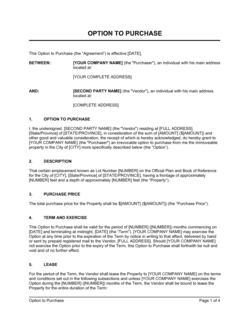
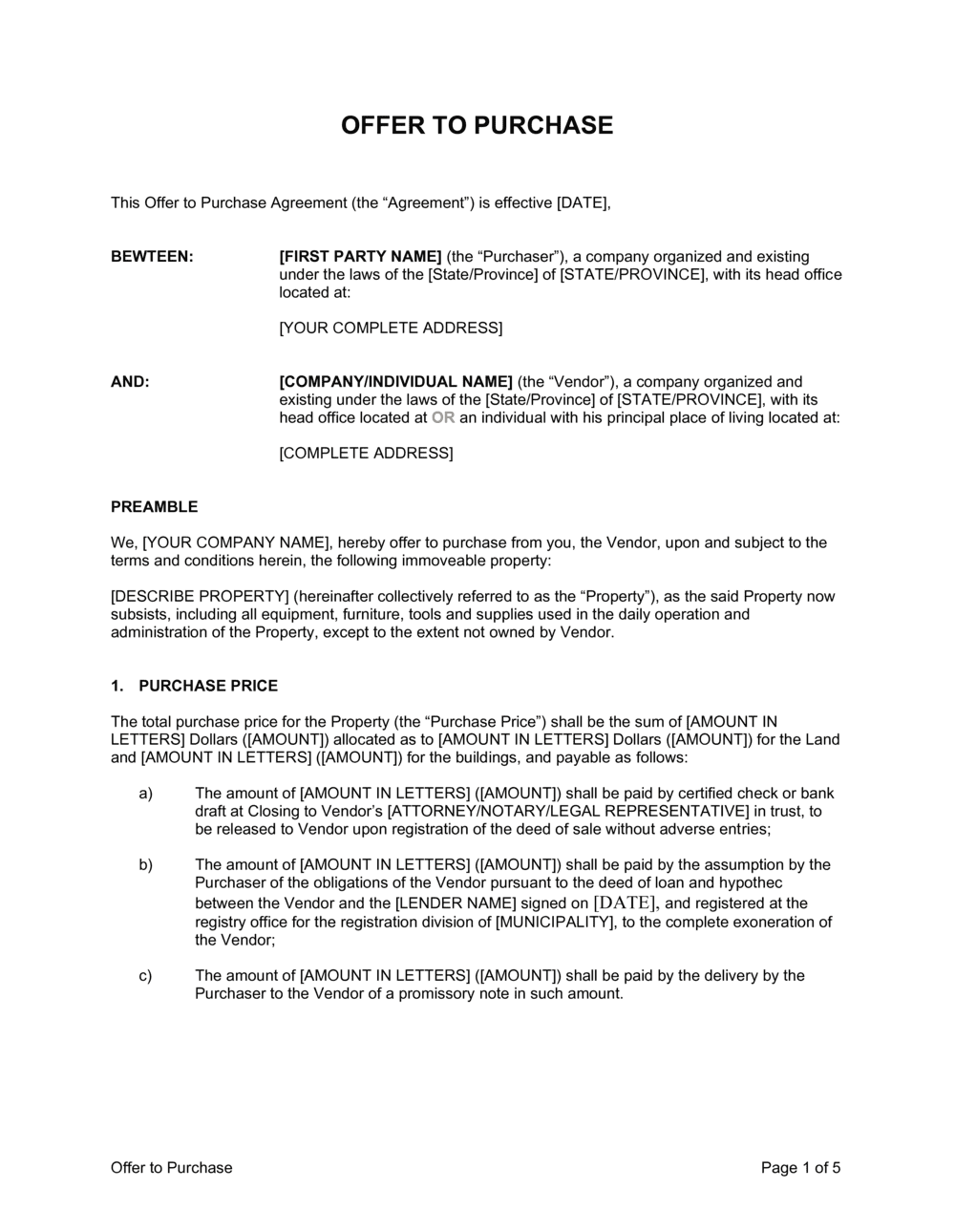
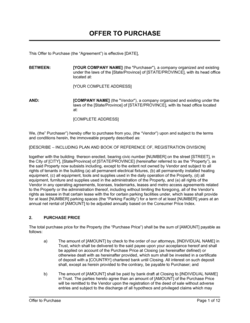
An Offer To Purchase Real Estate Property Short Form is a concise written letter submitted by a prospective buyer to a property seller stating the offered purchase price, deposit amount, key conditions, and proposed closing date. This free Word download gives you a structured starting point you can edit online and send as a PDF or printed letter in under 15 minutes.
When you need it
Use it when you want to formally express intent to purchase a residential or small commercial property and need to put your offer in writing before a full purchase agreement is drafted. It is particularly useful for off-market negotiations or as a preliminary step to trigger seller engagement.
What's inside
Buyer and seller identification, property description, offered purchase price, earnest money deposit amount, financing or inspection conditions, proposed closing date, and a clear statement of offer expiry.

What is an Offer To Purchase Real Estate Property Short Form?

An Offer To Purchase Real Estate Property Short Form is a concise formal letter a prospective buyer submits to a property seller to express a firm intent to purchase at a stated price, subject to defined conditions. It identifies both parties and the property, sets the offered purchase price and earnest money deposit, names any financing or inspection conditions with firm deadlines, and specifies a proposed closing date and offer expiry. Unlike a full purchase agreement, it fits on one to two pages β€” designed for speed in off-market negotiations or as a preliminary step before a comprehensive contract is prepared.

Why You Need This Document

Verbal offers are routinely forgotten, disputed, or ignored entirely. A written short-form offer creates a clear record of exactly what price and terms you proposed, when you proposed them, and what the seller agreed to β€” or did not. Without one, sellers can claim a different price was discussed, buyers lose leverage in disputes over included appliances or possession date, and earnest money deposits become difficult to recover if the deal falls through with no written terms governing refund. For off-market transactions where no agent is involved, this template provides the essential structure that keeps both parties honest from the first handshake to the closing table.

Which variant fits your situation?

If your situation is…Use this template
Buying a residential home through a licensed agent with standard contingenciesResidential Real Estate Purchase Agreement
Purchasing commercial or investment property with detailed lease and title provisionsCommercial Real Estate Purchase Agreement
Making an off-market offer on a residential property without an agentOffer To Purchase Real Estate Property Short Form
Buying land or a vacant lot for developmentLand Purchase Offer Letter
Leasing a property with an option to buy at a later dateLease With Option To Purchase Agreement
Countering a seller's listed price with formal written termsCounter Offer Letter (Real Estate)
Withdrawing or revoking a previously submitted offer in writingOffer Withdrawal Letter

Common mistakes to avoid

❌ No legal property description

Why it matters: An offer identified only by street address can reference the wrong parcel if the address is imprecise, creating a dispute about which property was intended.

Fix: Include the full legal description or parcel number from municipal records or the property title alongside the civic address.
❌ Open-ended conditions with no deadline

Why it matters: A financing or inspection condition without a stated expiry date keeps the seller in limbo indefinitely and often triggers an outright rejection of the offer.

Fix: Set a specific calendar date for each condition. Financing conditions typically run 5–10 business days; inspection conditions run 3–7 days.

❌ Deposit held by the seller rather than in escrow

Why it matters: Sending earnest money directly to the seller with no escrow agent named makes it extremely difficult to recover if the deal falls through and the seller disputes the refund.

Fix: Name a neutral escrow holder β€” a real estate lawyer, title company, or licensed broker β€” in the deposit clause.

❌ Vague or missing inclusions list

Why it matters: Without a written inclusions list, sellers can legally remove appliances, light fixtures, and window coverings before closing, leaving the buyer with an empty shell.

Fix: List every item you expect to remain in the property by name. When in doubt, include it β€” you can always remove it during negotiation.

The 9 key clauses, explained

Parties and property identification

In plain language: Names the buyer and seller as full legal names and identifies the property by civic address and legal description.

Sample language
[BUYER FULL NAME] ('Buyer') hereby offers to purchase from [SELLER FULL NAME] ('Seller') the property located at [CIVIC ADDRESS], legally described as [LEGAL DESCRIPTION / PARCEL NUMBER].

Common mistake: Using only a street address without a legal description or parcel number. If the address has a minor error, the offer may reference the wrong property and create a dispute over which parcel is intended.

Purchase price

In plain language: States the total dollar amount the buyer is offering and the currency.

Sample language
Buyer offers to purchase the above-described property for the total purchase price of [AMOUNT IN WORDS] ($[AMOUNT IN FIGURES] [CURRENCY]).

Common mistake: Writing the price in figures only. Spelling out the amount in words as well eliminates any ambiguity from typos or formatting that could affect the agreed price.

Earnest money deposit

In plain language: Specifies the deposit amount, how it will be held, and what happens to it if the deal does not close.

Sample language
Buyer agrees to deliver an earnest money deposit of $[AMOUNT] within [X] business days of acceptance, to be held in trust by [ESCROW AGENT / BROKER NAME] and applied toward the purchase price at closing.

Common mistake: Omitting who holds the deposit. A deposit sent directly to the seller β€” with no escrow agent named β€” is difficult to recover if the deal falls through and the seller disputes the refund.

Financing condition

In plain language: Makes the offer conditional on the buyer obtaining satisfactory mortgage financing by a set date, with a right to withdraw if financing is not secured.

Sample language
This offer is conditional upon Buyer obtaining financing satisfactory to Buyer, in Buyer's sole discretion, on or before [DATE]. If this condition is not satisfied, Buyer may withdraw this offer and the deposit shall be returned in full.

Common mistake: Using vague language like 'subject to financing' without a deadline. An open-ended financing condition can keep the property off the market indefinitely and cause sellers to reject the offer outright.

Inspection condition

In plain language: Gives the buyer the right to conduct a professional property inspection and withdraw or renegotiate if the results are unsatisfactory.

Sample language
This offer is conditional upon Buyer completing a property inspection satisfactory to Buyer within [X] days of acceptance. If results are unsatisfactory, Buyer may withdraw this offer by written notice and the deposit shall be returned in full.

Common mistake: Making the inspection condition subject to 'material defects only.' Courts interpret 'material' differently; using 'satisfactory to Buyer in Buyer's sole discretion' preserves a broader right to withdraw.

Inclusions and exclusions

In plain language: Lists any fixtures, appliances, or personal property included in or excluded from the sale.

Sample language
The purchase price includes the following: [LIST INCLUSIONS β€” e.g., built-in appliances, window coverings, garage door openers]. The following items are excluded: [LIST EXCLUSIONS].

Common mistake: Leaving inclusions undefined and assuming 'what's in the house stays.' Sellers routinely remove light fixtures, appliances, and window coverings unless they are explicitly listed as included.

Closing and possession date

In plain language: Sets the target date for legal transfer of title and the date the buyer takes physical possession.

Sample language
The closing date shall be on or before [CLOSING DATE]. Possession shall be granted to Buyer on [POSSESSION DATE] at [TIME], subject to the property being vacant and in the condition represented at time of offer.

Common mistake: Setting the possession date to the same day as closing without accounting for the time required to register title and transfer funds. Same-day possession is common but should be confirmed with the closing agent.

Offer expiry

In plain language: States the deadline by which the seller must accept the offer in writing, after which the offer lapses and the deposit is returned.

Sample language
This offer shall remain open for acceptance until [TIME] on [DATE]. If not accepted in writing by that time, this offer shall be null and void and any deposit shall be returned to Buyer without deduction.

Common mistake: Setting an expiry of several days or more on a competitive property. A 24–48 hour expiry is standard in active markets; a longer window exposes the buyer to competing offers being negotiated simultaneously.

Acceptance and signature block

In plain language: Space for the seller to acknowledge acceptance of the offer, including date and time of acceptance.

Sample language
The undersigned Seller accepts the above offer on the terms and conditions stated herein. Accepted this [DAY] day of [MONTH], [YEAR] at [TIME].

Common mistake: Leaving the acceptance block blank until the seller signs, without a countersignature line for the buyer to acknowledge any changes. If the seller adds handwritten amendments, the buyer must initial them β€” unsigned changes create ambiguity about what was agreed.

How to fill it out

  1. 1

    Enter buyer and seller names and the property address

    Use full legal names for both parties and include the civic address plus the legal description or parcel number from the property listing or municipal records.

    πŸ’‘ Pull the legal description directly from the seller's title or the MLS listing β€” do not rely on the street address alone.

  2. 2

    State the purchase price in words and figures

    Write the offered amount both in full words and in numerals in the price clause to prevent any ambiguity from formatting errors.

    πŸ’‘ If your offer is slightly below asking, avoid round-number offers β€” $387,500 signals more analysis than $390,000 and can influence seller perception.

  3. 3

    Set the deposit amount and escrow agent

    Specify the earnest money amount (typically 1–3% of the purchase price), who holds it in trust, and the number of business days after acceptance for delivery.

    πŸ’‘ A higher deposit signals stronger commitment and can tip a seller toward your offer when competing bids are similar in price.

  4. 4

    Add financing and inspection conditions with deadlines

    Include a specific date for each condition β€” not a vague number of days β€” so both parties know exactly when conditions must be satisfied or waived.

    πŸ’‘ Align your financing deadline with your mortgage broker's realistic approval timeline before you write it into the offer.

  5. 5

    List inclusions and exclusions explicitly

    Walk through the property mentally and list every item you expect to remain β€” appliances, window coverings, storage shelving, garage openers β€” and confirm any items the seller has indicated they will remove.

    πŸ’‘ Ask the listing agent for a completed inclusions/exclusions disclosure before submitting the offer to avoid surprises.

  6. 6

    Set the closing and possession dates

    Enter a realistic closing date that gives your lender and lawyer enough time to process. Confirm the possession time with your real estate lawyer before committing.

    πŸ’‘ Avoid closing on a Friday or the last day of the month β€” delays are harder to resolve when banks and registries operate with reduced staff.

  7. 7

    Set a short offer expiry and submit

    Enter a 24–48 hour expiry window, sign the offer, and submit it to the seller or listing agent by the method specified in the listing.

    πŸ’‘ Send the offer by email with a read receipt and follow up by phone to confirm receipt β€” unread offers have missed expiry deadlines.

Frequently asked questions

What is a short-form offer to purchase real estate?

A short-form offer to purchase is a concise written letter a prospective buyer submits to a property seller stating the offered price, deposit, key conditions, and proposed closing date. It is less detailed than a full purchase agreement but sufficient to open formal negotiations and record the buyer's intent in writing. Once accepted by the seller, it creates a preliminary agreement that the parties typically formalize in a full purchase contract.

Is a short-form offer to purchase legally binding?

In many jurisdictions, a signed offer that is accepted in writing by the seller can be legally enforceable as a binding agreement, even in short form, provided it includes the essential terms β€” parties, property, price, and closing date. However, enforceability depends on jurisdiction and the specific language used. It is advisable to follow a short-form offer with a comprehensive purchase agreement drafted or reviewed by a real estate lawyer for any significant transaction.

How is a short-form offer different from a full purchase agreement?

A short-form offer covers the core commercial terms β€” price, deposit, conditions, and closing date β€” in a page or two. A full purchase agreement runs 10–30 pages and addresses title warranties, representations, dispute resolution, default remedies, adjustments at closing, and regulatory compliance in detail. The short form is a negotiation opener; the full agreement is the binding governing document for the transaction.

What conditions should I include in a real estate offer?

The two most common conditions are a financing condition β€” making the offer subject to mortgage approval by a set date β€” and an inspection condition allowing the buyer to withdraw if a professional inspection reveals unsatisfactory results. Additional conditions may include a title search condition, a condition on the sale of the buyer's existing property, or a review of strata or condo documents.

How much earnest money should I offer?

Earnest money deposits typically range from 1% to 3% of the offered purchase price in most North American markets. A higher deposit signals stronger buyer commitment and can make your offer more attractive when competing with similar bids. The deposit is applied to the purchase price at closing and is generally refundable if a condition in the offer is not satisfied within the specified timeframe.

What happens if the seller does not accept before the offer expiry?

If the seller does not accept the offer in writing before the stated expiry date and time, the offer lapses automatically and is void. The buyer's deposit, if already submitted, must be returned in full. The seller may still choose to contact the buyer after expiry to negotiate, but any new agreement would require a fresh offer.

Do I need a real estate agent to submit an offer to purchase?

No, buyers can submit an offer to purchase directly to a seller without a real estate agent, particularly in off-market transactions. A short-form offer template makes it straightforward for an unrepresented buyer to put terms in writing. For transactions involving significant sums, unfamiliar markets, or complex conditions, working with a licensed agent or real estate lawyer reduces the risk of missing terms that protect the buyer.

Can a seller counter a short-form offer?

Yes. A seller who does not accept the offer as written can respond with a counter offer that modifies the price, conditions, closing date, or inclusions. The counter offer effectively voids the original offer and presents new terms for the buyer to accept or counter in turn. Any counter offer should also be made in writing with a stated acceptance deadline.

Should the offer be signed by both parties?

The buyer signs the offer when submitting it. The seller signs the acceptance block if they agree to the terms. Both signatures β€” along with the date and time of acceptance β€” should be on the same document to create a clear written record of the agreed terms. A verbal acceptance is not sufficient and creates significant ambiguity about what was agreed.

How this compares to alternatives

vs Real Estate Purchase Agreement

A full purchase agreement is a comprehensive 10–30 page contract covering title warranties, default remedies, closing adjustments, and regulatory obligations. A short-form offer captures only the essential commercial terms in a page or two to open negotiations quickly. For significant transactions, the short form should be followed by a full purchase agreement before closing.

vs Letter of Intent (Real Estate)

A letter of intent expresses preliminary interest and outlines proposed terms but is typically stated to be non-binding. A short-form offer to purchase is intended to be accepted and acted upon β€” it includes a deposit clause and conditions that create enforceable obligations once signed by both parties. Use an LOI for early-stage commercial negotiations; use the offer form when you are ready to commit.

vs Counter Offer Letter (Real Estate)

A counter offer is a seller's written response modifying the buyer's original offer terms. The short-form offer is the initiating document the buyer submits; the counter offer is the seller's reply when they want different terms. Together, the two letters form the negotiation record before a final agreement is executed.

vs Lease With Option To Purchase

A lease with option to purchase allows a tenant to occupy and use a property while preserving the right β€” but not the obligation β€” to buy it at an agreed price within a set period. A short-form offer to purchase is a direct and immediate offer to buy with no rental component. Use the lease-option structure when the buyer needs time to qualify for financing or wants to evaluate the property before committing.

Industry-specific considerations

Residential Real Estate

Used for single-family homes, condominiums, and multi-unit residential properties where a quick written offer is needed before a full purchase agreement is prepared.

Commercial Real Estate

Small commercial transactions β€” retail units, offices, and mixed-use properties β€” benefit from a short-form offer to confirm price and basic terms before engaging lawyers for the full agreement.

Real Estate Investment

Investors acquiring off-market properties use the short form to move quickly and signal serious intent before competitors, with conditions preserving the right to withdraw after due diligence.

Construction and Development

Developers use short-form offers on raw land or teardown properties to secure a site while environmental, zoning, and title conditions are investigated in the conditional period.

Template vs pro β€” what fits your needs?

PathBest forCostTime
Use the templateBuyers making straightforward residential or small commercial offers in familiar marketsFree15 minutes
Template + professional reviewBuyers in unfamiliar markets, high-value properties, or offers with complex conditions$150–$400 for a real estate lawyer review1–2 hours
Custom draftedLarge commercial acquisitions, development sites, or cross-border transactions requiring jurisdiction-specific terms$500–$2,000+1–3 days

Glossary

Earnest Money Deposit
A good-faith cash deposit submitted with or shortly after the offer to demonstrate the buyer's serious intent to purchase.
Offer Expiry
The specific date and time by which the seller must accept or reject the offer, after which it lapses automatically.
Closing Date
The target calendar date on which ownership transfers and all funds are exchanged between buyer and seller.
Financing Condition
A clause making the offer conditional on the buyer securing a mortgage or other financing by a specified date.
Inspection Condition
A clause allowing the buyer to withdraw or renegotiate if a professional property inspection reveals material defects.
Subject Property
The specific real estate parcel being offered on, identified by civic address and legal description.
Purchase Price
The total dollar amount the buyer is offering to pay for the property, before any adjustments at closing.
Title
Legal ownership of the property, including any encumbrances, liens, or easements that must be resolved before closing.
Possession Date
The date the buyer is entitled to physically occupy and control the property, which may differ from the closing date.
Counter Offer
A seller's written response to a buyer's offer that modifies one or more terms β€” price, conditions, or date β€” rather than accepting outright.

Part of your Business Operating System

This document is one of 3,000+ business & legal templates included in Business in a Box.

  • Fill-in-the-blanks β€” ready in minutes
  • 100% customizable Word document
  • Compatible with all office suites
  • Export to PDF and share electronically

Create your document in 3 simple steps.

From template to signed document β€” all inside one Business Operating System.
1
Download or open template

Access over 3,000+ business and legal templates for any business task, project or initiative.

2
Edit and fill in the blanks with AI

Customize your ready-made business document template and save it in the cloud.

3
Save, Share, Send, Sign

Share your files and folders with your team. Create a space of seamless collaboration.

Save time, save money, and create top-quality documents.

β˜…β˜…β˜…β˜…β˜…

"Fantastic value! I'm not sure how I'd do without it. It's worth its weight in gold and paid back for itself many times."

Managing Director Β· Mall Farm
Robert Whalley
Managing Director, Mall Farm Proprietary Limited
β˜…β˜…β˜…β˜…β˜…

"I have been using Business in a Box for years. It has been the most useful source of templates I have encountered. I recommend it to anyone."

Business Owner Β· 4+ years
Dr Michael John Freestone
Business Owner
β˜…β˜…β˜…β˜…β˜…

"It has been a life saver so many times I have lost count. Business in a Box has saved me so much time and as you know, time is money."

Owner Β· Upstate Web
David G. Moore Jr.
Owner, Upstate Web

Run your business with a system β€” not scattered tools

Stop downloading documents. Start operating with clarity. Business in a Box gives you the Business Operating System used by over 250,000 companies worldwide to structure, run, and grow their business.

Free Forever PlanΒ Β·Β No credit card required