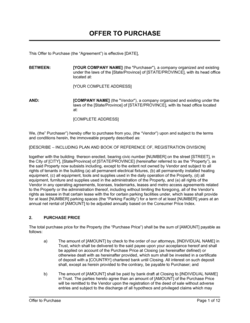
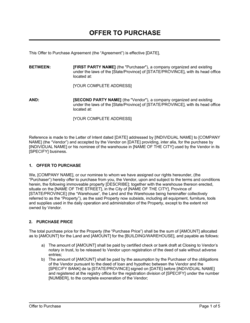
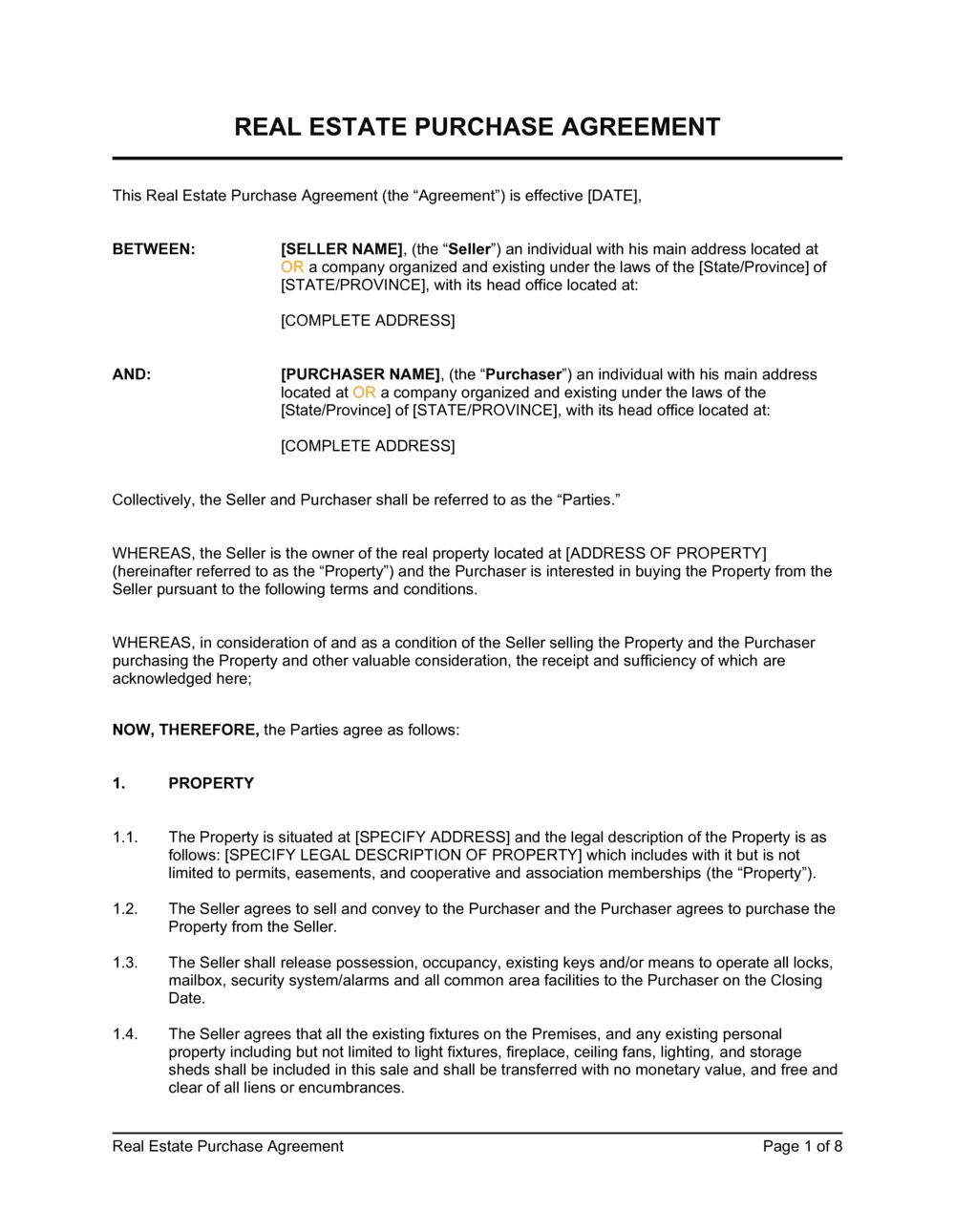
Real Estate Purchase Agreement Template

Free Word download • Edit online • Save & share with Drive • Export to PDF

8 pages30–40 min to fillDifficulty: ComplexSignature requiredLegal review recommended
Learn more ↓
FreeReal Estate Purchase Agreement Template

At a glance

What it is
A Real Estate Purchase Agreement is a legally binding contract between a buyer and a seller that sets out every material term of a property transaction — purchase price, deposit, contingencies, closing date, and transfer of title. This free Word download gives you a structured, attorney-reviewed starting point you can edit online and export as PDF for residential or commercial transactions.
When you need it
Use it when a buyer and seller have agreed in principle on a property sale and need a binding written contract before the closing process begins. It replaces informal offers or letters of intent once both parties are ready to commit to enforceable terms.
What's inside
Property identification, purchase price, earnest money deposit, financing and inspection contingencies, title and closing procedures, representations and warranties, default remedies, and governing law — covering the full lifecycle of a property transaction from acceptance to closing.

What is a Real Estate Purchase Agreement?

A Real Estate Purchase Agreement is a legally binding contract between a buyer and a seller that governs every material term of a property transaction — purchase price, earnest money deposit, financing and inspection contingencies, title requirements, closing date, and default remedies. Unlike an informal offer or letter of intent, a signed purchase agreement creates enforceable obligations on both parties and establishes the legal framework that guides the transaction from acceptance through to the transfer of title at closing. It is the foundational document of any real estate sale, whether residential or commercial, and must satisfy the Statute of Frauds requirements applicable in the governing jurisdiction to be valid.

Why You Need This Document

Proceeding with a property transaction without a properly drafted purchase agreement exposes both buyer and seller to serious financial and legal risk. Without clear contingency language, a buyer who cannot obtain financing or discovers a major structural defect has no contractual basis to cancel and recover their deposit. Without a written disclosure schedule and representations clause, a seller who fails to mention a known defect faces post-closing rescission claims and damages. Without a specific closing date tied to time-is-of-the-essence language, either party can delay indefinitely while the other incurs carrying costs, rate lock expirations, and opportunity losses. A complete purchase agreement eliminates these gaps — establishing exactly what each party must do, by when, and what happens if they don't — before any money changes hands.

Which variant fits your situation?

If your situation is…Use this template
Purchasing a single-family home from a private sellerResidential Real Estate Purchase Agreement
Acquiring commercial office, retail, or industrial propertyCommercial Real Estate Purchase Agreement
Buying land without an existing structureLand Purchase Agreement
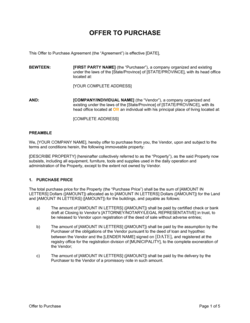
Recording agreed terms before a full contract is draftedLetter of Intent (Real Estate)
Renting a property with an option to purchase laterLease-to-Own Agreement
Transferring property ownership within a family or trustProperty Transfer Agreement
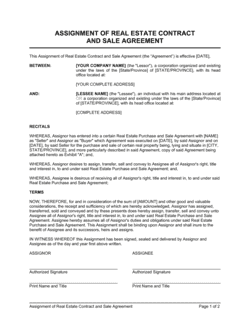
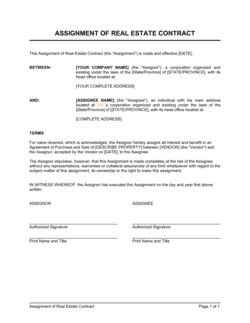
Assigning a purchase contract to a third-party buyerAssignment of Real Estate Purchase Agreement

Common mistakes to avoid

❌ Using only the street address to identify the property

Why it matters: Address errors, municipal renumbering, and informal descriptions have voided closings and triggered title claims. The legal description from the deed is the only unambiguous identifier recognized by courts and title companies.

Fix: Pull the exact legal description from the county land records or the seller's existing title policy and copy it verbatim into the contract.

❌ Waiving the inspection contingency without an AS-IS clause and price adjustment

Why it matters: Buyers who waive inspection to win a bidding war have no contractual basis to demand repairs or cancellation if significant defects are found before closing — the deposit is at risk.

Fix: If waiving inspection is unavoidable in a competitive market, conduct a pre-offer walkthrough with a contractor, and negotiate an AS-IS price that reflects the condition risk.

❌ Setting a closing date without a time-is-of-the-essence clause

Why it matters: Without this clause, courts in many jurisdictions treat closing dates as approximate rather than binding. Sellers who need to close on a specific date to fund a simultaneous purchase are exposed to costly delays.

Fix: Add a time-is-of-the-essence clause and include a per-day carrying cost charge for any delay caused by the defaulting party.

❌ Omitting the financing contingency interest rate cap

Why it matters: If market rates rise between signing and the commitment deadline, a buyer can be denied at the original qualifying rate and lose their deposit even though the property, seller, and buyer are unchanged.

Fix: Include an interest rate cap at least 0.5% above the current market rate to protect against near-term volatility while still binding the buyer to a realistic threshold.

❌ No written seller disclosure schedule attached to the contract

Why it matters: Verbal disclosures are nearly impossible to prove post-closing. Sellers who rely on 'I told the agent' have been held liable for undisclosed defects when there is no written record.

Fix: Attach a completed property disclosure form as Exhibit A and have the seller sign it separately. Use the state-specific statutory form where one is required.

❌ Liquidated damages clause that favors only the seller

Why it matters: A clause limiting buyer-default damages to the deposit is fair only if the buyer also has a specific-performance right for seller default. A one-sided remedy clause is often struck down by courts as unconscionable.

Fix: Draft symmetric remedies: deposit forfeiture for buyer default; buyer's election of deposit refund or specific performance for seller default.

The 10 key clauses, explained

Parties and property identification

In plain language: Names the buyer and seller as legal entities and provides the full legal description of the property being transferred, including parcel number and street address.

Sample language
This Real Estate Purchase Agreement ('Agreement') is entered into on [DATE] between [SELLER FULL NAME / ENTITY] ('Seller') and [BUYER FULL NAME / ENTITY] ('Buyer'). The property subject to this Agreement is located at [PROPERTY ADDRESS], [CITY], [STATE], legally described as [LEGAL DESCRIPTION], Parcel ID: [PARCEL NUMBER].

Common mistake: Using only the street address and omitting the legal description. Address errors or municipal renumbering can create title disputes — the legal description from the deed is the authoritative identifier.

Purchase price and earnest money deposit

In plain language: States the agreed total purchase price, the amount of the earnest money deposit, the deadline to deliver it, and the escrow agent who will hold it.

Sample language
The total purchase price is [AMOUNT IN WORDS] ($[AMOUNT IN FIGURES]), payable as follows: Earnest Money Deposit of $[DEPOSIT AMOUNT] to be delivered to [ESCROW AGENT NAME] within [X] business days of execution; balance due at closing.

Common mistake: Not specifying the deposit deadline or escrow agent. Vague deposit terms are the single most common source of early-stage disputes — buyers delay, sellers assume default.

Financing contingency

In plain language: Protects the buyer if they cannot secure a mortgage, specifying the loan amount, interest rate cap, and the number of days to obtain a written commitment before the contract can be cancelled.

Sample language
This Agreement is contingent upon Buyer obtaining a written mortgage commitment for no less than $[LOAN AMOUNT] at an interest rate not to exceed [X]% per annum, for a term of [X] years, within [X] calendar days of the Effective Date. If Buyer fails to obtain such commitment, Buyer may cancel this Agreement and receive a full refund of the Earnest Money Deposit.

Common mistake: Omitting the interest rate cap. If rates rise between signing and commitment, the buyer may be unable to qualify — without a rate cap, they lose their deposit even though market conditions changed.

Inspection contingency

In plain language: Gives the buyer the right to conduct a professional inspection within a defined period and to request repairs, a price credit, or cancellation if material defects are found.

Sample language
Buyer shall have [X] calendar days from the Effective Date to conduct, at Buyer's expense, any inspections of the property. If the inspection reveals defects materially affecting value or habitability, Buyer may (a) request written repairs or a price reduction, (b) accept the property as-is, or (c) cancel this Agreement and receive a full refund of the Earnest Money Deposit.

Common mistake: Setting the inspection window too short. Fewer than 10 business days often makes it impossible to schedule and receive a qualified inspector's written report, especially in competitive markets.

Title review and clear title obligation

In plain language: Requires the seller to deliver clear and marketable title at closing and gives the buyer the right to review a title commitment within a specified period and object to encumbrances.

Sample language
Seller shall deliver, within [X] days of the Effective Date, a title commitment for an owner's policy of title insurance issued by [TITLE COMPANY NAME]. Buyer shall have [X] days to raise written title objections. Seller shall have [X] days to cure objections. If Seller cannot cure, Buyer may cancel and recover all deposits.

Common mistake: No cure period or cancellation right if title cannot be cleared. Buyers who waive this clause can be forced to close on a property with undisclosed liens, easements, or ownership disputes.

Closing date, possession, and prorations

In plain language: Sets the specific closing date, the date the buyer takes physical possession, and how property taxes, HOA fees, and prepaid expenses are allocated between buyer and seller.

Sample language
Closing shall occur on or before [CLOSING DATE] at the offices of [TITLE / ESCROW COMPANY]. Possession shall be delivered to Buyer on [POSSESSION DATE]. Property taxes, HOA dues, and utility charges shall be prorated as of the Closing Date.

Common mistake: Using 'on or about' instead of a specific date. Vague closing dates make it impossible to calculate prorations accurately and expose both parties to carrying cost disputes.

Seller representations and warranties

In plain language: Records the seller's factual representations about the property — no undisclosed defects, no pending litigation, no violations, and authority to sell.

Sample language
Seller represents and warrants that, to the best of Seller's knowledge: (a) there are no material defects in the property not disclosed in writing; (b) no litigation or government proceedings are pending affecting the property; (c) all utility services are operational; and (d) Seller has full legal authority to sell the property.

Common mistake: Limiting representations to 'to Seller's actual knowledge' without a disclosure schedule. Without a written disclosure list, buyers have no documentary record of what was and wasn't disclosed at signing.

Default and remedies

In plain language: Specifies what constitutes default by either party and the remedies available — liquidated damages (forfeiture of earnest money) if the buyer defaults, or specific performance or damages if the seller defaults.

Sample language
If Buyer defaults, Seller's sole remedy shall be retention of the Earnest Money Deposit as liquidated damages. If Seller defaults, Buyer may elect to (a) cancel this Agreement and receive a full refund of all deposits, or (b) pursue specific performance to compel the sale.

Common mistake: No liquidated damages clause on the buyer-default side. Without it, the seller must prove actual damages in court — a lengthy and expensive process for a deposit dispute.

AS-IS clause and risk of loss

In plain language: States whether the property is sold in its present condition without further seller repair obligations, and allocates the risk if the property is damaged or destroyed between signing and closing.

Sample language
Unless otherwise stated herein, the property is sold AS-IS. Risk of loss or damage to the property shall remain with Seller until closing. If the property is materially damaged prior to closing, Buyer may cancel this Agreement and recover all deposits.

Common mistake: Including an AS-IS clause without a corresponding inspection contingency. Selling AS-IS does not waive disclosure obligations in most jurisdictions — buyers who waive inspection on an AS-IS property have little recourse for latent defects.

Governing law and dispute resolution

In plain language: Specifies the jurisdiction whose law governs the contract and how disputes are resolved — mediation, arbitration, or litigation — and which party pays attorney's fees in the event of a dispute.

Sample language
This Agreement shall be governed by the laws of [STATE / PROVINCE]. Any dispute arising hereunder shall first be submitted to non-binding mediation. If mediation fails, disputes shall be resolved by binding arbitration in [CITY, STATE]. The prevailing party shall be entitled to recover reasonable attorney's fees and costs.

Common mistake: No attorney's fees clause in a jurisdiction that doesn't award them by default. Without it, winning a $10,000 deposit dispute can cost more in legal fees than the deposit is worth.

How to fill it out

  1. 1

    Identify the parties and property correctly

    Enter the full legal names of buyer and seller — individuals use their legal names as they appear on government ID; entities use the registered corporate name. Include the full legal description of the property from the current deed, not just the street address.

    💡 Request the legal description from the county recorder's office or the seller's title insurance commitment before drafting — copying it from Zillow or MLS listings is unreliable.

  2. 2

    Set the purchase price and deposit terms

    State the total purchase price in both words and figures. Set the earnest money deposit amount (typically 1–3% of purchase price), the delivery deadline in business days, and name the escrow agent or title company holding the funds.

    💡 A higher deposit — 3–5% — signals buyer seriousness and can differentiate a competitive offer. Make sure the escrow agent is a licensed title company or real estate attorney, not an individual.

  3. 3

    Draft the financing contingency with specific loan terms

    Specify the loan amount, maximum interest rate, loan term in years, and the commitment deadline in calendar days. Match these parameters to the pre-approval letter the buyer already holds.

    💡 Set the commitment deadline at least 21 days out — most lenders need 15–21 days minimum for a written commitment even with a complete application.

  4. 4

    Set the inspection period and define buyer's election rights

    Allow at least 10 business days for inspections. Explicitly list the three buyer elections after inspection — request repairs, accept as-is, or cancel — so neither party can dispute the scope of the inspection right.

    💡 Encourage buyers to schedule the inspection the day the contract is signed, not the last day of the window. Inspector availability and report turnaround can consume the full period.

  5. 5

    Complete the title and closing provisions

    Name the title company, set the deadline for the title commitment, the buyer's objection period, the seller's cure period, and the specific closing date. Confirm possession timing — same day as closing is standard for vacant properties; negotiate a post-closing occupancy agreement if the seller needs extra time.

    💡 Avoid closing on a Friday — wire transfer delays on Fridays push funding to Monday in many states, creating a possession limbo over the weekend.

  6. 6

    Complete the seller's disclosure schedule

    Attach a written property disclosure schedule listing any known material defects, past repairs, boundary disputes, environmental issues, and HOA violations. Reference it in the representations and warranties clause.

    💡 Many states require a specific statutory disclosure form — confirm the applicable form for the property's state and attach it as Exhibit A to the contract.

  7. 7

    Review default and remedies language before signing

    Confirm that the buyer-default remedy is limited to liquidated damages equal to the earnest money deposit, and that the seller-default remedy includes both cancellation with deposit refund and specific performance. Have both parties initial the remedies clause to confirm they have read it.

    💡 In California, both parties must initial the liquidated damages clause separately for it to be enforceable — check whether your state has the same requirement.

  8. 8

    Execute with wet or electronic signatures before the deposit deadline

    Both buyer and seller must sign and date the agreement. In most US states, electronic signatures are valid for real estate contracts under the ESIGN Act, but confirm this for the specific jurisdiction. Deliver a fully executed copy to the escrow agent when transmitting the deposit.

    💡 Timestamp execution carefully — the 'Effective Date' (the date the last party signs) starts the clock on every contingency deadline in the contract.

Frequently asked questions

What is a real estate purchase agreement?

A real estate purchase agreement is a legally binding contract between a buyer and a seller that records every material term of a property sale — price, deposit, contingencies, closing date, title requirements, and default remedies. Once signed by both parties, it creates enforceable obligations and governs the transaction through to closing. It is distinct from an offer letter or letter of intent, which are typically non-binding.

What is the difference between a purchase agreement and a deed?

A purchase agreement is the contract that governs the sale process before closing — it sets the terms and conditions the parties must fulfill. A deed is the legal instrument that actually transfers ownership at closing and is recorded in the public land registry. The purchase agreement creates the obligation to transfer; the deed executes the transfer. Both documents are essential to a complete real estate transaction.

What contingencies should be included in a real estate purchase agreement?

The three most important contingencies are financing (the buyer's right to cancel if they cannot obtain a mortgage on the specified terms), inspection (the right to conduct due diligence and negotiate based on findings), and title (the right to clear title free from liens and encumbrances). In some markets, an appraisal contingency — allowing cancellation if the property appraises below the purchase price — is also standard. Each contingency should include a specific deadline and clearly defined buyer elections.

Is a real estate purchase agreement legally binding?

Yes, a properly executed real estate purchase agreement is generally legally binding on both buyer and seller once signed. To be enforceable in most jurisdictions, it must identify the parties, describe the property with sufficient certainty, state the purchase price, and be signed by both parties. Some jurisdictions require additional formalities — such as witnesses or specific disclosure forms — and consider consulting a real estate attorney in your jurisdiction before relying solely on a template.

What happens to the earnest money deposit if the deal falls through?

The outcome depends on why the deal fell through and what the contract says. If the buyer cancels within a valid contingency — financing, inspection, or title — the deposit is typically refunded in full. If the buyer defaults outside a contingency, the seller usually retains the deposit as liquidated damages. If the seller defaults, the buyer is generally entitled to a full refund and may also have the right to pursue specific performance to compel the sale.

Can a seller back out of a real estate purchase agreement?

A seller who backs out without cause is in breach of contract. The buyer's typical remedies are a full refund of the earnest money deposit plus any documented costs, or specific performance — a court order requiring the seller to complete the sale. Specific performance is available for real estate contracts in most jurisdictions because every property is considered unique. Sellers should not sign a purchase agreement unless they are certain they intend to close.

Do I need a lawyer for a real estate purchase agreement?

For straightforward residential transactions handled through a licensed real estate agent and a title company, a high-quality template reviewed by a real estate attorney typically provides adequate protection. Legal counsel is strongly recommended for transactions above $500,000, commercial acquisitions, properties with environmental or title issues, cross-border purchases, and any transaction where the parties are negotiating custom terms outside a standard form. Attorney fees for a real estate contract review typically run $300–$800.

What disclosures is a seller required to make?

Disclosure requirements vary by jurisdiction but generally require sellers to disclose known material defects — structural issues, roof condition, water damage, pest infestations, environmental hazards, and boundary disputes. In the US, federal law requires disclosure of known lead-based paint for pre-1978 homes. Many states mandate a specific statutory disclosure form. Failing to disclose known material defects can expose sellers to rescission of the contract and damages after closing.

How long does it take to close after signing a purchase agreement?

Residential transactions typically close 30 to 60 days after the purchase agreement is signed, depending on financing timelines, title search complexity, and negotiated repair periods. Cash transactions can close in as few as 7–14 days. Commercial transactions routinely take 60–120 days due to more complex due diligence, zoning reviews, and environmental assessments. The closing date in the contract should reflect realistic timelines, not aspirational ones.

How this compares to alternatives

vs Letter of Intent (Real Estate)

A letter of intent summarizes proposed deal terms as a non-binding starting point for negotiation — it does not create an obligation to buy or sell. A purchase agreement is fully binding once signed. Use an LOI to test alignment before committing to drafting costs; use the purchase agreement once both parties are ready to be legally bound.

vs Lease Agreement

A lease agreement transfers the right to occupy a property for a defined period in exchange for rent — it does not transfer ownership. A purchase agreement transfers title. Lease-to-own arrangements combine elements of both, but require a separate option-to-purchase clause to give the tenant an enforceable right to buy.

vs Quitclaim Deed

A quitclaim deed transfers whatever ownership interest the grantor holds without any warranty of clear title — commonly used for family transfers, divorce settlements, or trust funding rather than arm's-length sales. A purchase agreement is the governing contract for a negotiated sale with full title warranties, contingencies, and deposit protections.

vs Assignment of Purchase Agreement

An assignment of purchase agreement transfers a buyer's contractual rights under an existing purchase agreement to a third party — common in real estate wholesaling. The original purchase agreement must contain a permissive assignment clause for this to be enforceable. The assignment does not replace the purchase agreement; it operates alongside it.

Industry-specific considerations

Residential real estate

Standard contingency package (financing, inspection, appraisal), lead paint disclosure for pre-1978 homes, and HOA document review periods.

Commercial real estate

Environmental Phase I/II assessment contingencies, zoning confirmation, estoppel certificates from existing tenants, and longer due diligence periods of 30–60 days.

Real estate investment

Assignment clauses allowing wholesalers to transfer contracts to end buyers, inspection waivers on distressed properties, and cash-close timelines of 7–14 days.

Construction and development

Land purchase agreements with entitlement contingencies, soil testing rights, utility availability confirmation, and extended closing timelines tied to permit approvals.

Jurisdictional notes

United States

Real estate law is primarily state law in the US — contract requirements, disclosure obligations, and closing procedures vary significantly by state. Most states require a written contract under the Statute of Frauds. California mandates specific disclosure forms and requires both parties to separately initial the liquidated damages clause. Some states — including Georgia and South Carolina — require an attorney to be present at closing. Check the applicable state association of Realtors form requirements before using a generic template.

Canada

Real estate transactions in Canada are governed provincially. Ontario and British Columbia use standardized forms produced by OREA and BCREA respectively — parties using custom agreements should ensure they meet provincial requirements. Quebec transactions must comply with the Civil Code and typically involve a notary rather than a title company. Non-resident buyers in Canada face additional FINTRAC reporting and the federal Foreign Buyer Ban restrictions introduced in 2023.

United Kingdom

In England and Wales, a property transaction proceeds through 'exchange of contracts' followed by 'completion' — the equivalent of signing and closing. Contracts are not binding until exchange, and either party can withdraw before that point without penalty. Scotland uses a different system where a concluded missives creates a binding contract. Conveyancing is handled by a solicitor or licensed conveyancer rather than a title company.

European Union

EU member states each have distinct property law regimes. In France, Germany, and Spain, a notary is required to authenticate the deed of sale — the purchase agreement (compromis de vente in France, Kaufvertrag in Germany) precedes the notarial act. GDPR obligations apply to personal data collected during the transaction. Non-EU buyers may face additional restrictions or reporting requirements depending on the member state and nationality.

Template vs lawyer — what fits your deal?

PathBest forCostTime
Use the templateStraightforward residential transactions handled through a licensed agent and title company in a standard-form jurisdictionFree30–60 minutes to complete
Template + legal reviewTransactions above $300,000, any property with known title issues, environmental concerns, or custom contingency terms$300–$800 for a real estate attorney review1–3 business days
Custom draftedCommercial acquisitions, multi-parcel transactions, cross-border purchases, or properties with complex title, zoning, or environmental histories$1,500–$5,000+1–3 weeks

Glossary

Earnest Money Deposit
A good-faith payment made by the buyer upon signing, held in escrow and typically applied toward the purchase price at closing.
Contingency
A condition that must be satisfied before the contract becomes fully binding — common examples include financing approval and a satisfactory home inspection.
Escrow
A neutral third-party arrangement in which funds or documents are held until all contract conditions are met and closing can proceed.
Title
The legal right of ownership over a property, including the chain of prior ownership recorded in public land records.
Clear Title
Title that is free from liens, encumbrances, legal disputes, or other claims that would prevent clean transfer to the buyer.
Closing
The final step of the transaction where ownership is formally transferred, funds are disbursed, and all documents are signed and recorded.
Prorations
The division of ongoing costs — property taxes, HOA fees, utilities — between buyer and seller based on their respective ownership periods up to and from the closing date.
Inspection Contingency
A clause giving the buyer the right to have the property professionally inspected and to negotiate repairs, a price reduction, or cancellation based on the findings.
Financing Contingency
A clause allowing the buyer to cancel the contract and recover their deposit if they are unable to obtain mortgage financing on the specified terms within a defined period.
Representations and Warranties
Factual statements made by the seller — and sometimes the buyer — about the condition of the property and their authority to enter the transaction.
Liquidated Damages
A pre-agreed sum — typically the earnest money deposit — specified in the contract as the seller's exclusive remedy if the buyer defaults.
Deed
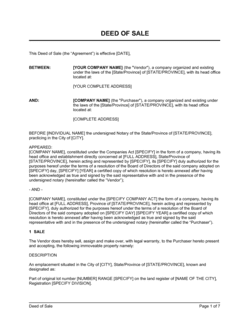
The legal instrument that formally conveys ownership of real property from the seller to the buyer, recorded in the public land registry after closing.

Part of your Business Operating System

This document is one of 3,000+ business & legal templates included in Business in a Box.

  • Fill-in-the-blanks — ready in minutes
  • 100% customizable Word document
  • Compatible with all office suites
  • Export to PDF and share electronically

Create your document in 3 simple steps.

From template to signed document — all inside one Business Operating System.
1
Download or open template

Access over 3,000+ business and legal templates for any business task, project or initiative.

2
Edit and fill in the blanks with AI

Customize your ready-made business document template and save it in the cloud.

3
Save, Share, Send, Sign

Share your files and folders with your team. Create a space of seamless collaboration.

Save time, save money, and create top-quality documents.

★★★★★

"Fantastic value! I'm not sure how I'd do without it. It's worth its weight in gold and paid back for itself many times."

Managing Director · Mall Farm
Robert Whalley
Managing Director, Mall Farm Proprietary Limited
★★★★★

"I have been using Business in a Box for years. It has been the most useful source of templates I have encountered. I recommend it to anyone."

Business Owner · 4+ years
Dr Michael John Freestone
Business Owner
★★★★★

"It has been a life saver so many times I have lost count. Business in a Box has saved me so much time and as you know, time is money."

Owner · Upstate Web
David G. Moore Jr.
Owner, Upstate Web

Run your business with a system — not scattered tools

Stop downloading documents. Start operating with clarity. Business in a Box gives you the Business Operating System used by over 250,000 companies worldwide to structure, run, and grow their business.

Free Forever Plan · No credit card required