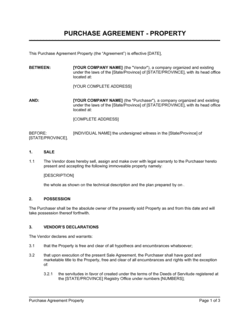
Offer to Purchase Real Estate Property Template

Free Word download β€’ Edit online β€’ Save & share with Drive β€’ Export to PDF

12 pagesβ€’25–35 min to fillβ€’Difficulty: Complex
Learn more ↓
FreeOffer to Purchase Real Estate Property Template

At a glance

What it is
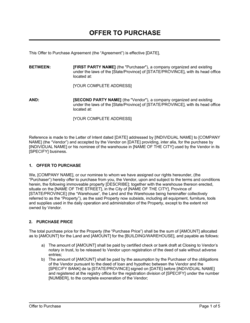
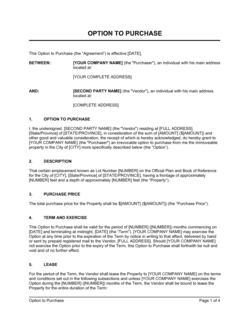
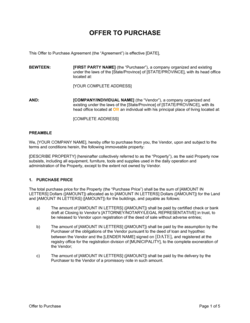
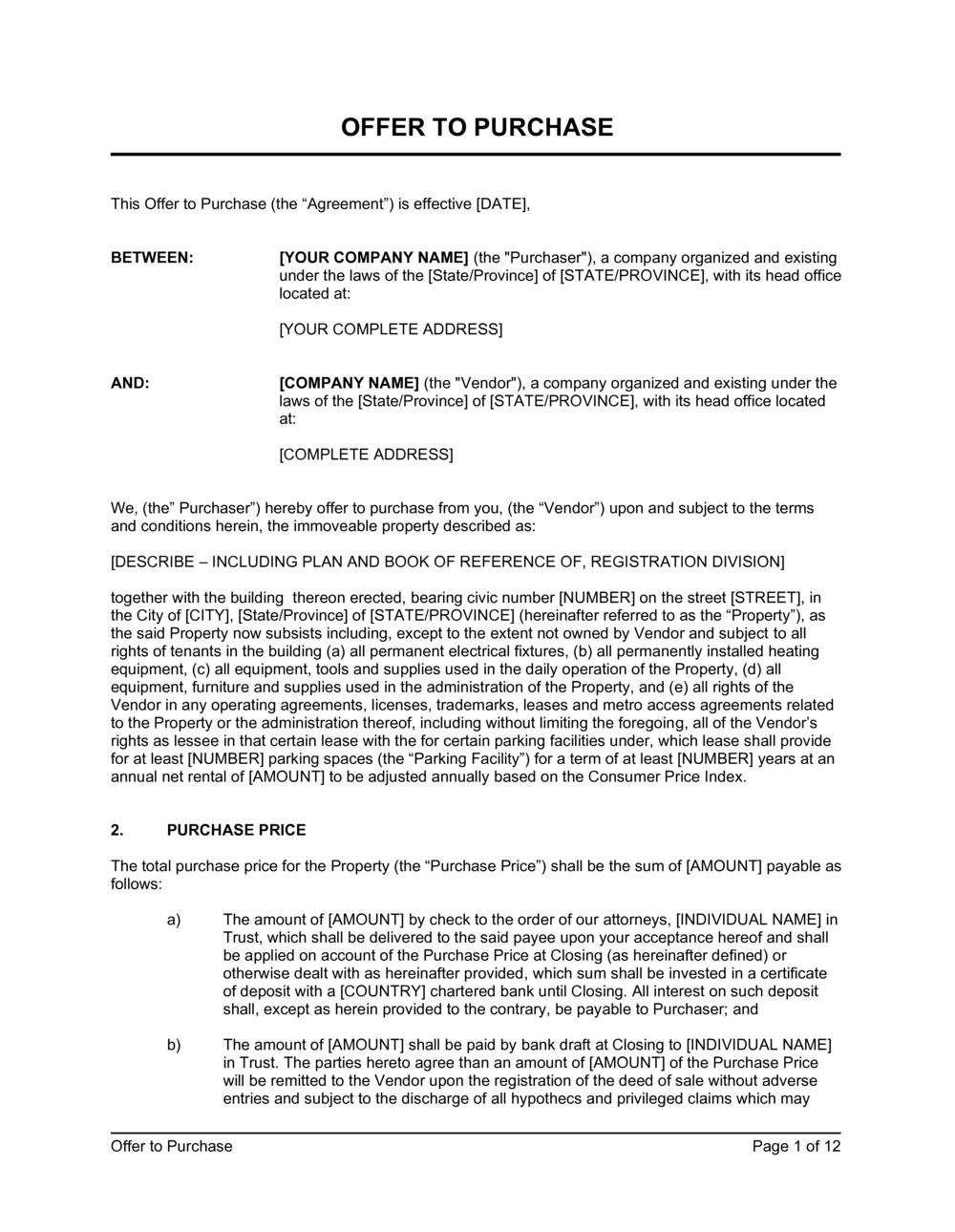
An Offer to Purchase Real Estate Property is a formal written letter from a prospective buyer to a property seller stating the buyer's intent to acquire a specific property, the proposed purchase price, key conditions, and a requested closing timeline. This free Word download gives you a structured starting point you can edit online and export as PDF to send to a seller or their agent within minutes.
When you need it
Use it when you have identified a property you want to buy and need to formally communicate your offer before a binding purchase agreement is drafted. It is commonly used in commercial real estate transactions, business acquisitions involving property, and private sales where the parties are not yet ready to engage a full purchase contract.
What's inside
Buyer and seller identification, property description and address, proposed purchase price, financing or cash terms, conditions precedent such as inspection and financing approval, proposed closing date, and an offer expiry clause.

What is an Offer to Purchase Real Estate Property?

An Offer to Purchase Real Estate Property is a formal written letter from a prospective buyer to a property owner or their agent that sets out the buyer's intent to acquire a specific property, the proposed purchase price, key conditions such as financing and inspection, a deposit amount, and a target closing date. It serves as the opening move in a real estate negotiation β€” precise enough to demonstrate a serious, funded buyer, but structured to allow conditions and counteroffers before a binding purchase agreement is signed. The document identifies both parties by their full legal names, describes the property by address and legal description, and places a clear expiry deadline on the seller's response window.

Why You Need This Document

Approaching a property seller with a verbal offer or a vague email puts you at a disadvantage from the first conversation. A properly structured offer letter signals credibility, locks in your proposed terms in writing, and forces both parties to address the details β€” deposit, conditions, inclusions, and closing date β€” before emotions or assumptions take over. Without it, sellers can claim oral understandings that differ from yours, include or exclude fixtures that were never discussed, and leave you with no paper trail if the deal sours. A written offer also gives you a defensible record if the seller later claims you agreed to a higher price or waived an inspection. This template gives you a complete, professionally formatted offer you can complete in under 30 minutes and submit to any seller or real estate agent with confidence.

Which variant fits your situation?

If your situation is…Use this template
Purchasing a commercial or industrial propertyOffer to Purchase Real Estate Property
Expressing early-stage intent before price is agreedLetter of Intent to Purchase Real Estate
Formalizing agreed terms into a binding contractReal Estate Purchase Agreement
Purchasing land for developmentLand Purchase Offer Letter
Offering to lease rather than buy the propertyCommercial Lease Agreement
Acquiring a business that includes real property assetsBusiness Purchase Agreement

Common mistakes to avoid

❌ Omitting the legal property description

Why it matters: An offer that identifies property by address only is ambiguous β€” civic addresses can change, and the address alone does not distinguish between parcels in a subdivision or strata development.

Fix: Pull the legal description from the land registry and include it verbatim in the property description clause, attaching a schedule if it is long.

❌ No deposit refund conditions

Why it matters: If the deposit clause does not specify what triggers a refund versus a forfeiture, the parties will dispute it if a condition is not met or the deal collapses.

Fix: State explicitly that the deposit is refundable in full if any condition is not satisfied by its deadline, and forfeited only in specific circumstances such as buyer default after condition waiver.

❌ Vague or absent offer expiry

Why it matters: Without an expiry, the seller can hold your offer open indefinitely while negotiating with other buyers, leaving you unable to make competing offers on other properties.

Fix: Always include a specific date and time by which the seller must respond, and keep it short β€” two to five business days is standard.

❌ Listing inclusions and exclusions as 'as per listing'

Why it matters: Listing descriptions change, are updated, or may never have been precise β€” referencing them instead of listing items explicitly creates a contractual gap.

Fix: Copy each included item from the listing into the offer and add any items you confirmed verbally with the agent, so there is no ambiguity at closing.

The 10 key clauses, explained

Date and parties

In plain language: Opens the letter with the date of the offer and the full legal names and addresses of both the buyer and the seller.

Sample language
This Offer to Purchase is submitted on [DATE] by [BUYER FULL NAME / ENTITY], located at [BUYER ADDRESS] ('Buyer'), to [SELLER FULL NAME / ENTITY], located at [SELLER ADDRESS] ('Seller').

Common mistake: Using a trade name instead of the buyer's registered legal entity name β€” this can create ambiguity about who is legally bound if the offer is accepted.

Property description

In plain language: Identifies the specific property by civic address and legal description to ensure no ambiguity about what is being purchased.

Sample language
Buyer offers to purchase the property municipally known as [FULL PROPERTY ADDRESS], legally described as [LEGAL DESCRIPTION], including all fixtures, improvements, and appurtenances (the 'Property').

Common mistake: Relying on the street address alone without including the legal description β€” addresses can change, and the legal description is the definitive identifier in public records.

Purchase price

In plain language: States the exact dollar amount being offered for the property and the currency in which payment will be made.

Sample language
Buyer offers to purchase the Property for the sum of [AMOUNT IN WORDS] ([AMOUNT IN FIGURES]) [CURRENCY], subject to the conditions set out below.

Common mistake: Omitting the currency when the transaction is cross-border or when the seller's listing price was stated in a different currency, creating potential disputes at closing.

Deposit

In plain language: Describes the earnest money deposit amount, when it is payable, and who holds it pending closing.

Sample language
Upon acceptance of this Offer, Buyer shall deliver a deposit of $[AMOUNT] to [ESCROW HOLDER / SELLER'S AGENT] to be held in trust and applied to the purchase price at closing.

Common mistake: Not specifying what happens to the deposit if the deal falls through β€” whether it is refundable, forfeited, or subject to conditions.

Financing condition

In plain language: Makes the offer conditional on the buyer securing mortgage or financing approval on satisfactory terms within a defined period.

Sample language
This Offer is conditional upon Buyer obtaining financing approval for not less than $[AMOUNT] at an interest rate not exceeding [X]% per annum within [X] business days of acceptance ('Financing Condition Date').

Common mistake: Setting an unrealistically short financing condition period that the buyer cannot meet, causing the deal to collapse and the deposit to be at risk.

Inspection condition

In plain language: Allows the buyer a defined period to conduct a professional property inspection and withdraw if the results are unsatisfactory.

Sample language
This Offer is conditional upon Buyer completing a property inspection to Buyer's satisfaction within [X] business days of acceptance. If unsatisfied, Buyer may terminate this Offer by written notice and receive a full refund of the deposit.

Common mistake: Using vague language such as 'satisfactory inspection' without specifying who conducts it or what standard applies, leading to disputes about whether the condition was properly waived.

Included and excluded items

In plain language: Lists fixtures, appliances, or other items that are specifically included in or excluded from the purchase price.

Sample language
The purchase price includes the following items: [LIST OF INCLUDED ITEMS]. The following items are excluded from the purchase: [LIST OF EXCLUDED ITEMS].

Common mistake: Leaving inclusions and exclusions undefined, which routinely results in disagreements at closing over items like HVAC units, signage, built-in shelving, or parking equipment.

Proposed closing date

In plain language: States the target date on which the buyer intends to complete the purchase and take possession of the property.

Sample language
The parties agree to complete this transaction on or before [CLOSING DATE], subject to satisfaction or waiver of all conditions set out herein.

Common mistake: Proposing a closing date that is too close to the offer date, leaving insufficient time for title searches, condition waivers, and financing confirmation.

Offer expiry

In plain language: Sets a deadline by which the seller must respond to the offer, after which it lapses automatically.

Sample language
This Offer shall remain open for acceptance by Seller until [TIME] on [DATE]. If not accepted by that time, this Offer shall be null and void and the deposit, if paid, shall be returned in full.

Common mistake: Setting an expiry date that is too far in the future, which allows the seller to shop the offer to other buyers while keeping the buyer's terms on the table.

Governing law and acknowledgment

In plain language: Identifies the jurisdiction whose laws govern the offer and includes a signature line for the buyer to execute the letter.

Sample language
This Offer shall be governed by the laws of [STATE / PROVINCE / JURISDICTION]. Submitted by: [BUYER SIGNATURE] [BUYER PRINTED NAME] [DATE].

Common mistake: Omitting the governing law clause β€” without it, jurisdictional disputes can arise if the buyer and seller are located in different states or provinces.

How to fill it out

  1. 1

    Enter the date and both parties' legal names

    Use the full registered legal name for any business entity β€” not a trade name or DBA. Include mailing addresses for both buyer and seller.

    πŸ’‘ If you are purchasing through a numbered company or trust, confirm the exact registered entity name before filling in the parties clause.

  2. 2

    Insert the complete property description

    Enter the civic address and the full legal description as it appears in the land registry or title records. Attach a schedule if the legal description is lengthy.

    πŸ’‘ Request the legal description from the seller's listing agent or look it up in the local property registry β€” do not guess from the address alone.

  3. 3

    State your offer price clearly

    Write the amount in both words and numerals and specify the currency. Keep this clause short β€” the number speaks for itself.

    πŸ’‘ Research recent comparable sales (comps) in the area before setting your price so the offer is grounded in market evidence.

  4. 4

    Define the deposit amount and holder

    Set a deposit that is credible relative to the purchase price β€” typically 1–5% for commercial transactions. Name the escrow holder or trust account.

    πŸ’‘ Confirm with the escrow holder that they can accept and hold the deposit in the timeframe stated before submitting the offer.

  5. 5

    Set realistic condition periods

    Allow sufficient time for financing approval (typically 5–10 business days) and inspection (3–5 business days). Conditions that expire too quickly signal a buyer who hasn't planned properly.

    πŸ’‘ Pre-qualify your financing before submitting the offer β€” it lets you shorten the financing condition period, making your offer more attractive to sellers.

  6. 6

    List all included and excluded items explicitly

    Walk through the property mentally and note every item that could be ambiguous β€” HVAC systems, parking structures, security cameras, signage. List each one as included or excluded.

    πŸ’‘ When in doubt, include an item on the list rather than assuming it is captured by 'fixtures and appurtenances.'

  7. 7

    Set the closing date and offer expiry

    Choose a closing date that gives both parties enough time to satisfy conditions and prepare transfer documentation β€” typically 30–60 days from offer acceptance for commercial deals. Set the expiry 2–5 business days from submission.

    πŸ’‘ A shorter expiry window (24–48 hours) signals confidence and urgency without committing to terms you cannot meet.

Frequently asked questions

What is an offer to purchase real estate property?

An offer to purchase real estate property is a formal written letter from a prospective buyer to a seller stating the buyer's intent to acquire a specific property at a defined price and on specified conditions. It initiates the negotiation process and, if accepted by the seller, forms the basis for a binding purchase agreement. It is not itself a binding contract in most jurisdictions but creates a clear record of the terms the buyer has proposed.

Is an offer to purchase legally binding?

In most jurisdictions, an offer letter of this type is not a fully binding purchase contract on its own β€” it is an expression of intent subject to conditions. When the seller countersigns and all conditions are waived or satisfied, the parties typically proceed to a formal purchase agreement. Some jurisdictions treat a signed offer as a binding contract, so it is worth confirming the local practice before submitting. Consider consulting a real estate lawyer if the transaction is high-value or complex.

What is the difference between an offer to purchase and a purchase agreement?

An offer to purchase is the opening document in a negotiation β€” it proposes a price, conditions, and timeline but is typically subject to conditions and further documentation. A purchase agreement is the fully negotiated, binding contract that governs the transaction through to closing. The offer letter starts the conversation; the purchase agreement closes it. In some markets and jurisdictions, the two documents are combined into a single form.

What conditions should I include in a real estate offer?

The two most common conditions are a financing condition β€” making the offer subject to mortgage or loan approval β€” and an inspection condition allowing the buyer to conduct a professional property inspection. For commercial properties, additional conditions might include satisfactory review of leases, environmental reports, zoning confirmation, or title searches. Each condition should specify a clear deadline and the consequence of non-satisfaction.

How long should a real estate offer be open for acceptance?

For most transactions, an offer expiry of two to five business days is standard. Shorter windows β€” 24 to 48 hours β€” signal urgency and can pressure a motivated seller to respond quickly. Longer windows work against the buyer by allowing the seller to use the offer to solicit competing bids. In a competitive market, same-day or next-business-day expiry is common.

Do I need a real estate agent to submit this offer?

No. A buyer can submit an offer to purchase directly to the seller or their agent without being represented. However, in commercial transactions or high-value residential deals, working with a buyer's agent or real estate lawyer can improve the offer's terms and help you avoid common drafting errors. This template gives you a professional starting point whether you are represented or acting on your own.

What happens to the deposit if the offer conditions are not met?

If a condition β€” such as financing approval or a satisfactory inspection β€” is not satisfied by its deadline, the offer typically terminates and the deposit is returned to the buyer in full. If the buyer waives all conditions and then defaults on the purchase without legal justification, the deposit is commonly forfeited to the seller. The specific terms depend on what is written in the offer and on applicable local law.

Can the seller reject or counter an offer to purchase?

Yes. The seller has three options: accept the offer as written, reject it outright, or respond with a counteroffer modifying the price, conditions, or timeline. A counteroffer typically nullifies the original offer and creates a new one that the buyer must then accept, counter, or reject. This back-and-forth continues until both parties agree on terms or either party walks away.

How this compares to alternatives

vs Letter of Intent to Purchase Real Estate

A letter of intent is a non-binding expression of general interest in a property β€” it outlines broad terms without committing the buyer to a specific price or conditions. An offer to purchase is a more detailed, price-specific document that, when accepted, moves directly toward a binding purchase agreement. Use an LOI for early-stage negotiations; use an offer to purchase when you are ready to transact.

vs Real Estate Purchase Agreement

A purchase agreement is the fully binding contract that governs a real estate transaction from acceptance through closing β€” it covers title, warranties, default remedies, closing mechanics, and representations. An offer to purchase initiates the process and establishes key commercial terms; the purchase agreement finalizes and enforces them. The offer comes first; the purchase agreement follows.

vs Commercial Lease Agreement

A commercial lease agreement grants a tenant the right to occupy and use a property for a defined period in exchange for rent β€” the buyer never acquires title. An offer to purchase leads to full ownership of the property. Use a lease when long-term ownership is not the goal or when capital is better deployed elsewhere in the business.

vs Business Purchase Agreement

A business purchase agreement covers the acquisition of a going concern β€” its goodwill, inventory, contracts, and staff. When that business also owns real property, a separate offer to purchase real estate is used to address the property component under the applicable real estate framework. The two documents work together in transactions involving both business assets and real estate.

Industry-specific considerations

Commercial Real Estate

Offers on office, retail, and industrial properties commonly include lease assignment conditions, environmental review periods, and zoning confirmation requirements.

Retail and Hospitality

Buyers acquiring premises for a restaurant, hotel, or retail location often attach business-use conditions confirming zoning permits the intended operation.

Construction and Development

Land acquisition offers frequently include conditions for soil testing, subdivision approval, and municipality servicing confirmations before the buyer commits.

Manufacturing

Industrial property purchases often require environmental assessments and confirmation that the site supports the buyer's intended load, utility, and access requirements.

Template vs pro β€” what fits your needs?

PathBest forCostTime
Use the templateBuyers submitting an initial offer on a commercial or private-sale property where a straightforward price and conditions applyFree15–30 minutes
Template + professional reviewHigh-value transactions, cross-border purchases, or deals with complex conditions such as environmental reviews or lease assignments$200–$500 for a real estate lawyer or agent review1–2 business days
Custom draftedMulti-parcel acquisitions, development land deals, or transactions requiring bespoke representations and warranties$800–$2,500+ for a real estate lawyer to draft from scratch3–7 business days

Glossary

Offer Price
The specific dollar amount the buyer proposes to pay for the property, which becomes the basis for negotiation.
Conditions Precedent
Requirements that must be satisfied before the transaction can proceed, such as a satisfactory property inspection or confirmed financing.
Due Diligence Period
A defined window of time after an offer is accepted during which the buyer investigates the property before committing to close.
Earnest Money Deposit
A sum paid by the buyer upon offer acceptance to demonstrate serious intent, typically held in trust and applied to the purchase price at closing.
Closing Date
The agreed calendar date on which ownership of the property transfers from seller to buyer and funds are exchanged.
Title Search
A review of public records to confirm the seller has clear, unencumbered ownership of the property and the right to sell it.
Encumbrance
Any claim, lien, mortgage, easement, or restriction attached to the property that may affect its value or transferability.
Letter of Intent (LOI)
A preliminary non-binding document expressing a buyer's general interest in a property before specific offer terms are formalized.
Offer Expiry
The date and time by which the seller must accept, counter, or reject the offer, after which it automatically lapses.
As-Is Condition
A term indicating the buyer accepts the property in its current state, with no obligation on the seller to make repairs or improvements.

Part of your Business Operating System

This document is one of 3,000+ business & legal templates included in Business in a Box.

  • Fill-in-the-blanks β€” ready in minutes
  • 100% customizable Word document
  • Compatible with all office suites
  • Export to PDF and share electronically

Create your document in 3 simple steps.

From template to signed document β€” all inside one Business Operating System.
1
Download or open template

Access over 3,000+ business and legal templates for any business task, project or initiative.

2
Edit and fill in the blanks with AI

Customize your ready-made business document template and save it in the cloud.

3
Save, Share, Send, Sign

Share your files and folders with your team. Create a space of seamless collaboration.

Save time, save money, and create top-quality documents.

β˜…β˜…β˜…β˜…β˜…

"Fantastic value! I'm not sure how I'd do without it. It's worth its weight in gold and paid back for itself many times."

Managing Director Β· Mall Farm
Robert Whalley
Managing Director, Mall Farm Proprietary Limited
β˜…β˜…β˜…β˜…β˜…

"I have been using Business in a Box for years. It has been the most useful source of templates I have encountered. I recommend it to anyone."

Business Owner Β· 4+ years
Dr Michael John Freestone
Business Owner
β˜…β˜…β˜…β˜…β˜…

"It has been a life saver so many times I have lost count. Business in a Box has saved me so much time and as you know, time is money."

Owner Β· Upstate Web
David G. Moore Jr.
Owner, Upstate Web

Run your business with a system β€” not scattered tools

Stop downloading documents. Start operating with clarity. Business in a Box gives you the Business Operating System used by over 250,000 companies worldwide to structure, run, and grow their business.

Free Forever PlanΒ Β·Β No credit card required