Asset Purchase Agreement For a Real Estate Property Template

Free Word download • Edit online • Save & share with Drive • Export to PDF

25 pages35–50 min to fillDifficulty: ComplexSignature requiredLegal review recommended
Learn more ↓
FreeAsset Purchase Agreement For a Real Estate Property Template

At a glance

What it is
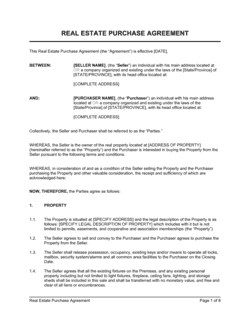
An Asset Purchase Agreement for a Real Estate Property is a legally binding contract between a buyer and a seller that documents the terms under which specific real property assets change ownership. This free Word download covers purchase price, earnest money deposit, due diligence period, representations and warranties, closing conditions, and title transfer in a single structured document you can edit online and export as PDF.
When you need it
Use it when acquiring commercial property, investment real estate, or land as an asset purchase — separate from any business entity — so that ownership of the physical property and its associated rights transfers directly to the buyer. It is the foundational document for any real property transaction where the parties want enforceable obligations in writing before closing.
What's inside
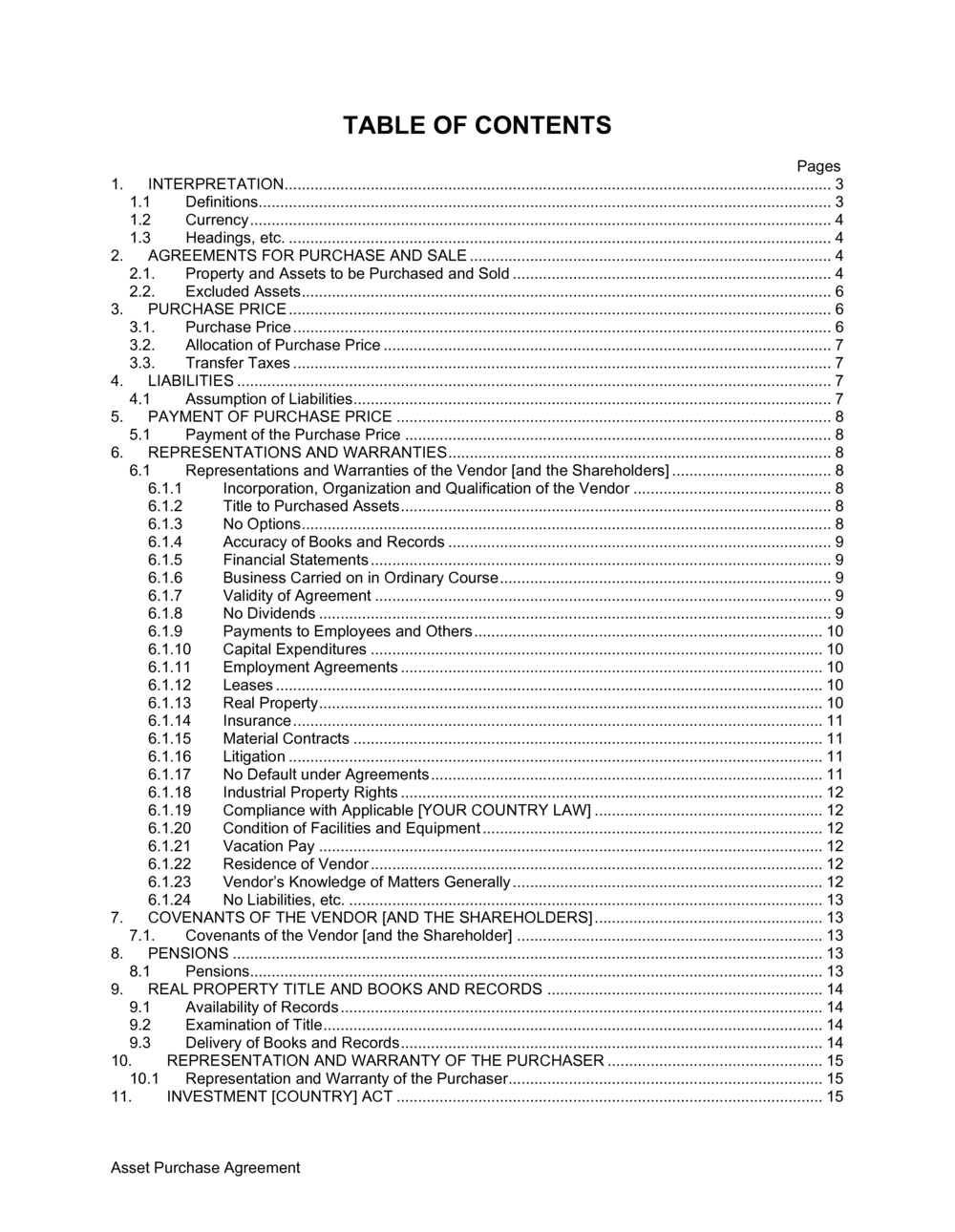
Property identification and legal description, purchase price and payment structure, earnest money and escrow terms, due diligence and inspection period, representations and warranties from both parties, closing conditions, proration of taxes and utilities, title insurance requirements, default and remedy provisions, and governing law.

What is an Asset Purchase Agreement for a Real Estate Property?

An Asset Purchase Agreement for a Real Estate Property is a legally binding contract between a buyer and a seller that governs the direct transfer of ownership of a specific parcel of real property — land, improvements, and associated rights — from one party to another. Unlike a share purchase, the buyer acquires the physical asset itself, not an interest in the entity that holds title, which means the buyer takes on only the liabilities explicitly assumed in the agreement and receives a fresh ownership basis for tax and depreciation purposes. The agreement documents every material term of the transaction: the legal description of the property, purchase price, earnest money deposit, due diligence period, seller representations and warranties, title requirements, closing conditions, proration of taxes and carrying costs, and the default remedies available to each party if the other fails to perform.

Why You Need This Document

Proceeding toward a real estate closing without a signed asset purchase agreement exposes both parties to immediate and costly risk. Without enforceable written terms, the seller has no legal basis to retain the buyer's deposit if the buyer walks away, and the buyer has no contractual right to inspect the property, review title, or terminate if a material defect surfaces. Courts across every major jurisdiction refuse to enforce oral agreements for real estate — the Statute of Frauds requires a signed written contract, and a letter of intent or informal email exchange will not satisfy that requirement. Beyond basic enforceability, a properly drafted agreement allocates the real financial risks of a transaction: who bears the cost of undiscovered title defects, what happens if the property is damaged between signing and closing, and who is responsible for unpaid taxes or tenant disputes that predate the sale. This template gives buyers and sellers a structured, jurisdiction-aware starting point that closes those gaps — reducing the time spent negotiating a bespoke agreement from scratch and providing both parties with the certainty needed to move confidently toward closing.

Which variant fits your situation?

If your situation is…Use this template
Purchasing a commercial building outright for business useAsset Purchase Agreement for a Real Estate Property
Acquiring a business along with its real property in a single transactionBusiness Asset Purchase Agreement
Buying shares of the entity that owns the property instead of the property itselfShare Purchase Agreement
Transferring real property between related entities or family membersDeed of Transfer / Quitclaim Deed
Leasing real property with an option to buy at a later dateLease Agreement with Option to Purchase
Purchasing residential property as a personal investmentResidential Real Estate Purchase Agreement
Seller financing the purchase instead of a third-party lenderSeller Financing Agreement / Promissory Note

Common mistakes to avoid

❌ Using street address instead of recorded legal description

Why it matters: A street address alone does not uniquely identify a parcel in law. If the address and the parcel records conflict, the agreement describes the wrong property, and the resulting deed can be challenged as conveying title to the incorrect land.

Fix: Copy the legal description verbatim from the most recent recorded deed and attach a copy of the current title commitment as an exhibit before both parties sign.

❌ Open-ended financing contingency with no deadline

Why it matters: A financing condition without a firm approval deadline allows a buyer to hold the property off the market indefinitely without committing to close, depriving the seller of the ability to relist or pursue other buyers.

Fix: Set a specific financing contingency deadline — typically 21–30 days from execution — and require the buyer to deliver written evidence of loan commitment or waive the contingency by that date.

❌ Governing law clause that conflicts with property situs

Why it matters: Real property is always governed by the law of the jurisdiction where it is physically located. A choice-of-law clause selecting another state or country's law will be disregarded by courts for property-specific issues — title, recording, and transfer taxes — leaving the parties uncertain about which rules apply.

Fix: Set governing law as the state, province, or country where the property is located. Reserve a different choice-of-law clause only for non-property provisions like dispute resolution or indemnification.

❌ Combining liquidated damages with a right to sue for actual damages

Why it matters: Drafting the seller's remedies to include both retention of the earnest money and a right to pursue damages creates an internally contradictory clause. Courts in many jurisdictions will void the entire remedies section, leaving both parties without the certainty the clause was intended to provide.

Fix: Elect one remedy for the seller on buyer default — either liquidated damages (earnest money forfeiture) or actual damages — and state clearly that it is the seller's sole and exclusive remedy.

❌ Skipping the due diligence period entirely on a 'clean' deal

Why it matters: Waiving due diligence to accelerate a transaction means the buyer closes without confirming clear title, environmental status, code compliance, or the accuracy of seller representations. Defects discovered post-closing are far more expensive to resolve than those caught before.

Fix: Retain at minimum a 15-day due diligence period even on straightforward transactions. Use the time to obtain a title commitment, a property condition report, and confirmation of any existing leases or encumbrances.

❌ Tax proration based on ambiguous 'most recent bill' language

Why it matters: If the most recent available tax bill is the prior year's and the current year's assessment has increased significantly, the seller is undercharged and the buyer overpays their share by thousands of dollars — a dispute that routinely surfaces at the first post-closing tax payment.

Fix: Specify whether proration uses the prior year's final bill, the current year's estimated bill, or a mutually agreed estimated amount, and include a post-closing true-up mechanism within 30 days of the actual tax bill being issued.

The 10 key clauses, explained

Property Identification and Legal Description

In plain language: Precisely identifies the real property being sold using its recorded legal description, street address, tax parcel number, and any included personal property or fixtures.

Sample language
Seller agrees to sell and Buyer agrees to purchase the real property located at [STREET ADDRESS], [CITY], [STATE/PROVINCE] [ZIP/POSTAL CODE], legally described as [LEGAL DESCRIPTION], Tax Parcel No. [PARCEL NUMBER], together with all improvements, fixtures, and appurtenances thereto ('Property').

Common mistake: Using only a street address without the recorded legal description. If the street address and parcel records conflict, the agreement may describe the wrong property, creating a title defect that can unwind the transaction at closing.

Purchase Price and Payment Terms

In plain language: States the total consideration, the breakdown between earnest money deposit and balance due at closing, and whether any portion is financed by a third-party lender or the seller.

Sample language
The total Purchase Price for the Property is [PURCHASE PRICE IN WORDS] ($[AMOUNT]). Buyer shall pay an Earnest Money Deposit of $[DEPOSIT AMOUNT] within [X] business days of execution. The balance of $[BALANCE] shall be paid at Closing by wire transfer of immediately available funds.

Common mistake: Stating the purchase price in numerals only. When numerals and written amounts conflict on any financial instrument or legal document, the written amount controls — leaving both figures out of sync creates ambiguity and potential disputes.

Earnest Money and Escrow Terms

In plain language: Specifies who holds the deposit, the conditions under which it is refundable to the buyer, the conditions under which the seller may retain it as liquidated damages, and the timeline for deposit.

Sample language
Earnest Money shall be deposited with [ESCROW HOLDER NAME] ('Escrow Holder') within [X] business days of mutual execution. The Earnest Money is refundable to Buyer if Buyer terminates during the Due Diligence Period or if a Closing Condition is not satisfied. The Earnest Money is non-refundable and shall be retained by Seller as liquidated damages if Buyer defaults after expiration of the Due Diligence Period.

Common mistake: Failing to name a specific escrow holder. When no holder is named and the parties later dispute who should hold the deposit, funds can remain undeposited and the closing timeline breaks down.

Due Diligence Period

In plain language: Grants the buyer a defined window to inspect the property physically, review environmental reports, leases, permits, tax records, and financial statements, and to terminate without penalty if findings are unsatisfactory.

Sample language
Buyer shall have [X] calendar days from the Effective Date ('Due Diligence Period') to conduct all inspections and investigations. Buyer may terminate this Agreement for any reason by delivering written notice to Seller prior to expiration of the Due Diligence Period, whereupon Escrow Holder shall return the Earnest Money to Buyer.

Common mistake: Setting a due diligence period shorter than the time needed to obtain environmental, structural, and title reports. Rushed diligence leaves buyers with undiscovered encumbrances, code violations, or contamination that cannot be negotiated away after the period expires.

Representations and Warranties of Seller

In plain language: Lists the seller's factual statements about the property — clear title, no undisclosed litigation, no known material defects, compliance with applicable laws, and accuracy of all documents delivered — that must be true at closing.

Sample language
Seller represents and warrants that: (a) Seller has full legal authority to sell the Property; (b) to Seller's actual knowledge, there are no material defects in the Property not disclosed in writing; (c) the Property is not subject to any pending litigation, condemnation, or governmental proceeding; and (d) all leases, permits, and approvals affecting the Property have been disclosed to Buyer.

Common mistake: Limiting seller representations to 'actual knowledge' without defining what 'actual knowledge' means. Courts interpret this differently — some hold that a seller cannot avoid liability by deliberately avoiding inquiry into facts readily available to them.

Title and Survey Conditions

In plain language: Requires the seller to deliver marketable, insurable title at closing, sets the buyer's deadline to raise title objections, and defines what constitutes a permitted exception versus a defect that allows the buyer to terminate.

Sample language
Seller shall deliver marketable title to the Property at Closing, free and clear of all liens, encumbrances, and exceptions other than Permitted Exceptions listed in Exhibit A. Buyer shall obtain a title commitment within [X] days of the Effective Date and deliver written objections within [Y] days thereafter. Seller shall have [Z] days to cure objections.

Common mistake: Not defining 'Permitted Exceptions' in an exhibit. Blanket language permitting 'standard exceptions' can inadvertently allow restrictive covenants, access easements, or senior liens to survive closing without the buyer's informed consent.

Closing Conditions

In plain language: Lists the specific conditions each party must satisfy before the closing can proceed — including delivery of a deed, payoff of liens, satisfaction of financing contingency, and completion of any agreed repairs.

Sample language
Closing is conditioned upon: (a) Seller delivering a duly executed [WARRANTY / GRANT / QUITCLAIM] Deed; (b) title company issuing an owner's policy of title insurance; (c) Buyer obtaining financing no less favorable than [RATE]% for [TERM] years on or before [DATE]; and (d) completion of Seller's agreed repairs as set out in Exhibit B.

Common mistake: Writing a financing contingency with no deadline and no fallback. An open-ended financing condition can let a buyer hold a property off the market indefinitely without committing to close.

Prorations and Closing Costs

In plain language: Allocates real property taxes, HOA dues, rents from existing tenants, utility deposits, and other periodic charges between buyer and seller based on the closing date, and specifies which party pays each category of closing cost.

Sample language
Real property taxes and assessments shall be prorated as of the Closing Date based on the most recent available tax bill. Seller shall pay [transfer taxes / deed stamps / broker commissions]. Buyer shall pay [title insurance premium / recording fees / lender fees]. Each party shall pay its own attorney fees.

Common mistake: Agreeing that taxes will be prorated 'at closing' without specifying whether the proration is based on the prior year's actual bill or the current year's estimated bill. This single ambiguity routinely produces post-closing disputes of thousands of dollars.

Default and Remedies

In plain language: Defines what constitutes a default by each party, the notice and cure period, and the available remedies — liquidated damages (retention of earnest money), specific performance, or actual damages.

Sample language
If Buyer defaults, Seller's sole remedy shall be retention of the Earnest Money as liquidated damages, which the parties agree is a reasonable estimate of Seller's damages. If Seller defaults, Buyer may elect to (a) terminate and receive a return of the Earnest Money, or (b) pursue specific performance in a court of competent jurisdiction.

Common mistake: Granting the seller both liquidated damages and the right to sue for actual damages in the same clause. Courts in many jurisdictions will void the entire remedies clause as unconscionable, leaving the parties without the certainty the clause was meant to provide.

Governing Law and Dispute Resolution

In plain language: Specifies the jurisdiction whose law governs the agreement, the forum for resolving disputes, and whether disputes go to arbitration or litigation — with a carve-out for injunctive relief.

Sample language
This Agreement shall be governed by the laws of [STATE/PROVINCE/COUNTRY]. Any dispute arising hereunder shall be resolved by [binding arbitration administered by [AAA/JAMS] in [CITY] / litigation in the courts of [COUNTY], [STATE]], except that either party may seek injunctive or other equitable relief in any court of competent jurisdiction without waiving arbitration.

Common mistake: Choosing governing law based on where the buyer is incorporated rather than where the property is located. Real property is governed by the law of the situs — the jurisdiction where the land sits — regardless of contractual choice-of-law provisions in most countries.

How to fill it out

  1. 1

    Identify the parties and confirm legal authority

    Enter the full legal names of buyer and seller — individuals use full legal names as on government ID; entities use the registered legal name and state or province of formation. Confirm the seller has authority to sell by checking title records and, for entities, corporate resolutions or LLC operating agreements.

    💡 Request a certificate of good standing for any selling entity before drafting — a dissolved or administratively terminated entity cannot convey clear title.

  2. 2

    Insert the full legal description of the property

    Copy the legal description verbatim from the most recent deed recorded in the applicable land records office. Include the tax parcel number, street address, and a description of any fixtures, personal property, or appurtenances included in the sale.

    💡 Order a preliminary title report before finalizing this section — it will surface any discrepancies between the deed description and current public records.

  3. 3

    Set the purchase price, deposit amount, and payment mechanics

    State the total purchase price in both numerals and written words. Define the earnest money amount, the deadline for deposit, the escrow holder's name and contact, and the payment method for the closing balance — wire transfer is standard for commercial transactions.

    💡 Set the earnest money at 1–3% of the purchase price for residential property and 2–5% for commercial — enough to signal commitment without overexposing the buyer in a deal that may not close.

  4. 4

    Define the due diligence period and deliverables

    Set a realistic due diligence window — 30 days minimum for a simple commercial property, 45–60 days for properties with environmental concerns, multiple tenants, or complex entitlements. List the documents the seller must deliver within a specified number of days of execution.

    💡 Build a due diligence checklist as an exhibit: title commitment, survey, environmental Phase I, lease abstracts, utility bills for the last 24 months, and permits.

  5. 5

    Negotiate and document seller representations

    Work through each representation category — title, litigation, environmental condition, lease status, code compliance, and physical condition — and agree on whether each is given to 'actual knowledge' or as an absolute warranty. Document any known exceptions in a disclosure schedule.

    💡 Ask the seller to complete a written property disclosure statement before finalizing representations — it creates a record of what was known at signing and limits post-closing disputes.

  6. 6

    Complete the title and permitted exceptions exhibit

    Attach a copy of the preliminary title report and list each recorded exception the buyer agrees to accept — utility easements, CC&Rs, and non-monetary encumbrances. Any exception not listed remains a seller obligation to cure.

    💡 Have your title officer confirm in writing which exceptions are insurable — non-insurable exceptions require negotiation or removal before closing.

  7. 7

    Set closing conditions, closing date, and proration methodology

    Enter the target closing date, the financing contingency deadline and loan terms, and the proration basis for taxes and rents. List any repairs the seller must complete before closing as a separate exhibit with cost estimates.

    💡 Set a closing date 10–15 days beyond your expected lender or escrow timeline as a buffer — extension provisions with a per-day carry cost protect both parties if closing slips.

  8. 8

    Execute before funds are deposited and have the deed prepared simultaneously

    Both parties must sign the agreement before earnest money is wired to escrow. Engage a title company or real estate attorney to prepare the deed in the correct form for the jurisdiction — warranty deed, grant deed, or special warranty deed — so it is ready for review well before the closing date.

    💡 In states with attorney-closing requirements (e.g., New York, Massachusetts, South Carolina), engage counsel before execution — not at closing — to avoid last-minute delays.

Frequently asked questions

What is an asset purchase agreement for real estate?

An asset purchase agreement for real estate is a legally binding contract between a buyer and a seller that governs the transfer of ownership of a specific parcel of real property as a direct asset purchase. It defines the purchase price, earnest money deposit, due diligence rights, seller representations and warranties, title requirements, closing conditions, and the allocation of costs and taxes between the parties. Unlike a share purchase, the buyer acquires the land and improvements directly — not an interest in the entity that owns them.

What is the difference between an asset purchase and a share purchase for real estate?

In an asset purchase, the buyer acquires the real property itself — land, improvements, and associated rights — and takes on only the liabilities explicitly assumed in the agreement. In a share purchase, the buyer acquires equity in the entity that owns the property, inheriting all of that entity's liabilities, including undisclosed ones. Asset purchases are generally preferred for real estate because the buyer gets a clean title transfer, a fresh depreciation basis, and no exposure to the selling entity's pre-closing liabilities.

Is an asset purchase agreement for real estate legally required?

Most jurisdictions do not require a formal asset purchase agreement by name, but they do require a written contract for any real property sale to be enforceable under the Statute of Frauds. A properly drafted agreement satisfies that writing requirement and provides the detailed terms — due diligence rights, representations, closing conditions — that a bare deed or letter of intent does not. Without it, parties are left to rely on verbal understandings that courts will not enforce.

What should a real estate asset purchase agreement include?

At minimum: the full legal description of the property, purchase price and payment breakdown, earnest money amount and escrow holder, due diligence period and termination rights, seller representations and warranties, title and survey conditions, closing conditions and target closing date, proration of taxes and rents, allocation of closing costs, default and remedy provisions, and governing law. Any included personal property or fixtures should be listed in a schedule, and permitted title exceptions should be attached as an exhibit.

How long should the due diligence period be in a real estate purchase agreement?

The appropriate due diligence period depends on the complexity of the property. For straightforward commercial properties with clean title, 15–30 days is typical. Properties with multiple tenants, environmental concerns, entitlement issues, or significant deferred maintenance warrant 45–60 days. For large portfolio acquisitions or properties in regulated industries, 60–90 days is common. Setting the period too short is the most common mistake buyers make — undiscovered defects after expiration cannot be raised to terminate without forfeiting the earnest money deposit.

Who pays closing costs in a real estate asset purchase?

Closing cost allocation is negotiable and varies by jurisdiction and market custom. Sellers typically pay real estate broker commissions, deed transfer or stamp taxes, and any cost to clear title defects. Buyers typically pay for lender fees, title insurance premiums, recording fees, and survey costs. Attorney fees are generally paid by each party for their own counsel. The agreement should state each party's obligations explicitly rather than relying on local custom, which can shift in a buyer's or seller's market.

Can I use this template for residential property as well as commercial?

This template is designed primarily for commercial real estate and investment property asset purchases. Residential transactions in most US states and Canadian provinces are governed by jurisdiction-specific standard forms (e.g., CAR forms in California, OREA forms in Ontario) that include consumer protection disclosures required by state or provincial law. Using a commercial template for a residential purchase may omit mandatory disclosures. Consult a local real estate attorney or agent before adapting this template for a residential transaction.

Does the agreement need to be notarized to be enforceable?

In most jurisdictions, the asset purchase agreement itself does not require notarization to be enforceable between the parties — a signed written contract is sufficient. However, the deed conveying title at closing typically must be notarized and then recorded in the applicable land registry or recorder's office to be valid against third parties. Some states also require the deed to be witnessed in addition to notarized. Check the recording requirements of the jurisdiction where the property is located.

What happens if the buyer cannot obtain financing before the contingency deadline?

If the buyer delivers timely written notice before the financing contingency deadline stating they were unable to obtain a committed loan on the agreed terms, the agreement is typically terminable and the earnest money deposit is returned to the buyer. If the buyer fails to notify the seller before the deadline and cannot close, most agreements treat this as a buyer default — the seller retains the earnest money as liquidated damages. This is why setting a realistic financing contingency deadline — and monitoring it — is critical for both parties.

Do I need a lawyer to complete a real estate asset purchase agreement?

For straightforward investment property acquisitions where the buyer has real estate experience and the property has clean title and no tenants, a well-drafted template can serve as a solid starting point. Legal review is strongly recommended when the property has existing tenants with long-term leases, environmental concerns, entitlement or zoning issues, seller financing, or when the transaction involves cross-border parties. A real estate attorney review typically costs $500–$2,000 and is worthwhile for any transaction above $250,000.

How this compares to alternatives

vs Business Asset Purchase Agreement

A business asset purchase agreement transfers a mix of operating assets — inventory, equipment, customer lists, goodwill, and sometimes real property — from a selling business to a buyer. A real estate asset purchase agreement is focused exclusively on the transfer of real property and its associated rights and obligations. When real estate is one component of a broader business sale, both documents are often used together.

vs Share Purchase Agreement

A share purchase agreement transfers ownership of the entity that holds the property rather than the property itself. The buyer assumes all of the entity's liabilities — disclosed and undisclosed. A real estate asset purchase is generally cleaner for the buyer because title transfers directly, liabilities are expressly assumed or excluded, and the buyer receives a fresh depreciation basis. Share purchases are sometimes preferred for their tax efficiency at the seller level.

vs Lease Agreement with Option to Purchase

A lease with option to purchase lets the buyer occupy and operate the property under a lease while reserving the right to buy it at a predetermined price within a defined window. A real estate asset purchase agreement is used when the parties have agreed to close the transaction without a preliminary lease period. The option structure suits buyers who need time to arrange financing or confirm the property's performance before committing to full ownership.

vs Letter of Intent (Real Estate)

A letter of intent records the parties' preliminary agreement on price, structure, and key terms before a binding contract is drafted. It is typically non-binding on the material transaction terms. A real estate asset purchase agreement is the binding document that follows a signed letter of intent and governs every aspect of the actual closing. Relying on a letter of intent as a substitute for a signed purchase agreement leaves both parties without enforceable rights.

Industry-specific considerations

Commercial Real Estate

Tenant rent rolls, estoppel certificates, CAM reconciliation obligations, and existing financing assumption or payoff requirements drive additional exhibits in commercial acquisitions.

Retail and Hospitality

Liquor license transfers, health department permits, and FF&E (furniture, fixtures, and equipment) schedules are often bundled into the asset purchase alongside the real property.

Manufacturing and Industrial

Environmental Phase I and Phase II site assessments, hazardous materials disclosures, and remediation cost allocation are critical negotiated terms for industrial property acquisitions.

Healthcare

Certificate of need approvals, zoning for medical use, ADA compliance status, and integration of real property acquisition with equipment and license transfer require coordinated legal review.

Jurisdictional notes

United States

Real property contracts must satisfy the Statute of Frauds in every US state — they must be in writing and signed by the party to be charged. Closing practices vary significantly: attorney-closing states (New York, Massachusetts, South Carolina, Georgia) require licensed counsel at closing; escrow states (California, Texas, Arizona) use title companies. Transfer taxes, deed stamp requirements, and seller disclosure obligations differ by state. Non-compete and non-compete rules do not apply, but 1031 exchange provisions are critical for investment buyers deferring capital gains.

Canada

Real estate transactions in Canada are provincially regulated. Ontario and British Columbia require agreements of purchase and sale to be in writing and signed by both parties. Land transfer taxes are payable by the buyer in most provinces, with Ontario and British Columbia also imposing municipal land transfer taxes in Toronto and Vancouver respectively. Quebec transactions are governed by the Civil Code of Quebec and must be notarized by a Quebec notary. FINTRAC anti-money-laundering identification requirements apply to all real estate transactions.

United Kingdom

In England and Wales, the exchange of signed contracts creates a binding agreement; completion (closing) typically follows 2–4 weeks later. Stamp Duty Land Tax (SDLT) is payable by the buyer based on purchase price bands and property use. Scotland operates under a separate system — missives form the binding contract and solicitors handle the full conveyancing process. Northern Ireland follows broadly similar rules to England and Wales. Registered title at HM Land Registry is the definitive record of ownership.

European Union

Real estate transactions across EU member states are subject to local civil law requirements that vary significantly. In Germany and France, a notarial deed authenticated by a civil-law notary is mandatory for the transfer to be valid and registrable. Transfer taxes range from 3.5% in Germany to 10% in Belgium. GDPR compliance is relevant when collecting and processing personal data of counterparties during due diligence. Foreign buyers in some EU states (e.g., Denmark, Croatia) face restrictions on acquiring certain categories of real property and should confirm local eligibility rules before signing.

Template vs lawyer — what fits your deal?

PathBest forCostTime
Use the templateExperienced real estate investors acquiring straightforward commercial or investment property with clean title and no existing tenantsFree1–2 hours to complete
Template + legal reviewFirst-time commercial buyers, transactions with existing tenants or leases, seller financing, or properties with known environmental or zoning issues$500–$2,000 for attorney review and negotiation support3–7 business days
Custom draftedLarge-scale portfolio acquisitions, cross-border transactions, properties requiring environmental remediation, or deals involving entity restructuring alongside the real estate transfer$3,000–$15,000+ depending on complexity2–6 weeks

Glossary

Asset Purchase
A transaction in which the buyer acquires specific assets — in this case, real property — rather than shares or membership interests in the entity that owns them.
Earnest Money Deposit
A good-faith sum paid by the buyer into escrow at signing to demonstrate serious intent; applied to the purchase price at closing or forfeited if the buyer defaults without cause.
Due Diligence Period
A contractually defined window — typically 15 to 45 days — during which the buyer may inspect the property, review documents, and terminate the agreement without penalty if unsatisfied.
Legal Description
The precise, government-recorded description of a parcel of real estate — metes and bounds, lot and block, or township-range system — that uniquely identifies the property in public records.
Title Insurance
An insurance policy protecting the buyer (and lender) against undiscovered defects in the property's chain of title, such as prior liens, encumbrances, or ownership disputes.
Prorations
The allocation of recurring property costs — real estate taxes, HOA fees, utility deposits — between buyer and seller based on the closing date.
Representations and Warranties
Factual statements each party makes about themselves and the property, the accuracy of which is a condition to closing and may give rise to indemnification claims if false.
Closing Conditions
Specific requirements that must be satisfied before the transaction can close — such as clear title, financing approval, and completion of agreed repairs.
Escrow
A neutral third-party arrangement — typically a title company or attorney — that holds funds and documents and disburses them only when all closing conditions are met.
Easement
A recorded right allowing a third party — such as a utility company or neighboring owner — to use a portion of the property for a specific purpose, which survives a change in ownership.
Indemnification
A contractual obligation by one party to compensate the other for losses arising from a breach of representations, warranties, or covenants in the agreement.
Closing Date
The specific date on which ownership legally transfers, funds are disbursed from escrow, and the deed is recorded in the applicable public registry.

Part of your Business Operating System

This document is one of 3,000+ business & legal templates included in Business in a Box.

  • Fill-in-the-blanks — ready in minutes
  • 100% customizable Word document
  • Compatible with all office suites
  • Export to PDF and share electronically

Create your document in 3 simple steps.

From template to signed document — all inside one Business Operating System.
1
Download or open template

Access over 3,000+ business and legal templates for any business task, project or initiative.

2
Edit and fill in the blanks with AI

Customize your ready-made business document template and save it in the cloud.

3
Save, Share, Send, Sign

Share your files and folders with your team. Create a space of seamless collaboration.

Save time, save money, and create top-quality documents.

★★★★★

"Fantastic value! I'm not sure how I'd do without it. It's worth its weight in gold and paid back for itself many times."

Managing Director · Mall Farm
Robert Whalley
Managing Director, Mall Farm Proprietary Limited
★★★★★

"I have been using Business in a Box for years. It has been the most useful source of templates I have encountered. I recommend it to anyone."

Business Owner · 4+ years
Dr Michael John Freestone
Business Owner
★★★★★

"It has been a life saver so many times I have lost count. Business in a Box has saved me so much time and as you know, time is money."

Owner · Upstate Web
David G. Moore Jr.
Owner, Upstate Web

Run your business with a system — not scattered tools

Stop downloading documents. Start operating with clarity. Business in a Box gives you the Business Operating System used by over 250,000 companies worldwide to structure, run, and grow their business.

Free Forever Plan · No credit card required