Lease Termination Letter Template

Free Word download β€’ Edit online β€’ Save & share with Drive β€’ Export to PDF

1 pageβ€’15–25 min to fillβ€’Difficulty: Standard
Learn more ↓
FreeLease Termination Letter Template

At a glance

What it is
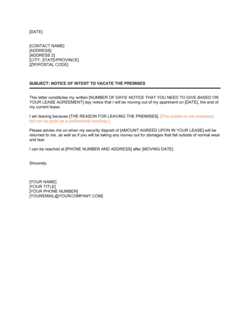
A Lease Termination Letter is a formal written notice from a landlord or tenant that officially communicates the intent to end a lease agreement on a specific date. This free Word download gives you an editable template you can complete in minutes and export as PDF β€” covering the lease reference, termination date, legal basis, and move-out logistics in a single page.
When you need it
Use it whenever a landlord or tenant needs to give formal written notice to end a tenancy β€” at the end of a fixed term, after a month-to-month notice period, following a lease breach, or by mutual agreement.
What's inside
Sender and recipient details, lease reference and property address, stated termination date, legal basis for termination, move-out instructions including key return and inspection scheduling, and a closing signature block.

What is a Lease Termination Letter?

A Lease Termination Letter is a formal written notice from a landlord or tenant that officially communicates the intent to end a rental agreement on a stated date. It identifies both parties by their names as they appear in the original lease, references the property address and lease commencement date, states the legal basis for termination β€” whether that is the expiry of a fixed term, the end of a notice period on a month-to-month tenancy, a breach of lease, or a mutual agreement β€” and sets out the practical steps for vacating, returning keys, scheduling a move-out inspection, and processing the security deposit. Unlike an eviction notice, a lease termination letter is not a demand to cure a breach or a filing with a court; it is the formal written record that one or both parties have exercised their right to end the tenancy.

Why You Need This Document

A verbal notice to vacate β€” or worse, no notice at all β€” leaves both parties exposed. Without a written termination letter, a landlord has no documented proof that proper notice was given, making it nearly impossible to enforce a move-out date, re-let the property on schedule, or retain any portion of a security deposit for unpaid rent. For tenants, sending a signed letter with a tracked delivery method protects them from claims of abandonment and provides evidence that rent obligations ended on the correct date rather than the date a landlord later chooses to assert. Missing or defective notice can reset the entire notice period, costing landlords weeks of lost rental income and tenants unexpected rent liability. This template gives you the correct structure β€” termination date calculated from the notice period, clear legal basis, and move-out logistics in one document β€” so you can deliver valid, professional notice in under fifteen minutes and keep a copy that holds up if the end of tenancy is ever disputed.

Which variant fits your situation?

If your situation is…Use this template
Landlord giving notice at the end of a fixed-term leaseLease Termination Letter (Landlord – End of Term)
Tenant giving 30-day or 60-day notice on a month-to-month tenancyNotice to Vacate (Tenant)
Landlord terminating due to non-payment of rentEviction Notice (Non-Payment)
Both parties agreeing to end the lease earlyLease Termination Agreement (Mutual)
Landlord terminating due to lease violations other than non-paymentNotice to Cure or Quit
Commercial tenant exercising a contractual break clauseCommercial Lease Termination Letter
Landlord confirming receipt and acceptance of tenant's notice to vacateLease Termination Acknowledgment Letter

Common mistakes to avoid

❌ No specific termination date

Why it matters: Stating '30 days notice' without a calendar date allows the recipient to dispute when the notice period begins, potentially extending the tenancy and delaying the landlord's ability to re-let.

Fix: Always calculate and print the exact calendar date β€” e.g., 'you must vacate by June 30, 2026' β€” based on the applicable notice period.

❌ Sending only to the rental address

Why it matters: If the tenant has already vacated or disputes receipt, delivery to a single address may not satisfy legal service requirements, invalidating the notice.

Fix: Send by certified mail to the rental address and any known forwarding address, and retain the delivery confirmation for each.

❌ Omitting the legal basis for termination

Why it matters: In many jurisdictions, a termination notice with no stated reason β€” especially one citing breach β€” is legally defective and gives the recipient grounds to challenge it.

Fix: Reference the specific lease clause or statutory provision that authorizes the termination, and briefly describe the triggering event if it is a breach.

❌ Using informal or hedged language

Why it matters: Phrases like 'I am thinking of ending the lease' or 'I would like you to vacate' do not constitute formal notice in most jurisdictions and can be argued as non-binding.

Fix: Use clear, unambiguous language: 'This letter constitutes formal written notice of termination of the lease agreement effective [DATE].'

The 9 key clauses, explained

Header: sender and recipient details

In plain language: Identifies who is sending the letter, who is receiving it, and when it was sent β€” establishing the paper trail from the first line.

Sample language
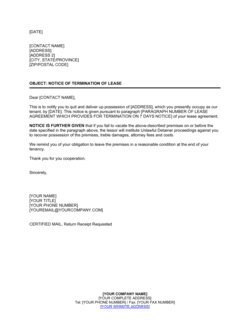
[SENDER FULL NAME] [SENDER ADDRESS] [CITY, STATE, ZIP] [DATE] [RECIPIENT FULL NAME] [RECIPIENT ADDRESS] [CITY, STATE, ZIP]

Common mistake: Sending to the tenant's current rental address only. If the tenant has already vacated or disputes receipt, service to a single address may not be considered valid notice.

Subject line and lease reference

In plain language: States the purpose of the letter and references the specific lease by property address and commencement date so both parties can locate the governing document.

Sample language
Re: Notice of Lease Termination β€” [PROPERTY ADDRESS], Lease dated [LEASE START DATE]

Common mistake: Omitting the lease date or using only the property address. If there have been multiple leases or renewals for the same property, an ambiguous reference creates a dispute about which agreement is being terminated.

Statement of termination intent

In plain language: The core declaration β€” clearly states that the sender is giving formal notice to terminate the lease, naming both parties as they appear in the original agreement.

Sample language
This letter serves as formal written notice that [SENDER NAME] (the '[LANDLORD/TENANT]') hereby terminates the lease agreement entered into with [RECIPIENT NAME] (the '[TENANT/LANDLORD]') for the premises located at [PROPERTY ADDRESS].

Common mistake: Using informal language such as 'I would like to end our lease' instead of an unambiguous declaration. Hedged phrasing invites the recipient to argue no firm notice was given.

Termination date

In plain language: States the exact calendar date the tenancy ends and possession must be returned β€” calculated from the notice date in accordance with the lease and applicable law.

Sample language
The tenancy shall terminate and you are required to vacate the premises no later than [TERMINATION DATE], which is [X] days from the date of this notice.

Common mistake: Stating the notice period (e.g., '30 days') without calculating and writing the actual calendar date. Recipients miscalculate or dispute the count; a specific date eliminates ambiguity.

Legal basis for termination

In plain language: Explains why the lease is being terminated β€” end of fixed term, expiry of a month-to-month arrangement, breach of lease, mutual agreement, or exercise of an early termination clause.

Sample language
This notice is given pursuant to [SECTION X] of the lease agreement, which provides for termination upon [X] days' written notice / the following breach: [DESCRIPTION OF BREACH] / the mutual agreement of both parties dated [DATE].

Common mistake: Citing no legal basis at all. A termination letter with no stated reason β€” especially in jurisdictions requiring 'just cause' for termination β€” may be legally defective and unenforceable.

Move-out instructions

In plain language: Tells the tenant how to leave the property β€” cleaning standard expected, what to do with keys, and how to schedule the move-out inspection.

Sample language
Please ensure the premises are left in clean condition, free of personal belongings. All keys, access cards, and garage openers must be returned to [ADDRESS / NAME] by [DATE/TIME]. A move-out inspection will be scheduled on [DATE] at [TIME] β€” please confirm your attendance.

Common mistake: Omitting move-out logistics entirely. Without written instructions, disputes over key return and inspection access lead to delayed security deposit processing and potential legal costs.

Security deposit notice

In plain language: Reminds the tenant of the security deposit amount held, the process for returning it, and the timeline and conditions for any lawful deductions.

Sample language
The security deposit of $[AMOUNT] held on account will be returned within [X] days of your vacating the premises, less any lawful deductions for unpaid rent or damages beyond normal wear and tear. An itemized statement of deductions, if any, will accompany the return.

Common mistake: Not mentioning the security deposit in the termination letter at all. Tenants who are not reminded of the return timeline and conditions are more likely to dispute deductions after the fact.

Outstanding obligations

In plain language: Reminds both parties of any rent, utility balances, or repair obligations that remain due up to and including the termination date.

Sample language
Rent and all other charges under the lease remain due and payable through [TERMINATION DATE]. Any outstanding balance as of that date will be deducted from the security deposit or pursued separately.

Common mistake: Implying that the termination date is the last day rent is owed without confirming the proration method. Month-to-month tenants often believe they owe nothing after giving notice mid-cycle.

Closing and signature block

In plain language: Closes the letter professionally, provides contact details for questions, and includes the sender's printed name, signature line, and date.

Sample language
Please feel free to contact me at [PHONE NUMBER] or [EMAIL ADDRESS] with any questions regarding this notice. Thank you for your attention to this matter. Sincerely, [SIGNATURE] [PRINTED NAME] [DATE]

Common mistake: Not providing a contact method for follow-up. Tenants who cannot reach the sender to confirm receipt or ask questions about logistics are more likely to delay compliance or escalate to a dispute.

How to fill it out

  1. 1

    Enter sender and recipient details

    Fill in the full legal names and mailing addresses for both the person sending the letter and the person receiving it. Use the names exactly as they appear in the original lease.

    πŸ’‘ For a landlord letter, also send a copy to any co-tenants named on the lease β€” each party is entitled to independent notice.

  2. 2

    Reference the lease and property

    Add the property's full street address and the exact date the original lease was signed. If there have been renewals, reference the most recent renewal date as well.

    πŸ’‘ Pull out the original lease before drafting to confirm the legal property address β€” unit numbers and suite designations matter in multi-unit buildings.

  3. 3

    Calculate and enter the termination date

    Count forward from today's date by the notice period required in the lease or applicable law (typically 30, 60, or 90 days). Write the resulting calendar date explicitly β€” do not just state the number of days.

    πŸ’‘ Check whether your jurisdiction counts notice days as calendar days or business days β€” the distinction can shift your termination date by up to two weeks.

  4. 4

    State the legal basis for termination

    Identify the specific clause in the lease or the statutory provision that authorizes this termination. For a breach, briefly describe the nature of the breach and any prior notice given.

    πŸ’‘ For breach-based terminations, attach copies of any prior written warnings or cure notices to the letter β€” they establish the paper trail if the matter escalates.

  5. 5

    Add move-out and key-return instructions

    Specify the expected move-out condition, where and how keys should be returned, and the date and time of the scheduled move-out inspection. Offer at least two inspection time options to reduce scheduling friction.

    πŸ’‘ Confirm the move-out inspection in writing separately β€” a follow-up email or text creates a timestamped record that both parties were notified.

  6. 6

    Include the security deposit statement

    State the amount of deposit held and the statutory return timeline in your jurisdiction. Note that deductions will be itemized if applicable.

    πŸ’‘ Many jurisdictions require security deposits to be returned within 14–30 days of move-out. Research the specific deadline before completing this clause β€” missing it can forfeit the landlord's right to deduct.

  7. 7

    Sign, date, and deliver by a trackable method

    Sign and date the letter, then send it by a method that creates proof of delivery β€” certified mail, email with read receipt, or hand delivery with a signed acknowledgment.

    πŸ’‘ Keep a copy of the sent letter and the delivery confirmation together in a single lease file. You may need both if the termination is later disputed.

Frequently asked questions

What is a lease termination letter?

A lease termination letter is a formal written notice from a landlord or tenant stating their intent to end a rental agreement on a specific date. It records the legal basis for termination, the required notice period, and the logistics for vacating and returning possession of the property. It creates a written record that protects both parties if a dispute arises later.

How much notice is required to terminate a lease?

The required notice period depends on the lease terms and the jurisdiction. Month-to-month tenancies typically require 30 days' notice in most US states, though some require 60 days after a tenancy has been in place for a year or more. Fixed-term leases usually expire automatically on the end date, but many require written notice 30–60 days before that date to avoid automatic renewal. Always check your specific lease and local law before calculating your termination date.

Can a landlord terminate a lease early?

A landlord can typically terminate a lease early only if the tenant has breached a material term β€” such as non-payment of rent, unauthorized subletting, or significant property damage β€” or if the lease contains an early termination clause. Termination for convenience without cause is generally not permitted during a fixed term. In many jurisdictions, the landlord must provide a cure period before terminating for breach.

Does a lease termination letter need to be signed?

A handwritten or electronic signature is best practice and expected by most courts and tribunals, but the letter's legal validity typically depends on its content and delivery method, not the signature alone. The most important factors are that the notice is in writing, delivered to the correct party, and provides the minimum required notice period. That said, a signed letter is harder to dispute and signals seriousness.

What is the difference between a lease termination letter and an eviction notice?

A lease termination letter ends the tenancy at a future date with proper notice β€” it is the first formal step in a cooperative or planned end of tenancy. An eviction notice is a demand to vacate, often based on a breach, and is typically followed by legal proceedings if the tenant does not comply. A termination letter does not by itself remove a tenant; eviction requires a court order in most jurisdictions.

How should a lease termination letter be delivered?

Deliver by a method that creates proof of receipt β€” certified mail with return receipt, hand delivery with a signed acknowledgment, or email with read receipt if the lease permits electronic notice. Oral notice is insufficient in virtually all jurisdictions. Keeping a copy of the sent letter and the delivery confirmation together is essential if the matter is later disputed.

Can a tenant break a lease early without penalty?

Breaking a fixed-term lease early typically triggers liability for rent through the end of the term, though most jurisdictions require the landlord to mitigate damages by attempting to re-let the property. Some leases include an early termination clause with a defined fee. Specific circumstances β€” military deployment under the Servicemembers Civil Relief Act, domestic violence situations, or uninhabitable conditions β€” may allow penalty-free early exit under applicable law.

What happens to the security deposit after a lease is terminated?

After the tenant vacates, the landlord typically has 14–30 days (the exact window varies by jurisdiction) to return the security deposit or provide an itemized written statement of deductions. Permissible deductions cover unpaid rent and damages beyond normal wear and tear. Failing to return the deposit or provide a deduction statement within the statutory deadline can result in the landlord forfeiting the right to deduct and owing the tenant penalties.

Is a lease termination letter the same as a notice to vacate?

The terms are often used interchangeably, but there is a subtle distinction. A notice to vacate is typically issued by a landlord demanding the tenant leave β€” it may or may not also end the lease. A lease termination letter is broader: either party can send one, and it explicitly terminates the lease agreement by reference, not just the occupancy. For most practical purposes, a well-drafted lease termination letter serves both functions.

How this compares to alternatives

vs Eviction Notice

An eviction notice demands that a tenant vacate due to a specific breach and sets the stage for court proceedings if the tenant does not comply. A lease termination letter ends the tenancy formally but does not initiate legal action β€” it is the appropriate tool for cooperative ends, planned non-renewals, or mutual agreements. Use a termination letter first; escalate to an eviction notice only if the tenant refuses to comply.

vs Lease Agreement

A lease agreement creates the tenancy and governs the entire landlord-tenant relationship for its term. A lease termination letter ends that relationship by invoking the lease's notice provisions. The termination letter must reference and be consistent with the governing lease β€” it cannot override terms the parties originally agreed to.

vs Lease Renewal Letter

A lease renewal letter extends an existing tenancy for a new term on the same or updated terms. A termination letter does the opposite β€” it gives notice that the tenancy will not continue. If you are uncertain which outcome you want, sending a termination letter while negotiating renewal creates conflicting obligations; send only one at a time.

vs Early Lease Termination Agreement

An early termination agreement is a bilateral document signed by both parties to mutually end a lease before its natural expiry β€” it typically includes agreed penalties, move-out dates, and deposit handling. A termination letter is a unilateral notice. When both parties agree to end early, an early termination agreement provides stronger protection than a letter alone.

Industry-specific considerations

Residential real estate

Notice periods, security deposit return timelines, and move-out inspection procedures vary significantly by state and municipality and must be reflected in the letter.

Commercial real estate

Commercial leases often include contractual break clauses with specific notice windows β€” missing the break-clause deadline by even one day can lock a tenant into another full term.

Property management

Property managers issuing notices on behalf of landlords must confirm they have written authorization to act as agent, and should reflect that authority in the letter header.

Corporate relocation

Employers managing employee relocations often coordinate lease exits across multiple cities simultaneously, requiring standardized letter templates with jurisdiction-specific notice periods pre-filled.

Template vs pro β€” what fits your needs?

PathBest forCostTime
Use the templateLandlords and tenants ending a tenancy cooperatively at term end or with proper notice on a month-to-month leaseFree10–15 minutes
Template + professional reviewBreach-based terminations, commercial lease exits, or situations where the tenant has indicated they may dispute the notice$100–$300 for a brief attorney review1–2 days
Custom draftedHigh-value commercial leases, multi-party disputes, or jurisdictions with complex rent-control or just-cause termination requirements$300–$1,000+3–7 days

Glossary

Notice Period
The minimum number of days one party must give the other before a lease termination becomes effective β€” commonly 30, 60, or 90 days depending on jurisdiction and lease terms.
Termination Date
The specific calendar date on which the tenancy ends and the tenant is required to have vacated and returned possession of the property.
Month-to-Month Tenancy
A rental arrangement with no fixed end date that renews automatically each month and can be ended by either party with proper written notice.
Fixed-Term Lease
A lease with a defined start and end date β€” tenancy automatically expires on the end date unless both parties agree to renew or extend.
Holdover Tenancy
When a tenant remains in possession after the lease end date without a new agreement β€” the landlord may accept rent (creating a month-to-month tenancy) or treat it as a trespass.
Breach of Lease
A violation of a material lease term by either party β€” such as non-payment of rent, unauthorized subletting, or property damage β€” that can justify early termination.
Security Deposit
A refundable sum paid by the tenant at the start of a tenancy, returnable after move-out less any lawful deductions for unpaid rent or damages beyond normal wear and tear.
Quiet Enjoyment
A tenant's right to use and occupy the rental property without interference from the landlord, so long as the tenant complies with the lease terms.
Move-Out Inspection
A walkthrough of the property by the landlord (and optionally the tenant) after vacating, used to document the property's condition and determine any security deposit deductions.
Early Termination Clause
A lease provision allowing one or both parties to end the agreement before the fixed end date, typically in exchange for a penalty fee or sufficient advance notice.

Part of your Business Operating System

This document is one of 3,000+ business & legal templates included in Business in a Box.

  • Fill-in-the-blanks β€” ready in minutes
  • 100% customizable Word document
  • Compatible with all office suites
  • Export to PDF and share electronically

Create your document in 3 simple steps.

From template to signed document β€” all inside one Business Operating System.
1
Download or open template

Access over 3,000+ business and legal templates for any business task, project or initiative.

2
Edit and fill in the blanks with AI

Customize your ready-made business document template and save it in the cloud.

3
Save, Share, Send, Sign

Share your files and folders with your team. Create a space of seamless collaboration.

Save time, save money, and create top-quality documents.

β˜…β˜…β˜…β˜…β˜…

"Fantastic value! I'm not sure how I'd do without it. It's worth its weight in gold and paid back for itself many times."

Managing Director Β· Mall Farm
Robert Whalley
Managing Director, Mall Farm Proprietary Limited
β˜…β˜…β˜…β˜…β˜…

"I have been using Business in a Box for years. It has been the most useful source of templates I have encountered. I recommend it to anyone."

Business Owner Β· 4+ years
Dr Michael John Freestone
Business Owner
β˜…β˜…β˜…β˜…β˜…

"It has been a life saver so many times I have lost count. Business in a Box has saved me so much time and as you know, time is money."

Owner Β· Upstate Web
David G. Moore Jr.
Owner, Upstate Web

Run your business with a system β€” not scattered tools

Stop downloading documents. Start operating with clarity. Business in a Box gives you the Business Operating System used by over 250,000 companies worldwide to structure, run, and grow their business.

Start freeΒ Β·Β No credit card required