Notice of Intent to Exercise Warehouse Lien by Auction Template

Free Word download β€’ Edit online β€’ Save & share with Drive β€’ Export to PDF

1 pageβ€’15–20 min to fillβ€’Difficulty: Standard
Learn more ↓
FreeNotice of Intent to Exercise Warehouse Lien by Auction Template

At a glance

What it is
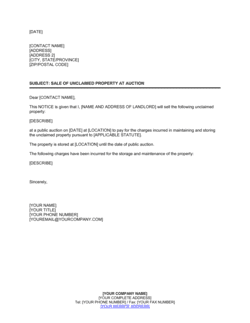
A Notice of Intent to Exercise Warehouse Lien by Auction is a formal written notice a warehouse operator sends to a depositor whose goods are being held for unpaid storage charges. It states the outstanding balance, identifies the stored goods subject to the lien, and provides the depositor a final opportunity to pay before the goods are sold at public auction. This free Word download is editable online and exportable as PDF.
When you need it
Send it when a depositor has failed to pay storage fees and you intend to enforce your statutory warehouse lien by selling the stored goods at auction. Most jurisdictions require this notice to be delivered within a specific timeframe before the auction date.
What's inside
Warehouse operator and depositor identification, description of the stored goods, itemized statement of charges owed, notice of the intended auction date and location, and instructions for the depositor to redeem the goods by settling the outstanding balance before the sale.

What is a Notice of Intent to Exercise Warehouse Lien by Auction?

A Notice of Intent to Exercise Warehouse Lien by Auction is a formal written notice a warehouse operator sends to a depositor who has failed to pay outstanding storage charges. It invokes the operator's statutory warehouse lien rights β€” typically under UCC Article 7 or an equivalent state warehousemen's lien act β€” and informs the depositor that their stored goods will be sold at public auction on a specified date unless the full balance is paid before then. The notice serves a dual purpose: it fulfills the legal requirement to give advance notice before a lien sale can proceed, and it gives the depositor a final opportunity to redeem their property by settling the debt.

Why You Need This Document

Selling a depositor's goods without first delivering a properly formatted lien notice β€” with sufficient advance time β€” exposes your warehouse operation to claims of conversion, wrongful sale, and potential civil liability. Courts have invalidated auction proceeds and ordered damages against operators who skipped or improperly served the notice, even when the underlying debt was legitimate. A correctly completed notice establishes the legal paper trail that protects your right to sell, documents the amount owed, and demonstrates that the depositor had a fair opportunity to redeem. This template gives you the structure to issue that notice consistently across every delinquent account, reducing the risk of procedural errors that can unravel an otherwise valid lien enforcement.

Which variant fits your situation?

If your situation is…Use this template
Goods held in a commercial warehouse with unpaid invoicesNotice of Intent to Exercise Warehouse Lien by Auction
Self-storage unit with delinquent rent beyond the statutory cure periodSelf-Storage Lien Notice
Outstanding debt where you want a formal written demand before any legal actionDemand for Payment Letter
Goods abandoned with no prior unpaid charges β€” ownership unclearNotice of Abandoned Property
Depositor disputes the charges and you need to document the claim in writingInvoice Dispute Response Letter
Goods already auctioned and proceeds need to be accounted for and notifiedNotice of Lien Sale Proceeds

Common mistakes to avoid

❌ Setting the auction date before the statutory notice period expires

Why it matters: An auction conducted before the required notice period renders the lien sale legally invalid. The depositor can seek to recover their goods or sue for conversion of property.

Fix: Count the notice period from the confirmed delivery date β€” not the send date β€” and add at least two extra days as a buffer before scheduling the auction.
❌ Addressing the notice to a contact person instead of the legal entity

Why it matters: If the depositor is a company and the notice is addressed to an individual, the depositor may argue proper notice was never served on the legal entity, invalidating the auction.

Fix: Use the full legal entity name exactly as it appears in the storage agreement, and address it to the entity's registered business address.

❌ Omitting an itemized breakdown of charges

Why it matters: A single lump-sum total with no calculation gives the depositor an easy basis to dispute the amount in court, stalling the auction for weeks or months.

Fix: List each charge category separately with the applicable rate, period, and subtotal, and attach the account statement as a supporting exhibit.

❌ Failing to cite the specific lien statute

Why it matters: Without a statutory citation, the depositor cannot verify your legal authority to sell the goods and may successfully challenge the process as lacking a proper legal basis.

Fix: Identify the governing statute by name and section number β€” e.g., 'UCC Β§ 7-210' or '[STATE] Code Β§ [SECTION]' β€” and confirm it is the version currently in force.

The 8 key clauses, explained

Header and parties identification

In plain language: Identifies the warehouse operator sending the notice, the depositor receiving it, and the date of the notice.

Sample language
[WAREHOUSE COMPANY NAME] | [ADDRESS] | [CITY, STATE, ZIP] | Date: [DATE] | To: [DEPOSITOR FULL NAME OR ENTITY] | [DEPOSITOR ADDRESS]

Common mistake: Addressing the notice to a contact person rather than the legal entity name on the storage agreement β€” this can invalidate the notice if the depositor challenges proper service.

Reference to storage agreement or warehouse receipt

In plain language: Identifies the specific storage agreement, warehouse receipt number, or account number under which the goods are held.

Sample language
Re: Storage Agreement No. [AGREEMENT NUMBER] / Warehouse Receipt No. [RECEIPT NUMBER] β€” Account: [ACCOUNT NUMBER]

Common mistake: Omitting the receipt or agreement reference entirely, making it difficult to establish a direct link between the notice and the contractual obligation to pay.

Description of stored goods

In plain language: Describes the goods subject to the lien with enough specificity for the depositor to identify them β€” item type, quantity, lot number, or storage unit.

Sample language
The following goods are currently held at the above-referenced facility: [DESCRIPTION OF GOODS β€” e.g., 42 pallets of packaged consumer electronics, Lot #[LOT NUMBER], stored in Bay [X] since [DATE]].

Common mistake: Using generic descriptions like 'various inventory' instead of specific identifiers. Vague descriptions weaken the enforceability of the lien and may trigger disputes over which goods are covered.

Statement of charges owed

In plain language: Itemizes the total amount past due, including storage fees, handling fees, and any accrued late charges, with the calculation period.

Sample language
As of [DATE], the following amounts are outstanding under your account: Storage fees ([DATE] to [DATE]): $[AMOUNT] | Handling charges: $[AMOUNT] | Late fees: $[AMOUNT] | TOTAL DUE: $[TOTAL AMOUNT]

Common mistake: Stating only a lump-sum total without itemizing how it was calculated β€” depositors frequently dispute amounts, and an unexplained total invites a challenge that delays the auction.

Notice of intent to exercise lien

In plain language: Formally states that the warehouse operator intends to exercise its warehouse lien rights under applicable law and sell the goods by public auction.

Sample language
Pursuant to [APPLICABLE STATUTE β€” e.g., UCC Article 7 / State Warehousemen's Lien Act], [WAREHOUSE COMPANY NAME] hereby provides notice of its intent to enforce its warehouse lien and sell the above-described goods at public auction to satisfy the outstanding charges.

Common mistake: Failing to cite the specific statute that grants lien rights. Without a statutory reference, the depositor cannot verify the legal basis for the sale and may successfully challenge the process.

Auction date, time, and location

In plain language: Specifies the scheduled auction date, time, and the physical or online location where the sale will take place.

Sample language
The auction will be conducted on [DATE] at [TIME] at [AUCTION LOCATION / ONLINE PLATFORM URL]. The goods will be sold to the highest bidder.

Common mistake: Scheduling the auction before the statutory notice period has expired. Most jurisdictions require 10 to 30 days between notice and sale β€” confirm the applicable minimum before setting the date.

Redemption instructions

In plain language: Tells the depositor how to reclaim the goods by settling the full outstanding balance before the auction date.

Sample language
You may redeem the above-described goods and prevent the auction by paying the total amount due of $[TOTAL AMOUNT] in full, by [REDEMPTION DEADLINE DATE], by [PAYMENT METHOD β€” e.g., certified check, wire transfer] payable to [WAREHOUSE COMPANY NAME].

Common mistake: Not specifying an accepted payment method or a clear redemption deadline. Ambiguity here lets a depositor claim they tried to pay but were unable to, potentially stalling the sale.

Contact information and signature block

In plain language: Provides the name, title, phone number, and email of the warehouse representative to contact, and closes the letter with an authorized signature.

Sample language
For questions or to arrange payment, please contact: [CONTACT NAME], [TITLE] | [PHONE] | [EMAIL] | Sincerely, [AUTHORIZED SIGNATORY NAME] | [TITLE] | [WAREHOUSE COMPANY NAME]

Common mistake: Listing a generic 'info@' email without a named contact. Depositors who cannot reach a specific person use this as a reason to dispute that they received adequate opportunity to respond.

How to fill it out

  1. 1

    Enter the warehouse operator's details

    Fill in your company's full legal name, address, and the date you are issuing the notice in the header section.

    πŸ’‘ Use the exact legal entity name that appears on the storage agreement β€” not a trade name β€” to ensure the notice is legally consistent with the underlying contract.

  2. 2

    Identify the depositor and reference the storage agreement

    Enter the depositor's full legal name and address. Include the storage agreement number, warehouse receipt number, or account number to tie the notice directly to the storage relationship.

    πŸ’‘ Send the notice to the address on the storage agreement, not just a contact email. Many statutes require delivery by certified mail or a specific service method.

  3. 3

    Describe the goods subject to the lien

    List the stored goods with sufficient specificity β€” item type, quantity, lot or batch number, and the storage location within your facility.

    πŸ’‘ Cross-reference your warehouse management system to confirm quantities before issuing. Errors in the goods description give depositors grounds to challenge the notice.

  4. 4

    Itemize all charges owed

    Break down the outstanding balance into storage fees, handling charges, and any late fees. State the calculation period for storage fees and the total amount due as of the notice date.

    πŸ’‘ Attach a copy of the account statement or aging report as an exhibit β€” it pre-empts disputes and demonstrates that the amount is not arbitrary.

  5. 5

    Cite the applicable statute

    Insert the specific statute number that grants you lien rights β€” typically UCC Article 7 or your state's warehousemen's lien act. Confirm the statute is current in your jurisdiction.

    πŸ’‘ Check that your state has not amended the lien statute in the past two years. Several states updated their self-storage and commercial warehouse lien procedures between 2022 and 2025.

  6. 6

    Set the auction date and confirm the notice period

    Schedule the auction date and verify it falls after the minimum statutory notice period from the date of delivery of this notice β€” typically 10 to 30 days depending on jurisdiction.

    πŸ’‘ Add two or three days to the minimum notice period as a buffer in case of a postal delivery delay. Courts have invalidated auctions where notice arrived one day late.

  7. 7

    State the redemption deadline and payment method

    Give the depositor a clear deadline to pay in full and specify exactly how payment must be made β€” certified check, wire transfer, or cashier's check β€” and to whom it should be made payable.

    πŸ’‘ Set the redemption deadline at least 24–48 hours before the auction to give yourself time to cancel or reschedule if payment arrives.

Frequently asked questions

What is a warehouse lien?

A warehouse lien is a statutory right that allows a warehouse operator to retain possession of stored goods until the depositor pays all outstanding storage charges. If the depositor fails to pay, the lien gives the warehouse operator the right to sell the goods at public auction and apply the proceeds to the unpaid balance. The lien right exists under UCC Article 7 in the United States and equivalent statutes in other jurisdictions.

When should I send a notice of intent to exercise a warehouse lien?

Send this notice after storage charges have gone unpaid past any grace period in your storage agreement and you have made reasonable attempts to collect the outstanding balance. The notice formally triggers the statutory process and starts the mandatory notice period before you can hold the auction. Sending it too early β€” before the account is genuinely delinquent β€” can expose you to a wrongful lien claim.

How much advance notice is required before a warehouse lien auction?

The required notice period varies by jurisdiction. Under UCC Article 7, the general requirement is that notice be given a reasonable time before the sale. Many state-specific warehousemen's lien statutes set explicit minimums ranging from 10 to 30 days. Always verify the current statutory requirement in the state where the goods are stored before scheduling the auction date.

Does the notice need to be sent by certified mail?

Many state statutes require the notice to be sent by certified mail, return receipt requested, to create a documented proof of delivery. Some jurisdictions also permit personal service or, in limited cases, published notice if the depositor cannot be located. Check the specific service requirements of your applicable statute β€” email alone is typically insufficient unless the storage agreement explicitly authorizes it.

What happens to proceeds from the auction that exceed the amount owed?

In most jurisdictions, any auction proceeds remaining after the full outstanding balance, auction costs, and related fees are paid must be returned to the depositor. Keeping surplus proceeds is generally prohibited and can expose the warehouse operator to liability. Some states require surplus funds to be held in escrow or paid into a court registry if the depositor cannot be located.

Can the depositor stop the auction after receiving this notice?

Yes. The depositor can prevent the auction at any time before the sale by paying the full outstanding balance plus any accrued costs. This is called redemption. Your notice should state a clear redemption deadline β€” typically 24 to 48 hours before the scheduled auction β€” and specify the accepted payment methods so there is no ambiguity about how to exercise that right.

Does this notice need to be signed to be valid?

No formal notarization or witness signature is required for this notice to be effective in most jurisdictions. However, it should be signed by an authorized representative of the warehouse operator to authenticate it. Keeping a signed copy in your records is essential if the depositor later disputes that the notice was properly issued or delivered.

Can I use this notice for a self-storage facility?

Self-storage facilities typically operate under a separate self-storage lien statute rather than the commercial warehouse lien provisions of UCC Article 7. While the structure of a self-storage lien notice is similar, the required content, notice periods, and auction procedures often differ. Confirm the applicable statute for your facility type before using this template, and adapt the statutory citation and procedural details accordingly.

How this compares to alternatives

vs Demand for Payment Letter

A demand for payment letter requests settlement of an overdue balance without referencing lien rights or an auction. It is an earlier-stage collection tool used before statutory lien procedures are triggered. The warehouse lien notice is appropriate only after informal collection attempts have failed and you are formally initiating the statutory sale process.

vs Notice of Abandoned Property

A notice of abandoned property is used when a depositor has vacated or cannot be located and ownership of the goods is unclear. A warehouse lien notice presumes an active storage relationship with identifiable unpaid charges. The two documents address different legal scenarios and should not be used interchangeably.

vs Eviction Notice

An eviction notice is a landlord-tenant document requiring a tenant to vacate leased premises. A warehouse lien notice governs the disposition of personal property held under a storage bailment, not the occupancy of real estate. The legal frameworks, notice periods, and remedies are entirely distinct.

vs Storage Agreement

A storage agreement is the underlying contract establishing the terms of the storage relationship, including fees, the operator's lien rights, and default provisions. The warehouse lien notice is the enforcement document sent when those terms are breached. Both documents should reference each other by agreement number to create a clear paper trail.

Industry-specific considerations

Warehousing and logistics

Commercial warehouse operators enforcing lien rights on palletized inventory, raw materials, or finished goods held for delinquent clients.

Self-storage

Self-storage facilities using a lien notice process to initiate unit auctions for tenants who have failed to pay monthly rent past the statutory cure period.

Moving and relocation

Moving companies enforcing a possessory lien over household goods or commercial freight held in transit storage when customers default on payment.

Cold storage and food distribution

Cold storage operators asserting lien rights over perishable or temperature-controlled inventory, with expedited notice timelines to address the goods' limited shelf life.

Template vs pro β€” what fits your needs?

PathBest forCostTime
Use the templateWarehouse operators and storage facility managers issuing standard lien notices for delinquent accountsFree15–20 minutes per notice
Template + professional reviewHigh-value goods, first-time lien enforcement, or jurisdictions with complex statutory requirements$100–$300 for a brief attorney review of the completed notice1–2 business days
Custom draftedMulti-state warehouse operations, disputed lien claims, or goods subject to third-party security interests$300–$800+3–5 business days

Glossary

Warehouse Lien
A statutory right allowing a warehouse operator to retain possession of stored goods and sell them to recover unpaid storage charges.
Depositor
The person or business entity that delivered goods to a warehouse for storage under an agreed storage contract or receipt.
Lien Sale
A public auction at which the warehouse operator sells the stored goods to satisfy the outstanding balance owed.
Storage Charges
Fees owed by the depositor for the physical storage of goods, typically calculated on a monthly or per-unit basis per the storage agreement.
Notice Period
The minimum number of days β€” set by applicable statute β€” that must pass between delivery of the lien notice and the auction date.
Redemption
The depositor's right to reclaim their goods before the auction by paying all outstanding charges, fees, and costs in full.
Warehouseman
The legal term used in many commercial codes for the warehouse operator who issued a warehouse receipt and holds goods for storage.
Warehouse Receipt
A document issued by a warehouse operator acknowledging receipt of specific goods for storage and describing the terms of their custody.
Public Auction
An open sale at which the stored goods are offered to the highest bidder, typically advertised in advance in a local publication or online.
Surplus Proceeds
Any auction proceeds remaining after the full outstanding balance, fees, and auction costs are deducted β€” which must be returned to the depositor in most jurisdictions.

Part of your Business Operating System

This document is one of 3,000+ business & legal templates included in Business in a Box.

  • Fill-in-the-blanks β€” ready in minutes
  • 100% customizable Word document
  • Compatible with all office suites
  • Export to PDF and share electronically

Create your document in 3 simple steps.

From template to signed document β€” all inside one Business Operating System.
1
Download or open template

Access over 3,000+ business and legal templates for any business task, project or initiative.

2
Edit and fill in the blanks with AI

Customize your ready-made business document template and save it in the cloud.

3
Save, Share, Send, Sign

Share your files and folders with your team. Create a space of seamless collaboration.

Save time, save money, and create top-quality documents.

β˜…β˜…β˜…β˜…β˜…

"Fantastic value! I'm not sure how I'd do without it. It's worth its weight in gold and paid back for itself many times."

Managing Director Β· Mall Farm
Robert Whalley
Managing Director, Mall Farm Proprietary Limited
β˜…β˜…β˜…β˜…β˜…

"I have been using Business in a Box for years. It has been the most useful source of templates I have encountered. I recommend it to anyone."

Business Owner Β· 4+ years
Dr Michael John Freestone
Business Owner
β˜…β˜…β˜…β˜…β˜…

"It has been a life saver so many times I have lost count. Business in a Box has saved me so much time and as you know, time is money."

Owner Β· Upstate Web
David G. Moore Jr.
Owner, Upstate Web

Run your business with a system β€” not scattered tools

Stop downloading documents. Start operating with clarity. Business in a Box gives you the Business Operating System used by over 250,000 companies worldwide to structure, run, and grow their business.

Free Forever PlanΒ Β·Β No credit card required