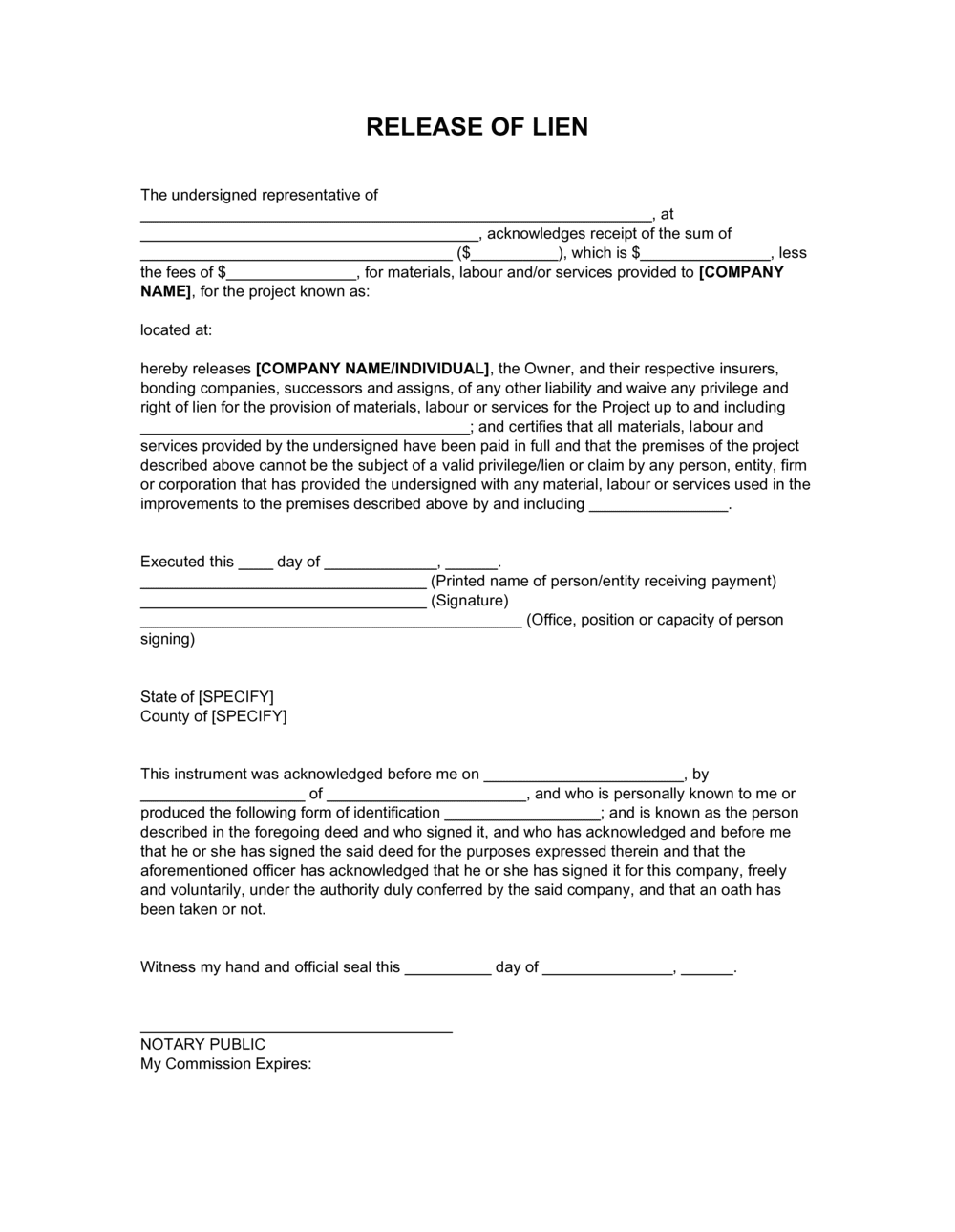
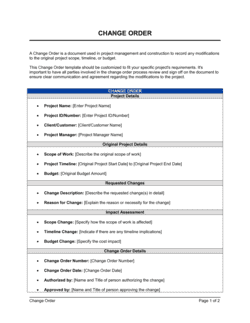
Release Of Lien Template

Free Word download β€’ Edit online β€’ Save & share with Drive β€’ Export to PDF

1 pageβ€’20–30 min to fillβ€’Difficulty: Standardβ€’Signature requiredβ€’Legal review recommended
Learn more ↓
FreeRelease Of Lien Template

At a glance

What it is
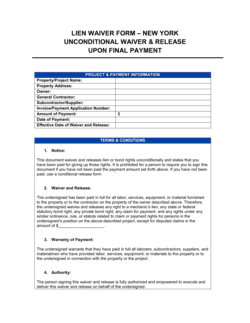
A Release of Lien is a legally binding document executed by a lienholder β€” a contractor, subcontractor, lender, or creditor β€” that formally discharges a lien recorded against real property, a vehicle, or equipment once the underlying debt or obligation has been satisfied. This free Word download lets you edit, sign, and record the release without starting from scratch, and is suitable for mechanic's liens, mortgage liens, and equipment financing liens.
When you need it
Use it when a contractor, subcontractor, or supplier has been paid in full and needs to clear a mechanic's lien from title, when a mortgage or deed of trust has been repaid and the lender must release its security interest, or when a vehicle or equipment loan is satisfied and the lienholder must be removed from the title record.
What's inside
Identification of the lienholder and property owner, a description of the original lien and the obligation it secured, a declaration that the debt is satisfied, the legal description of the encumbered property, notarization and signature blocks, and recording instructions for the applicable county or land registry.

What is a Release of Lien?

A Release of Lien is a legally binding document executed by a lienholder β€” a contractor, subcontractor, material supplier, or lender β€” that formally discharges a lien recorded against real property, a vehicle, or equipment once the underlying debt or obligation has been fully satisfied. The document identifies the original lien by its recording reference, describes the encumbered property by its legal description, declares the obligation paid, and releases all claims arising from that lien. Once notarized and recorded with the appropriate county recorder or land registry, it removes the encumbrance from the public record and restores clean title to the property owner.

Why You Need This Document

A lien that remains on title after payment has been made is not a technicality β€” it is an active obstacle. Title companies will not issue title insurance on a property with an open lien, which means any pending sale or refinance stalls until the encumbrance is cleared. In construction, a project owner who has paid every invoice in full but lacks recorded releases from each tier of contractor and supplier cannot close their permanent financing. For lenders, failing to record a mortgage satisfaction within the statutory window β€” typically 30 to 90 days in most US states β€” triggers statutory penalties and can expose the servicer to damages claims. A properly completed, notarized, and recorded Release of Lien eliminates the encumbrance from the public record in a single filing, giving every party β€” owner, lender, title insurer, and future buyer β€” the clean-title confirmation they require.

Which variant fits your situation?

If your situation is…Use this template
Contractor paid in full at project completionUnconditional Release of Lien (Final)
Contractor releasing lien after receiving a progress payment, with balance still owedConditional Release of Lien (Progress Payment)
Releasing a recorded mortgage or deed of trust after loan payoffSatisfaction of Mortgage
Owner requesting release from subcontractor before payment clearsConditional Release of Lien (Final)
Removing a lienholder from a vehicle title after loan payoffVehicle Lien Release Letter
Waiving lien rights on a portion of work covered by joint-check agreementPartial Release of Lien
Project owner collecting lien waivers upfront before disbursing paymentLien Waiver Form

Common mistakes to avoid

❌ Signing an unconditional release before payment clears

Why it matters: An unconditional release permanently extinguishes lien rights the moment it is signed and recorded β€” a returned check or stopped payment leaves the lienholder with no security interest and must pursue a general breach-of-contract claim instead.

Fix: Use a conditional release form when payment has not yet cleared, specifying the exact condition (e.g., 'clearance of Wire Transfer Reference No. [X] by [DATE]') before the release becomes effective.

❌ Using an incorrect or incomplete legal property description

Why it matters: A release recorded against the wrong parcel or with a defective description does not clear title on the intended property and may cloud title on an adjacent parcel.

Fix: Copy the legal description character-for-character from the recorded lien or the property's current deed, and include the assessor's parcel number as a cross-reference.

❌ Failing to record the release after signing

Why it matters: A signed but unrecorded release does not appear in the public record β€” the lien remains a visible encumbrance on title and will block any sale, refinance, or title insurance policy.

Fix: Assign recording responsibility in the document and confirm with the recording office within 5 business days of execution that the release has been accepted and stamped.

❌ Releasing more than the intended scope of work

Why it matters: An overly broad waiver of future claims can inadvertently cover unpaid work completed after the release date on the same project, eliminating the right to lien for that work.

Fix: Insert a specific cutoff date in the scope-of-release clause: 'this release covers all work performed through and including [DATE]' β€” and verify the date matches the pay period covered by the payment.

❌ Mismatching the lienholder name between the lien and the release

Why it matters: If the name on the release does not exactly match the name on the recorded lien, the county recorder will reject the document and the title company will not issue clean title insurance.

Fix: Pull the recorded lien before drafting the release and copy the lienholder's name exactly as it appears β€” include any legal suffix (Inc., LLC, LP) and confirm against the current business registry filing.

❌ Skipping notarization

Why it matters: Most county recorders and land registries require notarization as a condition of acceptance β€” an unnotarized release will be returned unfiled, leaving the lien on record and potentially delaying a closing.

Fix: Arrange notarization before or at the same time as execution. The signatory must appear in person before the notary; pre-signing and bringing the document to the notary later is invalid in most jurisdictions.

The 10 key clauses, explained

Identification of the parties

In plain language: Names and addresses of the lienholder releasing the lien and the property owner or debtor whose obligation has been satisfied.

Sample language
[LIENHOLDER FULL LEGAL NAME], having an address at [ADDRESS] ('Lienholder'), hereby releases all lien rights against [PROPERTY OWNER FULL LEGAL NAME], having an address at [ADDRESS] ('Owner').

Common mistake: Using a trade name instead of the lienholder's registered legal entity name β€” the name on the release must match the name on the recorded lien exactly, or the recorder's office will reject it.

Description of the original lien

In plain language: Identifies the lien being released by its recording reference number, recording date, and the county or registry where it was filed.

Sample language
This Release relates to the Mechanic's Lien recorded on [DATE] as Instrument No. [RECORDING NUMBER] in the Official Records of [COUNTY] County, [STATE].

Common mistake: Omitting the instrument or recording number β€” without it, the title company and recorder cannot match the release to the correct lien in the public record.

Legal description of the property

In plain language: The formal legal description of the encumbered real property β€” lot and block, metes and bounds, or parcel number β€” as it appears in the county land records.

Sample language
The property subject to this Release is legally described as: [LEGAL DESCRIPTION], also known as [STREET ADDRESS], [CITY], [STATE] [ZIP], Assessor's Parcel No. [APN].

Common mistake: Using only the street address without the full legal description. Recorders and title companies require the legal description to locate the correct parcel; a street address alone is insufficient.

Declaration of satisfaction

In plain language: States that the underlying debt or obligation secured by the lien has been paid in full and that the lienholder acknowledges receipt of the consideration.

Sample language
Lienholder hereby acknowledges receipt of the sum of $[AMOUNT] in full satisfaction of all amounts due for labor and/or materials furnished to the property described herein, and hereby releases and discharges the above-referenced lien in its entirety.

Common mistake: Failing to specify the dollar amount satisfied. A vague 'for value received' declaration can leave open a dispute about whether partial or full payment was intended.

Scope of release

In plain language: Defines whether the release covers all lien rights or only a portion, and whether it is unconditional (effective immediately) or conditional (effective upon payment clearing).

Sample language
This Release is [UNCONDITIONAL / CONDITIONAL upon clearance of payment in the amount of $[AMOUNT] by [DATE]], and covers all lien rights of Lienholder arising out of the work described in the Contract dated [DATE].

Common mistake: Using an unconditional release form when payment has not yet cleared β€” if the check is returned, the lienholder has permanently waived its lien rights with no recourse against the property.

Waiver of future claims

In plain language: Confirms that the lienholder waives any right to record additional or amended liens arising from the same project or obligation.

Sample language
Lienholder waives and relinquishes any and all rights to file or enforce any further mechanic's lien, stop notice, or bond claim arising out of the Project described herein through the date of this Release.

Common mistake: Leaving the waiver scope undefined so it potentially covers work performed after the release date β€” subcontractors should limit the waiver to work completed through a specified cutoff date.

Authority and representations

In plain language: The lienholder represents that it has authority to release the lien and that no other party holds an interest in the lien that would prevent the release.

Sample language
Lienholder represents and warrants that it has full authority to execute this Release, that the lien has not been assigned to any third party, and that no other person or entity has any interest in the lien being released.

Common mistake: Skipping this clause when the lienholder is a business entity β€” without it, the owner cannot confirm the signatory has actual authority to bind the company, creating a cloud on title.

Notarization and acknowledgment block

In plain language: The notary's certificate confirming the signatory appeared in person, was identified, and signed voluntarily β€” required by most jurisdictions for recording.

Sample language
State of [STATE], County of [COUNTY]. On [DATE], before me, [NOTARY NAME], Notary Public, personally appeared [SIGNATORY NAME], known to me to be the person whose name is subscribed to the foregoing instrument and acknowledged to me that they executed the same.

Common mistake: Signing the document before appearing before the notary β€” the notary must witness the actual signing or take an oath from the signer that the signature is genuine, depending on the jurisdiction.

Recording instructions

In plain language: Directs the document to be recorded in the appropriate public office and identifies the party responsible for recording costs.

Sample language
Upon execution, this Release shall be recorded in the Official Records of [COUNTY] County, [STATE]. Recording fees shall be paid by [OWNER / LIENHOLDER]. After recording, the original shall be returned to [PARTY] at the address stated above.

Common mistake: Leaving recording responsibility unassigned β€” if neither party knows who is responsible for filing, the release may never reach the public record, leaving the lien technically still encumbering the title.

Governing law

In plain language: Specifies the state or jurisdiction whose lien statutes and recording requirements govern the interpretation and enforcement of the release.

Sample language
This Release shall be governed by and construed in accordance with the laws of the State of [STATE], including its mechanic's lien statutes as set forth in [APPLICABLE CODE SECTION].

Common mistake: Choosing a governing law that differs from the location of the property β€” lien law is strictly territorial; the law of the state where the property sits governs, regardless of what the contract says.

How to fill it out

  1. 1

    Confirm the lien details from the public record

    Before completing the template, pull the recorded lien from the county recorder's website or office and copy the instrument number, recording date, and book/page reference exactly as they appear.

    πŸ’‘ A single transposed digit in the instrument number will cause the recorder to reject the release β€” verify character by character against the original recorded document.

  2. 2

    Enter both parties' full legal names

    Use the lienholder's registered entity name β€” not a DBA or trade name β€” exactly as it appears on the recorded lien. Enter the property owner's full legal name as it appears on the deed.

    πŸ’‘ If the lienholder is a company, confirm the current legal name with your state's business registry β€” companies sometimes change names after the lien was filed.

  3. 3

    Insert the legal description of the property

    Copy the legal description verbatim from the recorded lien or the property deed β€” lot and block number, subdivision name, and assessor's parcel number. Include the street address as a secondary identifier only.

    πŸ’‘ Title companies will reject a release that uses only a street address. Obtain the legal description from the county assessor's office if you do not have the deed.

  4. 4

    State the satisfaction amount and choose conditional or unconditional

    Enter the exact dollar amount paid. If the check has cleared and funds are confirmed, use the unconditional form. If you are signing in exchange for a payment that has not yet cleared, use the conditional form and specify the clearing condition and deadline.

    πŸ’‘ Never sign an unconditional release in exchange for a check that has not cleared β€” once recorded, the release cannot be undone even if the check bounces.

  5. 5

    Define the scope of the waiver by date

    Limit the waiver of future claims to work completed through a specific cutoff date. This protects subcontractors who may have ongoing work on the same project after the release date.

    πŸ’‘ Include language like 'through and including [DATE]' to prevent the release from inadvertently covering unpaid work performed after the payment date.

  6. 6

    Have an authorized signatory sign before a notary

    The signatory must be someone with legal authority to bind the lienholder β€” an officer for a corporation, a member for an LLC, or the individual if a sole proprietor. Arrange a notary appointment before signing.

    πŸ’‘ Many UPS Stores, banks, and public libraries offer walk-in notary services for under $15. Mobile notaries are available for same-day service in most metro areas.

  7. 7

    Record the executed release with the county

    Submit the notarized original to the county recorder, registrar of deeds, or land registry office where the lien was filed. Pay the recording fee β€” typically $10–$30 per page depending on the jurisdiction.

    πŸ’‘ Request a certified copy of the recorded release for your files. The title company handling a future sale or refinance will need it.

  8. 8

    Deliver a copy to the property owner and project file

    Send the recorded release (with recording stamp) to the property owner, general contractor, and lender as applicable. Retain the original in your project closeout file.

    πŸ’‘ For large construction projects, collect and scan all lien releases into a single PDF closeout package β€” title companies increasingly require this as a condition of insuring the owner's policy.

Frequently asked questions

What is a release of lien?

A release of lien is a legal document signed by a lienholder β€” typically a contractor, subcontractor, lender, or creditor β€” that formally discharges a recorded lien against real property, a vehicle, or equipment once the underlying debt or obligation has been paid in full. Recording the release with the appropriate public office removes the encumbrance from the property's title, allowing it to be sold, refinanced, or transferred without the cloud of an outstanding claim.

What is the difference between a lien release and a lien waiver?

A lien waiver is signed before or at the time of payment and waives the right to file a lien in exchange for the payment being made. A lien release is signed after a lien has already been recorded and discharges that specific recorded lien. Both documents extinguish lien rights, but a release is always tied to an existing public record that must be cleared; a waiver prevents a lien from being filed in the first place.

Does a release of lien need to be notarized?

In most US states and Canadian provinces, notarization is required before a release of lien can be accepted for recording by a county recorder or land registry. The notary verifies the identity of the signatory and confirms the signature was made voluntarily. Filing an unnotarized release will typically result in rejection at the recorder's office, leaving the lien on record.

What is the difference between a conditional and an unconditional lien release?

An unconditional release takes effect immediately upon signing and permanently extinguishes the lienholder's rights β€” use it only after payment has been confirmed received and cleared. A conditional release becomes effective only when a specified condition is met, such as a check clearing or a wire transfer being confirmed. Using an unconditional release before payment clears is one of the most common and costly mistakes in construction billing.

How do I release a mechanic's lien in construction?

Complete a release of lien form identifying the lienholder, the property owner, the original lien by its recording number and date, the legal description of the property, and the amount satisfied. Have the lienholder sign before a notary, then record the notarized document with the county recorder or land registry in the county where the property is located. Recording fees vary but typically run $10–$30 per page. Deliver a certified copy to the property owner, general contractor, and lender.

Who is responsible for recording the lien release?

This is a negotiable point and should be specified in the release document itself. In practice, the party with the most to gain from a clean title β€” usually the property owner or the general contractor β€” arranges and pays for recording. On construction projects, the owner's title company often handles recording as part of a project closeout or refinance process. Leaving responsibility unassigned is a common cause of releases that are signed but never filed.

Can a lien be released without the lienholder's signature?

In most jurisdictions, only the lienholder β€” or an authorized representative of the lienholder β€” can execute a valid release. If a lienholder refuses to sign or cannot be located, the property owner typically must pursue a court order to discharge the lien, a process called a lien discharge or cancellation action. Some jurisdictions allow a surety bond to be posted in lieu of a release to clear title pending resolution of the underlying dispute.

How long does a mechanic's lien stay on a property if not released?

Lien duration varies by jurisdiction. In most US states, a recorded mechanic's lien remains enforceable for 1–2 years from the recording date unless the lienholder files a lawsuit to foreclose on it within the statutory period. After the enforcement period expires, the lien may lapse, but it can still appear in title searches and cause title insurance issues until a formal release or court order is recorded. Property owners should obtain a written release rather than waiting for the lien to expire.

Is a release of lien the same as a satisfaction of mortgage?

They serve the same purpose β€” clearing an encumbrance from title β€” but for different types of liens. A satisfaction of mortgage (sometimes called a discharge of mortgage or deed of reconveyance) is used specifically when a real estate loan secured by a mortgage or deed of trust is paid off. A release of lien is the broader term covering mechanic's liens, judgment liens, and other recorded claims against property. Some jurisdictions use the terms interchangeably for mortgage payoffs.

How this compares to alternatives

vs Lien Waiver

A lien waiver is executed before or at the time of payment to prevent a lien from being filed in the first place. A release of lien discharges an existing recorded lien after payment. Use a waiver during active billing to protect the owner on progress payments; use a release when a lien has already been recorded and must be cleared from the public record.

vs Satisfaction of Mortgage

A satisfaction of mortgage is the specific form used to discharge a real estate loan lien β€” mortgage or deed of trust β€” after the loan is repaid. A release of lien is the broader instrument used for mechanic's liens, judgment liens, and other encumbrances. Both achieve the same outcome of clearing title, but lenders and title companies expect the satisfaction form for mortgage payoffs in most states.

vs Deed of Reconveyance

A deed of reconveyance is used specifically in deed-of-trust states β€” California, Texas, and about 30 others β€” to transfer legal title back from the trustee to the borrower after the loan is paid. A release of lien is used in mortgage states and for non-mortgage liens. The practical effect is the same, but the form required by the county recorder differs by state and instrument type.

vs Mechanic's Lien

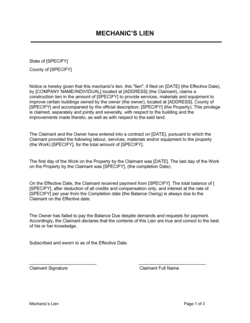
A mechanic's lien is the encumbrance a contractor records against property to secure payment for unpaid labor or materials. A release of lien is the document that discharges it. The two are opposite ends of the same transaction β€” file the lien to assert the claim; file the release to clear it once payment is received.

Industry-specific considerations

Construction

Mechanic's liens from general contractors, subcontractors, and material suppliers are released at project closeout to clear title for the owner's permanent financing or sale.

Real estate

Mortgage and deed of trust releases are recorded at loan payoff or refinance; judgment lien releases are required to convey clear title at closing.

Automotive and equipment

Lenders must execute and deliver a lien release to the DMV or equipment registry within a statutory window after a vehicle or equipment loan is paid off.

Financial services

Lenders and servicers issue lien releases at mortgage payoff, home equity loan satisfaction, and commercial real estate loan discharge β€” often under statutory deadlines with penalties for late release.

Jurisdictional notes

United States

Mechanic's lien law is entirely state-specific β€” deadlines to record, forms required, and notarization rules vary significantly by state. California, Texas, Florida, and New York each have distinct statutory forms that must be used. Mortgage satisfaction statutes in most states impose a deadline of 30–90 days after payoff for lenders to record a release, with penalties for late filing. Conditional versus unconditional release forms are a California-originated distinction now adopted in many states.

Canada

Construction liens (called builder's liens or construction liens depending on the province) are governed by provincial legislation β€” the Construction Act in Ontario, the Builder's Lien Act in British Columbia and Alberta. Each province sets its own form, notice, and discharge requirements. In Ontario, a lien can be vacated by posting a bond equal to 125% of the claimed amount, providing an alternative to a formal release when the lienholder is uncooperative. Quebec follows a distinct legal hypothec regime under the Civil Code.

United Kingdom

The UK does not have a mechanic's lien system equivalent to North America. Unpaid contractors and suppliers secure payment primarily through contractual retention provisions, adjudication under the Housing Grants, Construction and Regeneration Act 1996, and charging orders obtained through court proceedings. Mortgage discharges are registered at HM Land Registry using Form DS1 (full discharge) or Form DS3 (partial). Execution and registration requirements differ between England and Wales, Scotland, and Northern Ireland.

European Union

EU member states do not share a unified lien or construction charge system. Germany uses Bauhandwerkersicherung under Β§650f BGB; France has the privilege du constructeur under the Civil Code; the Netherlands uses a bouwrecht. Mortgage releases are registered with each country's land registry and typically require a notarial deed in civil-law jurisdictions such as France, Germany, Spain, and Italy. GDPR has limited relevance here, but cross-border property transactions may involve additional notarial and apostille requirements.

Template vs lawyer β€” what fits your deal?

PathBest forCostTime
Use the templateStraightforward mechanic's lien releases, single-state residential construction projects, and standard vehicle or equipment lien releasesFree30 minutes plus notary and recording time
Template + legal reviewCommercial real estate lien releases, conditional releases tied to large payment amounts, or releases involving multiple lienholders$200–$500 for a title attorney or construction lawyer review1–3 days
Custom draftedComplex multi-party construction disputes, partial releases on large commercial projects, or cross-jurisdictional property transactions$500–$2,000+3–7 days

Glossary

Mechanic's Lien
A security interest recorded against real property by a contractor, subcontractor, or supplier who provided labor or materials and has not been paid.
Lienholder
The party who holds a lien β€” typically a contractor, lender, or creditor β€” and whose claim encumbers the property until released.
Encumbrance
Any claim, lien, or restriction on a property's title that affects its transferability or value.
Unconditional Release
A lien release that takes effect immediately upon signing, regardless of whether the payment has actually cleared β€” used when funds are confirmed received.
Conditional Release
A lien release that becomes effective only when a specific condition β€” typically the clearing of a check or wire transfer β€” is met.
Deed of Trust
A three-party security instrument used in many US states instead of a mortgage, where a trustee holds title until the loan is repaid.
Recording
The process of filing a document with the county recorder, land registry, or equivalent public office to create official notice of the release.
Notarization
Authentication of a signature by a licensed notary public, required by most jurisdictions before a lien release can be accepted for recording.
Subrogation
The right of one party who has paid a debt to step into the shoes of the original creditor and pursue recovery against a third party.
Satisfaction of Lien
A document β€” sometimes used interchangeably with release of lien β€” that evidences full payment and formal discharge of a recorded lien.
Preliminary Notice
A notice filed by a subcontractor or supplier early in a project to preserve their right to later file a mechanic's lien if unpaid.
Lien Period
The statutory window β€” varying by state or province β€” within which a claimant must record a lien after completing work or delivering materials.

Part of your Business Operating System

This document is one of 3,000+ business & legal templates included in Business in a Box.

  • Fill-in-the-blanks β€” ready in minutes
  • 100% customizable Word document
  • Compatible with all office suites
  • Export to PDF and share electronically

Create your document in 3 simple steps.

From template to signed document β€” all inside one Business Operating System.
1
Download or open template

Access over 3,000+ business and legal templates for any business task, project or initiative.

2
Edit and fill in the blanks with AI

Customize your ready-made business document template and save it in the cloud.

3
Save, Share, Send, Sign

Share your files and folders with your team. Create a space of seamless collaboration.

Save time, save money, and create top-quality documents.

β˜…β˜…β˜…β˜…β˜…

"Fantastic value! I'm not sure how I'd do without it. It's worth its weight in gold and paid back for itself many times."

Managing Director Β· Mall Farm
Robert Whalley
Managing Director, Mall Farm Proprietary Limited
β˜…β˜…β˜…β˜…β˜…

"I have been using Business in a Box for years. It has been the most useful source of templates I have encountered. I recommend it to anyone."

Business Owner Β· 4+ years
Dr Michael John Freestone
Business Owner
β˜…β˜…β˜…β˜…β˜…

"It has been a life saver so many times I have lost count. Business in a Box has saved me so much time and as you know, time is money."

Owner Β· Upstate Web
David G. Moore Jr.
Owner, Upstate Web

Run your business with a system β€” not scattered tools

Stop downloading documents. Start operating with clarity. Business in a Box gives you the Business Operating System used by over 250,000 companies worldwide to structure, run, and grow their business.

Start freeΒ Β·Β No credit card required