Notice of Unclaimed Property at Auction Template

Free Word download β€’ Edit online β€’ Save & share with Drive β€’ Export to PDF

1 pageβ€’15–20 min to fillβ€’Difficulty: Standard
Learn more ↓
FreeNotice of Unclaimed Property at Auction Template

At a glance

What it is
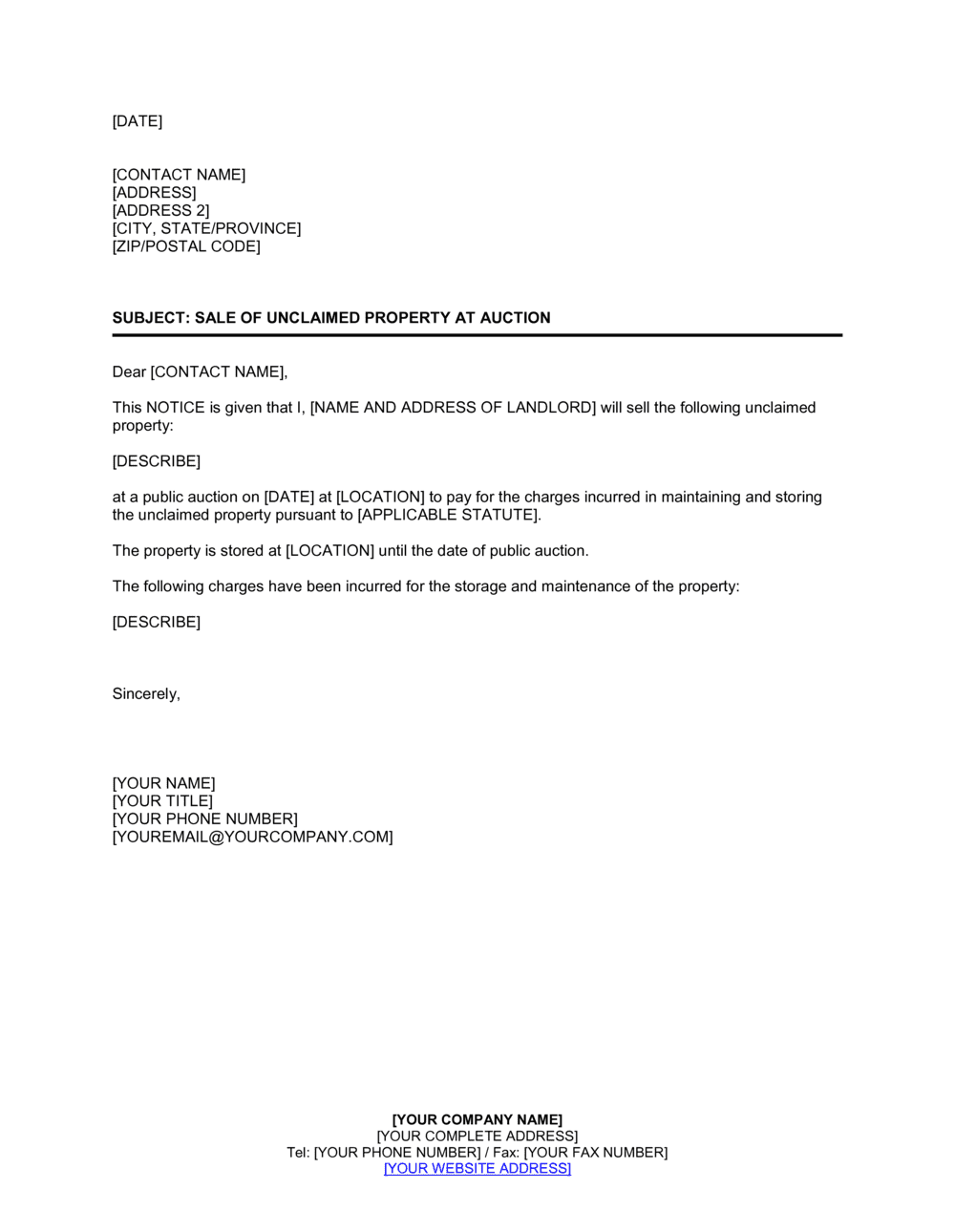
A Notice of Unclaimed Property at Auction is a formal written letter a business or property custodian sends to the last known owner of abandoned goods before selling them at auction. This free Word download gives you a ready-to-edit template you can complete in under ten minutes and export as PDF for mailing or delivery by any method that creates a record of receipt.
When you need it
Use it whenever you hold unclaimed goods β€” unpaid storage units, abandoned vehicles, unretrieved repairs, or uncollected shipments β€” and need to give the owner documented notice before you proceed with a public or private auction sale.
What's inside
The letter covers the owner's identification and contact details, a precise description of the property being held, the location and estimated value of the goods, the scheduled auction date and venue, a deadline for the owner to claim the property, and the sender's contact information for any response.

What is a Notice of Unclaimed Property at Auction?

A Notice of Unclaimed Property at Auction is a formal written letter a business or property custodian sends to the last known owner of abandoned or uncollected goods before selling them at public or private auction. It identifies the property being held, states the amount owed to reclaim it, sets a specific claim deadline, and gives the owner the date, time, and location of the scheduled sale. Beyond being a matter of professional courtesy, this notice satisfies a legal requirement in most jurisdictions β€” a custodian who sells abandoned property without documented prior notice can face liability for wrongful conversion of the owner's goods.

Why You Need This Document

Proceeding to auction without a properly delivered written notice exposes your business to claims that the sale was unlawful, regardless of how long the property sat uncollected or how much the owner owes. A documented notice creates the paper trail that protects you: it demonstrates good-faith effort to reach the owner, establishes the statutory clock for the required notice period, and defines the precise conditions under which title passes to the auction buyer. Without it, an owner can challenge the sale months or years later and seek damages for the value of items sold. This template gives you a complete, correctly structured notice you can fill in and send in under ten minutes β€” with every element a court or regulator would expect to see.

Which variant fits your situation?

If your situation is…Use this template
Auctioning contents of a delinquent self-storage unitNotice of Unclaimed Property at Auction
Disposing of an abandoned vehicle after lien enforcementVehicle Lien Sale Notice
Notifying a customer that uncollected goods will be donated or destroyedNotice of Disposal of Unclaimed Property
Demanding overdue storage or repair fees before any salePast Due Notice / Demand Letter
Formally transferring title of abandoned property to a new ownerBill of Sale
Documenting the auction sale proceeds and accounting to the former ownerAuction Sale Receipt

Common mistakes to avoid

❌ Setting the claim deadline too close to the auction date

Why it matters: Most jurisdictions require a minimum number of days between delivery of notice and the sale β€” violating this window can void the auction and expose you to liability for wrongful sale of property.

Fix: Look up the specific statutory notice period for your state or province and the type of property involved, then add at least two to three business days as a buffer for delivery time.
❌ Using a vague property description

Why it matters: If the owner claims valuable items were removed before the auction, a vague description like 'household goods' provides no basis to refute the allegation.

Fix: List every significant item individually with identifying characteristics β€” brand, model, color, condition, and serial number where available β€” and photograph the lot before sending the notice.

❌ Sending the notice by regular mail with no delivery record

Why it matters: Without proof of delivery, the owner can credibly claim they never received the notice, which may allow them to challenge the auction sale long after the property has been sold.

Fix: Send every notice of unclaimed property by certified mail with return receipt requested, or a courier service that provides a time-stamped delivery confirmation.

❌ Omitting the outstanding balance or conditions for reclaiming the property

Why it matters: If the notice does not state clearly what the owner must pay and do to recover their goods, a court may find the notice was incomplete and the sale was premature.

Fix: State the exact dollar balance owed, the payment methods accepted, and the specific steps the owner must take β€” including a contact name and number β€” to stop the auction.

The 8 key clauses, explained

Sender and recipient identification

In plain language: Names the business sending the notice, its address, and the full name and last known address of the property owner receiving it.

Sample language
[BUSINESS NAME] | [ADDRESS] | [CITY, STATE, ZIP] | Date: [DATE] | To: [OWNER FULL NAME] | [OWNER LAST KNOWN ADDRESS]

Common mistake: Using a nickname or trade name instead of the registered business name β€” the notice must come from the legal entity that holds the lien or custodial right.

Subject line and reference number

In plain language: Identifies the notice type and assigns a unique reference number so the letter can be tracked and cited in any follow-up correspondence or legal proceeding.

Sample language
RE: Notice of Unclaimed Property at Auction | Reference No.: [REF-XXXX] | Property Owner: [NAME]

Common mistake: Omitting a reference number. Without one, matching this notice to a specific account, storage unit, or work order in your records becomes difficult if the owner disputes the process later.

Description of the unclaimed property

In plain language: Provides a specific, itemized description of the goods being held, including quantity, condition, and any identifying marks or serial numbers where applicable.

Sample language
The following property is currently held at our facility: [DESCRIPTION OF ITEMS β€” e.g., one (1) upholstered sofa, brown, and three (3) cardboard boxes of assorted household goods].

Common mistake: Using a vague description like 'miscellaneous personal items.' A specific inventory protects you against claims that high-value items were misappropriated before the sale.

Location of the property

In plain language: States the physical address and unit or bay number where the property is currently stored so the owner can verify and collect it if they respond in time.

Sample language
The above-described property is currently located at [FACILITY ADDRESS], Unit/Bay [NUMBER], [CITY, STATE, ZIP].

Common mistake: Referencing only the business name without a full address. If the owner needs to arrange collection or send a representative, they need a precise location.

Estimated value and outstanding balance

In plain language: States the estimated market value of the property and the amount owed in storage, repair, or handling fees that must be paid before the owner can reclaim the goods.

Sample language
The estimated value of the above property is $[AMOUNT]. To reclaim your property, you must pay the outstanding balance of $[AMOUNT] in storage/handling fees on or before [CLAIM DEADLINE DATE].

Common mistake: Inflating the estimated value to discourage the owner from claiming. Courts interpret deliberately high valuations as evidence of bad faith and may void the subsequent sale.

Auction date, time, and venue

In plain language: States the exact scheduled date, start time, and location of the auction at which the property will be sold if unclaimed.

Sample language
If the balance is not paid and the property not claimed by [CLAIM DEADLINE DATE], the property will be sold at public auction on [AUCTION DATE] at [TIME] at [AUCTION VENUE ADDRESS].

Common mistake: Giving only the auction date without a start time or venue. Interested parties β€” including the owner β€” cannot attend or send a representative without full scheduling details.

Claim deadline and instructions

In plain language: Gives the owner a clear, specific date by which they must contact the sender and arrange collection, and explains what they must do to stop the auction.

Sample language
To claim your property and prevent its sale, you must contact us no later than [CLAIM DEADLINE DATE] at [PHONE NUMBER] or [EMAIL ADDRESS] and arrange full payment of the outstanding balance.

Common mistake: Setting the claim deadline on the same day as the auction. Most jurisdictions require a minimum gap β€” typically 10 to 30 days β€” between notice delivery and the scheduled sale date.

Sender's contact information and signature block

In plain language: Provides the name, title, phone number, and email address of the person at the business who can answer questions or receive a claim, along with a closing signature.

Sample language
Please contact [CONTACT NAME], [TITLE], at [PHONE NUMBER] or [EMAIL ADDRESS] with any questions. Sincerely, [AUTHORIZED SIGNATORY NAME] | [TITLE] | [BUSINESS NAME]

Common mistake: Listing only a general business phone number with no named contact. Owners who cannot reach a specific person are more likely to abandon the property and later dispute whether proper notice was given.

How to fill it out

  1. 1

    Enter the sender's business details

    Add the full registered business name, mailing address, city, state, zip code, and the date on which the notice is being issued at the top of the letter.

    πŸ’‘ Use the exact legal entity name that appears on the storage or service agreement with the owner β€” consistency protects you if the notice is challenged.

  2. 2

    Address the notice to the owner's last known address

    Enter the property owner's full legal name and the most recent address you have on file. If you have multiple addresses on record, use all of them and send a copy to each.

    πŸ’‘ Document how you obtained the address β€” a signed intake form is stronger evidence of a valid last known address than a verbal record.

  3. 3

    Assign a reference number and write the subject line

    Create a unique reference number tied to the account, storage unit, or work order and enter it in the subject line so the notice is traceable in your records.

    πŸ’‘ A format like REF-[YEAR]-[UNIT NUMBER] makes the reference self-explanatory and easy to sort.

  4. 4

    Describe the property specifically

    List each item or category of items with enough detail β€” material, color, brand, serial number β€” to distinguish them from other goods at your facility.

    πŸ’‘ Photograph the property on the same day you prepare this notice and keep the images on file with a copy of the letter.

  5. 5

    State the outstanding balance and estimated value

    Enter the exact dollar amount the owner owes in storage, repair, or handling fees, and provide a good-faith estimate of the property's current market value.

    πŸ’‘ Use comparable auction results or a resale price guide for the estimated value β€” document your source in case of dispute.

  6. 6

    Set the claim deadline and auction details

    Enter a claim deadline that gives the owner at least the minimum statutory notice period for your jurisdiction (typically 10–30 days from delivery), then enter the confirmed auction date, time, and venue.

    πŸ’‘ Check your state or provincial statute for the specific notice period required for your property type β€” storage units, vehicles, and freight each have different rules in many jurisdictions.

  7. 7

    Add contact information and send by recorded delivery

    Include a named contact person with a direct phone number and email, sign the letter, and send it via certified mail or another delivery method that generates a delivery record.

    πŸ’‘ Retain the certified mail receipt and the green return card β€” these are your proof of delivery if the owner later claims they never received notice.

Frequently asked questions

What is a notice of unclaimed property at auction?

A notice of unclaimed property at auction is a formal letter a business sends to the last known owner of abandoned or uncollected property before selling it at a public or private auction. It informs the owner of the scheduled sale, states what they must do to claim the property before that date, and documents that proper notice was given β€” which is a legal requirement in most jurisdictions before a custodian can lawfully transfer title through a sale.

When is this notice required?

This notice is typically required whenever a business holds tangible personal property that has been abandoned or left uncollected beyond a defined period β€” for example, contents of an unpaid storage unit, an uncollected vehicle, abandoned freight, or items left behind by a former tenant. Most state, provincial, and local laws mandate written notice to the last known owner before any auction sale can proceed. The specific trigger period and notice requirements vary by jurisdiction and property type.

How much notice must I give the owner before the auction?

The required notice period depends on your jurisdiction and the type of property involved. In the United States, most state self-storage lien laws require at least 10 to 14 days between delivery of notice and the auction date. Vehicle storage and repair liens typically require 20 to 30 days. Some jurisdictions also require publication of a public notice in a local newspaper in addition to direct written notice. Check the applicable statute for your property type and location before setting your auction date.

Does this notice need to be signed to be valid?

A signature from an authorized representative of the business is standard practice and strengthens the document's credibility, but most jurisdictions do not require a notarized or witnessed signature for this type of notice to be legally effective. What matters most is that the notice is sent to the correct address by a delivery method that generates a verifiable record of receipt, such as certified mail.

What happens to the proceeds after the auction?

After the auction, the custodian typically deducts unpaid storage, handling, and sale costs from the proceeds. In many jurisdictions, any surplus funds remaining after those deductions must be held for a statutory period β€” often one to three years β€” and remitted to the former owner upon request or turned over to the state as unclaimed property if never claimed. Check your local unclaimed property statutes for the specific handling rules that apply.

Can I send this notice by email?

Email is generally not accepted as sufficient notice on its own for unclaimed property auctions under most state and provincial statutes, which typically require written notice by first-class or certified mail to the last known address. However, sending an email copy in addition to certified mail is a reasonable supplementary step that may help you reach the owner faster. Always default to the delivery method specified by the applicable law, not the most convenient option.

What if the owner cannot be located at their last known address?

If the certified mail is returned undelivered, document the attempt and keep the returned envelope. Many jurisdictions allow you to proceed with the auction after demonstrating that a good-faith effort was made to notify the owner β€” including checking any other contact information on file and, in some cases, publishing a public notice in a local newspaper. Consult your jurisdiction's specific unclaimed property or storage lien statute for the exact steps required when the owner is unreachable.

Does sending this notice guarantee I can legally sell the property?

Sending a properly formatted notice is a necessary step, but it must be combined with compliance with all other requirements of the applicable statute β€” including the correct notice period, delivery method, property description, and handling of sale proceeds. A notice alone does not guarantee the sale is legally valid; it is one element of a broader compliance process. For high-value property or any situation where a dispute is likely, consider consulting a local attorney before proceeding.

How this compares to alternatives

vs Past Due Notice

A past due notice demands payment of an overdue balance without yet threatening disposal of property. A notice of unclaimed property at auction goes one step further β€” it informs the owner that the property will be sold on a specific date if the balance is not paid. Use a past due notice first; escalate to this auction notice if the account remains delinquent past a defined deadline.

vs Demand Letter

A demand letter requests a specific action or payment and may imply legal consequences but does not commit to a scheduled auction sale. This notice is a more specific and binding communication β€” it commits the sender to a sale on a stated date and time. The demand letter is a softer first step; this notice signals the final stage before disposal.

vs Bill of Sale

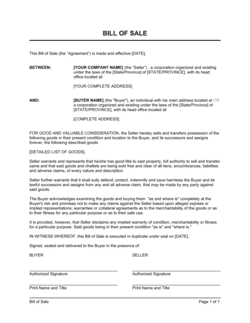
A bill of sale documents the transfer of ownership after a sale has occurred. This notice is issued before the sale to give the owner a final opportunity to claim the property. The two documents are complementary: this notice precedes the auction and the bill of sale records the completed transaction.

vs Eviction Notice

An eviction notice addresses a tenant's right to occupy a property, not the disposal of their belongings. After an eviction is completed, a separate notice of unclaimed property at auction may be required if the former tenant has left personal property behind. The two notices serve different legal purposes and are governed by different statutes.

Industry-specific considerations

Self-storage

Storage operators issue this notice when a tenant's unit is delinquent and must satisfy state storage lien statutes before auctioning the unit's contents β€” often requiring newspaper publication alongside direct notice.

Automotive services

Auto repair shops and towing companies use this notice before selling unclaimed vehicles, with vehicle-specific lien laws typically requiring longer notice periods and DMV-registered delivery.

Freight and logistics

Carriers and warehouse operators issue this notice for freight that cannot be delivered and remains unclaimed beyond the contractual free-storage period, with proceeds applied to accrued storage and handling charges.

Property management

Landlords and property managers send this notice to former tenants who have left personal belongings behind after a lease ends or an eviction, with state tenant property laws governing required notice periods and disposal methods.

Template vs pro β€” what fits your needs?

PathBest forCostTime
Use the templateStorage operators, repair shops, landlords, and logistics companies issuing routine pre-auction notices for standard property typesFree10 minutes per notice
Template + professional reviewHigh-value property, first-time use in a new jurisdiction, or any situation where the owner has already made a complaint or dispute$100–$300 for a one-time attorney review of your notice process1–2 business days
Custom draftedGovernment agencies, regulated industries, or businesses with a high volume of auctions requiring jurisdiction-specific statutory compliance across multiple states$300–$800 per custom notice procedure3–7 business days

Glossary

Unclaimed Property
Tangible personal property that has been left in the possession of a business or custodian and whose owner has not responded to contact attempts within a defined period.
Lien
A legal right a business holds against property in its custody β€” such as unpaid storage or repair fees β€” that must typically be satisfied before the property is released.
Statutory Notice Period
The minimum number of days required by law between sending a notice and taking action, such as an auction sale, to give the owner a fair opportunity to respond.
Last Known Address
The most recent mailing address on file for the property owner, used to satisfy legal notice requirements when the owner cannot be reached.
Public Auction
A sale open to the general public in which the highest bidder acquires title to the property being sold.
Custodian
The business or individual legally responsible for holding and maintaining another party's property until it is claimed or lawfully disposed of.
Abandonment
The legal status of property whose owner has relinquished possession and failed to claim it after proper notice, qualifying it for disposal under applicable law.
Proceeds
The net cash received from an auction sale after deducting storage, handling, and sale-related fees owed to the custodian.
Certified Mail
A postal service that provides proof of mailing and a delivery record β€” the most common method required by statute for formal property notices.

Part of your Business Operating System

This document is one of 3,000+ business & legal templates included in Business in a Box.

  • Fill-in-the-blanks β€” ready in minutes
  • 100% customizable Word document
  • Compatible with all office suites
  • Export to PDF and share electronically

Create your document in 3 simple steps.

From template to signed document β€” all inside one Business Operating System.
1
Download or open template

Access over 3,000+ business and legal templates for any business task, project or initiative.

2
Edit and fill in the blanks with AI

Customize your ready-made business document template and save it in the cloud.

3
Save, Share, Send, Sign

Share your files and folders with your team. Create a space of seamless collaboration.

Save time, save money, and create top-quality documents.

β˜…β˜…β˜…β˜…β˜…

"Fantastic value! I'm not sure how I'd do without it. It's worth its weight in gold and paid back for itself many times."

Managing Director Β· Mall Farm
Robert Whalley
Managing Director, Mall Farm Proprietary Limited
β˜…β˜…β˜…β˜…β˜…

"I have been using Business in a Box for years. It has been the most useful source of templates I have encountered. I recommend it to anyone."

Business Owner Β· 4+ years
Dr Michael John Freestone
Business Owner
β˜…β˜…β˜…β˜…β˜…

"It has been a life saver so many times I have lost count. Business in a Box has saved me so much time and as you know, time is money."

Owner Β· Upstate Web
David G. Moore Jr.
Owner, Upstate Web

Run your business with a system β€” not scattered tools

Stop downloading documents. Start operating with clarity. Business in a Box gives you the Business Operating System used by over 250,000 companies worldwide to structure, run, and grow their business.

Start freeΒ Β·Β No credit card required