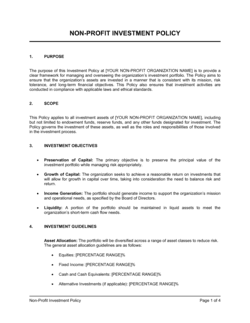
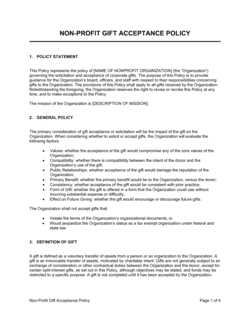
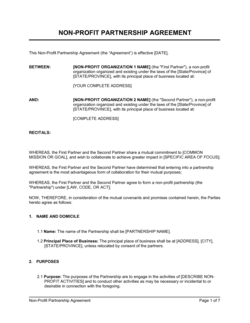
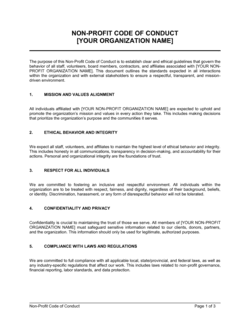
Non-Profit Whistleblower Policy Template

Free Word download β€’ Edit online β€’ Save & share with Drive β€’ Export to PDF

7 pagesβ€’20–30 min to fillβ€’Difficulty: Standard
Learn more ↓
FreeNon-Profit Whistleblower Policy Template

At a glance

What it is
A Non Profit Whistleblower Policy is a formal organizational document that establishes procedures for staff, volunteers, and board members to report suspected financial misconduct, fraud, or ethical violations without fear of retaliation. This free Word download gives nonprofits a structured, IRS-recommended policy they can edit online and export as PDF for board adoption and staff distribution.
When you need it
Use it when adopting or updating your nonprofit's governance policies, preparing for IRS Form 990 filing (which asks whether the organization has a whistleblower policy), or responding to an internal compliance review or audit finding.
What's inside
The policy covers the scope of reportable concerns, confidential reporting channels, protections against retaliation, investigation procedures, recordkeeping requirements, and board oversight responsibilities β€” all aligned with IRS guidance for tax-exempt organizations.

What is a Non Profit Whistleblower Policy?

A Non Profit Whistleblower Policy is a formal governance document that establishes how employees, volunteers, board members, and contractors can report suspected fraud, financial misconduct, or violations of law without fear of retaliation. It identifies who receives reports, how investigations are conducted, what confidentiality protections apply, and what consequences follow for anyone who retaliates against a reporter. The IRS explicitly references whistleblower policies on Form 990 as an indicator of sound nonprofit governance, and major funders and charity watchdog organizations treat the presence of a documented policy as a baseline governance expectation.

Why You Need This Document

Without a written whistleblower policy, employees who discover financial misconduct or fraud have no clear, safe channel to report it β€” so they either stay silent or go directly to state regulators, the IRS, or the media. Either outcome is damaging: ongoing fraud compounds until it surfaces externally, and self-censorship protects bad actors at the expense of the organization's mission and donors. A formal policy changes the calculus by giving reporters a defined, protected path. It also satisfies the IRS Form 990 Part VI governance question directly, signals accountability to grant-making foundations and major donors who scrutinize governance before committing funds, and creates the documentation trail needed to defend against retaliation claims if a report is ever disputed. This template gives you a board-ready, IRS-aligned policy in the time it takes to hold a single board meeting.

Which variant fits your situation?

If your situation is…Use this template
Small nonprofit with no dedicated compliance staffNon Profit Whistleblower Policy (Simplified)
Organization subject to state charity registration requirementsNon Profit Whistleblower Policy with State Addendum
Nonprofit with employees covered by federal contractor rulesEmployee Whistleblower Protection Policy
Organization updating the full governance policy suiteNon Profit Conflict of Interest Policy
Organization that needs a document destruction companion policyDocument Retention and Destruction Policy
Board adopting a code of ethics alongside whistleblower protectionsCode of Ethics Policy
Nonprofit undergoing an external audit or independent reviewInternal Audit Report Template

Common mistakes to avoid

❌ Naming a single reporting contact with no alternate

Why it matters: When the concern involves the only designated contact β€” often the executive director β€” reporters have no legitimate channel and either stay silent or go directly to regulators.

Fix: Always name a primary and an alternate contact. For concerns involving senior management, route reports directly to the board chair or audit committee chair.

❌ Promising absolute confidentiality

Why it matters: Some investigations require disclosing the reporter's identity to conduct a fair process or comply with employment law. A blanket confidentiality promise the organization cannot keep destroys credibility when it is broken.

Fix: Use qualified language: 'The organization will make all reasonable efforts to protect confidentiality to the extent permitted by law and the investigation process.'

❌ Omitting the safe harbor for good-faith reporters

Why it matters: Without an explicit safe harbor, employees read the policy as all risk and no protection β€” and stop reporting marginal concerns that often turn out to be significant.

Fix: Add a clearly labeled safe harbor section stating that unsubstantiated good-faith reports carry no disciplinary consequences, distinct from knowingly false reports.

❌ Adopting the policy without board acknowledgment in meeting minutes

Why it matters: IRS Form 990 and state charity regulators ask whether the board has reviewed and adopted the policy. A document sitting in a folder with no adoption record does not satisfy this requirement.

Fix: Document the board vote, the date, and the policy version number in formal board minutes. Attach the resolution to the policy file.

The 10 key sections, explained

Purpose and scope

Reportable concerns

Reporting procedures

Confidentiality protections

Anti-retaliation protections

Investigation procedures

Safe harbor for good-faith reporters

Recordkeeping

Board oversight and annual review

Policy acknowledgment and distribution

How to fill it out

  1. 1

    Enter your organization's legal name and effective date

    Replace all instances of [ORGANIZATION NAME] with your nonprofit's full registered legal name. Add the effective date the board adopted the policy β€” this date should match the board resolution or meeting minutes.

    πŸ’‘ Use the exact name from your IRS determination letter to ensure consistency across all governance documents.

  2. 2

    Name the designated reporting officer and alternate

    Identify by name and title the primary person who receives reports β€” typically the audit committee chair or board chair. Also name an alternate for situations where the primary officer is the subject of a report.

    πŸ’‘ For small nonprofits without an audit committee, the board chair and a designated board member make a workable primary-and-alternate pair.

  3. 3

    Define your reporting channels

    Choose the channels through which reports can be submitted β€” email, phone, written submission, or a third-party hotline. Specify whether anonymous submissions are accepted and, if so, how they will be handled.

    πŸ’‘ Third-party anonymous hotlines (available for as little as $50–$200 per year) significantly increase report rates by removing the fear that the reporting email or phone number is monitored by management.

  4. 4

    Set investigation timelines

    Insert specific day counts for initial acknowledgment (typically 5 business days) and investigation completion (typically 30–60 days). These commitments signal to reporters that the policy is real, not performative.

    πŸ’‘ Build in an exception clause β€” 'absent unusual circumstances' β€” so you have flexibility for complex or multi-party investigations without breaching the policy.

  5. 5

    Confirm the retention period for records

    Insert the minimum retention period for investigation records β€” 7 years is the most commonly recommended period for nonprofits, aligning with IRS audit windows and most state charity laws.

    πŸ’‘ Cross-reference your Document Retention Policy to ensure the whistleblower records retention period is consistent with it.

  6. 6

    Have the board formally adopt the policy

    Present the finalized policy to the full board for a vote. Document the adoption in board meeting minutes with the exact date. Attach the signed resolution as an exhibit to the policy file.

    πŸ’‘ A board resolution that references the specific IRS Form 990, Part VI, Section B questions gives auditors immediate evidence of intentional governance compliance.

  7. 7

    Distribute to all covered individuals and collect acknowledgments

    Send the adopted policy to all employees, board members, and regular volunteers. Collect signed acknowledgment forms and retain them in personnel or volunteer files.

    πŸ’‘ Schedule a 15-minute review session when distributing the policy β€” staff who understand the policy are more likely to use it correctly than those who receive it by email only.

  8. 8

    Calendar an annual review

    Set a recurring annual board agenda item to review the policy, confirm the designated officer is still current, and update any contact information or procedures that have changed.

    πŸ’‘ Pair the annual review with your Form 990 preparation cycle so the two tasks reinforce each other and neither gets skipped.

Frequently asked questions

Does a nonprofit legally need a whistleblower policy?

Federal law does not require all nonprofits to have a written whistleblower policy, but IRS Form 990 Part VI asks whether the organization has one β€” and answering 'no' draws scrutiny from regulators, donors, and grantors. Several states, including California and New York, require nonprofits meeting certain revenue or employee thresholds to maintain a formal whistleblower policy. Even where not legally mandated, governance best practices and most major funders expect one to be in place.

What should a nonprofit whistleblower policy include?

At minimum, a nonprofit whistleblower policy should define the scope of reportable concerns, identify one or more reporting channels (including an alternate for concerns involving senior staff), commit to confidentiality to the extent feasible, prohibit retaliation with defined consequences, establish an investigation timeline, include a safe harbor for good-faith reporters, and specify how records are retained. The board should formally adopt the policy and review it at least annually.

What is a 'good faith' report under a whistleblower policy?

A good-faith report is one the reporter genuinely and reasonably believed to be true at the time of submission β€” even if the investigation later finds no violation occurred. Good faith is distinct from accuracy: a mistaken report made honestly is protected, while a report the person knew to be false is not. Policies should define this clearly so staff understand they are protected for honest mistakes but not for deliberate false accusations.

Who should receive whistleblower reports in a nonprofit?

Best practice is to designate the audit committee chair or board chair as the primary recipient β€” not the executive director β€” so that concerns about senior management have a clear independent channel. Name an alternate for situations where the primary designee is the subject of the report. For smaller nonprofits without formal committees, any independent board member can serve as the alternate contact.

Can a whistleblower report anonymously?

Whether to accept anonymous reports is a policy decision each organization makes. Accepting anonymous reports increases the likelihood that staff will come forward, particularly for sensitive concerns. The tradeoff is that anonymous reports are harder to investigate thoroughly when follow-up questions are needed. Many nonprofits accept anonymous reports but note that investigations may be limited by the information available.

How does the whistleblower policy relate to IRS Form 990?

IRS Form 990 Part VI, Section B, Line 13 asks whether the organization has a written whistleblower policy. Answering 'yes' signals strong governance to the IRS, state regulators, major donors, and charity watchdog organizations like Charity Navigator and GuideStar. Answering 'no' does not automatically trigger an audit but is a red flag in broader governance reviews. The policy should be formally adopted by the board and documented in meeting minutes before the 990 is filed.

What is the difference between a whistleblower policy and a grievance policy?

A whistleblower policy covers reports of suspected illegal conduct, financial fraud, or serious ethical violations that affect the organization or the public interest. A grievance policy covers personal employment disputes β€” pay disagreements, scheduling conflicts, interpersonal complaints, or performance management concerns. Keeping the two separate prevents the whistleblower channel from becoming overloaded with routine HR matters, which dilutes its effectiveness for genuine compliance concerns.

How often should a nonprofit review its whistleblower policy?

At minimum, the board should review the policy annually β€” typically aligned with the Form 990 preparation cycle. The review should confirm that designated contacts are current, reporting channels are still functional, and any changes in state law or funder requirements are reflected. A policy that has not been reviewed in more than two years is unlikely to meet current expectations from regulators or major institutional funders.

What happens if someone retaliates against a whistleblower?

The policy should specify that retaliation is a disciplinary offense subject to consequences up to and including termination or removal from the board. Federal law under the Sarbanes-Oxley Act protects employees of nonprofits who report federal offenses, and several states extend broader retaliation protections. Documenting every report and any subsequent adverse actions involving the reporter is essential to defend against retaliation claims and to take corrective action when retaliation occurs.

How this compares to alternatives

vs Non Profit Conflict of Interest Policy

A conflict of interest policy governs undisclosed personal interests that could improperly influence board or staff decisions β€” such as contracting with a board member's company. A whistleblower policy establishes the channel for reporting those conflicts (and other misconduct) after they occur. Both are required for full IRS Form 990 governance compliance and should be adopted together.

vs Non Profit Code of Ethics

A code of ethics defines the standards of conduct the organization expects from everyone associated with it. A whistleblower policy is the enforcement mechanism β€” it tells people what to do when they observe a code violation. The two documents work as a pair: the code sets the standard; the whistleblower policy provides the reporting procedure.

vs Document Retention and Destruction Policy

A document retention policy governs how long organizational records are stored and when they may be destroyed. A whistleblower policy requires investigation records to be retained for a minimum period β€” and prohibits destroying documents once a concern is reported. The two policies must be cross-referenced so a document destruction schedule is never triggered while a whistleblower investigation is open.

vs Employee Handbook

An employee handbook consolidates all workplace policies β€” including the whistleblower policy β€” into a single reference document for staff. The whistleblower policy is a standalone governance document adopted by the board and filed with governance records; the handbook reference is a summary pointer. Board-adopted governance policies should always exist as independent documents, not only as handbook sections that can be revised without board approval.

Industry-specific considerations

Human Services Nonprofits

High volunteer turnover and complex funding streams make a clear, accessible reporting channel essential for catching misuse of restricted grant funds early.

Healthcare and Community Health

HIPAA compliance obligations and clinical billing integrity create a distinct category of reportable concerns that the policy should explicitly reference alongside general financial misconduct.

Education and Higher Education

Title IX reporting obligations and state accreditation requirements may intersect with the whistleblower channel; the policy should clarify how reports that trigger mandatory reporting obligations are escalated.

Arts and Cultural Organizations

Smaller staff sizes and close personal relationships among leadership make retaliation risk higher; the policy's alternate reporting channel and safe harbor provisions are especially important in these settings.

Template vs pro β€” what fits your needs?

PathBest forCostTime
Use the templateNonprofits adopting a standard whistleblower policy for the first time or updating an existing policy for Form 990 complianceFree1–2 hours to customize and prepare for board adoption
Template + professional reviewOrganizations in states with specific nonprofit whistleblower requirements (California, New York) or those receiving significant federal funding$200–$600 for a nonprofit attorney review3–5 business days
Custom draftedLarge nonprofits with 50+ employees, multi-state operations, or complex funding structures requiring a tailored compliance framework$800–$2,500 for a full custom governance policy suite2–4 weeks

Glossary

Whistleblower
An individual who in good faith reports suspected illegal activity, financial misconduct, or policy violations within an organization.
Retaliation
Any adverse action β€” termination, demotion, harassment, or reduced responsibilities β€” taken against an individual because they made a protected report.
Good Faith Report
A report made with a genuine, reasonable belief that the information is true, even if an investigation later finds no violation occurred.
Form 990
The IRS annual information return filed by most tax-exempt organizations; it includes a question asking whether the organization has a whistleblower policy in place.
Designated Reporting Officer
The individual named in the policy β€” typically the board chair, audit committee chair, or outside counsel β€” to receive whistleblower reports when the concern involves senior management.
Audit Committee
A committee of the nonprofit's board responsible for overseeing financial reporting, internal controls, and the investigation of reported concerns.
Confidentiality
The obligation to protect the identity of a reporter and the details of an investigation from unauthorized disclosure.
Substantiated Complaint
A reported concern for which the investigation found credible evidence that a violation occurred.
Anonymous Report
A concern submitted without identifying the reporter; policies must specify whether and how anonymous reports will be accepted and investigated.
Safe Harbor
A policy provision confirming that reporters acting in good faith will not face disciplinary consequences even if the reported concern is ultimately unsubstantiated.

Part of your Business Operating System

This document is one of 3,000+ business & legal templates included in Business in a Box.

  • Fill-in-the-blanks β€” ready in minutes
  • 100% customizable Word document
  • Compatible with all office suites
  • Export to PDF and share electronically

Create your document in 3 simple steps.

From template to signed document β€” all inside one Business Operating System.
1
Download or open template

Access over 3,000+ business and legal templates for any business task, project or initiative.

2
Edit and fill in the blanks with AI

Customize your ready-made business document template and save it in the cloud.

3
Save, Share, Send, Sign

Share your files and folders with your team. Create a space of seamless collaboration.

Save time, save money, and create top-quality documents.

β˜…β˜…β˜…β˜…β˜…

"Fantastic value! I'm not sure how I'd do without it. It's worth its weight in gold and paid back for itself many times."

Managing Director Β· Mall Farm
Robert Whalley
Managing Director, Mall Farm Proprietary Limited
β˜…β˜…β˜…β˜…β˜…

"I have been using Business in a Box for years. It has been the most useful source of templates I have encountered. I recommend it to anyone."

Business Owner Β· 4+ years
Dr Michael John Freestone
Business Owner
β˜…β˜…β˜…β˜…β˜…

"It has been a life saver so many times I have lost count. Business in a Box has saved me so much time and as you know, time is money."

Owner Β· Upstate Web
David G. Moore Jr.
Owner, Upstate Web

Run your business with a system β€” not scattered tools

Stop downloading documents. Start operating with clarity. Business in a Box gives you the Business Operating System used by over 250,000 companies worldwide to structure, run, and grow their business.

Start freeΒ Β·Β No credit card required