Pricing Strategy

Free Word download β€’ Edit online β€’ Save & share with Drive β€’ Export to PDF

10 pagesβ€’25–30 min to fillβ€’Difficulty: Standard
Learn more ↓
FreePricing Strategy Template

At a glance

What it is
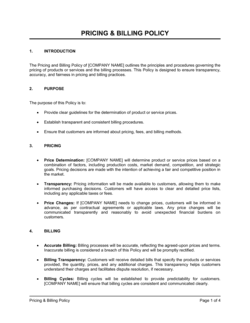
A Pricing Strategy is a structured operational document that defines how a business sets, justifies, and manages the prices of its products or services. This free Word download gives you a ready-to-edit framework covering cost analysis, competitive benchmarking, value positioning, pricing model selection, and discount governance β€” exportable as PDF for distribution to sales, finance, and leadership teams.
When you need it
Use it when launching a new product or service, entering a new market, responding to competitive price pressure, or aligning sales and finance teams around a consistent margin and discounting policy.
What's inside
Executive summary, pricing objectives, cost structure and margin analysis, competitive pricing benchmarks, customer value and willingness-to-pay assessment, pricing model selection, tier and bundle definitions, discount and exception policy, and implementation and review cadence.

What is a Pricing Strategy?

A Pricing Strategy is a structured operational document that defines how a business sets, justifies, and manages the prices of its products or services. It captures the full reasoning behind every price point β€” from fully loaded cost floors and competitive benchmarks to customer willingness-to-pay by segment and the discount governance rules that protect margin in the field. Unlike an informal pricing spreadsheet, a written pricing strategy aligns sales, finance, and product teams around a shared framework, documents the assumptions behind current prices, and establishes a formal cadence for reviewing and updating them as market conditions change.

Why You Need This Document

Without a documented pricing strategy, pricing decisions default to gut instinct, competitive mimicry, or cost-plus math that leaves significant value uncaptured. Sales reps discount without limits, different customers pay wildly different prices for the same product, and no one can explain to the board why gross margin is trending the wrong direction. A written strategy closes all three gaps: it sets a price floor below which no deal should close, establishes clear discount authority at each level of the organization, and gives leadership a documented baseline to compare against when quarterly results come in. This template gives you the structure to produce a complete pricing strategy in days rather than weeks β€” covering everything from cost analysis and competitive benchmarking to tier architecture and exception policy β€” so your next product launch or price revision starts from evidence, not assumption.

Which variant fits your situation?

If your situation is…Use this template
Setting prices for a SaaS product with multiple tiersSaaS Pricing Strategy
Pricing physical products sold through retail or wholesale channelsProduct Pricing Strategy
Defining hourly or project-based rates for a service businessService Pricing Strategy
Building a competitive pricing analysis to present to leadershipCompetitive Analysis
Planning a promotional discount or seasonal sale campaignMarketing Plan
Projecting revenue impact of a price change for investor reviewFinancial Projections (12 Months)
Aligning pricing with overall business goals and a 3-year roadmapStrategic Plan

Common mistakes to avoid

❌ Pricing from cost alone without checking willingness to pay

Why it matters: Cost-plus pricing sets a floor, not a ceiling. Products that deliver $50,000 of annual value to a customer are routinely priced at $5,000 because the seller never asked what the customer would actually pay.

Fix: Run at least five customer interviews per segment before finalizing prices. Ask directly: 'At what price would this feel expensive but still worth it?' The answers will surprise you.

❌ No documented discount policy

Why it matters: Without written discount limits, every rep negotiates independently. A company with a 50% gross margin target and no discount floor can watch margin erode to 30% within a single quarter.

Fix: Define maximum discount thresholds by role in writing, publish them in the CRM, and require a business case for any exception above the VP-level ceiling.

❌ Benchmarking list prices instead of transaction prices

Why it matters: SaaS and enterprise software companies routinely discount 20–40% off list. A strategy built on list-price comparisons positions you incorrectly against competitors whose real prices are far lower.

Fix: Triangulate list prices with buyer interviews, lost-deal debriefs, and public pricing databases to estimate actual transaction price ranges before setting your benchmark.

❌ Creating a pricing strategy document with no review date

Why it matters: Costs change, competitors reprice, and market conditions shift. A pricing document without a review cadence becomes stale within months and actively misleads the teams using it.

Fix: Embed a review date and owner in the implementation section before the document is distributed. Quarterly reviews are standard for high-velocity markets; annual is the minimum for stable ones.

❌ Designing tiers without a clear up-sell path

Why it matters: A middle tier that lacks a compelling feature creates a dead-end β€” buyers either buy the cheapest tier or skip to the top, and average selling price collapses.

Fix: Identify the one feature the target premium buyer considers essential and place it exclusively in the premium tier, with a preview or limit in the mid-tier to drive upgrade intent.

❌ Treating pricing as a one-time launch decision

Why it matters: Companies that set prices at launch and never revisit them systematically under-earn as their product matures, their costs change, and their competitive position strengthens.

Fix: Establish a formal pricing review committee with a defined cadence, a standard data package (margin actuals, win/loss data, churn by segment), and authority to make changes without re-running a full strategy process.

The 9 key sections, explained

Executive summary

Pricing objectives

Cost structure and margin analysis

Competitive pricing benchmark

Customer value and willingness-to-pay assessment

Pricing model selection

Tier and bundle definitions

Discount and exception policy

Implementation and review cadence

How to fill it out

  1. 1

    Define your pricing objectives with measurable targets

    State one to three specific, measurable goals β€” target gross margin percentage, average selling price, or maximum discount rate. Tie each to a timeframe and an owner.

    πŸ’‘ Objectives that can't be measured can't be managed. 'Improve profitability' is not an objective; '48% gross margin on the Pro tier by Q4' is.

  2. 2

    Calculate fully loaded cost per unit or customer

    Add up direct costs (materials, labor, delivery, hosting) and allocate a share of overhead (sales, G&A, support) to each unit or customer. This produces your price floor.

    πŸ’‘ Include customer acquisition cost in the per-customer cost calculation for subscription or recurring-revenue businesses β€” it is often the largest single cost item.

  3. 3

    Survey competitor prices at actual transaction level

    Collect list prices from at least three to five direct competitors, then adjust for known discount rates using industry benchmarks or buyer interviews to estimate real transaction prices.

    πŸ’‘ Sales reps often know competitor pricing from lost deals β€” debrief them before building the benchmark table, not after.

  4. 4

    Assess customer willingness to pay by segment

    Run customer interviews, survey data, or a Van Westendorp price sensitivity test for each key segment. Record the WTP range and the value drivers that justify the price.

    πŸ’‘ Even five customer interviews per segment will reveal pricing assumptions you didn't know you were making β€” and almost always uncover an underpriced tier.

  5. 5

    Select and document your pricing model

    Choose the structure that best matches how customers receive value β€” per seat, usage-based, project-based, or subscription. Write one paragraph explaining the rationale in terms of customer buying behavior.

    πŸ’‘ If your top three customers all ask 'can we pay monthly?' in the first sales call, that is a strong signal your annual billing model is misaligned with how they budget.

  6. 6

    Define tiers and bundles with margin targets for each

    List each tier or bundle with its feature set, target segment, price point, and gross margin. Verify that the mid-tier has a clear up-sell path to the premium tier.

    πŸ’‘ The middle tier should include at least one feature the target premium buyer considers essential β€” otherwise it becomes invisible and the pricing architecture collapses to two tiers.

  7. 7

    Set the discount policy with explicit approval levels

    Document the maximum discount each role can authorize, the process for exceptions, and any floors below which no discount is permitted regardless of deal size.

    πŸ’‘ Publish the discount policy in your CRM as a required field on every opportunity β€” this creates an audit trail and stops informal exceptions from becoming the default.

  8. 8

    Schedule the first formal review before publishing

    Before distributing the strategy, set a calendar date for the first review β€” no more than six months out. Assign an owner, specify the data inputs required, and record both in the implementation section.

    πŸ’‘ The review date is the most skipped field in pricing documents and the one that causes the most damage β€” an unreviewed strategy from 18 months ago is worse than no strategy.

Frequently asked questions

What is a pricing strategy?

A pricing strategy is a documented framework that defines how a business sets, justifies, and manages prices for its products or services. It covers cost structure, competitive positioning, customer value assessment, pricing model selection, tier definitions, discount governance, and a review cadence. The goal is to set prices that capture the value delivered to customers while meeting the company's margin and growth objectives.

What are the most common pricing strategies?

The four most widely used pricing strategies are cost-plus (price equals cost plus a fixed markup), value-based (price reflects the economic value delivered to the customer), competitive (price is set relative to competitor prices), and dynamic (price adjusts in real time based on demand, inventory, or customer segment). Most businesses use a hybrid: cost-plus sets the floor, competitive analysis sets the range, and value-based logic determines where within that range to land.

What is the difference between a pricing strategy and a pricing model?

A pricing strategy defines the overall philosophy and objectives β€” why you charge what you charge and what financial outcomes you are targeting. A pricing model defines the structure of how you charge β€” per unit, per seat, usage-based, subscription, or project-based. A complete pricing document covers both: the strategy explains the rationale, and the model specifies the mechanics.

How do I find out what customers are willing to pay?

Three methods work reliably: direct customer interviews asking for price ranges at which the product feels cheap, fair, expensive but acceptable, and too expensive (the Van Westendorp model); conjoint analysis surveys that test feature-price trade-offs; and analysis of existing pricing data β€” churn rates by price tier, discount acceptance rates, and win/loss data at different price points. Five to ten interviews per segment surfaces the most actionable insights at low cost.

How often should a pricing strategy be reviewed?

In high-velocity markets β€” SaaS, e-commerce, consumer goods β€” quarterly reviews are standard. In stable industries β€” professional services, manufacturing β€” an annual review is the minimum. Trigger an unscheduled review any time a major competitor reprices, your cost structure shifts by more than 10%, or a new customer segment emerges with different value drivers than your existing base.

What is a price floor and why does it matter?

A price floor is the minimum price at which you can sell a product or service without generating a net loss, after accounting for all direct costs and a fair share of overhead. It matters because discounting below the floor destroys cash rather than just margin. Every pricing strategy should calculate the floor explicitly by product and customer segment before defining any discount authority.

Should I use cost-plus or value-based pricing?

Cost-plus pricing is easy to calculate and guarantees you cover costs, but it systematically underprices products that deliver high value and ignores what the market will bear. Value-based pricing captures more of the economic value you create but requires customer research to quantify that value. The practical answer for most businesses: use cost-plus to set the floor, competitive analysis to set the realistic range, and value-based logic to decide where within the range to position.

How do I prevent sales reps from discounting too aggressively?

Document a tiered discount policy with explicit approval thresholds by role and enforce it in your CRM as a required field on every opportunity. Train reps on the gross margin impact of discounting β€” showing that a 10% discount on a 50% gross-margin product requires 25% more volume to break even often changes behavior more effectively than policy alone. Publish monthly margin reports by rep so everyone can see the pattern.

What should a pricing strategy document include?

A complete pricing strategy document covers: pricing objectives with measurable targets, fully loaded cost structure and price floor, competitive pricing benchmarks at transaction level, customer willingness-to-pay by segment, pricing model rationale, tier and bundle definitions with margin targets, discount and exception policy with approval levels, and an implementation timeline with a formal review cadence.

How this compares to alternatives

vs Competitive Analysis

A competitive analysis maps competitors' products, positioning, strengths, and weaknesses across all dimensions. A pricing strategy uses competitive pricing data as one input among several β€” alongside cost structure and customer value β€” to set specific price points and policies. The competitive analysis informs the strategy; it does not replace it.

vs Marketing Plan

A marketing plan covers the full go-to-market mix: target audience, messaging, channels, campaigns, and budget. Pricing is one element of the marketing mix, but a dedicated pricing strategy document goes far deeper β€” covering cost floors, discount governance, tier architecture, and a formal review cadence that a marketing plan does not include.

vs Financial Projections

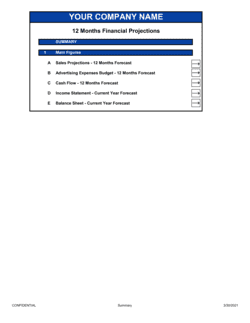
Financial projections model the revenue, cost, and cash-flow outcomes of a chosen pricing approach. A pricing strategy is the upstream decision document that determines the assumptions feeding those projections. Build the strategy first, then use it to populate the pricing inputs in your financial model.

vs Strategic Plan

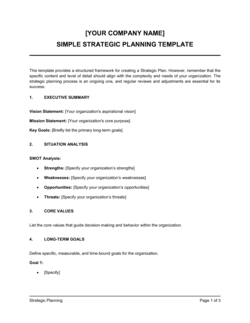
A strategic plan covers the full 3–5 year direction of the business β€” goals, initiatives, resource allocation, and KPIs across all functions. A pricing strategy is a functional-level document that operationalizes the revenue and margin targets set in the strategic plan into specific price points, models, and policies.

Industry-specific considerations

SaaS / Technology

Per-seat, usage-based, and tiered subscription models require a pricing strategy that aligns with the customer's value metric β€” active users, API calls, or data volume β€” and accounts for expansion revenue within existing accounts.

Retail / E-commerce

Competitive and dynamic pricing dominate, with the strategy needing to address MAP (minimum advertised price) policies for channel partners, promotional cadence, and the margin impact of free shipping thresholds.

Professional Services

Pricing strategy must choose between hourly billing, fixed-project fees, and retainer models, and set utilization-rate assumptions that ensure bill rates cover both direct labor costs and overhead at target margins.

Manufacturing and Wholesale

Pricing must account for volume discount tiers, distributor margin requirements, raw material cost volatility, and the need for price floors that hold even under maximum channel discounting.

Food and Beverage

Food cost percentage targets (typically 28–35% of menu price) anchor the strategy, with competitive benchmarking against local and national alternatives and promotional pricing designed to drive trial without permanently repositioning the brand.

Healthcare and MedTech

Pricing is constrained by reimbursement codes, payer contract rates, and regulatory requirements β€” the strategy must map price to billable codes and account for the gap between list price and net realized revenue after payer adjustments.

Template vs pro β€” what fits your needs?

PathBest forCostTime
Use the templateSmall businesses, startups, and product teams setting or refreshing pricing without a dedicated revenue operations functionFree1–2 weeks including customer interviews and competitive research
Template + professional reviewCompanies launching a new product line, entering a new market, or experiencing sustained margin erosion$1,000–$5,000 for a strategy consultant or pricing advisor review2–4 weeks
Custom draftedEnterprise businesses, complex multi-channel pricing, SaaS companies with expansion revenue models, or businesses preparing for a funding round where pricing architecture will be scrutinized$10,000–$40,000 for a dedicated pricing strategy engagement6–12 weeks

Glossary

Cost-Plus Pricing
A pricing method that sets price by adding a fixed markup percentage to the fully loaded cost of producing or delivering the product or service.
Value-Based Pricing
Setting price based on the economic value the customer receives, rather than on cost or competitor benchmarks.
Price Elasticity
A measure of how much demand for a product changes in response to a 1% change in price β€” high elasticity means demand drops sharply with price increases.
Gross Margin
Revenue minus the direct cost of goods sold or service delivery, expressed as a percentage of revenue.
Willingness to Pay (WTP)
The maximum price a specific customer segment will pay for a product or service before switching to an alternative.
Price Floor
The minimum price at which a product can be sold without generating a loss, after covering all direct and allocated costs.
Price Ceiling
The maximum price the market will bear for a product, determined by competitive alternatives and customer willingness to pay.
Anchor Price
A higher reference price displayed alongside the actual selling price to make the selling price appear more attractive by comparison.
Penetration Pricing
Launching at a deliberately low price to acquire market share quickly, with the intent to raise prices as adoption grows.
Price Skimming
Launching at a high price to capture maximum revenue from early adopters before reducing price to reach more price-sensitive segments.
Bundling
Combining two or more products or services into a single offer at a combined price lower than the sum of individual prices, to increase average order value.

Part of your Business Operating System

This document is one of 3,000+ business & legal templates included in Business in a Box.

  • Fill-in-the-blanks β€” ready in minutes
  • 100% customizable Word document
  • Compatible with all office suites
  • Export to PDF and share electronically

Create your document in 3 simple steps.

From template to signed document β€” all inside one Business Operating System.
1
Download or open template

Access over 3,000+ business and legal templates for any business task, project or initiative.

2
Edit and fill in the blanks with AI

Customize your ready-made business document template and save it in the cloud.

3
Save, Share, Send, Sign

Share your files and folders with your team. Create a space of seamless collaboration.

Save time, save money, and create top-quality documents.

β˜…β˜…β˜…β˜…β˜…

"Fantastic value! I'm not sure how I'd do without it. It's worth its weight in gold and paid back for itself many times."

Managing Director Β· Mall Farm
Robert Whalley
Managing Director, Mall Farm Proprietary Limited
β˜…β˜…β˜…β˜…β˜…

"I have been using Business in a Box for years. It has been the most useful source of templates I have encountered. I recommend it to anyone."

Business Owner Β· 4+ years
Dr Michael John Freestone
Business Owner
β˜…β˜…β˜…β˜…β˜…

"It has been a life saver so many times I have lost count. Business in a Box has saved me so much time and as you know, time is money."

Owner Β· Upstate Web
David G. Moore Jr.
Owner, Upstate Web

Run your business with a system β€” not scattered tools

Stop downloading documents. Start operating with clarity. Business in a Box gives you the Business Operating System used by over 250,000 companies worldwide to structure, run, and grow their business.

Start freeΒ Β·Β No credit card required