Reimbursement Form_Medical Expenses Template

Free Word download • Edit online • Save & share with Drive • Export to PDF

2 pages20–30 min to fillDifficulty: StandardSignature requiredLegal review recommended
Learn more ↓
FreeReimbursement Form_Medical Expenses Template

At a glance

What it is
A Medical Expense Reimbursement Form is a binding employer-employee document that authorizes an employee to submit out-of-pocket healthcare costs for reimbursement against a company-sponsored plan or policy. This free Word download lets HR teams or small business owners capture expense details, attach receipts, apply policy limits, and obtain required approvals — all in a single auditable record exportable as PDF.
When you need it
Use it whenever an employee pays for a covered medical, dental, vision, or prescription expense out of pocket and seeks reimbursement under a company health reimbursement arrangement (HRA), flexible spending account (FSA), or employer benefit policy. It is also required when a third-party insurer, government program, or self-insured employer needs documented proof of eligible expenses before issuing payment.
What's inside
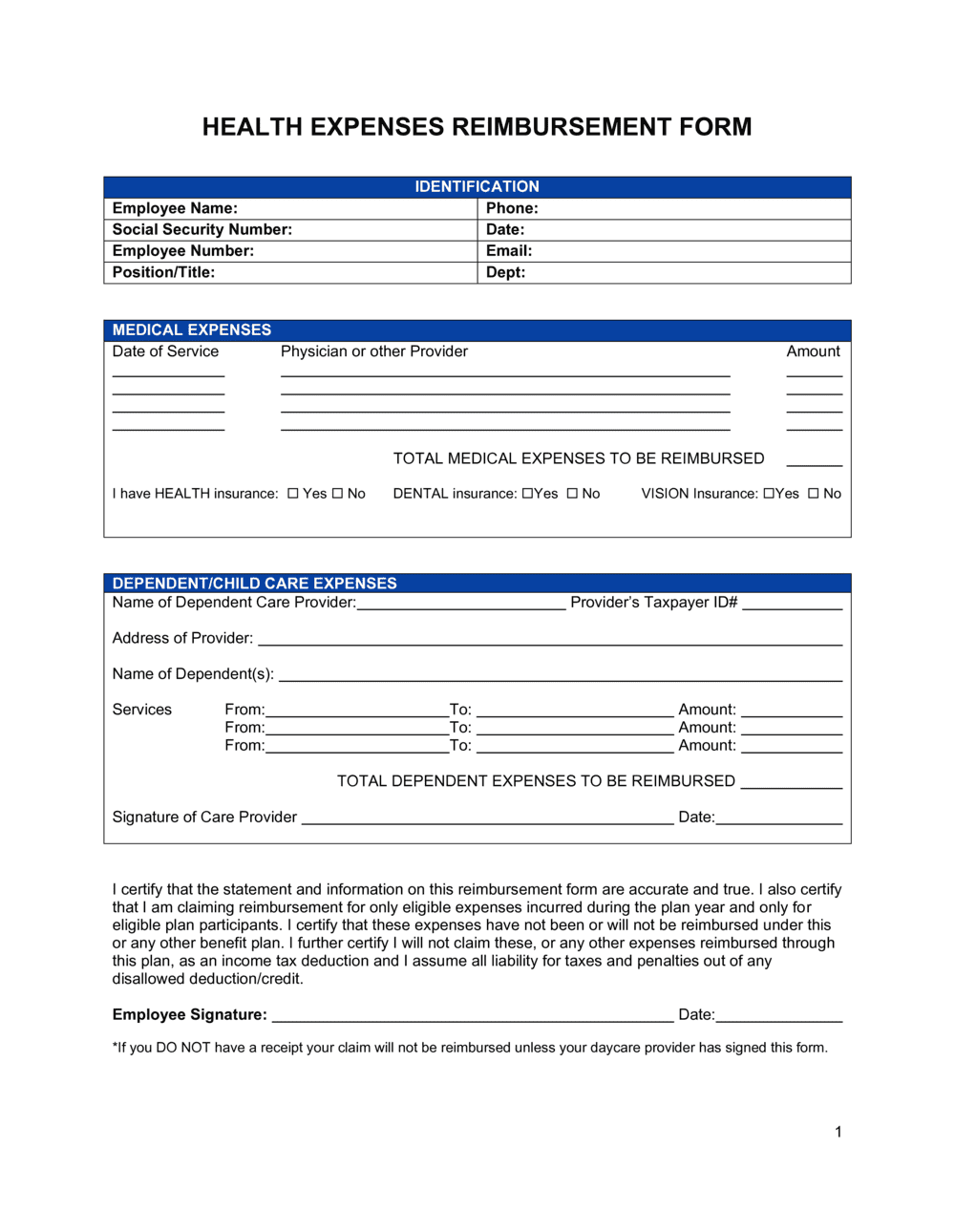
Employee and employer identification fields, expense itemization with dates and amounts, eligible expense classification, receipt attachment checklist, insurance coordination-of-benefits declaration, authorized signatory approval block, and policy limit acknowledgment language.

What is a Medical Expense Reimbursement Form?

A Medical Expense Reimbursement Form is a structured employer-employee document used to formally request and authorize payment for out-of-pocket healthcare costs incurred by an employee under a company-sponsored health benefit plan, health reimbursement arrangement (HRA), or flexible spending account (FSA). It captures each expense by date, provider, and type; requires supporting documentation such as itemized receipts and insurer explanations of benefits; and obtains a certified employee signature alongside an authorized employer approval before any payment is processed. The form creates the substantiation record the IRS requires to treat the reimbursement as a tax-advantaged benefit rather than ordinary taxable wages — a distinction that affects both the employer's deduction and the employee's take-home pay. This free Word download gives HR teams and small business owners a compliant, auditable starting point that can be edited online and exported as PDF.

Why You Need This Document

Processing medical reimbursements without a signed, itemized form exposes the employer to IRS reclassification of every payment as taxable wages — triggering back payroll taxes, penalties, and interest that dwarf the original reimbursement amounts. Without a formal approval workflow, segregation-of-duties failures go undetected, and fraudulent or duplicate claims pass through payroll unchecked. Employees who submit to the wrong insurer or fail to declare existing coverage create coordination-of-benefits liability that can result in the employer recovering funds from a worker who has already spent them. A properly completed reimbursement form eliminates all four risks in a single document: it substantiates eligibility, captures the COB declaration, enforces the plan's annual limit, and creates the audit trail your accountant, TPA, and ERISA counsel will request the moment a plan audit or employee dispute arises. This template gives you the complete structure — without starting from a blank page.

Which variant fits your situation?

If your situation is…Use this template
Reimbursing employees under a formal IRS-compliant HRAHealth Reimbursement Arrangement (HRA) Reimbursement Form
Employees submitting FSA-eligible expenses to a plan administratorFSA Expense Claim Form
Reimbursing general business or travel expenses including incidental medicalEmployee Expense Reimbursement Form
Employer reimbursing individual insurance premiums under a QSEHRAQSEHRA Reimbursement Request Form
Coordinating reimbursement between a primary and secondary insurerCoordination of Benefits Form
Documenting a one-time executive or dependent medical expense benefitExecutive Benefits Reimbursement Letter
Claiming dental or vision expenses separately from medicalDental and Vision Expense Reimbursement Form

Common mistakes to avoid

❌ Submitting unitemized lump-sum claims

Why it matters: IRS rules require each reimbursed expense to be individually substantiated. A single total without line items cannot be verified, turning the payment into taxable wages for the employee and a disallowed deduction for the employer.

Fix: Break every submission into individual line items with date of service, provider, expense type, and net amount. Attach a separate receipt or EOB for each line.

❌ Filing medical forms in the general personnel file

Why it matters: HIPAA and equivalent privacy laws prohibit storing medical information in the same file as general employment records. A violation can trigger regulatory fines and employee claims.

Fix: Maintain a separate, access-restricted medical file for each employee and limit access to plan administrators and HR staff with a direct plan-administration role.

❌ Reimbursing expenses after the plan year's run-out period

Why it matters: Payments made after the run-out deadline lose their tax-advantaged status — they become taxable income to the employee and may trigger payroll tax liability for the employer.

Fix: Post the run-out deadline prominently in your benefits communications and set a calendar reminder to reject or return late submissions rather than processing them informally.

❌ Allowing the claimant to also approve their own reimbursement

Why it matters: Self-approval on expense reimbursements is a segregation-of-duties failure that auditors flag consistently — it creates an undetected pathway for fraudulent or inflated claims.

Fix: Require a second authorized signatory — a supervisor, HR director, or CFO — to approve every reimbursement before it reaches payroll for processing.

❌ Accepting credit card statements as sole supporting documentation

Why it matters: Card statements prove a payment was made but not that it was for an eligible medical expense. The IRS requires documentation that identifies the provider, the service rendered, and the date.

Fix: Require itemized provider receipts or insurer EOBs for every line item. Credit card statements may be included as supplementary evidence but never as the primary document.

❌ Including non-eligible expenses without flagging them

Why it matters: Reimbursing ineligible expenses — cosmetic procedures, gym memberships, non-prescription supplements — taints the entire claim and can expose the employer to excise taxes under IRC Section 4980B.

Fix: Review every expense against IRS Publication 502 and the current plan document before approving. Return submissions that include ineligible items for correction rather than approving the eligible portion informally.

The 9 key clauses, explained

Employee and employer identification

In plain language: Captures the employee's full legal name, employee ID, department, and the employer's legal entity name — creating an auditable record tied to a specific employment relationship.

Sample language
Employee Name: [EMPLOYEE FULL NAME] | Employee ID: [ID NUMBER] | Department: [DEPARTMENT] | Employer: [EMPLOYER LEGAL NAME] | Plan Year: [YYYY]

Common mistake: Using a preferred name or nickname instead of the legal name on file with payroll. Mismatches between the form and payroll records can trigger IRS substantiation failures during an audit.

Expense itemization table

In plain language: Lists each out-of-pocket medical expense with date of service, provider name, type of expense, amount paid, and amount already reimbursed by insurance — giving the employer a line-by-line basis for approving the net claim.

Sample language
Date of Service: [MM/DD/YYYY] | Provider: [PROVIDER NAME] | Expense Type: [PRESCRIPTION / OFFICE VISIT / DENTAL / VISION / OTHER] | Amount Paid: $[X.XX] | Insurance Reimbursed: $[X.XX] | Net Claimed: $[X.XX]

Common mistake: Submitting a single lump-sum amount without itemization. Unitemized claims cannot be substantiated under IRS rules and expose the employer to treating the payment as taxable wages.

Eligible expense classification

In plain language: Requires the employee to classify each expense against IRS Publication 502 eligible categories or the employer's specific plan document, confirming the cost qualifies for tax-advantaged reimbursement.

Sample language
I confirm that each expense listed above is a qualified medical expense as defined under [IRS Publication 502 / the Company's Health Benefit Plan dated [DATE]] and has not been reimbursed by any other source.

Common mistake: Including cosmetic, general wellness, or over-the-counter items not covered by the plan without checking the current plan document. Non-eligible reimbursements become taxable income to the employee and a disallowed deduction for the employer.

Receipt and documentation checklist

In plain language: Lists the supporting documents the employee must attach — original receipts, EOBs, prescription labels, or provider invoices — and confirms they are enclosed with the submission.

Sample language
Attached documentation (check all that apply): [ ] Receipt from provider dated [DATE] [ ] Explanation of Benefits (EOB) from [INSURER NAME] [ ] Prescription receipt [ ] Other: [DESCRIPTION]

Common mistake: Accepting credit card statements as sole documentation. Card statements show a payment amount but not the medical nature of the expense — only itemized receipts or EOBs satisfy substantiation requirements.

Coordination of benefits declaration

In plain language: The employee declares whether any portion of the claimed expense has been or will be submitted to a primary or secondary insurer, ensuring the employer reimburses only the true out-of-pocket remainder.

Sample language
I confirm that the net amount claimed above reflects the actual out-of-pocket cost after all applicable insurance payments. I have not submitted, and will not submit, a claim for the same expense to any other reimbursement source.

Common mistake: Omitting the COB declaration when the employee has both employer coverage and a spouse's plan. Double-dipping — receiving full reimbursement from two sources — constitutes fraud and voids the reimbursement under most plan documents.

Policy limit acknowledgment

In plain language: Confirms the employee understands the maximum reimbursement available under the plan year, the per-expense or per-category caps, and the consequences of submitting claims that exceed the limit.

Sample language
I understand that my maximum annual reimbursement under this plan is $[ANNUAL LIMIT] and that any amount exceeding this limit will not be reimbursed. Year-to-date reimbursements as of this submission: $[YTD AMOUNT].

Common mistake: Not tracking year-to-date reimbursements before approving a new claim. Approving a payment that exceeds the plan's annual limit exposes the excess to income and payroll tax liability.

Employee certification and signature

In plain language: The employee attests under penalty of applicable law that all information is accurate, all expenses are eligible, and no fraudulent or duplicate claims have been submitted.

Sample language
I certify that the information provided on this form is true, accurate, and complete. I understand that submitting false or duplicate claims may result in disciplinary action, termination, and recovery of any improperly reimbursed amounts. Employee Signature: _______________ Date: [MM/DD/YYYY]

Common mistake: Treating the form as optional for informal reimbursements. Even small payments require a signed certification to maintain the employer's tax deduction and protect against future claims that the payment was wages.

Supervisor or HR approval block

In plain language: Records the name, title, and signature of the authorized approver confirming the claim is eligible, within budget, and compliant with plan rules before payment is processed.

Sample language
Approved by: [APPROVER NAME] | Title: [TITLE] | Signature: _______________ | Date: [MM/DD/YYYY] | Payment Method: [ ] Check [ ] Direct Deposit [ ] Payroll | Approved Amount: $[X.XX]

Common mistake: Allowing self-approval by the employee who also has payroll access. A segregation-of-duties failure on medical reimbursements is a common internal-controls finding in financial audits.

Record retention and confidentiality notice

In plain language: States the employer's obligation to retain the completed form and supporting documents for the required statutory period, and confirms that medical information disclosed will be handled under applicable privacy law.

Sample language
This form and all attached documentation will be retained for a minimum of [7 / 6 / 5] years from the date of payment in accordance with [IRS requirements / applicable law]. Medical information collected is subject to [HIPAA / applicable privacy law] and will not be shared beyond plan administration.

Common mistake: Filing the completed form in the employee's general personnel file. HIPAA and equivalent privacy laws require medical information to be stored separately from employment records, with access limited to plan administrators.

How to fill it out

  1. 1

    Complete the employee and employer identification fields

    Enter the employee's full legal name exactly as it appears in payroll records, along with employee ID, department, and the employer's registered legal entity name. Record the applicable plan year.

    💡 Cross-reference the name against the most recent payroll register before submitting — a mismatch is the most common reason forms are returned for correction.

  2. 2

    Itemize each expense on a separate line

    List every expense individually with the date of service, provider name, expense type, total amount paid, and the amount already covered by insurance. Calculate the net out-of-pocket amount for each line.

    💡 Use the date of service, not the date the bill arrived or was paid — IRS substantiation rules are based on when the service was rendered.

  3. 3

    Classify each expense as eligible under the plan

    Check each expense against IRS Publication 502 and your company's plan document. Mark ineligible items clearly and exclude them from the total claimed. Common ineligible items include gym memberships, cosmetic procedures, and non-prescription vitamins.

    💡 When in doubt, call your TPA before submitting — including one ineligible item in a claim can trigger a review of the entire submission.

  4. 4

    Attach all required documentation

    Gather itemized receipts, EOBs, and prescription labels for every line item. Check each box in the documentation checklist and attach originals or clear scans. Do not attach bank or credit card statements as standalone documentation.

    💡 Scan and save digital copies before submitting — original documents can be lost in processing, and the IRS requires you to be able to produce them on request for up to three years.

  5. 5

    Complete the coordination of benefits declaration

    Confirm whether any portion of each expense was submitted to a primary or secondary insurer. Enter the amount already reimbursed by insurance for each line and verify the net claimed amount reflects only the true out-of-pocket cost.

    💡 If your spouse also carries health coverage, check both EOBs before submitting — even partial overlap without disclosure constitutes a duplicate claim.

  6. 6

    Verify your year-to-date reimbursements against the plan limit

    Check your running total of reimbursements received in the current plan year. Enter that figure in the policy limit acknowledgment field and confirm the current claim does not push the total beyond your annual maximum.

    💡 Most HRAs and FSAs provide a participant portal showing YTD balances — use it rather than relying on memory or spreadsheets.

  7. 7

    Sign the employee certification block

    Read the certification statement carefully, then sign and date the form. Your signature confirms all information is accurate, all expenses are eligible, and no duplicate claims have been filed.

    💡 Never pre-sign blank forms for a manager to complete later — this creates liability if the form is used to submit inaccurate or unauthorized claims.

  8. 8

    Route for supervisor or HR approval and file

    Submit the completed form with attachments to the designated approver. After approval, retain a copy for your personal records and confirm the payment amount and method with payroll before the next cycle.

    💡 Follow up in writing if you do not receive approval confirmation within five business days — delays beyond the run-out period can forfeit FSA claims permanently.

Frequently asked questions

What is a medical expense reimbursement form?

A medical expense reimbursement form is a document an employee submits to an employer or plan administrator to request payment for out-of-pocket healthcare costs covered by a company health benefit plan, HRA, or FSA. It itemizes each expense, attaches supporting documentation, declares any insurance coverage already received, and obtains an authorized approval before payment is processed. The completed form serves as the audit trail required for tax-advantaged reimbursement under IRS rules.

What medical expenses can be reimbursed by an employer?

Eligible expenses are defined by IRS Publication 502 and the employer's specific plan document. Generally covered costs include doctor and specialist visits, hospital care, prescription medications, dental treatment, vision care, mental health services, and medical equipment such as crutches or hearing aids. Ineligible items typically include cosmetic procedures, gym memberships, non-prescription vitamins, and expenses already reimbursed by insurance. Always verify against your current plan document, as employer plans may be more restrictive than the IRS baseline.

Are employer medical reimbursements taxable?

Reimbursements made through a properly structured HRA or FSA are generally tax-free to the employee and deductible for the employer, provided they are for IRS-eligible expenses and are substantiated with receipts or EOBs. Informal reimbursements made outside a formal plan document are typically treated as taxable wages, subject to income tax and payroll tax for both parties. Consult a tax advisor to confirm treatment under your specific plan structure.

How long does an employee have to submit a medical reimbursement claim?

Deadlines vary by plan type. FSA plans typically allow a run-out period of 60 to 90 days after the plan year ends to submit claims for expenses incurred during that year. HRA plans may have different submission windows defined in the plan document. Submitting after the deadline results in the claim being denied, and for FSAs, the forfeited balance reverts to the employer. Employees should check their specific plan document for exact deadlines.

Does a medical reimbursement form need to be signed?

Yes. Both the employee and an authorized approver — typically a supervisor or HR manager — must sign the form before payment is processed. The employee's signature certifies the accuracy of the claim and the eligibility of all expenses. The approver's signature confirms the claim is within plan limits and compliant with company policy. Unsigned reimbursements lack the documentation trail required for tax-advantaged treatment and internal audit purposes.

What documentation must be attached to a medical reimbursement form?

At minimum, attach an itemized receipt from the provider showing the date of service, provider name, service description, and amount charged. If insurance was billed, include the insurer's Explanation of Benefits showing the amount paid by the plan and the patient's remaining responsibility. Prescription receipts should show the medication name, date dispensed, and amount paid. Credit card statements alone are not sufficient for IRS substantiation purposes.

Can an employee submit the same expense to both an employer plan and a personal insurer?

No. Receiving reimbursement for the same expense from more than one source — whether an employer plan, a personal insurer, or a spouse's plan — is considered a duplicate claim and may constitute fraud. The coordination of benefits declaration on the form requires the employee to disclose all other coverage and confirm the net amount claimed reflects only the true out-of-pocket balance after all insurance payments. Employers should cross-check EOBs when an employee carries coverage under multiple plans.

What is the difference between an HRA and an FSA reimbursement form?

Both forms capture similar information — expense details, receipts, and authorization — but the underlying plans differ significantly. An HRA is funded entirely by the employer, has no use-it-or-lose-it deadline in most designs, and is governed by a formal plan document. An FSA is funded by employee pre-tax contributions, imposes a plan-year spending deadline (with limited rollover), and has a fixed annual contribution cap set by the IRS. The reimbursement form should reference the correct plan type and apply the corresponding eligibility rules and limits.

How long should medical reimbursement forms be retained?

The IRS generally requires health plan records to be retained for at least six years from the date the return was filed or three years from the return due date, whichever is later — but many advisors recommend seven years as a conservative standard. HIPAA requires covered entities to retain medical privacy records for six years from creation or last effective date. Store completed forms and attachments separately from general personnel files in a secure, access-controlled location.

How this compares to alternatives

vs Employee Expense Reimbursement Form

A general employee expense reimbursement form covers business costs such as travel, meals, and office supplies — categories that are taxable compensation when paid as reimbursements outside an accountable plan. A medical expense reimbursement form is purpose-built for healthcare costs under an HRA, FSA, or employer health plan, where tax-advantaged treatment depends on IRS substantiation rules not applicable to general expenses. Using the wrong form for medical expenses loses the tax benefit and creates audit risk.

vs Health Insurance Claim Form

A health insurance claim form is submitted to an insurer to trigger direct payment to a provider or the insured under an insurance policy. A medical expense reimbursement form is submitted to an employer or plan administrator to recover costs the employee already paid out of pocket. The claim form initiates the insurance payment; the reimbursement form recovers the patient's remaining liability after insurance has acted.

vs FSA Enrollment Form

An FSA enrollment form elects the annual contribution amount at the start of a plan year. A medical expense reimbursement form is used throughout the year to draw down that pre-funded balance against actual eligible expenses. Enrollment creates the account; the reimbursement form is the mechanism for accessing the funds in it.

vs Workers' Compensation Claim Form

A workers' compensation claim form initiates a statutory insurance claim for a work-related injury or illness — a process governed by state law with specific filing deadlines and insurer involvement. A medical expense reimbursement form covers routine and elective healthcare costs under a voluntary employer benefit plan. Using a reimbursement form for a workplace injury claim bypasses the workers' compensation system and can expose the employer to significant statutory liability.

Industry-specific considerations

Technology / SaaS

Distributed workforces with remote employees in multiple states create multi-jurisdiction FSA and HRA administration needs, requiring plan documents and reimbursement forms that reference applicable state tax treatment.

Construction and Trades

High rates of workplace injury and physical strain mean medical reimbursement forms frequently interact with workers' compensation claims, requiring careful coordination to avoid double recovery.

Healthcare

Healthcare employers must maintain strict HIPAA-compliant segregation between employee medical reimbursement records and patient records, with enhanced access controls and audit logging.

Retail / Hospitality

High employee turnover and part-time workforce structures require clear plan eligibility rules on the form itself — defining whether part-time and seasonal staff qualify — to prevent erroneous reimbursements.

Professional Services

Partner and executive benefit packages often include enhanced medical reimbursement limits above the standard employee plan, requiring a separate form variant that references the applicable tier and annual cap.

Manufacturing

Union collective agreements may define specific reimbursable expense categories and approval workflows that must be reflected in the form, and any deviation from the CBA terms can trigger a grievance.

Jurisdictional notes

United States

Medical expense reimbursements must comply with IRS Publication 502 for eligible expenses and IRC Sections 105 and 106 for tax-advantaged treatment. HRAs are governed by IRS Notice 2013-54 and the ACA integration rules; QSEHRAs are subject to annual dollar limits indexed for inflation. ERISA requires formal plan documents, summary plan descriptions, and Form 5500 filing for plans covering 100 or more participants. Several states — including California, New Jersey, and Massachusetts — impose additional state-level requirements on employer health plans.

Canada

Canadian employers may establish a Private Health Services Plan (PHSP) to reimburse employees for eligible medical expenses on a tax-free basis under CRA administrative guidance. The CRA defines eligible expenses similarly to the federal medical expense tax credit under Income Tax Act Section 118.2(2). Quebec imposes additional payroll tax (FSS) on employer-paid premiums and reimbursements that do not meet provincial private health plan criteria. Sole proprietors and incorporated owner-managers have specific rules governing how much of their own medical costs may be reimbursed through a PHSP.

United Kingdom

Employer medical expense reimbursements are generally treated as a taxable benefit in kind (BIK) and reported on Form P11D, with Class 1A National Insurance contributions due from the employer. An exception applies for treatment of injuries or conditions caused by work, which may be reimbursed tax-free up to certain limits under HMRC's exemptions for employer-arranged medical treatment. Employers operating occupational health schemes should ensure their reimbursement form references the relevant HMRC dispensation or PAYE settlement agreement to avoid double reporting.

European Union

Medical reimbursement treatment varies significantly across EU member states — France, Germany, and the Netherlands each have statutory social health insurance systems that interact differently with employer top-up reimbursement plans. GDPR classifies health data as a special category of personal data requiring explicit consent, a legitimate processing basis, and strict access controls; completed reimbursement forms containing medical details must be stored in a GDPR-compliant manner with documented retention and deletion schedules. Cross-border employers should obtain local employment law advice before implementing a uniform EU-wide reimbursement form.

Template vs lawyer — what fits your deal?

PathBest forCostTime
Use the templateSmall employers with fewer than 50 employees administering a straightforward HRA or informal medical reimbursement benefitFree15 minutes per submission
Template + legal reviewEmployers establishing a formal QSEHRA, level-funded plan, or HRA with annual limits above $5,000 per employee$300–$800 for a benefits attorney or CPA review1–3 days
Custom draftedSelf-insured employers, unionized workforces, multi-state plans, or organizations subject to ERISA reporting and disclosure requirements$1,500–$5,000+ for a benefits attorney and TPA setup2–6 weeks

Glossary

Health Reimbursement Arrangement (HRA)
An employer-funded account that reimburses employees for qualified medical expenses and, in some cases, individual insurance premiums — tax-free to both employer and employee when IRS rules are followed.
Flexible Spending Account (FSA)
A pre-tax employee-funded account that pays for eligible medical, dental, and vision expenses; funds not used by the plan year's deadline are typically forfeited.
Eligible Medical Expense
A healthcare cost that qualifies for reimbursement under IRS Publication 502 or the applicable employer plan document — covering most doctor visits, prescriptions, dental, and vision care.
Explanation of Benefits (EOB)
A statement from an insurer showing what portion of a claim it paid, what it denied, and what the patient owes — the primary documentation attached to a reimbursement request.
Coordination of Benefits (COB)
The process of determining how multiple insurers share the cost of a claim when an employee is covered by more than one plan, ensuring total reimbursement does not exceed the actual expense.
QSEHRA
Qualified Small Employer Health Reimbursement Arrangement — an IRS-recognized program allowing employers with fewer than 50 full-time employees to reimburse individual health insurance premiums and qualified medical expenses up to annual dollar limits.
Substantiation
The IRS-required process of documenting that a reimbursed amount corresponds to an actual eligible medical expense, typically satisfied by submitting receipts and EOBs.
Third-Party Administrator (TPA)
An independent organization that processes claims, maintains plan records, and handles compliance for self-insured or employer-funded health benefit plans.
Run-Out Period
A defined window after a plan year ends — typically 60 to 90 days — during which employees may still submit claims for expenses incurred during the prior plan year.
Subrogation
The right of an insurer or employer plan to recover reimbursed amounts from a liable third party — for example, after a workplace injury or auto accident — once the employee has been compensated.

Part of your Business Operating System

This document is one of 3,000+ business & legal templates included in Business in a Box.

  • Fill-in-the-blanks — ready in minutes
  • 100% customizable Word document
  • Compatible with all office suites
  • Export to PDF and share electronically

Create your document in 3 simple steps.

From template to signed document — all inside one Business Operating System.
1
Download or open template

Access over 3,000+ business and legal templates for any business task, project or initiative.

2
Edit and fill in the blanks with AI

Customize your ready-made business document template and save it in the cloud.

3
Save, Share, Send, Sign

Share your files and folders with your team. Create a space of seamless collaboration.

Save time, save money, and create top-quality documents.

★★★★★

"Fantastic value! I'm not sure how I'd do without it. It's worth its weight in gold and paid back for itself many times."

Managing Director · Mall Farm
Robert Whalley
Managing Director, Mall Farm Proprietary Limited
★★★★★

"I have been using Business in a Box for years. It has been the most useful source of templates I have encountered. I recommend it to anyone."

Business Owner · 4+ years
Dr Michael John Freestone
Business Owner
★★★★★

"It has been a life saver so many times I have lost count. Business in a Box has saved me so much time and as you know, time is money."

Owner · Upstate Web
David G. Moore Jr.
Owner, Upstate Web

Run your business with a system — not scattered tools

Stop downloading documents. Start operating with clarity. Business in a Box gives you the Business Operating System used by over 250,000 companies worldwide to structure, run, and grow their business.

Start free · No credit card required