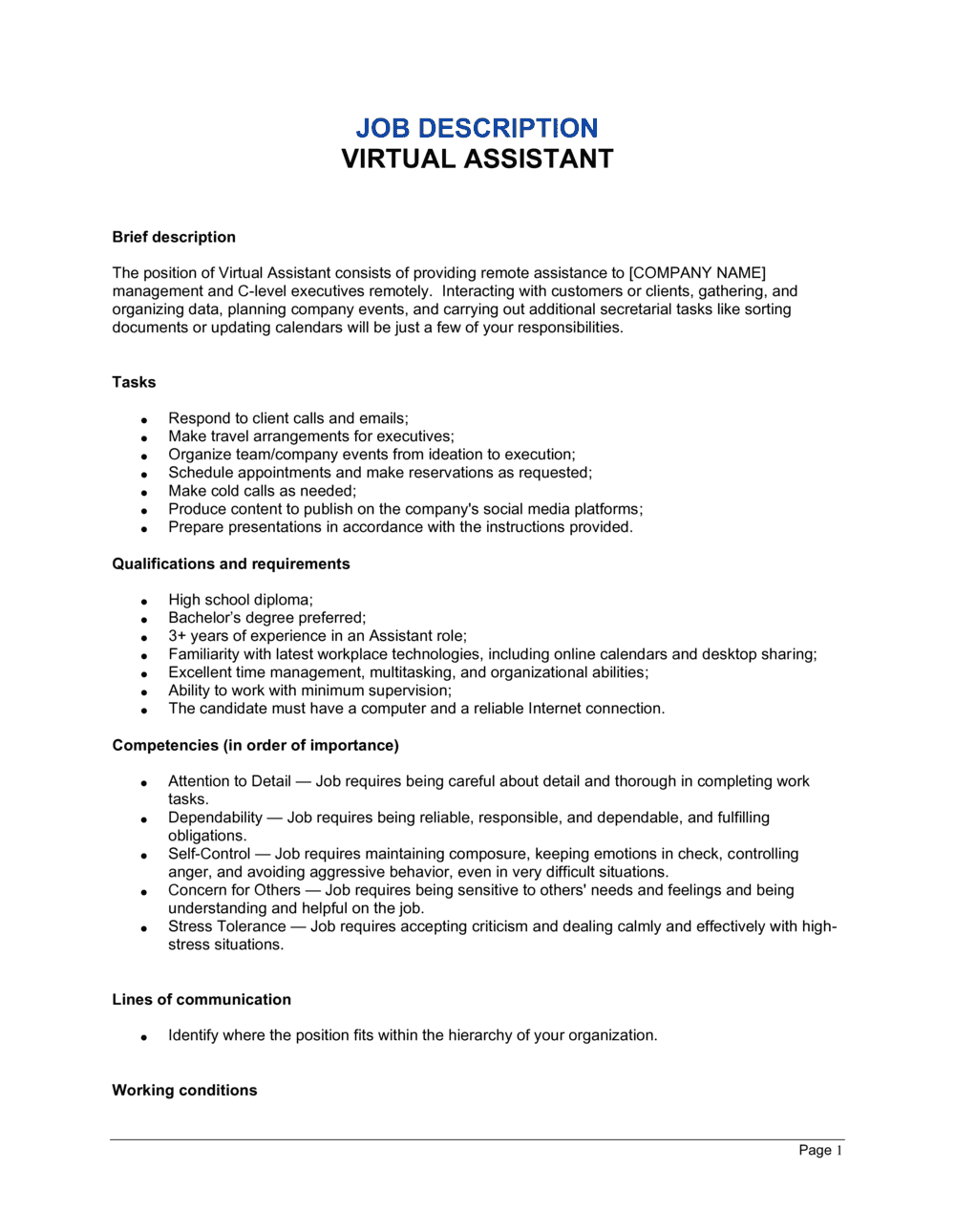
Virtual Assistant Job Description Template

Free Word download • Edit online • Save & share with Drive • Export to PDF

2 pages20–30 min to fillDifficulty: StandardSignature requiredLegal review recommended
Learn more ↓
FreeVirtual Assistant Job Description Template

At a glance

What it is
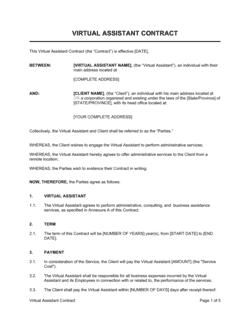
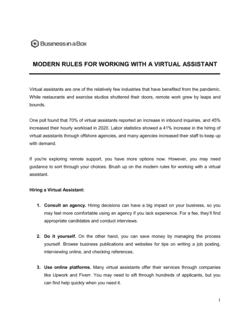
A Virtual Assistant Job Description is a binding document that defines the scope of work, compensation, confidentiality obligations, intellectual property ownership, and termination terms for a remote administrative support role. This free Word download gives you a complete, editable starting point you can tailor to your specific role and export as PDF for signature before work begins.
When you need it
Use it before engaging any remote assistant — whether as an employee or independent contractor — to establish clear expectations, protect confidential business information, and confirm who owns work product created during the engagement. It is also useful when converting an informal arrangement with an existing VA into a documented agreement.
What's inside
Role title and reporting structure, detailed duties and deliverables, compensation and payment schedule, working hours and availability windows, confidentiality and data-handling obligations, intellectual property assignment, termination and notice requirements, and governing law.

What is a Virtual Assistant Job Description?

A Virtual Assistant Job Description is a binding document that defines the full terms of a remote administrative support engagement — covering the VA's specific duties, compensation, working hours, confidentiality obligations, intellectual property ownership, system-access controls, and termination requirements. Unlike a simple posting or informal onboarding email, a properly drafted job description functions as a legal agreement that creates enforceable obligations on both the business and the VA before a single task is performed. It is used for both employment and independent contractor arrangements and is the primary document governing the day-to-day working relationship.

Why You Need This Document

Operating without a written, signed virtual assistant job description exposes your business on four fronts simultaneously. Without an IP assignment clause, any template, document, or content your VA creates may legally belong to them — not you — under default copyright rules in most common-law jurisdictions. Without a confidentiality clause, a former VA faces no contractual barrier to sharing your client lists, login credentials, or internal processes. Without defined duties and deliverables, you have no documented basis to manage performance or terminate for non-delivery. And without a credential-return obligation, a departing VA can retain access to your email, CRM, and social accounts indefinitely. This template closes all four gaps in under 30 minutes, and a single attorney review is typically sufficient for any engagement involving sensitive data or material intellectual property.

Which variant fits your situation?

If your situation is…Use this template
Engaging a VA as an independent contractor rather than an employeeIndependent Contractor Agreement
Hiring a full-time remote administrative employeeRemote Work Employment Agreement
Bringing on a social media VA to manage accounts and contentSocial Media Manager Job Description
Engaging a VA for a fixed project or short-term period onlyFixed-Term Employment Contract
Adding a non-disclosure layer without a full contractNon-Disclosure Agreement (NDA)
Hiring a VA through a staffing or outsourcing agencyStaffing Agency Agreement
Defining deliverables for a project-based VA engagementService Agreement

Common mistakes to avoid

❌ Misclassifying a VA as an independent contractor when they function as an employee

Why it matters: Tax authorities in the US, Canada, UK, and EU apply multi-factor tests to determine employment status. Misclassification triggers back payroll taxes, penalties, and potential benefit liability — all of which fall on the Client.

Fix: Review the IRS 20-factor test (US), CRA control test (Canada), or HMRC IR35 rules (UK) before finalizing the engagement type. If in doubt, engage a labor attorney or accountant before signing.

❌ No IP assignment clause

Why it matters: In most common-law jurisdictions, the creator of a work holds copyright by default. Without an explicit assignment clause, deliverables the VA was paid to produce may legally belong to them, not to the Client.

Fix: Include a clear, broad IP assignment clause covering all work product created in connection with the engagement, regardless of the device or platform used.

❌ Leaving login credentials and system access unaddressed

Why it matters: A former VA retaining access to business email, CRM, cloud storage, or social media accounts is one of the most common and costly operational risks in remote work arrangements.

Fix: Name every platform the VA will access in the contract, include an obligation to return or destroy credentials on termination, and revoke access on the final day of work — not after the notice period.

❌ Signing the agreement after the VA has already started work

Why it matters: In common-law jurisdictions, a VA already performing work has given nothing new in exchange for post-start-date restrictions. Courts have voided IP assignment, confidentiality, and non-solicitation clauses on this basis.

Fix: Execute the document before the VA's first task. If circumstances require a later signature, provide documented fresh consideration — a one-time bonus, a rate increase, or additional benefits.

❌ Defining duties too vaguely

Why it matters: A job description that simply says 'administrative support' gives the Client no basis to assess performance, hold the VA accountable for specific deliverables, or terminate for non-performance.

Fix: List each recurring task with a concrete output and quality standard. Attach a Schedule A for detailed SOPs if the role involves more than five distinct task types.

❌ Omitting a non-solicitation clause for client and staff contacts

Why it matters: A VA with access to your full customer list and employee contact details can redirect those relationships immediately after leaving, with no legal mechanism to prevent it.

Fix: Include a non-solicitation clause covering direct clients, referral sources, and internal team members for at least 12 months post-termination, calibrated to the VA's actual level of contact.

The 10 key clauses, explained

Parties, role title, and engagement type

In plain language: Identifies the business and the VA by full legal name, states the job title, and specifies whether the arrangement is employment or independent contracting.

Sample language
This Virtual Assistant Job Description and Agreement is entered into on [DATE] between [BUSINESS LEGAL NAME] ('Client') and [VA FULL NAME / COMPANY NAME] ('Virtual Assistant'). The Virtual Assistant is engaged as a [EMPLOYMENT TYPE] in the role of [JOB TITLE], commencing [START DATE].

Common mistake: Using a trade name instead of the registered legal entity. If the Client entity name doesn't match payment records, IP assignment and confidentiality clauses may be difficult to enforce against the correct party.

Duties and deliverables

In plain language: Lists the specific tasks the VA is expected to perform, the expected output quality or volume, and any tools or platforms they will use.

Sample language
The Virtual Assistant shall perform the following duties: (a) manage [CLIENT]'s email inbox and respond within [X] business hours; (b) schedule and confirm calendar appointments using [PLATFORM]; (c) prepare weekly reports in [FORMAT]; and (d) such other tasks as mutually agreed in writing.

Common mistake: Writing duties so broadly that any task can be assigned without limit. Equally, listing duties so narrowly that adding a reasonable new task requires a formal amendment.

Compensation, invoicing, and payment schedule

In plain language: States the hourly rate or fixed retainer, how and when the VA invoices, and the payment deadline.

Sample language
Client shall pay the Virtual Assistant [an hourly rate of $[X] / a monthly retainer of $[X]], invoiced [weekly / bi-weekly / monthly] in arrears. Payment is due within [NET 15 / NET 30] of receipt of a valid invoice. Late payments accrue interest at [X]% per month.

Common mistake: Omitting a late-payment interest clause. Without it, the VA has no contractual mechanism to charge for delayed payment beyond chasing manually.

Working hours, availability, and response times

In plain language: Defines when the VA is expected to be available, their core working hours, time zone, and maximum response time for communications.

Sample language
The Virtual Assistant shall be available during [HOURS] [TIME ZONE] on [DAYS]. The Virtual Assistant shall respond to communications from Client within [X] business hours during availability windows.

Common mistake: Leaving availability undefined and assuming overlap. A VA in a different time zone working non-overlapping hours can cause serious operational delays if response expectations are not written down.

Confidentiality and data handling

In plain language: Prohibits the VA from disclosing or misusing any confidential business information — including login credentials, client data, financial records, and internal processes — during and after the engagement.

Sample language
The Virtual Assistant shall not, during or after this engagement, disclose or use any Confidential Information of the Client without prior written consent. 'Confidential Information' includes login credentials, client data, financial records, internal processes, and any other non-public business information.

Common mistake: Relying on a generic NDA signed separately without incorporating confidentiality obligations into the job description itself. If the NDA and job description conflict, the VA can exploit the gap.

Intellectual property assignment

In plain language: Transfers ownership of all work product — documents, templates, graphics, code, and other deliverables — created by the VA in connection with the engagement to the Client.

Sample language
All work product, documents, templates, content, and deliverables created by the Virtual Assistant in the course of this engagement are the sole property of the Client and are hereby irrevocably assigned to the Client upon creation.

Common mistake: No IP assignment clause at all. By default in many jurisdictions, the creator of a work retains copyright — without an explicit assignment, the VA may own deliverables they were paid to produce.

Tools, equipment, and system access

In plain language: Specifies which tools and platforms the Client will provide versus what the VA is expected to supply, and how access credentials are handled and revoked.

Sample language
Client shall provide access to [TOOLS / PLATFORMS] via [METHOD]. The Virtual Assistant shall not use Client credentials for any purpose outside the scope of this engagement. Upon termination, the Virtual Assistant shall immediately return or destroy all access credentials and Client-owned materials.

Common mistake: Not including a credential-return obligation. A former VA retaining access to business email, CRM, or social accounts is a common and costly security risk.

Non-solicitation

In plain language: Restricts the VA from approaching the Client's customers, employees, or contractors directly for personal gain during and for a defined period after the engagement.

Sample language
For [12] months following termination, the Virtual Assistant shall not solicit or accept business from any customer or client of [CLIENT] with whom the Virtual Assistant had contact during the engagement, nor solicit any employee or contractor of [CLIENT].

Common mistake: Omitting a non-solicitation clause entirely. A VA with access to your full client list and internal team contacts can redirect relationships quickly without one.

Termination, notice, and offboarding

In plain language: States how either party may end the engagement, the notice period required, grounds for immediate termination for cause, and the final payment and handover process.

Sample language
Either party may terminate this Agreement with [14 days'] written notice. Client may terminate immediately for Cause, defined as a material breach including confidentiality violation, misconduct, or failure to deliver. Upon termination, the Virtual Assistant shall complete a structured handover within [X] business days and return all Client materials.

Common mistake: No structured offboarding requirement. Without a handover clause, a departing VA can leave processes, passwords, and in-progress tasks completely undocumented.

Governing law and dispute resolution

In plain language: Specifies which jurisdiction's law governs the agreement and how disputes are resolved — negotiation, mediation, arbitration, or court.

Sample language
This Agreement is governed by the laws of [STATE / PROVINCE / COUNTRY]. Any dispute arising under this Agreement shall first be addressed through good-faith negotiation for [30] days, after which either party may pursue [ARBITRATION / MEDIATION / COURT] in [VENUE].

Common mistake: Choosing a governing law with no connection to where either party works. Some jurisdictions — including several US states and EU member countries — apply local employment law regardless of what the contract specifies.

How to fill it out

  1. 1

    Identify the parties and engagement type

    Enter the Client's full registered legal name and the VA's legal name or trading entity. Clearly state whether the arrangement is employment or independent contracting — this single classification determines tax obligations, benefit entitlements, and termination rights.

    💡 If you are unsure whether the arrangement qualifies as employment or contracting in your jurisdiction, the IRS common-law test (US) or IR35 rules (UK) are the starting point — misclassification triggers back taxes and penalties.

  2. 2

    Define duties with specific, measurable tasks

    List every recurring task the VA will perform, the expected output quality or volume, and the tools or platforms they will use. Attach a Schedule A for detailed standard operating procedures if the role is complex.

    💡 Use action verbs and concrete outputs — 'respond to customer emails within 4 business hours using Zendesk' rather than 'handle customer communications.'

  3. 3

    Set compensation, invoicing cadence, and late-payment terms

    Enter the hourly rate or retainer amount, the invoicing schedule (weekly, bi-weekly, or monthly), the payment deadline (Net 15 or Net 30), and an interest rate for late payments.

    💡 State the currency explicitly — USD, CAD, GBP, EUR — especially for cross-border engagements where exchange rate assumptions can create disputes.

  4. 4

    Confirm availability windows and time zone

    Write out the VA's core available hours, the time zone those hours apply to, and the maximum response time for communications. If the VA is in a significantly different time zone, specify whether overlap hours are required.

    💡 A 2-hour overlap window in real time often matters more than total hours — build it into the clause if your business requires same-day turnaround.

  5. 5

    Complete the confidentiality and data-handling clause

    Define 'Confidential Information' specifically to include login credentials, client lists, financial data, and internal processes. Add a GDPR data processing addendum if the VA will handle personal data of EU residents.

    💡 List the specific platforms and data types the VA will access — vague confidentiality clauses are harder to enforce than specific ones.

  6. 6

    Insert the IP assignment and tools-access terms

    Confirm that all deliverables are assigned to the Client upon creation. List the tools the Client will provide access to and include an explicit obligation to return or destroy credentials on termination.

    💡 Revoke system access on the same day the engagement ends — not after the notice period — to prevent inadvertent data access.

  7. 7

    Set termination notice and offboarding requirements

    Choose a notice period (14 days is standard for VA roles), define what constitutes cause for immediate termination, and specify the handover deliverables — documented processes, outstanding tasks, and credential return.

    💡 Build the handover checklist into the contract as a Schedule B so both parties know exactly what 'complete offboarding' looks like before the engagement starts.

  8. 8

    Execute before the first day of work

    Both parties should sign before the VA performs any task. Post-start-date signatures raise a fresh-consideration problem in common-law jurisdictions, potentially voiding IP assignment and non-solicitation clauses.

    💡 Use an e-signature tool to timestamp execution and create a tamper-evident record — this is critical if confidentiality or IP ownership is ever disputed.

Frequently asked questions

What is a virtual assistant job description?

A virtual assistant job description is a document — and typically a binding agreement — that defines the scope of work, compensation, availability, confidentiality obligations, and termination terms for a remote administrative support role. It serves two purposes: communicating role expectations to a prospective VA, and creating enforceable legal obligations once signed. A well-drafted document protects both the business and the VA by eliminating ambiguity before work begins.

Should a virtual assistant be classified as an employee or an independent contractor?

Classification depends on the degree of control the business exercises over how, when, and where the work is performed. If you set the VA's hours, require them to use specific tools, and direct their day-to-day tasks in detail, most tax authorities will treat the relationship as employment — regardless of what the contract says. The IRS 20-factor test (US), CRA control test (Canada), and HMRC IR35 rules (UK) are the primary frameworks. Misclassification exposes the Client to back payroll taxes, penalties, and benefit liability. When in doubt, consult a labor attorney or accountant before signing.

Who owns the work a virtual assistant produces?

Without an explicit IP assignment clause, the VA typically retains copyright in work they create under the laws of most common-law jurisdictions. This means documents, templates, graphics, and other deliverables may legally belong to the VA — not the business that paid for them. Including a clear IP assignment clause in the job description and agreement transfers ownership to the Client upon creation and eliminates this risk.

What should a virtual assistant job description include?

At minimum: the parties and engagement type (employment or contracting), job title, specific duties and deliverables, compensation and invoicing terms, availability and response-time expectations, confidentiality and data-handling obligations, IP assignment, tools and system access with credential-return obligations, a non-solicitation clause, termination notice period with offboarding requirements, and governing law. Missing any of these creates enforceable gaps courts will fill using jurisdiction-specific defaults.

Is a virtual assistant job description legally binding?

A signed virtual assistant job description that includes offer, acceptance, and consideration — typically the agreed fee — is generally enforceable as a contract in most jurisdictions. The document functions as both a role descriptor and a binding agreement when properly executed before work begins. Post-start-date signatures may reduce the enforceability of restrictive clauses like IP assignment and non-solicitation in common-law jurisdictions.

What notice period is standard for a virtual assistant engagement?

For most VA arrangements, 14 days is the standard notice period — long enough to allow a structured handover without leaving either party exposed for an extended period. For longer-tenured or more senior VA roles with deep operational access, 30 days is common. Always include grounds for immediate termination for cause — covering confidentiality breaches, misconduct, or material failure to deliver — alongside the standard notice period.

Do I need an NDA in addition to a virtual assistant job description?

If your job description includes a comprehensive confidentiality clause that clearly defines Confidential Information and the VA's obligations, a separate NDA is typically redundant. However, some businesses require a standalone NDA signed before sharing any sensitive information during the hiring process — before the full job description is executed. In that case, the NDA covers the pre-engagement period and the job description governs the engagement itself.

How do I handle a virtual assistant working in a different country?

Cross-border VA arrangements require careful attention to governing law, tax obligations, and worker classification. Specify the governing jurisdiction in the contract, confirm whether the VA's home country imposes local employment protections regardless of the contract terms, and determine whether the Client has any payroll withholding or social contribution obligations in the VA's country. EU-based VAs processing personal data trigger GDPR obligations — a data processing agreement is typically required in addition to the main contract.

Can I use a virtual assistant job description template without a lawyer?

For straightforward domestic VA engagements, a high-quality template covers the essential terms and is a significant improvement over an informal arrangement. Consider engaging a lawyer when the VA will access highly sensitive data (financial records, medical information, legal files), when the engagement spans multiple jurisdictions, when significant IP is at stake, or when the VA's classification as contractor versus employee is genuinely ambiguous. A one-hour review typically costs $150–$400 and is worthwhile for engagements involving material business risk.

How this compares to alternatives

vs Independent Contractor Agreement

An independent contractor agreement is a general-purpose engagement contract for any self-employed service provider. A virtual assistant job description combines role-specific task definitions, availability requirements, and system-access protocols that a generic contractor agreement typically omits. Use the contractor agreement when the engagement is project-based and output-focused; use the VA job description when the role involves ongoing access to systems, data, and client communications.

vs Remote Work Employment Agreement

A remote work employment agreement governs a full-time employee who works from home, with all associated employment entitlements — paid leave, benefits, and statutory notice. A virtual assistant job description typically covers a contractor or part-time engagement with no employment entitlements. The classification determines which document is appropriate, and misapplying one to the other creates significant legal and tax exposure.

vs Non-Disclosure Agreement (NDA)

An NDA covers only confidentiality — it does not address duties, compensation, IP ownership, or termination. A virtual assistant job description includes confidentiality obligations as one clause within a comprehensive engagement framework. Use a standalone NDA before sharing sensitive information during the hiring process; use the job description as the binding governing document once the engagement begins.

vs Service Agreement

A service agreement defines deliverables, fees, and terms for a one-time or project-based engagement. A virtual assistant job description is better suited for ongoing, role-based arrangements with recurring tasks, defined availability windows, and system access. If the VA engagement is scoped to a single project with a clear end date, a service agreement may be the more appropriate document.

Industry-specific considerations

E-commerce and retail

VAs managing product listings, order tracking, and customer service inboxes require explicit data-access boundaries and platform credential protocols given direct access to payment and customer data.

Professional services

Law firms, accountancies, and consultancies use VAs for scheduling, document preparation, and client communication — roles that demand heightened confidentiality clauses given privileged client information.

SaaS and technology

Tech startups engaging VAs for admin, customer success support, or data entry need robust IP assignment clauses and specific restrictions on access to source code repositories and product roadmaps.

Healthcare

Medical practices and health-tech firms engaging VAs for patient scheduling or billing must include HIPAA-compliant data handling obligations and, for EU patients, a GDPR data processing addendum.

Real estate

Real estate professionals use VAs for MLS data entry, lead follow-up, and transaction coordination — roles with direct access to client financial and property data that require specific confidentiality and access controls.

Marketing and creative agencies

Agencies engaging VAs for social media management, content scheduling, and client reporting need clear IP assignment over content created, plus non-solicitation clauses covering direct client relationships.

Jurisdictional notes

United States

Worker classification is the primary legal risk in the US. The IRS 20-factor common-law test and the DOL economic reality test both apply depending on context. California applies the ABC test under AB5, which presumes employment unless the business can prove all three prongs — making true contractor VA arrangements harder to sustain in that state. Non-solicitation clauses for contractors are generally enforceable if reasonable in scope, though California limits their use even for non-employees.

Canada

Canada's CRA applies a multi-factor control test to distinguish employees from contractors. Provincial employment standards acts set minimum obligations that apply regardless of how the contract is labeled — including in Ontario, British Columbia, and Quebec. Quebec requires contracts to be in French for provincially-regulated employers and applies the Civil Code rather than common law. VA arrangements classified as employment trigger provincial minimum wage, overtime, and notice obligations.

United Kingdom

UK employment law recognizes three worker categories: employee, worker, and independent contractor. VAs engaged through a personal service company fall under IR35 if the client controls how and when work is performed, shifting employer NIC obligations to the client. The mutuality-of-obligation test means regular ongoing VA arrangements can imply worker or employee status even under a contractor label. Post-termination non-solicitation clauses must be reasonable in scope to be enforceable.

European Union

GDPR obligations apply whenever a VA handles personal data of EU residents — a data processing agreement (DPA) is required in addition to the main contract. Several EU member states, including France, Germany, and Spain, presume employment for ongoing service relationships with a single client, which can expose the business to local labor protections. Non-compete and non-solicitation clauses typically require financial compensation to the VA to be enforceable under local law.

Template vs lawyer — what fits your deal?

PathBest forCostTime
Use the templateStandard domestic VA engagements for administrative, scheduling, and inbox management tasksFree20–30 minutes
Template + legal reviewCross-border engagements, roles with access to sensitive client data, or arrangements where contractor classification is borderline$150–$400 for a one-hour attorney review1–3 days
Custom draftedVA roles with access to regulated data (HIPAA, GDPR), executive-level responsibilities, or equity and revenue-share components$800–$2,500+1–2 weeks

Glossary

Virtual Assistant (VA)
A remote worker who provides administrative, operational, or specialist support services to a business or individual, typically via internet-based tools.
Independent Contractor
A self-employed individual engaged to perform specific services under a contract, with no entitlement to employee benefits such as paid leave or employer tax contributions.
Scope of Work
The defined set of tasks, deliverables, and responsibilities the VA is expected to perform within a given engagement period.
Confidential Information
Any non-public business data — including client lists, financial records, login credentials, and internal processes — that the VA may access during the engagement.
IP Assignment
A contractual clause transferring ownership of work product, documents, and other intellectual property created by the VA to the engaging business.
Termination for Cause
Ending the engagement immediately due to a specific breach — such as a confidentiality violation, failure to deliver, or misconduct — without notice or final payment beyond work completed.
Notice Period
The minimum advance warning either party must give before ending the engagement, typically expressed in days or weeks.
Right to Substitute
A provision in contractor arrangements allowing the VA to send a qualified replacement to perform the services — a factor courts use to distinguish contractors from employees.
Non-Solicitation Clause
A restriction preventing the VA from approaching the client's customers, employees, or suppliers for personal gain during and after the engagement.
Data Processing Agreement (DPA)
A supplementary document required when the VA handles personal data subject to GDPR or similar privacy laws, defining data-handling obligations and liability.
Mutuality of Obligation
The legal test in UK and some Commonwealth employment law that determines whether a working relationship constitutes employment — if each party is obligated to offer and accept work, employment may be implied.

Part of your Business Operating System

This document is one of 3,000+ business & legal templates included in Business in a Box.

  • Fill-in-the-blanks — ready in minutes
  • 100% customizable Word document
  • Compatible with all office suites
  • Export to PDF and share electronically

Create your document in 3 simple steps.

From template to signed document — all inside one Business Operating System.
1
Download or open template

Access over 3,000+ business and legal templates for any business task, project or initiative.

2
Edit and fill in the blanks with AI

Customize your ready-made business document template and save it in the cloud.

3
Save, Share, Send, Sign

Share your files and folders with your team. Create a space of seamless collaboration.

Save time, save money, and create top-quality documents.

★★★★★

"Fantastic value! I'm not sure how I'd do without it. It's worth its weight in gold and paid back for itself many times."

Managing Director · Mall Farm
Robert Whalley
Managing Director, Mall Farm Proprietary Limited
★★★★★

"I have been using Business in a Box for years. It has been the most useful source of templates I have encountered. I recommend it to anyone."

Business Owner · 4+ years
Dr Michael John Freestone
Business Owner
★★★★★

"It has been a life saver so many times I have lost count. Business in a Box has saved me so much time and as you know, time is money."

Owner · Upstate Web
David G. Moore Jr.
Owner, Upstate Web

Run your business with a system — not scattered tools

Stop downloading documents. Start operating with clarity. Business in a Box gives you the Business Operating System used by over 250,000 companies worldwide to structure, run, and grow their business.

Free Forever Plan · No credit card required