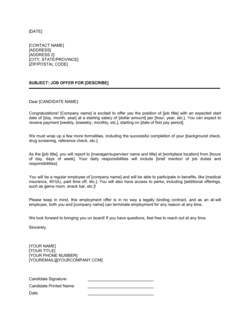
Paralegal and Legal Assistant Job Description Template

Free Word download • Edit online • Save & share with Drive • Export to PDF

2 pages20–30 min to fillDifficulty: StandardSignature requiredLegal review recommended
Learn more ↓
FreeParalegal and Legal Assistant Job Description Template

At a glance

What it is
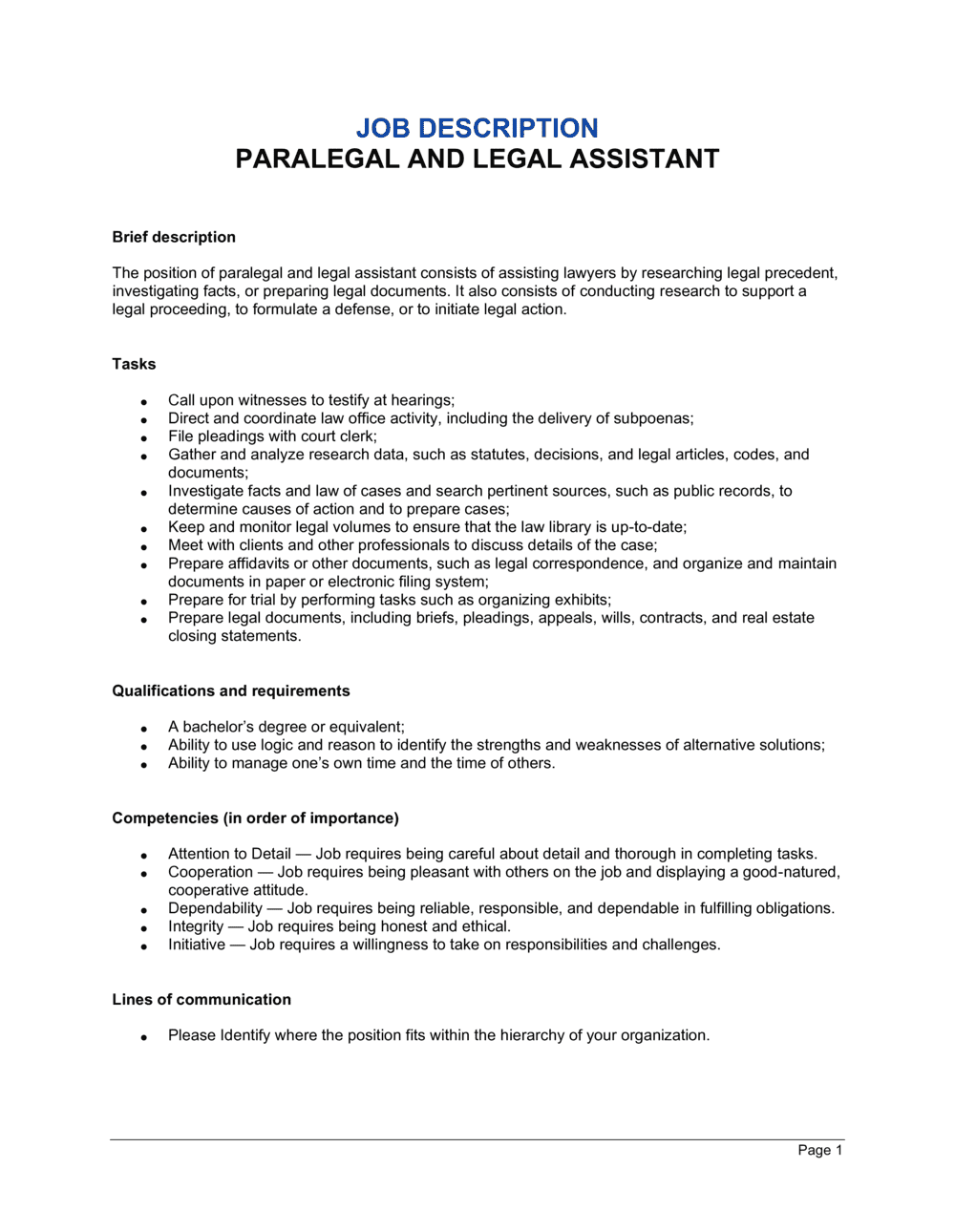
A Paralegal and Legal Assistant Job Description is a formal document that defines the role, responsibilities, required qualifications, reporting structure, and compensation expectations for a legal support professional within a law firm, corporate legal department, or government agency. This free Word download gives you a structured, ready-to-post template you can edit online and export as PDF for internal approval and public job postings.
When you need it
Use it when opening a new paralegal or legal assistant position, backfilling a vacated role, restructuring your legal support team, or standardizing inconsistent role definitions across a multi-office practice.
What's inside
Role title and reporting structure, summary of position purpose, detailed duties and responsibilities, required and preferred qualifications, technical competencies, compensation range, and employment classification. The template also includes an acknowledgment block for the hiring manager and candidate to sign.

What is a Paralegal and Legal Assistant Job Description?

A Paralegal and Legal Assistant Job Description is a formal employment document that defines the title, duties, qualifications, reporting structure, compensation, and scope limitations for a legal support professional working under attorney supervision. Unlike a generic job posting, a properly drafted legal job description includes an unauthorized practice of law (UPL) boundary clause — specifying which tasks require attorney review before delivery to clients or courts — along with FLSA classification language, billable-hour expectations, and a signed acknowledgment block that becomes part of the employment record. This template is a free Word download you can edit online and export as PDF for internal approvals and public job postings.

Why You Need This Document

Hiring a paralegal or legal assistant without a clear, signed job description creates four compounding risks. First, undefined UPL boundaries expose the firm and supervising attorney to state bar disciplinary action if the paralegal oversteps into legal advice territory. Second, an FLSA misclassification — treating a non-exempt paralegal as salaried exempt — can generate back-pay liability for every overtime hour worked without compensation. Third, in a growing number of US states and Canadian provinces, posting a role without a salary range violates pay transparency laws and triggers regulatory penalties. Fourth, without a signed description establishing mutual expectations, performance management and termination proceedings rest on contested verbal understandings rather than documented agreement. A completed, executed job description closes all four gaps before the employee's first day — and this template gives you the structure to do it in under an hour.

Which variant fits your situation?

If your situation is…Use this template
Hiring a paralegal for a litigation-focused practiceLitigation Paralegal Job Description
Recruiting a corporate transactional paralegalCorporate Paralegal Job Description
Posting a senior or supervising paralegal roleSenior Paralegal Job Description
Hiring administrative legal support with no case management dutiesLegal Secretary Job Description
Engaging a paralegal as an independent contractor rather than an employeeIndependent Contractor Agreement
Formalizing the hire after a candidate accepts the roleEmployment Contract
Posting a law clerk or summer associate role at a firmLaw Clerk Job Description

Common mistakes to avoid

❌ Omitting the UPL boundary clause

Why it matters: Without explicit scope language, a paralegal who provides legal advice — even informally — exposes the firm to state bar disciplinary action and potential malpractice liability.

Fix: Add a dedicated clause specifying which outputs require attorney sign-off and expressly prohibiting independent legal advice or client representation.

❌ Conflating 'Paralegal' and 'Legal Assistant' titles

Why it matters: Using both titles interchangeably in a single posting confuses candidates about scope and may mismatch compensation to the actual role in jurisdictions where the titles carry distinct regulatory meaning.

Fix: Decide which title governs the role, define it in the position summary, and use it consistently throughout the document.

❌ Setting an FLSA classification without confirming the exemption test

Why it matters: Misclassifying a paralegal as FLSA exempt when they do not meet the learned professional exemption test exposes the employer to back-pay claims for unpaid overtime.

Fix: Apply the FLSA duties test — most paralegals do not qualify as learned professionals and should be classified non-exempt. Consult an employment attorney if uncertain.

❌ Publishing a job description without a salary range in states that require it

Why it matters: Colorado, New York, California, and Washington, among others, require salary range disclosure on job postings. Non-compliance triggers regulatory penalties and reputational risk.

Fix: Research pay transparency laws in every state and province where the role will be posted and add a salary range before publishing.

❌ Treating the signature block as optional

Why it matters: An unsigned job description carries far less evidentiary weight in performance management disputes or wrongful termination claims — courts and arbitrators look for documented mutual agreement.

Fix: Route the document for signature before the employee's first day and store the executed copy in the personnel file alongside the employment contract.

❌ Omitting billable-hour targets for revenue-generating roles

Why it matters: Paralegals hired without a stated billing expectation frequently fall short of firm profitability targets, creating friction that could have been avoided with upfront clarity.

Fix: State the monthly billable-hour target explicitly and reference the timekeeping system used to track it.

The 9 key clauses, explained

Position title and classification

In plain language: States the official job title, FLSA classification (exempt or non-exempt), employment type (full-time, part-time, or contract), and the practice group or department the role sits within.

Sample language
Position: Paralegal — Litigation Practice Group | Classification: Non-Exempt, Full-Time | Reports to: [SUPERVISING ATTORNEY NAME / TITLE] | Department: [PRACTICE GROUP NAME]

Common mistake: Using the title 'Paralegal' and 'Legal Assistant' interchangeably in the same posting without defining the distinction. This creates confusion during screening and may attract candidates mismatched to the actual scope.

Position summary

In plain language: A 3–5 sentence overview of the role's primary purpose, the types of matters supported, and the level of independence expected.

Sample language
The Paralegal supports the [PRACTICE GROUP] team with legal research, document drafting, case file management, and client coordination. Working under the supervision of [SUPERVISING ATTORNEY TITLE], this role handles [MATTER TYPE] from intake through resolution, exercising independent judgment on procedural tasks while escalating substantive legal questions to the supervising attorney.

Common mistake: Writing a position summary so generic that it could apply to any administrative role. A specific summary — naming practice area, matter types, and supervision model — filters applicants more effectively.

Duties and responsibilities

In plain language: A detailed, prioritized list of the tasks the paralegal is expected to perform day-to-day, from substantive legal work to administrative coordination.

Sample language
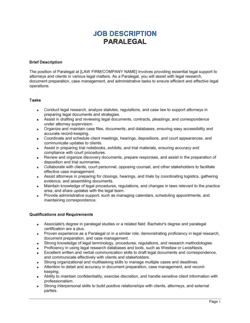
Primary duties include: (a) drafting and proofreading pleadings, motions, and correspondence; (b) conducting legal research using Westlaw and LexisNexis; (c) managing docket deadlines and court filing calendars; (d) coordinating discovery and organizing document productions; (e) maintaining client files in [CASE MANAGEMENT SOFTWARE]; (f) communicating with clients, courts, and opposing counsel under attorney supervision.

Common mistake: Listing duties without signaling relative priority or time allocation. Candidates cannot self-assess fit when every bullet carries equal weight.

Required qualifications

In plain language: The minimum education, experience, and certification a candidate must have to be considered for the role.

Sample language
Required: (a) Associate's or Bachelor's degree in paralegal studies or a related field, or equivalent experience; (b) minimum [X] years of paralegal experience in [PRACTICE AREA]; (c) proficiency in [CASE MANAGEMENT SOFTWARE] and Microsoft Office Suite; (d) demonstrated knowledge of [STATE/PROVINCE] court filing procedures.

Common mistake: Setting experience requirements so high that qualified candidates self-select out. Distinguish genuinely required baseline qualifications from preferred attributes that the firm can train.

Preferred qualifications

In plain language: Credentials and experience that would make a candidate more competitive but are not mandatory — certifications, specialized software, or second-language ability.

Sample language
Preferred: (a) NALA Certified Paralegal (CP) or NFPA Registered Paralegal (RP) credential; (b) experience with [SPECIFIC LEGAL SOFTWARE, e.g., Clio, iManage, or Relativity]; (c) prior experience in [SPECIFIC MATTER TYPE, e.g., commercial litigation, M&A transactions]; (d) bilingual proficiency in [LANGUAGE].

Common mistake: Treating preferred qualifications as effectively required during screening, eliminating otherwise strong candidates who lack a certification that can be obtained after hire.

Supervisory obligations and UPL boundaries

In plain language: Defines the supervision structure, clarifies which tasks require attorney review before delivery to clients or courts, and expressly prohibits the employee from providing independent legal advice.

Sample language
All work product prepared by the Paralegal shall be reviewed and approved by a licensed attorney before delivery to any client, court, or third party. The Paralegal shall not provide legal advice, represent clients in any proceeding, or exercise independent legal judgment on matters of substantive law. All client communications involving legal strategy must be directed to [SUPERVISING ATTORNEY TITLE].

Common mistake: Omitting the UPL boundary clause entirely. Without explicit scope language, firms face unauthorized practice of law exposure and state bar disciplinary risk if a paralegal oversteps.

Compensation, benefits, and billing expectations

In plain language: States the salary range or hourly rate, bonus eligibility, benefits package, and — where applicable — any billable-hour target the paralegal is expected to meet.

Sample language
Compensation: $[MIN] – $[MAX] per year (or $[X]/hour), commensurate with experience. Annual discretionary bonus eligible. Benefits: [BENEFITS SUMMARY]. Billable hour target: [X] hours per month, tracked in [TIMEKEEPING SYSTEM].

Common mistake: Omitting the billable-hour target for revenue-generating paralegal roles. Paralegals hired without clarity on billing expectations frequently underperform on firm profitability metrics.

Working conditions and location

In plain language: Describes physical work requirements, remote-work eligibility, travel expectations, and any after-hours availability obligations — such as filing deadlines or client emergencies.

Sample language
This position is [on-site / hybrid / remote], based at [OFFICE LOCATION]. Occasional extended hours may be required to meet court filing deadlines. Travel to [COURTS / CLIENT SITES / OTHER OFFICES] is required approximately [X]% of the time.

Common mistake: Describing the role as fully remote without disclosing that in-person court attendance or client meetings may be required occasionally. This leads to disputes and early attrition.

Acknowledgment and signature block

In plain language: A section where both the hiring manager and the candidate confirm they have read and understood the job description, and that it accurately reflects the role's expectations.

Sample language
I have read and understand the duties and expectations described above and confirm that this job description accurately reflects the position as it will be performed. Employee Signature: _______________ Date: ___ | Hiring Manager Signature: _______________ Date: ___

Common mistake: Treating the signature block as optional. A signed job description becomes part of the employment record and is critical evidence in performance management or wrongful termination disputes.

How to fill it out

  1. 1

    Define the position title and classification

    Enter the exact job title, confirm whether the role is classified as FLSA exempt or non-exempt, and identify the practice group or department. Check whether your jurisdiction has specific rules about paralegal title usage.

    💡 In Canada and several US states, the title 'Paralegal' carries a regulated meaning — confirm local requirements before posting.

  2. 2

    Write a specific position summary

    Draft a 3–5 sentence summary naming the practice area, the types of matters the paralegal will support, and the supervision model. Avoid generic language like 'provides legal support' without specifying to whom and in what context.

    💡 Include the case management software the firm uses — candidates who already know Clio, iManage, or Filevine are meaningfully faster to onboard.

  3. 3

    List duties in priority order

    Organize responsibilities from most time-intensive to least. Group related tasks — all research duties together, all docket and calendar duties together — so candidates can quickly assess whether the role matches their experience.

    💡 Aim for 8–12 duty bullets. Fewer than 6 looks skeletal; more than 15 looks unmanageable and discourages strong candidates.

  4. 4

    Set minimum and preferred qualifications separately

    Enter the non-negotiable minimum — degree, years of experience, specific software — in the required block. Move certifications, specialized experience, and language skills to preferred. This two-tier structure increases your qualified applicant pool.

    💡 Data consistently shows that women apply for jobs only when they meet ~100% of listed requirements, while men apply at ~60%. Keeping required qualifications to the true minimum broadens your candidate pool.

  5. 5

    Insert the UPL boundary and supervision clause

    Confirm the clause naming the supervising attorney title, specifying which outputs require attorney review before delivery, and expressly prohibiting independent legal advice. Tailor it to the specific tasks in the duties section.

    💡 Have the supervising attorney review this clause specifically — they bear professional responsibility for the paralegal's work product.

  6. 6

    Enter compensation and billable-hour targets

    Add the salary range or hourly rate and confirm that any bonus is described as discretionary. If the role has a billable-hour target, state it as a monthly or annual number and name the timekeeping system.

    💡 Publishing a salary range in the posting reduces time-to-hire and reduces salary negotiation friction — increasingly required by law in several US states and Canadian provinces.

  7. 7

    Obtain signatures before the start date

    Route the completed job description to the hiring manager and the candidate for signature before the employee's first day. File the signed copy in the personnel record alongside the employment contract.

    💡 A signed job description is your first line of defense in a performance-improvement or termination proceeding — it establishes mutual agreement on expectations from day one.

Frequently asked questions

Do paralegals need to be supervised by an attorney?

Yes, in all major jurisdictions paralegals must work under the supervision of a licensed attorney and may not provide independent legal advice or represent clients in proceedings (except in jurisdictions like Ontario, where licensed paralegals can appear in certain courts). The supervising attorney retains professional responsibility for the paralegal's work product. This supervision requirement should be expressly stated in the job description to reduce unauthorized practice of law risk.

Is a paralegal job description a legally binding document?

A job description is generally not a standalone binding contract, but once signed by both the hiring manager and the employee, it becomes part of the employment record and carries significant evidentiary weight in performance management, disciplinary proceedings, and wrongful termination claims. It should be used alongside — not instead of — a formal employment contract.

What qualifications should I require for a paralegal role?

At minimum, most firms require an associate's or bachelor's degree in paralegal studies or a related field (or equivalent experience), proficiency in the firm's case management and timekeeping software, and knowledge of the applicable court filing procedures. Preferred qualifications typically include a NALA Certified Paralegal (CP) or NFPA Registered Paralegal (RP) credential and experience in the specific practice area. Required and preferred qualifications should be listed separately to maximize the qualified applicant pool.

Should I include a salary range in a paralegal job posting?

Yes — both for legal compliance and practical efficiency. Colorado, New York, California, Washington, and several other US states and Canadian provinces legally require salary range disclosure on job postings. Beyond compliance, postings with a stated salary range generate more qualified applicants and reduce time spent screening candidates whose compensation expectations are misaligned with the role.

How is a paralegal typically classified under the FLSA?

Most paralegals are classified as non-exempt under the FLSA and are entitled to overtime pay at 1.5× their regular rate for hours over 40 per week. The learned professional exemption — which covers attorneys — generally does not apply to paralegals because the role does not require a law license. Misclassifying a paralegal as exempt exposes the employer to back-pay liability and penalties. Confirm classification with an employment attorney if the role has hybrid administrative and legal duties.

What is unauthorized practice of law and why does it matter in a job description?

Unauthorized practice of law (UPL) occurs when a non-licensed individual provides legal advice, drafts legal instruments independently, or represents a client in a legal proceeding. A job description that fails to define the boundary between permissible paralegal tasks and attorney-exclusive functions creates UPL risk for the firm and the individual. Including an explicit UPL clause — stating that all substantive outputs require attorney review before delivery — is one of the most important protective elements in a paralegal job description.

Can I use the same job description for both a paralegal and a legal assistant?

Generally no. While there is overlap in administrative tasks, the substantive legal work performed by a paralegal — research, drafting, discovery management — differs materially from the procedural support of a legal assistant. Using a single undifferentiated description creates mismatched compensation benchmarks, classification uncertainty, and unclear scope expectations. Draft separate descriptions for each role, even if they share a common benefits and reporting structure.

How this compares to alternatives

vs Legal Secretary Job Description

A legal secretary job description covers administrative and clerical support — scheduling, correspondence, filing, and court logistics — with no substantive legal work component. A paralegal job description includes substantive tasks such as legal research, drafting pleadings, and case management. The distinction determines compensation benchmarks, FLSA classification, and the scope of UPL risk language required.

vs Employment Contract

A job description defines the role's duties, qualifications, and performance expectations. An employment contract creates the legally binding employment relationship — covering compensation, IP assignment, confidentiality, non-compete, termination, and severance. Both documents should be executed before the employee's start date; neither replaces the other.

vs Independent Contractor Agreement

An independent contractor agreement governs a self-employed paralegal engaged for specific projects without employment entitlements. An employee job description is appropriate only for W-2 or T4 employees. Misclassifying a paralegal who works regular hours under firm supervision as an independent contractor triggers tax, benefits, and labor law liability.

vs Offer Letter

An offer letter summarizes compensation and start date to secure a candidate's acceptance. A job description defines the full scope of duties, qualifications, supervision structure, and working conditions. The offer letter triggers the hire; the job description governs day-to-day expectations and becomes part of the performance management record. Both should be issued before the start date.

Industry-specific considerations

Law Firms

Practice-group-specific duties (litigation, corporate, real estate), billable-hour targets, and cite-checking and docket management responsibilities are central to most law firm paralegal descriptions.

Corporate Legal Departments

In-house paralegals typically support contract management, compliance tracking, regulatory filings, and cross-functional coordination rather than court-focused litigation tasks.

Government and Public Sector

Civil service classification requirements, public records compliance, and government-specific filing systems (e.g., PACER, agency portals) shape job description language and qualification thresholds.

Financial Services and Fintech

Paralegals in financial services focus on regulatory filings, securities documentation, loan agreement management, and coordination with external counsel — requiring familiarity with SEC or FCA filing procedures.

Jurisdictional notes

United States

The ABA defines paralegal standards but does not regulate the title federally — any state can permit non-certified individuals to use it. Most paralegals are non-exempt under the FLSA and entitled to overtime. Colorado, New York, California, and Washington require salary range disclosure in job postings. Non-compete clauses for paralegals face increasing restrictions; California bans them almost entirely.

Canada

Ontario is the only Canadian province where 'Paralegal' is a licensed profession regulated by the Law Society of Ontario; licensed paralegals can represent clients in specific courts and proceedings. In all other provinces, paralegals are unregulated support staff and the title carries no formal legal meaning. Salary disclosure requirements vary by province. Quebec contracts must be available in French for provincially regulated employers.

United Kingdom

The title 'Paralegal' is unregulated in England, Wales, and Scotland — anyone may use it. The Chartered Institute of Legal Executives (CILEx) provides voluntary professional credentials. Employers must issue a written statement of employment particulars on or before day one. The National Minimum Wage applies, and Working Time Regulations cap the average working week at 48 hours unless an opt-out is signed.

European Union

Paralegal roles are largely unregulated across EU member states, though the precise scope of permissible tasks varies by country — notably Germany, where certain legal activities are restricted to licensed Rechtsanwälte. The EU Transparent and Predictable Working Conditions Directive requires written employment terms within seven days of hire. GDPR applies to any personal data accessed by the paralegal in the course of their duties, requiring explicit confidentiality and data handling obligations in the job description.

Template vs lawyer — what fits your deal?

PathBest forCostTime
Use the templateLaw firms and legal departments hiring standard paralegal or legal assistant roles in a single jurisdictionFree30–60 minutes
Template + legal reviewMulti-state or multi-province postings, roles with material UPL risk, or positions requiring regulated paralegal licensing (e.g., Ontario)$200–$500 for an employment attorney review1–3 days
Custom draftedLarge firms standardizing job description frameworks across multiple practice groups, or organizations in heavily regulated jurisdictions with civil service requirements$800–$2,5001–2 weeks

Glossary

Paralegal
A trained legal professional who performs substantive legal work — research, drafting, case management — under the supervision of a licensed attorney.
Legal Assistant
A support professional who assists attorneys with administrative and procedural tasks; the title is sometimes used interchangeably with paralegal but often denotes a less specialized role.
Unauthorized Practice of Law (UPL)
The act of providing legal advice or performing attorney-exclusive functions without a law license — a risk that job descriptions must explicitly guard against by defining scope.
Practice Group
A team of attorneys and support staff within a firm specializing in a particular area of law — litigation, corporate, real estate, or family law, for example.
Billable Hours
Time spent on client matters that the firm charges to the client, tracked at the paralegal or attorney level and typically recorded in six-minute increments.
FLSA Exempt vs. Non-Exempt
A US classification determining overtime eligibility; most paralegals are classified as non-exempt and entitled to 1.5× pay for hours over 40 per week unless they meet a specific exemption test.
NALA / NFPA
The National Association of Legal Assistants and the National Federation of Paralegal Associations — the two primary US professional bodies offering paralegal certification (CP and RP credentials respectively).
ABA Guidelines
The American Bar Association's guidelines on the utilization of paralegals, which define permissible tasks and supervisory obligations for attorneys who delegate work to legal support staff.
Docket Management
The systematic tracking of court deadlines, filing dates, and case milestones to ensure no critical dates are missed.
Cite-Checking
The process of verifying that legal citations in briefs and memos are accurate, properly formatted, and that the cited authority has not been overruled — typically using Westlaw or LexisNexis.

Part of your Business Operating System

This document is one of 3,000+ business & legal templates included in Business in a Box.

  • Fill-in-the-blanks — ready in minutes
  • 100% customizable Word document
  • Compatible with all office suites
  • Export to PDF and share electronically

Create your document in 3 simple steps.

From template to signed document — all inside one Business Operating System.
1
Download or open template

Access over 3,000+ business and legal templates for any business task, project or initiative.

2
Edit and fill in the blanks with AI

Customize your ready-made business document template and save it in the cloud.

3
Save, Share, Send, Sign

Share your files and folders with your team. Create a space of seamless collaboration.

Save time, save money, and create top-quality documents.

★★★★★

"Fantastic value! I'm not sure how I'd do without it. It's worth its weight in gold and paid back for itself many times."

Managing Director · Mall Farm
Robert Whalley
Managing Director, Mall Farm Proprietary Limited
★★★★★

"I have been using Business in a Box for years. It has been the most useful source of templates I have encountered. I recommend it to anyone."

Business Owner · 4+ years
Dr Michael John Freestone
Business Owner
★★★★★

"It has been a life saver so many times I have lost count. Business in a Box has saved me so much time and as you know, time is money."

Owner · Upstate Web
David G. Moore Jr.
Owner, Upstate Web

Run your business with a system — not scattered tools

Stop downloading documents. Start operating with clarity. Business in a Box gives you the Business Operating System used by over 250,000 companies worldwide to structure, run, and grow their business.

Free Forever Plan · No credit card required