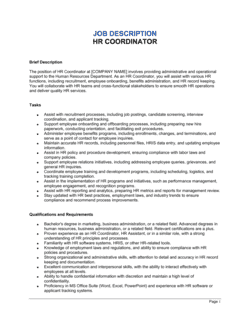
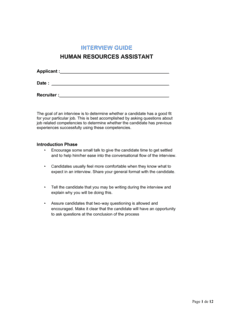
Human Resources Assistant Job Description Template

Free Word download • Edit online • Save & share with Drive • Export to PDF

2 pages20–30 min to fillDifficulty: StandardSignature requiredLegal review recommended
Learn more ↓
FreeHuman Resources Assistant Job Description Template

At a glance

What it is
A Human Resources Assistant Job Description is a formal document that defines the scope, duties, qualifications, reporting structure, and performance expectations for an HR assistant role. This free Word download gives you a structured, legally considered starting point you can edit online and export as PDF for posting, onboarding packets, or inclusion in employment contracts.
When you need it
Use it when hiring a new HR assistant, backfilling a vacated role, restructuring your HR department, or formalizing a role that has grown organically without documented duties. It is also required when the job description will be attached to or incorporated by reference into an employment agreement.
What's inside
Role title and department, reporting line, position summary, a detailed list of duties and responsibilities, required and preferred qualifications, compensation range and benefits overview, working conditions, and an acknowledgment block for the employee to confirm receipt and agreement.

What is a Human Resources Assistant Job Description?

A Human Resources Assistant Job Description is a formal document that defines the duties, qualifications, reporting structure, compensation range, and working conditions for an HR support role. It identifies the essential functions of the position — the specific, legally significant tasks that the employee must be able to perform — and establishes the documented baseline against which recruitment decisions, performance reviews, and accommodation requests are evaluated. When signed by the employee and their manager, it becomes part of the personnel file and the evidentiary record of agreed expectations from day one.

Why You Need This Document

Without a documented job description, every downstream HR decision becomes harder to defend. Performance improvement plans lack a written baseline of expected duties. ADA accommodation analyses have no essential-functions record to work from. FLSA misclassification claims arise because no one formally verified exempt status before the role was filled. Recruiting generates misaligned candidates because the role was described inconsistently across interviewers. In jurisdictions with pay-transparency laws — Colorado, New York, California, and Washington — posting a role without a documented compensation range is a compliance violation. A properly completed, signed HR assistant job description closes all of these gaps in under 30 minutes, and this template gives you the structure to do it correctly the first time.

Which variant fits your situation?

If your situation is…Use this template
Posting the role publicly on a job boardHR Assistant Job Posting
Attaching the description to a formal employment contractEmployment Agreement with Schedule A (Job Description)
Defining a more senior standalone HR roleHR Manager Job Description
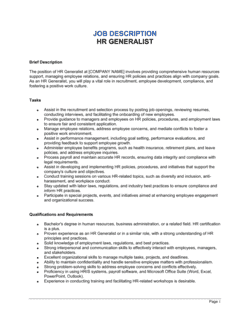
Describing a generalist role covering all HR functions in a small businessHR Generalist Job Description
Defining a temporary or contract HR support roleIndependent Contractor Agreement
Documenting expected performance standards after hireEmployee Performance Review Template
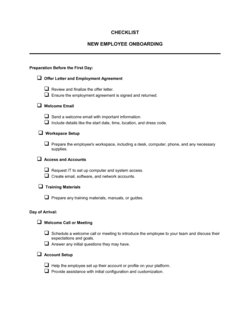
Onboarding the new hire with a structured process documentEmployee Onboarding Checklist

Common mistakes to avoid

❌ Misclassifying the role as FLSA-exempt

Why it matters: An HR assistant who does not meet the salary basis test ($684/week as of 2024) or the duties test for administrative exemption is legally non-exempt. The employer owes overtime from day one of misclassification.

Fix: Apply the two-part FLSA test — salary basis and duties — before assigning exempt status. When in doubt, classify as non-exempt; reclassifying upward later carries no penalty.

❌ Requiring credentials unrelated to job performance

Why it matters: Requiring a four-year degree for a role that can be performed with an associate degree and relevant experience can constitute disparate-impact discrimination under EEOC Title VII guidance, exposing the employer to enforcement action.

Fix: Audit every required qualification against the essential functions. If a credential cannot be tied to a specific duty, move it to 'preferred' or remove it entirely.

❌ Omitting physical demands and working conditions

Why it matters: Without a documented physical requirements section, employers cannot establish the essential-functions baseline needed to assess and document ADA reasonable-accommodation decisions.

Fix: Add a working conditions section listing environment (office, hybrid), schedule, and any physical demands — even for sedentary roles (e.g., 'prolonged computer use required').

❌ Publishing a salary range that doesn't match budget

Why it matters: In pay-transparency jurisdictions, posting a range wider than what you intend to offer violates state law and triggers candidate resentment when the offer comes in at the bottom of the posted range.

Fix: Confirm the actual approved compensation budget before writing the range into the template. The range should reflect what you will realistically offer, not the theoretical band.

❌ Using the job description as an implied employment contract

Why it matters: Language like 'permanent position' or 'guaranteed responsibilities' in a job description has been used successfully in wrongful-termination claims to argue the employer modified at-will status.

Fix: Include a clear disclaimer in the acknowledgment block: 'This job description does not constitute a contract of employment and may be amended with reasonable notice.'

❌ Never updating the job description after hire

Why it matters: When a role evolves significantly over time and the job description remains unchanged, performance management and termination decisions can be challenged on the grounds that expectations were never formally documented.

Fix: Review and update job descriptions annually or whenever the role changes materially. Have the employee re-sign the updated version and file it in their personnel record.

The 9 key clauses, explained

Role title, department, and classification

In plain language: States the official job title, which department the role sits in, whether it is full-time or part-time, exempt or non-exempt, and whether it is permanent or fixed-term.

Sample language
Job Title: Human Resources Assistant | Department: Human Resources | Employment Type: Full-Time, Permanent | FLSA Classification: Non-Exempt | Reports To: [HR MANAGER TITLE]

Common mistake: Misclassifying the role as exempt when the duties and salary do not meet FLSA thresholds — the employer becomes liable for unpaid overtime back to the date of hire.

Position summary

In plain language: A 3–5 sentence overview of why the role exists, what it primarily contributes to the organization, and the general nature of the work — written for a job-board audience and for internal alignment.

Sample language
The Human Resources Assistant supports the HR department in day-to-day administrative operations, including recruitment coordination, employee records management, benefits administration, and onboarding. This role is critical to maintaining accurate HR data and ensuring a positive employee experience at [COMPANY NAME].

Common mistake: Writing a position summary that duplicates the duties list word for word. The summary should convey the purpose and scope of the role, not enumerate every task.

Essential duties and responsibilities

In plain language: A prioritized list of the core tasks the employee is expected to perform, written with active verbs and organized from most to least time-intensive. Legally, these define the 'essential functions' of the role under ADA.

Sample language
1. Coordinates scheduling for interviews, onboarding sessions, and HR meetings. 2. Maintains and updates employee records in [HRIS SYSTEM]. 3. Processes new-hire paperwork including I-9 verification, tax forms, and benefits enrollment. 4. Assists in preparing HR reports and compliance filings. 5. Responds to employee inquiries regarding HR policies and procedures.

Common mistake: Using vague language such as 'assists with HR tasks' without specifying which tasks. Courts and HR tribunals apply essential-functions analysis to what is actually written — vagueness creates interpretive disputes.

Required qualifications

In plain language: States the minimum education, experience, certifications, and technical skills that an applicant must possess to be considered for the role.

Sample language
Requirements: Associate's or Bachelor's degree in Human Resources, Business, or a related field; [1–2] years of administrative or HR support experience; proficiency in Microsoft Office Suite; working knowledge of [HRIS PLATFORM]; strong organizational and communication skills.

Common mistake: Requiring a Bachelor's degree for a role where it has no demonstrable relationship to job performance — this can constitute disparate-impact discrimination under EEOC guidance if it disproportionately excludes protected groups.

Preferred qualifications

In plain language: Lists additional credentials, experience, or skills that make a candidate more competitive but are not disqualifying if absent — distinguished from required qualifications to avoid unintentional exclusion.

Sample language
Preferred: PHR or SHRM-CP certification; experience with [SPECIFIC HRIS]; bilingual in English and [LANGUAGE]; prior experience in a company with [X]+ employees.

Common mistake: Mixing required and preferred qualifications in the same list without clearly labeling them. Recruiters and candidates then treat every item as a hard requirement, narrowing the talent pool unnecessarily.

Compensation and benefits

In plain language: States the salary range or hourly rate, pay frequency, and a summary of benefits offered — without promising specific plan terms that may change annually.

Sample language
Compensation: $[MINIMUM]–$[MAXIMUM] per year / $[X]–$[Y] per hour, paid [bi-weekly / semi-monthly]. Benefits include participation in the Company's health, dental, vision, and retirement programs as amended from time to time, plus [X] days of paid time off annually.

Common mistake: Publishing a salary range that does not reflect what the company is actually prepared to offer. In jurisdictions with pay-transparency laws (CO, NY, CA, WA), this creates legal exposure and candidate trust issues.

Working conditions and physical requirements

In plain language: Describes the work environment (office, remote, hybrid), schedule, travel requirements, and any physical demands — essential for ADA reasonable-accommodation analysis.

Sample language
Work Environment: [Office-based / Hybrid — [X] days on-site] at [LOCATION]. Schedule: Monday–Friday, [HOURS]. Occasional lifting of files or office supplies up to 20 lbs. Prolonged periods of sitting and computer use required.

Common mistake: Omitting physical requirements entirely. If an accommodation dispute arises and the job description is silent on physical demands, the employer has no documented baseline to assess what is 'essential' under the ADA.

Confidentiality and data-handling obligations

In plain language: Makes explicit that the role involves access to sensitive personal and organizational data — including salary information, disciplinary records, and medical information — and that the employee is bound by confidentiality obligations.

Sample language
The HR Assistant will have access to confidential employee information, including compensation data, performance records, and medical accommodation files. The employee agrees to maintain strict confidentiality of all such information during and after employment, in accordance with [COMPANY NAME]'s Privacy Policy and applicable law.

Common mistake: Omitting confidentiality language from the job description when the role routinely handles sensitive data — leaving the employer without a documented acknowledgment of confidentiality obligations separate from a standalone NDA.

Acknowledgment and signature block

In plain language: Confirms that the employee has received, read, and understood the job description, and that the document does not constitute a guarantee of employment or alter at-will status in applicable jurisdictions.

Sample language
I acknowledge that I have received and reviewed this Job Description and understand that it is not a contract of employment and may be amended by [COMPANY NAME] with reasonable notice. Employee Signature: _______________ Date: _______________ | Manager Signature: _______________ Date: _______________

Common mistake: Using language in the acknowledgment that inadvertently creates an implied employment contract — phrases like 'guaranteed role responsibilities' or 'permanent position' can be used against the employer in wrongful-termination claims.

How to fill it out

  1. 1

    Enter the role classification and reporting line

    Fill in the official job title, department name, FLSA classification (exempt or non-exempt), employment type (full-time, part-time, or fixed-term), and the direct supervisor's title.

    💡 Confirm FLSA classification with your payroll provider or employment counsel before publishing — misclassification triggers retroactive overtime liability.

  2. 2

    Write the position summary

    Draft a 3–5 sentence paragraph explaining why the role exists, what it primarily contributes, and the general scope of work. This is the paragraph a candidate reads first on a job board.

    💡 Avoid internal jargon. Write as if the reader has never heard of your company — it improves candidate quality and reduces misaligned applications.

  3. 3

    List essential duties with active verbs

    Write 8–12 duty statements, each beginning with an active verb (Coordinates, Maintains, Processes, Assists). Order from most to least time-intensive. These are the legally significant 'essential functions' under ADA.

    💡 Include a catch-all final item — 'Performs other duties as assigned by the HR Manager' — to preserve flexibility without amending the document for minor task additions.

  4. 4

    Separate required from preferred qualifications

    List required qualifications (degree, years of experience, specific systems) in one clearly labeled section and preferred qualifications in a separate section. Review required qualifications for potential disparate-impact issues.

    💡 If a Bachelor's degree is listed as required, document the business justification. EEOC guidance requires that educational requirements be demonstrably related to job performance.

  5. 5

    Insert the compensation range

    Enter the minimum and maximum annual salary or hourly rate the company is genuinely prepared to offer. Check whether your jurisdiction requires pay-range disclosure on job postings.

    💡 Colorado, New York, California, and Washington mandate pay-range disclosure on job postings. Other states are adopting similar rules — verify current requirements before publishing.

  6. 6

    Define working conditions and physical requirements

    Specify office, remote, or hybrid status, standard hours, any travel obligations, and the physical demands of the role — lifting limits, prolonged sitting, or screen use.

    💡 Be accurate, not aspirational. Overstating physical requirements to filter candidates is a recognized ADA compliance risk.

  7. 7

    Add confidentiality and data-handling obligations

    Include explicit language that the role involves access to confidential employee data and that the employee is bound by confidentiality obligations during and after employment.

    💡 Reference your company's data privacy policy by name so the employee is on notice of the specific standards that apply.

  8. 8

    Execute the acknowledgment block

    Have both the employee and their direct manager sign and date the completed job description before or on the employee's first day. File the executed copy in the employee's personnel file.

    💡 Use Business in a Box eSign to timestamp execution — a dated digital signature is sufficient in most jurisdictions and eliminates the 'I never received it' defense.

Frequently asked questions

What is a human resources assistant job description?

A human resources assistant job description is a formal document that defines the scope, duties, qualifications, reporting structure, and employment conditions for an HR support role. It serves as the foundation for recruiting, performance management, compensation benchmarking, and ADA compliance. When signed by the employee, it creates a documented record of agreed expectations from the first day of employment.

What does an HR assistant typically do?

An HR assistant typically supports recruitment coordination, new-hire onboarding and paperwork, employee records maintenance in an HRIS, benefits enrollment processing, and responding to routine employee inquiries about HR policies. In smaller organizations, the role may also include payroll support, training coordination, and compliance filing assistance. The exact duties vary by company size and HR department structure.

Is a job description a legally binding contract?

In most US states with at-will employment, a job description is not a contract of employment unless it is explicitly incorporated by reference into a signed employment agreement. However, language in a job description can be used as evidence of implied contractual terms in some jurisdictions. Always include a disclaimer confirming the document is not a contract and may be amended with notice.

What qualifications should I require for an HR assistant?

Typical required qualifications include an associate's or bachelor's degree in human resources or business (or equivalent experience), 1–2 years of administrative or HR support experience, and proficiency in Microsoft Office. HRIS experience and SHRM-CP or PHR certification are commonly listed as preferred. Avoid requiring credentials — especially four-year degrees — that cannot be tied to specific job duties, as this may create EEOC disparate-impact exposure.

Do I need to include a salary range in the job description?

In Colorado, New York, California, Washington, and a growing list of other jurisdictions, including a pay range on job postings is legally required. Even where not mandated, publishing a range improves candidate quality and reduces wasted time for both parties. The range should reflect what the company is actually prepared to offer — not the theoretical compensation band.

How detailed should the duties section be?

The duties section should be detailed enough that a new employee understands their primary responsibilities and a court can determine the essential functions of the role under ADA. Eight to twelve duty statements, each beginning with an active verb and specific enough to distinguish the role from adjacent positions, is the standard range. Include a catch-all clause for flexibility without requiring formal amendments for minor task additions.

What is the difference between required and preferred qualifications?

Required qualifications are the minimum threshold for being considered — candidates who lack them are screened out. Preferred qualifications make a candidate more competitive but are not disqualifying. Mixing the two in a single list without labeling causes recruiters to treat every item as a hard filter, unnecessarily narrowing the talent pool and increasing disparate-impact risk for qualifications that cannot be tied to essential functions.

Should the employee sign the job description?

Yes. Having the employee sign an acknowledgment block before or on their first day creates a documented record that they received, reviewed, and understood their responsibilities. This is particularly important for performance management and termination decisions — it eliminates the 'I wasn't told' defense and establishes the baseline against which performance is measured.

How often should a job description be updated?

Review job descriptions at least annually and immediately after any material change in the role's duties, reporting structure, or classification. When the role changes significantly, have the employee sign the updated version and file it in their personnel record. An outdated job description used as the basis for a performance improvement plan or termination is a common target in employment disputes.

How this compares to alternatives

vs HR Manager Job Description

An HR manager job description covers a supervisory role responsible for setting HR policy, managing the HR function, and making strategic decisions. An HR assistant description documents a support role focused on administrative execution, data entry, and coordination. Using the wrong template misrepresents the role's authority level and FLSA classification, creating misalignment with candidates and potential overtime liability.

vs Employment Contract

An employment contract is a legally binding agreement covering compensation, benefits, IP assignment, confidentiality, and termination terms. A job description defines duties and qualifications but is not a contract of employment in at-will jurisdictions unless explicitly incorporated. For most hires, both documents are needed — the job description as Schedule A attached to the employment contract.

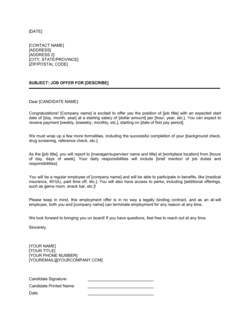
vs Job Offer Letter

A job offer letter confirms the role, compensation, and start date to secure candidate acceptance — it is typically 1–2 pages and not a full legal document. A job description provides the operational and legal detail of the role and may be longer than 3 pages. The offer letter references the job description; they are complementary, not interchangeable.

vs HR Generalist Job Description

An HR generalist job description covers a broader, often more senior role responsible for the full HR function in a smaller organization — including policy development, employee relations, and compliance decisions. The HR assistant description is narrower, administrative in focus, and typically non-exempt. Use the generalist template when the hire is expected to operate independently across all HR domains.

Industry-specific considerations

Technology / SaaS

HR assistants in SaaS companies often manage HRIS administration for distributed teams, support remote onboarding workflows, and assist with equity plan enrollment — requiring explicit documentation of remote-work conditions and digital-tool proficiency.

Healthcare

HR assistants handle credentialing support, HIPAA-compliant employee records, and compliance filing for clinical staff — making the confidentiality clause and physical-requirements section legally significant for joint-commission and regulatory audits.

Professional Services

In law firms, accounting practices, and consulting firms, HR assistants manage high-volume lateral hiring coordination, bar or CPA license tracking, and billable-hour policy administration — requiring more detailed systems-proficiency requirements.

Manufacturing

HR assistants in manufacturing environments support shift-scheduling administration, union-agreement record-keeping, OSHA incident reporting, and high-turnover onboarding volume — making physical-requirements and shift-flexibility clauses operationally essential.

Retail / Hospitality

High employee turnover and seasonal hiring make the HR assistant role critical for rapid onboarding, I-9 compliance under time pressure, and benefits administration across part-time and variable-hour workforces.

Financial Services

HR assistants in banks and financial institutions handle background-check coordination, FINRA registration support, and strict confidentiality obligations around compensation and performance data — making the data-handling clause particularly important.

Jurisdictional notes

United States

The FLSA requires that HR assistants be correctly classified as non-exempt unless they meet both the salary basis test ($684/week minimum as of 2024) and the administrative duties test. EEOC guidance requires that all qualifications listed as required be demonstrably job-related. Colorado, New York, California, and Washington mandate pay-range disclosure on job postings. ADA requires the essential-functions and physical-requirements sections to be accurate and complete.

Canada

Provincial employment standards acts set minimum wages and classification rules that govern how HR assistant roles are structured. Quebec requires that any document provided to employees at or before hire be available in French for provincially regulated employers. Pay transparency requirements are emerging in British Columbia and Ontario — verify current obligations before posting. Job descriptions attached to employment agreements must be consistent with the contract terms or the more favorable provision governs.

United Kingdom

Under the Employment Rights Act 1996, employers must provide a written statement of employment particulars — including job title and a brief description of duties — on or before the first day of employment. The Equality Act 2010 prohibits job description language or requirements that indirectly discriminate on the basis of protected characteristics. Pay-gap reporting obligations under the Gender Pay Gap Regulations apply to employers with 250 or more employees and are informed by job-classification data.

European Union

The EU Transparent and Predictable Working Conditions Directive requires that workers receive written information on their role, duties, and working conditions within seven days of hire. GDPR applies to the personal data collected during the hiring process and referenced in the job description — including any health or accommodation information. Several member states, including France and Germany, have statutory works-council consultation requirements before new roles are formally created or advertised.

Template vs lawyer — what fits your deal?

PathBest forCostTime
Use the templateSmall and mid-size employers hiring for a standard domestic HR assistant role in a single jurisdictionFree20–30 minutes
Template + legal reviewEmployers in pay-transparency jurisdictions, multi-state operations, or those attaching the description to a formal employment agreement$150–$400 for an employment counsel review1–2 days
Custom draftedEmployers in heavily regulated industries (healthcare, financial services), unionized workplaces, or multi-jurisdiction hiring with conflicting ADA and accommodation laws$500–$1,500+3–7 days

Glossary

Job Description
A formal document that specifies a role's title, duties, required qualifications, reporting structure, and employment conditions — used in hiring, performance management, and compensation benchmarking.
Essential Functions
The core duties that are fundamental to a position and cannot be removed without fundamentally changing the job — a legally significant term under the ADA in the United States.
EEOC
The Equal Employment Opportunity Commission — the US federal agency that enforces laws prohibiting employment discrimination; job descriptions must avoid language that could be construed as discriminatory.
ADA (Americans with Disabilities Act)
A US federal law requiring employers to provide reasonable accommodations to qualified individuals with disabilities; job descriptions must accurately reflect physical and cognitive demands to determine accommodation obligations.
At-Will Employment
An employment arrangement in most US states where either party may end the relationship at any time for any lawful reason — a job description alone does not create an employment contract in at-will jurisdictions.
HRIS (Human Resources Information System)
Software used to store and manage employee data, payroll, benefits, and compliance records — an HR assistant often serves as a primary user and data-entry point.
Onboarding
The structured process of integrating a new employee into the organization, including paperwork, orientation, systems access, and role training — commonly managed by an HR assistant.
Confidentiality Clause
A provision in a job description or employment agreement requiring the employee to protect sensitive HR data such as salary records, performance reviews, and personal employee information.
KSAs (Knowledge, Skills, and Abilities)
A framework used in job descriptions to specify what an applicant must know, what they must be able to do, and what inherent capabilities the role requires.
Reporting Line
The direct supervisory relationship defined in a job description — specifying who the employee reports to and, if applicable, who reports to them.
Reasonable Accommodation
A modification to a job, work environment, or process that allows a qualified person with a disability to perform the essential functions of the role without undue hardship to the employer.

Part of your Business Operating System

This document is one of 3,000+ business & legal templates included in Business in a Box.

  • Fill-in-the-blanks — ready in minutes
  • 100% customizable Word document
  • Compatible with all office suites
  • Export to PDF and share electronically

Create your document in 3 simple steps.

From template to signed document — all inside one Business Operating System.
1
Download or open template

Access over 3,000+ business and legal templates for any business task, project or initiative.

2
Edit and fill in the blanks with AI

Customize your ready-made business document template and save it in the cloud.

3
Save, Share, Send, Sign

Share your files and folders with your team. Create a space of seamless collaboration.

Save time, save money, and create top-quality documents.

★★★★★

"Fantastic value! I'm not sure how I'd do without it. It's worth its weight in gold and paid back for itself many times."

Managing Director · Mall Farm
Robert Whalley
Managing Director, Mall Farm Proprietary Limited
★★★★★

"I have been using Business in a Box for years. It has been the most useful source of templates I have encountered. I recommend it to anyone."

Business Owner · 4+ years
Dr Michael John Freestone
Business Owner
★★★★★

"It has been a life saver so many times I have lost count. Business in a Box has saved me so much time and as you know, time is money."

Owner · Upstate Web
David G. Moore Jr.
Owner, Upstate Web

Run your business with a system — not scattered tools

Stop downloading documents. Start operating with clarity. Business in a Box gives you the Business Operating System used by over 250,000 companies worldwide to structure, run, and grow their business.

Free Forever Plan · No credit card required