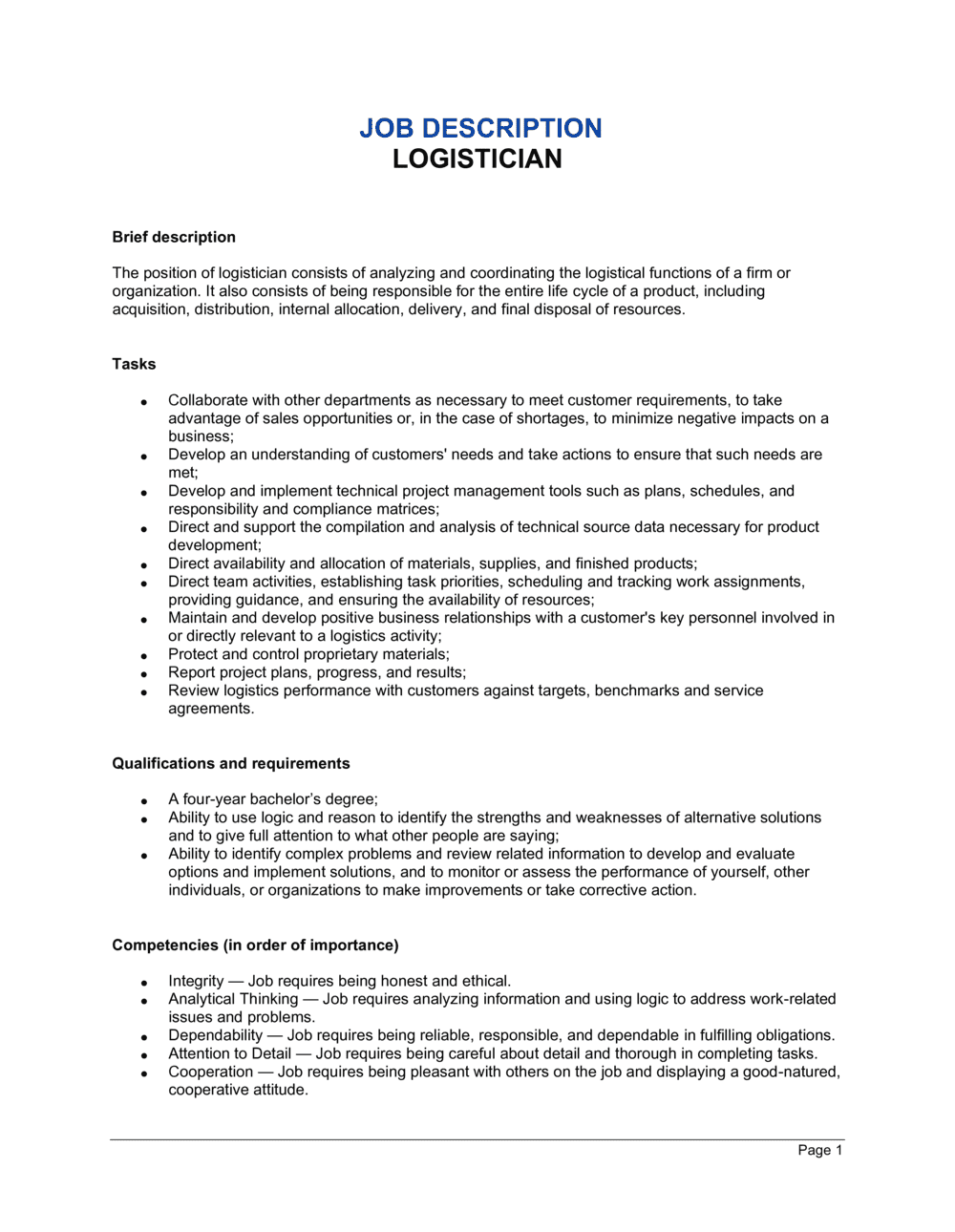
Logistician Job Description Template

Free Word download • Edit online • Save & share with Drive • Export to PDF

2 pages20–30 min to fillDifficulty: StandardSignature requiredLegal review recommended
Learn more ↓
FreeLogistician Job Description Template

At a glance

What it is
A Logistician Job Description is a formal hiring document that defines the scope, responsibilities, qualifications, reporting structure, and compensation for a logistician role. This free Word download gives you an editable, compliant starting point you can tailor to your operation and export as PDF for job postings, offer packages, and employment records.
When you need it
Use it when opening a new logistician position, backfilling a departure, or standardizing role definitions across a supply chain or warehouse team. It is also required as supporting documentation when onboarding the hire into payroll and HR systems.
What's inside
Job title and department, reporting structure, a detailed list of duties and responsibilities, required and preferred qualifications, physical and environmental requirements, compensation range and benefits summary, and an equal opportunity employment statement. An acknowledgement signature block confirms the hire has read and accepted the role definition.

What is a Logistician Job Description?

A Logistician Job Description is a formal employment document that defines the scope, duties, qualifications, physical requirements, compensation, and reporting structure for a logistician role within an organization's supply chain or operations function. It serves as both an external recruitment tool — used to attract qualified candidates through job boards and staffing agencies — and an internal HR record that establishes the agreed terms of the role for performance management, accommodation requests, and termination proceedings. A properly drafted and signed logistician job description gives the employer a documented, enforceable baseline against which the employee's performance can be measured from day one.

Why You Need This Document

Operating without a written logistician job description creates compounding risk across hiring, compliance, and employment law. Without documented essential functions, ADA accommodation requests become nearly impossible to evaluate — courts and regulators look first for the written role definition when assessing whether a proposed accommodation is reasonable. Without an FLSA exemption status on record, a routine Department of Labor audit or employee complaint can trigger back-pay liability for every overtime hour worked since hire. Without a signed acknowledgement, duty disputes during performance improvement plans or termination proceedings become credibility contests rather than contract interpretation. In Canada and the UK, undocumented role changes can support constructive dismissal claims that result in significant wrongful termination awards. This template gives you a complete, compliant starting point for one of the most operationally critical roles in any product-moving business — ready to edit, post, and file in under 30 minutes.

Which variant fits your situation?

If your situation is…Use this template
Hiring for a senior supply chain oversight role with team managementLogistics Manager Job Description
Filling an entry-level position focused on order tracking and data entryLogistics Coordinator Job Description
Hiring for day-to-day warehouse inventory and receiving operationsWarehouse Manager Job Description
Engaging a logistics consultant on a project basis rather than as an employeeIndependent Contractor Agreement
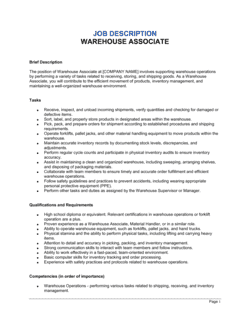
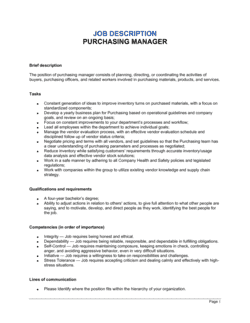
Defining a role that combines procurement and logistics functionsPurchasing Manager Job Description
Hiring a driver or transportation coordinator rather than a plannerTruck Driver Job Description
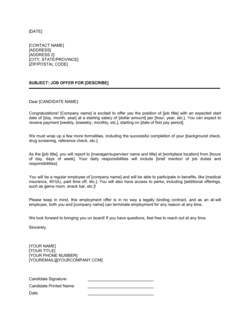
Creating a formal offer package once the candidate has been selectedEmployment Contract

Common mistakes to avoid

❌ Omitting FLSA exemption status

Why it matters: Misclassifying a logistician as exempt when the role is non-exempt triggers back pay liability for all overtime hours worked, plus civil penalties that compound with each pay period.

Fix: Apply the FLSA duties test — administrative exemption requires that the employee's primary duty is non-manual work directly related to management or general business operations and includes the exercise of discretion and independent judgment. Most field-level logisticians are non-exempt.

❌ Using non-standard or internally invented job titles

Why it matters: Titles like 'Supply Flow Coordinator' or 'Logistics Ninja' reduce applicant volume from job boards, make compensation benchmarking unreliable, and create classification ambiguity for HR and legal purposes.

Fix: Use the standard market title 'Logistician' or a recognized variant such as 'Logistics Coordinator' or 'Supply Chain Analyst,' with an internal alias in parentheses if needed.

❌ Not documenting physical requirements for warehouse-adjacent roles

Why it matters: When a logistician who spends 30% of their time on a warehouse floor requests an accommodation, an undocumented physical requirement makes the ADA interactive process nearly impossible to conduct properly.

Fix: Describe all physical demands accurately — lifting limits, standing time, temperature exposure — even when the role is primarily administrative.

❌ Conflating required and preferred qualifications

Why it matters: Listing an APICS certification as required when only two of your last ten hires had it creates disparate-impact exposure and unnecessarily disqualifies qualified candidates.

Fix: Audit the last three to five people who successfully performed the role — only list as 'required' what they all had on day one.

The 10 key clauses, explained

Job title, department, and location

In plain language: Identifies the exact job title, the department the role sits within, the primary work location, and whether remote or hybrid work is permitted.

Sample language
Job Title: Logistician | Department: Supply Chain & Operations | Location: [CITY, STATE] | Work Arrangement: [On-site / Hybrid / Remote]

Common mistake: Using a vague title like 'Logistics Person' instead of a standard market title. Non-standard titles make compensation benchmarking inaccurate and reduce applicant volume from job boards.

Reporting structure

In plain language: States who the logistician reports to and lists any direct reports, establishing where the role sits in the management hierarchy.

Sample language
Reports to: [TITLE OF DIRECT MANAGER]. Direct reports: [NONE / LIST OF TITLES]. Dotted-line relationships: [TITLE, if applicable].

Common mistake: Omitting dotted-line relationships in matrixed organizations. When the logistician coordinates with procurement, finance, or a 3PL manager, ambiguous authority leads to escalation failures and missed deadlines.

Position summary

In plain language: A 3–5 sentence overview of the role's purpose and its contribution to the organization, written at a level of abstraction suitable for external job postings.

Sample language
The Logistician is responsible for coordinating the movement, storage, and distribution of [GOODS / MATERIALS / EQUIPMENT] across [COMPANY NAME]'s supply chain. This role manages relationships with [CARRIERS / SUPPLIERS / 3PLs], optimizes transportation routes, and ensures on-time delivery to [CUSTOMERS / INTERNAL STAKEHOLDERS] in compliance with regulatory and contractual requirements.

Common mistake: Writing the position summary as a list of tasks rather than a purpose statement. A task list belongs in the duties section; the summary should explain why the role exists and what success looks like at a strategic level.

Duties and responsibilities

In plain language: An itemized list of the specific tasks the logistician is expected to perform, typically 8–14 bullet points organized from most to least critical.

Sample language
Coordinate inbound and outbound freight with [CARRIERS / 3PL PROVIDERS] to meet [X]-day delivery targets. Monitor inventory levels at [LOCATION(S)] and initiate replenishment orders when stock falls below [THRESHOLD]. Maintain accurate records in [ERP / WMS SYSTEM NAME] and generate weekly performance reports for the [OPERATIONS / SUPPLY CHAIN] team.

Common mistake: Listing duties without indicating frequency or scope. 'Manages freight' is unenforceable as a performance standard; 'coordinates 50–80 inbound shipments per week using [SYSTEM NAME]' is specific enough to evaluate.

Required qualifications

In plain language: Lists the minimum education, certifications, years of experience, and technical skills a candidate must possess to be considered for the role.

Sample language
Bachelor's degree in Logistics, Supply Chain Management, Business Administration, or a related field, or equivalent experience. Minimum [X] years of experience in a logistics, supply chain, or operations role. Proficiency in [ERP / WMS PLATFORM, e.g., SAP, Oracle, NetSuite]. [APICS CSCP / CLTD certification preferred].

Common mistake: Setting degree requirements that screen out qualified candidates without a legitimate business necessity. In the US, overly rigid degree requirements can create disparate-impact exposure under Title VII; consider replacing them with 'degree or equivalent experience.'

Preferred qualifications

In plain language: Lists additional skills, certifications, or experience that would make a candidate more competitive but are not strictly required to perform the role.

Sample language
Experience managing [IMPORT / EXPORT / CUSTOMS BROKERAGE] documentation. Familiarity with [CARRIER NAME / FREIGHT PLATFORM]. APICS Certified Supply Chain Professional (CSCP) or equivalent. Bilingual in [LANGUAGE] preferred for roles serving [MARKET / REGION].

Common mistake: Promoting preferred qualifications to required status during the screening process without updating the posted job description. This creates a gap between the written role definition and actual hiring criteria, exposing the company to discrimination claims.

Physical and environmental requirements

In plain language: Describes any physical demands of the role — lifting limits, time on feet, warehouse environment exposure — required for ADA compliance and equivalent legislation in other jurisdictions.

Sample language
Ability to lift up to [X] lbs on an occasional basis. Ability to stand or walk for up to [X] hours per shift. Exposure to [WAREHOUSE / COLD STORAGE / OUTDOOR LOADING DOCK] environments. Use of personal protective equipment (PPE) as required.

Common mistake: Omitting this section for logistician roles because the title sounds office-based. Many logisticians split time between a desk and a warehouse floor — failing to document physical requirements creates ADA accommodation ambiguity and workers' compensation exposure.

Compensation and benefits

In plain language: States the salary range or hourly rate, FLSA exemption status, eligible benefits, and any variable compensation such as bonuses or shift differentials.

Sample language
Salary Range: $[MIN] – $[MAX] per year | FLSA Status: [Exempt / Non-Exempt] | Benefits: Medical, dental, vision, 401(k) with [X]% employer match, [X] days PTO. Eligible for annual performance bonus of up to [X]% of base salary.

Common mistake: Omitting FLSA status. Misclassifying a logistician as exempt when their duties and salary don't meet the duties test triggers back pay liability for unpaid overtime, plus penalties — a common audit finding in warehouse and distribution operations.

Equal opportunity employment statement

In plain language: A standard declaration that the employer does not discriminate based on protected characteristics, required for federal contractors in the US and mirrored by equivalent obligations in Canada, the UK, and EU member states.

Sample language
[COMPANY NAME] is an Equal Opportunity Employer. We do not discriminate on the basis of race, color, religion, sex, national origin, age, disability, veteran status, sexual orientation, gender identity, or any other characteristic protected by applicable law.

Common mistake: Using a one-size-fits-all EEO statement that omits protected categories added by recent state or local legislation — for example, New York City's requirement to include salary ranges in job postings, or Illinois' biometric privacy obligations.

Acknowledgement and signature block

In plain language: Confirms the employee has read, understood, and accepted the job description as the formal definition of their role and duties.

Sample language
I acknowledge that I have received, read, and understand this job description. I understand that it is not an exhaustive list of all duties and that [COMPANY NAME] may amend this job description at any time with reasonable notice. Employee Signature: _______________ | Date: _______________ | Manager Signature: _______________ | Date: _______________.

Common mistake: Not including the 'not an exhaustive list' language. Without it, employees have successfully argued that undocumented tasks fall outside their role — particularly relevant when courts assess constructive dismissal claims in Canada and the UK.

How to fill it out

  1. 1

    Enter the job title, department, and work location

    Use the standard market title 'Logistician' or the internal equivalent. Confirm the department name matches your org chart and specify whether the role is on-site, hybrid, or remote.

    💡 Cross-check the title against ONET O*NET-SOC codes (13-1081) and LinkedIn job data before posting — this aligns your compensation benchmarking and improves job board ranking.

  2. 2

    Define the reporting structure and direct reports

    Name the role this position reports to by title, not person. List any titles that report to the logistician and note dotted-line relationships with procurement, finance, or 3PL partners.

    💡 Document dotted-line relationships explicitly — ambiguous authority in logistics operations causes costly escalation delays and missed shipment windows.

  3. 3

    Write the position summary

    Draft 3–5 sentences explaining why the role exists, what it contributes to the business, and the primary stakeholders it serves. Save duty enumeration for the next section.

    💡 Read the summary aloud — if it could describe any operations role, it is too generic. Include a specific reference to your industry, freight volume, or supply chain scope.

  4. 4

    List duties in order of importance and frequency

    Write 8–14 bullet points starting with the most critical responsibilities. For each, specify the system used, the frequency or volume, and the output produced.

    💡 Use action verbs in the present tense: 'Coordinates,' 'Manages,' 'Analyzes' — not 'Responsible for coordinating.' Passive constructions reduce ATS keyword matching performance.

  5. 5

    Set required and preferred qualifications separately

    List only genuine minimum requirements under 'Required.' Move aspirational skills — certifications, language fluency, ERP experience — to 'Preferred.' Conflating the two artificially narrows the applicant pool.

    💡 Replace blanket degree requirements with 'bachelor's degree or equivalent experience' to avoid disparate-impact exposure and capture qualified candidates from non-traditional backgrounds.

  6. 6

    Document physical and environmental requirements

    Describe any lifting limits, time on feet, temperature exposure, or PPE requirements. Even primarily desk-based logisticians often spend time in warehouses — document this accurately.

    💡 Review your workers' compensation and safety records for similar roles before drafting this section — underdocumenting physical demands creates liability when accommodation requests arise.

  7. 7

    State compensation range and FLSA status

    Enter the salary band or hourly rate, confirm exempt or non-exempt status under the FLSA duties test, and list eligible benefits and any variable pay components.

    💡 As of 2024, salary transparency laws in California, Colorado, New York, and Washington require posting the pay range — include it by default to stay compliant across jurisdictions.

  8. 8

    Obtain signatures before the start date

    Have both the hiring manager and the new employee sign the acknowledgement block before or on the first day of employment. File the signed copy in the employee's HR record.

    💡 Unsigned job descriptions are difficult to enforce as performance standards. Courts and arbitrators look first for the signed document when adjudicating duty disputes or termination for cause.

Frequently asked questions

What does a logistician do?

A logistician plans, coordinates, and manages the movement, storage, and distribution of goods, materials, or services across a supply chain. Day-to-day responsibilities typically include scheduling inbound and outbound freight, managing carrier relationships, monitoring inventory levels, maintaining records in ERP or WMS systems, and generating performance reports. The specific scope varies significantly by industry — a defense logistician manages equipment and personnel deployment, while a retail logistician focuses on replenishment and last-mile delivery.

What qualifications should a logistician job description require?

Most logistician roles require a bachelor's degree in supply chain management, logistics, business administration, or a related field — or equivalent practical experience. Proficiency in at least one ERP or WMS platform (SAP, Oracle, NetSuite) is typically required for mid-level roles. APICS certifications (CSCP or CLTD) are strong preferred qualifications. For senior roles, 5–8 years of progressive logistics experience and demonstrated team management are standard minimums.

Is a logistician job description a legally binding document?

A signed job description is generally considered a component of the employment agreement and can be relied upon as evidence of the agreed scope of the role in disputes over duties, performance standards, and termination for cause. It is not a standalone contract, but courts and arbitrators in most jurisdictions treat it as a material representation of the employer-employee relationship. Including an acknowledgement signature block strengthens its evidentiary weight significantly.

What is the difference between a logistician and a logistics manager?

A logistician typically handles execution-level responsibilities — coordinating shipments, managing carrier relationships, monitoring inventory, and maintaining records. A logistics manager oversees a team of logisticians or coordinators, owns the function's budget, sets performance targets, and interfaces with senior leadership. The job description should reflect this distinction clearly in the reporting structure and duties sections to avoid misclassification and compensation disputes.

Should a logistician job description include a salary range?

In an increasing number of US states — including California, Colorado, New York, and Washington — salary transparency laws require employers to include a pay range in any job posting. Even where not legally required, including a salary band reduces time-to-fill and improves offer acceptance rates. The job description should state both the range and FLSA exemption status so candidates understand overtime eligibility from the outset.

How often should a logistician job description be updated?

Review and update job descriptions annually or whenever the role materially changes — new systems, expanded geographic scope, added direct reports, or revised performance metrics. An outdated job description creates performance management gaps: if the employee is being evaluated on duties not in the written description, corrective action and termination for cause become much harder to defend. Have the employee sign the updated version each time.

What physical requirements should be included for a logistician role?

Physical requirements depend on how much time the logistician spends in a warehouse, distribution center, or on-site at carrier facilities versus at a desk. At minimum, document lifting limits (commonly 25–50 lbs), standing or walking time per shift, and any exposure to extreme temperatures or hazardous materials. These disclosures are required for ADA compliance in the US and equivalent legislation in Canada, the UK, and EU member states.

Can I use one job description for logisticians across multiple locations?

A core template can be reused across locations, but location-specific addenda are advisable. Pay ranges differ by labor market; physical requirements may differ by facility type; local employment laws — such as salary transparency requirements, predictive scheduling rules, or language requirements in Quebec — may require location-specific disclosures. Build a master template and maintain a short addendum for each jurisdiction.

What EEO language is required in a logistician job description?

At minimum, the EEO statement must cover the federally protected categories under Title VII, the ADEA, and the ADA: race, color, religion, sex, national origin, age, and disability. Many states and municipalities add sexual orientation, gender identity, veteran status, and other categories. Federal contractors must also include the VEVRAA and Section 503 affirmative action taglines. Review state and local requirements for each location where the role is posted.

How this compares to alternatives

vs Logistics Manager Job Description

A logistics manager job description covers a supervisory or department-head role with budget ownership, team management, and strategic vendor relationships. A logistician job description defines an individual contributor or mid-level execution role. Use the manager template when the hire will lead a team of two or more direct reports or own a logistics P&L.

vs Warehouse Manager Job Description

A warehouse manager job description focuses on facility operations — inventory control, staff scheduling, safety compliance, and dock management. A logistician job description covers the broader movement and coordination of goods across the supply chain, including carrier management and transportation planning. The two roles often overlap in small operations but are distinct in mid-size and enterprise settings.

vs Purchasing Manager Job Description

A purchasing manager job description governs procurement — sourcing suppliers, negotiating contracts, and managing purchase orders. A logistician job description governs what happens after the purchase order is issued: transportation, delivery, and storage. In lean teams, one person may do both, but the job descriptions define distinct accountability and should be maintained separately.

vs Independent Contractor Agreement

An independent contractor agreement engages a self-employed logistics consultant for project-based work with no employment entitlements — no benefits, no tax withholding, no overtime. A logistician job description establishes an employment relationship with the full set of legal obligations that entails. Misclassifying an employee as a contractor triggers back taxes, benefit liability, and penalties — the degree of control you exercise over how work is performed is the central test.

Industry-specific considerations

Manufacturing

Logisticians in manufacturing manage inbound raw material flow, production scheduling coordination, and outbound finished goods distribution — often requiring ERP integration skills and supplier performance metrics.

Retail and E-commerce

Retail logisticians focus on replenishment cycles, last-mile carrier management, returns processing, and peak-season surge planning — with KPIs centered on on-time delivery rate and inventory accuracy.

Healthcare and Life Sciences

Healthcare logisticians handle temperature-controlled shipments, FDA-regulated documentation, chain-of-custody compliance, and medical device tracking — requiring specific regulatory knowledge beyond standard logistics roles.

Defense and Government

Defense logisticians manage equipment, parts, and personnel deployment under strict government contracting rules — roles often require security clearances and familiarity with Defense Logistics Agency standards.

Construction

Construction logisticians coordinate materials delivery to active job sites, manage equipment rental schedules, and track subcontractor material usage against project timelines.

Food and Beverage

Food and beverage logisticians manage cold-chain compliance, FDA and USDA traceability requirements, short shelf-life inventory rotation, and carrier food-safety certifications.

Jurisdictional notes

United States

FLSA classification is the primary compliance risk — logisticians performing non-manual work with genuine discretion may qualify as exempt under the administrative exemption, but field-level coordinators typically do not. Salary transparency laws in California, Colorado, New York, and Washington require posting a pay range. Federal contractors must include VEVRAA and Section 503 EEO taglines. Title VII and ADA require accurate physical requirement disclosures.

Canada

Each province's Employment Standards Act governs minimum wage, overtime thresholds, and termination obligations — job descriptions that reference compensation must align with the applicable provincial floor. Quebec employers in provincially-regulated industries must provide French-language job descriptions. The Canadian Human Rights Act and provincial equivalents require EEO language covering all federally and provincially protected characteristics.

United Kingdom

UK employers must provide a written statement of particulars within the first day of employment, and the job description is typically incorporated by reference. The Equality Act 2010 requires that physical requirements be genuine and proportionate to avoid indirect disability discrimination. Pay transparency is not yet legally mandated nationally, but the government has signalled forthcoming reforms — including the pay range in job postings is already considered best practice.

European Union

The EU Pay Transparency Directive (2023/970) requires member states to implement salary disclosure obligations by June 2026 — job descriptions posted in EU jurisdictions should include pay ranges as implementation rolls out. The Working Conditions Directive requires written terms within seven days of hire. GDPR applies to any personal data collected during the recruitment process, including data submitted in response to the job posting.

Template vs lawyer — what fits your deal?

PathBest forCostTime
Use the templateStandard domestic logistician hires at companies with an existing HR function and employment policiesFree20–30 minutes
Template + legal reviewMulti-state or cross-border hires, roles with non-compete or confidentiality requirements, or companies subject to federal contractor obligations$200–$500 for an employment attorney review1–3 days
Custom draftedDefense contractors, heavily regulated industries, executive-level logistics roles with equity or complex severance, or operations in jurisdictions with complex pay transparency laws$800–$2,500+1–2 weeks

Glossary

Logistician
A professional responsible for planning, coordinating, and executing the movement and storage of goods, materials, or personnel across a supply chain.
Supply Chain
The end-to-end network of suppliers, manufacturers, distributors, and retailers involved in producing and delivering a product to the end customer.
KPI (Key Performance Indicator)
A measurable metric used to evaluate how effectively a role or team is achieving its objectives — for logisticians, common KPIs include on-time delivery rate and inventory accuracy.
3PL (Third-Party Logistics)
An outsourced logistics provider that manages transportation, warehousing, or fulfillment on behalf of a business.
FLSA Classification
The determination under the Fair Labor Standards Act of whether a US employee is exempt or non-exempt from overtime pay requirements.
EEO Statement
An Equal Employment Opportunity statement affirming the employer does not discriminate based on protected characteristics such as race, gender, age, or disability.
RACI Matrix
A chart that defines who is Responsible, Accountable, Consulted, and Informed for each task — used to clarify a logistician's role relative to adjacent functions.
Reporting Structure
The formal hierarchy defining who the logistician reports to and, where applicable, who reports to them.
Essential Functions
The core duties that define a job — distinguished from marginal functions for ADA compliance purposes in the US and equivalent legislation elsewhere.
At-Will Employment
A US employment doctrine allowing either party to end the working relationship at any time for any lawful reason, often referenced in the job description's acknowledgement clause.

Part of your Business Operating System

This document is one of 3,000+ business & legal templates included in Business in a Box.

  • Fill-in-the-blanks — ready in minutes
  • 100% customizable Word document
  • Compatible with all office suites
  • Export to PDF and share electronically

Create your document in 3 simple steps.

From template to signed document — all inside one Business Operating System.
1
Download or open template

Access over 3,000+ business and legal templates for any business task, project or initiative.

2
Edit and fill in the blanks with AI

Customize your ready-made business document template and save it in the cloud.

3
Save, Share, Send, Sign

Share your files and folders with your team. Create a space of seamless collaboration.

Save time, save money, and create top-quality documents.

★★★★★

"Fantastic value! I'm not sure how I'd do without it. It's worth its weight in gold and paid back for itself many times."

Managing Director · Mall Farm
Robert Whalley
Managing Director, Mall Farm Proprietary Limited
★★★★★

"I have been using Business in a Box for years. It has been the most useful source of templates I have encountered. I recommend it to anyone."

Business Owner · 4+ years
Dr Michael John Freestone
Business Owner
★★★★★

"It has been a life saver so many times I have lost count. Business in a Box has saved me so much time and as you know, time is money."

Owner · Upstate Web
David G. Moore Jr.
Owner, Upstate Web

Run your business with a system — not scattered tools

Stop downloading documents. Start operating with clarity. Business in a Box gives you the Business Operating System used by over 250,000 companies worldwide to structure, run, and grow their business.

Free Forever Plan · No credit card required