Driver Sales Worker Job Description Template

Free Word download • Edit online • Save & share with Drive • Export to PDF

2 pages20–30 min to fillDifficulty: StandardSignature requiredLegal review recommended
Learn more ↓
FreeDriver Sales Worker Job Description Template

At a glance

What it is
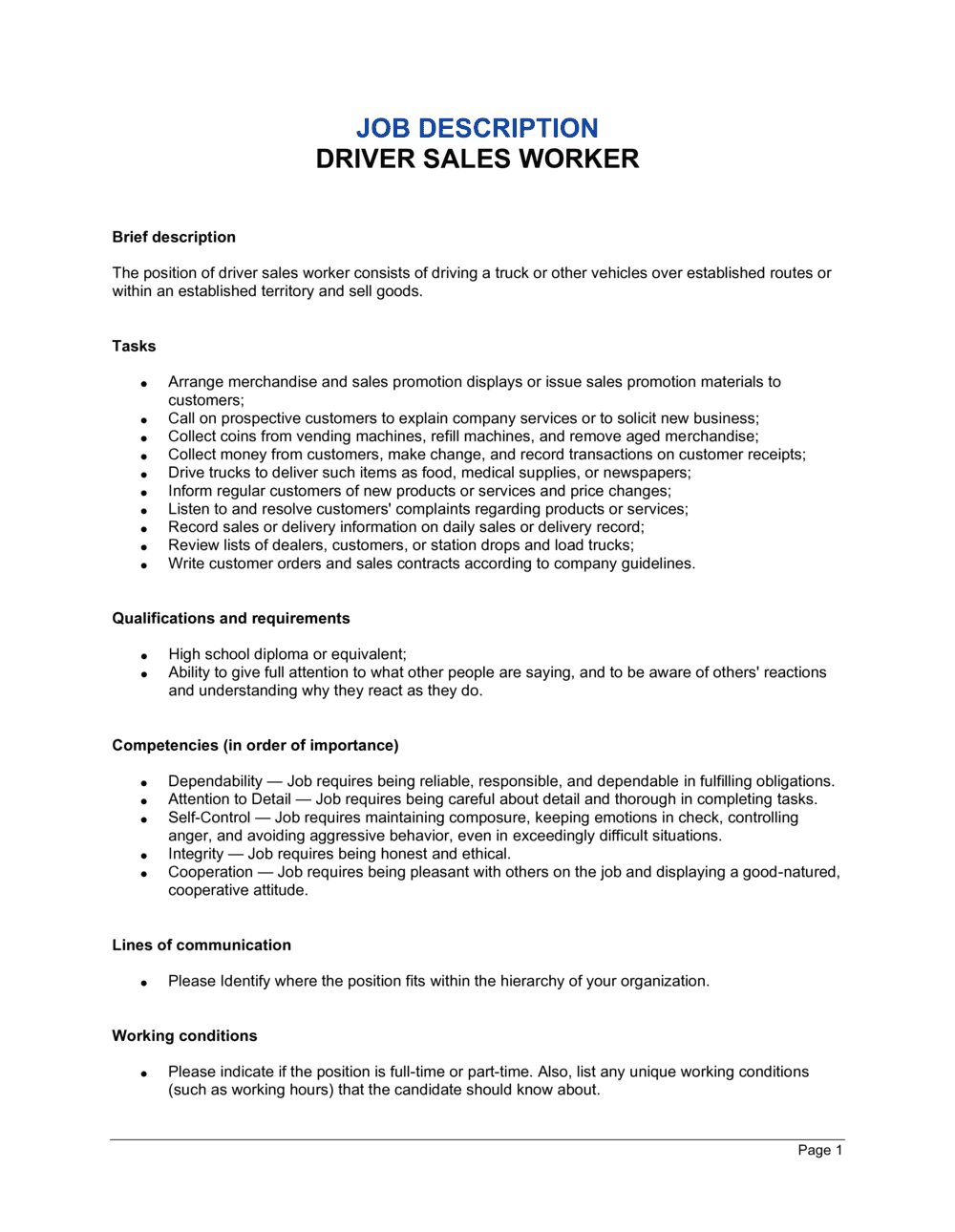
A Driver Sales Worker Job Description is a binding employment document that defines the duties, performance expectations, compensation structure, licensing requirements, and compliance obligations for a driver who simultaneously delivers products and sells to customers along an assigned route. This free Word download gives you a structured, legally grounded template you can customize, sign, and file as the authoritative record of the role.
When you need it
Use it when hiring, re-hiring, or reclassifying any employee who drives a company vehicle and performs direct sales or merchandising activities during delivery runs — including route drivers, delivery sales associates, and territory sales drivers. It is also required when auditors or regulators ask for documented proof of job scope and compliance acknowledgment.
What's inside
Role summary and reporting structure, detailed duties covering both driving and sales responsibilities, territory and route assignment, compensation including base pay and commission, required licenses and certifications, vehicle use and safety policy, performance metrics, confidentiality obligations, and an acknowledgment and signature block.

What is a Driver Sales Worker Job Description?

A Driver Sales Worker Job Description is a binding employment document that defines the full scope of a role where an employee simultaneously operates a company vehicle and sells products directly to customers along an assigned route. Unlike a generic job posting, this document establishes enforceable obligations on both sides — covering daily driving and delivery duties, sales and account management responsibilities, territory boundaries, compensation and commission structure, required commercial licenses, DOT compliance obligations, vehicle use rules, measurable performance standards, and post-employment non-solicitation restrictions. When signed by both parties before the employee's first route day, it functions as an authoritative record of agreed terms that can be produced in disputes, audits, and regulatory inspections.

Why You Need This Document

Without a signed, detailed job description, four costly problems tend to surface simultaneously. Commission disputes become credibility contests — a driver who claims they were promised a higher rate and never signed anything is difficult to counter in court. Performance terminations are challenged as wrongful dismissal when there is no written record of what targets were agreed. An employee who loses their CDL and continues driving creates uninsured liability exposure if there is no documented protocol requiring immediate reporting and suspension from route duties. And a departing driver who takes your customer accounts to a competitor cannot be legally restrained without a signed non-solicitation clause. This template closes all four gaps for the cost of thirty minutes, and the jurisdictions block ensures you calibrate the document correctly whether your routes run through Texas, Ontario, or Germany.

Which variant fits your situation?

If your situation is…Use this template
Hiring a driver who only delivers with no selling responsibilitiesDelivery Driver Job Description
Engaging an independent contractor for route sales coverageIndependent Contractor Agreement
Documenting a full employment relationship for a route driverEmployment Contract
Hiring a territory sales representative without driving dutiesSales Representative Job Description
Defining the role of a driver who also supervises other driversDriver Supervisor Job Description
Creating a written safety acknowledgment for commercial vehicle operatorsVehicle Use Policy
Establishing performance goals tied to route sales targetsSales Commission Agreement

Common mistakes to avoid

❌ Omitting a signature block entirely

Why it matters: An unsigned job description is an informational handout, not a binding document. Without a signature, the employer cannot enforce performance standards, commission clawbacks, or non-solicitation clauses.

Fix: Add a formal acknowledgment and signature block as the final clause and obtain execution before the employee's first day on route.

❌ Leaving commission terms undefined

Why it matters: When commission is paid regularly without a written formula, courts in several jurisdictions treat it as a guaranteed entitlement. Disputes over unpaid commission become credibility contests rather than contract interpretation.

Fix: Write the full commission formula — percentage, base volume threshold, payment trigger, and clawback conditions — into the compensation clause and have the employee initial it separately.

❌ No protocol for license or CDL lapse

Why it matters: A driver who loses their CDL and continues operating the route exposes the employer to uninsured liability and DOT civil penalties. If the job description is silent on this, suspension or termination for a license lapse is harder to defend.

Fix: Include a clause requiring the employee to report any license suspension, revocation, or medical disqualification within 24 hours, with immediate removal from driving duties pending review.

❌ Using a broad non-compete instead of a targeted non-solicitation

Why it matters: Broad geographic non-competes for route-level roles are routinely struck down as unreasonable, voiding the entire restrictive covenant and leaving the employer with no post-employment protection.

Fix: Replace the non-compete with a narrowly drawn non-solicitation covering only the accounts within the assigned route for 12 months post-separation — courts enforce this far more consistently.

❌ Combining driving and sales duties in a single undifferentiated list

Why it matters: When performance falls short, an employer must show which specific duties were not met. A mixed duty list makes it impossible to attribute failures to the delivery side versus the sales side, weakening any disciplinary or termination case.

Fix: Create two clearly labeled sections — 'Delivery and Vehicle Responsibilities' and 'Sales and Account Management Responsibilities' — with distinct bullets under each.

❌ No right-to-modify-route clause

Why it matters: Without an explicit reservation to reassign or restructure routes, a territory change can be argued as a unilateral variation of the employment contract, exposing the employer to constructive dismissal claims in common-law jurisdictions.

Fix: Include a clause stating that the company reserves the right to modify route assignments, account allocations, and territory boundaries with reasonable written notice.

The 10 key clauses, explained

Role Summary and Reporting Structure

In plain language: Defines the position title, the department the role sits in, and who the driver sales worker reports to directly.

Sample language
The Driver Sales Worker reports to the [ROUTE SALES MANAGER / DISTRICT MANAGER] and is responsible for delivering [PRODUCT TYPE] to assigned accounts within [TERRITORY NAME] while actively soliciting and closing sales on each stop.

Common mistake: Using a generic title like 'Driver' without specifying the sales component — this undermines the employer's ability to enforce sales performance standards or commission clawbacks.

Core Driving and Delivery Duties

In plain language: Lists the physical driving, vehicle inspection, loading, unloading, and delivery confirmation responsibilities tied to the role.

Sample language
Employee shall conduct pre- and post-trip vehicle inspections per [EMPLOYER / DOT] standards, load and unload product safely, obtain customer signatures on delivery receipts, and maintain accurate daily delivery logs.

Common mistake: Omitting pre-trip inspection duties — if an accident occurs and no inspection protocol is documented, the employer faces significantly greater liability exposure.

Sales and Account Management Duties

In plain language: Describes the selling, upselling, new account acquisition, and customer relationship management responsibilities performed during the route.

Sample language
Employee shall solicit orders from existing accounts, introduce new products and promotions, pursue new account acquisition within the assigned territory, and report competitive activity to [SALES MANAGER] weekly.

Common mistake: Combining driving and sales duties in a single vague bullet. Separate the two categories so each set of responsibilities is measurable and defensible in a performance review.

Territory and Route Assignment

In plain language: Defines the geographic boundaries of the employee's assigned route and the company's right to adjust territory as business needs change.

Sample language
Employee is assigned to [ROUTE NAME / NUMBER] covering [GEOGRAPHIC DESCRIPTION]. The Company reserves the right to modify route boundaries or account assignments with [X] days' written notice.

Common mistake: Failing to reserve the right to change route assignments. Without this clause, a territory reassignment can be argued as constructive dismissal in common-law jurisdictions.

Compensation, Commission, and Expense Reimbursement

In plain language: States base pay rate, the commission formula tied to sales performance, and the process for reimbursing work-related expenses.

Sample language
Employee shall receive a base wage of $[X] per hour / week, plus a commission of [X]% on net sales exceeding $[BASE VOLUME] per week within the assigned route. Business expenses substantiated by receipts shall be reimbursed within [30] days.

Common mistake: Leaving the commission formula vague — courts have found that regularly paid commissions become contractual entitlements even without a written formula, making disputes expensive to resolve.

Licensing, Certification, and Compliance Requirements

In plain language: Lists the licenses and certifications the employee must hold and maintain as a condition of employment, including CDL class, endorsements, and DOT medical card.

Sample language
As a condition of continued employment, Employee must maintain a valid [Class A / B] CDL with [ENDORSEMENTS] and a current DOT medical certificate. Failure to maintain required credentials will result in immediate suspension from driving duties pending review.

Common mistake: Not specifying what happens when a license lapses. An employee who loses their CDL but continues on the route creates uninsured liability — the job description must address this explicitly.

Vehicle Use Policy and Safety Obligations

In plain language: Sets the rules for authorized use of company vehicles, personal use restrictions, accident reporting, and the employee's obligation to follow all traffic and DOT regulations.

Sample language
Company vehicles shall be used exclusively for authorized business purposes. Employee must report any accident, traffic citation, or license suspension to [FLEET MANAGER] within [24] hours of occurrence. Personal use of Company vehicles is [permitted / prohibited] outside scheduled route hours.

Common mistake: Permitting personal vehicle use without specifying insurance implications. Personal use that is not disclosed to the carrier can void commercial auto coverage after an accident.

Performance Standards and KPIs

In plain language: Documents the measurable performance expectations — stop counts, sales volume, new account targets — used to evaluate the employee and trigger progressive discipline.

Sample language
Employee is expected to complete a minimum of [X] stops per day, achieve monthly route sales of $[X], open [X] new accounts per quarter, and maintain a customer satisfaction score of [X] or above as measured by [METHOD].

Common mistake: Setting KPIs only verbally. Without written performance standards, a termination for poor performance is nearly impossible to defend against a wrongful dismissal claim.

Confidentiality and Non-Solicitation

In plain language: Prevents the employee from disclosing customer lists, pricing, or route data and from soliciting the employer's accounts after separation.

Sample language
Employee shall not disclose customer account information, pricing, or route data to any third party during or after employment. For [12] months following separation, Employee shall not solicit accounts within the assigned territory on behalf of a competing business.

Common mistake: Using a post-employment non-compete instead of a narrower non-solicitation clause for driver sales workers. Courts are far more likely to enforce a targeted non-solicitation than a broad geographic non-compete for this role.

Acknowledgment and Signature Block

In plain language: Confirms that the employee has read, understood, and agreed to the job description and all attached policies, and records the date of execution.

Sample language
By signing below, Employee acknowledges receipt of this Job Description, confirms they meet all stated licensing and compliance requirements, and agrees to the duties, performance standards, and policies set out herein. Employee: [SIGNATURE / DATE]. Employer Representative: [SIGNATURE / TITLE / DATE].

Common mistake: Treating the job description as an informational document rather than obtaining a signature. An unsigned job description cannot be introduced as evidence of agreed terms in a dispute.

How to fill it out

  1. 1

    Enter the employer's legal entity name and location

    Use the registered corporate name — not a trade name — and include the business address. This ties the document to the correct legal entity for any future enforcement action.

    💡 Cross-reference your state or provincial business registry to confirm the exact registered name before printing for signature.

  2. 2

    Define the role title and reporting line

    Specify the exact job title (e.g., 'Driver Sales Worker — Route [NUMBER]') and name the direct supervisor position — not the individual — so the clause survives personnel changes.

    💡 Avoid generic titles like 'Driver' or 'Delivery Person' — the sales component must appear in the title to support commission and performance management clauses.

  3. 3

    Separate driving duties from sales duties in the core responsibilities clause

    Write distinct bullet lists for delivery-side duties (vehicle inspection, loading, delivery confirmation) and sales-side duties (order solicitation, new account acquisition, merchandising). Mixed lists make performance measurement ambiguous.

    💡 Each bullet should describe a behavior observable by a supervisor, not an outcome — 'completes pre-trip inspection daily' is enforceable; 'maintains vehicle safety' is not.

  4. 4

    Fill in the territory and route assignment details

    Name the specific route number or geographic boundary, list the key accounts if applicable, and include the company's right to reassign routes with written notice.

    💡 If the territory includes accounts in multiple states or provinces, note each jurisdiction — different HOS rules and sales tax obligations may apply.

  5. 5

    Complete the compensation and commission block

    Enter the base wage rate, the commission percentage and the sales threshold it applies above, the payment frequency, and the expense reimbursement timeline. Mark commissions as 'earned upon cash collection' if that is company policy.

    💡 State the currency explicitly for any cross-border operation. USD and CAD are easy to confuse in a border-territory role.

  6. 6

    List all required licenses and certifications with expiry obligations

    Specify CDL class (A or B), any required endorsements (hazmat, tanker), DOT medical certificate requirements, and what must happen if a credential lapses. Define the suspension protocol clearly.

    💡 Check the FMCSA or provincial transport authority website for the current medical certificate validity period — it can be as short as one year for drivers with certain health conditions.

  7. 7

    Set written KPIs and attach them as a schedule

    Enter specific, measurable performance targets — stops per day, monthly sales volume, new accounts per quarter — and attach them as Schedule A so targets can be updated without amending the main document.

    💡 Attach a signed copy of Schedule A at onboarding and again each time targets change. Unsigned updated KPIs cannot be used as the basis for termination.

  8. 8

    Obtain signatures before the first route day

    Both the employee and an authorized employer representative must sign and date the document before the employee's first scheduled route. Post-start signatures require fresh consideration to bind restrictive covenants.

    💡 Use Business in a Box eSign to timestamp execution and store the fully executed copy in BIB Drive for instant retrieval during audits or disputes.

Frequently asked questions

What is a driver sales worker job description?

A driver sales worker job description is a formal employment document that defines every material aspect of a role where an employee both operates a company vehicle and sells products directly to customers along an assigned route. It covers duties, territory, compensation, licensing requirements, safety obligations, performance standards, and post-employment restrictions. When signed by both parties before the first day of work, it functions as a binding agreement enforceable in employment disputes.

What is the difference between a driver sales worker and a delivery driver?

A delivery driver's primary obligation is transporting goods from a warehouse or depot to customers — selling is incidental or absent. A driver sales worker is equally responsible for soliciting and closing sales, maintaining accounts, and growing revenue along the route. The dual responsibility affects compensation structure (base plus commission), performance management, and the applicable overtime exemption analysis under the FLSA in the United States.

Does a driver sales worker job description need to be signed?

Yes — without a signature from both the employee and an authorized employer representative, the document is not a binding contract. An unsigned job description cannot be used to enforce non-solicitation clauses, commission clawbacks, or termination-for-cause provisions. Both parties should sign before the employee's first route day; post-start signatures require fresh legal consideration in common-law jurisdictions to bind restrictive covenants.

What licenses does a driver sales worker typically need?

Requirements depend on the vehicle weight and cargo type. In the US, vehicles over 26,001 lbs GVWR require a Class B CDL at minimum; combined vehicle weights over 26,001 lbs with a towed unit over 10,000 lbs require a Class A CDL. A DOT medical certificate is required for interstate commercial driving. Hazardous materials cargo requires a separate HAZMAT endorsement. Canadian requirements are similar under provincial transport legislation with equivalent license classes.

Is a driver sales worker exempt from overtime under the FLSA?

Potentially yes — the Motor Carrier Exemption under Section 13(b)(1) of the FLSA exempts certain commercial drivers from overtime requirements when they operate vehicles over 10,000 lbs in interstate commerce. However, drivers of smaller vehicles or those operating exclusively intrastate may not qualify. The exemption analysis is fact-specific and has been the subject of significant litigation. Employers should confirm the applicable classification with employment counsel before relying on it.

Can I restrict a driver sales worker from contacting my customers after they leave?

Yes, but the restriction must be narrowly tailored to be enforceable. A non-solicitation clause covering only the accounts within the employee's assigned route for 12 months post-separation is consistently upheld. A broad geographic non-compete covering the entire industry is frequently struck down for this type of role. California, Minnesota, and Oklahoma prohibit most post-employment restrictions entirely, so the clause must be removed or restructured for employees working in those states.

What KPIs should a driver sales worker job description include?

Standard measurable KPIs for this role include: daily stops completed, monthly route revenue, new accounts opened per quarter, order fill rate (units delivered vs. units ordered), merchandising compliance scores, and vehicle inspection completion rate. Each KPI should have a numeric target and a defined measurement method. Attaching KPIs as a signed Schedule A rather than embedding them in the body lets you update targets annually without executing a new job description.

What happens if the employee loses their CDL while employed?

If the job description is silent on this, the employer has limited options and faces potential liability for allowing an unlicensed driver to continue on route. A well-drafted document should require the employee to report any license suspension, revocation, or medical disqualification within 24 hours, trigger immediate removal from driving duties, and specify whether the employer will hold the position during a reinstatement period. Without these provisions, termination for license lapse can be challenged as wrongful dismissal.

Do I need a lawyer to create a driver sales worker job description?

For a standard domestic hire in a single US state or Canadian province, a high-quality template is sufficient for most small and mid-size employers. Engage employment counsel when the role involves interstate DOT compliance in multiple states, significant commission earnings that create clawback risk, a non-solicitation clause covering high-value accounts, or operations in jurisdictions with complex employment statutes such as California or Ontario. A 1–2 hour template review typically costs $300–$600 and is worthwhile for senior route sales roles.

How this compares to alternatives

vs Delivery Driver Job Description

A delivery driver job description covers vehicle operation, loading, unloading, and proof-of-delivery — with no selling responsibilities. A driver sales worker job description adds order solicitation, commission terms, new account acquisition, and merchandising duties. Using the wrong template misclassifies the role and creates gaps in commission and performance management documentation.

vs Sales Representative Job Description

A sales representative job description focuses on prospecting, pipeline management, and closing — typically without any vehicle operation. The driver sales worker document adds CDL requirements, DOT compliance obligations, vehicle use policy, and route-specific duties. Use the sales rep template only when the role has no regular driving or delivery component.

vs Independent Contractor Agreement

An independent contractor agreement engages a self-employed route driver with no employment entitlements — no benefits, no overtime, no tax withholding. Misclassifying a driver sales worker as a contractor triggers back taxes, penalties, and benefit liability. The key test is control: if the employer sets routes, schedules, and sales quotas, an employment relationship almost certainly exists.

vs Employment Contract

An employment contract governs the full legal relationship — compensation, IP, non-compete, termination, and severance — but does not describe daily duties or performance standards in operational detail. Use both documents together: the job description defines what the employee does and how performance is measured; the employment contract defines the legal terms of the relationship and post-employment obligations.

Industry-specific considerations

Food and Beverage Distribution

Route drivers sell and deliver perishable products under strict temperature and rotation requirements, making merchandising duties and sell-by-date compliance critical components of the job description.

Consumer Packaged Goods (CPG)

Driver sales workers manage shelf space, planogram compliance, and promotional displays at retail accounts, requiring detailed merchandising duties and new-product introduction protocols in the role definition.

Industrial and Commercial Supply

Routes cover business-to-business accounts with high average order values, making commission structure, credit limit authority, and customer relationship management duties especially important to document.

Newspaper and Publication Distribution

Early-morning routes, subscription management, new subscriber acquisition, and insertion handling create a unique mix of delivery and sales duties that must be documented separately to support accurate overtime classification.

Jurisdictional notes

United States

FMCSA regulations govern CDL requirements, hours of service, drug and alcohol testing, and driver qualification files for interstate commercial drivers. The Motor Carrier Exemption under FLSA Section 13(b)(1) may eliminate overtime obligations for drivers of vehicles over 10,000 lbs in interstate commerce — but the analysis is fact-specific. Non-compete enforceability varies sharply by state; California, Minnesota, and Oklahoma prohibit most post-employment restrictions. At-will employment applies in 49 states.

Canada

Commercial vehicle licensing and hours-of-service rules are set provincially but largely harmonized through the National Safety Code. At-will employment does not exist in Canada — termination requires notice or pay in lieu meeting Employment Standards Act minimums in the applicable province. Ontario common-law notice for long-tenured drivers can be substantial. Non-solicitation clauses are enforceable if reasonable in scope and duration. Quebec employers must provide French-language documents for provincially regulated employees.

United Kingdom

Drivers operating vehicles over 3.5 tonnes require a Category C or C+E licence and must comply with EU-derived tachograph and drivers' hours rules retained in UK law post-Brexit. Employers must provide a written statement of employment particulars on or before day one. Statutory minimum notice is 1 week per year of service after 2 years, capped at 12 weeks. Post-termination non-solicitation clauses are enforceable if reasonable and supported by a legitimate business interest.

European Union

EU Regulation 561/2006 governs drivers' hours and rest periods for commercial vehicles above 3.5 tonnes. The EU Transparent and Predictable Working Conditions Directive requires written employment terms within 7 days of the start date. Post-employment non-solicitation clauses typically require financial compensation to the employee to be enforceable, with the required payment percentage varying by member state. GDPR applies to any customer data accessed by the driver during route operations.

Template vs lawyer — what fits your deal?

PathBest forCostTime
Use the templateSmall fleet operators and distributors hiring standard route sales drivers in a single state or provinceFree20–30 minutes
Template + legal reviewEmployers with commission-heavy roles, multi-state DOT operations, or non-solicitation clauses covering high-value accounts$300–$6001–3 days
Custom draftedLarge distributors with complex commission structures, HAZMAT endorsement requirements, union considerations, or California operations$1,000–$3,500+1–2 weeks

Glossary

Driver Sales Worker
An employee who operates a company vehicle to deliver products along a set route while simultaneously soliciting orders and selling directly to customers.
Route Assignment
The defined geographic territory and sequence of customer stops a driver sales worker is responsible for covering on a recurring schedule.
CDL (Commercial Driver's License)
A government-issued license required in the US and Canada to operate commercial motor vehicles above a specified weight threshold — mandatory for many driver sales roles.
DOT Compliance
Adherence to US Department of Transportation regulations covering driver hours of service, vehicle inspection, drug and alcohol testing, and recordkeeping for commercial vehicle operators.
Commission Structure
The formula determining variable compensation earned by the driver sales worker based on sales volume, new account acquisition, or target attainment within the assigned route.
Merchandising
In-store activities performed by the driver sales worker at customer locations — including stocking shelves, rotating stock, setting up displays, and removing expired or damaged product.
Hours of Service (HOS)
Federal or provincial regulations limiting the number of hours a commercial driver may operate a vehicle before mandatory rest periods, designed to prevent fatigue-related accidents.
At-Will Employment
An employment arrangement in most US states where either the employer or employee may end the relationship at any time for any lawful reason without advance notice.
Non-Solicitation Clause
A post-employment restriction preventing the driver sales worker from soliciting the employer's customers or accounts within the assigned territory for a defined period after separation.
Vehicle Use Policy
A written set of rules governing the driver's authorized use of company vehicles, including personal use restrictions, accident reporting obligations, and maintenance responsibilities.
Key Performance Indicator (KPI)
A measurable target used to evaluate driver sales worker performance — such as daily stops completed, new accounts opened per month, or revenue per route mile.

Part of your Business Operating System

This document is one of 3,000+ business & legal templates included in Business in a Box.

  • Fill-in-the-blanks — ready in minutes
  • 100% customizable Word document
  • Compatible with all office suites
  • Export to PDF and share electronically

Create your document in 3 simple steps.

From template to signed document — all inside one Business Operating System.
1
Download or open template

Access over 3,000+ business and legal templates for any business task, project or initiative.

2
Edit and fill in the blanks with AI

Customize your ready-made business document template and save it in the cloud.

3
Save, Share, Send, Sign

Share your files and folders with your team. Create a space of seamless collaboration.

Save time, save money, and create top-quality documents.

★★★★★

"Fantastic value! I'm not sure how I'd do without it. It's worth its weight in gold and paid back for itself many times."

Managing Director · Mall Farm
Robert Whalley
Managing Director, Mall Farm Proprietary Limited
★★★★★

"I have been using Business in a Box for years. It has been the most useful source of templates I have encountered. I recommend it to anyone."

Business Owner · 4+ years
Dr Michael John Freestone
Business Owner
★★★★★

"It has been a life saver so many times I have lost count. Business in a Box has saved me so much time and as you know, time is money."

Owner · Upstate Web
David G. Moore Jr.
Owner, Upstate Web

Run your business with a system — not scattered tools

Stop downloading documents. Start operating with clarity. Business in a Box gives you the Business Operating System used by over 250,000 companies worldwide to structure, run, and grow their business.

Start free · No credit card required