Logistics Coordinator Job Description Template

Free Word download β€’ Edit online β€’ Save & share with Drive β€’ Export to PDF

2 pagesβ€’20–30 min to fillβ€’Difficulty: Standardβ€’Signature requiredβ€’Legal review recommended
Learn more ↓
FreeLogistics Coordinator Job Description Template

At a glance

What it is
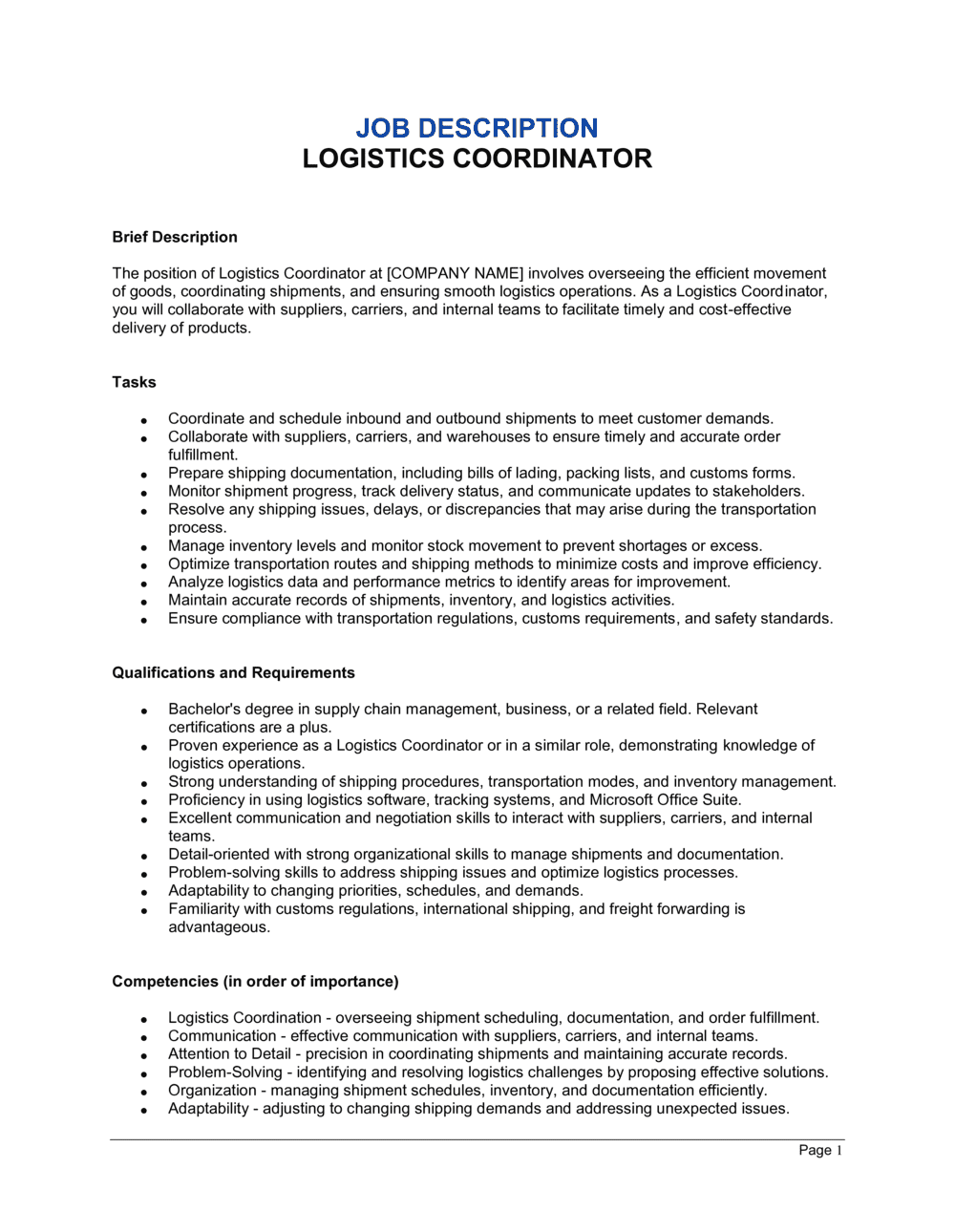
A Logistics Coordinator Job Description is a formal document that defines the scope, duties, reporting structure, qualifications, and compensation range for a logistics coordination role. This free Word download gives employers a structured, legally grounded starting point they can edit online and export as PDF for job postings, offer packages, and employment contract annexes.
When you need it
Use it when opening a new logistics coordinator position, backfilling a vacancy, or standardizing role definitions across a supply chain or operations team. It is also attached to employment contracts to define contractual duties and performance expectations.
What's inside
Job title and department, reporting lines, position summary, core responsibilities, required and preferred qualifications, key performance indicators, compensation and benefits overview, and working conditions including travel and physical requirements.

What is a Logistics Coordinator Job Description?

A Logistics Coordinator Job Description is a formal document that defines the duties, qualifications, reporting structure, performance expectations, and working conditions for a logistics coordination role. It functions both as a recruitment tool β€” setting precise expectations for candidates β€” and as a binding exhibit to an employment contract, establishing the documented scope of duties that governs performance management, accommodation requests, and role-change disputes. Unlike a casual job posting, a properly drafted job description designates essential functions, states the FLSA classification, includes measurable KPIs, and contains a signed acknowledgment block that creates enforceable documentation of agreed role scope.

Why You Need This Document

Without a documented, signed job description, employers face exposure on four fronts simultaneously. First, an unclassified or misclassified role exposes the company to unpaid overtime claims under the FLSA or equivalent provincial and national statutes. Second, missing essential-function designations make it nearly impossible to deny an accommodation request or sustain a performance-improvement plan β€” because there is no documented record of what the employee was actually required to do. Third, when a logistics coordinator's duties expand and a constructive dismissal claim follows in Canada or the UK, a current, signed job description is the primary defense. Fourth, disputes over non-solicitation or IP scope in employment contracts often turn on whether the employee's actual duties were clearly defined and acknowledged. This template gives employers a structured, legally grounded starting point that closes all four gaps in under an hour.

Which variant fits your situation?

If your situation is…Use this template
Hiring for international freight and customs coordinationInternational Logistics Coordinator Job Description
Recruiting a senior-level supply chain or logistics managerLogistics Manager Job Description
Defining a warehouse operations or inventory control roleWarehouse Manager Job Description
Hiring a transport or fleet scheduling coordinatorTransportation Coordinator Job Description
Recruiting a procurement or purchasing specialistPurchasing Manager Job Description
Hiring for third-party logistics (3PL) account managementAccount Manager Job Description
Defining a junior or entry-level supply chain support roleSupply Chain Analyst Job Description

Common mistakes to avoid

❌ Misclassifying the role as FLSA-exempt

Why it matters: Logistics coordinators who primarily execute tasks under supervision typically do not meet the administrative exemption test. Misclassification creates liability for up to three years of unpaid overtime plus penalties.

Fix: Apply the DOL's two-part administrative exemption test β€” primary duty of office work and genuine exercise of discretion on significant matters β€” before marking the role exempt. When in doubt, classify as non-exempt.

❌ Vague or missing essential-function designations

Why it matters: Without designated essential functions, an employer cannot lawfully deny an accommodation request by arguing the task is fundamental to the job β€” leaving the company exposed to ADA and ADAAD claims.

Fix: Explicitly label the five to eight most critical duties as 'essential functions' and document the business justification β€” time spent, consequences of not performing, and whether the duty can be redistributed.

❌ Overstating educational requirements

Why it matters: Requiring a four-year degree for a role where demonstrated experience is an equal substitute can trigger disparate-impact discrimination claims under Title VII and equivalent statutes.

Fix: Add an equivalency clause: 'or equivalent combination of education and work experience.' This broadens the pool without lowering standards.

❌ Publishing no KPIs or purely qualitative performance metrics

Why it matters: When a performance improvement plan or termination-for-cause decision is challenged, employers without documented, measurable role standards struggle to demonstrate that expectations were clear from day one.

Fix: Include at least three numeric KPIs with target thresholds in the job description. Tie each to a data source the employee and manager can both access.

❌ Attaching the job description to the employment contract without a standalone signature

Why it matters: Courts in several jurisdictions treat a job description incorporated by reference without separate acknowledgment as notice, not agreement β€” making duty disputes and non-compete scope arguments harder to win.

Fix: Use a dedicated acknowledgment and signature block on the job description itself, obtained before the employee's first day, and file it separately in the HR record.

❌ Never updating the job description after the role evolves

Why it matters: A job description that no longer reflects actual duties is useless for performance management, creates misalignment during reviews, and can undermine termination-for-cause decisions if the real job bore no resemblance to the documented one.

Fix: Review and reissue the job description annually or whenever duties change materially. Obtain a fresh signature each time and note the revision date on the document.

The 10 key clauses, explained

Job title, department, and FLSA classification

In plain language: States the official role title, the department it sits in, the employment type (full-time, part-time, contract), and whether the role is exempt or non-exempt from overtime.

Sample language
Job Title: Logistics Coordinator | Department: Supply Chain & Operations | Employment Type: Full-Time | FLSA Status: Non-Exempt | Reports To: [LOGISTICS MANAGER / OPERATIONS DIRECTOR]

Common mistake: Misclassifying a logistics coordinator as exempt when their duties and salary do not meet the FLSA executive, administrative, or professional exemption tests β€” this creates back-pay and penalty exposure.

Position summary

In plain language: A 3–5 sentence overview of the role's primary purpose and how it fits within the organization's supply chain and operations functions.

Sample language
The Logistics Coordinator is responsible for planning, coordinating, and monitoring inbound and outbound shipments for [COMPANY NAME]. This role works closely with carriers, warehouses, and internal stakeholders to ensure on-time delivery, accurate inventory records, and compliance with shipping regulations. The Coordinator reports directly to the [LOGISTICS MANAGER] and supports a team of [X] warehouse staff.

Common mistake: Writing a position summary that duplicates the responsibilities section. The summary should answer why the role exists and what it achieves β€” not list what the person does day to day.

Core responsibilities and essential functions

In plain language: A detailed list of the day-to-day duties the employee is expected to perform, written in specific, action-oriented language and designated as essential under applicable disability accommodation statutes.

Sample language
Essential functions include: (1) Coordinate domestic and international freight bookings with approved carriers; (2) Track shipments and proactively resolve delays using [TMS / ERP SYSTEM]; (3) Prepare and verify shipping documentation including bills of lading, customs declarations, and packing lists; (4) Maintain accurate inventory records and reconcile discrepancies within [X] business days.

Common mistake: Using vague verbs like 'assist with' or 'support' without specifying the actual tasks β€” this creates performance management gaps and makes the ADA essential-function defense harder to sustain.

Required qualifications and skills

In plain language: Minimum education, experience, certifications, and technical skills a candidate must have to be considered for the role.

Sample language
Required: (1) Bachelor's degree in Supply Chain Management, Business, or a related field, or equivalent work experience; (2) Minimum [2] years of experience in logistics, freight coordination, or supply chain operations; (3) Proficiency in [ERP SYSTEM NAME] and Microsoft Excel; (4) Knowledge of domestic carrier compliance requirements and customs documentation.

Common mistake: Setting education requirements that screen out qualified candidates unnecessarily β€” courts and the EEOC scrutinize degree requirements for roles where demonstrated experience is an equal substitute.

Preferred qualifications

In plain language: Additional skills or credentials that distinguish strong candidates but are not mandatory for the role.

Sample language
Preferred: (1) APICS CSCP or CLTD certification; (2) Experience with SAP, Oracle WMS, or equivalent ERP; (3) Bilingual proficiency in [LANGUAGE]; (4) Familiarity with Incoterms 2020 and import/export compliance.

Common mistake: Blending preferred qualifications into the required qualifications list β€” this confuses candidates and recruiters, and can create legal exposure if a hire is later rejected for lacking a 'requirement' that was never truly mandatory.

Reporting structure and internal relationships

In plain language: Defines the direct supervisor, any dotted-line reporting, and the key internal teams and external partners the coordinator interacts with regularly.

Sample language
Reports directly to: [LOGISTICS MANAGER]. Works closely with: Procurement, Warehouse Operations, Customer Service, and Finance. External contacts: carriers, freight forwarders, customs brokers, and third-party logistics providers.

Common mistake: Omitting external stakeholder relationships entirely. A logistics coordinator spends significant time with carriers and 3PLs β€” leaving these out understates the role's scope and surprises new hires.

Key performance indicators (KPIs)

In plain language: Measurable outcomes the employee is accountable for, used as the basis for performance reviews and goal-setting.

Sample language
Performance will be evaluated against: (1) On-time delivery rate (target: β‰₯[X]%); (2) Shipment documentation accuracy rate (target: β‰₯[X]%); (3) Inventory discrepancy resolution time (target: within [X] business days); (4) Carrier claims rate (target: <[X]% of shipments).

Common mistake: Setting no KPIs or setting qualitative KPIs with no measurement method β€” this makes performance improvement plans and termination-for-cause decisions much harder to defend.

Compensation, benefits, and work schedule

In plain language: States the salary range or hourly rate, pay frequency, benefits eligibility, and standard working hours including any shift, on-call, or overtime expectations.

Sample language
Compensation: $[MIN]–$[MAX] per year / $[X] per hour, paid [bi-weekly / semi-monthly]. Benefits: eligible for the Company's standard health, dental, and retirement plan per plan terms. Schedule: Monday–Friday, [8:00 AM–5:00 PM], with occasional overtime and on-call availability during peak shipping periods.

Common mistake: Publishing a compensation range so wide it is meaningless (e.g., $35,000–$90,000) β€” this triggers candidate skepticism and, in salary-range-disclosure states like Colorado and New York, may not meet statutory specificity requirements.

Working conditions and physical requirements

In plain language: Documents the physical and environmental demands of the role β€” office or warehouse setting, lifting requirements, travel expectations β€” as required for ADA compliance and job posting accuracy.

Sample language
This position operates primarily in an office and warehouse environment. The employee may be required to lift up to [35] lbs, stand for extended periods, and travel up to [X]% of the time to supplier or carrier facilities. Reasonable accommodations will be made for qualified individuals with disabilities.

Common mistake: Overstating physical requirements to deter applicants β€” courts and the EEOC treat inflated physical requirements as potential ADA violations if they cannot be linked to actual essential functions.

Acknowledgment and signature block

In plain language: Confirms that the employee has read, understood, and agreed to the job description as a condition of employment, and that the document may be revised by the employer with notice.

Sample language
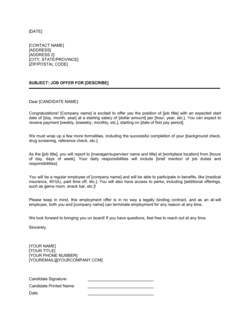
I acknowledge that I have received and reviewed this Job Description and understand that it outlines, but does not limit, the duties of my position. I understand that [COMPANY NAME] may revise this Job Description at any time with reasonable notice. Employee Signature: _______________ Date: _______________ Manager Signature: _______________ Date: _______________

Common mistake: Omitting the acknowledgment block and attaching the job description to the employment contract without separate sign-off β€” if duties are later disputed, there is no standalone evidence the employee agreed to the defined scope.

How to fill it out

  1. 1

    Enter the job title, department, and FLSA classification

    Use the role's official title as it will appear on payroll and org charts. Confirm whether the role meets the FLSA administrative exemption tests before selecting exempt status β€” logistics coordinators are typically non-exempt unless their primary duty involves genuine independent judgment on significant matters.

    πŸ’‘ Check the DOL's FLSA exemption guidelines for the administrative exemption before classifying β€” misclassification is the single most common wage-and-hour audit trigger for operations roles.

  2. 2

    Write the position summary in three to five sentences

    Describe the role's primary purpose, where it sits in the supply chain structure, and what success looks like at a high level. Avoid listing tasks β€” save those for the responsibilities section.

    πŸ’‘ Paste your position summary into a plain-text editor and read it aloud. If it takes longer than 30 seconds, it is too long for a job posting header.

  3. 3

    List essential functions with specific, action-oriented language

    Use verbs like 'coordinates,' 'prepares,' 'monitors,' and 'reconciles' rather than 'assists' or 'supports.' Mark the most critical duties as essential functions to support ADA reasonable-accommodation determinations.

    πŸ’‘ Rank duties by estimated percentage of time β€” functions that consume 20% or more of the work week are almost always essential by legal standards.

  4. 4

    Define required qualifications with defensible thresholds

    Set minimum education and experience levels that genuinely reflect the skills needed. If a two-year degree plus three years of experience is equivalent to a four-year degree, say so explicitly β€” this broadens the candidate pool and reduces disparate-impact risk.

    πŸ’‘ Review your last three successful hires in similar roles and note what credentials they actually had versus what the job posting required β€” mismatches reveal over-specified requirements.

  5. 5

    Set measurable KPIs for the role

    Add at least three numeric KPIs with targets β€” on-time delivery rate, documentation accuracy, inventory reconciliation time. These become the foundation for 30/60/90-day onboarding goals and annual performance reviews.

    πŸ’‘ KPIs tied to real operational data (TMS reports, WMS dashboards) are more defensible in a performance-management dispute than qualitative assessments.

  6. 6

    Complete the compensation and schedule block

    Enter a salary range that reflects current market rates for your region (use BLS OOH, Glassdoor, or Levels.fyi benchmarks for logistics roles). Include on-call and overtime expectations explicitly β€” surprises here drive early turnover.

    πŸ’‘ In salary-range disclosure states (CO, NY, WA, CA, IL, and others), publishing the range is legally required. Check your state's current threshold before posting.

  7. 7

    Document physical requirements accurately

    List only the physical demands that genuinely apply to the role β€” lifting limits, standing time, travel percentage β€” and include the standard ADA reasonable-accommodation statement. Overstated requirements create legal exposure.

    πŸ’‘ Walk through a typical workday for the role and note every physical demand you observe β€” this produces a more accurate list than writing from memory.

  8. 8

    Obtain signed acknowledgment before the employee's first day

    Have the hiring manager sign the document first, then obtain the employee's signature on or before the start date. File the signed copy in the employee's HR record alongside the employment contract.

    πŸ’‘ If the role changes materially within the first year, issue a revised job description and obtain a new signature β€” this resets the documented duty baseline for performance management purposes.

Frequently asked questions

What does a logistics coordinator do?

A logistics coordinator plans, schedules, and monitors the movement of goods through a supply chain β€” booking freight with carriers, tracking shipments, preparing customs and shipping documentation, and resolving delivery delays. They serve as the operational link between suppliers, warehouses, carriers, and internal teams such as procurement and customer service. In most organizations, they report to a logistics manager or operations director and handle the day-to-day execution that keeps inventory moving on schedule.

What should a logistics coordinator job description include?

A complete job description includes the official job title and FLSA classification, a position summary, a list of core responsibilities designated as essential functions, required and preferred qualifications, reporting structure, measurable KPIs, compensation range, working hours, physical requirements, and a signed acknowledgment block. Missing any of these creates gaps in performance management, ADA compliance, and wage- and-hour classification defense.

Is a logistics coordinator considered exempt or non-exempt under the FLSA?

In most cases, a logistics coordinator is non-exempt and entitled to overtime pay under the FLSA. The administrative exemption requires that the employee's primary duty involve genuine exercise of discretion and independent judgment on significant matters β€” most coordinators execute established procedures and escalate exceptions rather than make independent policy decisions. Employers should apply the full two-part DOL exemption test before classifying the role as exempt.

What qualifications should I require for a logistics coordinator?

Typical required qualifications include a bachelor's degree in supply chain, business, or a related field (or equivalent experience), 2–3 years of logistics or freight coordination experience, proficiency in a TMS or ERP system, and familiarity with domestic carrier compliance requirements and shipping documentation. Preferred qualifications often include APICS CSCP or CLTD certification, ERP system experience (SAP, Oracle), and bilingual proficiency for roles with international freight exposure.

What KPIs should be in a logistics coordinator job description?

The most defensible KPIs are tied to operational data the employee can directly influence: on-time delivery rate (typically targeting 95%+), shipment documentation accuracy rate, inventory discrepancy resolution time, and carrier claims rate. Each KPI should include a numeric target and a reference to the data source β€” TMS dashboard, WMS report, or carrier scorecard β€” so expectations are unambiguous from day one.

Does a job description need to be signed?

A job description is not legally required to be signed in most jurisdictions, but obtaining a signature is strongly recommended. A signed acknowledgment block creates documented evidence that the employee received, reviewed, and agreed to the defined scope of their role β€” which is critical for performance management, termination-for-cause defense, and non-compete scope disputes. Always obtain the signature before or on the employee's first day.

How often should a logistics coordinator job description be updated?

Review the job description at least annually and whenever the role's duties change materially β€” for example, when a new TMS is implemented, when the team structure changes, or when international freight responsibilities are added. Issue a revised document with a new revision date, obtain a fresh signature, and file the updated version in the employee's HR record. Outdated job descriptions undermine performance reviews and create ambiguity in disciplinary proceedings.

What is the difference between a logistics coordinator and a logistics manager?

A logistics coordinator is an execution-focused role that books shipments, tracks freight, and processes documentation β€” typically non-exempt and operating within defined procedures. A logistics manager oversees the full logistics function: setting carrier strategy, managing budgets, supervising coordinators, and making independent operational decisions. The manager role typically meets the FLSA administrative or executive exemption threshold; the coordinator role typically does not.

Can a job description be used as an exhibit to an employment contract?

Yes β€” in most jurisdictions, a job description can be incorporated into an employment contract by reference as a schedule or exhibit defining the employee's duties. When doing so, use a separate signature block on the job description itself, not just on the main contract. This ensures the employee has specifically acknowledged the duty scope rather than simply signing a contract that references a document they may not have reviewed in detail.

How this compares to alternatives

vs Logistics Manager Job Description

A logistics manager job description defines a supervisory, strategy-setting role responsible for the full logistics function β€” budgets, carrier contracts, team management, and performance reporting. A logistics coordinator job description defines an execution-focused role operating within the manager's framework. Use the manager template when hiring for a role with direct reports and budget authority; use the coordinator template for an individual contributor focused on shipment execution and documentation.

vs Warehouse Manager Job Description

A warehouse manager job description focuses on facility operations β€” receiving, storage, pick-and-pack, and inventory accuracy within a physical site. A logistics coordinator job description covers the transportation and shipment coordination function that moves goods into and out of that facility. Both roles interact closely, but the coordinator's scope extends to carriers and external partners while the warehouse manager's scope is primarily internal.

vs Employment Contract

An employment contract is the binding legal agreement governing the entire employment relationship β€” compensation, IP, confidentiality, non-compete, and termination. A job description defines the scope of duties and qualifications within that relationship. The job description is typically attached to the employment contract as a schedule but is not a substitute for it. Both documents should be signed before the employee's first day.

vs Job Offer Letter

A job offer letter confirms the role, compensation, and start date to secure the candidate's acceptance. It is not a full duty specification. A job description provides the detailed functional scope that the offer letter summarizes. Together, the two documents β€” offer letter, job description, and employment contract β€” form a complete onboarding document set.

Industry-specific considerations

Retail and e-commerce

High-volume inbound and outbound freight, peak-season capacity planning, last-mile carrier management, and returns processing coordination.

Manufacturing

Raw material inbound scheduling, production-aligned delivery windows, customs and import compliance for international components, and JIT inventory coordination.

Food and beverage

Temperature-controlled carrier management, FSMA compliance documentation, shelf-life tracking, and co-packer shipment coordination.

Healthcare and medical devices

FDA-regulated shipping documentation, cold-chain integrity requirements, serialization and traceability obligations, and reverse logistics for expired or recalled products.

Third-party logistics (3PL)

Multi-client account management, carrier contract compliance, WMS proficiency across multiple platforms, and SLA reporting for each client account.

Construction and industrial

Project-site delivery scheduling, oversized and hazmat freight coordination, equipment tracking, and subcontractor logistics compliance.

Jurisdictional notes

United States

FLSA classification is the primary compliance risk β€” logistics coordinators are typically non-exempt, and misclassification triggers up to three years of back overtime plus liquidated damages. Several states (CO, NY, WA, CA, IL) now require salary range disclosure in job postings. The ADA requires essential-function designations and a reasonable-accommodation statement. Title VII disparate-impact analysis applies to educational and experience requirements.

Canada

Employment Standards Acts in each province set overtime thresholds β€” typically 44 hours per week in Ontario and 40 hours in British Columbia β€” that apply regardless of job title. Job descriptions incorporated into employment contracts must be clear about duty scope, as Canadian courts use them to assess constructive dismissal claims when duties change. Quebec job postings must be in French for provincially regulated employers.

United Kingdom

Job descriptions attached to employment contracts form part of the written statement of particulars required under the Employment Rights Act 1996. Employers must ensure physical and qualification requirements do not indirectly discriminate under the Equality Act 2010. The Working Time Regulations 1998 cap average weekly hours at 48 unless the employee opts out in writing β€” this should be reflected in the working conditions clause.

European Union

The EU Transparent and Predictable Working Conditions Directive requires employers to provide written terms, including a description of the role, within seven calendar days of the start date. Member states such as France, Germany, and the Netherlands impose strict rules on varying job duties without employee consent β€” making a precise and agreed-upon job description essential for operational flexibility. GDPR applies to any personal data processed during recruitment and onboarding.

Template vs lawyer β€” what fits your deal?

PathBest forCostTime
Use the templateHR managers and operations leaders hiring a standard logistics coordinator for a domestic roleFree30–45 minutes
Template + legal reviewRoles with significant overtime classification risk, international freight duties, or union-adjacent positions$200–$500 (HR consultant or employment counsel review)1–2 days
Custom draftedExecutive-track logistics roles, regulated industries (healthcare, food), or multi-jurisdiction hiring with complex compliance requirements$800–$2,500+3–7 days

Glossary

Job Description
A formal written document outlining the duties, responsibilities, qualifications, and reporting structure for a specific role within an organization.
KPI (Key Performance Indicator)
A measurable metric used to evaluate whether an employee is meeting the performance expectations of their role.
Reporting Line
The formal supervisory relationship that defines who the employee reports to and, where applicable, who reports to them.
FLSA Classification
A US federal designation of a role as exempt or non-exempt from overtime pay requirements under the Fair Labor Standards Act.
At-Will Employment
An employment arrangement in which either the employer or employee may end the relationship at any time for any lawful reason, without advance notice.
Essential Functions
The fundamental duties of a position that an employee must be able to perform, with or without reasonable accommodation, under the ADA and equivalent statutes.
Preferred Qualifications
Skills or credentials that are desirable but not mandatory, used to distinguish candidates beyond the minimum requirements.
3PL (Third-Party Logistics)
The outsourcing of logistics operations β€” warehousing, transport, and fulfillment β€” to an external service provider.
Incoterms
Internationally recognized trade terms published by the ICC that define the responsibilities of buyers and sellers for shipping, insurance, and customs clearance.
ERP System
Enterprise Resource Planning software that integrates core business processes β€” inventory, procurement, finance, and logistics β€” into a single platform.
Job Requisition
An internal document submitted by a hiring manager to formally request approval to fill a new or vacant position.

Part of your Business Operating System

This document is one of 3,000+ business & legal templates included in Business in a Box.

  • Fill-in-the-blanks β€” ready in minutes
  • 100% customizable Word document
  • Compatible with all office suites
  • Export to PDF and share electronically

Create your document in 3 simple steps.

From template to signed document β€” all inside one Business Operating System.
1
Download or open template

Access over 3,000+ business and legal templates for any business task, project or initiative.

2
Edit and fill in the blanks with AI

Customize your ready-made business document template and save it in the cloud.

3
Save, Share, Send, Sign

Share your files and folders with your team. Create a space of seamless collaboration.

Save time, save money, and create top-quality documents.

β˜…β˜…β˜…β˜…β˜…

"Fantastic value! I'm not sure how I'd do without it. It's worth its weight in gold and paid back for itself many times."

Managing Director Β· Mall Farm
Robert Whalley
Managing Director, Mall Farm Proprietary Limited
β˜…β˜…β˜…β˜…β˜…

"I have been using Business in a Box for years. It has been the most useful source of templates I have encountered. I recommend it to anyone."

Business Owner Β· 4+ years
Dr Michael John Freestone
Business Owner
β˜…β˜…β˜…β˜…β˜…

"It has been a life saver so many times I have lost count. Business in a Box has saved me so much time and as you know, time is money."

Owner Β· Upstate Web
David G. Moore Jr.
Owner, Upstate Web

Run your business with a system β€” not scattered tools

Stop downloading documents. Start operating with clarity. Business in a Box gives you the Business Operating System used by over 250,000 companies worldwide to structure, run, and grow their business.

Free Forever PlanΒ Β·Β No credit card required