List Of Marketing Channels Template

Free Word download β€’ Edit online β€’ Save & share with Drive β€’ Export to PDF

2 pagesβ€’20–30 min to fillβ€’Difficulty: Standardβ€’Signature requiredβ€’Legal review recommended
Learn more ↓
FreeList Of Marketing Channels Template

At a glance

What it is
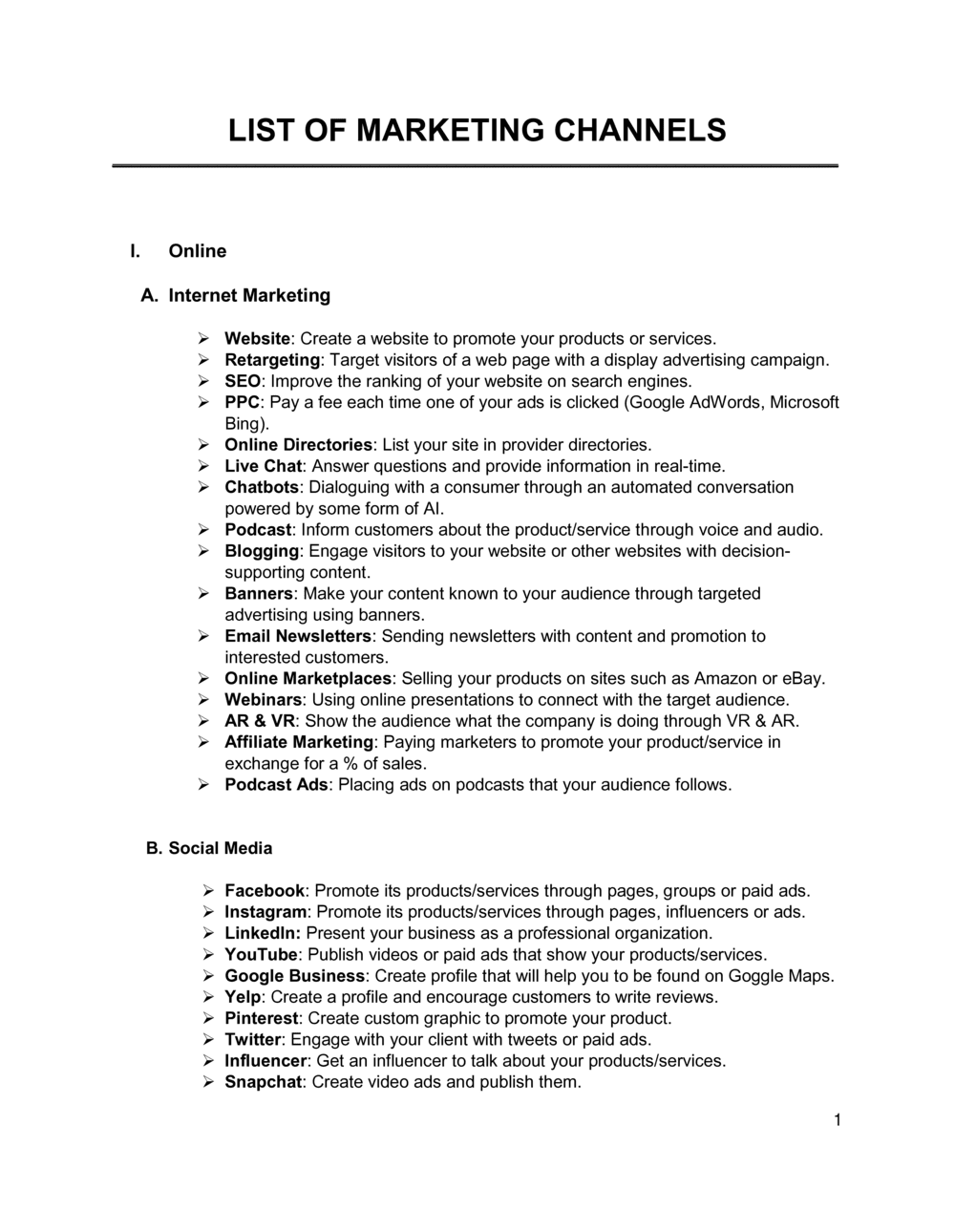
A List of Marketing Channels is a formal schedule or addendum β€” typically attached to a broader marketing agreement, distribution contract, or brand license β€” that identifies every approved channel through which a product, service, or brand may be promoted, sold, or advertised. This free Word download gives you a structured, editable document you can tailor to your channel mix, attach to any master agreement, and export as PDF for signature and record-keeping.
When you need it
Use it whenever you engage an agency, reseller, distributor, or affiliate to market on your behalf, and you need a binding record of which channels are approved, restricted, or excluded. It is also used internally when formalizing a marketing plan that must be approved by a board, franchisor, or licensing partner before funds are committed.
What's inside
Approved channel definitions with scope and geographic limits, exclusivity designations per channel, compliance and brand-guideline obligations, reporting requirements, prohibited channels and activities, amendment procedures, and governing law.

What is a List of Marketing Channels?

A List of Marketing Channels is a formal legal schedule that identifies every medium, platform, and distribution path through which a brand, product, or service may be promoted under a specific business arrangement. It is typically signed as a binding addendum to a master marketing services agreement, franchise contract, affiliate program, or brand license, and creates enforceable obligations on the partner to use only the channels listed β€” and to comply with applicable brand standards, platform policies, and advertising laws when doing so. Unlike an internal marketing plan, this document carries contractual weight: using a channel not listed, or failing to follow the compliance obligations attached to an approved channel, constitutes a breach that gives the brand owner clear remedies.

Why You Need This Document

Without a signed channel list, a partner, agency, or affiliate can use any marketing medium they choose β€” including platforms that carry regulatory risk, conflict with existing exclusivity arrangements, violate brand guidelines, or expose the brand owner to liability for the partner's actions. The damage from a single unauthorized influencer campaign, an off-brand paid search campaign bidding on competitor keywords, or an email blast sent without proper consent can take months to remediate. A signed list of marketing channels closes that exposure by creating a written record of exactly what was authorized, when, and under what conditions β€” giving the brand owner a contractual right to demand immediate takedowns, claim damages, and terminate specific channel authorizations without unwinding the entire relationship.

Which variant fits your situation?

If your situation is…Use this template
Attaching a channel list to a master marketing services agreementMarketing Services Agreement
Defining approved channels for an affiliate partner programAffiliate Marketing Agreement
Restricting channels for a product distribution partnerDistribution Agreement
Controlling marketing activity under a franchise arrangementFranchise Agreement
Listing approved channels for a co-branding campaignCo-Branding Agreement
Documenting digital-only channel restrictions for an agency retainerDigital Marketing Agreement
Setting channel boundaries within a brand licensing dealBrand Licensing Agreement

Common mistakes to avoid

❌ Listing channel categories instead of specific platforms

Why it matters: Approving 'social media' without naming platforms gives the partner carte blanche to run campaigns on any network, including those with different audiences, content standards, or regulatory environments than you intended.

Fix: Name every platform explicitly β€” 'Meta (Facebook and Instagram), LinkedIn' β€” and add a catch-all prohibition covering any platform not listed.

❌ No catch-all prohibition on unlisted channels

Why it matters: Without one, a partner can argue that silence implies permission. A single unauthorized campaign on a non-compliant channel can trigger regulatory action or brand damage before you can intervene.

Fix: Add a clause stating: 'Any channel not listed in Section 3 as an Approved Channel is automatically prohibited unless added by signed written amendment.'

❌ Exclusivity granted without a performance minimum

Why it matters: An exclusive partner who spends nothing on their exclusive channel can effectively block the brand owner from using that channel for the full contract term β€” with no recourse.

Fix: Attach a minimum spend or activity threshold to every exclusive channel grant, with a lapse provision if the threshold is not met within a defined review period.

❌ No pre-approval requirement for creative assets

Why it matters: A partner can publish non-compliant, off-brand, or legally problematic content across approved channels before you know it exists. Removing live content is far more damaging than preventing it.

Fix: Require written pre-approval for all creative at least 5 business days before publication, with a clear process for feedback and revision.

❌ Treating the schedule as a standalone document

Why it matters: A list of marketing channels without a clear reference to the master agreement has no enforcement mechanism β€” there are no remedy provisions, no indemnities, and no dispute resolution procedures.

Fix: Always reference the master agreement in the schedule's opening recital, and confirm the master agreement incorporates the schedule by name in its exhibits or attachments list.

❌ Using a governing law that conflicts with the master agreement

Why it matters: Inconsistent governing law between a schedule and its master agreement creates an ambiguity that courts must resolve, often by applying one body of law to some issues and another to others β€” an expensive and unpredictable outcome.

Fix: Match the governing law clause in this schedule exactly to the governing law clause in the master agreement, and remove the schedule's governing law clause if the master agreement already covers it.

The 10 key clauses, explained

Parties and Recitals

In plain language: Identifies the brand owner and the marketing party (agency, affiliate, licensee, or distributor) and states the purpose of the document β€” formalizing which channels are authorized.

Sample language
This List of Marketing Channels ('Schedule') is entered into as of [DATE] between [BRAND OWNER LEGAL NAME] ('Company') and [MARKETING PARTY LEGAL NAME] ('Partner') and forms part of the [MASTER AGREEMENT NAME] dated [DATE].

Common mistake: Attaching the schedule without referencing it in the master agreement. If the master agreement doesn't incorporate the schedule by name, a court may treat it as a standalone document with no binding effect.

Definitions

In plain language: Defines key terms used throughout the schedule β€” 'Approved Channel,' 'Prohibited Channel,' 'Territory,' 'Brand Assets,' and 'Reporting Period' β€” to prevent disputes over meaning.

Sample language
'Approved Channel' means each medium listed in Section 3 of this Schedule. 'Territory' means [COUNTRY / REGION]. 'Brand Assets' means all logos, taglines, imagery, and copy provided by the Company.

Common mistake: Relying on definitions in the master agreement without restating or cross-referencing them in the schedule. Schedules are often read and signed in isolation, creating interpretation gaps.

Approved Channels (Schedule)

In plain language: Lists every channel the partner is authorized to use, with a description of scope, permitted formats, and any platform-specific limitations.

Sample language
Approved Channels: (a) Paid Social Media β€” Meta and LinkedIn only, within [TERRITORY], using Company-approved creative; (b) Email Marketing β€” existing subscriber lists only, CAN-SPAM and CASL compliant; (c) Search Engine Marketing β€” Google Ads only, excluding competitor keyword bidding.

Common mistake: Listing channel categories (e.g., 'social media') without specifying platforms. 'Social media' could include TikTok, X, Reddit, or Snapchat β€” each with distinct compliance and audience implications.

Prohibited Channels and Restrictions

In plain language: Explicitly identifies channels the partner may not use, including any general restrictions that apply across all approved channels.

Sample language
Partner shall not use the following channels without prior written consent: (a) television or radio broadcast; (b) out-of-home advertising; (c) any platform not listed in Section 3; (d) influencer marketing exceeding [X] followers. Across all channels, Partner shall not bid on the following keywords: [LIST].

Common mistake: Omitting a catch-all prohibition covering unlisted channels. Without one, a partner may argue that any channel not explicitly prohibited is implicitly permitted.

Exclusivity Designations

In plain language: States which channels are granted exclusively to the partner in the defined territory, and which remain non-exclusive or reserved by the brand owner.

Sample language
The following channels are granted exclusively to Partner within the Territory for the term of this Agreement: [CHANNEL LIST]. All other Approved Channels are non-exclusive. Company retains the right to use all channels directly or through other partners outside the Territory.

Common mistake: Granting broad exclusivity without a revenue or activity minimum. An exclusive channel partner who is inactive can block the brand owner from using a high-value channel for the full contract term.

Brand Guidelines and Compliance Obligations

In plain language: Requires the partner to follow the brand's visual and messaging standards across all channels and comply with all applicable laws, platform policies, and advertising standards.

Sample language
Partner shall comply with Company's Brand Guidelines (Exhibit [X]) in all marketing activity. Partner is solely responsible for ensuring all channel activity complies with applicable advertising laws, including FTC disclosure rules, ASA codes, GDPR, and each platform's terms of service.

Common mistake: Placing compliance responsibility on the brand owner rather than the partner. If the partner executes the campaign, the partner must own the compliance obligation β€” shifting it to the brand owner creates exposure without control.

Reporting and Approval Rights

In plain language: Sets out how often the partner must report channel spend and performance, and whether the brand owner has pre-approval rights over creative or copy before it goes live.

Sample language
Partner shall provide monthly channel performance reports within [10] business days of each month-end, including spend by channel, impressions, click-through rate, and conversions. All creative assets must be submitted for Company approval at least [5] business days before publication.

Common mistake: No pre-approval requirement for creative. Without it, a partner may publish non-compliant or off-brand content across approved channels before the brand owner can intervene.

Amendment and Channel Addition Procedure

In plain language: Defines the process for adding new channels, removing existing ones, or adjusting restrictions β€” requiring mutual written consent before any change takes effect.

Sample language
Either party may propose the addition or removal of a channel by written notice to the other. Channel amendments become effective only upon execution of a written amendment signed by both parties. Verbal or email-only approvals are not valid unless subsequently confirmed in a signed amendment.

Common mistake: Allowing channel additions by email approval only. Informal approvals are difficult to trace and create disputes over whether the new channel was ever formally authorized.

Term and Termination of Channel Rights

In plain language: States the duration of the channel authorizations, what triggers termination of specific channel rights (e.g., regulatory action, platform ban, brand violation), and what the partner must do upon termination.

Sample language
Channel authorizations under this Schedule are co-terminus with the Master Agreement. Company may terminate authorization for any specific channel immediately upon written notice if Partner violates this Schedule or if use of the channel poses reputational or legal risk to the Company. Upon termination, Partner shall cease all activity on the affected channel within [48] hours.

Common mistake: Tying termination solely to the master agreement expiry without a channel-specific termination right. A brand-damaging campaign on one channel should not require terminating the entire relationship to stop it.

Governing Law and Dispute Resolution

In plain language: Specifies which jurisdiction's law governs the schedule and how disputes over channel authorization or compliance are resolved.

Sample language
This Schedule is governed by the laws of [STATE / PROVINCE / COUNTRY]. Any dispute arising under this Schedule that cannot be resolved within [30] days of written notice shall be submitted to binding arbitration in [CITY] under the rules of [AAA / JAMS / LCIA], except claims for injunctive relief.

Common mistake: Choosing a governing law inconsistent with the master agreement. If the master agreement is governed by New York law but the schedule specifies California, conflicts between the two documents become significantly harder to resolve.

How to fill it out

  1. 1

    Identify the parties and link to the master agreement

    Enter the full legal names of both parties and explicitly reference the master agreement (marketing services, distribution, franchise, or affiliate agreement) that this schedule supplements. Include the master agreement's execution date.

    πŸ’‘ Confirm the entity names in the schedule exactly match those in the master agreement β€” a mismatch creates a gap that can be exploited in a dispute.

  2. 2

    Define all key terms used in the schedule

    Complete the definitions section with the specific meanings of 'Approved Channel,' 'Territory,' 'Brand Assets,' 'Reporting Period,' and any other terms used throughout. Do not rely solely on cross-references to the master agreement.

    πŸ’‘ If the master agreement defines 'Territory' as a country, and this schedule restricts specific channels to a sub-region, define a separate 'Channel Territory' term to avoid ambiguity.

  3. 3

    List every approved channel with platform-level specificity

    Complete Section 3 with each approved channel, naming the specific platform or medium (e.g., 'Instagram and Facebook' not 'social media'), the permitted content format, and any audience or spend limits.

    πŸ’‘ Organize channels into categories (paid digital, organic, offline, partner-driven) so it is easy to scan during compliance reviews.

  4. 4

    Define prohibited channels and add a catch-all restriction

    List every channel the partner may not use, then add a catch-all clause stating that any channel not listed as approved in Section 3 is automatically prohibited unless added by signed amendment.

    πŸ’‘ Review the partner's existing marketing footprint before finalizing prohibitions β€” banning a channel the partner already uses actively will require a transition plan.

  5. 5

    Set exclusivity terms and minimum performance conditions

    For each exclusively granted channel, specify the territory, the term of exclusivity, and any minimum spend or activity threshold the partner must meet to retain it.

    πŸ’‘ A 6-month exclusivity review clause β€” where exclusivity lapses if spend falls below a threshold β€” protects you from an inactive exclusive partner blocking a key channel.

  6. 6

    Attach brand guidelines and set the approval workflow

    Reference the brand guidelines exhibit by name and version date. Define the pre-approval process: who reviews creative, the turnaround time, and what constitutes deemed approval if no response is received.

    πŸ’‘ A 5-business-day review window with deemed approval after non-response is standard β€” shorter windows cause bottlenecks; longer windows slow campaign launches.

  7. 7

    Define reporting obligations and data formats

    Specify what data the partner must report (spend, impressions, CTR, conversions), how often, in what format (dashboard, CSV, PDF), and to whom it must be sent.

    πŸ’‘ Align the reporting period with the master agreement's invoice cycle so performance data and billing arrive at the same time.

  8. 8

    Execute with signatures before any marketing activity begins

    Both parties must sign the schedule before the partner runs any campaign or publishes any content. Use the same execution formalities as the master agreement β€” if the master requires wet signatures, so does the schedule.

    πŸ’‘ Date the schedule on or before the campaign launch date β€” a retroactively signed schedule is difficult to enforce against activity that already occurred.

Frequently asked questions

What is a list of marketing channels?

A list of marketing channels is a formal schedule or addendum that identifies every approved medium, platform, or distribution path through which a brand, product, or service may be promoted. It is typically attached to a broader marketing services agreement, franchise agreement, affiliate contract, or distribution deal and creates binding obligations on the partner to use only the channels listed and to comply with applicable brand guidelines and laws.

What is the difference between an approved channel and an exclusive channel?

An approved channel is one the partner is authorized to use, but the brand owner may also use it directly or grant the same authorization to other partners. An exclusive channel is one the partner has the sole right to use in a defined territory for the contract term, meaning the brand owner cannot use it directly or grant it to anyone else during that period. Exclusivity is a significant commercial concession and should always be tied to a performance minimum.

Can new channels be added after the document is signed?

Yes, but only through the amendment procedure defined in the schedule. Both parties must sign a written amendment authorizing the new channel before the partner uses it. Verbal approvals, instant messages, or email exchanges are generally insufficient unless they are explicitly designated as valid approval mechanisms in the agreement β€” and even then, they create evidentiary problems.

Does this document need to be signed before marketing begins?

Yes. The schedule should be signed before any campaign is launched or any content is published. A retroactively signed channel list does not create enforceable restrictions over activity that already occurred and may not protect the brand owner from liability for unauthorized use of channels that happened before execution.

What happens if a partner uses a prohibited channel?

Typically, the agreement will give the brand owner the right to demand immediate cessation of the prohibited channel activity, claim damages for any harm caused, and potentially terminate the channel authorization or the entire master agreement. In regulated industries, unauthorized channel use can also trigger regulatory penalties β€” making a clear written record of what was and was not approved critical to demonstrating the brand owner's due diligence.

Is this document relevant for digital-only marketing relationships?

Yes, and arguably more so. Digital channels β€” paid social, search, email, influencer, programmatic display, affiliate networks β€” each have distinct regulatory requirements, platform policies, and audience targeting rules. A schedule that specifies approved digital platforms and prohibits others protects the brand owner from unauthorized ad spend, data privacy violations, and platform policy breaches committed by the partner in the brand's name.

How does this document interact with data privacy laws like GDPR?

The compliance obligations clause should require the partner to comply with all applicable data privacy laws β€” including GDPR, CCPA, and CASL β€” in every approved channel. Email and digital advertising channels in particular involve personal data processing, which triggers specific consent, data-sharing, and processing obligations. In many cases, the master agreement will also require a Data Processing Agreement when the partner processes personal data on the brand owner's behalf.

Should the list of marketing channels be reviewed by a lawyer?

For straightforward agency or affiliate arrangements with clear channel boundaries, a well-completed template is typically sufficient. Legal review is recommended when the document grants exclusivity, involves regulated industries (financial services, healthcare, pharmaceuticals, alcohol), covers cross-border arrangements with different advertising laws, or is attached to a high-value master agreement where channel violations could carry significant financial or reputational consequences.

How this compares to alternatives

vs Marketing Services Agreement

A marketing services agreement is the master contract defining scope of work, fees, IP ownership, and liability. A list of marketing channels is a schedule attached to that master agreement that specifies exactly which channels are authorized. The master agreement governs the overall relationship; the channel list governs where and how campaigns may run. Both documents are needed for a complete arrangement.

vs Affiliate Marketing Agreement

An affiliate marketing agreement governs commission structures, tracking, payment terms, and the affiliate's obligations. It may include a channel list as a schedule, but the agreement itself does not enumerate specific platforms in enforceable detail. A standalone list of marketing channels provides the platform-level specificity that a typical affiliate agreement lacks.

vs Distribution Agreement

A distribution agreement governs the purchase, resale, and territory rights for a product. A list of marketing channels is narrower β€” it addresses only how the distributor may promote the product, not the commercial terms of the distribution itself. For a distributor who also markets on the brand's behalf, both documents are typically required.

vs Brand Licensing Agreement

A brand licensing agreement grants a licensee the right to use a brand's IP in exchange for royalties. A list of marketing channels is a schedule within or attached to that license specifying which platforms the licensee may use to promote licensed products. The licensing agreement creates the IP right; the channel list controls how that right is exercised in the market.

Industry-specific considerations

Franchise and Retail

Franchisors routinely require franchisees to obtain prior approval for every marketing channel, restricting local advertising to brand-approved platforms and co-op fund eligible media.

Financial Services

Regulated advertising channels for financial products must comply with FCA, SEC, or FINRA rules β€” a channel schedule is essential to ensure partners do not use unapproved media that triggers regulatory review.

Healthcare and Pharma

FDA and equivalent regulators restrict direct-to-consumer advertising for prescription products to specific approved media β€” a formal channel list documents compliance and restricts partners from running campaigns outside those boundaries.

SaaS and Technology

Co-marketing and affiliate programs for SaaS products typically restrict partners from bidding on branded keywords, using certain ad networks, or running campaigns on platforms outside the agreed channel mix.

Jurisdictional notes

United States

FTC regulations require clear disclosure of material connections between advertisers and endorsers across all channels, including social media and influencer marketing. Channel lists for financial, pharmaceutical, and alcohol products must reflect sector-specific advertising rules enforced by the SEC, FINRA, FDA, and TTB respectively. State-level consumer protection laws β€” particularly in California β€” may impose additional disclosure requirements on digital advertising channels.

Canada

CASL (Canada's Anti-Spam Legislation) imposes strict consent and identification requirements on commercial electronic messages, making it essential that email and digital advertising channels include explicit CASL compliance obligations. The Competition Act regulates misleading advertising across all channels. Quebec's Act Respecting the Protection of Personal Information in the Private Sector (Law 25) adds additional data obligations for digital channel partners processing Quebec residents' data.

United Kingdom

The Advertising Standards Authority (ASA) and CAP Codes govern most advertising channels in the UK, with specific rules for online, broadcast, and direct marketing. Financial promotions must be approved by an FCA-authorized person before use in any channel. Post-Brexit, UK GDPR applies independently of EU GDPR, and channel compliance obligations for data-driven advertising must reference UK GDPR rather than β€” or in addition to β€” the EU framework.

European Union

GDPR significantly affects digital advertising channels β€” email marketing, programmatic display, and behavioral targeting all require lawful bases for personal data processing, and the channel list's compliance clause should reference GDPR obligations explicitly. The EU Digital Services Act (DSA) and Digital Markets Act (DMA) impose additional obligations on large platform operators and the advertisers who use them. Member states apply national advertising standards on top of EU-wide rules, requiring jurisdiction-specific review for campaigns across multiple EU markets.

Template vs lawyer β€” what fits your deal?

PathBest forCostTime
Use the templateSmall businesses and startups formalizing channel boundaries with a single agency, affiliate, or reseller in a non-regulated industryFree30–60 minutes
Template + legal reviewArrangements involving exclusivity, cross-border channels, co-op marketing funds, or attachment to a high-value master agreement$300–$8001–3 days
Custom draftedRegulated industries (financial services, healthcare, pharma), franchise networks with multiple partners, or global channel programs with jurisdiction-specific compliance requirements$1,500–$5,000+1–3 weeks

Glossary

Approved Channel
A specific medium, platform, or distribution path that has been explicitly authorized in writing for use in promoting the brand, product, or service.
Prohibited Channel
Any marketing medium or platform that the parties have agreed is off-limits, typically listed in a schedule or annex to prevent unauthorized promotion.
Exclusivity
A contractual right granting one party the sole ability to use a particular channel in a defined geography or category, preventing the other party from using or granting it to third parties.
Channel Scope
The defined boundaries of how a given channel may be used, including geographic limits, audience targeting restrictions, and approved content formats.
Brand Guidelines
A set of rules governing the visual identity, tone, messaging, and usage standards that must be followed whenever the brand appears in any approved channel.
Co-op Marketing Funds
Shared budget contributions β€” typically from a brand owner or franchisor β€” that a partner may spend only within pre-approved channels and subject to reimbursement claims.
Amendment Procedure
The process by which new channels may be added or existing channels removed, typically requiring written consent from both parties before the change takes effect.
Compliance Obligation
A party's duty to ensure that all marketing activity within an approved channel adheres to applicable laws, platform terms of service, and brand standards.
Geographic Restriction
A limitation that confines use of a particular channel to a specific country, region, or territory as defined in the agreement.
Reporting Period
The defined interval β€” monthly, quarterly, or campaign-specific β€” during which a party must submit channel performance data or spend reports to the other party.

Part of your Business Operating System

This document is one of 3,000+ business & legal templates included in Business in a Box.

  • Fill-in-the-blanks β€” ready in minutes
  • 100% customizable Word document
  • Compatible with all office suites
  • Export to PDF and share electronically

Create your document in 3 simple steps.

From template to signed document β€” all inside one Business Operating System.
1
Download or open template

Access over 3,000+ business and legal templates for any business task, project or initiative.

2
Edit and fill in the blanks with AI

Customize your ready-made business document template and save it in the cloud.

3
Save, Share, Send, Sign

Share your files and folders with your team. Create a space of seamless collaboration.

Save time, save money, and create top-quality documents.

β˜…β˜…β˜…β˜…β˜…

"Fantastic value! I'm not sure how I'd do without it. It's worth its weight in gold and paid back for itself many times."

Managing Director Β· Mall Farm
Robert Whalley
Managing Director, Mall Farm Proprietary Limited
β˜…β˜…β˜…β˜…β˜…

"I have been using Business in a Box for years. It has been the most useful source of templates I have encountered. I recommend it to anyone."

Business Owner Β· 4+ years
Dr Michael John Freestone
Business Owner
β˜…β˜…β˜…β˜…β˜…

"It has been a life saver so many times I have lost count. Business in a Box has saved me so much time and as you know, time is money."

Owner Β· Upstate Web
David G. Moore Jr.
Owner, Upstate Web

Run your business with a system β€” not scattered tools

Stop downloading documents. Start operating with clarity. Business in a Box gives you the Business Operating System used by over 250,000 companies worldwide to structure, run, and grow their business.

Start freeΒ Β·Β No credit card required