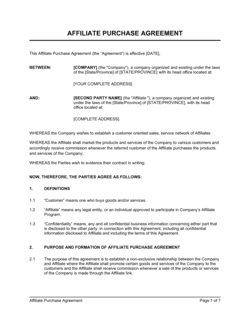
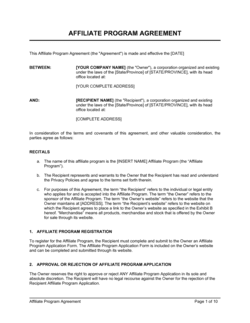
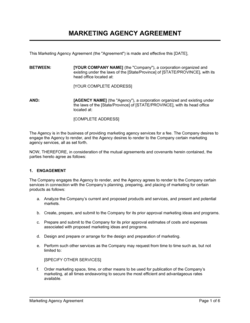
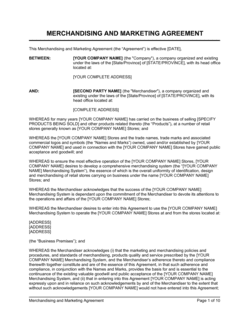
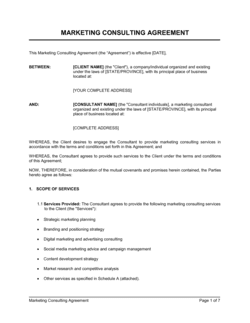
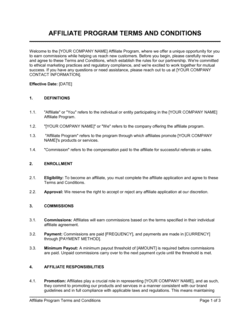
Affiliate Marketing Agreement Template

Free Word download • Edit online • Save & share with Drive • Export to PDF

10 pages30–40 min to fillDifficulty: ComplexSignature requiredLegal review recommended
Learn more ↓
FreeAffiliate Marketing Agreement Template

At a glance

What it is
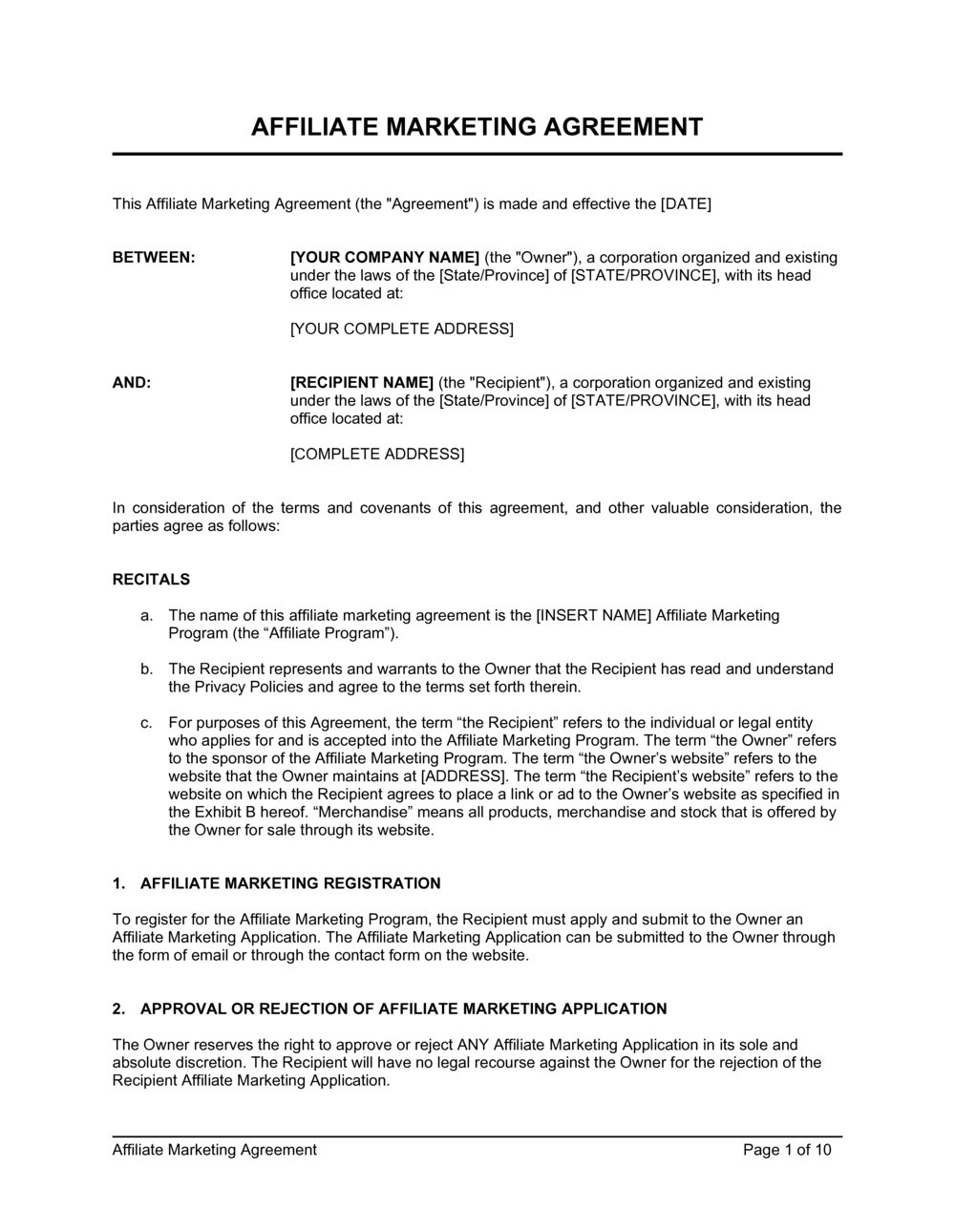
An Affiliate Marketing Agreement is a legally binding contract between a merchant and an affiliate that governs how the affiliate promotes the merchant's products or services in exchange for a commission. This free Word download covers commission structure, tracking methods, payment terms, approved promotional methods, IP licensing, confidentiality, and termination — all in a single customizable document you can edit online and export as PDF.
When you need it
Use it before launching an affiliate program or onboarding any individual affiliate, influencer, or publisher who will earn commissions by driving traffic or sales to your business. It is equally important when joining another company's program as an affiliate and need written confirmation of your earnings terms and obligations.
What's inside
Definitions of the parties and program scope, commission rates and payment schedule, approved and prohibited marketing practices, intellectual property licensing, confidentiality obligations, representations and warranties, termination rights, and governing law.

What is an Affiliate Marketing Agreement?

An Affiliate Marketing Agreement is a legally binding contract between a merchant and an affiliate that governs every material aspect of their performance-based promotional relationship. It defines how the affiliate is authorized to promote the merchant's products or services, how conversions are tracked and attributed, what commission rate applies to qualifying actions, when and how payment is made, what marketing tactics are permitted or prohibited, and what happens if either party ends the arrangement. Unlike informal program terms accepted through a click-wrap interface, a signed bilateral agreement creates clear, enforceable obligations on both sides and provides a concrete reference point if commissions, compliance, or conduct become disputed.

Why You Need This Document

Running an affiliate program without a written agreement is one of the most overlooked legal risks in digital marketing. Without it, you have no enforceable basis to stop an affiliate from bidding on your brand keywords in Google Ads, inflating their commissions through fraudulent clicks, making health or performance claims your products can't support, or continuing to use your logo and brand assets after you've ended the relationship. Affiliates face the mirror-image risk: no documented proof of the commission rate that was promised, no clarity on how disputes are resolved, and no protection against unilateral program changes that cut their earnings. Merchants whose affiliates publish non-compliant promotional content — particularly undisclosed endorsements — share the regulatory exposure under FTC rules even when the affiliate acted independently. A properly drafted affiliate marketing agreement closes all of these gaps before a single tracking link goes live, and this template gives you a complete, customizable starting point in under an hour.

Which variant fits your situation?

If your situation is…Use this template
Paying a flat fee per lead rather than a percentage of saleReferral Agreement
Engaging a single high-profile influencer for a defined campaignInfluencer Marketing Agreement
Recruiting a reseller who buys and resells your productsReseller Agreement
Bringing on a white-label or co-branded distribution partnerDistribution Agreement
Structuring a revenue-share arrangement between two businessesRevenue Sharing Agreement
Setting up a joint venture with shared marketing responsibilitiesJoint Venture Agreement
Licensing your brand to a third party for promotional useBrand Licensing Agreement

Common mistakes to avoid

❌ No attribution model specified

Why it matters: When multiple affiliates touch the same conversion, the merchant faces competing commission claims. Without a written attribution rule, every disputed payment becomes a negotiation.

Fix: State the attribution model explicitly — last-click, first-click, or multi-touch — and document how the tracking platform applies it.

❌ Omitting prohibited promotional tactics

Why it matters: Affiliates bidding on your brand keywords in Google Ads drive up your own paid search costs and can generate low-quality traffic that inflates commission expenses without adding real value.

Fix: List prohibited tactics specifically: brand-keyword PPC, coupon site scraping, cookie stuffing, incentivized traffic, and email to non-opted-in lists. Vague 'no spam' language is not enforceable.

❌ No FTC disclosure requirement

Why it matters: The FTC has issued warning letters and enforcement actions against brands whose affiliates failed to disclose material relationships — the merchant shares regulatory exposure for the affiliate's omission.

Fix: Include a specific clause requiring clear and conspicuous disclosure in all promotional content, and provide affiliates with compliant sample language they can use.

❌ Termination without post-termination commission clarity

Why it matters: Affiliates whose links remain indexed in Google can continue driving tracked conversions for weeks after the agreement ends. Silence on post-termination commissions creates disputes and bad reviews.

Fix: State exactly how long after termination the merchant will track and pay conversions — a 30-day wind-down window is common — and require the affiliate to remove all tracking links and creative assets.

❌ Commission defined on gross sale price with no deduction list

Why it matters: Affiliates budget around a stated commission rate. Deductions for taxes, shipping, returns, and platform fees that were never disclosed create payment surprises and damage the relationship.

Fix: Define 'net sale price' explicitly: gross transaction value less refunds, chargebacks, sales tax, and any stated platform fees. List every deduction by name.

❌ No minimum payment threshold or rollover rule

Why it matters: Paying $1.50 commissions to hundreds of affiliates each month creates processing costs that exceed the payment value, and payment processors may flag high-volume micro-transactions.

Fix: Set a minimum payout threshold — $25 to $50 is standard — with an explicit rollover clause stating that sub-threshold balances carry forward to the next period.

The 10 key clauses, explained

Parties, definitions, and program scope

In plain language: Identifies the merchant and affiliate as legal entities, defines key terms used throughout the agreement, and describes the specific products, services, or program the affiliate is authorized to promote.

Sample language
This Affiliate Marketing Agreement is entered into as of [DATE] between [MERCHANT LEGAL NAME], a [STATE] [ENTITY TYPE] ('Merchant'), and [AFFILIATE LEGAL NAME / INDIVIDUAL FULL NAME] ('Affiliate'). Affiliate is authorized to promote [PRODUCT / SERVICE DESCRIPTION] under Merchant's [PROGRAM NAME] affiliate program.

Common mistake: Using a brand name instead of the merchant's registered legal entity name. If the contracting entity doesn't match the entity that processes payments, commission disputes become harder to enforce.

Commission structure and qualifying actions

In plain language: States the commission rate or flat fee, the action that triggers a commission (sale, lead, click, or subscription), and any tiered or performance-based adjustments.

Sample language
Merchant shall pay Affiliate a commission of [X]% of the net sale price of each Qualifying Purchase, or $[X] per Qualifying Lead, generated through Affiliate's unique tracking link. Commissions on subscription purchases apply to the first [X] payments only, unless otherwise agreed in writing.

Common mistake: Defining commission on gross rather than net sale price without specifying what deductions apply. Affiliates later dispute deductions for refunds, shipping, and taxes that were never disclosed upfront.

Tracking, attribution, and cookie policy

In plain language: Describes how affiliate-driven conversions are tracked, the cookie duration, the attribution model used (last-click, first-click, or multi-touch), and what happens when tracking fails.

Sample language
Conversions will be tracked using [PLATFORM / TECHNOLOGY]. Affiliate's tracking cookie has a duration of [X] days from the visitor's initial click. Merchant uses a last-click attribution model. Merchant is not liable for commissions on conversions that cannot be verified through the tracking system.

Common mistake: Omitting the attribution model entirely. When two affiliates both touched a sale, with no written attribution rule the merchant faces competing commission claims with no contractual basis for a decision.

Payment schedule and minimum threshold

In plain language: Sets out when commissions are paid, the payment method, the minimum balance required before payment is issued, and the process for disputing a commission statement.

Sample language
Merchant shall pay earned commissions on a [monthly / bi-monthly] basis, within [30] days after the close of each calendar period. Payment will be made via [PayPal / bank transfer / check]. Commissions below $[MINIMUM THRESHOLD] will roll over to the following period. Disputes must be raised within [30] days of statement delivery.

Common mistake: No minimum payment threshold and no rollover rule. Processing a $2 commission payment costs more in transaction fees than its value and creates administrative burden at scale.

Approved and prohibited promotional methods

In plain language: Enumerates the marketing channels and tactics the affiliate is permitted to use, and explicitly prohibits practices such as PPC bidding on brand keywords, cookie stuffing, spam, and misleading claims.

Sample language
Affiliate may promote Merchant's products through [APPROVED CHANNELS: blog content, social media, email to opted-in lists, YouTube]. Affiliate shall not: (a) bid on [BRAND NAME] or any variation thereof in paid search; (b) engage in cookie stuffing or forced clicks; (c) make claims about Merchant's products not supported by Merchant's official materials.

Common mistake: Listing only prohibited tactics without specifying approved channels. When a dispute arises over an unapproved channel, there is no positive permission to reference, making enforcement ambiguous.

Intellectual property license

In plain language: Grants the affiliate a limited, non-exclusive, revocable license to use the merchant's trademarks, logos, and approved creative assets solely for the purpose of promoting under the agreement.

Sample language
Merchant grants Affiliate a limited, non-exclusive, revocable, non-transferable license to use Merchant's trademarks, logos, and approved creative materials ('Merchant IP') solely to promote Merchant's products pursuant to this Agreement. Affiliate shall not modify Merchant IP without prior written consent.

Common mistake: No IP clause at all, or a clause that doesn't include a revocation mechanism. Without revocation language, terminating the agreement doesn't automatically stop the affiliate from continuing to use your brand assets.

FTC disclosure and regulatory compliance

In plain language: Requires the affiliate to comply with applicable advertising laws, including the FTC's endorsement guidelines, GDPR, CASL, and any other applicable data-privacy or consumer-protection regulations.

Sample language
Affiliate shall clearly and conspicuously disclose their material connection to Merchant in all promotional content, in accordance with FTC 16 C.F.R. Part 255 and any applicable local regulations. Affiliate represents that all email marketing is conducted in compliance with the CAN-SPAM Act and CASL where applicable.

Common mistake: No compliance clause at all. Merchants have been held jointly liable for an affiliate's undisclosed promotional content — the FTC has issued warning letters to brands whose affiliates failed to disclose.

Confidentiality

In plain language: Prevents the affiliate from disclosing the merchant's commission rates, conversion data, customer information, and other non-public program details to third parties.

Sample language
Affiliate agrees to keep confidential all non-public information disclosed by Merchant, including commission rates, conversion data, program performance metrics, and customer data ('Confidential Information'), and shall not disclose it to any third party without Merchant's prior written consent.

Common mistake: No confidentiality clause in affiliate agreements. Commission rates and conversion data disclosed to competitors or competing affiliates can undermine the entire program's economics.

Term, termination, and effect of termination

In plain language: States the initial term, renewal mechanism, each party's right to terminate with or without cause, and what happens to earned but unpaid commissions after termination.

Sample language
This Agreement commences on [DATE] and continues for [one year], renewing automatically unless either party provides [30] days' written notice. Either party may terminate immediately for cause. Upon termination, Affiliate shall remove all Merchant links and creative assets. Merchant shall pay commissions earned prior to termination on the next scheduled payment date.

Common mistake: Termination language that doesn't address post-termination commission obligations. Affiliates often continue to drive tracked conversions for days after notice is given — a payment cliff creates disputes and damages the relationship.

Representations, warranties, and indemnification

In plain language: Each party warrants they have authority to enter the agreement; the affiliate warrants their promotional content is accurate and compliant; and each party indemnifies the other against third-party claims arising from their own actions.

Sample language
Affiliate represents and warrants that: (a) it has full authority to enter this Agreement; (b) its promotional content is accurate and does not infringe any third-party rights; and (c) it will comply with all applicable laws. Each party shall indemnify and hold harmless the other from claims arising from its own breach or misconduct.

Common mistake: One-sided indemnification that only protects the merchant. Courts in several jurisdictions have rebalanced one-sided indemnity clauses or refused to enforce them entirely — mutual indemnification is both fairer and more durable.

How to fill it out

  1. 1

    Enter the parties' legal names and program details

    Replace the placeholder fields with the merchant's full registered legal entity name and the affiliate's legal name or business name. Add the name of the affiliate program, the product or service category being promoted, and the agreement date.

    💡 Cross-check the merchant entity name against your business registration — using a trade name instead of the legal entity can create enforcement gaps.

  2. 2

    Define the commission structure precisely

    Choose between percentage-of-sale, flat fee per lead, or a tiered model. State whether commission applies to net or gross sale price, which deductions apply, and whether recurring subscriptions earn ongoing or one-time commissions.

    💡 If you offer tiered rates (e.g., 8% for fewer than 50 sales/month, 12% above that), document each tier threshold and the date from which the new rate applies.

  3. 3

    Specify the tracking technology and cookie duration

    Name the affiliate platform or tracking software you use, state the cookie duration in days, and identify your attribution model. If you use server-side tracking as a fallback, note it here.

    💡 30-day cookie duration is the most common standard; shorter durations disadvantage affiliates in high-consideration categories like software or financial products where purchase cycles are long.

  4. 4

    List approved channels and prohibited tactics

    Write out every channel the affiliate is permitted to use — blog, email, social media, comparison sites, paid social — and explicitly prohibit brand-keyword PPC bidding, cookie stuffing, spam, and any misleading claims.

    💡 Add your brand's exact trademarked terms to the PPC exclusion list — including common misspellings — so the prohibition is unambiguous.

  5. 5

    Set the payment schedule and minimum threshold

    Choose a payment cadence (monthly is standard), name the payment method, set the minimum payout threshold, and describe the rollover rule for sub-threshold balances.

    💡 State explicitly whether commissions are held for a chargeback window (typically 30–45 days after the underlying sale) before being paid — this prevents disputes when refunds arrive after commission is already issued.

  6. 6

    Attach or reference the approved creative assets

    List the approved logos, banners, and copy the affiliate may use, or reference a creative brief attached as Schedule A. Include the license scope and any brand guideline requirements.

    💡 Version-control your creative assets — attach the specific asset set in effect at signing and include a process for updating them during the term.

  7. 7

    Confirm the compliance and disclosure requirements

    Ensure the FTC disclosure obligation is clearly stated for US-based affiliates, add GDPR or CASL requirements for EU or Canadian audiences, and include a warranty that the affiliate's email list is fully opted-in.

    💡 Provide affiliates with a sample disclosure line — e.g., 'This post contains affiliate links. I earn a commission if you make a purchase' — to reduce the risk of non-compliant promotions.

  8. 8

    Sign before the affiliate publishes any promotional content

    Both parties must execute the agreement before any links go live or any promotional material is published. Collect signatures via eSign or in wet ink, and store the fully executed copy securely.

    💡 In the US, courts have occasionally recognized click-wrap affiliate program terms as binding — but a signed bilateral agreement is far stronger evidence of specific commission terms than a program ToS acceptance.

Frequently asked questions

What is an affiliate marketing agreement?

An affiliate marketing agreement is a legally binding contract between a merchant and an affiliate that sets out the terms under which the affiliate promotes the merchant's products or services in exchange for a commission. It covers commission rates, tracking and attribution, payment terms, approved promotional methods, IP licensing, compliance obligations, and termination rights. Without a written agreement, both parties operate on implied terms that courts will fill in unpredictably if a dispute arises.

Is an affiliate marketing agreement legally required?

No law in the US, Canada, UK, or EU mandates a written affiliate agreement, but operating without one exposes both parties to significant risk. The merchant has no enforceable basis to prohibit brand-keyword bidding, require FTC disclosures, or clawback commissions on fraudulent sales. The affiliate has no documented proof of the agreed commission rate or payment schedule. A written agreement is the only reliable way to protect both sides.

What commission rate is standard in an affiliate marketing agreement?

Commission rates vary widely by industry. Physical product retailers typically offer 5–15% of net sale price. SaaS and software companies commonly pay 20–30% of first-year subscription value, or a flat referral fee of $50–$500 per qualified sign-up. High-margin digital products like online courses can range from 30–50%. The right rate depends on your gross margin, customer lifetime value, and the CAC you would otherwise pay through paid channels.

What is the difference between an affiliate agreement and a referral agreement?

An affiliate agreement typically governs an ongoing promotional relationship where the affiliate actively markets the merchant's products to an audience through tracked links, content, or ads — and earns a percentage of each resulting sale. A referral agreement is usually simpler, covering a flat fee per qualified lead or introduction made by someone already in the merchant's network. Affiliates are generally external publishers; referrers are often existing customers, partners, or employees.

Can an affiliate market your products without a signed agreement?

Technically, affiliates often begin promoting through program terms accepted via a click-wrap interface on an affiliate platform. These platform terms are generally binding but may be thin on specifics — particularly around prohibited tactics, IP use, and post-termination obligations. A signed bilateral agreement provides much stronger evidence of the specific terms negotiated between the parties and is advisable for any affiliate generating material revenue.

What FTC rules apply to affiliate marketing?

The FTC's Endorsement Guides (16 C.F.R. Part 255) require affiliates to clearly and conspicuously disclose any material connection to the merchant whenever they promote the merchant's products. Disclosure must appear close to the promotional claim — not buried in a footer or linked disclosure page. The FTC updated its guidance in 2023 to address social media and video content specifically. Merchants whose affiliates fail to disclose can face regulatory exposure alongside the affiliate.

What happens to commissions if the affiliate agreement is terminated?

The agreement should explicitly address three scenarios: commissions earned but not yet paid as of the termination date (typically paid on the next scheduled date), conversions tracked in the days immediately following termination while links remain active (a 30-day wind-down window is common), and any commissions subject to a chargeback or fraud review. Without written terms covering these scenarios, termination typically triggers a dispute over every open commission balance.

Do I need a lawyer to draft an affiliate marketing agreement?

For standard programs with straightforward commission structures and domestic affiliates, a high-quality template is generally sufficient. Engage a lawyer when your program involves significant commission exposure, international affiliates in heavily regulated jurisdictions, complex IP licensing, or sub-affiliate (multi-tier) structures. A legal review of a completed template typically costs $300–$600 and is worthwhile before launching a program at scale.

How this compares to alternatives

vs Referral Agreement

A referral agreement covers a simpler, typically one-time arrangement where an existing contact introduces a potential customer in exchange for a flat fee. An affiliate marketing agreement governs an ongoing, performance-based relationship where the affiliate actively markets to an audience through tracked links, content, or ads. Affiliate agreements include tracking, IP licensing, FTC compliance, and content restrictions that referral agreements typically do not need.

vs Influencer Marketing Agreement

An influencer marketing agreement covers a defined campaign with a specific deliverable — a set number of posts, videos, or stories — usually paid as a flat fee regardless of conversions. An affiliate marketing agreement is performance-based: the affiliate earns only when tracked conversions occur. Many influencer relationships combine both structures, with a base fee plus an affiliate commission layer.

vs Reseller Agreement

A reseller buys your product at a wholesale price and sells it at a markup, taking title to the goods and bearing inventory risk. An affiliate never takes title — they simply drive traffic or leads and earn a commission on resulting sales. Reseller agreements are more complex because they govern pricing, inventory, territory, and supply chain obligations that affiliate relationships don't involve.

vs Distribution Agreement

A distribution agreement appoints a distributor to sell your products within a defined territory, often exclusively, and involves purchase minimums, logistics, and local compliance obligations. An affiliate simply promotes and refers — they have no territory rights, hold no inventory, and bear no supply chain responsibility. The legal complexity and financial exposure of a distribution agreement is substantially higher than an affiliate arrangement.

Industry-specific considerations

E-commerce and retail

Percentage-of-sale commissions on net order value, chargeback windows aligned to return policies, and brand-keyword PPC prohibitions to protect paid search spend.

SaaS and technology

Recurring commission on monthly or annual subscriptions, trial-to-paid conversion tracking, and sub-affiliate restrictions common in partner and VAR channel programs.

Financial services and fintech

Strict FTC, FINRA, and FCA compliance obligations, lead-quality requirements tied to applicant creditworthiness, and enhanced clawback provisions for fraudulent applications.

Online education and publishing

High commission rates (30–50%) on digital product sales, refund windows of 14–30 days before commissions are confirmed, and content accuracy warranties given the reputational stakes.

Travel and hospitality

Long cookie durations (60–90 days) reflecting extended booking cycles, commission structures tied to booking confirmation rather than inquiry, and cancellation-clawback provisions.

Health and wellness

FTC and FDA compliance clauses prohibiting unsubstantiated health claims, mandatory disclosure requirements for testimonials, and enhanced indemnification for product liability exposure.

Jurisdictional notes

United States

FTC Endorsement Guides (16 C.F.R. Part 255) require clear and conspicuous disclosure of any material connection between the affiliate and the merchant in all promotional content, including social media. The CAN-SPAM Act governs email promotions. Several states — including California, New York, and Illinois — previously enacted affiliate nexus tax laws requiring merchants to collect sales tax when affiliates created economic nexus; most have been superseded by the Supreme Court's Wayfair decision, but state-level nuances persist. Non-compete clauses attached to affiliate agreements are generally unenforceable in California.

Canada

CASL (Canada's Anti-Spam Legislation) is among the world's strictest email marketing laws and applies to any commercial electronic message sent to or by Canadian recipients — affiliates conducting email campaigns must have express consent from recipients. Quebec's Act Respecting the Protection of Personal Information in the Private Sector (Law 25) imposes GDPR-like data obligations and requires French-language contracts for provincially regulated dealings in Quebec. Commission income paid to Canadian affiliates may require withholding tax reporting depending on whether the affiliate is a resident individual or corporation.

United Kingdom

The ASA (Advertising Standards Authority) and CAP Code require that affiliate promotional content is clearly identified as advertising — '#ad' or 'Affiliate Link' labels are expected on social media posts. The ICO enforces UK GDPR and PECR (Privacy and Electronic Communications Regulations) for email and cookie-based tracking. Affiliate programs involving financial products require FCA authorisation or an appointed-representative arrangement. Post-Brexit, UK GDPR operates independently of EU GDPR, and separate compliance assessments are required for programs reaching both UK and EU audiences.

European Union

GDPR applies to any tracking activity involving EU residents — affiliate cookie tracking and conversion pixels must be disclosed in the merchant's cookie policy and consent framework, and data processing agreements may be required between the merchant and affiliate platform. The EU Digital Services Act (DSA) imposes transparency obligations on platforms facilitating affiliate-style commercial relationships at scale. The Unfair Commercial Practices Directive requires clear identification of advertising in all member states. Commission structures in Germany and France must be carefully documented to avoid classification of the affiliate as a commercial agent under local agency law, which would trigger statutory compensation rights on termination.

Template vs lawyer — what fits your deal?

PathBest forCostTime
Use the templateSmall to mid-size programs with straightforward commission structures and domestic affiliatesFree30–45 minutes
Template + legal reviewPrograms with recurring commissions, sub-affiliate tiers, or affiliates in the EU, UK, or Canada$300–$6002–5 days
Custom draftedHigh-volume programs, financial services or health product verticals, or complex multi-jurisdiction structures$1,500–$4,000+1–3 weeks

Glossary

Affiliate
The individual or company that promotes the merchant's products or services in exchange for a commission on resulting sales, leads, or clicks.
Merchant
The business that owns the product or service being promoted and is responsible for paying commissions to the affiliate.
Commission Rate
The agreed percentage of a sale price, or fixed fee per action, that the merchant pays the affiliate upon a qualifying conversion.
Tracking Link
A unique URL or cookie-based identifier assigned to the affiliate that attributes clicks, sign-ups, or purchases to their promotional activity.
Cookie Duration
The length of time an affiliate's tracking cookie remains active on a visitor's browser — commonly 7, 30, or 90 days — during which a conversion still earns commission.
Qualifying Purchase
A completed transaction that meets the conditions for commission payment — typically a non-refunded sale from a new customer who arrived via the affiliate's tracking link.
Chargeback
A reversal of a previously paid commission when the underlying sale is refunded, disputed, or voided, reducing the affiliate's next payment.
Sub-Affiliate
A third party recruited by the primary affiliate to participate in promotion, creating a second tier of commission obligations that must be explicitly permitted in the agreement.
FTC Disclosure
The Federal Trade Commission requirement that affiliates clearly disclose their commercial relationship with the merchant whenever they promote the merchant's products — applicable to US-based promotions.
Clawback
A contractual provision allowing the merchant to recover previously paid commissions if fraud, returns, or policy violations are discovered after payment.
Net 30 / Net 60
Payment terms specifying that commissions earned in a given period are paid 30 or 60 days after the period closes, allowing time to reverse chargebacks and verify qualifying purchases.

Part of your Business Operating System

This document is one of 3,000+ business & legal templates included in Business in a Box.

  • Fill-in-the-blanks — ready in minutes
  • 100% customizable Word document
  • Compatible with all office suites
  • Export to PDF and share electronically

Create your document in 3 simple steps.

From template to signed document — all inside one Business Operating System.
1
Download or open template

Access over 3,000+ business and legal templates for any business task, project or initiative.

2
Edit and fill in the blanks with AI

Customize your ready-made business document template and save it in the cloud.

3
Save, Share, Send, Sign

Share your files and folders with your team. Create a space of seamless collaboration.

Save time, save money, and create top-quality documents.

★★★★★

"Fantastic value! I'm not sure how I'd do without it. It's worth its weight in gold and paid back for itself many times."

Managing Director · Mall Farm
Robert Whalley
Managing Director, Mall Farm Proprietary Limited
★★★★★

"I have been using Business in a Box for years. It has been the most useful source of templates I have encountered. I recommend it to anyone."

Business Owner · 4+ years
Dr Michael John Freestone
Business Owner
★★★★★

"It has been a life saver so many times I have lost count. Business in a Box has saved me so much time and as you know, time is money."

Owner · Upstate Web
David G. Moore Jr.
Owner, Upstate Web

Run your business with a system — not scattered tools

Stop downloading documents. Start operating with clarity. Business in a Box gives you the Business Operating System used by over 250,000 companies worldwide to structure, run, and grow their business.

Start free · No credit card required