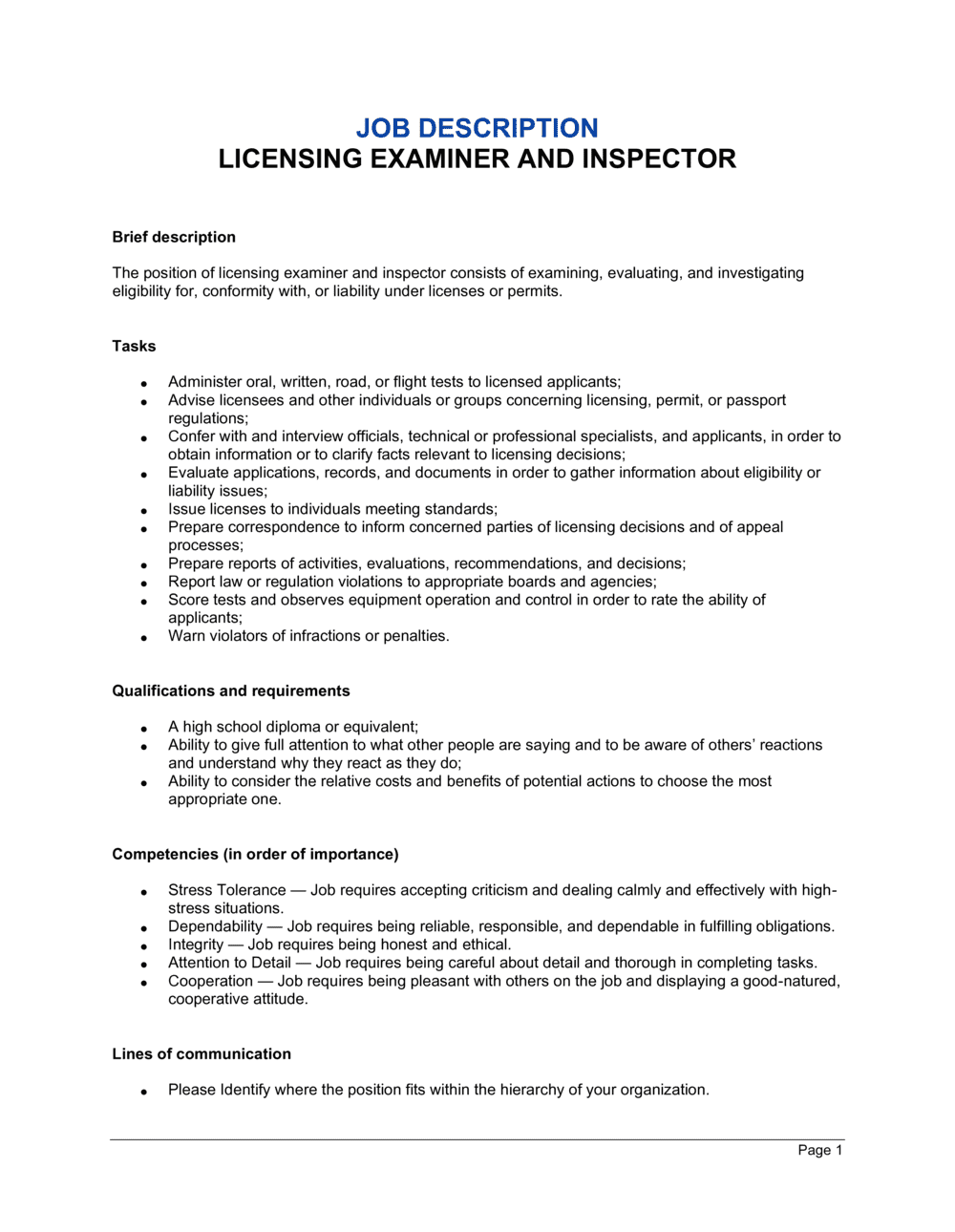
Licensing Examiner and Inspector Job Description Template

Free Word download • Edit online • Save & share with Drive • Export to PDF

2 pages20–30 min to fillDifficulty: StandardSignature requiredLegal review recommended
Learn more ↓
FreeLicensing Examiner and Inspector Job Description Template

At a glance

What it is
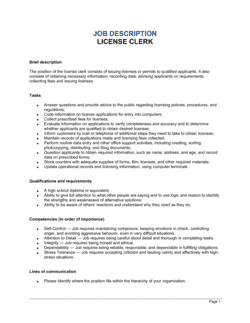
A Licensing Examiner and Inspector Job Description is a formal employment document that defines the role, authority, duties, qualifications, and compliance obligations of an individual responsible for reviewing license applications and conducting regulatory inspections. This free Word download gives you a structured, legally grounded starting point you can edit online and export as PDF for use in public-sector hiring, regulatory agency staffing, or private compliance departments.
When you need it
Use it when hiring a licensing examiner or inspector for a government agency, regulatory body, or regulated private enterprise that requires staff to evaluate applicants, conduct field inspections, enforce licensing standards, or make determination decisions on permits and certifications.
What's inside
Role title and reporting structure, scope of authority, core duties and inspection responsibilities, required qualifications and certifications, regulatory compliance obligations, performance standards, confidentiality requirements, and signature acknowledgment confirming the employee has read and accepted the described terms.

What is a Licensing Examiner and Inspector Job Description?

A Licensing Examiner and Inspector Job Description is a formal employment document that defines the role, statutory authority, core duties, required qualifications, compliance obligations, and performance standards of an individual responsible for evaluating license and permit applications and conducting regulatory inspections. Unlike a general job posting, this document functions as a binding reference point within the employment relationship — establishing the legal basis for the examiner's enforcement powers, the ethics and confidentiality standards they must uphold, and the measurable benchmarks against which their performance will be evaluated. It is executed with signatures from both the employee and the supervising official before the first day of work, making it part of the formal personnel record.

Why You Need This Document

Without a precisely drafted job description, an examiner who issues a Notice of Violation or denies a license application may face a successful legal challenge on the grounds that their authority was never formally documented. Regulatory enforcement actions are routinely appealed, and an examiner operating without a clear statutory citation in their role documentation gives applicants and licensees a procedural basis to challenge findings — potentially invalidating enforcement work and exposing the agency to liability. Beyond enforcement risk, an undefined role creates performance management problems: vague duty language makes it nearly impossible to sustain termination-for-cause proceedings when an examiner fails to meet expectations. A properly executed job description closes both gaps — it documents the legal basis for every inspection and determination, and it sets the measurable standards that support defensible HR decisions. This template gives you a structured, jurisdiction-aware starting point that you can tailor to your regulatory domain and execute in under an hour.

Which variant fits your situation?

If your situation is…Use this template
Hiring a field inspector who conducts on-site premises inspectionsField Inspector Job Description
Recruiting a compliance officer overseeing a regulatory programCompliance Officer Job Description
Defining duties for a permit technician processing applications onlyPermit Technician Job Description
Staffing a health and safety inspector for workplace environmentsHealth and Safety Inspector Job Description
Hiring a quality assurance auditor for manufacturing complianceQuality Assurance Auditor Job Description
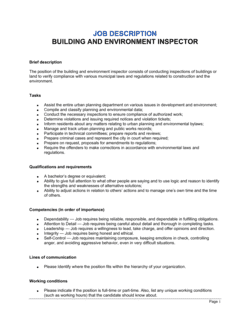
Recruiting a building code enforcement officerBuilding Inspector Job Description
Engaging a contractor for short-term regulatory examination workIndependent Contractor Agreement

Common mistakes to avoid

❌ Omitting the statutory authority citation

Why it matters: An examiner who issues a Notice of Violation without a traceable grant of legal authority faces a high probability of successful legal challenge — the violation finding can be dismissed and the agency exposed to claims for damages.

Fix: Insert the specific statute, regulation, or ordinance number that grants inspection and determination authority in the scope clause. Review it annually to confirm it remains current.

❌ Using vague duty language without measurable benchmarks

Why it matters: Duties described as 'assists with inspections' or 'helps prepare reports' provide no enforceable standard for performance management, making termination-for-cause proceedings legally fragile.

Fix: Rewrite each duty with a directive verb and a measurable output — 'conducts a minimum of [X] field inspections per month and submits reports within [X] business days.'

❌ No access-refusal or safety protocol clause

Why it matters: When a licensee refuses entry, an examiner without documented guidance may force entry unlawfully or abandon the inspection without a record — either outcome can compromise an enforcement case or create personal liability.

Fix: Add an explicit access-refusal protocol requiring the examiner to document the refusal in writing and notify a supervisor or legal counsel within a defined timeframe before any further action.

❌ Signing the job description after the employee's start date

Why it matters: In common-law employment jurisdictions, post-commencement signatures on documents imposing new obligations — such as confidentiality and conflict-of-interest requirements — may be unenforceable without separate consideration.

Fix: Execute the job description acknowledgment before or on the employee's first day. If a later signature is unavoidable, provide documented additional consideration — a training allowance, signing bonus, or extra leave — at the time of execution.

The 10 key clauses, explained

Role title, classification, and reporting structure

In plain language: Establishes the official job title, civil service classification (where applicable), grade level, and the direct supervisory chain the examiner or inspector reports to.

Sample language
Position Title: Licensing Examiner and Inspector [GRADE/LEVEL]. Classification: [CIVIL SERVICE CLASS / EXEMPT / AT-WILL]. Reports to: [SUPERVISOR TITLE], [DEPARTMENT NAME], [AGENCY / ORGANIZATION NAME].

Common mistake: Using a generic title like 'Inspector' without specifying the regulatory domain — this creates classification disputes in civil service systems and ambiguity about the scope of delegated authority.

Scope of authority and delegated powers

In plain language: Defines the specific regulatory authority the examiner holds — including which statutes, regulations, and geographic area they operate under — and what enforcement actions they may independently initiate.

Sample language
The Examiner is authorized to review and evaluate license applications, conduct scheduled and unannounced inspections, issue Notices of Violation, and recommend suspension or revocation of licenses under [APPLICABLE STATUTE / REGULATION] within [GEOGRAPHIC JURISDICTION].

Common mistake: Omitting the specific statutory or regulatory references that grant the authority. Without a citation, the examiner's actions may be challenged as ultra vires — beyond their legal power.

Core duties and inspection responsibilities

In plain language: Lists the primary job functions: reviewing applications, scheduling inspections, conducting field audits, collecting samples or evidence, documenting findings, and preparing inspection reports.

Sample language
Duties include: (a) reviewing license and permit applications for completeness and regulatory compliance; (b) conducting scheduled and unannounced field inspections of [SUBJECT PREMISES / OPERATIONS]; (c) collecting, labeling, and maintaining chain of custody for samples or evidence; (d) preparing written inspection reports within [X] business days of each inspection.

Common mistake: Describing duties in aspirational terms ('will assist with') rather than directive language ('conducts', 'reviews', 'issues') — vague duty language weakens performance management and complicates disciplinary proceedings.

Required qualifications and certifications

In plain language: States minimum education, years of experience, required professional licenses or certifications, and any mandated training programs the incumbent must hold or complete upon hire.

Sample language
Minimum qualifications: [DEGREE / DIPLOMA] in [FIELD] or equivalent combination of education and experience; [X] years of experience in [REGULATORY AREA]; possession of [CERTIFICATION NAME] required within [X] months of hire; valid [STATE / PROVINCIAL] driver's license.

Common mistake: Setting qualification thresholds so high that the role cannot be filled, or so low that underqualified candidates are hired into positions with significant enforcement authority — both create operational and liability risk.

Regulatory compliance and conduct standards

In plain language: Obligates the examiner to comply with all applicable statutes, administrative codes, agency policies, and professional standards of conduct — including prohibitions on conflicts of interest and improper relationships with licensees.

Sample language
The Examiner shall at all times comply with [AGENCY NAME] Code of Conduct, [APPLICABLE STATUTE], and all applicable administrative regulations. The Examiner shall disclose and recuse from any inspection or determination in which a conflict of interest, real or apparent, exists.

Common mistake: Referencing 'agency policies generally' without specifying the conflict-of-interest and ethics obligations by name — leaving the examiner's conduct standards undefined and making disciplinary action for ethics violations harder to sustain.

Confidentiality and records management

In plain language: Restricts the examiner from disclosing non-public application information, inspection findings, or enforcement deliberations outside authorized channels, and requires compliance with records retention schedules.

Sample language
The Examiner shall maintain the confidentiality of all non-public records, applicant information, and pre-decisional inspection findings in accordance with [FREEDOM OF INFORMATION ACT / PRIVACY ACT / APPLICABLE LAW]. Records shall be retained and disposed of in accordance with [AGENCY RECORDS SCHEDULE / RETENTION POLICY].

Common mistake: No confidentiality clause at all, or one that fails to distinguish between public records and pre-decisional deliberative material — both create exposure to unauthorized disclosure claims and FOIA compliance failures.

Performance standards and reporting obligations

In plain language: Sets measurable expectations for inspection volume, report turnaround time, determination accuracy, and participation in required training — providing the basis for performance evaluations.

Sample language
Performance expectations include: completing a minimum of [X] inspections per [period]; submitting inspection reports within [X] business days of each visit; maintaining a determination error rate below [X]% as measured by supervisory review; completing [X] hours of continuing education annually.

Common mistake: Omitting numeric performance benchmarks and relying on subjective language like 'performs duties satisfactorily' — without measurable standards, performance management and termination-for-cause proceedings are difficult to defend.

Use of force, safety, and inspection access protocols

In plain language: Addresses the inspector's obligations regarding personal safety, right-of-entry procedures, and — where applicable — coordination with law enforcement when access is denied or conditions are unsafe.

Sample language
The Examiner shall follow [AGENCY] Safety Protocol [NUMBER] when conducting field inspections. If access to a premises is refused, the Examiner shall not force entry but shall document the refusal and notify [SUPERVISOR / LEGAL COUNSEL] within [X] hours to initiate appropriate legal process.

Common mistake: No access-refusal protocol — leaving the examiner to improvise when entry is denied, which can result in unlawful entry claims or loss of evidence admissibility in subsequent enforcement proceedings.

Termination, amendment, and at-will status

In plain language: States whether the position is at-will or governed by civil service tenure protections, the process for amending the job description, and acknowledgment that the document does not constitute a contract of indefinite employment.

Sample language
This job description does not constitute a contract of employment. [AGENCY / EMPLOYER] reserves the right to modify duties, qualifications, and performance standards with [X] days' written notice. [At-will clause / Civil service tenure provision] applies as set out in [EMPLOYMENT AGREEMENT / CIVIL SERVICE CODE].

Common mistake: Omitting the disclaimer that a job description is not an employment contract — in several jurisdictions, a detailed job description without this language has been held to imply contractual obligations, limiting the employer's ability to modify the role.

Acknowledgment and signature block

In plain language: Confirms that both the employee and the supervising official have reviewed the job description, that the employee understands their duties and obligations, and documents the date of acceptance.

Sample language
I, [EMPLOYEE FULL NAME], acknowledge that I have read, understood, and received a copy of this job description. I understand that it describes the general nature and expectations of my role and may be amended. Signature: ___________ Date: [DATE]. Supervisor: ___________ Date: [DATE].

Common mistake: Collecting only the employee's signature and not the supervisor's — leaving no record that the role was formally communicated from both sides, which complicates disputes about whether expectations were properly set.

How to fill it out

  1. 1

    Enter the position title and civil service classification

    Insert the full official job title, any applicable grade or band level, and the employing agency or organization name. If the role is covered by civil service regulations, include the classification code.

    💡 Align the title exactly with your HR or payroll system to prevent classification disputes and benefits eligibility errors.

  2. 2

    Define the statutory basis for authority

    Identify the specific statutes, administrative codes, or ordinances that grant the examiner inspection and determination authority. Insert the citation directly into the scope-of-authority clause.

    💡 Cross-reference the cited statute to confirm it is currently in force and has not been superseded — regulatory codes change frequently and outdated citations can void enforcement actions.

  3. 3

    List core duties in directive, measurable language

    Use present-tense active verbs ('conducts', 'reviews', 'issues') for every duty. Attach numeric targets where possible — inspection volume, report turnaround time, and determination timelines.

    💡 Keep each duty statement to one action and one object. Combined duties ('reviews and approves and files') are harder to evaluate and harder to enforce.

  4. 4

    Set minimum qualifications precisely

    State the minimum education level, years and type of relevant experience, and any certifications required at hire versus those that can be obtained within a defined window after hire. Include driver's license requirements if field work is involved.

    💡 Validate qualifications against comparable positions in your jurisdiction's civil service classification system before finalizing — exceeding classification minimums can trigger pay equity challenges.

  5. 5

    Incorporate agency-specific compliance and ethics obligations

    Reference the specific ethics code, conflict-of-interest policy, and confidentiality regulations by name and citation. Insert the recusal requirement and the disclosure reporting chain.

    💡 For positions with enforcement authority, an explicit reference to administrative due process obligations (notice, opportunity to respond, appeal rights) reduces agency liability in contested determinations.

  6. 6

    Add performance standards with numeric benchmarks

    Set measurable expectations for inspection volume per period, report submission deadlines, determination accuracy, and mandatory training hours. These become the basis for the annual performance evaluation.

    💡 Review the past two years of inspection data before setting benchmarks — targets that are 20% above historical average are motivating; targets that require 100% more output than any prior examiner achieved are legally vulnerable as pretext.

  7. 7

    Insert the at-will or civil service tenure disclaimer

    Confirm whether the position is at-will, probationary, or covered by civil service tenure protections. Include the amendment notice period and the statement that the document is not an employment contract.

    💡 In jurisdictions with strong public-sector employment protections (e.g., Ontario, France, many US states for classified employees), omitting the civil service tenure reference does not eliminate the employee's statutory rights — but including it prevents misunderstanding about the basis for termination.

  8. 8

    Obtain dual signatures before the start date

    Have both the employee and the direct supervisor sign and date the acknowledgment block before the employee's first day of work. Distribute one copy to the employee and retain the original in the personnel file.

    💡 Digital signatures with a timestamp are acceptable in most jurisdictions and easier to retrieve during grievance or litigation proceedings than paper copies.

Frequently asked questions

What does a licensing examiner and inspector do?

A licensing examiner and inspector reviews applications for licenses, permits, or certifications to verify that applicants meet all regulatory requirements, and conducts field or document-based inspections to confirm ongoing compliance by existing licensees. They issue determination decisions approving or denying applications, prepare formal inspection reports, issue Notices of Violation when breaches are found, and may recommend suspension or revocation of licenses. The role exists in government agencies, regulatory bodies, and regulated private enterprises across sectors including construction, healthcare, food service, and financial services.

Why does a licensing examiner job description need to be a formal legal document?

Because the examiner exercises delegated governmental or regulatory authority — including the power to deny licenses, issue violations, and recommend enforcement actions — the scope of that authority must be precisely documented to withstand legal challenge. A vague or informal job description creates exposure: enforcement actions can be challenged as ultra vires, and the agency can face liability for actions taken outside the examiner's documented authority. A formally executed job description also defines the compliance and ethics obligations that protect the agency against misconduct claims.

What qualifications are typically required for a licensing examiner and inspector?

Requirements vary by jurisdiction and regulatory domain, but typical minimums include an associate's or bachelor's degree in a relevant field (public administration, environmental science, engineering, or a sector-specific discipline), two to five years of directly related experience, and one or more professional certifications relevant to the inspection area. Many positions also require a valid driver's license for field work and completion of agency-specific examiner training within 90 to 180 days of hire. Civil service positions often have additional classification-based requirements.

Is a job description legally binding on the employer?

Generally, a job description alone is not a contract of employment and does not bind the employer to specific duties indefinitely. However, in some jurisdictions and circumstances, a sufficiently detailed job description — particularly one signed by both parties and lacking a clear disclaimer — has been found to create implied contractual obligations. Including an explicit statement that the document does not constitute an employment contract and that duties may be amended with reasonable notice protects the employer's right to update the role.

Can a private company use this job description, or is it only for government agencies?

Both public and private organizations can use this template. Government agencies and regulatory bodies use it to document delegated authority and civil service compliance. Private companies in regulated industries — such as food processing, pharmaceutical manufacturing, construction, and financial services — use it to define internal compliance inspector roles that mirror regulatory requirements, support ISO or accreditation audits, and establish defensible performance standards for in-house examiners.

What is the difference between a licensing examiner and a compliance officer?

A licensing examiner specifically evaluates applications for licenses and permits and conducts inspections to verify regulatory eligibility — the role has a direct determination function with legal consequences for the applicant. A compliance officer typically focuses on internal program management: designing policies, training staff, monitoring adherence, and reporting to leadership. In practice, larger organizations separate the roles; smaller organizations often combine them. This template covers the examiner-inspector function; the Compliance Officer Job Description template covers the broader program management role.

Do I need a lawyer to create a licensing examiner job description?

For straightforward positions in standard regulatory environments, a high-quality template is typically sufficient. Legal review is recommended when the position carries significant enforcement authority, when the jurisdiction has complex civil service or public-sector employment laws, when the role involves cross-border or multi-jurisdictional authority, or when the hiring agency has experienced prior legal challenges to examiner actions. A 1–2 hour review by an employment or administrative law attorney typically costs $300–$600 and is worthwhile for senior examiner positions with material enforcement powers.

What happens if the examiner acts outside the scope defined in the job description?

Actions taken outside the documented scope of authority — known as ultra vires acts — are typically voidable and can expose the agency to legal challenge by the affected licensee or applicant. In administrative law, a determination made by an examiner who lacked the documented authority to make it may be reversed on appeal. The examiner personally may also face disciplinary action. A precise scope-of-authority clause, with statutory citations, is the primary defense against this risk.

How often should a licensing examiner job description be updated?

Review the job description at minimum once per year and whenever the underlying statutes, regulations, or agency policies that define the role's authority change. Regulatory codes are updated regularly — an outdated statutory citation in the scope clause can invalidate enforcement actions taken in reliance on it. Updates should be executed with a new acknowledgment signature from the incumbent to document awareness of the changes.

How this compares to alternatives

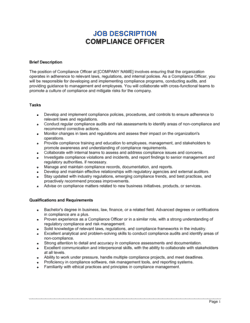
vs Compliance Officer Job Description

A compliance officer job description defines an internal program management role focused on policy design, staff training, and monitoring adherence to regulations. A licensing examiner and inspector job description defines a role with direct regulatory determination authority — approving or denying licenses and issuing violations. Use the compliance officer template for internal risk management roles; use this template for roles that exercise external regulatory enforcement powers.

vs Employment Contract

An employment contract is the comprehensive binding agreement governing the full employment relationship — compensation, benefits, IP, non-compete, and termination. A job description documents role-specific duties, qualifications, and authority within that relationship. Both documents are typically required for a senior examiner hire: the job description defines the regulatory scope; the employment contract governs the terms of engagement.

vs Independent Contractor Agreement

An independent contractor agreement engages a self-employed examiner or inspector for a defined project or term without employment entitlements. A job description applies to an employee with ongoing duties and formal authority within an agency structure. Misclassifying a full-time examiner exercising delegated governmental authority as a contractor creates significant tax, liability, and regulatory-legitimacy risk.

vs Health and Safety Officer Job Description

A health and safety officer job description focuses on workplace hazard identification, OSHA/WHS compliance, and internal safety program management. A licensing examiner and inspector job description covers the broader regulatory examination function — evaluating license eligibility and conducting compliance inspections across multiple regulatory domains. Use the health and safety template for dedicated WHS roles; use this template when the inspector's mandate spans licensing, permits, and multi-domain compliance.

Industry-specific considerations

Government and Public Administration

Examiner authority is derived from statute or ordinance; civil service classification, delegated powers, and administrative due process obligations must all be precisely documented.

Construction and Real Estate

Building and zoning inspectors require specific code citations (IBC, local ordinances), right-of-entry protocols, and coordination procedures with law enforcement for access-refusal situations.

Healthcare and Pharmaceuticals

FDA, state health department, and accreditation-body inspection authority must be cited; HIPAA confidentiality obligations apply to records accessed during inspections.

Food and Beverage

FDA Food Safety Modernization Act and state health code authority citations, sample chain-of-custody requirements, and unannounced inspection authority are sector-specific requirements.

Jurisdictional notes

United States

Federal examiner positions are governed by OPM classification standards and the Administrative Procedure Act. State and local positions operate under individual civil service codes that vary significantly — some states require cause for termination of classified examiners after a probationary period. The scope-of-authority clause must cite the specific federal or state statute under which the examiner operates. California, New York, and Texas each have distinct administrative law frameworks affecting examiner powers and due process obligations.

Canada

Provincial licensing and inspection authority derives from provincial statutes — each province's Administrative Procedures Act or equivalent governs examiner conduct and applicant rights. Federal examiners are governed by the Federal Public Sector Labour Relations Act. In Quebec, job descriptions for provincially-regulated positions must be available in French. Public-sector examiners in most provinces enjoy significant termination protections under public service employment legislation.

United Kingdom

UK regulatory inspectors typically derive authority from specific enabling legislation — the Health and Safety at Work Act, Food Safety Act, Building Act, or sector-specific statutes. The job description must reference the correct statutory basis for entry, inspection, and enforcement powers. Under the Employment Rights Act 1996, employers must provide written particulars of employment on or before the first day of work. IR35 considerations apply if inspectors are engaged through personal service companies.

European Union

EU member states each maintain national administrative law frameworks governing licensing and inspection authority, but the EU Transparent and Predictable Working Conditions Directive requires written employment terms within seven days of hire. GDPR obligations apply to any personal data accessed during inspections — the job description should reference data protection obligations explicitly. Countries including France, Germany, and Spain impose significant public-sector employment protections that limit amendment and termination rights for classified inspectors.

Template vs lawyer — what fits your deal?

PathBest forCostTime
Use the templateStandard government agency or private compliance inspector hires in a single jurisdiction with well-defined regulatory authorityFree30–45 minutes
Template + legal reviewSenior examiner positions with significant enforcement powers, cross-jurisdictional authority, or civil service classification implications$300–$6001–3 days
Custom draftedFederal regulatory agency roles, multi-jurisdictional inspection authority, or positions subject to collective bargaining agreements$1,000–$3,500+1–3 weeks

Glossary

Licensing Examiner
A professional authorized to review, evaluate, and make determination recommendations on applications for licenses, permits, or certifications.
Regulatory Inspector
An individual empowered to conduct on-site or document-based inspections to verify compliance with applicable laws, regulations, or standards.
Scope of Authority
The defined boundaries within which an examiner or inspector may act, including the geographic area, subject-matter jurisdiction, and enforcement powers granted.
Determination Decision
A formal finding by a licensing examiner approving, denying, suspending, or revoking a license or permit application based on regulatory criteria.
Chain of Custody
The documented sequence of possession and handling of evidence, samples, or inspection records collected during a regulatory examination.
Compliance Standard
A specific rule, regulation, code, or criterion against which an inspector measures the subject's practices, facilities, or documentation.
Probable Cause
Reasonable grounds — based on observable facts or evidence — that justify conducting an unannounced inspection or initiating an enforcement action.
Notice of Violation
A formal written document issued by an inspector or examiner notifying a licensee or applicant of a specific regulatory breach and required corrective action.
Delegated Authority
The transfer of specific decision-making powers from a supervising agency or official to an examiner or inspector for a defined set of actions.
Administrative Due Process
The procedural rights — notice, opportunity to respond, and appeal — that a license applicant or holder is entitled to before an adverse determination is finalized.
Field Audit
An on-site examination of a licensee's premises, records, or operations conducted by a regulatory inspector to verify ongoing compliance.

Part of your Business Operating System

This document is one of 3,000+ business & legal templates included in Business in a Box.

  • Fill-in-the-blanks — ready in minutes
  • 100% customizable Word document
  • Compatible with all office suites
  • Export to PDF and share electronically

Create your document in 3 simple steps.

From template to signed document — all inside one Business Operating System.
1
Download or open template

Access over 3,000+ business and legal templates for any business task, project or initiative.

2
Edit and fill in the blanks with AI

Customize your ready-made business document template and save it in the cloud.

3
Save, Share, Send, Sign

Share your files and folders with your team. Create a space of seamless collaboration.

Save time, save money, and create top-quality documents.

★★★★★

"Fantastic value! I'm not sure how I'd do without it. It's worth its weight in gold and paid back for itself many times."

Managing Director · Mall Farm
Robert Whalley
Managing Director, Mall Farm Proprietary Limited
★★★★★

"I have been using Business in a Box for years. It has been the most useful source of templates I have encountered. I recommend it to anyone."

Business Owner · 4+ years
Dr Michael John Freestone
Business Owner
★★★★★

"It has been a life saver so many times I have lost count. Business in a Box has saved me so much time and as you know, time is money."

Owner · Upstate Web
David G. Moore Jr.
Owner, Upstate Web

Run your business with a system — not scattered tools

Stop downloading documents. Start operating with clarity. Business in a Box gives you the Business Operating System used by over 250,000 companies worldwide to structure, run, and grow their business.

Free Forever Plan · No credit card required