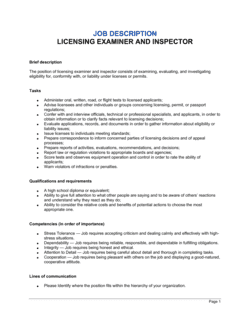
Building and Environment Inspector Job Description Template

Free Word download • Edit online • Save & share with Drive • Export to PDF

2 pages20–30 min to fillDifficulty: StandardSignature requiredLegal review recommended
Learn more ↓
FreeBuilding and Environment Inspector Job Description Template

At a glance

What it is
A Building and Environment Inspector Job Description is a binding employment document that formally defines the role, responsibilities, qualifications, licensing requirements, and reporting structure for an inspector charged with assessing buildings, construction sites, or environmental conditions for regulatory compliance. This free Word download is fully editable online and exportable as PDF, giving employers a consistent, legally defensible baseline for the role before any hire is made.
When you need it
Use it when recruiting for a new or backfilled inspection position, when restructuring an existing inspector role, or when a regulatory audit or HR dispute requires documented evidence of what the position was formally expected to do. It is also essential when the role carries licensing, certification, or professional liability obligations that must be recorded in writing.
What's inside
Job title, department, and reporting structure; a detailed duties and responsibilities clause; required qualifications, certifications, and licensing; physical and environmental working conditions; performance standards and compliance obligations; compensation and benefits; and confidentiality and IP assignment provisions relevant to inspection reports and proprietary methodologies.

What is a Building and Environment Inspector Job Description?

A Building and Environment Inspector Job Description is a formal employment document that defines the title, essential duties, required qualifications, licensing obligations, physical demands, performance standards, and termination provisions for a professional responsible for assessing buildings, construction sites, or environmental conditions against applicable codes and regulations. It functions both as the operative record of what the role requires and as the legal foundation for hiring, accommodation, performance management, and enforcement decisions. Unlike a general job posting, a completed and signed job description carries evidentiary weight in employment disputes, licensing audits, and regulatory reviews — particularly when the inspector holds delegated enforcement authority.

Why You Need This Document

Without a documented job description, four problems emerge simultaneously: first, there is no defensible record of what qualifications and certifications were required at the time of hire, making it nearly impossible to terminate for credential failure without litigation risk; second, the essential functions necessary to support an ADA or human rights code accommodation analysis simply do not exist in writing; third, performance standards are left to supervisory discretion rather than agreed contractual terms, weakening every formal disciplinary action; and fourth, the confidentiality obligations covering non-public enforcement data and pre-litigation inspection records are nowhere recorded. For inspector roles that carry regulatory authority — issuing Notices of Violation, approving occupancy certificates, or documenting environmental violations — a vague or absent job description is an organizational liability, not merely an HR oversight. This template gives employers a structured, jurisdiction-aware starting point that closes all four gaps before a single interview is scheduled.

Which variant fits your situation?

If your situation is…Use this template
Hiring a municipal building code enforcement officerBuilding And Environment Inspector Job Description
Defining a site safety inspector role on a construction projectConstruction Site Safety Inspector Job Description
Recruiting an environmental compliance officer for an industrial facilityEnvironmental Compliance Officer Job Description
Hiring a home inspector for a real estate services companyHome Inspector Job Description
Formalizing a quality control inspector role in manufacturingQuality Control Inspector Job Description
Engaging an inspector on a contract rather than employment basisIndependent Contractor Agreement
Creating a broader job offer for the inspector role after description is finalizedJob Offer Letter

Common mistakes to avoid

❌ Omitting the FLSA classification

Why it matters: Building and environment inspectors span the exempt/non-exempt line depending on their supervisory duties and salary level. An undocumented classification creates overtime liability that can accrue over two to three years.

Fix: Confirm the classification with an HR specialist or employment attorney before finalizing and post it explicitly in the job title block of every inspector job description.

❌ Using generic qualification language without specifying certification bodies

Why it matters: Phrases like 'relevant certification required' are unenforceable during a termination for credential failure if the specific certification was never documented in the hiring record.

Fix: Name the exact certification body and credential — ICC Building Inspector certification, NEHA Registered Environmental Health Specialist, or applicable state board — and include the renewal cadence.

❌ No physical demands analysis before drafting working conditions

Why it matters: Without documented physical requirements, employers cannot lawfully rescind a conditional offer based on a pre-employment medical assessment, and cannot request a fitness-for-duty evaluation under the ADA.

Fix: Conduct a site-based physical demands analysis before finalizing the working conditions clause. Record actual measurements — ladder heights, lift weights, outdoor exposure — rather than generic industry estimates.

❌ Listing non-essential tasks as essential functions

Why it matters: Mixing incidental tasks into the essential functions list allows a departing employee to argue that their accommodation request was improperly denied because the task was actually marginal to the role.

Fix: Audit each listed duty against the test: would removing this function fundamentally change the nature of the role? If not, label it 'other duties as assigned' rather than an essential function.

❌ No confidentiality clause for inspection records

Why it matters: Inspectors handle pre-litigation evidence, commercially sensitive site data, and non-public enforcement actions. Without a confidentiality clause, there is no contractual basis to restrict unauthorized disclosure.

Fix: Include a confidentiality clause that covers inspection reports, enforcement records, site data, and any proprietary assessment methodology, and state that records remain the property of the employer.

❌ At-will termination language used in Canadian or UK jurisdictions

Why it matters: At-will employment is a US doctrine with no legal equivalent in Canada, the UK, or the EU. A job description that says 'employment may be terminated at any time without notice' is void in those jurisdictions and may generate constructive dismissal exposure.

Fix: Replace at-will language with a notice-period clause that meets or exceeds the statutory minimum in the employee's work location, and have a local employment lawyer review the termination clause before posting.

The 10 key clauses, explained

Job Title, Department, and Reporting Structure

In plain language: Establishes the official position title, the organizational unit it sits within, and the direct supervisor or manager to whom the inspector reports.

Sample language
Position: Building and Environment Inspector | Department: [DEPARTMENT NAME] | Reports To: [SUPERVISOR TITLE] | FLSA Classification: [EXEMPT / NON-EXEMPT] | Employment Type: [FULL-TIME / PART-TIME / CONTRACT]

Common mistake: Using a generic title that does not reflect the specific inspection scope — for example, 'Inspector' instead of 'Building and Environment Inspector.' Vague titles create confusion during disciplinary proceedings or licensing audits when the role's authority is challenged.

Position Summary

In plain language: A concise 3–5 sentence overview of the role's primary purpose, the regulatory framework it operates within, and the populations or assets it affects.

Sample language
The Building and Environment Inspector is responsible for conducting field inspections of [RESIDENTIAL / COMMERCIAL / INDUSTRIAL] properties and sites within [JURISDICTION] to ensure compliance with [APPLICABLE CODES AND REGULATIONS]. The Inspector evaluates construction, environmental conditions, and operational practices, documents findings, and issues Notices of Violation where required.

Common mistake: Writing a position summary that doubles as a marketing blurb. Courts and HR tribunals treat the position summary as the operative definition of the role — vague or aspirational language weakens the employer's position in misclassification or wrongful termination disputes.

Essential Duties and Responsibilities

In plain language: A detailed enumeration of the core functions the inspector is required to perform, distinguished from non-essential tasks to support ADA compliance documentation.

Sample language
Essential functions include: (a) conducting scheduled and unannounced field inspections of [SITE TYPES]; (b) reviewing construction plans and permits for code compliance prior to approval; (c) issuing Notices of Violation and compliance orders; (d) preparing accurate written inspection reports within [X] business days of each inspection; (e) testifying at hearings or legal proceedings as required.

Common mistake: Listing non-essential tasks alongside essential functions without distinguishing them. Failure to separate essential from marginal duties undermines ADA reasonable-accommodation analysis and creates ambiguity in performance management.

Required Qualifications and Certifications

In plain language: Specifies the minimum education, years of experience, professional licenses, and industry certifications required to hold the position.

Sample language
Minimum qualifications: [DEGREE OR DIPLOMA] in [FIELD]; [X] years of experience in building inspection, construction, or environmental compliance; valid [ICC / STATE / PROVINCIAL] building inspector certification; current driver's license. Preferred: [ADDITIONAL CERTIFICATION, e.g., CHMM, REHS, or LEED AP].

Common mistake: Listing overly restrictive qualifications that screen out protected classes without a documented business necessity. Requiring a four-year degree for a role where a two-year technical certificate plus experience is equally sufficient can expose the employer to disparate-impact discrimination claims.

Licensing and Regulatory Authorization

In plain language: Confirms the specific permits, licenses, or delegated enforcement authorities the inspector must hold or obtain, and whether the employer or the employee is responsible for maintaining them.

Sample language
The Inspector shall hold and maintain, at all times during employment, a valid [STATE / PROVINCIAL / LOCAL] building inspector license or equivalent regulatory authorization. Failure to maintain required licensure constitutes grounds for immediate suspension or termination. [EMPLOYER NAME] will reimburse annual renewal fees up to $[AMOUNT].

Common mistake: Omitting which party bears responsibility for license renewal costs and compliance. Disputes over who pays for continuing education or renewal fees are a leading cause of grievances in inspector roles covered by collective bargaining agreements.

Working Conditions and Physical Requirements

In plain language: Documents the physical demands of the role — lifting, climbing, outdoor exposure, travel — and the environmental conditions the inspector routinely encounters.

Sample language
The Inspector must be able to: climb ladders and scaffolding to heights of up to [X] feet; lift and carry equipment weighing up to [X] lbs; work outdoors in weather extremes ranging from [TEMPERATURE RANGE]; and operate a motor vehicle for up to [X] hours per day. Exposure to construction dust, hazardous materials, and loud environments is routine.

Common mistake: Omitting physical requirements entirely. Without a documented physical-demands analysis, employers cannot lawfully withdraw a conditional job offer based on a failed medical assessment or request a fitness-for-duty examination.

Performance Standards and Compliance Obligations

In plain language: Sets measurable performance expectations — inspection volume, report turnaround time, violation accuracy rate — and states the compliance obligations the inspector must uphold.

Sample language
The Inspector is expected to complete a minimum of [X] inspections per [day / week], submit all inspection reports within [X] business days, maintain a report accuracy rate of [X]% as measured by supervisory review, and comply at all times with [APPLICABLE PROFESSIONAL CODE OF ETHICS / REGULATORY STANDARDS].

Common mistake: Setting performance standards only in an employee handbook rather than the job description itself. Standards referenced solely in changeable internal documents can be challenged as unilateral policy rather than agreed-upon terms of employment.

Confidentiality and Records Obligations

In plain language: Restricts the inspector from disclosing non-public inspection data, investigation records, or proprietary methodologies to unauthorized parties, and governs custody of inspection records.

Sample language
The Inspector shall treat all non-public inspection data, site records, enforcement actions, and investigation materials as confidential. Disclosure to unauthorized parties is prohibited without prior written authorization from [SUPERVISOR TITLE]. All inspection records remain the property of [EMPLOYER NAME] and must be returned or destroyed upon separation.

Common mistake: No confidentiality clause at all in inspection roles. Environmental and code-enforcement inspectors routinely access commercially sensitive site data and pre-litigation evidence — an omission here creates real exposure if a disgruntled employee shares findings with a competitor, media outlet, or opposing counsel.

Termination, Notice, and At-Will Status

In plain language: Clarifies the employment relationship type, required notice periods, and the conditions under which the position may be terminated with or without cause.

Sample language
Employment in this position is [at-will / subject to [X] weeks' written notice by either party]. The Employer may terminate employment immediately for cause, including but not limited to loss of required licensure, falsification of inspection records, or gross misconduct. Severance, if any, is governed by the Employer's standard policy in effect at the time of termination.

Common mistake: Using an at-will clause in a jurisdiction where minimum notice is mandated by statute. In Canada and the UK, a job description that states 'employment may be terminated at any time without notice' is void to the extent it conflicts with statutory minimums.

Governing Law and Acknowledgment

In plain language: States the jurisdiction whose employment law governs the document and includes a signature block confirming the employee received, read, and understood the job description.

Sample language
This Job Description is governed by the laws of [STATE / PROVINCE / COUNTRY]. The Employee's signature below confirms receipt and acknowledgment of this document. It does not constitute a guarantee of employment for any specific period. | Employee Signature: _______________ | Date: _______________ | Supervisor Signature: _______________ | Date: _______________

Common mistake: Omitting the acknowledgment signature block. Without a signed receipt, employers cannot prove the employee was aware of role requirements during a wrongful termination or negligent hiring claim.

How to fill it out

  1. 1

    Enter the job title and organizational details

    Fill in the official position title, the department, and the direct reporting line. Confirm the FLSA classification (exempt or non-exempt) and the employment type (full-time, part-time, or contract) before circulating the document.

    💡 Verify the FLSA classification with a payroll or HR specialist before posting. Misclassifying a non-exempt inspector as exempt creates overtime liability that can accumulate for up to three years.

  2. 2

    Write a specific position summary

    Draft a 3–5 sentence summary that names the specific codes or regulatory frameworks the inspector enforces, the types of structures or sites involved, and the primary output of the role (reports, NOVs, approvals).

    💡 Reference the specific codes by name — IBC, IEBC, RCRA, or state environmental statutes — rather than generic phrases like 'applicable regulations.' Specificity strengthens enforcement authority and deters disputes.

  3. 3

    List essential duties with clear action verbs

    Use active, measurable verbs — 'conducts,' 'documents,' 'issues,' 'reviews,' 'testifies' — for each essential function. Separate essential duties from preferred or incidental tasks with a clear label.

    💡 Aim for 8–12 essential functions. Fewer looks underspecified; more risks diluting what is truly essential for ADA reasonable-accommodation analysis.

  4. 4

    Specify minimum and preferred qualifications separately

    Create two tiers: minimum qualifications the candidate must hold on day one, and preferred qualifications that differentiate candidates but are not required. Include specific certification bodies (ICC, NEHA, state boards) rather than generic phrases.

    💡 Document the business necessity for every minimum qualification. If challenged, you need to show why a specific degree or license is genuinely required for safe and effective performance of the role.

  5. 5

    Define licensing obligations and renewal responsibility

    State the exact license or certification the inspector must maintain, the renewing authority, and whether the employer covers renewal costs. Include a clause on what happens if licensure lapses — typically immediate suspension pending reinstatement.

    💡 Check the renewal cycle for each required certification and build a calendar reminder. An expired inspector license mid-project can halt construction timelines and trigger employer liability.

  6. 6

    Document physical requirements based on a site walkthrough

    Conduct or commission a physical demands analysis before finalizing this clause. Record actual lifting weights, heights, temperature ranges, and travel distances based on real working conditions rather than estimates.

    💡 A documented physical-demands analysis prepared before hiring is substantially more defensible than one constructed retroactively after a failed medical accommodation request.

  7. 7

    Set measurable performance standards

    Enter specific, quantifiable benchmarks — inspections per day, report turnaround in business days, accuracy rate — rather than qualitative descriptors like 'timely' or 'thorough.'

    💡 Tie performance standards to the inspection type. A structural framing inspection standard of 6 per day is reasonable; a complex environmental site assessment at that rate is not — and using the wrong benchmark damages credibility in a performance dispute.

  8. 8

    Obtain signed acknowledgment before the first day

    Route the completed job description to the selected candidate for signature before or on day one. File the signed copy in the employee's personnel record and provide the employee with a copy.

    💡 Use Business in a Box eSign to timestamp acknowledgment and create an auditable record — particularly valuable if the role involves regulatory enforcement authority that could later be disputed.

Frequently asked questions

What is a building and environment inspector job description?

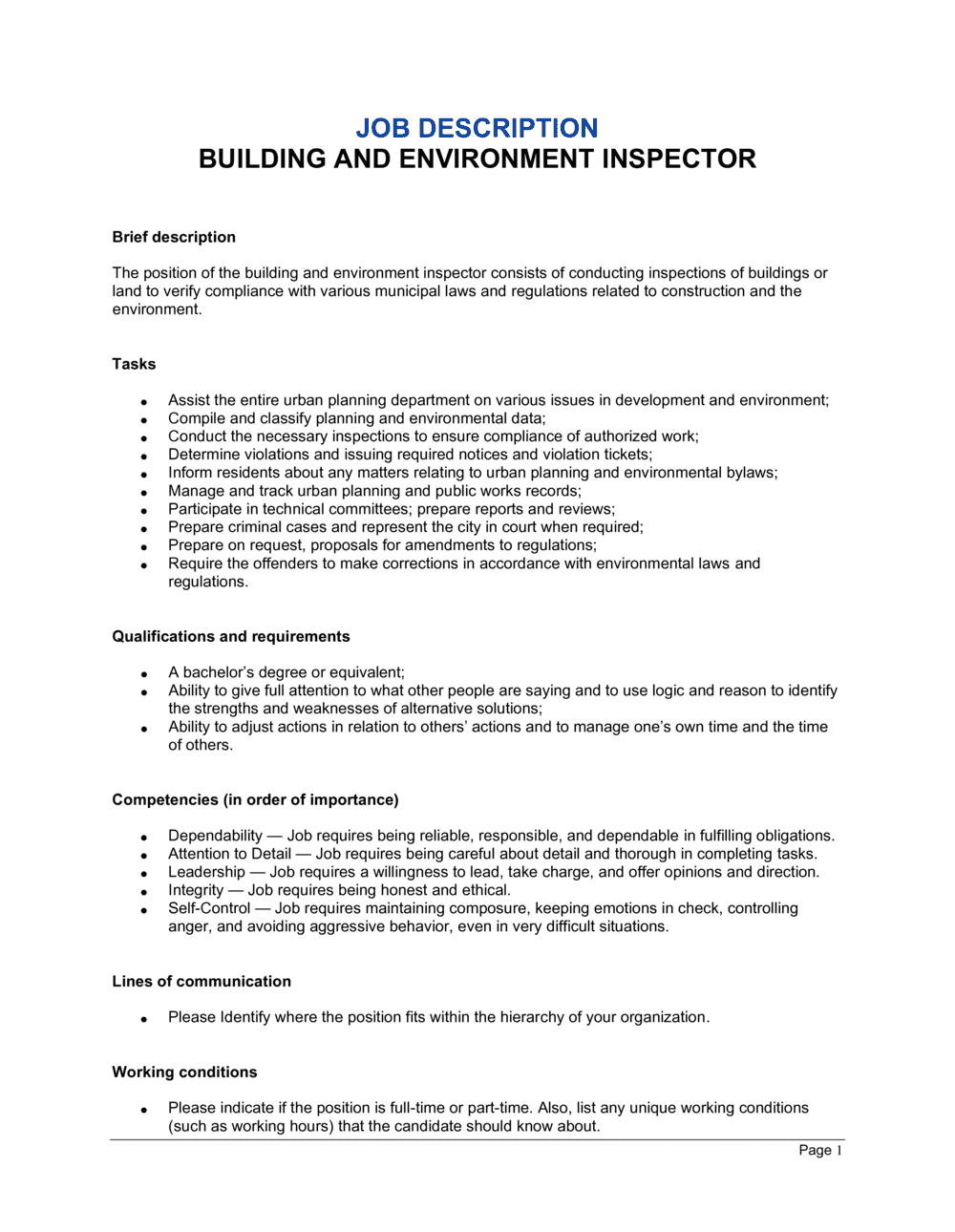
A building and environment inspector job description is a formal employment document that defines the title, duties, qualifications, licensing requirements, performance standards, and working conditions for a professional responsible for assessing structures or environmental conditions for regulatory compliance. It functions both as the legal record of what the role requires and as the primary document governing performance expectations and termination grounds.

Is a job description legally binding?

A signed job description is generally considered part of the employment relationship and can be introduced as evidence in wrongful termination, discrimination, or ADA accommodation disputes. In most jurisdictions, it is not a standalone contract of employment but is legally significant when it documents essential functions, qualifications, and performance standards that the employer relied upon. For inspector roles with regulatory enforcement authority, the documented scope of duties carries additional legal weight.

What qualifications should a building and environment inspector have?

Minimum qualifications typically include a post-secondary qualification in construction technology, civil engineering, environmental science, or a related field; two to five years of relevant inspection or construction experience; and a valid jurisdiction-specific building inspector certification (such as an ICC certification in the US or a provincial trade qualification in Canada). Environmental inspector roles often additionally require credentials such as the NEHA Registered Environmental Health Specialist designation, CHMM certification, or a state-issued environmental professional license.

Does a building inspector job description need to include physical requirements?

Yes — and specifically so. Building and environment inspectors routinely climb ladders, access confined spaces, lift equipment, and work outdoors in extreme weather. Documenting these physical requirements before hiring is legally necessary to support pre-employment medical assessments and future fitness-for-duty evaluations under the ADA (US) or equivalent human rights legislation. A physical demands analysis based on actual site conditions is more defensible than generic language.

What is the difference between a building inspector and an environmental inspector?

A building inspector primarily assesses structural integrity, code compliance, and occupancy safety — reviewing foundations, framing, electrical, mechanical, and plumbing systems against adopted building codes. An environmental inspector focuses on regulatory compliance related to air quality, water, soil contamination, hazardous waste handling, and environmental permits. Many employers combine both functions into a single Building and Environment Inspector role, particularly in municipal government and industrial facility settings, which is why a single job description template covering both scopes is practical and common.

Should the job description distinguish essential from non-essential functions?

Yes, particularly in jurisdictions covered by the Americans with Disabilities Act or equivalent legislation (Canada's human rights codes, the UK Equality Act). Essential functions are the duties that define the role and that a qualified candidate must be able to perform with or without reasonable accommodation. Non-essential or marginal tasks should be labeled separately — typically as 'other duties as assigned.' Failure to make this distinction weakens an employer's defense when an accommodation request is denied.

Can I use this job description for both full-time employees and contractors?

No — a job description that contains performance standards, working hours, equipment requirements, and supervisory control language is written for an employment relationship. Using it verbatim for an independent contractor can contribute to a worker-misclassification finding if the contractor is ever audited by the IRS, CRA, or HMRC. For contract inspectors, use an Independent Contractor Agreement that describes the scope of services rather than the duties of an employee.

What performance standards are typical for a building inspector role?

Common benchmarks include a minimum number of inspections per day (typically 6–10 for standard residential inspections, 2–4 for complex commercial or environmental site assessments), a report submission turnaround of one to three business days, a report accuracy rate above 95% as measured by supervisory review, and a Notice of Violation issuance rate consistent with peer inspectors in the same jurisdiction. Documenting these standards in the job description — rather than only in a handbook — makes them contractually binding and more enforceable in performance management proceedings.

How often should a building and environment inspector job description be updated?

Review it whenever the applicable building or environmental codes are substantially amended, when licensing requirements change, when the reporting structure is reorganized, or when the physical working conditions of the role materially change. A job description that is more than three years old in a jurisdiction with active code revision cycles may no longer accurately reflect the legal authority or technical obligations of the position, which can complicate both hiring and enforcement decisions.

How this compares to alternatives

vs Employment Contract

An employment contract is the binding legal instrument governing all terms of the employment relationship — compensation, IP assignment, non-compete, and termination. A job description defines the scope and requirements of the role but is not a standalone contract of employment. For inspector roles, both documents are needed: the job description establishes what the role requires; the employment contract governs the legal relationship. Using a job description alone without a contract leaves confidentiality and IP assignment unprotected.

vs Independent Contractor Agreement

A job description is written for an employee and includes behavioral control language — working hours, supervisory structure, performance standards — that signals an employment relationship. An independent contractor agreement engages a self-employed professional for a defined scope of services without those controls. Providing a job description to a contractor engagement instead of a contractor agreement can contribute to a worker-misclassification finding.

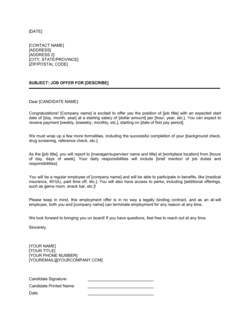
vs Job Offer Letter

A job offer letter confirms salary, start date, and role title to secure a candidate's acceptance. It does not document essential functions, physical requirements, or licensing obligations in the detail needed for ADA compliance or performance management. The job description and offer letter serve different purposes and should both be issued — the description defines the role; the letter closes the hire.

vs Employee Handbook

An employee handbook covers company-wide policies — conduct, leave, benefits, safety — that apply to all staff. A job description is role-specific and documents the duties, qualifications, and performance standards unique to one position. Performance standards placed only in a handbook can be challenged as unilateral policy rather than agreed employment terms; those embedded in a signed job description carry greater contractual weight.

Industry-specific considerations

Municipal Government and Public Administration

Inspectors carry delegated statutory enforcement authority under municipal bylaws or building acts, requiring the job description to document the specific legislative powers granted to the position.

Construction and Engineering

On-site quality-control and third-party inspectors work against project-specific inspection and test plans, meaning the job description must align with contract administration obligations and project reporting timelines.

Environmental Consulting

Field inspectors handling environmental samples must comply with chain-of-custody and laboratory protocols, and the job description should reference applicable environmental regulations and accreditation requirements by name.

Industrial Facilities and Manufacturing

In-house compliance inspectors often hold dual building and environmental mandates, requiring the job description to clearly delineate which regulatory regimes (OSHA, EPA, state environmental agencies) each duty set falls under.

Jurisdictional notes

United States

Building inspector licensing is administered at the state and local level — there is no single federal license. Most jurisdictions recognize ICC certifications, but state-specific endorsements are frequently required in addition. The ADA requires employers to document essential functions and physical requirements before extending conditional offers of employment. FLSA overtime classification depends on whether the inspector exercises independent judgment and discretion in a recognized profession — a fact-specific determination that varies by role seniority.

Canada

Building inspection is regulated provincially; requirements vary significantly between British Columbia, Ontario, and Alberta. At-will employment does not exist — job descriptions that reference it are void to the extent they conflict with provincial Employment Standards Act minimums. Quebec employers must provide a French-language version of the job description for provincially regulated roles. Human rights codes in each province require documented essential functions and physical demands analysis before any medical accommodation decision is made.

United Kingdom

Building control inspectors in the UK operate under the Building Safety Act 2022, which significantly expanded competence and registration requirements for higher-risk buildings following the Grenfell Tower inquiry. Registered Building Inspectors must be registered with the Building Safety Regulator. The Equality Act 2010 requires employers to document the essential requirements of a role before withdrawing an offer or denying an accommodation. Employment particulars, including a job description, must be provided on or before the first day of work.

European Union

EU member states administer their own building and environmental inspection regimes; there is no pan-EU building inspector certification. The EU Transparent and Predictable Working Conditions Directive requires written employment particulars — including a description of duties — within seven calendar days of the start date. GDPR implications arise when inspectors process personal data about property owners or site workers as part of their enforcement activities — data handling obligations should be referenced in the confidentiality clause.

Template vs lawyer — what fits your deal?

PathBest forCostTime
Use the templateHR teams and small employers hiring standard inspection roles in a single US state or Canadian provinceFree30–60 minutes
Template + legal reviewMunicipal employers with delegated enforcement authority, roles requiring multiple certifications, or cross-border hires$300–$600 for an employment lawyer review2–5 business days
Custom draftedSenior regulatory inspector roles with executive authority, union environments, or positions in heavily regulated industries with complex licensing frameworks$1,000–$3,000+1–3 weeks

Glossary

Building Code
A set of regulations specifying minimum standards for construction, materials, and occupancy that inspectors are authorized to enforce.
Certificate of Occupancy
An official document issued by a local authority confirming that a building meets code requirements and is safe for occupancy.
Environmental Impact Assessment (EIA)
A formal evaluation of the likely environmental effects of a proposed development or activity, often reviewed or conducted by environment inspectors.
ICC Certification
A credential issued by the International Code Council confirming a building inspector's competency in specific code categories such as residential, commercial, or mechanical inspection.
Scope of Work
The defined boundaries of an inspector's assigned duties on a project or within a role, used to allocate liability and clarify reporting obligations.
Regulatory Compliance
Adherence to applicable laws, codes, permits, and standards — the primary objective of most building and environment inspection roles.
Chain of Custody
A documented record tracking who collected, handled, and transferred an environmental sample or inspection evidence, essential for legal defensibility.
Notice of Violation (NOV)
A formal written notice issued by an inspector or enforcement agency identifying a specific code or regulatory violation and the corrective action required.
At-Will Employment
Employment that either party may end at any time for any lawful reason, without cause — applicable in most US states unless a contract specifies otherwise.
Essential Functions
The fundamental duties of a job that a qualified employee must be able to perform, with or without reasonable accommodation — a term with specific meaning under the Americans with Disabilities Act.
Professional Liability
Legal exposure arising from errors or omissions in professional judgment — relevant for inspectors whose certifications and reports carry formal authority.

Part of your Business Operating System

This document is one of 3,000+ business & legal templates included in Business in a Box.

  • Fill-in-the-blanks — ready in minutes
  • 100% customizable Word document
  • Compatible with all office suites
  • Export to PDF and share electronically

Create your document in 3 simple steps.

From template to signed document — all inside one Business Operating System.
1
Download or open template

Access over 3,000+ business and legal templates for any business task, project or initiative.

2
Edit and fill in the blanks with AI

Customize your ready-made business document template and save it in the cloud.

3
Save, Share, Send, Sign

Share your files and folders with your team. Create a space of seamless collaboration.

Save time, save money, and create top-quality documents.

★★★★★

"Fantastic value! I'm not sure how I'd do without it. It's worth its weight in gold and paid back for itself many times."

Managing Director · Mall Farm
Robert Whalley
Managing Director, Mall Farm Proprietary Limited
★★★★★

"I have been using Business in a Box for years. It has been the most useful source of templates I have encountered. I recommend it to anyone."

Business Owner · 4+ years
Dr Michael John Freestone
Business Owner
★★★★★

"It has been a life saver so many times I have lost count. Business in a Box has saved me so much time and as you know, time is money."

Owner · Upstate Web
David G. Moore Jr.
Owner, Upstate Web

Run your business with a system — not scattered tools

Stop downloading documents. Start operating with clarity. Business in a Box gives you the Business Operating System used by over 250,000 companies worldwide to structure, run, and grow their business.

Free Forever Plan · No credit card required