Letter Announcing New Service Template

Free Word download β€’ Edit online β€’ Save & share with Drive β€’ Export to PDF

2 pagesβ€’15–25 min to fillβ€’Difficulty: Standard
Learn more ↓
FreeLetter Announcing New Service Template

At a glance

What it is
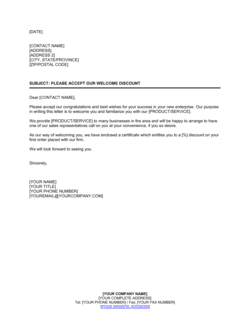
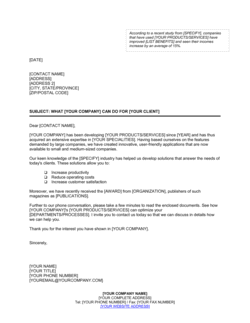
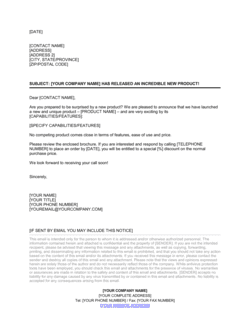
A Letter Announcing New Service is a formal business communication sent by a company to its existing clients, prospects, or partners to inform them of a new offering. This free Word download gives you a structured, professional starting point you can edit online and export as PDF or send by email in under 15 minutes.
When you need it
Use it whenever you launch a new product line, add a new service tier, expand into a new specialty, or introduce a new capability that existing and prospective clients should know about. It is also appropriate when re-engaging dormant contacts with a reason to reconnect.
What's inside
Sender and recipient details, a clear subject line, an opening that states the announcement directly, a description of the new service and its benefits, a call to action with next steps, and a professional closing with contact information.

What is a Letter Announcing New Service?

A Letter Announcing New Service is a formal business letter a company sends to its clients, partners, or prospects to inform them that a new service is now available. It introduces the offering, explains the benefit to the recipient, and invites a specific response β€” a consultation, a reply, or a visit to a landing page. Unlike a mass marketing email or press release, this letter is addressed to a named individual or a defined audience segment, which gives it a personal weight that broadcast communications lack. It functions as both a sales tool and a relationship touchpoint, signaling that the company is growing and that the recipient is valued enough to hear the news directly.

Why You Need This Document

Without a formal announcement letter, clients learn about your new service by accident β€” through a third party, a website update they happened to notice, or a competitor who got there first. That missed introduction is a missed revenue opportunity and a signal that the client relationship is not being actively managed. A structured letter gives you a consistent, professional way to reach every relevant contact at the right moment, with the right message. It also creates a written record of when the announcement was made, which matters in regulated industries where new service communications are subject to disclosure requirements. This template cuts the drafting time to under 30 minutes while ensuring you hit every structural element β€” from a compelling opening to a single, clear call to action β€” that drives a response.

Which variant fits your situation?

If your situation is…Use this template
Announcing a new service to existing clients onlyLetter Announcing New Service (Client Edition)
Introducing your business and services to a brand-new prospectLetter of Introduction
Announcing a new product rather than a serviceNew Product Announcement Letter
Announcing a new pricing structure or rate change alongside the servicePrice Increase Letter
Announcing the launch of a business or new location, not just a serviceBusiness Opening Announcement Letter
Promoting a limited-time offer tied to the new servicePromotional Letter

Common mistakes to avoid

❌ Opening with company history instead of the announcement

Why it matters: Readers decide in the first two seconds whether to continue. A paragraph about your founding story before the news buries the reason they should care.

Fix: Move the announcement to the first sentence of the body. Save background context for the credentials paragraph lower in the letter.
❌ Using vague feature language instead of client outcomes

Why it matters: Describing what the service does without explaining what the client gains gives recipients no reason to respond β€” they cannot evaluate relevance.

Fix: For every feature you list, add a 'which means' clause: '[FEATURE], which means [CLIENT OUTCOME].'

❌ Including multiple competing calls to action

Why it matters: When readers are asked to call, email, visit a website, and attend a webinar in the same paragraph, decision paralysis sets in and response rates drop.

Fix: Choose one primary CTA and make it the only instruction in the paragraph. Mention secondary channels only in the closing contact block.

❌ Sending the same letter word-for-word to every segment

Why it matters: A new service is not equally relevant to all clients in the same way. A generic letter signals the sender did not think about the recipient's specific situation.

Fix: Create two to three versions of the relevance paragraph, each tailored to a different client segment, and merge accordingly.

The 8 key clauses, explained

Sender and recipient header

In plain language: The opening block identifying who is sending the letter, who it is addressed to, and when it was written.

Sample language
[COMPANY NAME] | [STREET ADDRESS] | [CITY, STATE, ZIP] | [DATE] | [RECIPIENT NAME] | [RECIPIENT TITLE] | [COMPANY] | [ADDRESS]

Common mistake: Using a trade name instead of the registered business name in the sender block β€” this creates inconsistency with contracts or invoices the recipient may already have on file.

Subject line

In plain language: A brief, specific reference line that tells the reader at a glance what the letter is about before they read the opening paragraph.

Sample language
Re: Introducing [SERVICE NAME] β€” Now Available to [COMPANY NAME] Clients

Common mistake: Writing a vague subject like 'Exciting Update' instead of naming the service β€” vague subject lines reduce open rates on printed mail and cause email attachments to be skipped.

Opening paragraph

In plain language: States the purpose of the letter directly and immediately: a new service is being launched and the recipient should know about it.

Sample language
We are pleased to announce that [COMPANY NAME] now offers [SERVICE NAME], a [BRIEF DESCRIPTION] designed to help [TARGET CLIENT TYPE] [ACHIEVE OUTCOME].

Common mistake: Opening with background about the company instead of the announcement. Readers scan the first sentence to decide whether to keep reading β€” bury the news and you lose them.

Service description

In plain language: Explains what the new service is, how it works, and what problem it solves β€” in plain language the reader can act on.

Sample language
[SERVICE NAME] provides [DELIVERABLE OR CAPABILITY], enabling clients to [SPECIFIC OUTCOME] within [TIMEFRAME OR CONDITION]. The service includes [KEY FEATURE 1], [KEY FEATURE 2], and [KEY FEATURE 3].

Common mistake: Listing features without connecting them to outcomes the client actually cares about. A feature description tells readers what you do; a benefit description tells them why it matters to them.

Relevance to the recipient

In plain language: Personalizes the announcement by connecting the new service to the recipient's specific situation, industry, or prior relationship.

Sample language
Given your work in [INDUSTRY / CONTEXT], [SERVICE NAME] is particularly well-suited to help you [SPECIFIC BENEFIT RELEVANT TO RECIPIENT].

Common mistake: Sending a generic mass letter without any personalization signal β€” even one sentence referencing the recipient's industry or prior engagement significantly improves response rates.

Social proof or credentials

In plain language: Briefly establishes credibility by referencing relevant experience, early client results, certifications, or industry recognition tied to the new service.

Sample language
Our team brings [X] years of experience in [FIELD], and [SERVICE NAME] has already been piloted with [NUMBER] clients, achieving [RESULT].

Common mistake: Omitting this paragraph entirely for new services with no track record. If you lack client results, reference team credentials, partnerships, or the methodology behind the service instead.

Call to action

In plain language: Tells the recipient exactly what to do next β€” schedule a call, reply to the letter, visit a URL, or attend a launch event.

Sample language
To learn more or schedule a complimentary [30-minute / introductory] consultation, please contact [NAME] at [PHONE] or [EMAIL], or visit [URL] by [DATE].

Common mistake: Including multiple competing calls to action (call us, email us, visit the site, attend the webinar) without prioritizing one β€” readers who are asked to do everything typically do nothing.

Closing and signature

In plain language: A professional sign-off with the sender's name, title, and contact details, maintaining a tone consistent with the existing client relationship.

Sample language
We look forward to the opportunity to support your goals with [SERVICE NAME]. Sincerely, [SENDER NAME] [TITLE] [COMPANY NAME] [PHONE] | [EMAIL]

Common mistake: Closing with an impersonal block signature and no warm sign-off sentence. A single sentence expressing genuine interest in the recipient's response closes the letter on a human note and increases reply rates.

How to fill it out

  1. 1

    Complete the sender and recipient header

    Enter your company's full legal name, street address, and the letter date. Add the recipient's name, title, company, and address. For bulk mailings, use a mail-merge field for the inside address.

    πŸ’‘ If you are sending this by email as a PDF attachment, still include the full header β€” it signals formality and makes the letter easy to file.

  2. 2

    Write a specific subject line

    Name the service in the subject line. Pair it with a benefit phrase or the recipient's audience type so the relevance is immediately clear.

    πŸ’‘ Test two subject lines on a small segment before sending the full list β€” even a 5% difference in response rate compounds over a large contact base.

  3. 3

    Draft the opening paragraph around the announcement

    Lead with the news. State the service name, what it does, and who it is for in the first two sentences. Resist the urge to warm up with company history.

    πŸ’‘ Read the first sentence aloud β€” if it does not name the new service, cut everything before the sentence that does.

  4. 4

    Describe the service in outcome-first language

    List two to three key features, but frame each one as an outcome for the client. Replace 'we provide X' with 'clients gain X, which means Y for their business.'

    πŸ’‘ If you are stuck, fill in this template: '[Feature] so that [client] can [outcome] without [pain].'

  5. 5

    Add a personalization sentence

    Insert one sentence that references the recipient's industry, company type, or prior engagement with your firm. Even a category-level reference ('as a professional services firm') increases perceived relevance.

    πŸ’‘ Segment your list into three to four audience types and write a single unique sentence for each segment β€” this is faster than full personalization but more effective than a generic letter.

  6. 6

    State one clear call to action

    Pick the single next step you want the recipient to take β€” a phone call, a reply email, or a link to book a consultation. Include a deadline or limited-availability signal if appropriate.

    πŸ’‘ Calls to action with a specific deadline ('by [DATE]') consistently outperform open-ended ones. Even a soft deadline ('before the end of [MONTH]') improves response rates.

  7. 7

    Finalize the closing and review before sending

    Add a warm closing sentence, your sign-off phrase, and your full name, title, and contact details. Proofread for the recipient's name spelling, the service name consistency, and any placeholder text left unfilled.

    πŸ’‘ Search the finished document for '[' β€” any remaining bracket means an unfilled placeholder. Sending with a visible placeholder like '[COMPANY NAME]' immediately undermines credibility.

Frequently asked questions

What is a letter announcing a new service?

A letter announcing a new service is a formal business communication a company sends to clients, partners, or prospects to inform them of a new offering. It introduces the service, explains its benefits, and invites the recipient to take a specific next step β€” such as scheduling a call or visiting a website. It is typically one page and sent by post, email, or as a PDF attachment.

When should I send a new service announcement letter?

Send it as close to the service launch date as possible β€” ideally one to two weeks before the service becomes publicly available so existing clients feel they are being given early access. If the service is already live, send the letter immediately rather than waiting. Delays mean clients may hear about the new offering from a competitor or a third party first.

Should I send this letter by email or by post?

For most B2B contexts, email is the standard delivery method β€” it is faster, trackable, and easy to act on. A printed letter sent by post stands out in high-value client relationships where formality matters, or when the new service carries a premium price point. For the strongest impact, send a printed letter to top-tier clients and email to the broader list simultaneously.

How long should a letter announcing a new service be?

One page is the standard target. Readers of business correspondence typically allocate 30 to 60 seconds to a letter before deciding whether to act. A tight, well-structured single page with a clear call to action outperforms a two-page letter that pads the service description. If you need to explain the service in depth, link to a brochure or landing page rather than expanding the letter itself.

Can I use this letter to announce a service to prospects who are not yet clients?

Yes, with a small adjustment to the opening paragraph. For existing clients, the letter can reference your prior relationship. For cold prospects, open with a concise statement of who you are and why the service is relevant to their business before moving into the announcement. The structure, call to action, and closing remain the same in both cases.

Should the letter include pricing information?

Generally, no. A service announcement letter is designed to generate interest and prompt a conversation β€” not to close a sale on paper. Including a specific price before the reader understands the full value can cause premature rejection. Instead, reference that pricing details are available upon request or link to a pricing page for self-service readers.

How is a new service announcement letter different from a marketing brochure?

A letter is a personal, direct communication addressed to a specific individual or segment β€” it has a salutation, a body, and a signature. A brochure is a broadcast marketing piece designed for general audiences with no specific addressee. Letters carry more perceived weight in formal B2B relationships and are better suited to high-value, named client lists. Use the letter to open the conversation and the brochure as an enclosure or follow-up resource.

Do I need to follow up after sending the letter?

Yes. A letter without a follow-up call or email typically generates a response rate of 1 to 5% on its own. A structured follow-up β€” a phone call or email three to five business days after the letter arrives β€” can double or triple that rate. Reference the letter in your follow-up to give the conversation immediate context.

How this compares to alternatives

vs Letter of Introduction

A letter of introduction presents a person or company to someone they have not met before, establishing credibility and requesting a first conversation. A letter announcing a new service is sent to an existing audience β€” clients, prospects, or partners β€” to inform them of a specific new offering. The introduction letter builds a relationship; the announcement letter deepens or re-activates one.

vs Promotional Letter

A promotional letter is a sales-driven communication centered on a limited-time offer, discount, or incentive. A new service announcement letter is informational first and promotional second β€” it describes the offering and invites dialogue rather than driving an immediate purchase decision. Use the promotional letter when price is the hook; use the announcement letter when the service itself is the news.

vs Press Release

A press release announces news to media outlets and the public in a standardized format designed for publication. A letter announcing a new service is a private, addressed communication to a specific individual or audience. The press release generates broad awareness; the letter drives a direct response from a named contact.

vs Letter Announcing Price Increase

A price increase letter informs clients that the cost of existing services is changing β€” typically requiring more careful framing to manage retention risk. A new service announcement letter is additive news with no negative implication for the recipient. The tone, structure, and risk calculus of the two letters are fundamentally different even though both announce a change to the service offering.

Industry-specific considerations

Professional Services

Law firms, accounting practices, and consultancies use this letter to notify existing clients of a new practice area or specialty before announcing it publicly.

Healthcare and Wellness

Clinics, dental practices, and wellness providers send this letter to patient lists when adding a new treatment, therapy, or diagnostic service.

Financial Services

Banks, insurance brokers, and financial advisors use it to introduce new product tiers, investment vehicles, or advisory packages to their client book.

Technology and SaaS

Software companies send this letter to current subscribers or prospects when launching a new module, integration, or service tier that expands the platform's value.

Template vs pro β€” what fits your needs?

PathBest forCostTime
Use the templateAny business notifying clients or prospects of a new service with a standard B2B or B2C relationshipFree15–30 minutes
Template + professional reviewRegulated industries (financial services, healthcare) or high-stakes client relationships where tone and compliance matter$50–$200 (copywriter or compliance review)1–2 days
Custom draftedEnterprise accounts requiring a bespoke campaign letter, or firms subject to regulatory disclosure requirements on new service communications$300–$1,000+3–7 days

Glossary

Service Announcement
A formal communication that introduces a new offering to an existing or prospective audience.
Call to Action (CTA)
A specific instruction to the reader describing the next step β€” scheduling a call, visiting a URL, or replying to the letter.
Value Proposition
A concise statement of the tangible benefit the new service delivers to the recipient, expressed in terms the recipient cares about.
Salutation
The opening greeting of a formal letter, typically 'Dear [NAME]' or 'Dear [TITLE]' for personalized communications.
Complimentary Close
The sign-off phrase before the sender's signature β€” for example, 'Sincerely,' 'Best regards,' or 'Yours faithfully.'
Inside Address
The recipient's name, title, company, and mailing address block placed at the top of a formal letter, below the sender's address.
Re: Line (Subject Line)
An optional reference line placed between the salutation and the body that states the topic of the letter in a single phrase.
Postscript (P.S.)
A short line added after the signature to reinforce a key message β€” often the most-read element of a direct-mail or printed letter.

Part of your Business Operating System

This document is one of 3,000+ business & legal templates included in Business in a Box.

  • Fill-in-the-blanks β€” ready in minutes
  • 100% customizable Word document
  • Compatible with all office suites
  • Export to PDF and share electronically

Create your document in 3 simple steps.

From template to signed document β€” all inside one Business Operating System.
1
Download or open template

Access over 3,000+ business and legal templates for any business task, project or initiative.

2
Edit and fill in the blanks with AI

Customize your ready-made business document template and save it in the cloud.

3
Save, Share, Send, Sign

Share your files and folders with your team. Create a space of seamless collaboration.

Save time, save money, and create top-quality documents.

β˜…β˜…β˜…β˜…β˜…

"Fantastic value! I'm not sure how I'd do without it. It's worth its weight in gold and paid back for itself many times."

Managing Director Β· Mall Farm
Robert Whalley
Managing Director, Mall Farm Proprietary Limited
β˜…β˜…β˜…β˜…β˜…

"I have been using Business in a Box for years. It has been the most useful source of templates I have encountered. I recommend it to anyone."

Business Owner Β· 4+ years
Dr Michael John Freestone
Business Owner
β˜…β˜…β˜…β˜…β˜…

"It has been a life saver so many times I have lost count. Business in a Box has saved me so much time and as you know, time is money."

Owner Β· Upstate Web
David G. Moore Jr.
Owner, Upstate Web

Run your business with a system β€” not scattered tools

Stop downloading documents. Start operating with clarity. Business in a Box gives you the Business Operating System used by over 250,000 companies worldwide to structure, run, and grow their business.

Free Forever PlanΒ Β·Β No credit card required