New Open Account Welcome and Terms Letter Template

Free Word download β€’ Edit online β€’ Save & share with Drive β€’ Export to PDF

2 pagesβ€’15–20 min to fillβ€’Difficulty: Standard
Learn more ↓
FreeNew Open Account Welcome and Terms Letter Template

At a glance

What it is
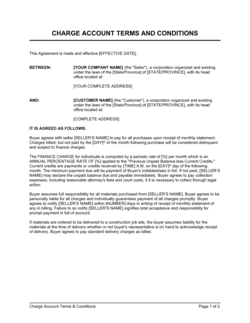
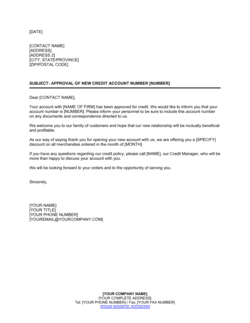
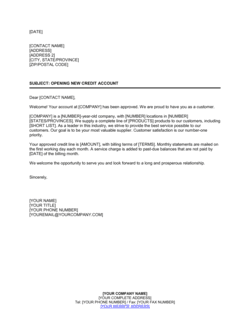
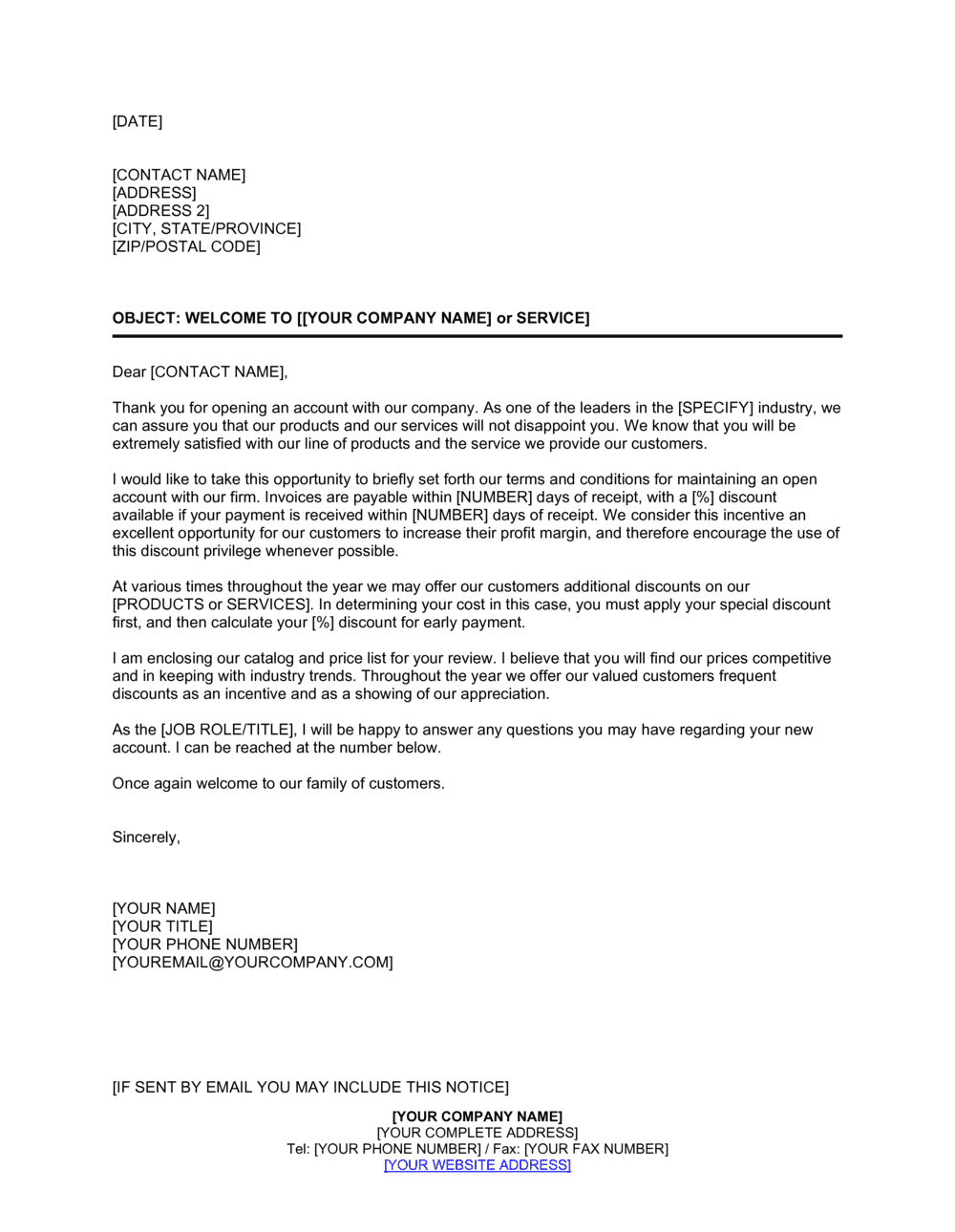
A New Open Account Welcome and Terms Letter is a formal business letter sent to a newly approved customer confirming that a trade credit account has been opened in their name and outlining the specific terms under which purchases may be made on account. This free Word download gives you a ready-to-edit template you can customize with your company details, credit limit, payment terms, and conditions, then send by email or post in minutes.
When you need it
Send it immediately after approving a new customer's credit application or opening a net-terms account. It is also appropriate when onboarding a long-standing cash customer who has been upgraded to open-account status.
What's inside
A formal greeting and account confirmation, the approved credit limit and payment terms (e.g., Net 30), late payment and interest provisions, ordering and invoicing procedures, and a closing that reinforces the business relationship and invites questions.

What is a New Open Account Welcome and Terms Letter?

A New Open Account Welcome and Terms Letter is a formal business letter sent by a supplier or vendor to a customer whose application for a trade credit account has been approved. It confirms that the account is open and active, states the approved credit limit, and sets out the payment terms β€” including the net-day payment window, accepted payment methods, late fee rate, and ordering procedure β€” that will govern every purchase made on account. Unlike a credit agreement, which is a full legal contract, this letter communicates the same essential terms in plain, readable language suited to a direct business correspondence.

Why You Need This Document

Without a written record of agreed credit terms, disputes over payment due dates, credit limits, and late fees are almost inevitable β€” and they are difficult to resolve in your favor without documentation. A welcome and terms letter establishes the baseline in writing before the first order is placed, so your accounts payable team has no legitimate reason to misinterpret when payment is due or what happens when it is not. It also protects your right to charge late fees: disclosing them in a letter signed by your company before the account is used is far stronger than trying to introduce them in a collection letter after the fact. This template gives you a professional, complete letter you can customize and send in minutes, ensuring every new account starts with clarity on both sides.

Which variant fits your situation?

If your situation is…Use this template
Customer is new and has been approved for a standard credit limitNew Open Account Welcome and Terms Letter
Existing cash customer upgraded to open-account statusAccount Terms Change Notification Letter
Customer's credit application was declinedCredit Application Denial Letter
Customer has exceeded their credit limit and needs a formal noticeCredit Limit Exceeded Letter
Following up on an unpaid invoice past the due datePast Due Invoice Letter
Formally closing or suspending a delinquent customer accountAccount Suspension Letter

Common mistakes to avoid

❌ Omitting the credit limit

Why it matters: Without a stated limit, customers have no clear ceiling and may place orders that exceed your risk tolerance. Enforcing an unwritten limit feels arbitrary and damages the relationship.

Fix: Always include the approved credit limit in writing. If you intend to adjust it over time, add a credit review clause that gives you explicit authority to do so.
❌ Using vague payment terms like 'due upon receipt'

Why it matters: Buyers interpret 'due upon receipt' inconsistently β€” some treat it as 30 days, others as 10. This ambiguity makes late-payment follow-up difficult and disputes common.

Fix: State a specific net-day term β€” Net 15, Net 30, or Net 60 β€” and calculate a due date on each invoice to remove any ambiguity.

❌ Failing to disclose late fees before the account is active

Why it matters: Attempting to charge a late fee that was not disclosed in writing when the account was opened can be disputed and in some jurisdictions may be unenforceable.

Fix: Include the late fee rate and returned-payment fee in this welcome letter so the customer acknowledges them at the start of the relationship.

❌ Sending the letter to the wrong contact

Why it matters: A letter addressed to the sales contact who negotiated the account may never reach accounts payable, leaving AP unaware of payment terms until the first invoice arrives late.

Fix: Confirm the AP department contact name and email during onboarding and address the terms letter directly to that person, copying the sales contact.

The 8 key clauses, explained

Opening greeting and account confirmation

In plain language: Welcomes the customer by name, identifies the supplier, and formally confirms that an open account has been approved and activated.

Sample language
Dear [CUSTOMER NAME], on behalf of [COMPANY NAME], we are pleased to confirm that a new open account has been established in the name of [CUSTOMER BUSINESS NAME], effective [DATE].

Common mistake: Addressing the letter to a generic contact title like 'Accounts Payable' instead of a named individual β€” impersonal letters are more likely to be filed without being read.

Approved credit limit

In plain language: States the maximum outstanding balance the customer is authorized to carry on the account at any time.

Sample language
Your account has been approved with an initial credit limit of $[AMOUNT]. Purchases that would cause your outstanding balance to exceed this limit may require advance payment or prior written approval.

Common mistake: Omitting the credit limit entirely and relying on verbal agreements β€” without a written limit, enforcing it when a customer over-orders is difficult.

Payment terms

In plain language: Specifies when payment is due, calculated from the invoice date, and the accepted payment methods.

Sample language
Payment is due [NET 30 / NET 60] days from the invoice date. We accept payment by [CHECK / ACH / WIRE TRANSFER / CREDIT CARD]. Please reference your invoice number on all remittances.

Common mistake: Stating 'due upon receipt' instead of a specific net-day term β€” recipients interpret this differently and it makes follow-up on late payments harder to standardize.

Late payment fees and interest

In plain language: Describes the interest or service charge applied to balances not paid by the due date, expressed as a monthly or annual rate.

Sample language
Balances not received by the due date are subject to a late payment fee of [X]% per month ([ANNUAL RATE]% per annum) on the outstanding balance until paid in full.

Common mistake: Omitting the late fee provision and adding it later in a collection letter β€” customers who were not told about fees upfront often dispute them, delaying payment further.

Ordering and invoicing procedure

In plain language: Explains how the customer should place orders, how invoices will be delivered, and any purchase order requirements.

Sample language
Orders may be placed by [EMAIL / PHONE / ONLINE PORTAL]. A formal invoice will be issued upon each shipment or delivery. If your organization requires a purchase order number on invoices, please provide it at the time of ordering.

Common mistake: Leaving out PO number requirements β€” if your customer's AP system requires a PO to process payment and you haven't asked for one, your invoice will sit unpaid until re-issued.

Credit review and adjustment clause

In plain language: Reserves the supplier's right to review, increase, reduce, or suspend the credit limit based on payment history or changed financial circumstances.

Sample language
Your credit limit will be reviewed periodically based on your account activity. [COMPANY NAME] reserves the right to adjust or suspend credit privileges at any time, with or without notice, based on payment performance or changes in your financial status.

Common mistake: Omitting this clause β€” without it, customers may assume the credit limit is permanent and take exception when it is revised following late payments.

Returned check or failed payment clause

In plain language: States the fee charged for returned checks or failed electronic payments and any consequences for the account.

Sample language
A returned check or failed ACH payment will incur a returned payment fee of $[AMOUNT]. Multiple returned payments may result in your account being placed on a cash-only or prepayment basis.

Common mistake: Failing to include a returned payment clause β€” without a disclosed fee and consequence, charging one after the fact may be legally challenged in some jurisdictions.

Closing and relationship statement

In plain language: Expresses appreciation for the new business relationship, invites the customer to contact the company with questions, and provides the AR contact's name and details.

Sample language
We value your business and look forward to a long and mutually beneficial relationship. Should you have any questions about your account, please contact [AR CONTACT NAME] at [PHONE / EMAIL].

Common mistake: Ending the letter without a named contact β€” customers with billing questions will call a general line instead of AR, slowing resolution and delaying payment.

How to fill it out

  1. 1

    Enter your company and customer details

    Replace all placeholders with your company's full legal name, address, and the customer's full legal business name and billing address. Use the customer's legal entity name, not a trade name or contact person.

    πŸ’‘ Match the customer name exactly to what appears on their credit application β€” inconsistencies cause disputes when invoices are sent.

  2. 2

    Set the effective date and account number

    Enter the date the account is officially active and assign a unique account number for your AR records. The customer will use this number on all future correspondence and remittances.

    πŸ’‘ Use a consistent account numbering format β€” e.g., a prefix plus five digits β€” so the number can be read into your accounting system without reformatting.

  3. 3

    State the approved credit limit

    Enter the maximum outstanding balance authorized for this account. If the limit was determined by a formal credit review, cross-reference the approval memo before entering the number.

    πŸ’‘ For new customers with limited credit history, start conservatively β€” a $5,000–$10,000 initial limit is typical, with a review after 90 days of on-time payments.

  4. 4

    Define payment terms and accepted methods

    Enter the net-day payment term (e.g., Net 30) and list every accepted payment method with the routing and account details for ACH or the mailing address for checks.

    πŸ’‘ Including a payment portal URL here reduces payment friction and typically shortens the average collection period by 5–7 days.

  5. 5

    Fill in late fee rate and returned payment fee

    Enter the monthly late fee percentage and annual equivalent, plus the flat returned-payment fee. Confirm both figures are consistent with any maximum rates permitted in your state.

    πŸ’‘ 1.5% per month (18% per annum) is a widely used standard that is enforceable in most US states β€” check your state's usury limits before going higher.

  6. 6

    Describe the ordering and invoicing process

    Briefly explain how the customer should place orders, whether a PO number is required, and how invoices will be delivered (email PDF, mail, or portal).

    πŸ’‘ Ask new customers explicitly whether they require invoices in a specific format β€” some ERP systems only import invoices in a particular template structure.

  7. 7

    Add the AR contact and sign off

    Enter the name, direct phone number, and email address of the AR team member responsible for this account. Sign the letter with the name and title of an appropriate manager or owner.

    πŸ’‘ A named AR contact reduces inbound calls to your general line and builds a direct relationship that speeds dispute resolution.

Frequently asked questions

What is a new open account welcome and terms letter?

It is a formal business letter sent to a newly approved customer confirming that a trade credit account has been opened and setting out the specific terms β€” credit limit, payment due date, late fees, and ordering procedures β€” under which the customer may purchase on account. It serves as both a relationship-building welcome and a written record of the agreed credit conditions.

When should I send this letter?

Send it immediately after approving the customer's credit application and before any goods or services are shipped on account. Sending it ahead of the first order ensures the customer's AP team knows the payment terms before the first invoice arrives. It is also appropriate when upgrading an existing cash customer to open-account status.

Does this letter need to be signed by the customer?

No signature is required from the customer for this letter to be effective in most business-to-business contexts. The letter documents the terms the supplier is offering; the customer's acceptance is typically implied when they place their first order on account. If you want an explicit acknowledgment, you can add a signature line and request that the customer return a signed copy, but this is not standard practice.

What credit limit should I set for a new account?

Start conservatively for new customers with limited payment history with your company. A common approach is to set the initial limit at one to two times the customer's expected monthly order value, typically $5,000–$25,000 for small to mid-sized B2B accounts. Include a credit review clause that allows you to increase the limit after 90 days of on-time payments.

What payment terms are standard for open accounts?

Net 30 is the most common standard in North American B2B trade. Net 15 is typical for smaller or newer accounts with less established credit history. Net 45 and Net 60 are sometimes required by larger corporate buyers or government purchasers. Always state a specific net-day term rather than an open-ended phrase like 'due upon receipt.'

Can I charge a late fee on overdue open-account balances?

Yes, in most jurisdictions, provided the late fee rate was disclosed to the customer in writing before the account was used. This welcome letter is the appropriate place to disclose that fee. Typical rates are 1%–2% per month on the outstanding balance. Check your jurisdiction's usury or consumer-protection rules to confirm the maximum allowable rate for commercial accounts.

What is the difference between a welcome letter and a credit agreement?

A welcome letter is a concise, readable business letter that confirms account approval and summarizes key terms in plain language. A credit agreement is a formal multi-page legal contract with detailed covenants, security interests, and default provisions. For most small to mid-sized B2B trade credit relationships, a well-drafted welcome letter is sufficient. Larger credit exposures β€” typically above $50,000 β€” may warrant a formal credit agreement reviewed by legal counsel.

Should I send this letter by email or post?

Email is standard for most B2B open accounts today and ensures the letter reaches accounts payable quickly. Send a PDF attachment rather than pasting the text into the email body so the customer can file it easily. For high-value accounts or customers with formal procurement processes, send both email and a physical copy by post and request a read receipt or written acknowledgment.

What should I do if a customer disputes the credit terms stated in this letter?

Respond in writing promptly, referencing the specific clause in the letter. If the dispute involves a genuine miscommunication from the credit approval process, issue a corrected letter with the agreed terms before any orders are shipped. Do not ship goods on account until the terms are confirmed in writing. For significant term changes, note them as an amendment to the original letter with both parties' initials.

How this compares to alternatives

vs Credit Application Form

A credit application is completed by the customer before account approval β€” it collects financial and business information so the supplier can assess risk. The welcome and terms letter is sent after approval to confirm the outcome and document the terms. The application precedes and informs the letter; they work in sequence, not as alternatives.

vs Credit Agreement

A credit agreement is a formal multi-page legal contract with detailed covenants, security interests, default provisions, and personal guarantee requirements. A welcome and terms letter is a concise business letter suitable for most small to mid-sized trade credit relationships. Use a credit agreement for exposures above $50,000 or customers requiring contractual security; use this letter for routine open-account onboarding.

vs Past Due Invoice Letter

A past due invoice letter is sent after payment terms have been missed β€” it is a collections tool. The welcome and terms letter is sent at the start of the relationship to prevent misunderstandings that lead to late payments. The two documents serve opposite ends of the credit lifecycle: the welcome letter opens the account; the past due letter responds when those terms are not met.

vs Account Terms Change Notification Letter

An account terms change notification is sent to existing customers when the supplier modifies credit limits, payment schedules, or late fee rates on an established account. The welcome and terms letter is for new accounts only. If you are updating terms for an existing customer, use the change notification to document the amendment without confusion.

Industry-specific considerations

Wholesale Distribution

Wholesale distributors use this letter to formalize net-30 or net-60 terms with new retail or reseller customers before the first inventory order is released.

Manufacturing

Manufacturers issue open account letters to new OEM or component buyers, tying the credit limit to anticipated monthly production volumes and shipment schedules.

Professional Services

Service firms opening retainer or on-account billing arrangements with new corporate clients use this letter to document billing cycles and payment expectations from day one.

Retail and E-commerce

B2B-facing retailers extending trade credit to business buyers β€” such as an office supply company opening accounts for corporate customers β€” use this letter to set spending limits and monthly payment cycles.

Template vs pro β€” what fits your needs?

PathBest forCostTime
Use the templateSmall to mid-sized businesses opening standard net-30 or net-60 trade credit accounts with new B2B customersFree10–15 minutes per letter
Template + professional reviewBusinesses with high-volume credit operations or accounts above $25,000 who want AR or legal review of their standard terms$100–$300 (accountant or attorney review of template defaults)1–2 days
Custom draftedLarge suppliers extending significant credit lines above $50,000, or those requiring personal guarantees, security interests, or jurisdiction-specific compliance$500–$1,500 (attorney-drafted credit terms)3–7 days

Glossary

Open Account
A credit arrangement in which a seller ships goods or delivers services and invoices the buyer, who pays at a later agreed date without prepayment or a letter of credit.
Net 30 / Net 60
Payment terms stating the full invoice balance is due 30 or 60 calendar days from the invoice date.
Credit Limit
The maximum outstanding balance a seller will allow a customer to carry on an open account at any one time.
Trade Credit
Short-term financing extended by one business to another, allowing the buyer to defer payment for goods or services already received.
Accounts Receivable (AR)
Money owed to a business by its customers for goods or services delivered but not yet paid for.
Late Payment Fee
A charge applied to balances not paid by the due date, typically expressed as a monthly percentage of the outstanding balance.
Credit Application
A formal request submitted by a prospective customer providing financial and business information so the supplier can assess creditworthiness.
Invoice Date
The date printed on the invoice, from which payment terms are typically calculated.
Remittance Advice
A document or note sent by the buyer with a payment that identifies which invoices are being paid and in what amounts.
Aging Schedule
An accounts-receivable report that groups outstanding invoices by how long they have been unpaid, typically in 0–30, 31–60, 61–90, and 90+ day buckets.

Part of your Business Operating System

This document is one of 3,000+ business & legal templates included in Business in a Box.

  • Fill-in-the-blanks β€” ready in minutes
  • 100% customizable Word document
  • Compatible with all office suites
  • Export to PDF and share electronically

Create your document in 3 simple steps.

From template to signed document β€” all inside one Business Operating System.
1
Download or open template

Access over 3,000+ business and legal templates for any business task, project or initiative.

2
Edit and fill in the blanks with AI

Customize your ready-made business document template and save it in the cloud.

3
Save, Share, Send, Sign

Share your files and folders with your team. Create a space of seamless collaboration.

Save time, save money, and create top-quality documents.

β˜…β˜…β˜…β˜…β˜…

"Fantastic value! I'm not sure how I'd do without it. It's worth its weight in gold and paid back for itself many times."

Managing Director Β· Mall Farm
Robert Whalley
Managing Director, Mall Farm Proprietary Limited
β˜…β˜…β˜…β˜…β˜…

"I have been using Business in a Box for years. It has been the most useful source of templates I have encountered. I recommend it to anyone."

Business Owner Β· 4+ years
Dr Michael John Freestone
Business Owner
β˜…β˜…β˜…β˜…β˜…

"It has been a life saver so many times I have lost count. Business in a Box has saved me so much time and as you know, time is money."

Owner Β· Upstate Web
David G. Moore Jr.
Owner, Upstate Web

Run your business with a system β€” not scattered tools

Stop downloading documents. Start operating with clarity. Business in a Box gives you the Business Operating System used by over 250,000 companies worldwide to structure, run, and grow their business.

Start freeΒ Β·Β No credit card required