Congratulations on Formation of a New Company Template

Free Word download • Edit online • Save & share with Drive • Export to PDF

1 page20–30 min to fillDifficulty: StandardSignature requiredLegal review recommended
Learn more ↓
FreeCongratulations on Formation of a New Company Template

At a glance

What it is
A Congratulations On Formation Of A New Company letter is a formal written communication sent by one business entity — typically a legal advisor, financial institution, partner, or investor — to the principals of a newly incorporated or formed company. This free Word download gives you a professionally structured template you can edit online and export as PDF, covering acknowledgment of the formation event, the entity's registered details, and any preliminary terms or conditions attached to the relationship going forward.
When you need it
Use it immediately after a new company's articles of incorporation, certificate of formation, or equivalent registration document have been filed and accepted by the relevant government authority. It is also appropriate when confirming the start of a banking, advisory, or partnership relationship with the newly formed entity.
What's inside
Sender and recipient identification, formal acknowledgment of the formation event with the entity's registered name and jurisdiction, reference to the governing documents, any preliminary terms or next steps in the relationship, representations by the sender, confidentiality or non-disclosure provisions where applicable, and a signature block for both parties.

What is a Congratulations On Formation Of A New Company Letter?

A Congratulations On Formation Of A New Company letter is a formal written communication issued to the founders or principals of a newly incorporated or organized business entity to acknowledge its legal existence and initiate or confirm an ongoing relationship. Unlike a casual note, this document references the company's registered name, jurisdiction of formation, governing documents, and the nature of the relationship being established — whether banking, investment, advisory, or commercial partnership. It functions as both a professional courtesy and a foundational legal record that confirms the factual baseline of the relationship from the moment the entity comes into existence.

Why You Need This Document

Failing to formally acknowledge a new company's formation creates a gap in the paper trail that underpins every subsequent agreement in the relationship. Banks that do not document formation details at account opening face KYC compliance exposure. Investors who advance funds before confirming entity status risk dealing with a company whose formation is disputed or incomplete. Attorneys who begin work without a signed acknowledgment have no documented basis for the scope of their engagement. This template closes that gap — confirming the company's registered details, establishing the parties' relationship on the record, and creating an executed document that anchors every contract, engagement letter, or investment agreement that follows. For the cost of 20 minutes and a legal review where the stakes warrant it, both parties have clear, written confirmation of who they are dealing with and on what basis the relationship begins.

Which variant fits your situation?

If your situation is…Use this template
Law firm welcoming a newly incorporated corporate clientCongratulations On Formation Of A New Company
Bank or financial institution opening accounts for a new entityNew Client Welcome Letter
Investor confirming formation before funding a startupInvestment Commitment Letter
Business partner formalizing a relationship with a new LLC or corporationLetter of Intent (Business Partnership)
Accountant engaging a newly formed company for ongoing servicesAccounting Engagement Letter
Company acknowledging its own formation to internal stakeholdersInternal Corporate Announcement
Congratulating a joint venture formed between two existing entitiesJoint Venture Formation Letter

Common mistakes to avoid

❌ Using trade names instead of registered legal entity names

Why it matters: A letter addressed to 'Acme Tech' instead of 'Acme Technology Inc.' may not legally bind the correct entity, creating enforceability gaps if the relationship later involves disputes or regulatory review.

Fix: Cross-reference the exact legal name from the certificate of formation or articles of incorporation before inserting it into any clause of the letter.

❌ Omitting the company's registration number and jurisdiction

Why it matters: Without the official file number and jurisdiction, the acknowledgment cannot be definitively matched to a specific legal entity — particularly problematic if multiple similar entities exist or if the company reincorporates later.

Fix: Include the full registration number, jurisdiction of formation, and date of filing as issued by the relevant government authority, sourced directly from the official formation certificate.

❌ Treating the letter as purely ceremonial with no operative clauses

Why it matters: A congratulatory letter that contains no representations, confidentiality terms, or governing law clause provides no legal protection to either party and is effectively a piece of stationery.

Fix: Include at minimum a representations clause, a governing law clause, and a disclaimer that the letter does not constitute legal advice, even for straightforward banking or advisory relationships.

❌ Having an unauthorized person sign on behalf of the new company

Why it matters: A newly formed company's signatory must be authorized by a board resolution, member consent, or operating agreement — without documented authority, the company can later disclaim the letter's terms.

Fix: Require the company to provide a certified copy of its authorizing resolution or the relevant operating agreement provision before accepting the signature as valid.

❌ Failing to define the nature of the ongoing relationship

Why it matters: Vague language like 'we look forward to a productive partnership' can be interpreted as creating implied contractual obligations, exposing the sender to liability for expectations the letter never intended to create.

Fix: State explicitly in the preliminary terms clause what relationship is being initiated, what agreement will govern its terms, and the expected date of that agreement's execution.

❌ Omitting a no-legal-advice disclaimer when the sender is not the company's counsel

Why it matters: A bank, investor, or business partner that issues a letter discussing the company's formation and legal status can inadvertently appear to be providing legal advice, creating a duty of care it has no professional basis to fulfill.

Fix: Add a clear, prominent disclaimer stating that the letter is for informational and relationship-initiation purposes only and that the company should seek independent legal advice regarding its formation and any agreements it executes.

The 10 key clauses, explained

Identification of Parties

In plain language: Names the sender (the congratulating party) and the recipient (the newly formed company and its principals) with full legal names and addresses.

Sample language
This letter is addressed by [SENDER LEGAL NAME], a [ENTITY TYPE] organized under the laws of [JURISDICTION] ('Sender'), to [NEW COMPANY LEGAL NAME], a [ENTITY TYPE] formed on [DATE OF FORMATION] under the laws of [STATE / PROVINCE / COUNTRY] ('Company'), and its founding principals [FOUNDER NAMES].

Common mistake: Using a trade name or brand name instead of the registered legal entity name for either party — this can create ambiguity about which entity is actually bound by any undertakings in the letter.

Acknowledgment of Formation

In plain language: Formally recognizes that the company has been duly formed and is in good standing, referencing the specific filing, date, and jurisdiction.

Sample language
Sender hereby acknowledges and congratulates the formation of [COMPANY NAME], incorporated / organized on [DATE] in [JURISDICTION], File No. [REGISTRATION NUMBER], and confirms receipt of the company's [Certificate of Incorporation / Certificate of Formation / equivalent].

Common mistake: Omitting the official registration number and jurisdiction — without these identifiers, the acknowledgment cannot be matched to a specific legal entity, which matters if disputes arise later.

Representations Regarding Formation

In plain language: The newly formed company (or its principals on its behalf) represents that the entity was legally formed, is in good standing, and that all governing documents are in place.

Sample language
The Company represents and warrants to Sender that: (a) it has been duly organized and is validly existing in good standing under the laws of [JURISDICTION]; (b) its [Articles of Incorporation / Certificate of Formation] and [Bylaws / Operating Agreement] are in full force and effect; and (c) the individuals signing this letter have full authority to bind the Company.

Common mistake: Skipping representations entirely and treating the letter as purely ceremonial. A letter that confirms the relationship going forward benefits from representations to establish the factual baseline.

Reference to Governing Documents

In plain language: Identifies the company's founding and governing documents by name so both parties are aligned on which documents control the entity's operations and the relationship described in the letter.

Sample language
This letter is issued in connection with the [Articles of Incorporation / Certificate of Formation] dated [DATE], the [Bylaws / Operating Agreement] adopted on [DATE], and any applicable Shareholder Agreement (collectively, the 'Governing Documents'), copies of which have been provided to Sender.

Common mistake: Referencing only one governing document when others exist — for example, acknowledging the certificate of formation but not the operating agreement, which often contains the actual terms governing member conduct.

Preliminary Terms of the Relationship

In plain language: Describes the purpose of the relationship being initiated or confirmed — banking, advisory, partnership, investment, or professional services — and any initial conditions or obligations.

Sample language
Sender and Company agree that this letter establishes the preliminary basis for [DESCRIPTION OF RELATIONSHIP — e.g., 'banking services to be provided by Sender under a separate Account Agreement'] and that such relationship shall be governed by the terms of [SUBSEQUENT AGREEMENT / APPLICABLE TERMS] to be executed by [DATE].

Common mistake: Being vague about the nature of the relationship — writing 'we look forward to working together' without specifying what that means can create implied contractual obligations if one party later claims a binding arrangement was formed.

Confidentiality of Formation Information

In plain language: Where the sender has received non-public information about the company's formation, structure, or principals, this clause restricts its disclosure to third parties.

Sample language
Sender agrees to maintain the confidentiality of any non-public information provided in connection with the Company's formation, including ownership structure, EIN, and financial details, and shall not disclose such information to any third party except as required by applicable law or with the prior written consent of the Company.

Common mistake: Including a confidentiality clause but failing to define what counts as 'non-public information' — an undefined scope is effectively unenforceable because the parties will disagree on what it covers.

Compliance and Regulatory Acknowledgment

In plain language: Confirms that the sender acknowledges the company's obligation to comply with applicable laws, regulations, and licensing requirements in its jurisdiction of formation and any jurisdiction where it intends to operate.

Sample language
Sender acknowledges that [COMPANY NAME] is responsible for maintaining compliance with all applicable federal, state / provincial, and local laws, including business licensing requirements, tax registration obligations, and any industry-specific regulations applicable to its operations in [JURISDICTION(S)].

Common mistake: Framing compliance acknowledgment as a representation by the sender rather than an obligation of the company — this misallocates risk and can be read as the sender vouching for the company's compliance.

No Legal Advice Disclaimer

In plain language: When sent by a non-legal party (bank, investor, partner), clarifies that the letter does not constitute legal advice and that the company should consult its own counsel.

Sample language
This letter is provided for informational and relationship-initiation purposes only and does not constitute legal advice. [COMPANY NAME] is encouraged to consult with its own legal counsel regarding the implications of its formation and the terms of any agreements it enters into.

Common mistake: Omitting this disclaimer when the sender is not acting as the company's lawyer — a bank or investor that appears to be advising on formation can inadvertently create a duty of care or conflict of interest.

Governing Law and Notices

In plain language: States which jurisdiction's law governs the letter and how formal notices between the parties must be delivered.

Sample language
This letter shall be governed by and construed in accordance with the laws of [STATE / PROVINCE / COUNTRY]. All notices shall be in writing and delivered by [COURIER / EMAIL WITH READ RECEIPT / CERTIFIED MAIL] to the addresses set out above.

Common mistake: Choosing a governing law that has no connection to either party's location or the company's jurisdiction of formation — this can make enforcement unnecessarily complex and is often flagged by courts.

Signature Block and Authority

In plain language: Provides a formal execution block confirming that each signatory has authority to bind their respective entity to the terms of the letter.

Sample language
Each party represents that the individual signing below has full authority to execute this letter on behalf of the respective entity. Signed as of [DATE]. [SENDER AUTHORIZED SIGNATORY NAME / TITLE / SIGNATURE] | [COMPANY AUTHORIZED SIGNATORY NAME / TITLE / SIGNATURE].

Common mistake: Having an unauthorized person sign on behalf of the company — for example, an employee signing on behalf of a corporation before a board resolution has authorized them to do so.

How to fill it out

  1. 1

    Enter the sender's full legal details

    Fill in the sender's registered legal name, entity type, jurisdiction, address, and the name and title of the authorized signatory. This establishes who is issuing the letter and their authority.

    💡 Confirm the sender's exact legal name against its own formation documents — mismatches between the letter and official records can complicate enforcement of any obligations stated in it.

  2. 2

    Insert the new company's registered details

    Enter the new company's full legal name exactly as registered, its entity type (corporation, LLC, LLP, etc.), jurisdiction of formation, date of formation, and official registration or file number.

    💡 Pull the registration number directly from the certificate of formation or articles of incorporation issued by the relevant government authority — do not rely on the company's own letterhead.

  3. 3

    Reference the governing documents

    Identify all founding documents by name and date — articles of incorporation or certificate of formation, bylaws or operating agreement, and any shareholder or member agreement. Attach copies if sending in a formal legal context.

    💡 If the operating agreement or shareholder agreement has not yet been finalized at the time of writing, note that it is 'in preparation' and include a deadline for execution.

  4. 4

    Describe the relationship being initiated

    In the preliminary terms section, clearly state the nature of the ongoing relationship — banking, investment, advisory, partnership, or professional services — and reference any subsequent agreements that will govern the specific terms.

    💡 Avoid open-ended phrases like 'as agreed.' Specify the agreement by name and expected execution date to prevent the letter itself from being treated as the binding arrangement.

  5. 5

    Tailor the confidentiality clause to the information exchanged

    Define 'confidential information' specifically for your context — ownership structure, EIN, cap table, or financial projections — and state the duration of the confidentiality obligation (typically 2–5 years).

    💡 If the parties intend to execute a full NDA separately, reference it here and confirm it supersedes the confidentiality provisions in this letter.

  6. 6

    Confirm governing law and notice details

    Select the jurisdiction whose laws will govern the letter — typically the jurisdiction where the new company is formed or where the sender operates. Add the email address and physical address for formal notices.

    💡 For cross-border relationships, choose a single governing jurisdiction rather than leaving it ambiguous — 'the laws of [JURISDICTION]' should name a specific state, province, or country.

  7. 7

    Obtain authorized signatures before any relationship actions begin

    Have both parties sign before the sender takes any actions in connection with the new company — opening accounts, transferring funds, or commencing advisory services. Confirm that each signatory has board or member authorization.

    💡 Request a copy of the authorizing board resolution or member consent for corporate signatories — this protects the sender if the signatory's authority is later challenged.

  8. 8

    Retain an executed copy with the entity's formation file

    File the fully executed letter alongside the company's formation documents — certificate, operating agreement, and EIN confirmation — so the complete record of the company's early legal relationships is in one place.

    💡 Use a document management platform to store the executed copy with a timestamp and both parties' email confirmations as supplementary evidence of delivery and receipt.

Frequently asked questions

What is a congratulations on formation of a new company letter?

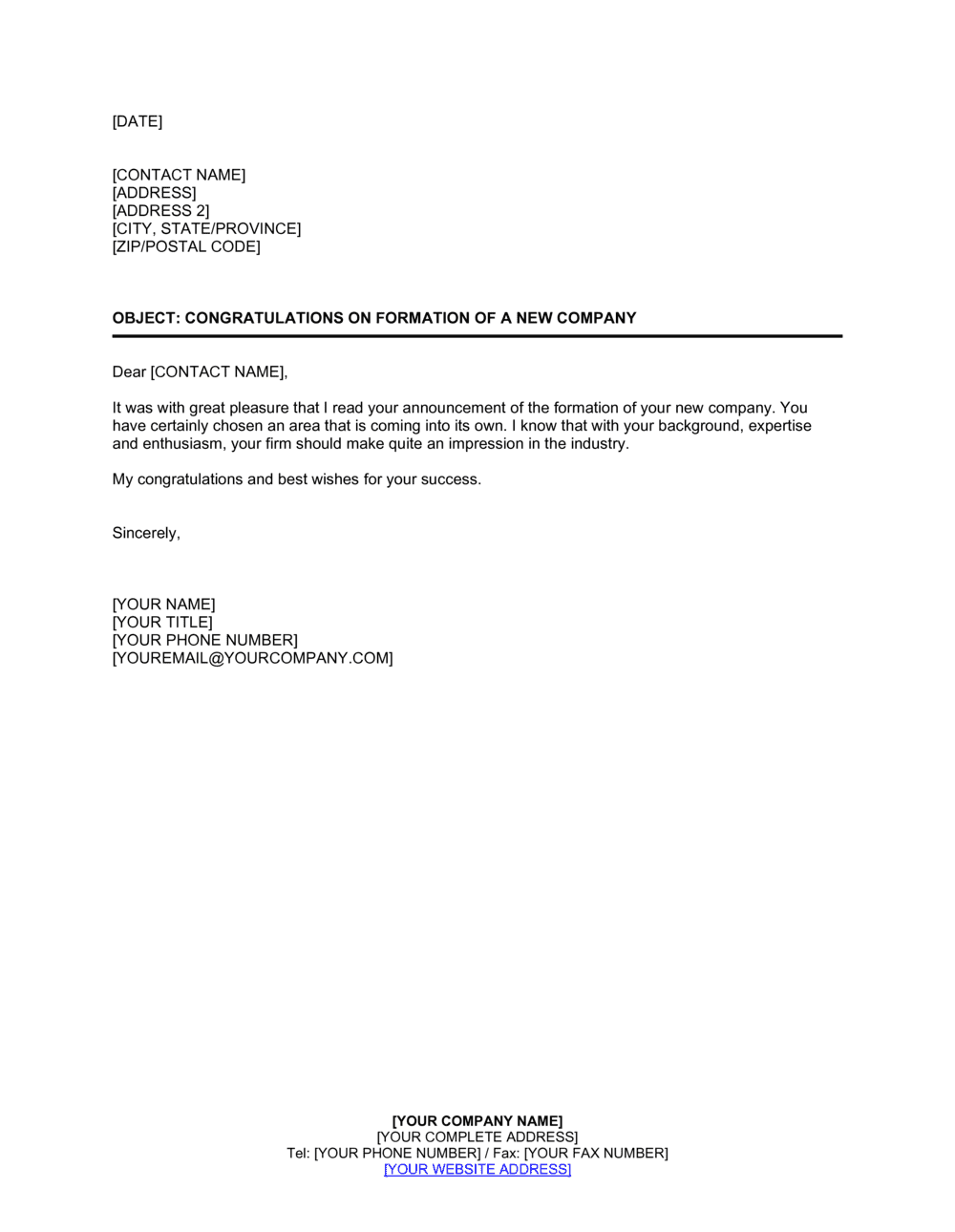
A congratulations on formation of a new company letter is a formal written communication issued by a business partner, bank, investor, attorney, or other stakeholder to acknowledge and celebrate the legal formation of a new business entity. While its tone is congratulatory, its legal purpose is to confirm the existence of the new entity, establish the basis of the relationship going forward, and document any preliminary terms or representations associated with that relationship.

Is this letter legally binding?

It can be, depending on its contents. A letter that contains representations, confidentiality obligations, a governing law clause, and authorized signatures from both parties is generally enforceable as a binding agreement in most jurisdictions. A letter that is purely congratulatory with no operative clauses is typically not legally binding. If the letter is intended to create enforceable obligations, it should be drafted and reviewed accordingly.

When should this letter be sent?

The letter should be sent as soon as the company's formation is confirmed by the relevant government authority — typically within 5–10 business days of receiving the certificate of incorporation, certificate of formation, or equivalent document. Sending it before formation is confirmed risks acknowledging an entity that does not yet legally exist. In a banking or investment context, it is often sent simultaneously with or immediately before the first operative agreement.

Who typically sends this letter?

Corporate attorneys send it to formalize their engagement with a new client. Banks and financial institutions send it to welcome a new business account holder. Investors and venture capital firms send it to confirm receipt of formation documents before advancing funding. Business partners and suppliers send it to initiate a formal commercial relationship. In each case, the letter serves as both a professional courtesy and a foundational record of the relationship's start.

Does the letter need to be notarized?

Notarization is not required for most congratulations and formation acknowledgment letters in standard business contexts. However, if the letter includes operative undertakings — such as a commitment to provide funding, banking services, or legal representation — and either party requires it as a condition of their internal compliance process, notarization may be added. Consult legal counsel in the applicable jurisdiction if there is any question about whether notarization is required.

What is the difference between this letter and an engagement letter?

A congratulations on formation letter acknowledges the existence of the new entity and establishes the preliminary basis of a relationship. An engagement letter is a separate, more detailed document that defines the specific scope of services, fees, timelines, and responsibilities for a professional engagement. The formation letter typically precedes the engagement letter and sets the context for it.

What jurisdictional law should govern the letter?

The governing law should typically be the jurisdiction in which the new company was formed, or the jurisdiction in which the sender's primary operations are located if that differs. For cross-border relationships, both parties should agree on a single jurisdiction in advance. In the United States, the state of formation is most commonly chosen. In Canada, the applicable province. In the UK or EU, the country of the sender or recipient depending on where the primary obligations arise.

Can this template be used for LLCs, corporations, and other entity types?

Yes. The template is designed to accommodate any business entity type — LLC, corporation (C-corp or S-corp), LLP, partnership, or sole proprietorship. The key fields that vary by entity type are the governing document references (articles of incorporation vs. certificate of formation, bylaws vs. operating agreement) and the signatory authority language. The template includes placeholders for each of these that should be completed to match the specific entity type of the new company.

Should the new company's founders sign the letter?

In most cases, the letter should be signed by an authorized officer or member of the new company — not merely its founders in their personal capacity — to ensure the company itself, as a legal entity, is bound by any representations or undertakings in the letter. If the company has just been formed and governance documents are not yet fully executed, include a representation that the signatory has authority to bind the entity pending formal adoption of its operating agreement or bylaws.

How this compares to alternatives

vs Letter of Intent

A letter of intent outlines the proposed terms of a future transaction or partnership before a binding agreement is executed. A congratulations on formation letter acknowledges an event that has already occurred — the legal creation of the entity — and establishes a relationship baseline. Use the letter of intent when negotiating future terms; use the formation letter when confirming an existing fact and initiating a relationship.

vs Engagement Letter

An engagement letter defines the specific scope, fees, deliverables, and responsibilities for a professional services relationship. A congratulations on formation letter is a precursor document that acknowledges the entity's existence and the intent to establish a relationship. The engagement letter governs the work; the formation letter records the starting point of the relationship.

vs Non-Disclosure Agreement

A non-disclosure agreement creates standalone, enforceable confidentiality obligations between parties sharing sensitive information. A congratulations on formation letter may include a confidentiality clause, but it is incidental to the letter's primary purpose. Where protecting formation details — cap tables, EINs, or ownership structures — is critical, a separate NDA should be executed in addition to this letter.

vs Welcome Letter to a New Client

A generic new client welcome letter covers onboarding logistics, contact information, and service expectations for any new client regardless of their corporate status. A congratulations on formation letter is specifically triggered by the legal formation event, references the governing documents, and may include representations and warranties tied to the entity's existence. Use the formation letter when the corporate formation itself is the relevant event; use the welcome letter for general client onboarding.

Industry-specific considerations

Legal Services

Law firms use this letter to formalize client intake for newly formed entities, establish the scope of the engagement, and document receipt of formation documents before billing commences.

Financial Services

Banks and credit unions issue this letter when opening business accounts for new entities, satisfying KYC requirements by confirming formation details, EIN, and authorized signatories.

Technology / SaaS

Investors and accelerators send this letter to newly incorporated startups before executing subscription agreements or SAFEs, confirming the entity's formation and cap table structure.

Professional Services

Accounting firms, HR consultancies, and management advisors use this letter to establish an engagement with a new corporate client, referencing the governing documents before onboarding begins.

Jurisdictional notes

United States

Company formation is governed at the state level — Delaware, Wyoming, and Nevada are common formation states for startups due to favorable corporate law. The letter should reference the specific state of formation and the relevant statute (e.g., Delaware General Corporation Law or the applicable LLC Act). EIN issuance by the IRS is a federal requirement and should be confirmed before the letter is executed. In regulated industries such as banking or securities, additional disclosures may be required.

Canada

Companies in Canada are formed either federally under the Canada Business Corporations Act (CBCA) or provincially under the relevant provincial statute. The letter should specify whether the entity is a federal or provincial corporation and reference the applicable act. Quebec requires that documents addressed to Quebec-based entities be available in French under the Charter of the French Language. Business number registration with the CRA is the Canadian equivalent of EIN and should be referenced where applicable.

United Kingdom

UK companies are incorporated under the Companies Act 2006 and registered with Companies House, which assigns a unique Company Registration Number (CRN). The letter should reference the CRN and the date of incorporation as confirmed by the Certificate of Incorporation issued by Companies House. For regulated activities, the Financial Conduct Authority (FCA) authorization status should be noted if relevant. Scotland has a separate legal system, and Scottish partnerships and companies have distinct formation rules.

European Union

EU member states have distinct national company law regimes — a German GmbH, French SAS, or Dutch BV each has different formation requirements and governing document terminology. The letter should reference the specific national statute under which the entity was formed and the national business register entry. GDPR obligations apply where the letter contains personal data about founders or directors. For cross-border EU relationships, consider specifying the governing law and jurisdiction for dispute resolution explicitly, as EU Regulation 593/2008 (Rome I) governs contractual obligations across member states.

Template vs lawyer — what fits your deal?

PathBest forCostTime
Use the templateBanks, advisors, and business partners initiating straightforward relationships with newly formed domestic entitiesFree15–20 minutes
Template + legal reviewInvestors, law firms, or regulated institutions requiring compliance review before issuing formation acknowledgments$150–$4001–2 business days
Custom draftedCross-border formations, complex multi-party ownership structures, or letters that include binding preliminary investment terms$800–$2,500+3–7 business days

Glossary

Articles of Incorporation
The foundational document filed with a state or provincial authority to legally create a corporation, establishing its name, purpose, and share structure.
Certificate of Formation
The equivalent of articles of incorporation for a limited liability company (LLC), filed with the relevant government body to bring the LLC into legal existence.
Registered Agent
An individual or entity designated to receive official legal and government correspondence on behalf of the newly formed company.
Entity Type
The legal structure chosen for the company — such as a corporation, LLC, LLP, or sole proprietorship — which determines liability exposure, tax treatment, and governance requirements.
Good Standing
A status confirming that a company has met all state or provincial filing and fee requirements and is authorized to conduct business in the relevant jurisdiction.
Operating Agreement
An internal governing document for an LLC that outlines member roles, ownership percentages, profit distribution, and decision-making procedures.
EIN (Employer Identification Number)
A nine-digit tax identification number issued by the IRS to a business entity in the United States, equivalent to a Social Security Number for an individual.
Governing Documents
The full set of founding and operational documents for a company — including articles of incorporation, bylaws, operating agreement, and shareholder agreements.
Jurisdiction of Formation
The state, province, or country in which a company was legally formed and whose laws govern its corporate existence and structure.
Representations and Warranties
Statements of fact made by one party to another in a formal document, confirming the accuracy of information such as the entity's formation status, authority, and legal standing.
Counterpart Execution
A signing method that allows each party to sign a separate copy of the same document, with all copies together forming one binding agreement.

Part of your Business Operating System

This document is one of 3,000+ business & legal templates included in Business in a Box.

  • Fill-in-the-blanks — ready in minutes
  • 100% customizable Word document
  • Compatible with all office suites
  • Export to PDF and share electronically

Create your document in 3 simple steps.

From template to signed document — all inside one Business Operating System.
1
Download or open template

Access over 3,000+ business and legal templates for any business task, project or initiative.

2
Edit and fill in the blanks with AI

Customize your ready-made business document template and save it in the cloud.

3
Save, Share, Send, Sign

Share your files and folders with your team. Create a space of seamless collaboration.

Save time, save money, and create top-quality documents.

★★★★★

"Fantastic value! I'm not sure how I'd do without it. It's worth its weight in gold and paid back for itself many times."

Managing Director · Mall Farm
Robert Whalley
Managing Director, Mall Farm Proprietary Limited
★★★★★

"I have been using Business in a Box for years. It has been the most useful source of templates I have encountered. I recommend it to anyone."

Business Owner · 4+ years
Dr Michael John Freestone
Business Owner
★★★★★

"It has been a life saver so many times I have lost count. Business in a Box has saved me so much time and as you know, time is money."

Owner · Upstate Web
David G. Moore Jr.
Owner, Upstate Web

Run your business with a system — not scattered tools

Stop downloading documents. Start operating with clarity. Business in a Box gives you the Business Operating System used by over 250,000 companies worldwide to structure, run, and grow their business.

Free Forever Plan · No credit card required