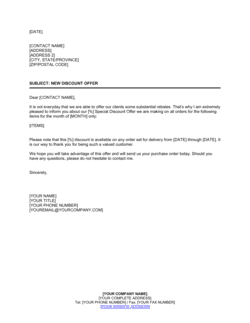
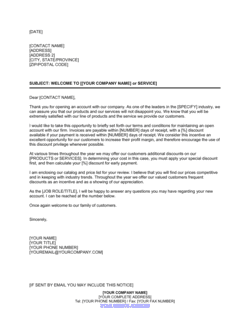
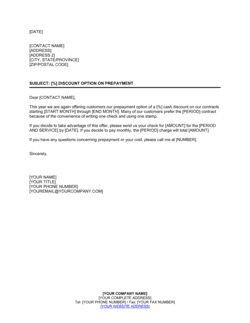
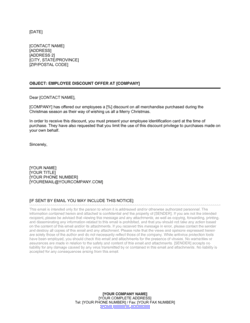
Welcome Discount for New Enterprise Template

Free Word download • Edit online • Save & share with Drive • Export to PDF

1 page20–30 min to fillDifficulty: StandardSignature requiredLegal review recommended
Learn more ↓
FreeWelcome Discount for New Enterprise Template

At a glance

What it is
A Welcome Discount for New Enterprise is a legally binding document that formalizes an introductory pricing concession offered by a vendor or service provider to a new enterprise-level client. This free Word download lets you define the discount amount, eligibility criteria, duration, conditions, and what happens when the introductory period ends — all in a single, editable agreement you can export as PDF and execute before the relationship begins.
When you need it
Use it when onboarding a new enterprise account and offering a discounted rate to secure the initial commitment. It is especially important when the discount is tied to volume, contract length, or specific performance milestones that must be documented to avoid future disputes.
What's inside
Parties and effective date, discount description and calculation method, eligibility conditions, discount period and expiry, renewal and standard pricing terms, obligations and compliance requirements, termination triggers, limitation of liability, and governing law.

What is a Welcome Discount for New Enterprise?

A Welcome Discount for New Enterprise is a legally binding agreement between a vendor and a new enterprise-level client that formally documents an introductory price reduction, the conditions that govern it, and the consequences of non-compliance. It goes beyond an informal discount conversation or a line item on a quote by establishing eligibility criteria, a fixed discount period with clear start and end dates, obligations the client must meet to retain the discount, and a clawback mechanism the vendor can invoke if those conditions are not satisfied. The agreement protects both parties: the client has a documented right to reduced pricing, and the vendor has enforceable terms tied to every concession it makes.

Why You Need This Document

Offering an enterprise welcome discount without a signed agreement creates four distinct risks simultaneously. First, without a locked base price, you cannot prevent the net benefit from eroding if your standard rates increase. Second, without eligibility conditions in writing, a client who pays late, underuses the product, or fails to meet minimum volume commitments can still demand the discounted rate. Third, without an explicit expiry and notice provision, clients routinely dispute the first full-price invoice and delay payment — often at the worst possible moment in the account relationship. Fourth, without a clawback clause, you have no mechanism to recover the discount value if the client churns six months into a twelve-month introductory period. This template closes all four gaps in under thirty minutes, giving your sales team a professional, signable document to present alongside the initial proposal.

Which variant fits your situation?

If your situation is…Use this template
Offering a flat percentage discount for the first 12 months of a SaaS subscriptionWelcome Discount for New Enterprise
Providing a volume-based price reduction tied to minimum purchase commitmentsVolume Discount Agreement
Granting a one-time promotional rebate after a qualifying first purchaseCustomer Rebate Agreement
Extending preferential pricing to a long-term enterprise account with multi-year termsPreferred Pricing Agreement
Issuing a formal credit against future invoices instead of a rate reductionCredit Note
Documenting a negotiated price exception within a master services agreementMaster Services Agreement
Confirming discount terms as part of a full enterprise software licenseSoftware License Agreement

Common mistakes to avoid

❌ Floating discount base with no locked standard price

Why it matters: If the agreement says '20% off standard pricing' but does not fix what standard pricing is at signing, the vendor can raise rates and the discount value erodes without any breach of contract.

Fix: Attach a Schedule A with the current standard price list signed by both parties on the effective date. State that the discount applies to the prices in Schedule A, not to future list prices unless separately agreed.

❌ No notice requirement before pricing transitions to standard rates

Why it matters: Clients who receive a full-price invoice without advance warning routinely dispute it, delay payment, and escalate to their procurement team — creating a relationship problem at a critical account-growth moment.

Fix: Insert a clause requiring the vendor to send written notice at least 30 days before the discount expiry date, restating the standard pricing that will apply on renewal.

❌ Vague 'new customer' eligibility with no affiliate carve-out

Why it matters: Without a definition of 'new enterprise' that covers subsidiaries and affiliated entities, an existing customer can incorporate a new legal entity and claim the welcome discount indefinitely.

Fix: Define eligibility to exclude any entity that shares 25% or more common ownership with a current or prior customer, or that was previously a subsidiary, division, or rebranded version of an existing account.

❌ Clawback clause with no calculation method or notice period

Why it matters: A clawback with no defined formula and no notice period before enforcement is frequently characterized as a penalty clause — which courts in the US, UK, and Canada routinely refuse to enforce.

Fix: Specify the lookback period, the per-billing-cycle discount value used in the calculation, and a minimum 15-day written notice period before any clawback invoice is issued. Cap the total at the discount actually received.

❌ No exclusions for professional services and pass-through costs

Why it matters: Without explicit exclusions, the client will apply the discount to every line item on every invoice — including one-time implementation fees and third-party software costs that were never intended to be discounted.

Fix: List every excluded service, fee, or product category explicitly in the agreement body or in a signed exhibit. Mark each line of your fee schedule as 'eligible' or 'excluded' at the time of signing.

❌ Signing after the first discounted invoice has already been issued

Why it matters: A discount applied before the agreement is signed may be treated as a unilateral concession rather than a binding contractual term, undermining the enforceability of the eligibility conditions and clawback provisions.

Fix: Execute the agreement before issuing the first invoice reflecting the discount. If the invoice was already sent, issue an amendment or side letter that explicitly supersedes the earlier invoice and confirms the contractual terms.

The 10 key clauses, explained

Parties and effective date

In plain language: Identifies the vendor and the new enterprise client as legal entities and establishes the date the discount arrangement takes effect.

Sample language
This Welcome Discount Agreement ('Agreement') is entered into as of [EFFECTIVE DATE] between [VENDOR LEGAL NAME], a [STATE/PROVINCE] [ENTITY TYPE] ('Vendor'), and [CLIENT LEGAL NAME], a [STATE/PROVINCE] [ENTITY TYPE] ('Client').

Common mistake: Using a trade name or DBA instead of the registered legal entity name, which creates enforcement difficulties if a dispute arises and the signatory entity cannot be identified in court records.

Discount description and calculation

In plain language: Specifies the exact discount — percentage, fixed amount, or formula — and how it is applied to the invoice or contract price.

Sample language
Vendor agrees to apply a discount of [X]% to the Standard Pricing set out in Schedule A for all qualifying purchases made by Client during the Discount Period. The discounted net price per [unit / seat / engagement] is $[NET PRICE].

Common mistake: Stating the discount as a percentage without anchoring it to a defined base price. If standard pricing changes, the net benefit to the client becomes ambiguous and disputed.

Eligibility conditions

In plain language: States the specific criteria the client must satisfy to qualify for and maintain the discount — such as minimum annual spend, seat count, or account status.

Sample language
Client qualifies for this discount provided that: (a) Client has not previously held an active account with Vendor; (b) Client maintains a minimum of [X] licensed seats or $[X] in annual spend; and (c) Client's account remains in good standing throughout the Discount Period.

Common mistake: Leaving eligibility conditions vague — for example, stating 'new customers only' without defining what constitutes a new customer. Prior subsidiaries, affiliates, or reactivated dormant accounts can exploit the gap.

Discount period and expiry

In plain language: Defines the start and end date of the introductory pricing window and confirms that standard rates apply automatically once it expires.

Sample language
The Discount Period commences on [START DATE] and expires on [END DATE] ('Expiry Date'). Upon expiration, Vendor's Standard Pricing as set out in Schedule A shall apply automatically without further notice, unless the parties execute a written amendment.

Common mistake: Using relative time references such as 'for the first year' without anchoring to a fixed start date. If onboarding is delayed, both parties dispute when the clock started.

Renewal and transition to standard pricing

In plain language: Describes the process and notice required when transitioning the client from discounted to standard pricing, and whether any renewal discount is available.

Sample language
Vendor shall provide Client with not less than [30] days' written notice prior to the Expiry Date confirming the Standard Pricing that will apply upon renewal. No welcome discount applies to any renewal term unless expressly agreed in writing by both parties.

Common mistake: Failing to include a notice requirement for the pricing transition. Clients who are not warned in advance of the rate increase frequently dispute the first full-price invoice and delay payment.

Obligations and compliance requirements

In plain language: Sets out what the client must do — timely payment, minimum usage, accurate reporting — to remain eligible for the discount throughout the period.

Sample language
Client shall: (a) pay all invoices within [NET 30] days of the invoice date; (b) maintain the minimum usage or spend threshold set out in Section 3; and (c) provide accurate usage data within [X] business days of each billing cycle upon Vendor's reasonable request.

Common mistake: Omitting a payment-timeliness requirement. Courts in many jurisdictions have found that a client who pays late but eventually pays cannot be stripped of a discount unless the contract explicitly ties discount eligibility to on-time payment.

Clawback and forfeiture

In plain language: States what happens if the client fails to meet eligibility conditions — specifically whether the vendor can reclaim the discount value already applied.

Sample language
If Client fails to meet any Eligibility Condition during the Discount Period, Vendor may, upon [15] days' written notice, (a) terminate the discount prospectively, or (b) invoice Client for the amount of discount applied since the date of non-compliance, at Vendor's election.

Common mistake: Including a clawback without specifying the remediation period or the calculation method. A clawback clause with no notice period or lookback formula is routinely found to be unenforceable as a penalty clause.

Limitations and exclusions

In plain language: Clarifies what the discount does and does not apply to — professional services, add-ons, third-party fees, or out-of-scope purchases.

Sample language
This discount applies solely to [DEFINED PRODUCTS / SERVICES] listed in Schedule A. It does not apply to: (a) professional services, implementation, or training fees; (b) third-party software or pass-through costs; or (c) any products or services added after the Effective Date unless separately agreed in writing.

Common mistake: Stating no exclusions, leaving the client to argue the discount applies to every line item on every invoice — including implementation fees that were negotiated separately at full price.

Limitation of liability

In plain language: Caps the vendor's exposure in connection with the discount arrangement and excludes indirect or consequential damages.

Sample language
Vendor's total liability under this Agreement shall not exceed the aggregate discount value applied to Client's account during the Discount Period. In no event shall either party be liable for indirect, incidental, or consequential damages arising from this Agreement.

Common mistake: Omitting a liability cap specific to the discount agreement. Without one, a client could argue that the vendor's failure to honor the discount caused lost business opportunity damages far exceeding the discount value itself.

Governing law and dispute resolution

In plain language: Specifies which jurisdiction's law governs the agreement and how disputes are resolved — arbitration, mediation, or litigation.

Sample language
This Agreement is governed by the laws of [STATE / PROVINCE / COUNTRY], without regard to conflict-of-law principles. Any dispute shall be resolved by binding arbitration administered by [AAA / JAMS / ICC] in [CITY], except that either party may seek injunctive relief in any court of competent jurisdiction.

Common mistake: Selecting governing law that has no connection to either party's place of business. Courts sometimes decline to enforce a choice-of-law clause that appears to have been chosen solely to disadvantage the weaker party.

How to fill it out

  1. 1

    Enter the parties' full legal entity names

    Use the registered corporate or LLC name for both vendor and client — not a brand name or DBA. Include the state, province, or country of incorporation and entity type for both parties.

    💡 Search the relevant corporate registry to verify the exact legal name before drafting. A mismatch between the contract name and the signatory's authority can void enforcement of the restrictive clauses.

  2. 2

    Define the discount precisely

    State the discount as a percentage of a named base price (e.g., '20% off the Standard Pricing listed in Schedule A, which is $[X] per seat per month') rather than a standalone percentage. Attach Schedule A with the current standard price list.

    💡 Lock the standard pricing in Schedule A at the time of signing. If your pricing changes during the discount period, the net benefit remains calculable without renegotiation.

  3. 3

    Set clear eligibility conditions

    Define what makes the client a 'new enterprise' — for example, no active account within the prior 24 months, no common ownership with an existing customer, and a minimum of [X] licensed seats or $[X] in annual contract value.

    💡 Include an affiliate or subsidiary carve-out if you want to prevent existing customers from creating a new entity to claim the welcome discount.

  4. 4

    Anchor the discount period to fixed calendar dates

    Enter a specific start date and expiry date for the discount rather than using relative language. If onboarding has not yet begun, use the date of first invoice as the start date and define the end date as 12 months from that date.

    💡 Add a clause requiring you to send a 30-day advance notice before the expiry date. This single step reduces invoice disputes at renewal by a significant margin.

  5. 5

    List all exclusions explicitly

    Identify every product, service, or fee category that is excluded from the discount — professional services, implementation, training, third-party pass-throughs, and any new SKUs added after signing.

    💡 Attach your current product catalog or fee schedule as an exhibit and mark each line as 'eligible' or 'excluded.' This eliminates interpretive disputes at the invoice level.

  6. 6

    Draft the clawback terms with a calculation method

    Specify the lookback period (e.g., from the date of first non-compliance), the calculation formula (discount value applied per billing cycle × number of non-compliant cycles), and the notice period before the clawback invoice is issued.

    💡 Cap the clawback at the total discount value actually applied. An uncapped clawback that could exceed the discount amount may be characterized as a penalty and struck down.

  7. 7

    Select governing law that matches where you do business

    Choose the law of the state, province, or country where the vendor is incorporated or where the services are primarily delivered. Confirm this aligns with the master services agreement or software license agreement the client already signed.

    💡 If the client is in a different jurisdiction, add a dispute-resolution clause requiring mediation before arbitration — it reduces litigation costs for low-value discount disputes.

  8. 8

    Execute before the first discounted invoice is issued

    Both parties must sign the agreement before the first invoice reflecting the discount is sent. A discount applied before the agreement is signed may be characterized as a unilateral concession rather than a contractual obligation.

    💡 Use an eSignature platform that timestamps execution and stores the fully signed copy automatically — this eliminates 'I never signed that' disputes and creates a clean audit trail for revenue accounting.

Frequently asked questions

What is a welcome discount for new enterprise?

A welcome discount for new enterprise is a formally documented introductory price reduction offered by a vendor to a new enterprise-level client to incentivize the initial commercial commitment. Unlike an informal pricing conversation, this agreement defines the discount amount, eligibility conditions, duration, what the client must do to keep the discount, and what happens when the introductory period ends. It protects both sides — the client gets a documented right to reduced pricing, and the vendor gets enforceable conditions tied to the concession.

Is a welcome discount agreement legally binding?

Yes — when properly executed with offer, acceptance, and consideration, a welcome discount agreement is generally enforceable as a binding contract. The vendor's obligation to apply the discount and the client's obligation to meet eligibility conditions (minimum spend, timely payment) constitute mutual consideration. Both parties should sign before the first discounted invoice is issued to avoid any 'past consideration' challenge to enforceability.

What should be included in a welcome discount agreement?

At minimum: the parties' full legal names, the discount amount and the base price it applies to, eligibility conditions, the discount period with fixed start and end dates, transition-to-standard-pricing terms, exclusions, a clawback or forfeiture provision if conditions are not met, a limitation of liability, and governing law. Missing any of these creates gaps that are typically resolved in the client's favor.

How long should a welcome discount period last?

For SaaS and subscription businesses, 6 to 12 months is the most common introductory period. Professional services firms often use a single engagement or 90-day period. The duration should be long enough to give the client a meaningful incentive but short enough that the vendor can return to standard pricing without losing the account. Periods longer than 24 months are unusual and may be interpreted as a permanent price concession in some jurisdictions.

Can the vendor change the standard pricing during the discount period?

If the agreement anchors the discount to a fixed base price in a signed schedule, the vendor typically cannot change the net price paid by the client during the discount period — though standard pricing for new customers may increase. If the agreement references 'standard pricing' without a locked schedule, rate increases during the discount period can erode the discount value without any breach. Locking the base price in a Schedule A at signing is strongly recommended.

What happens if the client does not meet the eligibility conditions?

Depending on the clawback clause, the vendor may terminate the discount prospectively — stopping the discount from applying to future invoices — or may invoice the client for the discount value already applied since the date of non-compliance. Most well-drafted agreements require written notice and a cure period before either remedy is triggered. Without a clawback clause, the vendor may have limited remedies beyond terminating the relationship.

Does a welcome discount agreement need to be signed by both parties?

Yes. A welcome discount agreement is a bilateral contract and requires signatures from authorized representatives of both the vendor and the enterprise client to be enforceable. A discount letter signed only by the vendor may create an offer, but the client must accept it — ideally in writing — before the discount terms and conditions bind the client.

How does a welcome discount affect revenue recognition?

Under ASC 606 (US GAAP) and IFRS 15, discounts must be allocated across the performance obligations in a contract based on their relative standalone selling prices. A welcome discount that applies only to the first year of a multi-year SaaS contract may need to be recognized differently from a discount that is spread ratably over the full contract term. Finance and revenue operations teams should ensure the discount terms are clearly documented and reviewed alongside the master contract before signing.

Do I need a lawyer to draft this agreement?

For straightforward introductory discounts with a single enterprise client, a high-quality template is typically sufficient. Engage a lawyer when the discount value is material (above $50,000), when the client is in a jurisdiction with specific commercial law requirements, when the agreement interacts with a complex master services agreement, or when the clawback provision involves a significant recovery mechanism. A short template review typically costs $200–$400 and is worthwhile for high-value accounts.

How this compares to alternatives

vs Volume Discount Agreement

A volume discount agreement provides ongoing price reductions based on purchase thresholds that reset each period — the discount is perpetual and earned by volume. A welcome discount is time-limited and tied to new-customer status rather than ongoing volume. Once the introductory period ends, standard pricing applies regardless of spend level unless a separate volume agreement is in place.

vs Preferred Pricing Agreement

A preferred pricing agreement grants a long-term client a guaranteed price advantage — often including a most-favoured-customer clause — that renews automatically. A welcome discount is a one-time introductory concession with a defined expiry. Preferred pricing rewards tenure; a welcome discount rewards new commitment. Established enterprise accounts typically transition from a welcome discount to a preferred pricing agreement.

vs Master Services Agreement

A master services agreement governs the entire commercial relationship — scope, liability, IP, indemnification, and payment terms. A welcome discount agreement is a narrow, purpose-specific addendum covering only the pricing concession and its conditions. The two documents should be read together; the MSA governs the relationship while the discount agreement governs the specific introductory pricing terms.

vs Credit Note

A credit note is a retrospective document that reduces the amount owed on a previously issued invoice — typically issued after a billing error or approved return. A welcome discount agreement is a prospective pricing instrument that governs future invoices. Credit notes are accounting documents; welcome discount agreements are contracts. Using a credit note instead of a discount agreement means there are no eligibility conditions, clawback rights, or expiry terms documented in advance.

Industry-specific considerations

SaaS / Technology

Seat-based or consumption-based discount tied to minimum annual recurring revenue commitments, with a clawback if the client churns within the discount period.

Professional Services

Reduced hourly or project rate for a defined initial engagement, with standard rates applying automatically to any scope extension or follow-on statement of work.

Financial Services

Introductory fee waiver or reduced transaction fees for new institutional clients, subject to minimum transaction volume and compliance with KYC onboarding requirements.

Manufacturing and Wholesale

Volume-based introductory discount on first-order quantities, with eligibility tied to minimum purchase commitments and payment within agreed trade terms.

Jurisdictional notes

United States

Contract enforceability is governed by state law — most states follow the UCC for goods and common law for services. Clawback provisions must be structured as liquidated damages rather than penalties to be enforceable; courts look at whether the amount is a reasonable pre-estimate of harm. California courts apply heightened scrutiny to provisions that could function as forfeiture clauses. Discount agreements affecting public companies may require disclosure under SEC rules if material.

Canada

Commercial contracts are governed by provincial law — Ontario, Alberta, and British Columbia follow common-law principles similar to the US. Clawback clauses must represent a genuine pre-estimate of loss, not a penalty, to be enforceable under Canadian common law. In Quebec, contracts are governed by the Civil Code, which applies slightly different rules on forfeiture and penalty clauses. French-language requirements may apply to contracts with Quebec-based enterprises under the Charter of the French Language.

United Kingdom

UK courts apply the rule against penalties strictly — a clawback clause that is disproportionate to the vendor's legitimate interest in performance will be struck down. The Consumer Rights Act 2015 does not apply to B2B contracts, but the Unfair Contract Terms Act 1977 may apply to standard-form commercial agreements. Welcome discount agreements should be reviewed alongside any existing framework agreement to avoid conflicting terms. VAT treatment of discounts must comply with HMRC guidelines.

European Union

Commercial discount agreements between businesses are primarily governed by member state contract law, with significant variation across France, Germany, the Netherlands, and others. GDPR applies if the agreement involves processing personal data of the client's employees or users. In Germany, the principle of good faith (Treu und Glauben under §242 BGB) may require a court to adjust clawback amounts deemed disproportionate. France requires clear written documentation of commercial discount terms under the Loi Dutreil commercial relations framework.

Template vs lawyer — what fits your deal?

PathBest forCostTime
Use the templateVendors offering a standard introductory discount to a single new enterprise client with a deal value under $50,000Free20–30 minutes
Template + legal reviewDiscount agreements tied to complex eligibility conditions, multi-year contracts, or clawback provisions above $25,000$200–$5001–2 days
Custom draftedHigh-value enterprise accounts, cross-border arrangements, or discount terms embedded in a regulated financial services or healthcare contract$1,000–$3,000+1–2 weeks

Glossary

Welcome Discount
An introductory price reduction offered to a new client for a defined period as an incentive to begin the commercial relationship.
Enterprise Client
A business customer of significant size — typically defined by employee count, annual revenue, or contract value — that qualifies for customized commercial terms.
Discount Period
The specific window of time during which the reduced pricing applies, after which standard rates automatically resume unless otherwise agreed.
Eligibility Conditions
The requirements a new client must meet to qualify for and retain the welcome discount, such as minimum order volume or timely payment.
Standard Pricing
The vendor's published or contracted rates that apply once the introductory discount period expires.
Automatic Renewal
A contract provision under which the agreement or standard pricing terms renew for successive periods without either party taking explicit action.
Most Favoured Customer Clause
A provision guaranteeing the client that it will receive pricing no less favorable than that offered to any comparable customer.
Clawback Provision
A clause allowing the vendor to recover the monetary value of the discount if the client fails to meet specified conditions, such as minimum spend or contract duration.
Net Price
The final amount payable after applying all discounts, credits, and adjustments to the list or standard price.
Revenue Recognition
The accounting principle governing when and how income from a discounted arrangement is recorded, which affects how the discount must be documented under ASC 606 or IFRS 15.
Governing Law
The jurisdiction whose laws interpret and enforce the agreement, typically the vendor's home state, province, or country.

Part of your Business Operating System

This document is one of 3,000+ business & legal templates included in Business in a Box.

  • Fill-in-the-blanks — ready in minutes
  • 100% customizable Word document
  • Compatible with all office suites
  • Export to PDF and share electronically

Create your document in 3 simple steps.

From template to signed document — all inside one Business Operating System.
1
Download or open template

Access over 3,000+ business and legal templates for any business task, project or initiative.

2
Edit and fill in the blanks with AI

Customize your ready-made business document template and save it in the cloud.

3
Save, Share, Send, Sign

Share your files and folders with your team. Create a space of seamless collaboration.

Save time, save money, and create top-quality documents.

★★★★★

"Fantastic value! I'm not sure how I'd do without it. It's worth its weight in gold and paid back for itself many times."

Managing Director · Mall Farm
Robert Whalley
Managing Director, Mall Farm Proprietary Limited
★★★★★

"I have been using Business in a Box for years. It has been the most useful source of templates I have encountered. I recommend it to anyone."

Business Owner · 4+ years
Dr Michael John Freestone
Business Owner
★★★★★

"It has been a life saver so many times I have lost count. Business in a Box has saved me so much time and as you know, time is money."

Owner · Upstate Web
David G. Moore Jr.
Owner, Upstate Web

Run your business with a system — not scattered tools

Stop downloading documents. Start operating with clarity. Business in a Box gives you the Business Operating System used by over 250,000 companies worldwide to structure, run, and grow their business.

Free Forever Plan · No credit card required