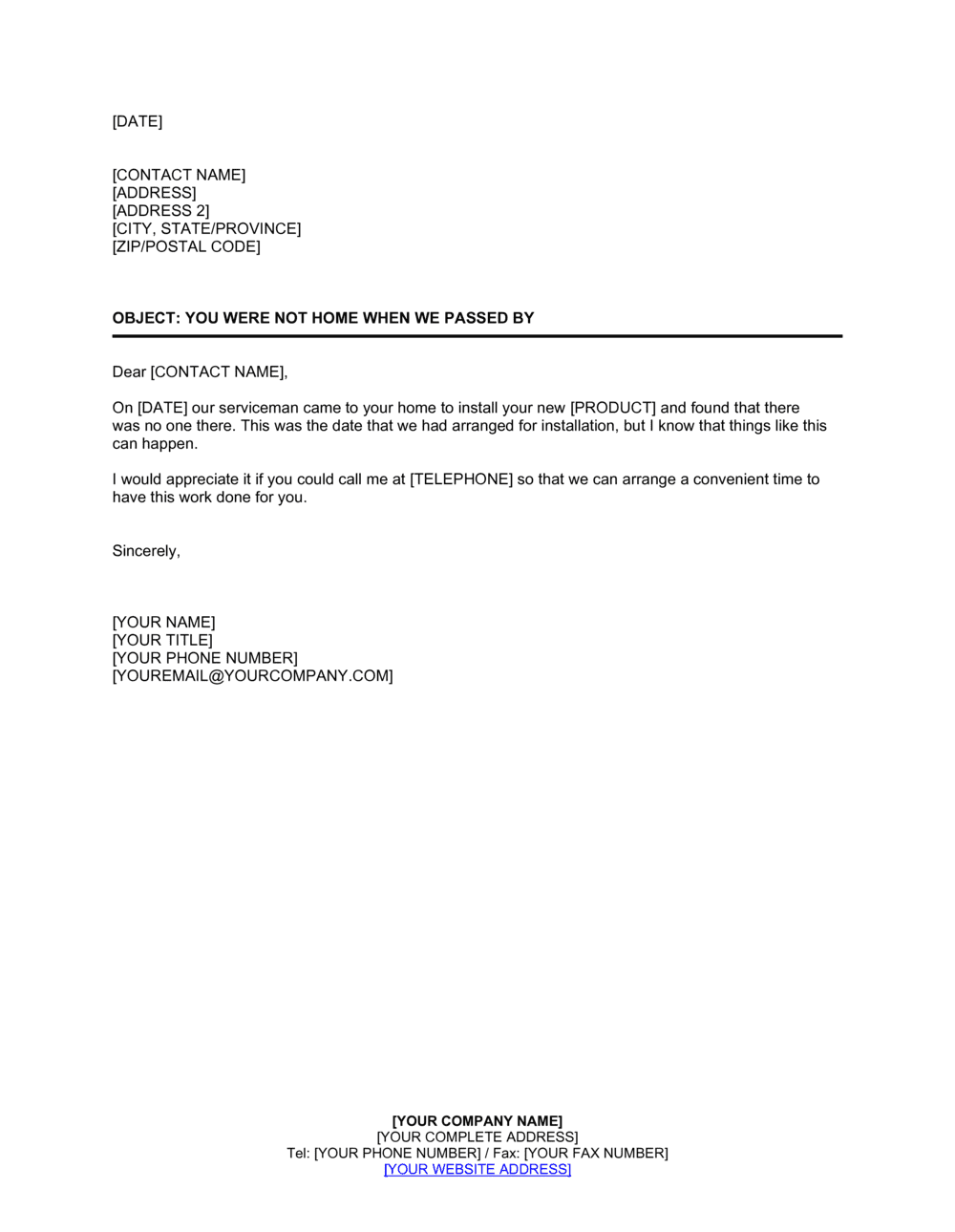
Letter to Customer Not Home for Service Appointment Template

Free Word download β€’ Edit online β€’ Save & share with Drive β€’ Export to PDF

1 pageβ€’15–20 min to fillβ€’Difficulty: Standard
Learn more ↓
FreeLetter to Customer Not Home for Service Appointment Template

At a glance

What it is
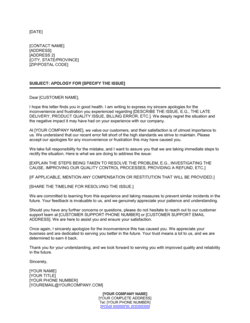
A Letter to Customer Not Home for Service Appointment is a short formal notice a service provider leaves or sends when a technician, contractor, or representative arrives at a customer's address and finds no one home to grant access. This free Word download gives you a ready-to-edit template you can personalize with your company branding and send β€” or leave on-site β€” in minutes.
When you need it
Use it immediately after a failed service visit to document the attempted call, inform the customer of the missed appointment, and invite them to reschedule before the job is delayed or a second trip charge is applied.
What's inside
Company and customer identifying information, date and time of the attempted visit, a clear statement that no one was available, contact details and instructions for rescheduling, and any next-steps or fee notice relevant to the missed appointment.

What is a Letter to Customer Not Home for Service Appointment?

A Letter to Customer Not Home for Service Appointment is a formal written notice a service provider sends or leaves when a technician arrives at a scheduled address and finds no one available to grant access. It documents the attempted visit with a date, time, and reference number; explains what happens next if the customer does not reschedule; and provides clear instructions for booking a new time. The letter serves three purposes simultaneously: it informs the customer, protects the service provider with a written record of the attempt, and keeps the job moving toward completion rather than stalling in an unresolved state.

Why You Need This Document

A missed service visit without a formal follow-up creates immediate problems on both sides. For the service provider, there is no paper trail to justify a no-show fee, no documented proof the visit occurred for billing or regulatory purposes, and no prompt to the customer to rebook β€” leaving a technician's time uncompensated and a job slot wasted. For the customer, a generic phone call or no communication at all leaves them unsure whether the appointment was skipped by the company or missed on their end. A clear, professionally formatted letter eliminates that ambiguity, sets an explicit rescheduling deadline, and demonstrates the kind of customer communication that builds retention. This template gives field teams and customer service departments a consistent, ready-to-send notice that takes five minutes to complete and prevents the confusion that leads to disputes, second trips, and lost revenue.

Which variant fits your situation?

If your situation is…Use this template
Customer repeatedly misses scheduled visitsWarning Letter to Customer for Repeated Missed Appointments
Service is time-sensitive and delay has cost implicationsService Delay Notice Letter
A missed appointment will trigger a no-show feeMissed Appointment Fee Notice
Access was denied by a third party rather than simply no answerAccess Denied Service Visit Letter
Following up after multiple failed contact attemptsFinal Notice to Schedule Service Appointment
Confirming a rescheduled date after the customer respondsService Appointment Confirmation Letter

Common mistakes to avoid

❌ Leading with consequences before the explanation

Why it matters: Opening with a fee notice before explaining the missed visit comes across as aggressive and damages the customer relationship before they have understood what happened.

Fix: State the reason for the letter clearly in the first sentence, then introduce any fee or rescheduling deadline in a later paragraph after the context is established.
❌ Omitting the work order or reference number

Why it matters: Without a reference number, the customer cannot match the letter to their appointment records and your scheduling team wastes time searching for the job when the customer calls.

Fix: Always include the work order number in a clearly labelled field early in the letter, and ask the customer to have it ready when they call to reschedule.

❌ Offering only one contact method for rescheduling

Why it matters: A customer who cannot reach the scheduling line during business hours has no alternative and may simply not reschedule, costing the company a second trip or lost revenue.

Fix: Provide at least two contact options β€” a phone number and either an email address or an online booking link β€” so the customer can respond at their convenience.

❌ Using a vague or impersonal closing

Why it matters: Signing off as 'The Service Team' with no direct contact removes accountability and reduces the likelihood that the customer will follow up promptly.

Fix: Include a named representative with a direct phone number or email in the signature block so the customer knows exactly who to ask for.

The 8 key clauses, explained

Sender and recipient header

In plain language: Identifies the service company and the customer by name and address, and records the date the letter was written or left.

Sample language
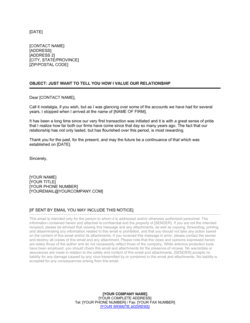
[COMPANY NAME] | [COMPANY ADDRESS] | [CITY, STATE, ZIP] | [DATE] Dear [CUSTOMER FULL NAME],

Common mistake: Using only a customer account number without the customer's name. A letter addressed to an account number feels automated and is less likely to prompt a prompt callback.

Purpose statement

In plain language: A single opening sentence that tells the customer immediately why they are receiving this letter β€” the technician visited and found no one home.

Sample language
We are writing to let you know that our technician visited your property at [PROPERTY ADDRESS] on [DATE] at approximately [TIME] for your scheduled [SERVICE TYPE] appointment and was unable to gain access.

Common mistake: Burying the core message in the second or third paragraph. Customers skim letters; lead with the reason for contact in the first sentence.

Appointment reference details

In plain language: States the original appointment date, time, and work order or reference number so the customer can verify the visit against their own records.

Sample language
Appointment Date: [DATE] | Scheduled Time: [TIME WINDOW] | Work Order #: [REFERENCE NUMBER] | Service Type: [DESCRIPTION OF SERVICE]

Common mistake: Omitting the work order or reference number. Without it, a customer who calls to reschedule cannot be matched to the correct job quickly, adding time to the call.

Statement of attempted contact

In plain language: Documents any on-site contact attempts β€” knocking, ringing the bell, calling a mobile number β€” to establish that a genuine effort was made.

Sample language
Our technician knocked and rang the doorbell at [TIME] and attempted to reach you by telephone at [PHONE NUMBER] but received no answer.

Common mistake: Skipping this clause entirely. Without a record of attempted contact, the customer may dispute whether the visit took place, especially if a no-show fee is later applied.

Impact or consequence notice

In plain language: Explains what happens next if the customer does not reschedule β€” delay to their service, a possible no-show fee, or rescheduling to the back of the queue.

Sample language
Please note that failure to reschedule within [X] business days may result in a missed appointment fee of $[AMOUNT] and/or rescheduling to the next available date, which may be [X] weeks away.

Common mistake: Being vague about consequences β€” writing 'there may be delays' instead of specifying the fee amount or the queue wait time. Vague warnings are ignored; specific ones prompt action.

Rescheduling instructions

In plain language: Tells the customer exactly how to book a new appointment β€” phone number, website, or email β€” and the hours during which the scheduling team is available.

Sample language
To reschedule your appointment, please contact us at [PHONE NUMBER] or visit [WEBSITE URL] between [HOURS] on [DAYS]. Please have your Work Order # [REFERENCE NUMBER] ready when you call.

Common mistake: Listing only one contact method. If the customer cannot reach the company by phone during business hours, they need an email or online option β€” otherwise the letter generates frustration rather than a booking.

Goodwill or customer care statement

In plain language: A brief sentence acknowledging that missing appointments is sometimes unavoidable, maintaining a professional and courteous tone.

Sample language
We understand that unexpected circumstances arise, and we are happy to work with you to find a convenient time for our return visit.

Common mistake: Omitting any acknowledgment of inconvenience and writing a purely transactional notice. Customers who feel the company is indifferent to their situation are less likely to reschedule promptly.

Closing and signature block

In plain language: A professional sign-off with the name, title, and contact details of the sender or customer service department.

Sample language
Sincerely, [REPRESENTATIVE NAME] [TITLE] [COMPANY NAME] [PHONE] | [EMAIL]

Common mistake: Closing with a generic 'The [Company Name] Team' and no direct contact name. A named contact increases response rates and gives the customer a person to ask for when they call.

How to fill it out

  1. 1

    Enter the company and customer details

    Add your company name, address, and contact details to the header. Enter the customer's full name and service address. Confirm spelling against your scheduling system.

    πŸ’‘ Pre-populate your company details in a master template file so each technician only needs to fill in the customer-specific fields before printing or leaving the notice.

  2. 2

    Record the appointment date, time, and reference number

    Enter the original scheduled date and time window, and add the work order or job reference number from your dispatch system. This links the letter to your billing and scheduling records.

    πŸ’‘ Use the same reference number that appears in your customer's original confirmation email β€” it makes it easy for your scheduling team to pull up the job when the customer calls.

  3. 3

    Document the on-site contact attempts

    Note the exact time the technician arrived, any knocking or doorbell attempts, and whether a phone call was made to the customer's registered number. Record the outcome of each attempt.

    πŸ’‘ Have technicians log the exact arrival time in the field β€” a letter that states '10:47 AM' is far more credible than 'approximately mid-morning.'

  4. 4

    Fill in the consequence notice

    Enter the rescheduling deadline in business days, the no-show fee amount if applicable, and the estimated wait time for the next available slot. These should match your standard service terms.

    πŸ’‘ Check your service agreement or terms and conditions before stating any fee amount β€” the letter and the contract must be consistent.

  5. 5

    Add rescheduling contact details

    Enter the phone number, email or website URL, and available hours for your scheduling team. Include the customer's work order number as a reference to have ready when calling.

    πŸ’‘ If your business uses an online booking portal, include the direct URL rather than just the homepage β€” fewer clicks means more completed reschedules.

  6. 6

    Sign off with a named contact

    Add the name and title of the customer service representative or dispatcher responsible for this account. Include a direct phone number or email where possible.

    πŸ’‘ A letter signed by a real person rather than a department name consistently generates faster responses β€” customers feel there is someone accountable on the other end.

Frequently asked questions

When should I send this letter?

Send or leave it on the same day as the missed service visit. Prompt communication minimises the gap before rescheduling and reduces the risk the customer forgets the original appointment entirely. If the letter is being mailed rather than left on-site, send it within one business day of the missed visit.

Should I leave the letter at the property or send it separately?

Both. Leave a printed copy at the property β€” under the door, in the mailbox, or on the doorstep β€” so the customer sees it immediately upon returning. Follow up with an emailed or mailed copy the same day to ensure the message is received even if the on-site copy is lost. For regulated industries, the mailed copy creates a paper trail.

Can I charge a no-show fee and reference it in this letter?

Yes, provided the fee is outlined in your original service agreement or terms and conditions and the customer was informed before the appointment date. State the exact fee amount and the deadline for rescheduling before it is applied. Do not introduce a fee in this letter that was not previously disclosed β€” courts and consumer protection regulators in most jurisdictions treat undisclosed fees as unenforceable.

What tone should the letter use?

Keep it professional, direct, and courteous. Avoid accusatory language β€” the customer may have had a genuine emergency. The goal is to prompt rescheduling, not to assign blame. A single sentence acknowledging that circumstances arise is sufficient; the rest of the letter should focus on the practical next steps.

How many times should I attempt to contact the customer before escalating?

Most service businesses make two to three contact attempts β€” the on-site visit, a follow-up phone call, and this letter β€” before applying a no-show fee or escalating to a final notice. Document each attempt with a date and time. If the customer does not respond after the letter and a follow-up call, a final written notice stating the service will be cancelled if no contact is made within a specific deadline is appropriate.

Does this letter need to be signed?

A handwritten signature is not required for the letter to be effective. A printed name and title in the signature block is sufficient for a standard service notice. For regulated utilities or government service providers, check whether your jurisdiction requires a specific format or signature for official customer communications.

Can I use this letter template for commercial or business customers?

Yes. Adjust the salutation from 'Dear [CUSTOMER NAME]' to 'Dear [CONTACT NAME] / [COMPANY NAME] Accounts' and reference the relevant site address and purchase order number in place of a residential address. The body and rescheduling instructions remain the same.

How this compares to alternatives

vs Appointment Confirmation Letter

An appointment confirmation letter is sent before the visit to confirm the date, time, and location with the customer. This letter is sent after a failed visit to document what happened and prompt rescheduling. The confirmation prevents the missed appointment; this letter responds to it.

vs Service Cancellation Letter

A service cancellation letter formally ends the service relationship or a specific work order. This letter keeps the relationship open and invites the customer to rebook. Use a cancellation letter only after repeated failed visits or non-response to this initial notice.

vs Warning Letter to Customer

A warning letter is a more formal escalation used after a customer has missed multiple appointments or failed to respond to earlier notices. This letter is a first-contact, courteous notice β€” the warning letter follows it if the customer does not reschedule.

vs Missed Appointment Fee Invoice

A fee invoice formally bills the customer for the no-show charge after the rescheduling deadline has passed. This letter comes first β€” it informs the customer and gives them the opportunity to reschedule before any fee is applied. The invoice is issued only if the customer does not respond within the stated window.

Industry-specific considerations

HVAC and home services

Technicians leave the letter on-site after a failed heating, cooling, or plumbing call, referencing the work order and the seasonal urgency of the repair.

Utilities and telecoms

Field teams use a printed or digitally generated version to document no-access visits for regulatory compliance and to trigger the rescheduling workflow in the dispatch system.

Property management

Property managers send the letter to tenants after a missed maintenance or inspection visit, noting lease obligations around providing access for scheduled works.

Healthcare and social care

Home care providers file the letter in the patient record as evidence of an attempted visit, which is often required for insurance billing and safeguarding compliance.

Template vs pro β€” what fits your needs?

PathBest forCostTime
Use the templateAny service business, property manager, or field team that needs a professional, consistent notice to leave after a missed appointmentFree5 minutes per letter
Template + professional reviewRegulated utilities, healthcare providers, or businesses that apply no-show fees and want to confirm the notice language aligns with their service agreement$50–$150 (brief legal or compliance check)1–2 hours
Custom draftedLarge enterprises with multi-brand field operations requiring custom workflows, legally reviewed fee clauses, and version-controlled templates per jurisdiction$300–$8002–5 days

Glossary

Service Appointment
A pre-arranged date and time when a technician or representative is scheduled to visit a customer's address to perform a specific task.
Attempted Visit
A documented record that a service provider arrived at the customer's location on the agreed date but was unable to gain access or make contact.
No-Access Situation
The condition where a service provider reaches a property and finds no one present or authorized to allow entry.
Rescheduling Window
The period of time offered to the customer within which they must contact the provider to book a new appointment before additional charges or service cancellation apply.
No-Show Fee
A charge levied on a customer when a service provider attends as scheduled but cannot proceed because no authorized person is available at the property.
Work Order
An internal reference document authorizing and tracking a specific service task, identified by a number that links the field visit to billing and scheduling systems.
Contact Window
The stated hours and method by which the customer should reach the service provider to reschedule, typically printed prominently in the letter.
Service Agreement
The underlying contract between a service provider and customer that governs terms including scheduling obligations, cancellation policy, and any applicable fees.

Part of your Business Operating System

This document is one of 3,000+ business & legal templates included in Business in a Box.

  • Fill-in-the-blanks β€” ready in minutes
  • 100% customizable Word document
  • Compatible with all office suites
  • Export to PDF and share electronically

Create your document in 3 simple steps.

From template to signed document β€” all inside one Business Operating System.
1
Download or open template

Access over 3,000+ business and legal templates for any business task, project or initiative.

2
Edit and fill in the blanks with AI

Customize your ready-made business document template and save it in the cloud.

3
Save, Share, Send, Sign

Share your files and folders with your team. Create a space of seamless collaboration.

Save time, save money, and create top-quality documents.

β˜…β˜…β˜…β˜…β˜…

"Fantastic value! I'm not sure how I'd do without it. It's worth its weight in gold and paid back for itself many times."

Managing Director Β· Mall Farm
Robert Whalley
Managing Director, Mall Farm Proprietary Limited
β˜…β˜…β˜…β˜…β˜…

"I have been using Business in a Box for years. It has been the most useful source of templates I have encountered. I recommend it to anyone."

Business Owner Β· 4+ years
Dr Michael John Freestone
Business Owner
β˜…β˜…β˜…β˜…β˜…

"It has been a life saver so many times I have lost count. Business in a Box has saved me so much time and as you know, time is money."

Owner Β· Upstate Web
David G. Moore Jr.
Owner, Upstate Web

Run your business with a system β€” not scattered tools

Stop downloading documents. Start operating with clarity. Business in a Box gives you the Business Operating System used by over 250,000 companies worldwide to structure, run, and grow their business.

Free Forever PlanΒ Β·Β No credit card required