60 Ways To Grow Your Business

Free to read β€’ Save or share with one click

Free60 Ways To Grow Your Business Template

At a glance

What it is
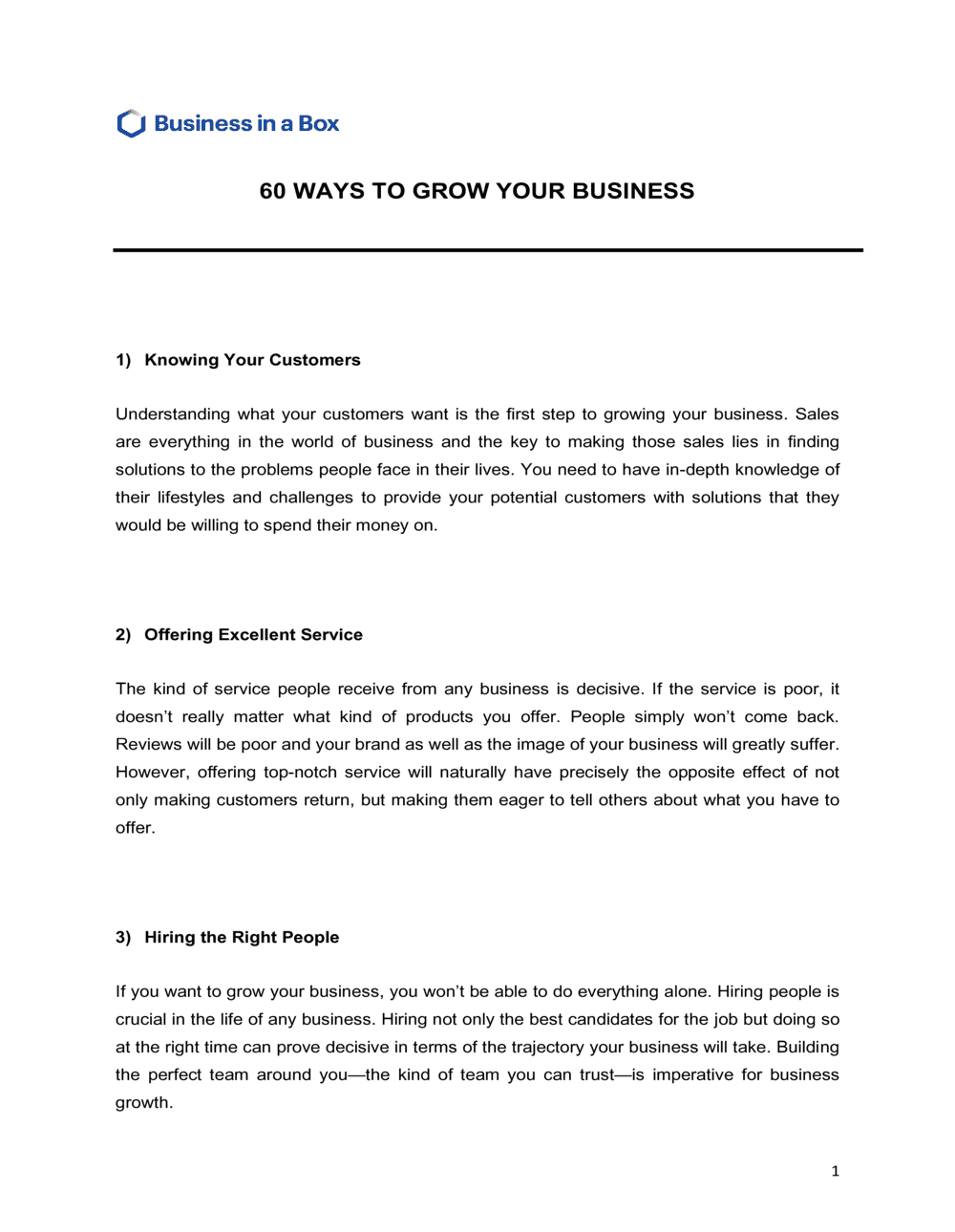
60 Ways To Grow Your Business is a structured reference guide and action framework that organizes 60 proven business growth tactics into logical categories β€” covering marketing, sales, customer retention, operations, product development, and strategic partnerships. This free Word download lets you review, prioritize, and assign the tactics most relevant to your stage and industry, then export as PDF to share with your leadership team.
When you need it
Use it when revenue has plateaued, when you are planning for a new fiscal year, or when you need to align a leadership team around a concrete set of growth priorities rather than an abstract goal like "grow faster."
What's inside
Categorized growth tactics spanning customer acquisition, pricing strategy, digital marketing, referral programs, operational efficiency, team development, and strategic expansion β€” each accompanied by a brief description and implementation prompt so you can move from idea to action without starting from scratch.

What is 60 Ways To Grow Your Business?

60 Ways To Grow Your Business is a structured action guide that organizes 60 proven growth tactics into logical categories β€” customer acquisition, retention, upselling, pricing, digital marketing, referrals, partnerships, operations, product expansion, and performance tracking. Unlike a business plan or a strategy document, it is built for execution: each tactic comes with a brief description, an implementation prompt, and fields for assigning an owner, setting a target outcome, and recording a deadline. The result is a prioritized growth sprint plan rather than a theoretical framework.

Why You Need This Document

Most businesses stall not because there are no growth options available, but because there is no structured process for identifying and acting on the right ones. Without a framework like this, leadership teams default to the same two or three tactics they already know β€” usually paid advertising and word of mouth β€” while dozens of higher-leverage opportunities go unexamined. The cost is invisible: you never see the referral program that would have generated 20% of new revenue, or the upsell sequence that would have increased average contract value by $800. This template forces a systematic audit of every growth lever across every business function, then narrows the full list to a focused shortlist of 8–12 tactics with named owners and measurable targets β€” turning an abstract goal of "grow the business" into a weekly execution checklist your team can actually be held accountable to.

Which variant fits your situation?

If your situation is…Use this template
Focusing exclusively on acquiring new customersMarketing Plan
Planning revenue and profit targets for the next 12 monthsAnnual Business Plan
Aligning the full leadership team on multi-year strategic directionStrategic Plan
Expanding into a new market or geographyBusiness Expansion Plan
Increasing revenue from existing customers specificallySales Plan
Running a structured annual business review before planning seasonBusiness Review Report
Identifying operational savings that free up capital for growthBusiness Process Improvement Plan

Common mistakes to avoid

❌ Selecting tactics before diagnosing the constraint

Why it matters: Pouring budget into acquisition tactics when the real problem is a 40% first-year churn rate accelerates losses, not growth.

Fix: Spend 30 minutes mapping your current funnel from awareness to retention before selecting a single tactic, then prioritize the section that addresses the biggest drop-off.

❌ Assigning tactics to a team rather than a named individual

Why it matters: Without a single named owner, accountability diffuses and the monthly review becomes a group discussion with no one responsible for the outcome.

Fix: Name one person per tactic in the owner field and confirm they have agreed to the responsibility before finalizing the plan.

❌ Activating more than 12 tactics simultaneously

Why it matters: Most teams can execute 6–10 growth initiatives well at any given time. More than 12 guarantees context-switching costs that reduce output on every tactic.

Fix: Prioritize ruthlessly to a shortlist of 8–10 tactics per quarter and resist adding new ones until a completed tactic frees up bandwidth.

❌ No measurable target attached to each tactic

Why it matters: A tactic without a target outcome cannot be evaluated β€” you cannot tell whether it worked, whether to invest more in it, or when it is complete.

Fix: Write the target in the format '[METRIC] from [CURRENT VALUE] to [TARGET VALUE] by [DATE]' for every tactic before the review cycle begins.

❌ Treating the document as a one-time exercise

Why it matters: A growth plan reviewed once at the start of the year and filed away has no accountability mechanism and delivers no results by Q4.

Fix: Schedule a recurring monthly growth review and assign a facilitator to run it. Tactics without a review cadence stall within 60 days.

❌ Skipping the resource estimation step

Why it matters: Selecting 15 high-priority tactics without confirming the team has the hours and budget to execute them creates a plan that looks complete on paper and fails in practice.

Fix: Add a rough hours-per-week estimate to each tactic and sum them β€” if the total exceeds available capacity, cut tactics until the plan is executable.

The 10 key sections, explained

Customer Acquisition Tactics

Customer Retention and Loyalty Strategies

Upsell and Cross-sell Opportunities

Pricing and Packaging Strategies

Digital Marketing and Online Presence

Referral and Word-of-Mouth Programs

Strategic Partnerships and Distribution

Team and Operational Growth Enablers

New Revenue Streams and Product Expansion

Performance Tracking and Growth Accountability

How to fill it out

  1. 1

    Audit your current growth constraints

    Before selecting tactics, identify your single biggest constraint β€” is growth limited by awareness, conversion, retention, or capacity? The constraint determines which sections of the template to prioritize.

    πŸ’‘ A business losing customers faster than it acquires them should go to the retention and churn sections first, not acquisition.

  2. 2

    Review each of the 60 tactics and mark relevance

    Read through all 60 tactics and mark each as high, medium, or low priority based on your current stage, resources, and identified constraint. Aim to shortlist 8–12 high-priority tactics.

    πŸ’‘ Resist the urge to mark everything high priority β€” a shortlist of 10 executed well outperforms 40 tactics executed inconsistently.

  3. 3

    Assign an owner to each selected tactic

    For every tactic you intend to activate, name a single accountable owner β€” a specific person, not a team or department β€” and record their name in the designated field.

    πŸ’‘ Owners should have the authority and resources to execute the tactic, not just coordinate it. If they need approval for every step, assign the tactic to the approver.

  4. 4

    Set a target outcome and deadline for each tactic

    Add a measurable outcome (e.g., 'increase referral-sourced leads from 5% to 15% of pipeline') and a specific target date for each activated tactic. Vague goals produce vague results.

    πŸ’‘ Deadlines within the next 90 days build momentum. Tactics with deadlines beyond 6 months rarely get prioritized.

  5. 5

    Estimate resource requirements

    For each selected tactic, note the estimated budget, hours required, and any tooling or hiring dependencies. This surfaces resource conflicts before they derail execution.

    πŸ’‘ If your top 10 tactics collectively require more hours than your team has available, cut to the top 6 β€” overcommitting is the leading cause of zero tactics completing.

  6. 6

    Build a monthly review cadence

    Set a recurring monthly growth review meeting β€” no more than 90 minutes β€” where each tactic owner reports status against the target outcome, flags blockers, and recommends acceleration or deprioritization.

    πŸ’‘ Track the ratio of tactics on schedule to those stalled. If more than 30% are stalled, the problem is capacity or clarity β€” both solvable at the system level.

  7. 7

    Replace completed tactics with new ones each quarter

    As tactics are completed or prove ineffective, replace them with new ones from the remaining list. Treat the 60 tactics as a pipeline, not a one-time checklist.

    πŸ’‘ Document what worked and what did not in a shared log β€” this institutional knowledge prevents the same ineffective tactics from being re-selected in future quarters.

Frequently asked questions

What is '60 Ways To Grow Your Business'?

It is a structured reference guide that organizes 60 proven business growth tactics into actionable categories β€” customer acquisition, retention, pricing, digital marketing, partnerships, and operations. It functions as both a strategic checklist and an execution framework, helping business owners and leaders identify which growth levers they are underusing and prioritize the ones most likely to move the needle given their current stage and constraints.

Who should use this template?

Small business owners who have reached a revenue plateau, startup founders looking to accelerate traction, marketing and sales directors building out their annual playbook, and business coaches facilitating growth workshops with clients all benefit from this template. It is equally useful for a solopreneur choosing their next 3 growth moves and a 50-person company aligning a leadership team around a quarterly growth sprint.

How many tactics should I try to implement at once?

Most teams can execute 6–10 growth tactics well in any given quarter. Attempting all 60 simultaneously is not a strategy β€” it is a guarantee of partial execution across every front. The most effective approach is to diagnose your biggest growth constraint, shortlist 8–12 high-priority tactics that address it, assign owners, and review progress monthly.

How is this different from a business plan or a marketing plan?

A business plan defines your overall strategy, financial projections, and capital requirements β€” it answers where you are going and why. A marketing plan focuses on customer acquisition channels and campaign strategy. This template is a tactically focused action guide that spans all growth functions β€” sales, marketing, product, operations, and partnerships β€” making it a complement to, not a replacement for, a business or marketing plan.

Do I need to complete all 60 tactics to get value from the document?

No. The value of the template comes from using it as a structured audit tool β€” reviewing all 60 tactics to identify which you have never tried, which you have tried poorly, and which are most likely to deliver results given your current situation. Most businesses will actively pursue 8–15 tactics at any one time, rotating through the full list over multiple quarters as priorities and constraints evolve.

How often should I revisit this template?

Review and update your active tactics list quarterly. At the start of each quarter, retire completed or ineffective tactics, promote new candidates from the full list of 60, assign owners, and set targets. A monthly progress review within each quarter keeps execution on track. The full document should be revisited annually as part of your business planning cycle.

What is the most important tactic category for a new business?

For businesses under $500K in annual revenue, customer acquisition and referral tactics typically deliver the highest return per hour invested. Retention optimization matters most once you have a base of 50 or more paying customers and can measure churn meaningfully. Pricing and operational efficiency tactics tend to have the highest leverage for businesses between $1M and $5M that have already proven product-market fit and are scaling.

Can I use this template in a team workshop or planning session?

Yes β€” the template is well-suited to a structured 2–3 hour growth workshop where team members independently score each tactic's relevance and feasibility, then compare scores to identify consensus priorities. This approach surfaces blind spots, builds buy-in for the selected tactics, and produces a prioritized shortlist with shared ownership in a single session.

What tools do I need to implement the tactics in this guide?

The guide itself requires only Word or a compatible editor. Implementation tools depend on the tactics selected β€” common requirements include email marketing software (for retention and referral tactics), CRM or sales tools (for acquisition and upsell tactics), and analytics platforms (for performance tracking). Each tactic description includes an implementation prompt that identifies any tooling dependency so you can assess readiness before committing.

How this compares to alternatives

vs Strategic Plan

A strategic plan defines the 3–5 year direction of the business β€” mission, vision, goals, and resource allocation. This template is a tactical action guide focused on specific, executable growth moves. A strategic plan answers where you are going; this template answers what you will do in the next 90 days to get there. Both serve different purposes and most businesses need both.

vs Marketing Plan

A marketing plan focuses specifically on customer acquisition and brand β€” channels, campaigns, budgets, and messaging. This template covers growth across every business function, including pricing, operations, partnerships, and team development. Use the marketing plan to go deep on acquisition channels and this template to ensure growth levers outside marketing are not overlooked.

vs Sales Plan

A sales plan focuses on revenue targets, sales team structure, pipeline management, and quota allocation. This template is broader, covering all growth functions β€” not just revenue from the sales team. For businesses where sales-team performance is the primary growth driver, the sales plan goes deeper; for businesses with multiple growth levers, this template provides the fuller picture.

vs Business Plan

A business plan is a comprehensive document covering market analysis, competitive positioning, financial projections, and capital requirements β€” written primarily for external audiences like investors and lenders. This template is an internal operational tool focused on activating specific growth tactics in the near term. They complement each other: the business plan sets the strategic context; this template drives week-by-week execution.

Industry-specific considerations

Professional Services

Referral programs, thought leadership content, and upsell-to-retainer tactics are the highest-leverage growth levers for consulting, legal, and accounting firms.

Retail and E-commerce

Pricing and bundling tactics, email list segmentation, abandoned-cart recovery, and loyalty program design are particularly high-impact in retail and e-commerce contexts.

SaaS and Technology

Free trial optimization, in-app upsell triggers, integration partnerships, and NPS-driven retention programs are the primary growth levers for SaaS businesses.

Food and Beverage

Local SEO, catering and wholesale channel development, loyalty card programs, and seasonal menu launches are the most actionable growth tactics for food and beverage operators.

Template vs pro β€” what fits your needs?

PathBest forCostTime
Use the templateSmall business owners and founders who want a structured framework for growth planning without hiring a consultantFree2–4 hours to prioritize and assign tactics; ongoing monthly reviews of 60–90 minutes
Template + professional reviewBusinesses that want a business coach or growth consultant to facilitate the prioritization session and stress-test the selected tactics$500–$2,000 for a facilitated growth workshop1–2 days including preparation and the workshop session
Custom draftedGrowth-stage companies that need a fully customized growth strategy with financial modeling, competitive analysis, and a 12-month execution roadmap$5,000–$20,000 for a full growth strategy engagement4–8 weeks

Glossary

Growth Lever
A specific, actionable input β€” such as a pricing change, referral program, or new channel β€” that predictably increases revenue or customer count when activated.
Customer Acquisition Cost (CAC)
Total sales and marketing spend divided by the number of new customers acquired in the same period.
Customer Lifetime Value (LTV)
The total gross profit a business expects to earn from a single customer over the full duration of the relationship.
Churn Rate
The percentage of customers who cancel or do not renew within a given period β€” the primary metric that determines whether growth compounds or leaks.
Upsell
Persuading an existing customer to purchase a higher-tier product or service than they currently use.
Cross-sell
Offering an existing customer a complementary product or service that adds value alongside their current purchase.
Net Promoter Score (NPS)
A measure of customer loyalty based on a single question β€” 'How likely are you to recommend us?' β€” scored on a 0–10 scale and aggregated into a net score.
Go-to-Market (GTM) Strategy
The specific channels, messaging, and sequencing a business uses to reach new customer segments and convert them.
Conversion Rate
The percentage of prospects or visitors who complete a desired action β€” signing up, purchasing, or booking β€” out of the total who entered the funnel.
Strategic Partnership
A formal arrangement with another business to share resources, customers, or distribution in ways that benefit both parties.
Referral Program
A structured incentive for existing customers or partners to introduce new customers, typically in exchange for a discount, credit, or cash reward.

Part of your Business Operating System

This document is one of 3,000+ business & legal templates included in Business in a Box.

  • Fill-in-the-blanks β€” ready in minutes
  • Compatible with all office suites
  • Export to PDF and share electronically

Create your document in 3 simple steps.

From template to signed document β€” all inside one Business Operating System.
1
Download or open template

Access over 3,000+ business and legal templates for any business task, project or initiative.

2
Edit and fill in the blanks with AI

Customize your ready-made business document template and save it in the cloud.

3
Save, Share, Send, Sign

Share your files and folders with your team. Create a space of seamless collaboration.

Save time, save money, and create top-quality documents.

β˜…β˜…β˜…β˜…β˜…

"Fantastic value! I'm not sure how I'd do without it. It's worth its weight in gold and paid back for itself many times."

Managing Director Β· Mall Farm
Robert Whalley
Managing Director, Mall Farm Proprietary Limited
β˜…β˜…β˜…β˜…β˜…

"I have been using Business in a Box for years. It has been the most useful source of templates I have encountered. I recommend it to anyone."

Business Owner Β· 4+ years
Dr Michael John Freestone
Business Owner
β˜…β˜…β˜…β˜…β˜…

"It has been a life saver so many times I have lost count. Business in a Box has saved me so much time and as you know, time is money."

Owner Β· Upstate Web
David G. Moore Jr.
Owner, Upstate Web

Run your business with a system β€” not scattered tools

Stop downloading documents. Start operating with clarity. Business in a Box gives you the Business Operating System used by over 250,000 companies worldwide to structure, run, and grow their business.

Start freeΒ Β·Β No credit card required