How To Find New Business Opportunities

Free to read β€’ Save or share with one click

FreeHow To Find New Business Opportunities Template

At a glance

What it is
A How To Find New Business Opportunities template is a structured Word document that guides you through scanning your market, evaluating potential growth ideas, and prioritizing the ones worth pursuing. This free download gives you a repeatable framework β€” covering market signals, customer feedback, competitive gaps, and resource fit β€” that you can edit online and export as PDF to share with your leadership team or board.
When you need it
Use it during annual strategy reviews, when revenue from existing lines plateaus, or when external market shifts signal an opening your competitors have not yet captured. It is equally useful when a leadership team needs a common framework for evaluating multiple competing growth ideas at once.
What's inside
An executive summary of opportunity context, a market and trend scan, a customer needs analysis, competitive gap mapping, an internal capability assessment, a prioritization matrix, an action plan with owners and timelines, and a risk and resource overview.

What is a How To Find New Business Opportunities document?

A How To Find New Business Opportunities document is a structured operational template that guides a business through the systematic process of scanning its market, identifying unmet customer needs, mapping competitive gaps, and evaluating which growth options are worth pursuing given its current resources and strategic direction. Rather than relying on brainstorming sessions or executive intuition alone, it applies a repeatable framework β€” from market trend scanning through a scored prioritization matrix β€” that produces a ranked shortlist of opportunities with a concrete action plan attached. It is available as a free Word download, editable online and exportable as PDF for sharing with leadership teams or boards.

Why You Need This Document

Without a structured process for finding and evaluating new opportunities, growth decisions default to whoever makes the loudest case in a meeting rather than the option that scores best against consistent criteria. The result is resources allocated to initiatives that felt exciting but were never validated against real customer evidence or competitive reality β€” and genuinely strong opportunities missed because they were not surfaced systematically. A well-completed opportunity analysis forces every candidate through the same filter: market evidence, competitive gap, internal capability fit, and a go/no-go gate that commits the team to stopping if the evidence does not support continuing. This template provides that filter in a format your team can complete in two to three weeks β€” before committing capital or headcount to a direction that has not been tested.

Which variant fits your situation?

If your situation is…Use this template
Evaluating a single specific opportunity in detailBusiness Opportunity Assessment
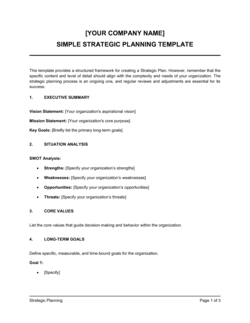
Launching a full strategic planning cycle for the year aheadStrategic Planning Template
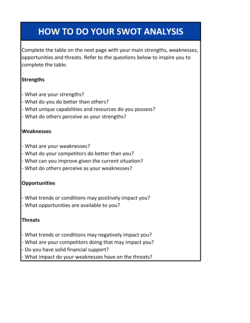
Analyzing internal strengths and external market gaps togetherSWOT Analysis
Building the business case once an opportunity is selectedBusiness Case Template
Mapping market size and competitive positioning for a new productMarket Analysis Template
Presenting findings to investors or a boardBusiness Plan Template
Planning a specific new product or service launchNew Product Launch Plan

Common mistakes to avoid

❌ Skipping customer validation entirely

Why it matters: Opportunities identified from internal assumptions alone fail at a significantly higher rate β€” the team builds something nobody wants to pay for at the price required.

Fix: Require at least three pieces of direct customer evidence (interviews, NPS data, or sales-call notes) before any opportunity advances past the longlist stage.

❌ Pursuing more than three opportunities simultaneously

Why it matters: Resources β€” particularly leadership attention β€” spread across too many initiatives means none reaches a validation milestone before budget runs out or momentum is lost.

Fix: Use the prioritization matrix to select the top two or three opportunities and formally park the rest for the next planning cycle.

❌ Treating the absence of direct competitors as market validation

Why it matters: If no competitor is serving a segment, the most common reason is that the segment is too small, too hard to reach, or unwilling to pay β€” not that you found a hidden gem.

Fix: Require both a competitive gap and direct customer evidence of willingness to pay before advancing an opportunity. An untapped market with no paying customers is not an opportunity yet.

❌ Assigning ownership to a team rather than a named individual

Why it matters: Shared ownership is no ownership. When everyone is responsible, the first obstacle produces a consensus to deprioritize rather than a decision to push through.

Fix: Every action in the plan must have a single named owner with explicit accountability β€” that person's name, not their department or team.

❌ Omitting a go/no-go decision gate for each opportunity

Why it matters: Without a predefined criterion for stopping, teams continue investing in failing opportunities long after the evidence says to stop β€” because stopping feels like failure.

Fix: Define a specific, measurable go/no-go criterion before the initiative begins β€” for example, 'three signed letters of intent by [DATE]' β€” and commit to applying it regardless of sunk cost.

❌ Completing the prioritization matrix with more than six criteria

Why it matters: Too many criteria compress scores toward the middle, making it impossible to distinguish between a strong opportunity and a weak one β€” the matrix produces no useful ranking.

Fix: Limit scoring criteria to four or five, weight the two most important ones at 1.5Γ— the others, and document the rationale for the weighting before scoring begins.

The 9 key sections, explained

Executive Summary

Market and Trend Scan

Customer Needs Analysis

Competitive Gap Analysis

Internal Capability Assessment

Opportunity Identification and Longlist

Prioritization Matrix

Action Plan for Top Opportunities

Risk and Resource Overview

How to fill it out

  1. 1

    Define the scope and time horizon

    Before completing any section, agree on the geographic scope, the business units in scope, and the planning horizon β€” typically 12 to 36 months. Write this into the document header so every reader interprets the analysis in the same context.

    πŸ’‘ A scope that is too broad (e.g., 'all markets globally') produces a longlist you cannot action. Limit to two to three markets or segments for the first cycle.

  2. 2

    Complete the market and trend scan

    Gather data from at least two external sources per trend β€” industry reports, trade publications, government statistics, or analyst briefings. For each trend, write a one-sentence 'so what' implication specific to your business.

    πŸ’‘ Set a 90-minute time limit for this section. More research time rarely improves decision quality β€” it delays it.

  3. 3

    Collect direct customer evidence

    Conduct at least three 30-minute customer interviews or analyze the last 60 days of support tickets, sales-call notes, and NPS verbatims. Summarize the top three unmet needs with supporting evidence.

    πŸ’‘ Ask customers what they wish they could do that they currently cannot β€” not whether they would buy a hypothetical product.

  4. 4

    Map the competitive gap

    List four to six competitors and plot their coverage against the customer needs identified in Step 3. Mark the gaps that no competitor addresses well and that align with your existing strengths.

    πŸ’‘ A simple table with competitors as columns and customer needs as rows β€” with 'strong', 'weak', or 'absent' in each cell β€” is faster to build and easier to read than a narrative.

  5. 5

    Audit your internal capabilities

    List the resources, skills, and relationships already in the business. For each candidate opportunity, score how much of what is needed you already have versus what must be acquired.

    πŸ’‘ Be specific: 'we have a sales team' is not a capability. 'We have 4 enterprise AEs with existing relationships at 50 target accounts in the healthcare sector' is.

  6. 6

    Build the longlist and apply the prioritization matrix

    Document every candidate opportunity surfaced by the previous steps, then score each one against your chosen criteria. Use the composite scores to produce a ranked shortlist of three to five opportunities.

    πŸ’‘ If two opportunities score within 10% of each other, use a tiebreaker: which one builds capabilities that make the next opportunity easier to pursue?

  7. 7

    Write the action plan for the top two or three opportunities

    For each shortlisted opportunity, assign a single named owner, set a 90-day milestone, specify the go/no-go decision criterion, and estimate the immediate budget required.

    πŸ’‘ Limit the action plan to two or three opportunities maximum. Pursuing more simultaneously typically means none gets the focus needed to reach the validation gate.

  8. 8

    Write the executive summary last

    Pull the three most important findings and the top-ranked opportunity into a one-page summary. State the recommended first action and the decision needed from leadership.

    πŸ’‘ If leadership reads only the executive summary, they should know exactly what to decide and by when β€” build it to that standard.

Frequently asked questions

What is a business opportunity analysis?

A business opportunity analysis is a structured document that identifies gaps in a market, evaluates whether a business has the capability to address them profitably, and ranks the most promising options for pursuit. It combines external market data β€” trends, competitive gaps, and customer needs β€” with an honest internal assessment of resources and strategic fit to produce a prioritized action plan.

How do you identify new business opportunities?

The most reliable sources of genuine opportunities are direct customer feedback (interviews, support data, NPS verbatims), competitive gaps where existing solutions are weak or absent, emerging macro trends creating new demand, and internal capabilities that could serve adjacent markets at low marginal cost. Relying on a single source β€” especially internal brainstorming alone β€” produces biased longlists. A structured template forces you to draw from all four sources before building a shortlist.

What is the difference between a business opportunity and a business idea?

A business idea is a hypothesis β€” an untested belief that a product or service could create value. A business opportunity is a validated gap: there is confirmed customer demand, the gap is not well-served by existing solutions, and the business has or can acquire the capability to address it at a profit. This template bridges the gap between the two by providing a systematic validation process.

How many opportunities should a company pursue at once?

Most small to mid-size businesses can actively pursue two to three new opportunities simultaneously without diluting focus. Each additional opportunity competes for the same limited pool of leadership attention, capital, and sales capacity. This template's prioritization matrix is designed to help teams make the difficult decision to park strong opportunities for a future cycle rather than pursue everything at once.

What criteria should I use to prioritize business opportunities?

The five most useful criteria for most businesses are: estimated revenue potential, strategic fit with existing capabilities and direction, speed to first revenue, total resource requirement (capital and headcount), and overall risk level. Weight the criteria according to your business context β€” a cash-constrained startup should weight speed to revenue and resource requirement more heavily than a well-funded growth-stage company.

When should I update a business opportunity analysis?

Review it at least annually as part of your strategic planning cycle. Trigger an unscheduled update when a major competitor exits or enters your market, when a key customer need shifts based on new feedback data, or when a previously parked opportunity becomes viable due to a change in resources or market conditions. A document that is more than 18 months old reflects a market that no longer exists.

What is the difference between a business opportunity analysis and a SWOT analysis?

A SWOT analysis is a broad diagnostic tool that maps strengths, weaknesses, opportunities, and threats at a high level β€” typically one to two pages. A business opportunity analysis is a deeper, action-oriented document that takes the 'opportunities' quadrant of a SWOT and builds it out fully: sizing each option, scoring it against consistent criteria, assigning ownership, and setting go/no-go gates. SWOT is a starting point; this template is the next step.

Can a small business use this template, or is it for large companies?

This template is designed for any business that needs a repeatable process for growth decisions β€” including sole proprietors, early-stage startups, and established small businesses. The sections scale to the level of rigor available: a solo founder might complete the customer needs section with five customer conversations rather than a formal survey, while a team of ten might run a structured workshop. The framework applies regardless of company size.

How long does it take to complete a business opportunity analysis?

A focused team can complete a thorough analysis in two to three weeks: roughly three to five days for data collection (market research and customer interviews), two to three days for the competitive and capability analysis, and one day to score the matrix, write the action plan, and draft the executive summary. Using a structured template reduces setup time by approximately 50% compared to building the document from scratch.

How this compares to alternatives

vs SWOT Analysis

A SWOT analysis is a one-to-two-page diagnostic that broadly maps a company's strengths, weaknesses, opportunities, and threats. A business opportunity analysis takes the 'opportunities' quadrant and builds it into a full decision framework β€” with market evidence, competitive gaps, scoring, and an action plan. Use the SWOT to orient the conversation; use this template to act on it.

vs Business Case Template

A business case makes the detailed financial and operational argument for a single, already-selected initiative β€” ROI, costs, risks, and a recommended course of action. A business opportunity analysis comes earlier in the process: it scans the landscape, identifies multiple candidates, and determines which one deserves a business case. Use this template first; write the business case after.

vs Strategic Planning Template

A strategic plan covers a company's full three-to-five-year direction β€” goals, initiatives, KPIs, and resource allocation across all functions. A business opportunity analysis is a focused input into that broader plan, answering specifically where new revenue will come from. The two documents work together: the opportunity analysis feeds the growth section of the strategic plan.

vs Market Analysis Template

A market analysis quantifies the size, structure, and dynamics of a specific market in depth β€” segments, growth rates, buyer behavior, and competitive landscape. A business opportunity analysis is broader and more action-oriented: it draws on market analysis data but also weighs internal capability fit and produces a prioritized list of specific opportunities to pursue. You may need both for a thorough opportunity evaluation.

Industry-specific considerations

Professional Services

Used to identify adjacent service lines, new vertical markets, or partnership channels where existing client relationships create a lower-cost entry point.

Retail / E-commerce

Applied to evaluate new product categories, geographic expansion, or channel additions (e.g., wholesale or marketplace) based on purchase data and customer segment analysis.

SaaS / Technology

Drives product-led growth decisions: new integrations, adjacent buyer personas, or underserved verticals identified through feature-request data and churn interviews.

Manufacturing

Evaluates new product lines, contract manufacturing opportunities, or supply-chain verticals where existing production capacity can be leveraged at marginal cost.

Template vs pro β€” what fits your needs?

PathBest forCostTime
Use the templateSmall business owners, founders, and internal strategy teams evaluating growth options without an outside consultantFree2–3 weeks (20–40 hours)
Template + professional reviewTeams making a significant capital allocation decision based on the findings β€” a second set of eyes on the market sizing and prioritization scoring$500–$2,000 for a strategy advisor or business development consultant review3–4 weeks
Custom draftedCompanies entering a new industry, considering M&A, or requiring primary market research to validate an opportunity before committing material resources$5,000–$25,000 for a full strategy consulting engagement4–12 weeks

Glossary

Business Opportunity
A confirmed gap between what the market currently offers and what a defined customer segment needs, which a business can address at a profit.
Market Signal
A data point β€” a shift in search volume, regulatory change, competitor exit, or customer complaint pattern β€” that hints at an emerging or unmet need.
Opportunity Prioritization Matrix
A scoring grid that ranks competing opportunities by criteria such as revenue potential, strategic fit, time to revenue, and resource requirements.
Adjacent Market
A market segment closely related to a company's existing business β€” sharing customers, distribution channels, or core competencies β€” that can be entered with lower risk than a completely new market.
Competitive Gap
A need or job-to-be-done that existing competitors address poorly or not at all, representing a potential opening for a new entrant or product.
Capability Assessment
An audit of the internal skills, technology, relationships, and capital a business currently has and what it would need to pursue a specific opportunity.
TAM / SAM / SOM
Total Addressable Market, Serviceable Addressable Market, and Serviceable Obtainable Market β€” three nested measures of how large an opportunity actually is for a specific business.
Validation
The process of testing whether a business opportunity is real β€” typically through customer interviews, pilots, landing-page tests, or letters of intent β€” before committing full resources.
Strategic Fit
The degree to which a new opportunity aligns with a company's existing mission, capabilities, customer relationships, and long-term direction.
Risk Register
A list of the specific threats that could prevent an opportunity from being realized, each rated by likelihood and impact, along with planned mitigations.

Part of your Business Operating System

This document is one of 3,000+ business & legal templates included in Business in a Box.

  • Fill-in-the-blanks β€” ready in minutes
  • Compatible with all office suites
  • Export to PDF and share electronically

Create your document in 3 simple steps.

From template to signed document β€” all inside one Business Operating System.
1
Download or open template

Access over 3,000+ business and legal templates for any business task, project or initiative.

2
Edit and fill in the blanks with AI

Customize your ready-made business document template and save it in the cloud.

3
Save, Share, Send, Sign

Share your files and folders with your team. Create a space of seamless collaboration.

Save time, save money, and create top-quality documents.

β˜…β˜…β˜…β˜…β˜…

"Fantastic value! I'm not sure how I'd do without it. It's worth its weight in gold and paid back for itself many times."

Managing Director Β· Mall Farm
Robert Whalley
Managing Director, Mall Farm Proprietary Limited
β˜…β˜…β˜…β˜…β˜…

"I have been using Business in a Box for years. It has been the most useful source of templates I have encountered. I recommend it to anyone."

Business Owner Β· 4+ years
Dr Michael John Freestone
Business Owner
β˜…β˜…β˜…β˜…β˜…

"It has been a life saver so many times I have lost count. Business in a Box has saved me so much time and as you know, time is money."

Owner Β· Upstate Web
David G. Moore Jr.
Owner, Upstate Web

Run your business with a system β€” not scattered tools

Stop downloading documents. Start operating with clarity. Business in a Box gives you the Business Operating System used by over 250,000 companies worldwide to structure, run, and grow their business.

Start freeΒ Β·Β No credit card required