How To Find Good Business Ideas_startup Blueprints_chapter 1 Worksheet

Free download β€’ Use as a template β€’ Print or share

3 pagesβ€’20–25 min to useβ€’Difficulty: Standard
Learn more ↓
FreeHow To Find Good Business Ideas_startup Blueprints_chapter 1 Worksheet Template

At a glance

What it is
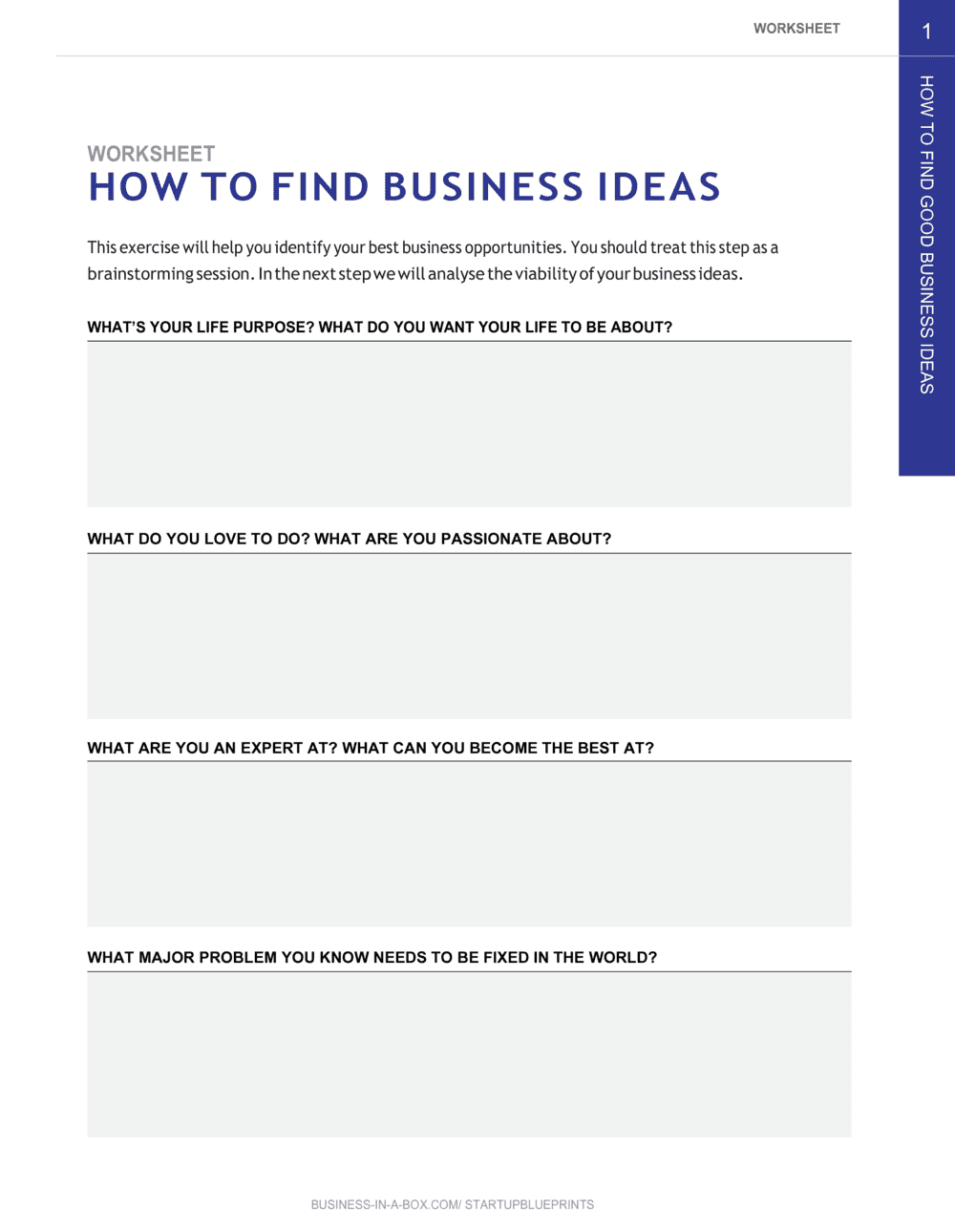
The How To Find Good Business Ideas Startup Blueprints Chapter 1 Worksheet is a structured guided workbook that walks aspiring founders through a proven framework for generating, filtering, and evaluating startup ideas before committing time or money. This free Word download is fully editable online and can be exported as PDF, giving you a reusable thinking tool for every new venture idea you want to explore.
When you need it
Use it when you know you want to start a business but have not yet identified a specific idea worth pursuing, or when you have several ideas and need an objective way to compare and prioritize them before investing further.
What's inside
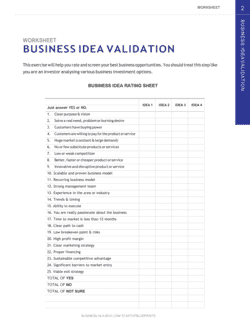
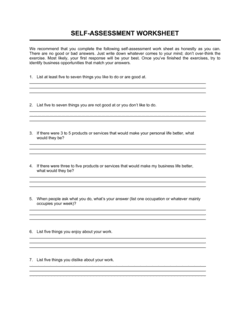
Problem identification prompts, personal skill and experience inventory, market pain-point mapping, idea generation exercises, a feasibility filter, an idea-scoring matrix, and a go/no-go decision framework β€” all structured as guided worksheets with worked examples and fill-in fields.

What is the How To Find Good Business Ideas Startup Blueprints Chapter 1 Worksheet?

The How To Find Good Business Ideas Startup Blueprints Chapter 1 Worksheet is a structured guided workbook that takes aspiring entrepreneurs through a repeatable, step-by-step framework for generating, evaluating, and selecting a business idea worth pursuing. Rather than leaving idea generation to chance or intuition, the worksheet sequences eight proven exercises β€” from a founder skills inventory through a weighted idea-scoring matrix and a formal go/no-go decision record β€” so that every idea you evaluate is measured against the same objective criteria. It is the foundational document in the Startup Blueprints series, designed to be completed before any business plan, pitch deck, or market research investment begins.

Why You Need This Document

Most first-time founders either start with the wrong idea or spend months building a business plan around an idea that a structured 4-hour exercise would have revealed as unviable. Without a systematic ideation process, you risk advancing an emotionally appealing concept that has a small addressable market, a blocker you didn't identify, or a competitive landscape that makes differentiation nearly impossible. The financial and time cost of that mistake β€” 6 to 18 months of effort and often $10,000 to $50,000 in early expenses β€” is entirely avoidable. This worksheet forces you to surface a long list of ideas, score them against consistent criteria, and validate the riskiest assumptions before committing any meaningful resources, giving you a documented, defensible rationale for the idea you ultimately choose to build.

Which variant fits your situation?

If your situation is…Use this template
You have an idea and need to test whether customers will pay for itMarket Research Report
You have validated an idea and need to map out a full launch planBusiness Plan
You want a one-page snapshot of your idea's viabilityOne-Page Business Plan
You need to present your idea to investors or acceleratorsPitch Deck / Elevator Pitch
You want to map your idea's competitive landscape before going furtherSWOT Analysis
You are ready to plan the actual product or service launchProduct Launch Plan
You need to size the market for your idea with research dataCompetitive Analysis

Common mistakes to avoid

❌ Skipping the self-assessment section

Why it matters: Founders who ignore their own skills and experience generate ideas that are technically or commercially beyond their current reach, increasing early failure rates significantly.

Fix: Complete every row of the skills and domain inventory before opening the idea generation exercises. The self-assessment constrains the search space productively.

❌ Validating ideas only with friends and family

Why it matters: People in your immediate network will affirm almost any idea to avoid conflict, producing false-positive signals that survive the worksheet and reach the business plan stage.

Fix: Source at least 70% of your validation conversations from people who do not know you personally β€” cold outreach on LinkedIn, community forums, or in-person events in the target industry.

❌ Treating the scoring matrix as a suggestion rather than a decision tool

Why it matters: Founders who complete the matrix but then override it based on gut feel tend to advance emotionally appealing ideas that scored poorly on market size or feasibility.

Fix: Commit to advancing only the highest-scoring idea unless you can articulate a specific, documented reason why the matrix misweighted a criterion for this particular opportunity.

❌ Writing validation experiments that require building a product first

Why it matters: Designing validation that depends on a working product delays feedback by months and spends capital before the core assumption is confirmed.

Fix: Use smoke-test landing pages, manual concierge delivery, or structured customer interviews to validate willingness to pay before writing a single line of code or producing a single unit.

❌ Stopping idea generation after the first exercise

Why it matters: Research on creative ideation consistently shows that the best ideas appear after the obvious ones are exhausted β€” typically in the second or third pass of generation.

Fix: Complete all three idea generation exercises in the worksheet before scoring. Require yourself to produce at least 20 candidate ideas before filtering begins.

❌ Using an unweighted scoring matrix

Why it matters: An equal-weight matrix treats passion for the idea as equally important as market size and feasibility, regularly surfacing ideas with small addressable markets or unresolved blockers.

Fix: Apply the recommended weighting scheme β€” or document your own explicit weights β€” before scoring. The weighting decision is strategic and should be made once, not adjusted per idea.

The 9 key sections, explained

Entrepreneurial self-assessment

Problem identification prompts

Idea generation exercises

Market pain-point mapping

Feasibility filter

Competitive landscape snapshot

Idea-scoring matrix

Validated learning plan

Go/no-go decision record

How to fill it out

  1. 1

    Complete the entrepreneurial self-assessment before generating any ideas

    Fill in every row of the skills inventory, professional experience log, and interest mapping exercise. Aim for at least 10 skills and 3 domains before moving on.

    πŸ’‘ Review your last three performance reviews or LinkedIn recommendations β€” the words other people use to describe your work surface skills you take for granted.

  2. 2

    Answer every problem identification prompt in writing

    Work through each guided question in sequence, writing full sentences rather than single words. The act of writing forces specificity and surfaces problems that vague mental brainstorming misses.

    πŸ’‘ Set a 15-minute timer per prompt. Quantity matters more than quality at this stage β€” you need a long list to filter down.

  3. 3

    Run all three idea generation exercises, not just one

    Complete the trend-scanning, job-to-be-done reframing, and underserved-segment exercises in order. Each technique surfaces different types of opportunities and they compound when done together.

    πŸ’‘ Do not filter while generating. Write every idea, including the ones that seem impractical β€” constraints on execution often disappear when you revisit them with more information.

  4. 4

    Map pain intensity for your top five ideas using external input

    For each of your five strongest candidate ideas, fill in the market pain-point mapping table with data from at least three conversations with people who are not in your immediate network.

    πŸ’‘ Ask open-ended questions: 'How do you currently handle X?' and 'What does it cost you when X goes wrong?' Avoid leading with your solution.

  5. 5

    Apply the feasibility filter to eliminate ideas with hard blockers

    Work through the yes/no checklist for each surviving idea. Mark any 'no' answer as a blocker and set that idea aside unless the blocker can be resolved with a specific, time-bound action.

    πŸ’‘ Capital requirement is the most commonly underestimated blocker. Be honest about what you can realistically deploy in the first 12 months.

  6. 6

    Score the remaining ideas using the weighted matrix

    Enter each surviving idea into the scoring matrix and assign scores for all criteria. Use the suggested weights (market size 25%, founder fit 25%, feasibility 20%, competition 15%, passion 15%) unless you have a strong reason to adjust them.

    πŸ’‘ If two ideas score within 3 points of each other, use the validated learning plan in the next step to run a quick experiment before deciding between them.

  7. 7

    Define and schedule your three validation experiments

    For the top-scored idea, write down the three riskiest assumptions and design the simplest possible test for each one. Assign a specific completion date no more than 30 days out.

    πŸ’‘ The riskiest assumption is usually the one you are most tempted to skip testing β€” that is the one to tackle first.

  8. 8

    Record your go/no-go decision and capture the reasoning

    Complete the decision record with the idea name, total score, the top remaining assumptions, and a one-sentence rationale. File the completed worksheet before starting Chapter 2.

    πŸ’‘ Save rejected ideas in a separate log. Many successful businesses were initially dismissed for a reason that ceased to be true 12–18 months later.

Frequently asked questions

What is the Startup Blueprints Chapter 1 Worksheet?

The Startup Blueprints Chapter 1 Worksheet is a guided ideation and evaluation tool that walks aspiring founders through a structured process for generating, filtering, and scoring business ideas before committing resources. It covers problem identification, founder-market fit assessment, feasibility screening, competitive landscape review, and a weighted idea-scoring matrix β€” producing a documented go/no-go decision as its output.

Who should use this worksheet?

Anyone who wants to start a business but has not yet identified a specific idea worth pursuing will find this worksheet useful. It is also valuable for founders with multiple ideas who need an objective framework for choosing between them. Business coaches, accelerator program facilitators, and entrepreneurship instructors use it as a structured teaching tool for early-stage ideation.

How long does it take to complete this worksheet?

Most first-time founders complete the full worksheet in 4–8 hours spread over 3–5 sessions. The self-assessment and idea generation sections typically take 1–2 hours each. The validation experiments in Section 8 take 1–3 weeks to execute, depending on how quickly you can schedule customer conversations. Do not rush the validation step β€” it is the highest-value part of the process.

Do I need a business idea before starting this worksheet?

No. The worksheet is specifically designed to help you generate ideas from scratch using your skills, experience, and observed problems as raw material. If you already have one or more ideas, you can use the feasibility filter and scoring matrix sections to evaluate and compare them without working through the earlier generation exercises.

What makes a business idea 'good' according to this framework?

The framework scores ideas on five criteria: market size (enough people with the problem to support a business), founder-market fit (skills and experience that give you an edge), feasibility (buildable with available resources), competition intensity (a differentiated position that is not immediately replicated), and passion (sufficient personal motivation to persist through early setbacks). An idea that scores well across all five is worth advancing to the business plan stage.

How is this worksheet different from a business plan?

This worksheet operates at the idea stage β€” before you know if the idea is worth pursuing. Its job is to surface and evaluate options quickly and cheaply. A business plan is written after an idea has been validated and you have decided to build it. The worksheet is the input to the business plan, not a substitute for it.

Can I use this worksheet to evaluate an existing business idea I already have?

Yes. Skip Sections 2 and 3 (problem identification prompts and idea generation exercises) and start at Section 4 (market pain-point mapping). Enter your existing idea in the scoring matrix alongside one or two alternatives to confirm it is the strongest option available to you, rather than simply the first one you thought of.

What should I do after completing this worksheet?

If your go/no-go decision is to advance, move to Chapter 2 of the Startup Blueprints series and begin your business plan. Start with the market analysis section, since the pain-point mapping and competitive snapshot from this worksheet feed directly into it. If your decision is to return to ideation, revisit Sections 2 and 3 with the constraints surfaced by the feasibility filter as new inputs.

How many ideas should I generate before scoring?

Aim for at least 20 candidate ideas before applying any filter. Research on creative problem-solving consistently shows that the best ideas emerge after the obvious ones are exhausted β€” typically past the first 10. The feasibility filter and scoring matrix are designed to handle a large initial list and quickly narrow it to the two or three strongest candidates for deeper evaluation.

How this compares to alternatives

vs Business Plan Template

A business plan is written after you have chosen and validated a specific idea. This worksheet is the step before β€” it generates and scores options to determine which idea is worth a full business plan. Using a business plan template before completing an ideation worksheet often means investing 40+ hours planning an idea that a 4-hour scoring exercise would have revealed as weak.

vs SWOT Analysis

A SWOT analysis evaluates a single, pre-selected idea or business by mapping its internal strengths and weaknesses against external opportunities and threats. This worksheet generates and compares multiple candidate ideas before any single one is selected. Use this worksheet first, then a SWOT to stress-test the winning idea.

vs Market Research Report

A market research report rigorously sizes and segments a market you have already decided to enter. This worksheet includes a lighter-weight market pain-point mapping exercise specifically to screen ideas before committing to deep research. Complete this worksheet to identify the idea worth researching, then commission a full market research report.

vs One-Page Business Plan

A one-page business plan summarizes a chosen idea's model, value proposition, and financial overview for quick communication. This worksheet does not assume an idea has been chosen β€” it is a decision tool, not a communication tool. The one-page plan is an output you can produce after this worksheet identifies and validates the idea worth pursuing.

Industry-specific considerations

Technology / SaaS

Idea generation exercises emphasize underserved workflow pain points in software, and the feasibility filter includes a technical build-time estimate and no-code MVP viability check.

Retail / E-commerce

Market pain-point mapping focuses on product discovery gaps, fulfillment frustrations, and underserved consumer niches identified through review-mining on Amazon or Etsy.

Professional Services

Founder-market fit assessment draws heavily on prior professional credentials and network, where niche expertise in law, accounting, or consulting translates directly into a defensible client base.

Food & Beverage

Feasibility filter includes regulatory and permitting questions specific to food handling, and the competitive snapshot maps local versus direct-to-consumer channel dynamics.

Template vs pro β€” what fits your needs?

PathBest forCostTime
Use the templateFirst-time founders, students, and self-directed entrepreneurs working through ideation independentlyFree4–8 hours over 3–5 sessions, plus 1–3 weeks for validation experiments
Template + professional reviewFounders preparing to apply to an accelerator or pitch a seed investor who want an experienced mentor to pressure-test their scoring and assumptions$150–$500 for a 2-hour session with a startup advisor or business coach1–2 additional days
Custom draftedCorporate innovation teams running structured ideation sprints for multiple concepts simultaneously, requiring a facilitated workshop format$1,500–$5,000 for a facilitated innovation workshop1–3 days

Glossary

Problem-Solution Fit
The degree to which a proposed product or service directly addresses a real, recurring pain point that a specific group of people actively wants solved.
Unfair Advantage
A skill, asset, network, or insight the founder possesses that competitors cannot easily replicate β€” often the strongest predictor of early traction.
Idea Scoring Matrix
A weighted table that rates candidate ideas against criteria such as market size, founder fit, feasibility, and competition level to produce a comparable score.
Market Pain Point
A specific frustration, inefficiency, or unmet need experienced by a defined group of people that is frequent enough and severe enough to motivate a purchase.
Feasibility Filter
A set of yes/no or scaled questions used to quickly eliminate ideas that are technically impossible, legally prohibited, or financially out of reach given current resources.
Founder-Market Fit
The alignment between a founder's background, skills, and genuine interest and the specific market they are targeting β€” a key factor investors assess at the idea stage.
Idea Generation
Structured exercises used to surface candidate business ideas from personal experience, observed problems, industry trends, or underserved customer segments.
Go/No-Go Decision
A formal binary conclusion β€” supported by scored criteria β€” that determines whether an idea advances to the next stage of development or is set aside.
Adjacent Market
A market close to your current idea in terms of customer, problem, or technology that could represent an alternative or expanded opportunity worth evaluating.
Validated Learning
Evidence gathered directly from potential customers β€” through interviews, surveys, or pre-sales β€” that confirms or disproves a key assumption about your idea.

Part of your Business Operating System

This document is one of 3,000+ business & legal templates included in Business in a Box.

  • Fill-in-the-blanks β€” ready in minutes
  • 100% customizable Word document
  • Compatible with all office suites
  • Export to PDF and share electronically

Create your document in 3 simple steps.

From template to signed document β€” all inside one Business Operating System.
1
Download or open template

Access over 3,000+ business and legal templates for any business task, project or initiative.

2
Edit and fill in the blanks with AI

Customize your ready-made business document template and save it in the cloud.

3
Save, Share, Send, Sign

Share your files and folders with your team. Create a space of seamless collaboration.

Save time, save money, and create top-quality documents.

β˜…β˜…β˜…β˜…β˜…

"Fantastic value! I'm not sure how I'd do without it. It's worth its weight in gold and paid back for itself many times."

Managing Director Β· Mall Farm
Robert Whalley
Managing Director, Mall Farm Proprietary Limited
β˜…β˜…β˜…β˜…β˜…

"I have been using Business in a Box for years. It has been the most useful source of templates I have encountered. I recommend it to anyone."

Business Owner Β· 4+ years
Dr Michael John Freestone
Business Owner
β˜…β˜…β˜…β˜…β˜…

"It has been a life saver so many times I have lost count. Business in a Box has saved me so much time and as you know, time is money."

Owner Β· Upstate Web
David G. Moore Jr.
Owner, Upstate Web

Run your business with a system β€” not scattered tools

Stop downloading documents. Start operating with clarity. Business in a Box gives you the Business Operating System used by over 250,000 companies worldwide to structure, run, and grow their business.

Free Forever PlanΒ Β·Β No credit card required