How to do Inventory Reconciliation

Free download β€’ Use as a template β€’ Print or share

2 pagesβ€’20–25 min to useβ€’Difficulty: Standard
Learn more ↓
FreeHow to do Inventory Reconciliation Template

At a glance

What it is
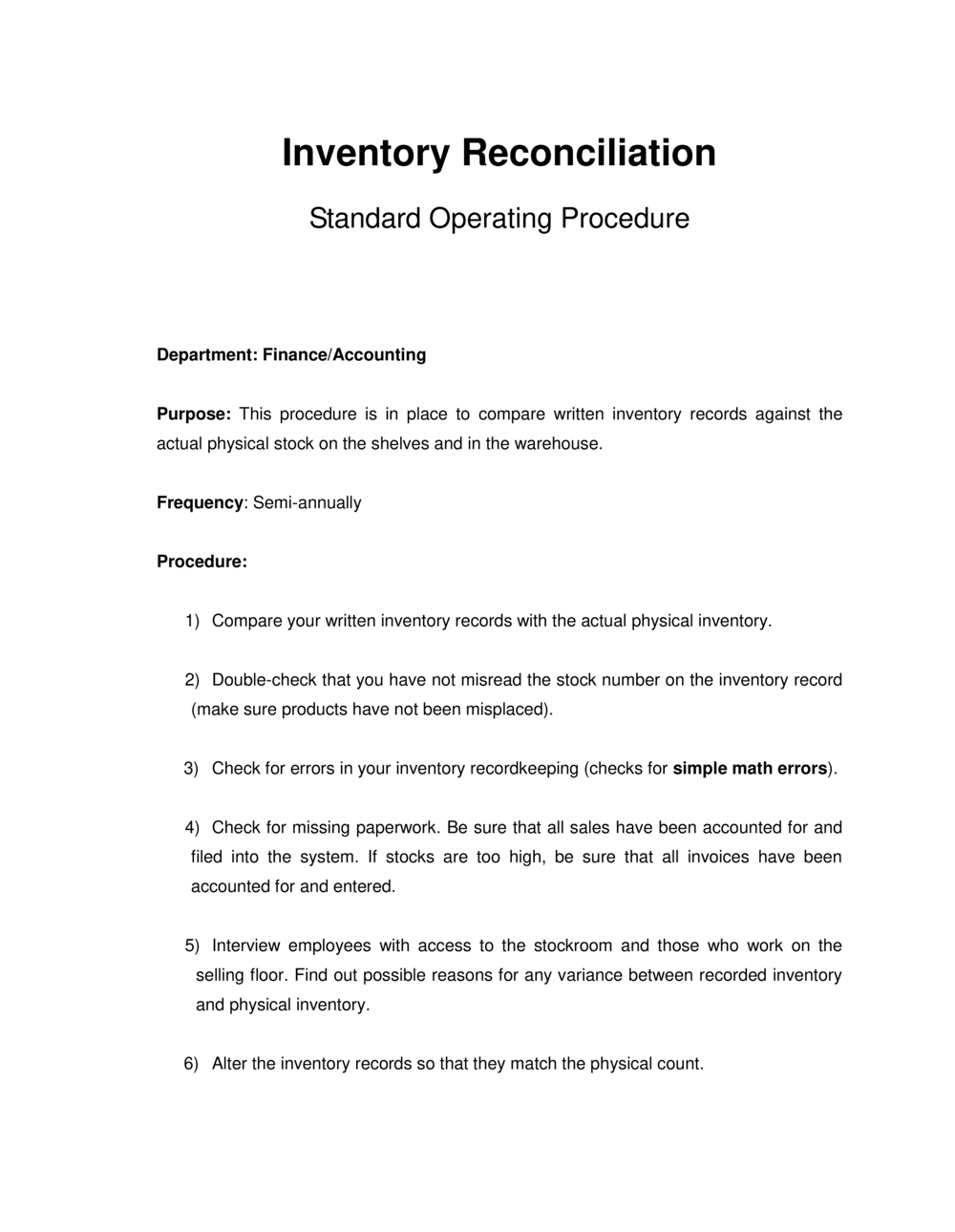
An Inventory Reconciliation document is a structured operational guide and worksheet that walks a business through comparing its book inventory records against an actual physical count, identifying every discrepancy, and documenting the corrective adjustments needed to bring both records into agreement. This free Word download gives you a step-by-step procedure, a variance tracking table, and a discrepancy resolution log you can edit online and export as PDF for your operations or accounting team.
When you need it
Use it at the end of a fiscal period, after a physical stocktake, following a suspected theft or data-entry error, or whenever your accounting system's on-hand quantities diverge from what is physically on the shelf.
What's inside
A reconciliation scope statement, preparation checklist, physical count recording table, variance calculation worksheet, root-cause analysis section, corrective adjustment log, and a sign-off summary for management review.

What is an Inventory Reconciliation?

An Inventory Reconciliation is a structured operational procedure that compares the quantities and values recorded in a business's inventory system or accounting ledger against an actual physical count of items on hand, then documents and resolves every discrepancy found. It produces a variance report, a root-cause analysis, and a corrective adjustment log that together form the audit trail required to close a period with accurate inventory balances. Rather than simply noting what was counted, a reconciliation explains why the numbers differ and records the approved corrections needed to bring system records into agreement with physical reality.

Why You Need This Document

Skipping a formal inventory reconciliation leaves your financial statements exposed to silent errors that compound period over period. Undetected receiving mistakes inflate asset values on the balance sheet; unrecorded shrinkage understates cost of goods sold; and unexplained count variances trigger expanded scope during financial audits β€” sometimes requiring a full recount at your expense. Without a documented procedure, adjustments are made inconsistently, without approval trails, and with no investigation of the underlying cause β€” meaning the same discrepancy recurs every quarter. This template gives operations teams and accountants a repeatable, auditor-ready process that catches errors close to when they occur, protects inventory asset accuracy, and produces the signed workpapers that external auditors and lenders expect to see as evidence of sound internal controls.

Which variant fits your situation?

If your situation is…Use this template
Counting all SKUs at once at fiscal year-endFull Physical Inventory Reconciliation
Counting a rotating subset of SKUs on a rolling scheduleCycle Count Reconciliation Worksheet
Reconciling raw materials against production consumption recordsManufacturing Inventory Reconciliation
Reconciling goods received against purchase orders and invoicesReceiving Discrepancy Report
Tracking stock losses due to theft, damage, or expiryInventory Shrinkage Report
Reconciling inventory held at a third-party logistics provider3PL Inventory Reconciliation Report
Performing a quick spot-check on high-value or fast-moving itemsSpot Check Inventory Count Sheet

Common mistakes to avoid

❌ Not freezing inventory transactions before counting

Why it matters: Receiving or shipping items while the count is in progress creates variances that cannot be attributed to real discrepancies versus timing differences, wasting hours of investigation time.

Fix: Set a documented freeze timestamp in your inventory system before the first counter begins, and communicate it to all departments that touch inventory.

❌ Showing counters the book quantity before they record the physical count

Why it matters: Counters unconsciously anchor to the expected number, so the count confirms the book instead of challenging it β€” defeating the entire purpose of reconciliation.

Fix: Print count sheets with SKU descriptions and bin locations only. Add book quantities in a separate column only after all physical counts are recorded and locked.

❌ Reporting unit variances without converting to dollar values

Why it matters: A 50-unit variance on a low-cost consumable is immaterial; the same variance on a high-value component may represent thousands of dollars of exposure. Without dollar values, management cannot prioritize investigation effort.

Fix: Add a unit-cost column to the variance table and calculate dollar variance for every SKU. Set a dollar materiality threshold to triage investigation priorities.

❌ Making system adjustments without documented management approval

Why it matters: Unapproved adjustments can mask theft, suppress shrinkage metrics, or manipulate period-end financial statements β€” and will be flagged immediately during an audit.

Fix: Define an approval hierarchy in the procedure header (e.g., adjustments over $250 require supervisor approval; over $1,000 require controller approval) and enforce it for every entry.

❌ Assigning a cause code to every variance without supporting evidence

Why it matters: Labeling unexplained losses as 'data entry error' or 'shipping variance' without documentation hides the true source of shrinkage and prevents corrective action.

Fix: Require at least one supporting document β€” a receiving log, pick ticket, or camera reference β€” for each material variance before a cause code is accepted.

❌ Performing reconciliation only at year-end

Why it matters: Annual-only reconciliation allows discrepancies to accumulate for 12 months, making root-cause investigation nearly impossible and producing a single large adjustment that distorts the annual financial statements.

Fix: Implement quarterly or monthly cycle counts for high-velocity or high-value SKUs so variances are caught and corrected close to the time they occurred.

The 9 key sections, explained

Reconciliation scope and period

Pre-count preparation checklist

Physical count recording table

Book inventory extract

Variance calculation worksheet

Root cause analysis log

Corrective adjustment log

Summary reconciliation statement

Sign-off and approval block

How to fill it out

  1. 1

    Define the scope, period, and responsible team

    Enter the warehouse or location name, the SKU range or product categories being counted, the fiscal period end date, and the names of the people performing and supervising the count.

    πŸ’‘ For large warehouses, assign specific aisles or bin ranges to individual counters to prevent double-counting and missed areas.

  2. 2

    Complete the pre-count checklist before counting begins

    Confirm that all received goods are put away, all outbound shipments are processed, and all inventory transactions are frozen in the system at a documented timestamp. Print count sheets sorted by bin location, not by SKU.

    πŸ’‘ Communicate the transaction freeze time to all departments β€” especially receiving and shipping β€” at least 24 hours in advance to avoid disruptions.

  3. 3

    Conduct the physical count without reference to book quantities

    Have counters record actual quantities on the count sheet before they have access to system figures. For high-value or high-variance SKUs, perform a blind second count by a different person.

    πŸ’‘ Use a barcode scanner or mobile counting app where available β€” scan errors are easier to trace than handwritten transposition mistakes.

  4. 4

    Extract the book inventory snapshot at the freeze timestamp

    Pull the on-hand quantity report from your inventory management or accounting system as of the exact freeze date and time. Export to the book inventory section of the template.

    πŸ’‘ Save a timestamped screenshot or system-generated report as audit evidence alongside the completed template.

  5. 5

    Calculate unit and dollar variances for every SKU

    Subtract book quantity from physical count to get unit variance. Multiply by unit cost to get dollar variance. Flag every line where the dollar variance exceeds your materiality threshold (e.g., $100 or 2% of SKU value).

    πŸ’‘ Sort the variance table by dollar variance descending β€” the top 10–20 SKUs typically account for 80% of total discrepancy value and deserve the most investigation time.

  6. 6

    Investigate and document the root cause of each material variance

    For each flagged SKU, review receiving documents, picking records, and system transaction history to identify the most probable cause. Record your finding and supporting evidence in the root cause log.

    πŸ’‘ Check whether variances cluster by vendor, shift, or bin zone β€” a pattern points to a process failure, not random error.

  7. 7

    Post corrective adjustments with management approval

    Enter each adjustment in the system with the approved quantity and value. Record the corresponding journal entry or WMS transaction reference in the corrective adjustment log.

    πŸ’‘ Set an approval threshold β€” for example, variances above $500 require controller sign-off β€” and document that policy in the procedure header.

  8. 8

    Complete the summary statement and obtain sign-off

    Compile total book value, total physical value, net variance in dollars and percentage, and the count of material SKUs. Have the operations manager and controller review and sign the document before closing the period.

    πŸ’‘ File the completed reconciliation with the supporting count sheets and system reports as a package β€” auditors will request all three together.

Frequently asked questions

What is inventory reconciliation?

Inventory reconciliation is the process of comparing the quantities and values recorded in a business's inventory management or accounting system against an actual physical count of items on hand. The goal is to identify every discrepancy, investigate its cause, and post corrective adjustments so that book records accurately reflect the physical reality. It is a required step in most period-end close processes and supports accurate financial reporting.

How often should inventory reconciliation be performed?

At minimum, businesses should reconcile at fiscal year-end. Best practice for most product-based businesses is monthly or quarterly full or cycle-count reconciliation. High-velocity e-commerce and retail operations often reconcile weekly for their top-selling SKUs. The more frequently you reconcile, the smaller and more traceable the variances β€” annual-only reconciliation routinely produces unexplainable losses that have accumulated over the full year.

What is the difference between a cycle count and a full physical inventory?

A full physical inventory counts every SKU in every location at one point in time, typically requiring a production or sales freeze. A cycle count counts a rotating subset of SKUs on an ongoing schedule β€” for example, counting 10% of items each week so every SKU is counted at least once per quarter. Cycle counts cause less operational disruption and catch errors faster, but require a disciplined scheduling system to ensure full coverage over time.

What causes inventory discrepancies?

The most common causes are receiving errors (wrong quantity booked in), picking errors (wrong quantity shipped out), data entry mistakes, theft or internal shrinkage, damage or expiry not recorded in the system, and timing differences from transactions processed after the count freeze. Systematic variances β€” the same SKU short every period β€” almost always point to a process failure rather than random error.

What is a material inventory variance?

A material variance is one large enough to affect a business decision or financial statement. The threshold varies by company size and industry β€” a $500 variance may be immaterial for a large manufacturer but significant for a small retailer. Most businesses set a dollar threshold (e.g., any variance over $200) or a percentage threshold (e.g., more than 2% of SKU value) to determine which discrepancies require formal root-cause investigation.

How are inventory adjustments recorded in accounting?

Inventory write-downs reduce the asset balance on the balance sheet and are typically charged to cost of goods sold or a shrinkage expense account on the income statement. Positive adjustments (physical exceeds book) increase the inventory asset balance. Both require a journal entry with an approval reference and a reconciliation document as supporting evidence. The specific accounts used depend on the company's chart of accounts and costing method (FIFO, LIFO, or weighted average).

Do I need special software to do inventory reconciliation?

No. A structured Word or Excel template is sufficient for most small and mid-size businesses. Dedicated inventory management systems (Fishbowl, DEAR, NetSuite, Cin7) automate parts of the process β€” particularly the book extract and variance calculation β€” but the investigation, root-cause documentation, and approval steps still require a structured procedure regardless of the software in use.

Who should be responsible for approving inventory adjustments?

The person who performs the count should not be the same person who approves the adjustment β€” this separation of duties is a basic internal control. Typically, the warehouse manager or operations supervisor reviews and approves minor adjustments, while the controller or CFO approves anything above a defined dollar threshold. The approval chain should be documented in the reconciliation procedure itself.

How does inventory reconciliation support financial audits?

Auditors verify inventory balances by requesting the reconciliation workpapers β€” the count sheets, the book extract, the variance calculation, the root-cause log, and the signed approval β€” as a complete package. A well-documented reconciliation demonstrates that management has appropriate controls over inventory assets. Missing or unsigned reconciliation documents are a common trigger for expanded audit testing and potential material weakness findings.

How this compares to alternatives

vs Physical Inventory Count Sheet

A physical inventory count sheet is the data-collection tool used during the count β€” it records what counters find on the shelf. An inventory reconciliation document is the analytical step that follows: it compares those counts to book records, calculates variances, investigates causes, and documents corrective adjustments. The count sheet feeds the reconciliation; neither replaces the other.

vs Inventory Management Policy

An inventory management policy sets the rules governing how inventory is received, stored, picked, and reported across the organization. An inventory reconciliation procedure is a specific operational task performed at defined intervals to verify that those rules produced accurate records. The policy is the governance framework; the reconciliation is the verification activity.

vs Stocktake Report

A stocktake report summarizes the results of a physical count β€” quantities found, locations checked, and total value on hand. It stops at description. An inventory reconciliation goes further: it computes variances against book records, documents root causes, and records the approved adjustments needed to correct the books. A stocktake report is an input to a reconciliation, not a substitute.

vs Inventory Shrinkage Report

An inventory shrinkage report isolates and quantifies losses specifically attributable to theft, damage, or unexplained disappearance as a percentage of sales or COGS. An inventory reconciliation covers all variances β€” including those from data entry errors, receiving discrepancies, and timing differences β€” not just shrinkage. Shrinkage reports are typically derived from reconciliation findings rather than prepared independently.

Industry-specific considerations

Retail

Shrinkage from shoplifting and internal theft is a primary driver β€” retail reconciliations typically include a shrinkage percentage benchmark against industry norms of 1–2% of revenue.

Manufacturing

Raw material consumption must be reconciled against bills of materials and production orders, with variances flagged as yield loss, scrap, or rework to isolate true process inefficiencies.

E-commerce and Fulfillment

Multi-location 3PL fulfillment requires reconciling the merchant's system of record against each 3PL's own count, with in-transit quantities tracked separately to avoid double-counting.

Food and Beverage

Expiry dates and spoilage create write-off variances that must be distinguished from theft or counting errors; FIFO compliance verification is a standard part of each reconciliation cycle.

Template vs pro β€” what fits your needs?

PathBest forCostTime
Use the templateSmall to mid-size businesses with a single warehouse location and a straightforward inventory systemFree2–8 hours depending on SKU count and variance volume
Template + professional reviewGrowing businesses implementing formal internal controls for the first time or preparing for an external audit$200–$800 for a review session with a controller or operations consultant1–3 days including process design and staff briefing
Custom draftedMulti-location warehouses, ERP-integrated operations, or businesses subject to audit by lenders or external accountants$1,000–$5,000 for a tailored procedure and system configuration1–3 weeks

Glossary

Book Inventory
The quantity of a SKU recorded in an accounting or inventory management system, based on transactions rather than a physical count.
Physical Count
The actual quantity of a specific item found on the shelf, bin, or floor during a manual or scanner-assisted count.
Variance
The numerical difference between book inventory and physical count for a given SKU β€” positive when physical exceeds book, negative when book exceeds physical.
Cycle Count
A scheduled, ongoing process of counting a rotating subset of SKUs rather than shutting down operations for a full stocktake.
Shrinkage
Inventory loss attributable to theft, damage, administrative error, or vendor fraud β€” expressed as a percentage of cost of goods sold.
SKU (Stock-Keeping Unit)
A unique alphanumeric identifier assigned to a specific product variant for tracking purposes in purchasing, sales, and inventory systems.
Adjustment Entry
A corrective journal entry or system transaction that updates book inventory to match the verified physical count after reconciliation.
Root Cause Analysis
The structured process of tracing a discrepancy back to its origin β€” receiving error, picking error, theft, system lag, or data entry mistake.
FIFO / LIFO
First-In-First-Out and Last-In-First-Out β€” inventory costing methods that affect the dollar value assigned to stock on hand and cost of goods sold.
Dead Stock
Inventory that has not moved within a defined period and is unlikely to sell, often requiring write-down or write-off in the reconciliation process.
Bin Location
A specific, labeled storage position in a warehouse or stockroom used to track exactly where each SKU is physically stored.

Part of your Business Operating System

This document is one of 3,000+ business & legal templates included in Business in a Box.

  • Fill-in-the-blanks β€” ready in minutes
  • 100% customizable Word document
  • Compatible with all office suites
  • Export to PDF and share electronically

Create your document in 3 simple steps.

From template to signed document β€” all inside one Business Operating System.
1
Download or open template

Access over 3,000+ business and legal templates for any business task, project or initiative.

2
Edit and fill in the blanks with AI

Customize your ready-made business document template and save it in the cloud.

3
Save, Share, Send, Sign

Share your files and folders with your team. Create a space of seamless collaboration.

Save time, save money, and create top-quality documents.

β˜…β˜…β˜…β˜…β˜…

"Fantastic value! I'm not sure how I'd do without it. It's worth its weight in gold and paid back for itself many times."

Managing Director Β· Mall Farm
Robert Whalley
Managing Director, Mall Farm Proprietary Limited
β˜…β˜…β˜…β˜…β˜…

"I have been using Business in a Box for years. It has been the most useful source of templates I have encountered. I recommend it to anyone."

Business Owner Β· 4+ years
Dr Michael John Freestone
Business Owner
β˜…β˜…β˜…β˜…β˜…

"It has been a life saver so many times I have lost count. Business in a Box has saved me so much time and as you know, time is money."

Owner Β· Upstate Web
David G. Moore Jr.
Owner, Upstate Web

Run your business with a system β€” not scattered tools

Stop downloading documents. Start operating with clarity. Business in a Box gives you the Business Operating System used by over 250,000 companies worldwide to structure, run, and grow their business.

Start freeΒ Β·Β No credit card required