What documents do I need to manage inventory effectively?
At minimum, most businesses need an inventory control sheet for day-to-day tracking, an inventory management policy to set procedures, and a reconciliation process to catch discrepancies. Companies using third-party storage also need a warehousing agreement. Larger or growing operations benefit from job descriptions for inventory roles and formal compliance checklists.
What is the difference between inventory control and inventory management?
Inventory control focuses narrowly on tracking quantities — making sure the right stock is in the right place in the right amount. Inventory management is broader: it encompasses purchasing, forecasting, storage, movement, and disposal of goods across the supply chain. Control is a subset of management.
How often should a business reconcile its inventory?
Most businesses reconcile inventory monthly or quarterly at a minimum. High-turnover operations — retail, e-commerce, food service — often reconcile weekly or use continuous cycle counting. The key is consistency: irregular reconciliation makes it harder to identify when and where discrepancies originated.
What is a warehouse lien, and when does it apply?
A warehouse lien is a legal right held by a warehouse operator to retain stored goods until outstanding storage fees are paid. It typically arises when a depositor fails to pay charges due under a warehousing agreement. The Notice of Intent to Exercise Warehouse Lien by Auction template is used to formally notify the depositor before proceeding to auction the goods.
Do I need a warehousing agreement even if I use my own storage space?
If you store goods in your own facility with your own staff, a formal warehousing agreement isn't required. However, an inventory management policy and standard operating procedures serve a similar internal governance function. A warehousing agreement becomes essential when a third party is handling or storing your goods, since it defines liability and service terms.
What should an inventory management policy include?
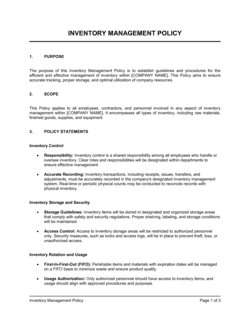
A complete policy covers scope, roles and responsibilities, counting methods and schedules, reorder thresholds, receiving procedures, discrepancy protocols, and record-keeping requirements. It should be reviewed at least annually and updated whenever systems, locations, or product lines change significantly.
Can small businesses use the same inventory templates as larger ones?
Yes. The short-version inventory control sheet and basic checklist templates are designed for businesses with simpler needs — fewer SKUs, a single location, smaller teams. As operations grow, the same categories of documents scale up in detail without changing in structure. Starting with a template early builds habits that are much harder to retrofit later.
Inventory and Warehousing vs. related documents
Warehousing Agreement vs. Warehouse Rental Agreement
A warehousing agreement governs the storage and handling of goods by a third-party logistics or storage provider — the focus is on services, liability for goods, and handling procedures. A warehouse rental agreement is a real estate lease for a physical building or unit; the tenant controls the space and operations inside. Use a warehousing agreement when you're paying someone to store and manage your goods; use a rental agreement when you're leasing the building itself.
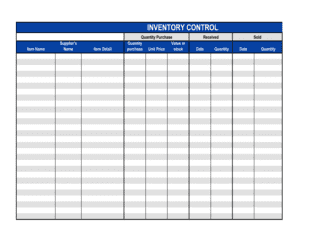
An inventory control sheet is an operational tool — a form employees fill out to log stock movements, quantities, and locations on a day-to-day basis. An inventory management policy is a governance document that sets the rules everyone must follow: how counts are scheduled, who has authority to adjust records, how discrepancies are escalated. Use the control sheet for daily tracking; use the policy to establish the framework those sheets operate within.
Key clauses every Inventory and Warehousing contains
Whether you're drafting a warehousing agreement or an inventory management policy, these core components appear across nearly every document in this category.
Parties and roles. Identifies who owns the goods, who stores or manages them, and what authority each party holds.
Description of goods or inventory. Specifies the type, quantity, and condition of items covered by the agreement or tracked by the document.
Storage and handling standards. Defines how goods must be stored, handled, and protected — including temperature, security, and access controls.
Inventory counting method. States whether periodic, cycle, or perpetual counting is used and how often counts must occur.
Discrepancy and adjustment procedures. Explains how differences between physical counts and records are identified, investigated, and corrected.
Liability and insurance. Allocates responsibility for loss, damage, or theft, and specifies required insurance coverage.
Term and termination. Sets the duration of the agreement or policy and the conditions under which it can be ended or revised.
Reporting and record-keeping. Requires regular documentation of stock levels, movements, and audits, and specifies how long records must be retained.
How to write an inventory management policy
A well-written inventory management policy gives every team member a clear reference for how stock is tracked, counted, and controlled — reducing errors and shrinkage before they happen.
1
Define the scope
Specify which locations, product categories, and teams the policy covers so there's no ambiguity about who must follow it.
2
Assign roles and responsibilities
Name who is accountable for receiving stock, maintaining records, conducting counts, and approving adjustments.
3
Choose your counting method
Decide between periodic counts (scheduled intervals), cycle counts (rotating sections), or perpetual tracking (real-time updates), and document the rationale.
4
Set reorder and threshold rules
Define minimum stock levels, reorder points, and maximum storage quantities to prevent stockouts and overages.
5
Document receiving and put-away procedures
Describe how incoming goods are inspected, logged, labeled, and placed in designated storage locations.
6
Establish discrepancy and shrinkage protocols
State how unexplained differences are investigated, who must be notified, and what corrective actions are taken.
7
Specify reporting cadence and record retention
Set how often inventory reports are produced, who receives them, and how long physical and digital records must be kept.
At a glance
What it is
Inventory and warehousing documents are operational templates that help businesses track stock levels, manage physical storage space, and maintain clear procedures for receiving, counting, and reconciling goods. They range from one-page control sheets to formal warehouse agreements and compliance checklists.
When you need one
Any time a business holds physical goods — whether in its own facility or a third-party warehouse — it needs structured documents to prevent shrinkage, audit discrepancies, and define storage responsibilities.
The right template depends on whether you need an operational tracking tool, a formal agreement, a policy document, or a procedural guide. Match your immediate need to the scenario below.
Your situation
Recommended template
Tracking stock quantities and locations on an ongoing basis
Provides a structured log for recording stock movements, quantities, and locations.
Hiring a professional to oversee stock control and inventory systems
Ready-to-post job description with duties, qualifications, and reporting structure.
Inventory Specialist Job Description
Glossary
Inventory control
The process of tracking stock quantities, locations, and movements to ensure accuracy between physical goods and recorded figures.
Cycle count
A method of counting a rotating subset of inventory items on a scheduled basis rather than conducting a full physical count at one time.
Warehousing agreement
A contract between a goods owner and a storage provider that defines storage terms, handling responsibilities, fees, and liability.
Perpetual inventory system
A real-time stock tracking method where records are updated continuously with every transaction, receipt, or shipment.
Shrinkage
The loss of inventory due to theft, damage, administrative error, or supplier fraud — typically measured as a percentage of sales.
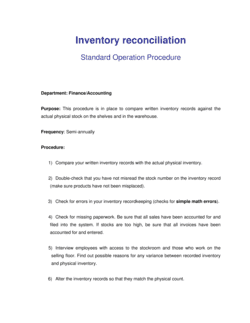
Inventory reconciliation
The process of comparing a physical count of goods against recorded inventory figures and resolving any differences found.
Reorder point
The stock level at which a new purchase order must be placed to avoid running out of a product before the next shipment arrives.
Warehouse lien
A legal right allowing a warehouse operator to hold stored goods as security for unpaid storage charges.
Put-away process
The steps taken after goods are received to inspect, label, and place them in their designated storage locations.
Dead stock
Inventory that has not been sold or used within a defined period and is unlikely to sell at full value, tying up capital and space.
What is an inventory and warehousing document?
Inventory and warehousing documents are the operational and legal templates
businesses use to track physical goods, manage storage facilities, and establish
clear procedures for everyone who handles stock. They cover a broad range — from
a simple one-page control sheet a warehouse team fills out each shift, to a formal
warehousing agreement that defines liability and service terms with a third-party
logistics provider.
These documents exist because physical inventory is one of the most common sources
of business loss and operational friction. Without a structured system for counting,
recording, and reconciling stock, discrepancies accumulate silently until they
surface as a financial problem. With the right documents in place, businesses can
assign accountability, detect errors early, and meet the record-keeping requirements
that lenders, auditors, and insurers typically expect.
When you need an inventory or warehousing document
Any business that holds physical goods — whether it's a manufacturer, retailer,
distributor, or e-commerce operator — needs at least a basic inventory tracking
document from day one. The need for more formal agreements and policies grows
as the volume of stock and the number of people handling it increases.
Common triggers:
Opening or expanding a warehouse, storage unit, or fulfillment center
Contracting a third-party logistics provider to store or ship your goods
Hiring staff into roles that involve receiving, picking, or counting stock
Experiencing unexplained shrinkage, stock discrepancies, or audit failures
Preparing for a financial audit, loan application, or investor due diligence
Building standard operating procedures before scaling production or distribution
Formalizing a lease for warehouse or storage space
Skipping these documents doesn't make the problems go away — it makes them harder
to trace and fix. A missing warehousing agreement leaves liability undefined when
goods are damaged. An absent inventory policy means every employee follows a
different process. Starting with proven templates ensures the fundamentals are
covered, even before you have the resources for a dedicated operations team.
Award-winning platform
Great Place to Work 2025
BIG Award — Product of the Year 2025
Smartest Companies 2025
Global 100 Excellence 2026
Best of the Best 2025
Create your document in 3 simple steps.
From template to signed document — all inside one Business Operating System.
1
Download or open template
Access over 3,000+ business and legal templates for any business task, project or initiative.
2
Edit and fill in the blanks with AI
Customize your ready-made business document template and save it in the cloud.
3
Share with your team
Share your files and folders with your team. Create a space of seamless collaboration.
Save time, save money, and create top-quality documents.
★★★★★
"Fantastic value! I'm not sure how I'd do without it. It's worth its weight in gold and paid back for itself many times."
Managing Director · Mall Farm
RW
Robert Whalley
Managing Director, Mall Farm Proprietary Limited
★★★★★
"I have been using Business in a Box for years. It has been the most useful source of templates I have encountered. I recommend it to anyone."
Business Owner · 4+ years
MF
Dr Michael John Freestone
Business Owner
★★★★★
"It has been a life saver so many times I have lost count. Business in a Box has saved me so much time and as you know, time is money."
Owner · Upstate Web
DM
David G. Moore Jr.
Owner, Upstate Web
Run your business with a system — not scattered tools
Stop downloading documents. Start operating with clarity. Business in a Box gives you the Business Operating System used by over 250,000 companies worldwide to structure, run, and grow their business.