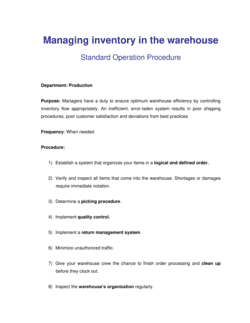
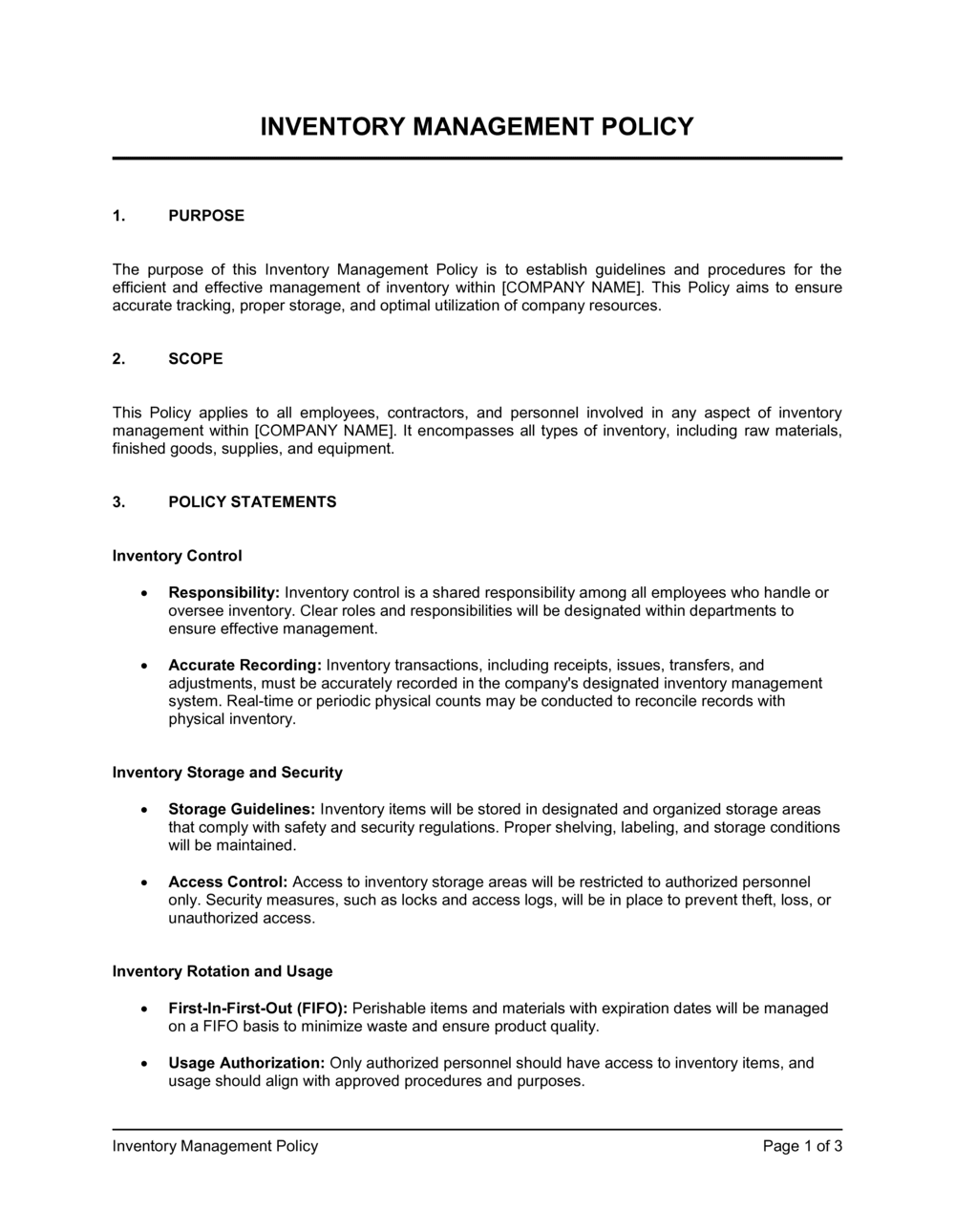
Inventory Management Policy Template

Free Word download β€’ Edit online β€’ Save & share with Drive β€’ Export to PDF

3 pagesβ€’20–25 min to fillβ€’Difficulty: Standard
Learn more ↓
FreeInventory Management Policy Template

At a glance

What it is
An Inventory Management Policy is a formal internal document that defines exactly how a business orders, receives, stores, counts, and writes off stock. This free Word download gives you a structured, editable template covering reorder points, safety stock levels, ABC classification, count cadence, and approval thresholds for adjustments β€” ready to deploy across your warehouse, retail, or manufacturing operation.
When you need it
Use it when stockouts or overstock situations are hurting cash flow, when audit findings flag inconsistent inventory records, or when you are standardizing operations ahead of growth, a new ERP rollout, or an external audit.
What's inside
Purpose and scope, roles and responsibilities, procurement and reorder rules, receiving and storage procedures, ABC classification criteria, cycle count and physical count schedules, inventory adjustment and write-off approval thresholds, and disposal procedures.

What is an Inventory Management Policy?

An Inventory Management Policy is a formal internal document that defines the rules, thresholds, and procedures a business uses to order, receive, store, count, and dispose of stock. It establishes the formulas for calculating reorder points and safety stock, sets the criteria for ABC classification of SKUs, prescribes cycle count and physical count cadences, and documents the approval authority required to post inventory adjustments or write off obsolete goods. Rather than leaving stock control to individual judgment calls, the policy gives every team member β€” from the warehouse floor to the CFO β€” a single authoritative reference for all inventory decisions.

Why You Need This Document

Without a documented inventory policy, stock control decisions default to inconsistent informal practices that compound over time: reorder points set by instinct rather than formula, write-offs posted without approval, and cycle counts skipped during busy periods. The consequences are measurable β€” chronic stockouts on fast-moving SKUs, excess working capital tied up in slow-moving stock, and inventory records that drift far enough from physical reality to trigger audit findings or mis-state the balance sheet. A formal policy eliminates these gaps by anchoring every stock decision to a defined rule, making discrepancies visible before they become material. For businesses scaling headcount, adding warehouse locations, or implementing a new ERP, a written policy is the operational foundation that ensures the system reflects reality β€” and keeps it that way.

Which variant fits your situation?

If your situation is…Use this template
Retail store with high-volume, fast-moving consumer goodsInventory Management Policy (Retail)
Manufacturing operation managing raw materials and WIPInventory Management Policy (Manufacturing)
Warehouse or 3PL with multiple client SKUsWarehouse Management SOP
Tracking physical assets rather than sellable goodsAsset Management Policy
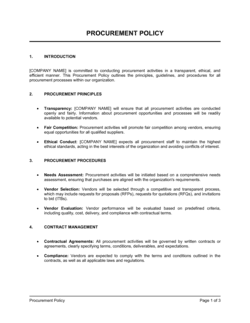
Documenting the end-to-end purchasing process separatelyProcurement Policy
Establishing a full year-end physical inventory count procedurePhysical Inventory Count Procedure
Setting supplier terms and performance expectationsVendor Management Policy

Common mistakes to avoid

❌ No escalation path for receiving discrepancies

Why it matters: When a delivery arrives short or damaged and no one is named as the escalation point, the error gets absorbed silently β€” the system shows more stock than physically exists, corrupting reorder signals.

Fix: Name a specific role responsible for resolving receiving discrepancies and set a time limit β€” for example, discrepancies exceeding 5% of PO quantity must be escalated within 4 business hours.

❌ Setting safety stock as a flat unit number

Why it matters: A flat buffer calibrated to last quarter's demand becomes dangerously low during a demand spike or supplier delay, and wastefully high during a slow period.

Fix: Use the formula-driven approach in the policy: safety stock = (maximum daily usage minus average daily usage) Γ— maximum lead time in days. Recalculate quarterly.

❌ Skipping the disposal documentation step after a write-off

Why it matters: Writing off inventory in the system without documenting physical disposal creates phantom stock that distorts warehouse capacity planning and can be exploited to mask theft.

Fix: Require a witnessed disposal record β€” signed by the person disposing and a witness β€” for every write-off above the minimum threshold, and attach it to the system adjustment record.

❌ Running the ABC classification once and never updating it

Why it matters: Product mix, pricing, and demand patterns shift β€” a C-item that becomes a bestseller will have Class C count frequency and safety stock, resulting in chronic stockouts.

Fix: Schedule an annual ABC re-classification using the most recent 12 months of sales or consumption data and update count schedules and safety stock targets accordingly.

The 9 key sections, explained

Purpose, scope, and objectives

Roles and responsibilities

Inventory classification (ABC method)

Reorder points and safety stock

Procurement and purchasing authorization

Receiving, inspection, and storage

Cycle count and physical count schedule

Inventory adjustment and write-off approvals

Disposal and obsolescence procedures

How to fill it out

  1. 1

    Define scope and primary objectives

    Start by identifying which facilities, product categories, and inventory types this policy covers. Set two to three measurable objectives β€” target fill rate, maximum shrinkage percentage, or system accuracy target.

    πŸ’‘ Narrow scope beats broad scope. A policy that covers finished goods only is followed; one that tries to cover everything often covers nothing in practice.

  2. 2

    Assign roles and ownership for each function

    List every inventory decision point β€” ordering, receiving, counting, adjustments, write-offs β€” and name the job title responsible for each. Avoid assigning the same role to both execute and approve the same action.

    πŸ’‘ Segregation of duties matters most for adjustments and write-offs. The person posting an adjustment should not be the same person approving it.

  3. 3

    Run an ABC analysis on your current SKU list

    Export your last 12 months of inventory spend or sales data, rank SKUs by annual value, and classify the top 70–80% of cumulative value as A items, the next 15–20% as B, and the remainder as C.

    πŸ’‘ Re-run the ABC analysis annually β€” a SKU that was Class C last year may be Class A this year if demand shifted.

  4. 4

    Calculate and document reorder points and safety stock

    For each A-item SKU, calculate ROP and safety stock using the formulas in the policy. Enter the results in your ERP or inventory system so reorder alerts fire automatically.

    πŸ’‘ Pull supplier lead time data from actual PO history, not quoted lead times β€” actual lead times are typically 20–40% longer than quoted.

  5. 5

    Set dollar thresholds for purchasing and adjustments

    Enter specific dollar amounts β€” not percentages β€” for each approval tier in the procurement and adjustment sections. Confirm the thresholds with your CFO or controller before publishing.

    πŸ’‘ Set the emergency-purchase threshold at the same level as standard purchasing β€” not higher. A higher limit for emergencies creates a loophole.

  6. 6

    Build the count schedule into the calendar

    Translate the cycle count policy into a recurring calendar β€” monthly for A items, quarterly for B, semi-annual for C. Assign named individuals, not just roles, to each count window.

    πŸ’‘ Schedule counts at the same time each month so they become routine. Ad hoc counts are skipped first when workloads spike.

  7. 7

    Obtain sign-off and communicate to the team

    Have the policy reviewed by the operations manager, CFO, and warehouse lead before publication. Distribute to all staff handling inventory and keep a record of who has read and acknowledged it.

    πŸ’‘ A one-page summary of the key thresholds and count schedule posted in the warehouse is more effective than a full policy binder no one opens.

Frequently asked questions

What is an inventory management policy?

An inventory management policy is a formal internal document that defines how a business orders, receives, stores, counts, and disposes of stock. It sets specific rules for reorder points, safety stock levels, ABC classification tiers, cycle count schedules, and the approval thresholds required to post adjustments or write-offs. It gives operations, finance, and warehouse teams a single authoritative reference for all stock control decisions.

What should an inventory management policy include?

At minimum, the policy should cover purpose and scope, roles and responsibilities, ABC classification criteria and management rules, reorder point and safety stock formulas, purchasing authorization thresholds, receiving and inspection procedures, cycle count and physical count schedules, adjustment and write-off approval levels, and disposal procedures. Missing any of these leaves a gap that teams fill with inconsistent informal practices.

What is ABC classification in inventory management?

ABC classification divides inventory into three tiers based on annual value or spend. Class A items typically represent 10–20% of SKUs but 70–80% of total inventory value β€” they get the tightest controls, most frequent counts, and highest purchasing approval requirements. Class B covers the middle tier, and Class C covers the high-volume, low-value items. The goal is to concentrate management effort where the financial exposure is greatest.

How do you calculate a reorder point?

Reorder Point = (Average Daily Usage Γ— Lead Time in Days) + Safety Stock. For example, if a SKU sells 50 units per day, your supplier takes 7 days to deliver, and you carry 3 days of safety stock, the reorder point is (50 Γ— 7) + (50 Γ— 3) = 500 units. When your on-hand quantity hits 500, you trigger a new purchase order. Use actual lead time from historical PO data, not the lead time your supplier quotes.

What is the difference between a cycle count and a physical inventory count?

A cycle count is a rolling audit where a subset of SKUs β€” typically sorted by ABC tier β€” is counted on a scheduled basis throughout the year without shutting down operations. A full physical inventory count halts receiving and picking while every SKU is counted simultaneously, usually once a year. Cycle counting catches errors faster and distributes the workload evenly, while the annual physical count provides a definitive year-end reconciliation for financial reporting.

Who needs to approve an inventory write-off?

Approval requirements depend on the size of the write-off and your internal controls framework. A common structure is: minor adjustments (under $500) approved by the inventory controller; mid-range write-offs ($500–$5,000) requiring operations manager sign-off with a variance report; and write-offs above $5,000 requiring CFO approval with full supporting documentation. The specific thresholds should be set based on your company's size and audit requirements.

How often should an inventory policy be reviewed and updated?

Review the policy at least annually, aligned to your fiscal year-end or annual physical count. Trigger an earlier review whenever you add a new product line, change your ERP system, open a new warehouse location, or experience a significant shrinkage event. The ABC classification and safety stock calculations within the policy should be recalculated annually using the most recent 12 months of data.

What is the financial impact of poor inventory management?

Poor inventory management creates costs on both ends of the spectrum. Excess stock ties up working capital, incurs storage costs, and risks obsolescence write-offs. Insufficient stock triggers stockouts that cost lost sales, expediting fees, and customer attrition. A 2023 IHL Group study estimated that out-of-stock situations cost global retailers over $1 trillion annually. A documented policy with accurate reorder points and safety stock directly reduces both forms of loss.

Can this template be used with any ERP or inventory system?

Yes. The policy defines rules, thresholds, and procedures that are system-agnostic β€” the same reorder point formula, ABC tiers, and approval authorities apply whether you use NetSuite, SAP, QuickBooks, Fishbowl, or a spreadsheet-based system. You will need to configure your specific system to enforce the reorder alerts and count schedules defined in the policy, but the policy itself does not depend on any particular platform.

How this compares to alternatives

vs Procurement Policy

A procurement policy governs how the business selects suppliers, obtains quotes, and authorizes purchases β€” it picks up where the inventory policy hands off. The inventory management policy defines when to order (reorder points, safety stock); the procurement policy defines how to order (supplier selection, PO approvals, contract terms). Most businesses need both, with cross-references between them.

vs Warehouse Management SOP

A warehouse management SOP provides step-by-step instructions for daily warehouse tasks β€” receiving, put-away, picking, packing, and shipping. An inventory management policy sets the rules and thresholds those tasks operate within. The policy defines what the acceptable count variance is; the SOP defines exactly how a count is physically executed.

vs Asset Management Policy

An asset management policy governs fixed and capital assets β€” equipment, vehicles, and IT hardware β€” tracking depreciation and useful life rather than units sold or consumed. An inventory management policy covers sellable goods, raw materials, and consumables. The two documents use different valuation methods and different count triggers.

vs Supply Chain Management Plan

A supply chain management plan addresses the end-to-end flow from supplier sourcing through customer delivery, including logistics, risk, and supplier relationships. An inventory management policy is narrower β€” it focuses on the rules governing stock once it is within your control. The supply chain plan sets strategic direction; the inventory policy operationalizes the stock-holding portion of it.

Industry-specific considerations

Retail and wholesale

High SKU counts, seasonal demand swings, and shrinkage from theft make ABC classification and cycle counting critical for maintaining accurate on-hand quantities.

Manufacturing

Raw material and WIP inventory must be tracked separately from finished goods, with reorder rules tied to production schedules and bill-of-materials consumption rates.

Food and beverage

FEFO (First Expired, First Out) rotation rules, expiry-date tracking at the lot level, and short-shelf-life write-off procedures are essential compliance and waste-control requirements.

E-commerce and fulfillment

Multi-channel demand signals, split-warehouse inventory allocation, and real-time system accuracy requirements make documented reorder and safety stock rules foundational to preventing overselling.

Template vs pro β€” what fits your needs?

PathBest forCostTime
Use the templateSMBs, retail operators, and operations managers formalizing existing informal practicesFree2–4 hours to complete and customize
Template + professional reviewBusinesses preparing for an external audit, ERP implementation, or ISO certification$300–$800 for a supply chain consultant or controller review1–3 days
Custom draftedMulti-site manufacturers, 3PLs, or heavily regulated industries requiring audit-ready documentation$1,500–$5,000 for a specialist operations consultant2–4 weeks

Glossary

Reorder Point (ROP)
The stock level at which a new purchase order must be triggered to replenish inventory before it runs out, calculated from lead time and average daily usage.
Safety Stock
A buffer quantity of inventory held above the expected demand during lead time to absorb unexpected spikes in demand or supplier delays.
ABC Classification
A method of categorizing inventory into three tiers β€” A (high-value, low-volume), B (moderate), and C (low-value, high-volume) β€” to prioritize management effort and count frequency.
Cycle Count
A rolling inventory audit where a subset of SKUs is counted on a scheduled basis throughout the year, rather than shutting down for a full annual count.
Lead Time
The total time from placing a purchase order to receiving usable goods in the warehouse, including supplier processing, transit, and receiving inspection.
Shrinkage
Inventory loss caused by theft, damage, administrative error, or spoilage β€” measured as the difference between recorded and physical stock quantities.
Write-Off
The accounting removal of inventory from the balance sheet when it is determined to be damaged, expired, obsolete, or otherwise unsaleable.
Days Inventory Outstanding (DIO)
The average number of days a business holds inventory before it is sold, calculated as (average inventory Γ· COGS) Γ— number of days in the period.
FIFO / FEFO
First In, First Out and First Expired, First Out β€” stock rotation methods ensuring oldest or soonest-expiring units are sold or used before newer stock.
Min/Max Replenishment
A replenishment method that triggers an order when stock falls to a minimum level and orders enough to bring it back to a defined maximum level.

Part of your Business Operating System

This document is one of 3,000+ business & legal templates included in Business in a Box.

  • Fill-in-the-blanks β€” ready in minutes
  • 100% customizable Word document
  • Compatible with all office suites
  • Export to PDF and share electronically

Create your document in 3 simple steps.

From template to signed document β€” all inside one Business Operating System.
1
Download or open template

Access over 3,000+ business and legal templates for any business task, project or initiative.

2
Edit and fill in the blanks with AI

Customize your ready-made business document template and save it in the cloud.

3
Save, Share, Send, Sign

Share your files and folders with your team. Create a space of seamless collaboration.

Save time, save money, and create top-quality documents.

β˜…β˜…β˜…β˜…β˜…

"Fantastic value! I'm not sure how I'd do without it. It's worth its weight in gold and paid back for itself many times."

Managing Director Β· Mall Farm
Robert Whalley
Managing Director, Mall Farm Proprietary Limited
β˜…β˜…β˜…β˜…β˜…

"I have been using Business in a Box for years. It has been the most useful source of templates I have encountered. I recommend it to anyone."

Business Owner Β· 4+ years
Dr Michael John Freestone
Business Owner
β˜…β˜…β˜…β˜…β˜…

"It has been a life saver so many times I have lost count. Business in a Box has saved me so much time and as you know, time is money."

Owner Β· Upstate Web
David G. Moore Jr.
Owner, Upstate Web

Run your business with a system β€” not scattered tools

Stop downloading documents. Start operating with clarity. Business in a Box gives you the Business Operating System used by over 250,000 companies worldwide to structure, run, and grow their business.

Free Forever PlanΒ Β·Β No credit card required