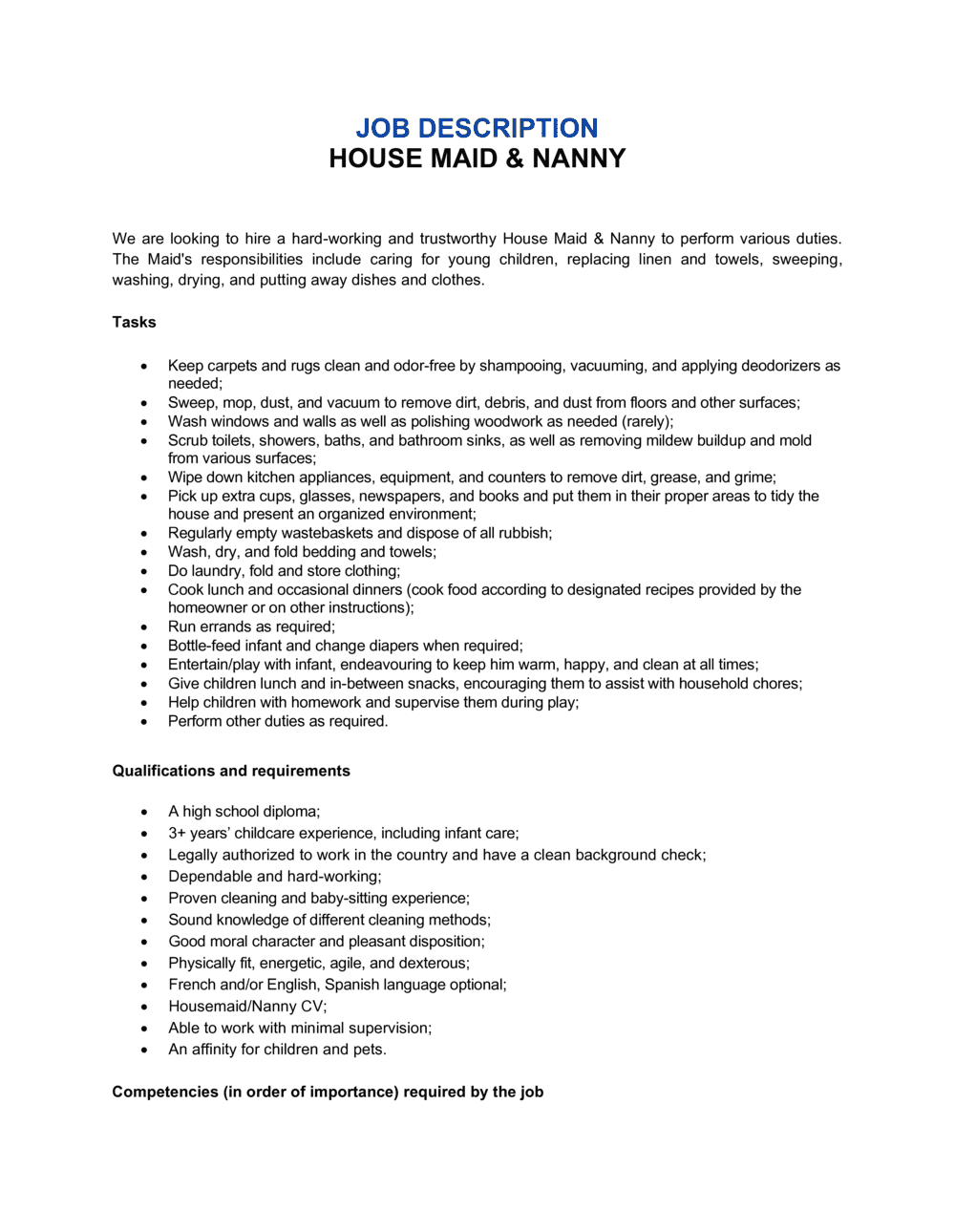
House Maid and Nanny Job Description Template

Free Word download β€’ Edit online β€’ Save & share with Drive β€’ Export to PDF

2 pagesβ€’20–30 min to fillβ€’Difficulty: Standardβ€’Signature requiredβ€’Legal review recommended
Learn more ↓
FreeHouse Maid and Nanny Job Description Template

At a glance

What it is
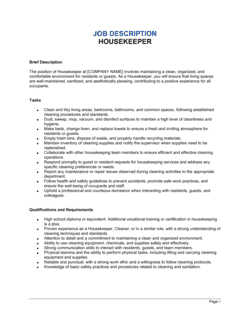
A House Maid and Nanny Job Description is a formal written document that defines the duties, working hours, compensation, expectations, and conduct standards for a domestic worker engaged in household and childcare roles. This free Word download gives employers a structured, editable starting point they can tailor to their household's needs and export as PDF for signing before employment begins.
When you need it
Use it before engaging any live-in or live-out domestic worker who will perform cleaning, household management, or childcare duties. It is especially important when the worker's responsibilities span both housekeeping and child supervision, since the dual role creates potential ambiguity about priorities, hours, and liability.
What's inside
The document covers the worker's job title and reporting structure, a detailed breakdown of housekeeping and childcare duties, working hours and schedule, compensation and benefits, conduct and confidentiality expectations, termination conditions, and governing law. Together these provisions create a clear, enforceable baseline for the employment relationship.

What is a House Maid and Nanny Job Description?

A House Maid and Nanny Job Description is a formal written document that defines the duties, schedule, compensation, conduct standards, and termination terms for a domestic worker engaged to perform both housekeeping and childcare functions within a private household. When signed by both the employer and the worker, it becomes a binding employment agreement that governs the relationship from the first day of work. Unlike a casual verbal arrangement, a properly completed job description eliminates ambiguity about what the worker is responsible for, how much they will be paid, what conduct is expected, and how the arrangement can be ended by either side.

Why You Need This Document

Without a written job description and employment agreement, household employers carry significant legal and practical risk. A worker who has no documented duties can claim their performance met expectations regardless of what actually occurred β€” making disciplinary action or dismissal difficult to sustain. Without a signed confidentiality clause, a worker who shares information about the family's routines, finances, or children online has breached no written obligation the employer can enforce. And in most jurisdictions β€” including the US, Canada, the UK, and EU member states β€” domestic workers are entitled to minimum wage, overtime, paid leave, and statutory notice, whether or not any of those terms appear in writing. A signed job description confirms the agreed terms, demonstrates the employer's compliance with statutory obligations, and provides the documentation trail needed if a dispute escalates to a labour tribunal or court. This template gives household employers a clear, editable starting point that covers every material dimension of the arrangement β€” from daily duties to emergency protocols to termination β€” in a single document ready for signing before the worker's first day.

Which variant fits your situation?

If your situation is…Use this template
Hiring a worker exclusively for childcare with no housekeeping dutiesNanny Employment Contract
Hiring a worker exclusively for housekeeping with no childcare dutiesHousekeeper Job Description
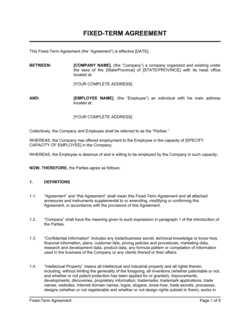
Engaging a domestic worker for a fixed term or trial periodFixed-Term Employment Contract
Formalizing an au pair arrangement with cultural exchange termsAu Pair Agreement
Hiring a full household staff team including a chef or driverHousehold Staff Employment Agreement
Placing a domestic worker through an agency with agency-employer termsDomestic Staffing Agency Agreement
Documenting performance expectations after an initial probationary periodEmployee Performance Review Template

Common mistakes to avoid

❌ Vague duty descriptions

Why it matters: Without specific tasks listed, a worker who does the minimum can reasonably claim they met expectations. Performance management and dismissal for underperformance become almost impossible to justify.

Fix: Replace every general category with a specific task, frequency, and standard. 'Clean the kitchen' becomes 'clean stovetop, counters, and sink daily; mop floor every Monday and Thursday.'

❌ No overtime or schedule-change provisions

Why it matters: Many jurisdictions β€” including New York, California, and the UK β€” extend overtime and rest-period rights to domestic workers. An agreement silent on overtime exposes the employer to back-pay liability for every uncompensated extra hour.

Fix: State the overtime threshold, the overtime rate (typically 1.5Γ— regular rate), and the minimum notice required for schedule changes. Verify these against the statutory minimums in your jurisdiction.

❌ Signing after the worker's first day

Why it matters: In common-law jurisdictions, a worker who has already started has given no new consideration for terms signed later. Confidentiality, conduct, and termination clauses may be unenforceable as a result.

Fix: Execute the agreement on or before the first day of work. If signing after start is unavoidable, provide a documented benefit β€” a pay increase or additional paid leave β€” as fresh consideration at the time of signing.

❌ No social media or privacy clause

Why it matters: A worker who posts images of the children, home layout, or daily routines creates privacy and security risks for the family that the employer has no contractual basis to stop or sanction.

Fix: Include an explicit prohibition on photographing, filming, or posting content about the family, their home, or their children on any platform, with written consent required for any exception.

❌ Omitting accommodation valuation for live-in workers

Why it matters: If accommodation is included as part of compensation but its value is not documented, disputes arise about whether the total package meets minimum wage β€” and tax authorities may treat undocumented benefits as unreported income.

Fix: State the accommodation value in dollars per month in the compensation clause, and confirm that the cash pay rate alone still meets or exceeds the applicable minimum wage.

❌ No cause-based termination definition

Why it matters: Terminating a worker for serious misconduct without a written definition of dismissible conduct exposes the employer to wrongful dismissal claims, even when the behaviour was clearly unacceptable.

Fix: List specific examples of dismissible conduct β€” theft, child endangerment, breach of confidentiality, serious dishonesty β€” directly in the termination clause so there is no ambiguity about what triggers immediate dismissal.

The 9 key clauses, explained

Parties, Job Title, and Start Date

In plain language: Identifies the employer (household or named individual) and the worker by full legal name, states the official job title, and records the first day of employment.

Sample language
This Job Description and Employment Agreement is entered into on [DATE] between [EMPLOYER FULL NAME] of [ADDRESS] ('Employer') and [WORKER FULL NAME] ('Employee'). Employee is engaged as House Maid and Nanny commencing [START DATE].

Common mistake: Using a nickname or informal name instead of the worker's legal name. Payroll, tax filings, and any future legal proceedings must reference the same name β€” discrepancies create compliance problems.

Duties and Responsibilities

In plain language: Lists the specific housekeeping and childcare tasks the worker is expected to perform, with enough detail to evaluate performance and prevent scope creep.

Sample language
Housekeeping duties include: vacuuming, mopping, and dusting all rooms daily; laundry and ironing [FREQUENCY]; and grocery shopping as directed. Childcare duties include: supervising [CHILD NAME(S)], aged [AGES], during school pick-up, meals, and homework; arranging age-appropriate activities; and transporting children to [ACTIVITIES] using Employer's vehicle.

Common mistake: Listing only general categories like 'cleaning and childcare' without specifics. Vague duties make it impossible to manage performance or dispute a dismissal for failure to perform.

Working Hours and Schedule

In plain language: Specifies the days and hours of work, whether the role is full-time or part-time, and how overtime or additional hours are requested and compensated.

Sample language
Employee shall work [DAYS], from [START TIME] to [END TIME], totalling [X] hours per week. Overtime exceeding [X] hours per week shall be compensated at [X]Γ— the regular hourly rate. Employer shall provide [MINIMUM X HOURS'] advance notice for schedule changes.

Common mistake: Failing to define overtime terms. Many jurisdictions extend overtime protections to domestic workers β€” leaving this blank exposes the employer to back-pay claims.

Compensation, Benefits, and Accommodation

In plain language: States the gross pay rate, payment frequency, any accommodation or meal value included, and any additional benefits such as transportation or health coverage.

Sample language
Employer shall pay Employee a gross salary of $[AMOUNT] per [week/month], payable on [DAY]. For live-in arrangements, accommodation valued at $[AMOUNT] per month and [MEALS/BOARD] are included as part of the total compensation package. Travel reimbursement: $[AMOUNT] per month.

Common mistake: Omitting the gross pay amount and listing only a net take-home figure. Employment law in most jurisdictions measures minimums against gross pay β€” net figures create ambiguity about whether statutory minimums are met.

Childcare Standards and Safety

In plain language: Sets out the standard of care expected when supervising children, emergency protocols, permitted activities, and any restrictions (e.g., no screen time under age 2).

Sample language
Employee shall supervise children at all times during working hours, apply basic first aid as needed, and contact Employer immediately in any medical or safety emergency. Screen time for children under [AGE] is limited to [X] minutes per day. Employee shall not transport children without Employer's explicit prior consent.

Common mistake: No emergency protocol clause. Without documented instructions, a worker in a genuine emergency may not know who to call or what authorisations they have, creating risk for the child and liability for the employer.

Conduct, Confidentiality, and Social Media

In plain language: Requires the worker to maintain professional conduct in the home, keep family information private, and refrain from posting about the family or household on social media.

Sample language
Employee shall maintain strict confidentiality regarding the Employer's family, finances, routines, guests, and household matters during and after employment. Employee shall not post photographs, videos, or commentary about the Employer's household or family members on any social media platform without prior written consent.

Common mistake: No social media clause. Without it, a worker who posts family photos or routines online creates privacy and safety risks the employer has no contractual basis to address.

Probationary Period and Performance Review

In plain language: Defines an initial assessment period during which either party can end the arrangement with reduced notice, and sets out how and when performance will be reviewed.

Sample language
The first [30/60/90] days of employment constitute a probationary period, during which either party may terminate with [X] days' written notice. Employer shall conduct a performance review at the end of the probationary period to confirm continued employment.

Common mistake: No probationary clause at all. Without one, terminating a worker within the first few weeks may still trigger full statutory notice obligations in many jurisdictions.

Termination and Notice

In plain language: States the notice period each party must give to end the arrangement, circumstances that justify immediate termination without notice, and any exit obligations such as returning keys or clearing accommodation.

Sample language
Either party may terminate this agreement with [X] weeks' written notice. Employer may terminate immediately, without notice or pay in lieu, for cause including theft, child endangerment, breach of confidentiality, or gross misconduct. Employee shall return all keys, access cards, and household property on the last day of employment.

Common mistake: No 'for cause' definition. Without specific examples of dismissible conduct, an employer who terminates for serious misconduct may still face a wrongful dismissal claim if the behaviour wasn't explicitly listed.

Governing Law and Jurisdiction

In plain language: Identifies which jurisdiction's law governs the agreement and where disputes will be resolved.

Sample language
This Agreement is governed by the laws of [STATE / PROVINCE / COUNTRY]. Any dispute arising under this Agreement shall be resolved in the courts of [JURISDICTION], and the parties submit to the exclusive jurisdiction of those courts.

Common mistake: Omitting a governing law clause and assuming local law applies automatically. For families who relocate or employ workers across borders, the absence of a governing law clause creates serious ambiguity about which jurisdiction's labour minimums apply.

How to fill it out

  1. 1

    Enter the names and contact details of both parties

    Fill in the employer's full legal name and residential address, and the worker's full legal name as it appears on government-issued ID. Include the agreed start date.

    πŸ’‘ For household employers who are a couple, decide whose name appears as 'Employer' for consistency β€” using both names can create ambiguity in enforcement.

  2. 2

    List all duties in specific, measurable terms

    Replace generic categories with concrete tasks. Instead of 'cleaning,' write 'vacuum and mop all floors on Monday, Wednesday, and Friday; clean bathrooms daily.' For childcare, name the children, their ages, and specific daily routines.

    πŸ’‘ Walk through a typical working day in your head and translate each task into a line item β€” this prevents disputes about what was or wasn't agreed.

  3. 3

    Set exact working hours and an overtime policy

    Enter the specific days and hours of work. State the weekly hour threshold at which overtime applies and the overtime rate. For live-in workers, be explicit about on-call expectations and off-duty periods.

    πŸ’‘ In the US, domestic workers in states like New York and California have specific overtime and rest-period rights β€” verify the rules in your state before completing this section.

  4. 4

    Complete the compensation and benefits block

    State the gross pay amount, payment frequency, and payment method. For live-in arrangements, document the value of accommodation and meals separately so both parties understand the total compensation package.

    πŸ’‘ Confirm that the base pay rate β€” excluding accommodation β€” meets the applicable minimum wage in your jurisdiction. Several jurisdictions prohibit offsetting accommodation against minimum wage for domestic workers.

  5. 5

    Define childcare standards and emergency procedures

    Enter the children's names and ages, specific supervision requirements, and a clear emergency protocol including who to call first, the family doctor's name and number, and hospital preference.

    πŸ’‘ Prepare a signed medical authorisation letter separately, allowing the nanny to consent to emergency treatment if you cannot be reached.

  6. 6

    Add the confidentiality and social media clause

    Confirm that the confidentiality clause covers the family's routines, finances, guests, and household matters. Explicitly name social media platforms if you want to be comprehensive.

    πŸ’‘ If the family is prominent or security-sensitive, consider adding a non-disclosure agreement as a separate document β€” a job description clause provides some protection but is narrower than a dedicated NDA.

  7. 7

    Set the probationary period and notice terms

    Choose a probationary period of 30, 60, or 90 days and set a reduced notice period for that phase. Enter the full notice period for post-probation termination by either party.

    πŸ’‘ In Canada and the UK, statutory minimums apply from day one regardless of what the contract says β€” confirm local minimums before setting notice periods shorter than the statutory floor.

  8. 8

    Sign before the worker's first day

    Both parties must sign the document before employment begins. For live-in workers, ensure the agreement is signed before the worker moves in. Keep a countersigned copy on file and provide one to the worker.

    πŸ’‘ Use Business in a Box eSign to timestamp execution and create a secure, retrievable record β€” especially important if the worker later disputes when the terms were agreed.

Frequently asked questions

What is a house maid and nanny job description?

A house maid and nanny job description is a written document that defines the duties, hours, compensation, conduct standards, and termination terms for a domestic worker engaged in both housekeeping and childcare. When signed by both parties, it functions as a binding employment agreement that protects the employer and the worker by setting clear, enforceable expectations before work begins.

Do I need a formal document if I am hiring informally?

Yes. Even informal domestic arrangements carry legal obligations β€” minimum wage, overtime, and payroll taxes apply regardless of whether anything is written down. A signed job description documents the agreed terms, reduces the risk of disputes about duties or pay, and gives both parties a clear record to refer to if the arrangement sours. In many jurisdictions, household employers are also required to provide written terms within a set number of days of the start date.

What is the difference between a nanny and a house maid?

A nanny's primary responsibility is childcare β€” supervising, nurturing, and educating children. A house maid's primary responsibility is household maintenance β€” cleaning, laundry, and domestic tasks. This template covers a combined role where one worker performs both functions. It is important to specify which duties take priority when the two conflict, since a worker cannot simultaneously supervise a child and perform deep-cleaning tasks.

Are domestic workers entitled to overtime pay?

In most US states, yes β€” domestic workers who work more than 40 hours per week are entitled to overtime at 1.5Γ— the regular rate under the Fair Labor Standards Act. Several states, including New York and California, have additional domestic worker protections. In the UK, domestic workers are entitled to the National Minimum Wage and Working Time Regulations rest breaks. In Canada, provincial employment standards apply. Always verify the specific rules in your jurisdiction before agreeing to a schedule.

Can I include accommodation as part of the nanny's compensation?

Yes, for live-in arrangements, accommodation and meals are commonly included as part of total compensation. However, most jurisdictions prohibit employers from using accommodation to bring cash pay below the minimum wage. The accommodation value must be documented in the agreement, and the cash component of pay should be confirmed to meet statutory minimums independently. Tax treatment of accommodation benefits also varies β€” consult a tax adviser or payroll professional.

What background checks should I run before hiring a nanny?

Standard practice is to verify identity, run a criminal background check (with the worker's written consent), check references from previous employers, and confirm any relevant certifications such as first aid or childcare qualifications. In the US, the Fair Credit Reporting Act governs background checks for household employers. In the UK, an enhanced DBS check is recommended for anyone working with children. The job description template should include a consent clause authorising these checks.

What happens if the nanny and house maid roles conflict?

When one worker holds both roles, duty conflicts are common β€” a child needs immediate attention while cleaning tasks are incomplete, or the house maid role demands tasks that cannot safely be done while supervising a toddler. The job description should explicitly state that childcare safety takes priority over housekeeping tasks in all cases, and that housekeeping tasks will be scheduled around, not during, active child supervision periods.

Is this document enforceable in all countries?

The template provides a solid framework but must be reviewed against the employment laws of the jurisdiction where the worker is employed. Statutory minimums β€” notice periods, overtime, paid leave, and dismissal protections β€” vary significantly between the US, Canada, the UK, and EU member states. Any clause that provides less than the statutory minimum in the applicable jurisdiction is automatically void, and the statutory minimum replaces it. A local employment lawyer or HR adviser can confirm that the completed document meets local requirements.

Does a nanny need to be on payroll?

In most jurisdictions, yes. If a nanny or house maid works regularly in your home and you control how and when they work, they are typically an employee β€” not an independent contractor. Household employers in the US must withhold and remit Social Security, Medicare, and applicable state taxes (the so-called 'nanny tax'), register for employer identification numbers, and provide W-2 forms annually. Misclassifying a domestic worker as a contractor carries back-tax penalties and potential personal liability.

How this compares to alternatives

vs Nanny Employment Contract

A standalone nanny contract covers childcare duties only and typically includes more detailed child welfare and emergency clauses. The house maid and nanny job description covers both housekeeping and childcare in a single document. Use this template when one worker performs both roles; use a dedicated nanny contract when childcare is the sole function.

vs Independent Contractor Agreement

An independent contractor agreement is designed for self-employed workers who control their own methods and schedule. Most domestic workers β€” especially those with regular hours and employer-controlled duties β€” are legally employees, not contractors. Misclassifying a domestic worker as a contractor triggers payroll tax liability, penalties, and potential personal liability for the household employer.

vs Fixed-Term Employment Contract

A fixed-term contract sets a specific end date and is appropriate for temporary or seasonal domestic arrangements. The house maid and nanny job description is designed for ongoing, indefinite employment. If you need a trial period before committing to a permanent arrangement, use a fixed-term contract, then convert to a permanent agreement with updated terms at the end of the term.

vs Employee Handbook

An employee handbook covers workplace policies, conduct standards, and procedures for an organisation with multiple staff. A house maid and nanny job description is a bilateral document tailored to the specific duties of one worker in a private household. Households with three or more domestic staff may benefit from a household handbook alongside individual job descriptions.

Industry-specific considerations

Private Households

Live-in and live-out arrangements covering combined housekeeping and childcare duties, with accommodation and meal benefits documented as part of total compensation.

Staffing and Placement Agencies

Agencies use standardised job descriptions to brief both the employer family and the placed worker, reducing placement disputes and return rates.

Expatriate and Diplomatic Households

Cross-border arrangements require governing law clauses, currency specification, and alignment with local labour law in the host country β€” a formal document is non-negotiable for visa and permit compliance.

Estate and Property Management

Large households with multiple staff use individual job descriptions to define lane boundaries between house maids, nannies, cooks, and groundskeepers, reducing overlap and accountability gaps.

Jurisdictional notes

United States

The Fair Labor Standards Act covers domestic workers β€” household employees working 8 or more hours per week for one employer are entitled to federal minimum wage and, in most cases, overtime at 1.5Γ— the regular rate for hours over 40 per week. Household employers must withhold Social Security and Medicare taxes and issue a W-2 annually. Several states β€” including New York, California, Massachusetts, and Illinois β€” have enacted Domestic Workers Bills of Rights providing additional protections including paid rest days, paid leave, and protection from harassment.

Canada

Domestic workers in Canada are covered by provincial Employment Standards Acts, which set minimum wage, overtime, and termination notice minimums. Ontario's ESA provides domestic workers with most standard protections; Quebec requires contracts to be in French for provincially regulated employers. Live-in caregivers may also be subject to federal immigration programs with additional requirements. Employers should confirm provincial minimums before setting pay rates or notice periods in the document.

United Kingdom

Domestic workers in the UK are entitled to the National Living Wage or National Minimum Wage, statutory annual leave of 5.6 weeks, and Working Time Regulations rest breaks. Employers must provide a written statement of employment particulars on or before the first day. An enhanced DBS (Disclosure and Barring Service) check is strongly recommended for any worker with unsupervised access to children. Live-in domestic workers retain these rights regardless of accommodation arrangements.

European Union

EU member states each have their own domestic worker protections, and standards vary significantly β€” France, Germany, and Spain provide among the strongest protections for household employees, including mandatory social insurance registration and strict dismissal notice requirements. The EU Transparent and Predictable Working Conditions Directive requires employers to provide written terms within seven days of the start date. GDPR applies to any personal data the employer holds about the worker, including background check records.

Template vs lawyer β€” what fits your deal?

PathBest forCostTime
Use the templatePrivate household employers hiring a single domestic worker in a straightforward live-in or live-out arrangement in a single jurisdictionFree20–30 minutes
Template + legal reviewLive-in arrangements, workers with access to young children, or households in jurisdictions with specific domestic worker legislation such as New York, California, or Ontario$200–$500 for an employment lawyer review2–5 days
Custom draftedHigh-profile or security-sensitive households, cross-border arrangements, or families employing multiple domestic staff with complex scheduling and compensation structures$800–$2,500+1–2 weeks

Glossary

Domestic Worker
A person employed within a private household to perform services such as cleaning, cooking, laundry, or childcare β€” distinct from commercial or corporate employment.
Live-In Arrangement
An employment structure where the domestic worker resides at the employer's property, often with accommodation and meals forming part of the compensation package.
Live-Out Arrangement
An employment structure where the domestic worker commutes to the employer's home and returns to their own residence at the end of each shift.
Probationary Period
An initial phase of employment β€” typically 30 to 90 days β€” during which either party may end the arrangement with shorter notice while suitability is assessed.
In Loco Parentis
Latin for 'in the place of a parent' β€” the legal standard of care a nanny or childcare worker is expected to exercise when supervising children.
At-Will Employment
A US employment doctrine under which either party may end the working relationship at any time for any lawful reason without advance notice, unless a contract states otherwise.
Overtime (Domestic)
Hours worked beyond the agreed weekly threshold β€” typically 40 hours in the US β€” for which additional pay is required under applicable labour law, including for domestic workers in many jurisdictions.
Household Employer
An individual who hires workers to perform services in or around their private residence and takes on employer obligations including payroll taxes, workers' compensation, and statutory minimums.
Non-Disclosure Obligation
A contractual duty on the domestic worker not to share information about the family's private life, routines, finances, or household matters with third parties.
Background Check Consent
A written authorisation from the worker permitting the employer to verify criminal history, references, and identity before or during employment.
Constructive Dismissal
When an employer unilaterally changes working conditions β€” such as duties, hours, or accommodation β€” so significantly that the worker is effectively forced to resign, treated legally as a termination.

Part of your Business Operating System

This document is one of 3,000+ business & legal templates included in Business in a Box.

  • Fill-in-the-blanks β€” ready in minutes
  • 100% customizable Word document
  • Compatible with all office suites
  • Export to PDF and share electronically

Create your document in 3 simple steps.

From template to signed document β€” all inside one Business Operating System.
1
Download or open template

Access over 3,000+ business and legal templates for any business task, project or initiative.

2
Edit and fill in the blanks with AI

Customize your ready-made business document template and save it in the cloud.

3
Save, Share, Send, Sign

Share your files and folders with your team. Create a space of seamless collaboration.

Save time, save money, and create top-quality documents.

β˜…β˜…β˜…β˜…β˜…

"Fantastic value! I'm not sure how I'd do without it. It's worth its weight in gold and paid back for itself many times."

Managing Director Β· Mall Farm
Robert Whalley
Managing Director, Mall Farm Proprietary Limited
β˜…β˜…β˜…β˜…β˜…

"I have been using Business in a Box for years. It has been the most useful source of templates I have encountered. I recommend it to anyone."

Business Owner Β· 4+ years
Dr Michael John Freestone
Business Owner
β˜…β˜…β˜…β˜…β˜…

"It has been a life saver so many times I have lost count. Business in a Box has saved me so much time and as you know, time is money."

Owner Β· Upstate Web
David G. Moore Jr.
Owner, Upstate Web

Run your business with a system β€” not scattered tools

Stop downloading documents. Start operating with clarity. Business in a Box gives you the Business Operating System used by over 250,000 companies worldwide to structure, run, and grow their business.

Start freeΒ Β·Β No credit card required