Hold Harmless Agreement Template

Free Word download • Edit online • Save & share with Drive • Export to PDF

3 pages25–30 min to fillDifficulty: StandardSignature requiredLegal review recommended
Learn more ↓
FreeHold Harmless Agreement Template

At a glance

What it is
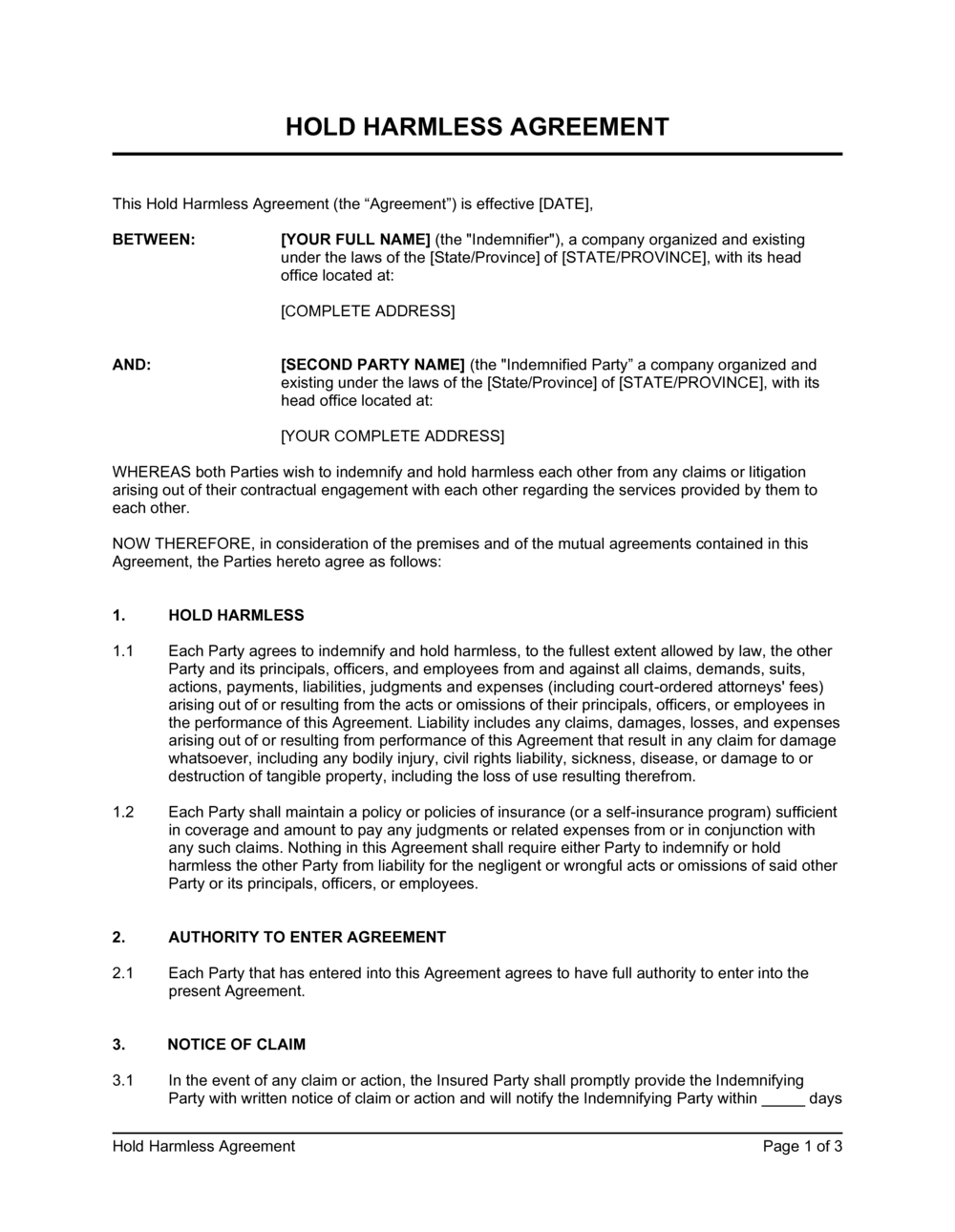
A Hold Harmless Agreement is a legally binding contract in which one party agrees not to hold another party liable for losses, injuries, or damages arising from a specified activity, service, or business relationship. This template is a free Word download you can edit online and export as PDF — covering indemnification scope, risk assumption, negligence carve-outs, and insurance requirements in a single enforceable document.
When you need it
Use it before engaging in any activity where one party assumes risk on behalf of another — event hosting, contractor engagements, equipment rentals, physical activities, or vendor relationships where liability exposure needs to be clearly allocated in writing.
What's inside
Party identification and relationship context, scope of protected activities, indemnification and hold harmless obligations, negligence and gross misconduct carve-outs, insurance requirements, duration and termination conditions, governing law, and signature blocks for both parties.

What is a Hold Harmless Agreement?

A Hold Harmless Agreement is a legally binding contract in which one party — the indemnitor — agrees not to hold another party — the indemnitee — liable for losses, damages, costs, or claims arising from a specified activity, service, or business relationship. The document typically combines three overlapping protections: a hold harmless promise (the indemnitee will not be pursued for covered claims), an indemnification obligation (the indemnitor will compensate the indemnitee for any covered losses), and a duty to defend (the indemnitor will fund and manage the legal defense of covered claims). Together, these provisions transfer the financial and legal risk of a defined activity from the protected party to the party best positioned to manage it.

Why You Need This Document

Without a signed hold harmless agreement in place before the covered activity begins, liability for injuries, property damage, or third-party claims defaults to whichever party a court finds responsible — often the party with the deepest pockets, not the one that actually caused the loss. A contractor who damages a client's property, a subcontractor whose worker is injured on your job site, or an event vendor whose equipment harms a guest can all generate claims that land on your business if there is no written liability allocation in place. Beyond deflecting claims, a properly executed hold harmless agreement forces both parties to address insurance requirements upfront — confirming that the indemnitor actually has coverage before anything goes wrong, not after. This template gives you a professionally drafted, jurisdiction-aware starting point that covers the scope, carve-outs, insurance obligations, and survival provisions that distinguish enforceable agreements from those that fall apart when tested in court.

Which variant fits your situation?

If your situation is…Use this template
One-sided protection for a service provider against client claimsUnilateral Hold Harmless Agreement
Mutual protection where both parties release each other from liabilityMutual Hold Harmless Agreement
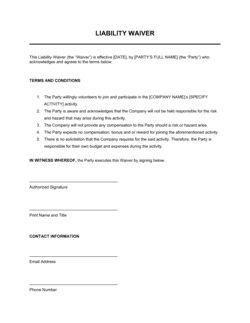
Participant waiving rights before a physical or recreational activityLiability Waiver and Release Form
Contractor indemnifying a property owner during construction workContractor Hold Harmless Agreement
Vendor or supplier releasing a business from liability tied to their productsVendor Indemnification Agreement
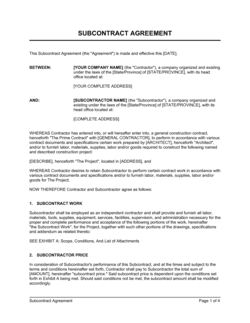
Subcontractor agreement with embedded indemnification clauseSubcontractor Agreement
Broad risk transfer as part of a larger services engagementGeneral Service Agreement with Indemnification

Common mistakes to avoid

❌ Signing after the covered activity has already started

Why it matters: A hold harmless agreement signed after an incident occurs provides no retroactive protection. Courts treat pre-existing claims as outside the scope of the agreement.

Fix: Make execution a prerequisite to the activity beginning. For recurring or ongoing services, include the hold harmless clause in the master agreement before any work commences.

❌ Using overly broad scope language

Why it matters: Phrases like 'any and all claims of any nature whatsoever' are frequently voided by courts as unreasonable attempts to eliminate liability for unrelated future acts.

Fix: Limit the scope to the specific activities, locations, and timeframe at issue. Specificity strengthens enforceability and signals that both parties understood what they were agreeing to.

❌ Omitting the duty to defend

Why it matters: Without an express duty to defend, the indemnitor is only obligated to reimburse costs after judgment — leaving the indemnitee to fund their own defense, which can cost tens of thousands of dollars before the case resolves.

Fix: Add 'defend' as an explicit obligation alongside 'indemnify and hold harmless.' State that the duty to defend is triggered on the filing of a claim, not on a final finding of liability.

❌ No carve-out for the indemnitee's own negligence

Why it matters: Many jurisdictions will not enforce a hold harmless agreement that purports to shield a party from the consequences of its own negligent acts unless this is stated with unmistakable clarity — and some states prohibit it outright.

Fix: Include a clear carve-out: 'this obligation shall not apply to losses caused by the sole negligence, gross negligence, or willful misconduct of Indemnitee.' Confirm this language meets local anti-indemnity statute requirements.

❌ Requiring insurance without demanding additional insured endorsement

Why it matters: A certificate of insurance confirms coverage exists but does not make the indemnitee an additional insured. Without the endorsement, the indemnitee cannot make a direct claim against the indemnitor's policy.

Fix: Require the indemnitor to provide both a certificate of insurance and a copy of the additional insured endorsement before work begins. Verify the endorsement actually names the indemnitee by entity name.

❌ No survival clause for indemnification obligations

Why it matters: If the agreement expires or terminates without a survival clause, claims that surface after termination but relate to covered activities may fall outside the agreement's protection — even if the incident occurred while the agreement was active.

Fix: Include an explicit survival clause: 'indemnification obligations shall survive expiration or termination of this Agreement for [X] years' — and align that period with the relevant statute of limitations.

The 9 key clauses, explained

Parties and relationship description

In plain language: Identifies both parties by their full legal names, roles in the agreement (indemnitor and indemnitee), and the nature of the business relationship that creates the liability exposure.

Sample language
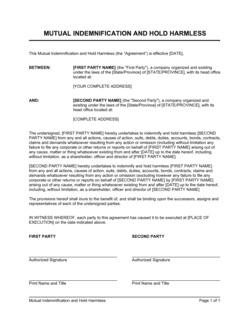
This Hold Harmless Agreement is entered into as of [DATE] by and between [INDEMNITOR FULL LEGAL NAME] ('Indemnitor') and [INDEMNITEE FULL LEGAL NAME] ('Indemnitee') in connection with [DESCRIPTION OF RELATIONSHIP OR ACTIVITY].

Common mistake: Using a trade name instead of the registered legal entity name. If a claim arises, enforcing the agreement against the wrong entity can void the protection entirely.

Scope of protected activities

In plain language: Defines precisely which activities, events, locations, or services the hold harmless protection applies to, preventing disputes about whether a particular incident falls within the agreement.

Sample language
This Agreement applies to all activities conducted by Indemnitor in connection with [SPECIFIC ACTIVITY, PROJECT, OR SERVICE] at [LOCATION/ADDRESS] during the period commencing [START DATE] and ending [END DATE OR 'until completion of services'].

Common mistake: Defining the scope too broadly with language like 'any and all activities.' Courts in several jurisdictions reject sweeping language as an attempt to waive liability for unrelated future acts.

Hold harmless and indemnification obligation

In plain language: The core clause where the indemnitor agrees to protect, defend, and compensate the indemnitee against claims, suits, costs, and damages arising from the covered activities.

Sample language
Indemnitor agrees to defend, indemnify, and hold harmless Indemnitee and its officers, directors, employees, and agents from and against any and all claims, damages, losses, costs, and expenses (including reasonable attorneys' fees) arising out of or related to [COVERED ACTIVITY], except as provided in Section [X].

Common mistake: Omitting defense obligations — requiring only indemnification after judgment. Without a duty to defend, the indemnitee must fund their own legal defense and seek reimbursement later, which can be costly and uncertain.

Negligence and gross misconduct carve-outs

In plain language: Specifies the circumstances under which the indemnitor's protection does not apply — most commonly, the indemnitee's own negligence, gross negligence, or intentional misconduct.

Sample language
Notwithstanding the foregoing, Indemnitor's obligations under this Agreement shall not apply to losses arising from the sole negligence, gross negligence, willful misconduct, or fraud of Indemnitee or any of its agents or employees.

Common mistake: Omitting carve-outs for the indemnitee's own negligence. Several US states and most non-US jurisdictions refuse to enforce agreements that purport to release a party from liability for its own negligence without explicit language.

Assumption of risk

In plain language: A declaration by the indemnitor — or by a participant in the covered activity — acknowledging they are aware of the inherent risks and voluntarily accept them.

Sample language
Indemnitor acknowledges that the activities described herein involve inherent risks, including [SPECIFIC RISKS], and voluntarily assumes all such risks on behalf of itself and its employees, agents, and subcontractors.

Common mistake: Using generic risk language without listing activity-specific hazards. Courts scrutinize assumption-of-risk clauses closely — the more specific the risk disclosure, the stronger the protection.

Insurance requirements

In plain language: Requires the indemnitor to maintain specified insurance coverage — type, minimum limits, and additional insured status — for the duration of the covered activities.

Sample language
Indemnitor shall maintain, at its own expense, commercial general liability insurance with minimum limits of $[AMOUNT] per occurrence and $[AMOUNT] in the aggregate, naming Indemnitee as an additional insured, and shall provide a certificate of insurance upon request.

Common mistake: Requiring insurance without mandating additional insured status for the indemnitee. Without this designation, the indemnitee's insurer must respond to claims first, undermining the hold harmless protection.

Duration and termination

In plain language: States when the agreement takes effect, how long the hold harmless obligations last, and whether any obligations survive termination of the underlying relationship.

Sample language
This Agreement shall be effective as of [EFFECTIVE DATE] and shall remain in full force during the period of [ACTIVITY/SERVICE]. The indemnification obligations set forth herein shall survive the expiration or termination of this Agreement for a period of [X] years.

Common mistake: Not including a survival clause. If the agreement expires or is terminated and no survival provision exists, claims that arise later — but relate to covered activities — may fall outside the protection.

Governing law and dispute resolution

In plain language: Specifies which jurisdiction's law governs the agreement and how disputes will be resolved — litigation, mediation, or arbitration — and in which venue.

Sample language
This Agreement shall be governed by and construed in accordance with the laws of the State of [STATE], without regard to conflicts of law principles. Any dispute arising hereunder shall be resolved by [binding arbitration / mediation / litigation] in [CITY, STATE].

Common mistake: Choosing a governing law that has no connection to where the activity occurs or where either party is based. Courts in the activity's jurisdiction may apply local law anyway, particularly for consumer-facing agreements.

Severability and entire agreement

In plain language: Confirms that if any clause is found unenforceable, the rest of the agreement remains in effect, and that the written document is the complete and final expression of the parties' agreement.

Sample language
If any provision of this Agreement is held to be invalid or unenforceable, the remaining provisions shall continue in full force and effect. This Agreement constitutes the entire agreement between the parties with respect to its subject matter and supersedes all prior representations and understandings.

Common mistake: Relying on severability alone without including a reformation clause. Some courts simply void an unenforceable clause rather than rewriting it; a reformation clause asks the court to modify the provision to the minimum extent necessary to make it enforceable.

How to fill it out

  1. 1

    Identify both parties with legal entity names

    Enter the full registered legal name of the indemnitor and the indemnitee — not trade names or DBAs. Include each party's state of formation, address, and authorized signatory.

    💡 Pull the exact entity name from your secretary of state's business registry to avoid a mismatch that could complicate enforcement.

  2. 2

    Define the scope of covered activities precisely

    Describe the specific activity, project, location, and date range the agreement covers. Avoid catch-all language like 'any activity whatsoever' — be as specific as the situation allows.

    💡 If the activity will occur at multiple locations or over a rolling period, list each location or define the period as 'the term of the master services agreement dated [DATE].'

  3. 3

    Draft the core indemnification obligation

    State clearly that the indemnitor will defend, indemnify, and hold harmless the indemnitee from covered claims. Confirm whether the duty to defend is included — it should be — and specify that it extends to attorneys' fees and costs.

    💡 Using 'defend, indemnify, and hold harmless' together covers the full spectrum: active legal defense, financial indemnification, and the broader hold harmless promise.

  4. 4

    Insert negligence and misconduct carve-outs

    Add explicit language excluding the indemnitee's own sole negligence, gross negligence, and willful misconduct from the covered protection. This is required for enforceability in most jurisdictions.

    💡 Some states — Texas, Louisiana, and Montana — require the carve-out language to meet specific anti-indemnity statute standards. Review the applicable statute before finalizing.

  5. 5

    Specify insurance requirements and additional insured status

    List the required insurance types (commercial general liability, workers' compensation, professional liability if applicable), minimum coverage limits, and the requirement to name the indemnitee as an additional insured on the CGL policy.

    💡 Ask the indemnitor to attach a certificate of insurance — ACORD 25 form — to the signed agreement. A certificate without an additional insured endorsement provides no actual coverage.

  6. 6

    Set the duration and include a survival clause

    State the effective date, the end date or triggering termination event, and confirm that indemnification obligations survive termination for a defined period — typically 2–3 years to cover the applicable statute of limitations.

    💡 Align the survival period with the statute of limitations for personal injury or property damage claims in the governing jurisdiction, which is typically 2–3 years in most US states.

  7. 7

    Confirm governing law and dispute resolution mechanism

    Choose the state or country whose law governs the agreement and specify how disputes will be resolved. Arbitration is faster and cheaper for most commercial disputes; litigation may be preferable if injunctive relief is likely to be needed.

    💡 For consumer-facing agreements (fitness, recreation, events), choose the jurisdiction where the activity occurs — courts frequently reject forum-selection clauses that require consumers to litigate in a distant state.

  8. 8

    Execute before the activity begins

    Both parties must sign before the covered activity starts. A hold harmless agreement signed after an incident has occurred provides no protection for that incident.

    💡 Use a digital signature platform to timestamp execution and create an audit trail. Store the fully executed copy alongside your insurance certificates.

Frequently asked questions

What is a hold harmless agreement?

A hold harmless agreement is a legally binding contract in which one party — the indemnitor — agrees not to hold another party — the indemnitee — liable for certain losses, damages, or claims arising from a specified activity or relationship. It transfers the financial risk of a potential claim from the protected party to the indemnitor and typically includes an obligation to defend the indemnitee against covered lawsuits as well as to compensate them for any resulting losses.

What is the difference between a hold harmless agreement and an indemnity agreement?

The terms are often used interchangeably in practice, but they have slightly different technical meanings. An indemnity obligation requires the indemnitor to compensate the indemnitee for covered losses after they occur. A hold harmless obligation goes further — the indemnitor agrees not to pursue the indemnitee for any covered claims at all. Most well-drafted agreements include both: 'defend, indemnify, and hold harmless' together provide the broadest protection available.

What is the difference between a hold harmless agreement and a liability waiver?

A liability waiver is typically a one-sided document signed by a participant — such as a gym member or event attendee — releasing the organizer from liability for the participant's own injuries. A hold harmless agreement is usually a bilateral business contract between two commercial parties that allocates liability for claims arising from their working relationship. Waivers are consumer-facing; hold harmless agreements are generally B2B instruments.

Is a hold harmless agreement enforceable?

A hold harmless agreement is generally enforceable when properly executed, clearly scoped, and consistent with applicable law. Enforceability depends heavily on jurisdiction — some states have anti-indemnity statutes that void certain provisions in construction contracts, and most jurisdictions refuse to enforce clauses that purport to protect a party from its own gross negligence or intentional misconduct. Courts also scrutinize consumer-facing agreements for unconscionability. Legal review before use in a high-stakes context is strongly recommended.

Do I need a lawyer to draft a hold harmless agreement?

For straightforward commercial arrangements — contractor engagements, event participation, vendor relationships — a well-drafted template is a solid starting point. You should engage a lawyer when the activity involves significant personal injury risk, when anti-indemnity statutes in your state apply to the industry (construction, in particular), when the agreement is part of a multi-party contract, or when the financial exposure justifies the cost. A 1–2 hour attorney review typically runs $300–$600 and is worthwhile for any agreement covering material risk.

What states have anti-indemnity statutes that affect hold harmless agreements?

Most US states have anti-indemnity statutes that restrict or void indemnification clauses in construction contracts — including California, Texas, Florida, New York, and Illinois. These statutes typically prohibit a general contractor from requiring a subcontractor to indemnify it for the general contractor's own negligence. Several states extend similar restrictions to other industries. If the agreement relates to construction or a regulated industry, confirm the applicable statute before finalizing the indemnification language.

Should a hold harmless agreement be mutual or one-sided?

It depends on the risk profile of each party. A unilateral (one-sided) agreement makes sense when one party — such as a contractor accessing a property — assumes substantially all the risk of the activity. A mutual agreement is appropriate when both parties face meaningful liability exposure from the relationship — for example, two businesses running a joint promotion where each creates its own legal exposure. Defaulting to mutual protection is common in commercial contracts to avoid negotiation friction.

How long should a hold harmless agreement last?

The agreement should remain in effect for the duration of the covered activity and, through a survival clause, for an additional period after termination equal to the applicable statute of limitations for personal injury or property damage claims — typically 2–3 years in most US states, and up to 6 years in the UK. For ongoing vendor or contractor relationships, tie the duration to the master services agreement and include automatic renewal language.

Can a hold harmless agreement protect against employee injury claims?

Generally no — workers' compensation statutes in every US state and most other jurisdictions prevent employers from contractually shifting liability for employee on-the-job injuries to third parties. A hold harmless agreement can, however, require a contractor to carry workers' compensation insurance for its own employees and to indemnify the property owner for third-party claims arising from those employees' work. This does not replace mandatory workers' comp coverage.

How this compares to alternatives

vs Liability Waiver

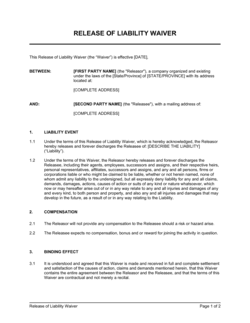
A liability waiver is a consumer-facing document signed by a participant releasing an organizer or operator from claims arising from the participant's own voluntary engagement in an activity. A hold harmless agreement is a commercial contract between two business parties that allocates liability for claims arising from their working relationship. Waivers are one-sided and participation-focused; hold harmless agreements are bilateral and relationship-focused.

vs Indemnification Clause (in a broader contract)

An indemnification clause embedded in a service agreement, lease, or construction contract addresses liability allocation within that specific relationship. A standalone hold harmless agreement provides a self-contained, fully executed document with its own recitals, representations, and governing terms — useful when the parties have no other written contract or need to supplement one with explicit liability language.

vs General Release of Liability

A general release extinguishes a known, specific existing claim between parties — often signed as part of a settlement. A hold harmless agreement is prospective, governing future claims that may arise from an ongoing or upcoming activity. Use a release to close out a past dispute; use a hold harmless agreement to manage risk before an activity begins.

vs Subcontractor Agreement

A subcontractor agreement covers the full scope of the working relationship — deliverables, payment, timeline, warranties, and termination — with an indemnification clause as one component. A standalone hold harmless agreement focuses exclusively on liability allocation and is used when a comprehensive subcontractor agreement already exists or when only the liability piece needs to be documented separately.

Industry-specific considerations

Construction and contracting

Subcontractor indemnification obligations must be carefully drafted around state anti-indemnity statutes that void clauses requiring subcontractors to indemnify general contractors for their own negligence.

Events and hospitality

Venue operators and event organizers use hold harmless agreements with vendors, performers, and sponsors to allocate liability for property damage, personal injury, and third-party claims arising from the event.

Fitness, recreation, and sports

Combined with assumption-of-risk language, hold harmless agreements help studios, gyms, and adventure-sport operators limit exposure for participant injuries inherent to physical activities.

Real estate and property management

Landlords and property managers require hold harmless clauses from tenants, service vendors, and contractors accessing managed properties to limit exposure for injuries or damage occurring on-site.

Professional services

Consultants, IT service providers, and marketing agencies include mutual hold harmless clauses in master service agreements to limit cross-liability arising from errors, delays, or third-party claims tied to deliverables.

Manufacturing and logistics

Supply chain agreements require vendor indemnification for product defects, shipping damage, and third-party IP infringement claims, with insurance minimums enforced through certificate-of-insurance requirements.

Jurisdictional notes

United States

Most US states have anti-indemnity statutes that void clauses requiring one party to indemnify another for that party's own negligence, particularly in the construction industry. California, Texas, Florida, New York, and Illinois each have specific statutes that affect indemnification scope. At-will carve-outs for gross negligence and willful misconduct are required for enforceability in most states. Enforceability of consumer-facing agreements is further tested under unconscionability doctrine.

Canada

Canadian courts generally enforce hold harmless and indemnification agreements between commercial parties, provided the language is clear and unambiguous. Most provinces restrict indemnification in construction contracts through builders' lien legislation. In Quebec, indemnification agreements are governed by the Civil Code rather than common law, which applies a good faith standard and limits enforcement of clauses that appear abusive or disproportionate. French-language versions may be required for provincially regulated employers in Quebec.

United Kingdom

The Unfair Contract Terms Act 1977 and the Consumer Rights Act 2015 impose significant restrictions on the enforceability of indemnity clauses in consumer contracts — any such clause must pass a reasonableness test. Between commercial parties, indemnification clauses are generally enforceable if clearly drafted, but courts will construe ambiguous language against the party relying on the clause. Post-Brexit, EU regulations no longer apply, but UK courts continue to follow established common law principles on indemnification.

European Union

EU member states generally permit commercial indemnification agreements, but consumer-facing hold harmless clauses are tightly restricted under the EU Unfair Contract Terms Directive. Clauses that significantly imbalance parties' rights to the consumer's detriment are void. GDPR may be relevant if the hold harmless agreement relates to data processing activities — liability allocation for data breaches should be addressed in a separate data processing agreement. Member-state civil code jurisdictions (France, Germany, Italy) each apply local rules on limitation of liability that may affect enforceability.

Template vs lawyer — what fits your deal?

PathBest forCostTime
Use the templateStandard commercial engagements — contractor access, event vendors, equipment rentals — with moderate, well-defined riskFree15–30 minutes
Template + legal reviewConstruction projects, high-risk physical activities, multi-party arrangements, or industries subject to anti-indemnity statutes$300–$6001–3 days
Custom draftedLarge-scale infrastructure projects, high-value commercial transactions, or agreements involving significant personal injury exposure and institutional counterparties$1,000–$4,000+1–2 weeks

Glossary

Hold Harmless
A contractual promise by one party to absorb liability for specified losses or claims and not pursue the other party for those damages.
Indemnification
An obligation by one party to compensate another for losses, costs, or damages arising from a defined event or relationship.
Indemnitor
The party who agrees to accept liability and compensate the other party — the one providing the protection.
Indemnitee
The party who is protected from liability and will be compensated if a covered claim arises.
Unilateral Hold Harmless
An arrangement where only one party is protected, typically the service provider or property owner with greater exposure.
Mutual Hold Harmless
An arrangement where both parties agree to protect each other from their respective liabilities arising from the relationship.
Gross Negligence
An extreme degree of carelessness or reckless disregard for others' safety that most hold harmless agreements explicitly exclude from protection.
Assumption of Risk
Acknowledgment by a party that they understand and voluntarily accept the known dangers associated with a particular activity.
Indemnification Trigger
The specific event, claim, or circumstance that activates the indemnifying party's obligation to compensate or defend the protected party.
Additional Insured
A designation on an insurance policy that extends coverage to a third party — often the indemnitee — named in a hold harmless agreement.
Severability
A contract provision stating that if one clause is found unenforceable, the remainder of the agreement continues in full force.

Part of your Business Operating System

This document is one of 3,000+ business & legal templates included in Business in a Box.

  • Fill-in-the-blanks — ready in minutes
  • 100% customizable Word document
  • Compatible with all office suites
  • Export to PDF and share electronically

Create your document in 3 simple steps.

From template to signed document — all inside one Business Operating System.
1
Download or open template

Access over 3,000+ business and legal templates for any business task, project or initiative.

2
Edit and fill in the blanks with AI

Customize your ready-made business document template and save it in the cloud.

3
Save, Share, Send, Sign

Share your files and folders with your team. Create a space of seamless collaboration.

Save time, save money, and create top-quality documents.

★★★★★

"Fantastic value! I'm not sure how I'd do without it. It's worth its weight in gold and paid back for itself many times."

Managing Director · Mall Farm
Robert Whalley
Managing Director, Mall Farm Proprietary Limited
★★★★★

"I have been using Business in a Box for years. It has been the most useful source of templates I have encountered. I recommend it to anyone."

Business Owner · 4+ years
Dr Michael John Freestone
Business Owner
★★★★★

"It has been a life saver so many times I have lost count. Business in a Box has saved me so much time and as you know, time is money."

Owner · Upstate Web
David G. Moore Jr.
Owner, Upstate Web

Run your business with a system — not scattered tools

Stop downloading documents. Start operating with clarity. Business in a Box gives you the Business Operating System used by over 250,000 companies worldwide to structure, run, and grow their business.

Free Forever Plan · No credit card required