Liability Waiver Template

Free Word download β€’ Edit online β€’ Save & share with Drive β€’ Export to PDF

1 pageβ€’20–30 min to fillβ€’Difficulty: Standardβ€’Signature requiredβ€’Legal review recommended
Learn more ↓
FreeLiability Waiver Template

At a glance

What it is
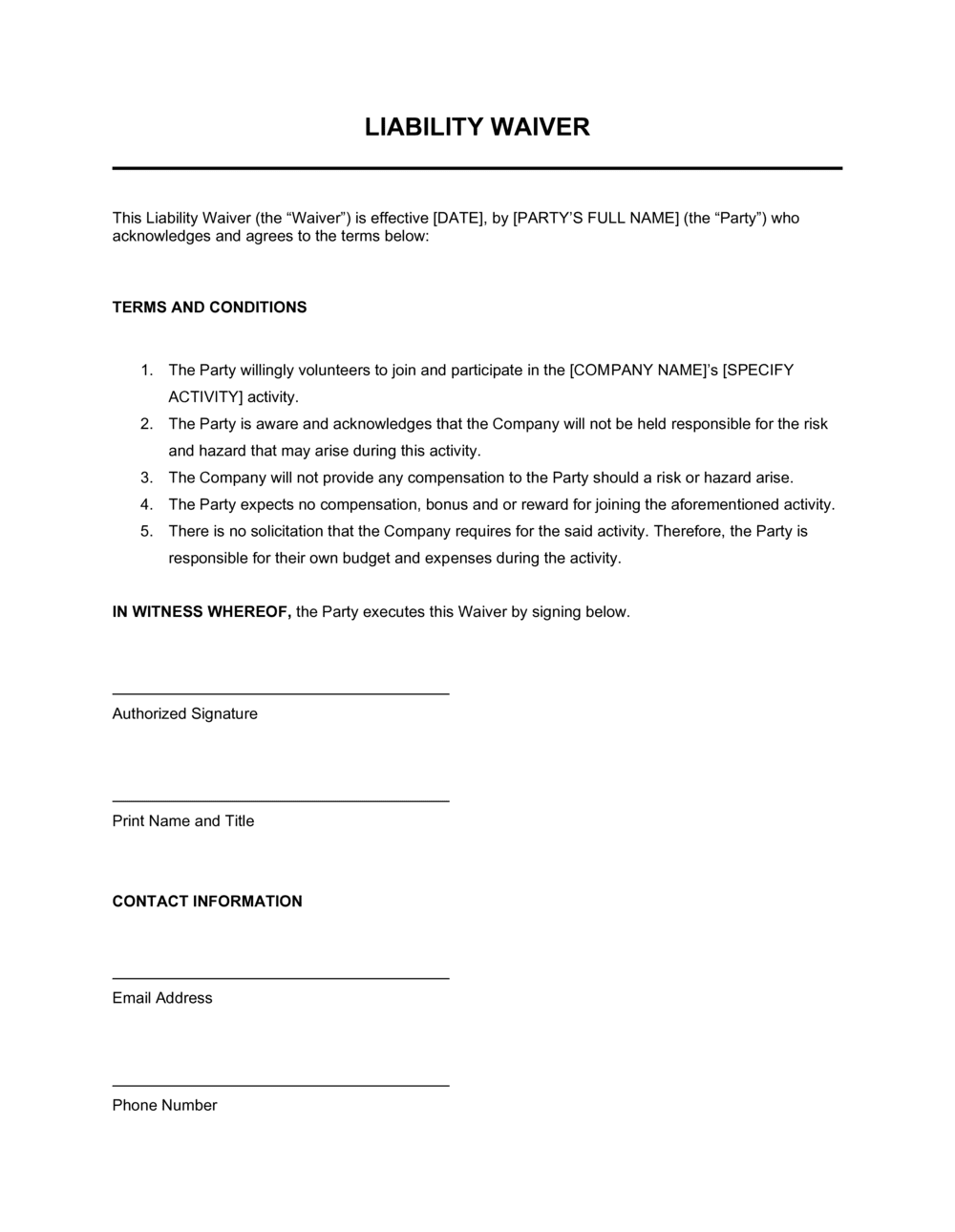
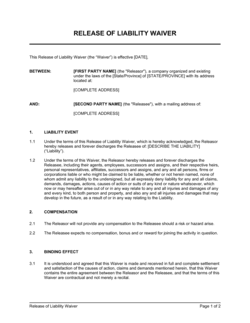
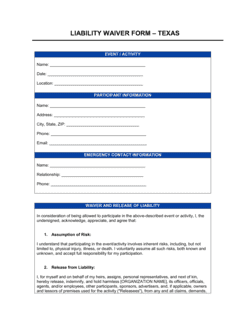
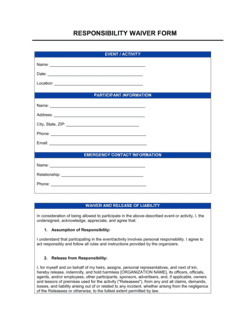
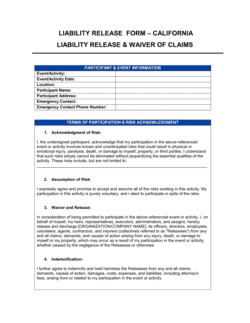
A Liability Waiver is a signed legal document in which a participant voluntarily releases an organization from claims for injury, loss, or damage arising from a specified activity. This template is a free Word download you can edit online and export as PDF β€” covering assumption of risk, release of claims, indemnification, and an emergency contact block in a single document ready for participant signature before any activity begins.
When you need it
Use it before any activity that carries a foreseeable risk of physical injury or property loss β€” fitness classes, sports leagues, outdoor adventures, events, recreational programs, or B2B engagements involving access to physical premises or equipment. Collect a signed copy from every participant before the activity starts.
What's inside
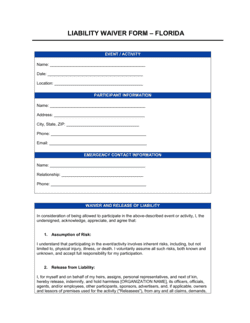
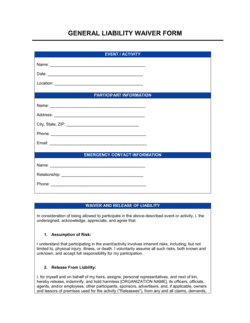
Identification of the releasing party and the organization, a description of the specific activity and its inherent risks, an assumption-of-risk acknowledgment, a release and waiver of claims clause, indemnification and hold-harmless language, a photo and media release, an emergency contact block, a severability clause, and a signature block with date.

What is a Liability Waiver?

A Liability Waiver is a signed legal document in which a participant voluntarily releases an organization from claims for injury, property loss, or damage arising from a specified activity. By signing, the participant acknowledges the inherent risks of the activity, confirms they are participating voluntarily, and agrees not to pursue legal claims against the organization for ordinary negligence β€” before any incident occurs. Waivers are standard practice in fitness, sports, outdoor recreation, events, and any context where foreseeable physical risk is part of the participant's experience.

Why You Need This Document

Operating any activity that carries physical risk without a signed waiver leaves your organization exposed to personal injury claims that can cost tens of thousands of dollars in legal fees alone β€” before any damages are assessed. A properly drafted waiver does three things simultaneously: it creates a documented record that the participant understood and accepted the specific risks; it extinguishes ordinary negligence claims under the law of most US states and Canadian provinces; and it provides indemnification protection if a participant's own conduct injures a third party. Without one, your first line of defense in any lawsuit is missing. This template gives you that foundation β€” covering assumption of risk, release of claims, indemnification, and emergency authorization in a single Word document you can have participants sign in minutes, digitally or on paper, before they set foot in your facility or event.

Which variant fits your situation?

If your situation is…Use this template
General activity or fitness class with adult participantsLiability Waiver
Participant is a minor requiring parental or guardian signatureMinor Liability Waiver (Parental Consent Form)
Waiver for a one-time event such as a race or festivalEvent Liability Waiver
Gym or fitness facility with ongoing membership enrollmentGym Membership Agreement with Liability Release
Contractor or vendor accessing a business's physical premisesIndemnification Agreement
Photo and media rights for event participants onlyPhoto Release Form
Medical or wellness procedure with informed-consent requirementsInformed Consent Form

Common mistakes to avoid

❌ Using a trade name instead of the registered legal entity as the releasee

Why it matters: If the organization named on the waiver does not match the legal defendant, a court may find the release does not cover the actual party being sued β€” voiding the protection entirely.

Fix: Use the full registered corporate or LLC name as it appears in your state or provincial registry, then add 'doing business as [BRAND NAME]' if needed.

❌ Collecting signatures after the activity has already begun

Why it matters: A waiver signed mid-activity or at the end provides little enforceability because the participant had no meaningful opportunity to decline and has already been exposed to the risk.

Fix: Build the waiver into your registration or check-in process so participants cannot access the activity area until a signed document is on file.

❌ Omitting specific risk language and relying on 'any and all risks'

Why it matters: Vague catch-all risk language is the single most common reason courts invalidate waivers β€” participants can argue they did not have informed notice of the specific hazard that caused their injury.

Fix: List at least four to six activity-specific risks by name, drawn from your incident history, industry standards, or insurer's risk assessment.

❌ Attempting to waive gross negligence or intentional misconduct

Why it matters: In most jurisdictions, waivers of gross negligence and all waivers of intentional wrongdoing are void as against public policy. Including such language can taint the entire agreement.

Fix: Limit the release to ordinary negligence. If you are unsure where your jurisdiction draws the line, have a local attorney review the release clause before use.

❌ Using the same waiver form for minors and adults

Why it matters: Minors lack legal capacity to contract in every jurisdiction. A waiver signed by a minor is not enforceable against them, and in many states a parent's waiver of a minor's future claims is also void.

Fix: Use a separate minor-participant waiver form with a parental or guardian signature block, and consult a lawyer about enforceability in your state before relying on it.

❌ Failing to retain signed waivers past the incident date

Why it matters: If a claim is filed years after an incident and you cannot produce the signed waiver, you have no defense β€” even if the participant did sign.

Fix: Implement a digital waiver system that archives signed documents with timestamps and auto-retains them for the maximum applicable statute of limitations period in your jurisdiction.

The 9 key clauses, explained

Parties and activity identification

In plain language: Names the participant (releasing party) and the organization (releasee) and describes the specific activity covered by the waiver.

Sample language
This Liability Waiver ('Agreement') is entered into by [PARTICIPANT FULL NAME] ('Participant') in favor of [ORGANIZATION LEGAL NAME], its officers, directors, employees, agents, and successors ('Organization'), in connection with Participant's voluntary participation in [ACTIVITY DESCRIPTION] on or after [DATE].

Common mistake: Using a brand name instead of the registered legal entity as the releasee. If the legal name on the waiver does not match the defendant in litigation, the organization's protection is weakened.

Description of inherent risks

In plain language: Lists the specific, foreseeable dangers of the activity so the participant's assumption of risk is clearly informed rather than generic.

Sample language
Participant acknowledges that [ACTIVITY NAME] involves inherent risks including, without limitation: physical exertion, falls, collisions with other participants or equipment, [ACTIVITY-SPECIFIC RISK], and environmental hazards that may result in serious injury, disability, or death.

Common mistake: Using a vague catch-all like 'any and all risks' without listing specific hazards. Courts scrutinize whether the participant truly understood what they were releasing; specific language is far more defensible.

Assumption of risk

In plain language: The participant expressly acknowledges they understand the risks and are voluntarily choosing to participate despite them.

Sample language
Participant voluntarily assumes all risks associated with [ACTIVITY NAME], whether known or unknown, foreseeable or unforeseeable, and agrees that Organization is not responsible for any injury or loss resulting from such risks.

Common mistake: Omitting the word 'voluntarily.' Without it, a participant can argue they had no meaningful choice β€” especially in employment or membership contexts where opting out would cost them a benefit.

Release and waiver of claims

In plain language: The core operative clause extinguishing the participant's right to sue the organization for negligence arising from the activity.

Sample language
In consideration of being permitted to participate, Participant hereby releases, waives, and forever discharges Organization from any and all claims, demands, actions, or causes of action arising out of or related to any loss, damage, or injury β€” including death β€” sustained during [ACTIVITY NAME], whether caused by the negligence of Organization or otherwise.

Common mistake: Failing to specify 'negligence' expressly. In many jurisdictions, a general release does not waive negligence claims unless negligence is mentioned explicitly in the clause.

Indemnification and hold harmless

In plain language: Requires the participant to reimburse the organization for legal costs and damages if a third party brings a claim related to the participant's own conduct during the activity.

Sample language
Participant agrees to indemnify, defend, and hold harmless Organization from any claim, liability, loss, or expense β€” including reasonable attorney's fees β€” arising out of or related to Participant's own acts or omissions during [ACTIVITY NAME].

Common mistake: Drafting the indemnification so broadly that it purports to cover the organization's own intentional misconduct. Courts regularly void such clauses and may invalidate the broader agreement.

Photo and media release

In plain language: Grants the organization the right to use photos, videos, and recordings of the participant taken during the activity for promotional or documentary purposes.

Sample language
Participant grants Organization a perpetual, royalty-free license to use Participant's name, image, likeness, and voice captured during [ACTIVITY NAME] for marketing, promotional, or educational purposes, without further compensation or consent.

Common mistake: Bundling the media release inside the liability release without a separate checkbox or acknowledgment. If a participant disputes the media use, a combined clause is harder to sever without affecting the liability release.

Emergency medical authorization

In plain language: Authorizes the organization to consent to emergency medical treatment on the participant's behalf if the participant is incapacitated and cannot consent themselves.

Sample language
In the event of a medical emergency in which Participant is unable to provide consent, Participant authorizes Organization to obtain emergency medical treatment on Participant's behalf. Emergency contact: [NAME], [PHONE].

Common mistake: Omitting an emergency contact block entirely. Without it, staff face delays contacting next of kin and organizations face criticism for operational unpreparedness β€” which can be used against them in negligence arguments.

Severability and entire agreement

In plain language: Ensures that if any clause is found unenforceable by a court, the rest of the agreement survives, and that the written document is the complete record of what was agreed.

Sample language
If any provision of this Agreement is held invalid or unenforceable, the remaining provisions shall continue in full force and effect. This Agreement constitutes the entire agreement between the parties regarding the subject matter herein and supersedes all prior representations or understandings.

Common mistake: No severability clause. In jurisdictions that void certain exculpatory clauses on public policy grounds, a waiver without severability can fail entirely rather than surviving with the offending clause excised.

Governing law and acknowledgment of voluntary execution

In plain language: States which jurisdiction's law governs the agreement and includes an express acknowledgment that the participant read, understood, and signed voluntarily β€” not under duress.

Sample language
This Agreement is governed by the laws of [STATE / PROVINCE / COUNTRY]. Participant acknowledges that they have read this Agreement, understand its terms, had the opportunity to ask questions, and are signing voluntarily and without duress.

Common mistake: Choosing a governing law that has no connection to where the activity occurs. Several states β€” California, New York β€” apply local public policy rules regardless of a contractual choice-of-law clause, potentially voiding the entire waiver.

How to fill it out

  1. 1

    Identify the releasee using the full legal entity name

    Enter the registered legal name of the organization β€” not a trade name or DBA β€” as the releasee. Include officers, employees, agents, and successors in the covered parties list.

    πŸ’‘ Cross-check the name against your state or provincial corporate registry before printing. A name mismatch is the first thing a plaintiff's attorney will exploit.

  2. 2

    Describe the specific activity and its date or date range

    Name the exact activity (e.g., 'indoor rock climbing sessions') and enter either a single event date or an ongoing date range if the waiver covers a membership period or season.

    πŸ’‘ Avoid 'any activity at our facility.' Courts read overbroad scope language skeptically β€” specificity strengthens enforceability.

  3. 3

    List the specific inherent risks of the activity

    Replace the placeholder risk list with hazards actually associated with your activity. For a cycling class: falls from stationary bikes, overexertion, dehydration. For a climbing wall: falls, rope entanglement, equipment failure.

    πŸ’‘ Pull your list from your insurance carrier's incident reports or industry safety guidelines β€” this shows the risk description is grounded in real operational knowledge.

  4. 4

    Confirm the release clause names negligence expressly

    Verify that the release of claims paragraph uses the word 'negligence' explicitly. If your jurisdiction requires it, also add 'gross negligence' only if local law permits such a waiver β€” consult a lawyer before including it.

    πŸ’‘ In California, Louisiana, and Virginia, waivers of gross negligence are void as against public policy. Remove that language for participants in those states.

  5. 5

    Set the governing law to match the activity location

    Enter the state, province, or country where the activity actually takes place β€” not where your business is incorporated. Local courts will apply local law regardless of what the contract says.

    πŸ’‘ If you operate in multiple states, consider a jurisdiction-specific version of the waiver for each location rather than a single national form.

  6. 6

    Add the emergency contact block and medical authorization

    Include fields for the participant's emergency contact name, relationship, and phone number. Confirm the medical authorization language authorizes staff to act in the participant's incapacity.

    πŸ’‘ For minors, replace the participant's emergency contact with a parental consent block and use a separate minor-participant waiver form signed by the parent or guardian.

  7. 7

    Collect signatures before β€” not during or after β€” the activity

    Present the waiver to each participant before they access the activity area, equipment, or event venue. Ensure they sign and date the document in your presence or via a verified e-signature platform.

    πŸ’‘ Digital waivers collected via e-signature are admissible in virtually all US jurisdictions β€” timestamp the signature and store the IP address and device fingerprint as supporting evidence.

  8. 8

    Retain signed waivers for the applicable statute of limitations period

    Store executed waivers for at least as long as the statute of limitations for personal injury claims in your jurisdiction β€” typically 2–3 years in most US states, up to 6 years in some Canadian provinces.

    πŸ’‘ For activities involving minors, the statute of limitations may not begin running until the minor turns 18. Retain those waivers until the participant is at least 20–21 years old depending on local rules.

Frequently asked questions

What is a liability waiver?

A liability waiver is a signed legal document in which a participant voluntarily releases an organization from claims for injury, loss, or damage arising from a specific activity. It typically includes an assumption-of-risk acknowledgment, a release of claims clause, and indemnification language. Waivers are commonly used in fitness, sports, recreation, events, and certain B2B engagements involving physical access to premises or equipment.

Are liability waivers enforceable?

Liability waivers are generally enforceable in most US states and Canadian provinces for ordinary negligence when they clearly identify the parties, describe the specific activity and its risks, and are signed voluntarily before the activity begins. However, enforceability varies significantly by jurisdiction β€” some states apply heightened scrutiny, and waivers of gross negligence or intentional misconduct are void in virtually all jurisdictions. A lawyer review is advisable before relying on a waiver for high-risk activities.

Can a liability waiver be signed electronically?

Yes. Electronic signatures on liability waivers are enforceable under the US ESIGN Act and UETA in all 50 states, under Canada's PIPEDA and provincial e-signature statutes, and under the EU eIDAS regulation. The key requirements are that the signer must affirmatively consent to electronic signing, the document must be clearly presented before signing, and the platform must generate a tamper-evident record with a timestamp and identity link.

Does a liability waiver protect against all types of claims?

No. A well-drafted waiver typically protects against claims of ordinary negligence β€” failure to meet a reasonable standard of care. It does not protect against gross negligence (reckless disregard for safety), intentional misconduct, or fraud, and those exclusions apply regardless of what the waiver language says. In some jurisdictions and industries (amusement parks in New York, ski resorts in Vermont), additional statutory protections or restrictions apply.

Can a parent sign a liability waiver on behalf of a minor child?

This is one of the most jurisdiction-dependent questions in waiver law. In most US states, a parent's pre-activity waiver of a minor's future personal injury claims is not enforceable against the minor once they reach adulthood. Some states β€” California, New York, and Florida β€” have specifically ruled against parental waivers in recreational contexts. A few states permit them under limited conditions. Always consult a local attorney before using a parental waiver for youth programs.

What language must a liability waiver include to be enforceable?

At minimum: the full legal names of both parties, a description of the specific activity, a list of the inherent risks, an express assumption of those risks, a release of claims clause that names 'negligence' explicitly, indemnification language, a severability clause, governing law, and a signature with date. Several jurisdictions also require the release language to appear in conspicuous typeface β€” bold or all-caps β€” to prove the participant's attention was drawn to it.

How long should I keep signed liability waivers?

Keep signed waivers for at least as long as the personal injury statute of limitations in your jurisdiction β€” typically 2 years in most US states, though some allow up to 6 years. For activities involving minors, the statute of limitations may not begin until the child turns 18, so retain those waivers until the participant is at least 20–21 years old. A digital waiver system with automatic retention scheduling is the most reliable way to manage this.

What is the difference between a liability waiver and an indemnification agreement?

A liability waiver is signed by the participant to release the organization from claims the participant themselves might bring. An indemnification agreement is a contract between two parties β€” typically two businesses β€” where one agrees to cover the other's losses or legal costs arising from a specified event or relationship. A liability waiver often includes an indemnification clause as one component, covering third-party claims arising from the participant's own conduct during the activity.

Do I need a lawyer to use a liability waiver template?

For routine, low-to-medium-risk activities with adult participants in a single state, a high-quality template is usually sufficient as a starting point. Legal review is advisable when the activity carries a serious injury risk, when minors participate, when the waiver will be used across multiple states or countries, or when you are unsure whether your jurisdiction permits waiver of negligence claims for your specific activity type. A one-hour attorney review typically costs $150–$400 and is worthwhile for any ongoing program.

How this compares to alternatives

vs Indemnification Agreement

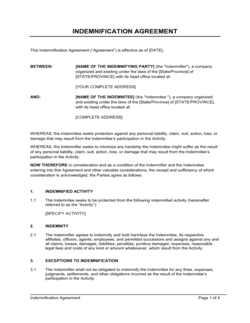
An indemnification agreement is a B2B contract where one party agrees to cover the other's losses arising from a shared project or relationship β€” typically used between companies, not between a business and an individual participant. A liability waiver is signed by an individual participant releasing an organization from personal injury claims. Use an indemnification agreement for vendor or contractor relationships; use a liability waiver for individual participants in activities.

vs Hold Harmless Agreement

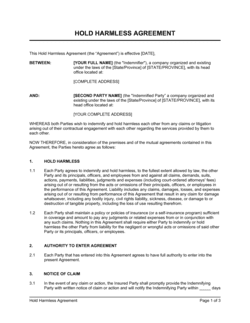
A hold harmless agreement and a liability waiver share similar protective language, but a hold harmless agreement is typically a standalone clause or short contract used in B2B or property contexts to prevent one party from suing another for specified losses. A liability waiver is specifically structured for individual participant use before a physical activity, with an assumption-of-risk acknowledgment and emergency contact block.

vs General Release

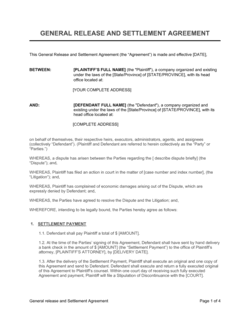
A general release extinguishes all claims between two parties β€” past, present, and future β€” arising from any matter, and is most commonly used to settle a dispute. A liability waiver is prospective only, covering future claims arising from a specific activity, and is signed before any incident occurs. A general release is the right tool after an incident; a liability waiver is the right tool before one.

vs Non-Disclosure Agreement

An NDA protects confidential information shared between parties during a business relationship β€” it has no connection to physical risk or personal injury. A liability waiver protects an organization from injury or loss claims arising from a participant's involvement in a physical activity. These documents serve entirely different purposes and should never be substituted for each other.

Industry-specific considerations

Fitness and Wellness

Waivers cover equipment use, group classes, and personal training; gyms should include specific risks such as overexertion, dropped weights, and cardiovascular stress.

Events and Entertainment

Race organizers, festivals, and experiential events use waivers for crowd-related injury, course hazards, and inclement-weather risks specific to the event format.

Outdoor Recreation and Adventure

Operators of climbing walls, zip lines, kayaking tours, and hiking excursions face elevated injury risk and should list activity-specific hazards in granular detail.

Youth Programs and Education

Camps, after-school sports, and field trip organizers require parental consent forms; minor-participant enforceability varies sharply by state and demands local legal review.

Jurisdictional notes

United States

Enforceability varies significantly by state. California courts apply strict scrutiny and frequently void waivers that are ambiguous or against public policy; New York and Virginia impose similar limitations. Most states enforce waivers of ordinary negligence but not gross negligence. Louisiana does not recognize pre-injury liability waivers at all. Many states require conspicuous typeface β€” bold or all-caps β€” for exculpatory language to be enforceable.

Canada

Canadian courts generally enforce liability waivers for ordinary negligence when the language is clear and the participant had a reasonable opportunity to review the document before signing. British Columbia's Negligence Act and Ontario case law impose a high standard of clarity. Quebec follows civil law principles and applies stricter limits on waiver enforceability. Parental waivers for minors are rarely enforceable in any province.

United Kingdom

The Unfair Contract Terms Act 1977 prohibits businesses from excluding liability for death or personal injury caused by their own negligence, making most liability waivers covering physical injury unenforceable against consumers in England, Wales, and Scotland. Consumer Rights Act 2015 extends similar protections. Waivers can still be useful for evidencing assumption of risk and are more enforceable in purely commercial (B2B) contexts. Legal advice is strongly recommended before use.

European Union

Consumer protection law across EU member states generally prohibits clauses that exclude liability for death or personal injury caused by a business's negligence. The EU Unfair Contract Terms Directive (93/13/EEC) renders such clauses unfair and non-binding against consumers. Waivers may carry some evidentiary value for assumption of risk arguments but cannot operate as a full release of liability in most member states. Country-specific rules apply, and local legal advice is essential for commercial operators.

Template vs lawyer β€” what fits your deal?

PathBest forCostTime
Use the templateLow-to-medium-risk activities with adult participants in a single US state or Canadian provinceFree15–30 minutes
Template + legal reviewHigh-risk activities, multi-state operations, or programs that include minor participants$150–$400 for a one-hour attorney review2–5 business days
Custom draftedCommercial adventure operators, regulated sports facilities, large-scale event organizers, or programs operating across multiple jurisdictions$500–$2,500+1–2 weeks

Glossary

Waiver
A voluntary and intentional relinquishment of a known legal right β€” in this context, the right to sue for injury or loss arising from a specified activity.
Release of Claims
A clause extinguishing the participant's right to pursue specific legal claims against the releasing organization, effective upon signature.
Assumption of Risk
An acknowledgment by the participant that they understand the inherent dangers of the activity and voluntarily choose to engage despite those risks.
Indemnification
A contractual obligation by one party to compensate another for losses, damages, or legal costs arising from a specified event or third-party claim.
Hold Harmless
A clause preventing one party from holding another legally responsible for losses β€” often paired with indemnification as 'indemnify, defend, and hold harmless.'
Gross Negligence
A standard of conduct significantly below ordinary care β€” reckless disregard for participant safety β€” that courts in most jurisdictions refuse to waive by contract.
Severability
A clause stating that if one provision of the agreement is found unenforceable, the remaining provisions continue in full effect.
Informed Consent
A participant's knowing agreement to an activity after being given sufficient information about its nature, risks, and alternatives.
Releasing Party
The individual signing the waiver and giving up the right to make a claim β€” typically the participant or, for a minor, the parent or guardian.
Releasee
The organization or individual being released from liability β€” typically the activity operator, its officers, employees, agents, and successors.
Exculpatory Clause
Contract language that attempts to excuse a party from liability for its own negligence β€” the core mechanism of a liability waiver.

Part of your Business Operating System

This document is one of 3,000+ business & legal templates included in Business in a Box.

  • Fill-in-the-blanks β€” ready in minutes
  • 100% customizable Word document
  • Compatible with all office suites
  • Export to PDF and share electronically

Create your document in 3 simple steps.

From template to signed document β€” all inside one Business Operating System.
1
Download or open template

Access over 3,000+ business and legal templates for any business task, project or initiative.

2
Edit and fill in the blanks with AI

Customize your ready-made business document template and save it in the cloud.

3
Save, Share, Send, Sign

Share your files and folders with your team. Create a space of seamless collaboration.

Save time, save money, and create top-quality documents.

β˜…β˜…β˜…β˜…β˜…

"Fantastic value! I'm not sure how I'd do without it. It's worth its weight in gold and paid back for itself many times."

Managing Director Β· Mall Farm
Robert Whalley
Managing Director, Mall Farm Proprietary Limited
β˜…β˜…β˜…β˜…β˜…

"I have been using Business in a Box for years. It has been the most useful source of templates I have encountered. I recommend it to anyone."

Business Owner Β· 4+ years
Dr Michael John Freestone
Business Owner
β˜…β˜…β˜…β˜…β˜…

"It has been a life saver so many times I have lost count. Business in a Box has saved me so much time and as you know, time is money."

Owner Β· Upstate Web
David G. Moore Jr.
Owner, Upstate Web

Run your business with a system β€” not scattered tools

Stop downloading documents. Start operating with clarity. Business in a Box gives you the Business Operating System used by over 250,000 companies worldwide to structure, run, and grow their business.

Start freeΒ Β·Β No credit card required