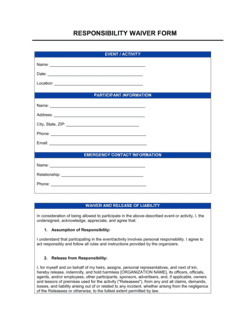
Release Of Liability Waiver Template

Free Word download β€’ Edit online β€’ Save & share with Drive β€’ Export to PDF

2 pagesβ€’20–30 min to fillβ€’Difficulty: Standardβ€’Signature requiredβ€’Legal review recommended
Learn more ↓
FreeRelease Of Liability Waiver Template

At a glance

What it is
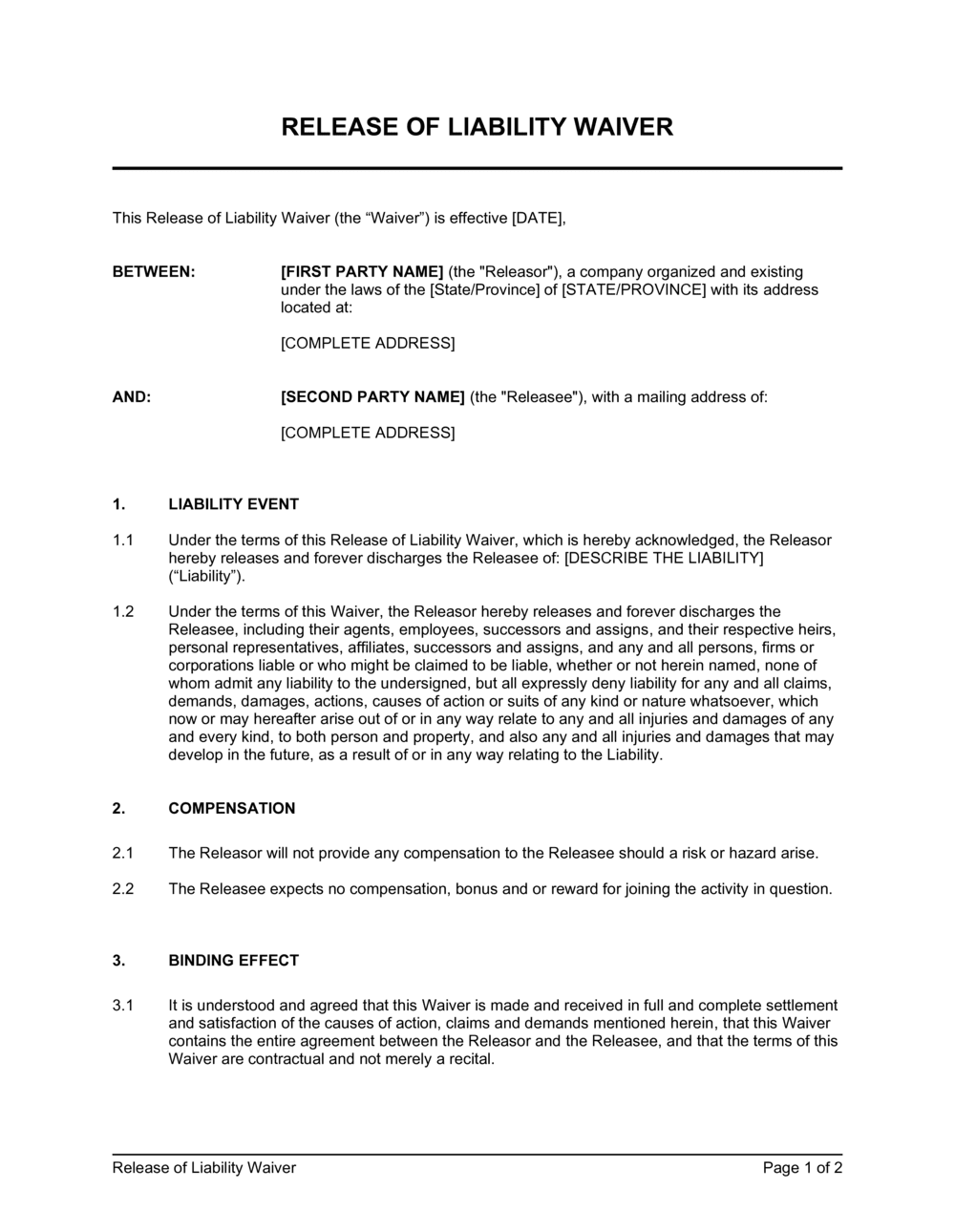
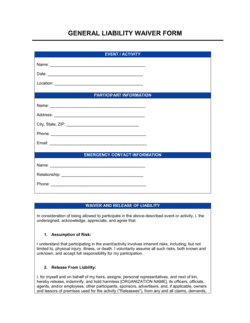
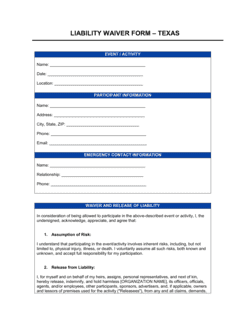
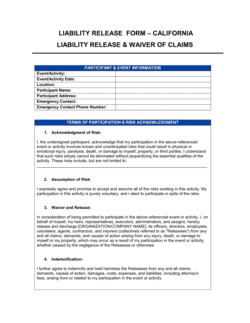
A Release of Liability Waiver is a legally binding document in which a participant or client voluntarily agrees to waive their right to sue a business or individual for injuries, losses, or damages arising from a specified activity or service. This free Word download gives you an editable, attorney-reviewed starting point you can tailor to your activity, export as PDF, and collect signatures before any participant takes part.
When you need it
Use it before any activity, event, or service that carries a risk of physical injury, property damage, or financial loss β€” including fitness classes, adventure sports, volunteer events, equipment rentals, and contractor engagements. It should be signed before participation begins, not after an incident has occurred.
What's inside
Identification of the parties, a plain-language description of the activity and its inherent risks, the waiver and release of claims, an assumption of risk acknowledgment, an indemnification clause, emergency medical authorization, and governing law.

What is a Release of Liability Waiver?

A Release of Liability Waiver is a legally binding document in which a participant or customer voluntarily relinquishes their right to bring legal claims against a business or individual for injuries, property damage, or losses arising from a specific activity or service. By signing, the participant acknowledges the inherent risks involved, agrees not to hold the operator responsible for ordinary negligence, and typically promises to indemnify the operator against related third-party claims. The document creates a contractual record β€” signed before participation β€” that courts can weigh when determining whether a plaintiff assumed the risks that led to their injury.

Why You Need This Document

Operating any activity that carries physical risk without a signed waiver leaves your business exposed to personal injury litigation that can cost tens of thousands of dollars to defend even when the claim ultimately fails. A properly drafted and delivered waiver creates a documented record that the participant understood the risks, chose to proceed voluntarily, and agreed not to sue for ordinary negligence β€” all of which are essential elements a court reviews before allowing a claim to proceed. Without one, a single incident can trigger a lawsuit that drains resources, disrupts operations, and raises your insurance premiums for years. This template gives you a fully editable, attorney-reviewed starting point that covers the clauses insurers and courts look for, so you can protect your business from day one of any new activity or program.

Which variant fits your situation?

If your situation is…Use this template
Participant in a fitness class, gym, or sports leagueFitness and Sports Liability Waiver
Volunteer performing services for a nonprofit or charityVolunteer Liability Waiver
Customer renting physical equipmentEquipment Rental Liability Waiver
Child participant requiring parental consentMinor Child Liability Waiver (with Parental Consent)
Contractor or vendor entering a worksiteContractor Hold Harmless Agreement
Event attendee or spectator at a public eventEvent Participant Liability Waiver
Patient or client consenting to a physical service (e.g., massage, tattoo)Client Service Consent and Waiver

Common mistakes to avoid

❌ Omitting 'negligence' from the release clause

Why it matters: In most jurisdictions, a release that does not explicitly mention negligence is interpreted as covering only intentional or strict-liability claims β€” leaving the most common basis for injury lawsuits entirely unprotected.

Fix: Ensure the release clause includes the phrase 'including claims arising from the negligence of Releasee' and review it every time you update the waiver.

❌ Presenting the waiver at the last moment before participation

Why it matters: Courts apply an unconscionability standard β€” if a participant had no real choice but to sign on the spot or forfeit a paid activity, the waiver may be voided as a contract of adhesion.

Fix: Send the waiver at least 24 hours in advance with a written delivery record. Note the delivery date and time in your participant management system.

❌ Using a parent's signature to waive a minor's own future claims

Why it matters: Many US states and Canadian provinces hold that a parent cannot waive a child's right to sue on the child's own behalf β€” the child may still bring suit upon reaching the age of majority.

Fix: Consult a local attorney if your activity regularly involves minors. Some jurisdictions enforce parental waivers for commercial activities; others do not. Rely on liability insurance as an additional layer of protection.

❌ Attempting to waive gross negligence or willful misconduct

Why it matters: Virtually every jurisdiction refuses to enforce waivers that attempt to release a party from liability for gross negligence or intentional harm β€” courts treat such clauses as void against public policy.

Fix: Limit the release to ordinary negligence and remove any language suggesting protection for reckless or intentional conduct. Overreaching waivers can invalidate the entire document in some states.

❌ Failing to update the waiver when the activity changes

Why it matters: A waiver drafted for indoor yoga classes does not cover a new outdoor parkour program. If the activity description no longer matches what the participant did, the waiver provides no protection for the new activity.

Fix: Review and update the waiver any time you add a new activity, change your equipment, or modify the environment in a way that introduces new risks.

❌ No severability clause

Why it matters: Without severability language, a court that finds one provision unenforceable β€” such as an overbroad media release or an illegal indemnification term β€” may void the entire waiver rather than severing only the offending clause.

Fix: Include a standard severability clause confirming that the unenforceability of any single provision does not affect the validity of the remaining terms.

The 9 key clauses, explained

Parties and Activity Description

In plain language: Identifies the releasor (participant) and releasee (business or operator) by full legal name and describes the specific activity or service covered.

Sample language
This Release of Liability Waiver ('Agreement') is entered into between [PARTICIPANT FULL NAME] ('Releasor') and [BUSINESS LEGAL NAME], a [STATE/PROVINCE] [ENTITY TYPE] ('Releasee'), in connection with Releasor's participation in [ACTIVITY DESCRIPTION] on or after [DATE].

Common mistake: Using a trade name instead of the registered legal entity as the releasee. If the entity name doesn't match your corporate registration, courts may question whether the waiver was made with the legally responsible party.

Assumption of Risk

In plain language: States that the participant understands and voluntarily accepts the inherent risks of the activity, including risks that may result in serious injury or death.

Sample language
Releasor acknowledges that [ACTIVITY] involves inherent risks including, but not limited to, [RISK 1], [RISK 2], and [RISK 3], which may result in personal injury, property damage, or death. Releasor voluntarily assumes all such risks.

Common mistake: Listing only generic risks instead of the specific hazards of your activity. Courts give more weight to waivers that demonstrate the participant was genuinely informed β€” vague language weakens enforceability.

Release and Waiver of Claims

In plain language: The core operative clause in which the participant releases the business from all claims, demands, and causes of action arising from the activity, including claims based on negligence.

Sample language
In consideration of being permitted to participate in [ACTIVITY], Releasor hereby releases, waives, and forever discharges Releasee and its officers, employees, agents, and successors from any and all claims, demands, or causes of action arising out of or related to [ACTIVITY], including claims based on Releasee's negligence.

Common mistake: Omitting the word 'negligence' from the release clause. In many jurisdictions, a general release that does not explicitly mention negligence is interpreted as not covering it β€” leaving the most common litigation basis fully open.

Indemnification and Hold Harmless

In plain language: Requires the participant to compensate the business for any costs, legal fees, or damages the business incurs as a result of claims brought by or related to the participant.

Sample language
Releasor agrees to indemnify, defend, and hold harmless Releasee from and against any claims, costs, expenses (including reasonable attorneys' fees), and liabilities arising from Releasor's participation in [ACTIVITY] or breach of this Agreement.

Common mistake: Confusing indemnification with the release clause and drafting them as one sentence. They serve distinct legal functions β€” the release stops the participant from suing; indemnification protects against third-party claims.

Medical Authorization

In plain language: Authorizes the business to seek emergency medical treatment for the participant if they are unable to consent, and clarifies financial responsibility for any resulting costs.

Sample language
In the event of a medical emergency during participation in [ACTIVITY], Releasor authorizes Releasee to obtain emergency medical treatment on Releasor's behalf. Releasor agrees to bear all costs of such treatment and releases Releasee from liability for any treatment obtained in good faith.

Common mistake: Skipping this clause under the assumption it isn't necessary for low-risk activities. Even minor events can produce situations where a participant is incapacitated β€” the absence of authorization creates both a care gap and a liability exposure.

Acknowledgment of Voluntary Participation

In plain language: Confirms that the participant is choosing to take part freely, has not been coerced, and had the opportunity to read and understand the waiver before signing.

Sample language
Releasor confirms that participation in [ACTIVITY] is entirely voluntary and that no representation, inducement, or promise not contained herein has been made. Releasor has read this Agreement, understands its terms, and signs it freely and without duress.

Common mistake: Presenting the waiver immediately before the activity begins with no time to read it. Courts scrutinize whether the participant had a genuine opportunity to review terms β€” last-minute signing undermines this clause's credibility.

Photographic and Media Release

In plain language: Grants the business permission to photograph, film, or record the participant during the activity and to use that content in marketing or promotional materials.

Sample language
Releasor grants Releasee a royalty-free, perpetual license to photograph, film, or record Releasor during [ACTIVITY] and to use such images or recordings for promotional, marketing, or training purposes without further compensation or consent.

Common mistake: Including the media release as a buried sub-clause without giving the participant a separate opt-out checkbox. Several jurisdictions treat embedded consent as insufficient where commercial use is involved.

Severability and Entire Agreement

In plain language: States that if any individual clause is found invalid or unenforceable, the rest of the waiver remains in effect β€” and that this document is the complete agreement between the parties on this subject.

Sample language
If any provision of this Agreement is found to be unenforceable, the remaining provisions shall remain in full force. This Agreement constitutes the entire agreement between the parties regarding the subject matter herein and supersedes all prior representations or understandings.

Common mistake: Omitting the severability clause entirely. Without it, a court finding one clause unenforceable β€” such as an overbroad indemnification β€” may void the entire waiver rather than severing the offending provision.

Governing Law and Jurisdiction

In plain language: Specifies which state, province, or country's law governs the waiver and where any legal disputes must be brought.

Sample language
This Agreement shall be governed by and construed in accordance with the laws of [STATE / PROVINCE / COUNTRY], without regard to its conflict-of-laws principles. Any dispute arising hereunder shall be submitted to the courts of [CITY / COUNTY], [STATE].

Common mistake: Choosing a governing law that has no meaningful connection to where the activity takes place or where the participant lives. Courts in several jurisdictions will apply local law regardless of what the contract specifies, particularly for consumer-facing waivers.

How to fill it out

  1. 1

    Identify both parties with their full legal names

    Enter the participant's full legal name as the releasor and your registered business entity's full legal name as the releasee. Include the entity type and state or province of incorporation.

    πŸ’‘ Avoid using 'doing business as' names as the sole identifier β€” if you are sued, the entity named on the waiver must match the entity on your corporate registration.

  2. 2

    Describe the specific activity and its inherent risks

    Replace the generic activity placeholder with a precise description of what the participant will be doing. Then list the actual physical, environmental, and equipment-related risks specific to that activity.

    πŸ’‘ A waiver that names 'rock climbing β€” including falls, equipment failure, and weather exposure' is more defensible than one that says 'outdoor activities.' Specificity signals genuine informed consent.

  3. 3

    Confirm the release clause explicitly names negligence

    Review the release clause to ensure it expressly covers claims arising from the releasee's negligence. Add 'including claims arising from the negligence of Releasee' if not already present.

    πŸ’‘ This single phrase is the most litigated element of any waiver. Confirm it is there before sending the document for signature.

  4. 4

    Set the indemnification scope

    Define whether indemnification covers only first-party claims (the participant suing you) or also third-party claims. For most business contexts, include both, plus attorneys' fees.

    πŸ’‘ If your activity involves minors or families, note that indemnification obligations signed by a parent on behalf of a child may be unenforceable in several states β€” consult a local attorney.

  5. 5

    Complete the medical authorization details

    Name the activity, confirm the financial responsibility language assigns medical costs to the participant, and add any specific medical instructions relevant to your activity (e.g., epipen location for wilderness activities).

    πŸ’‘ Keep a copy of each signed waiver on-site or accessible digitally during the activity so first responders can confirm consent and access emergency contact information.

  6. 6

    Select the governing law and jurisdiction

    Enter the state or province where the activity takes place as the governing law β€” not simply where your business is incorporated. Courts apply the law of the activity's location for consumer-facing waivers in most jurisdictions.

    πŸ’‘ If you operate in multiple states, consider creating jurisdiction-specific versions of the waiver rather than using a single cross-state template.

  7. 7

    Add signature blocks with date and witness fields

    Include a signature line, printed name line, and date field for the participant. Add a witness signature line if your jurisdiction or insurer requires it. For minors, add a parental consent block.

    πŸ’‘ Collect signatures digitally using a time-stamped e-signature tool β€” this creates an audit trail showing when and on which device the waiver was signed, which strengthens enforceability.

  8. 8

    Deliver the waiver in advance β€” not at the gate

    Send the waiver at least 24 hours before the activity so participants have a genuine opportunity to read, question, or decline. Document the delivery timestamp.

    πŸ’‘ Courts in several jurisdictions have voided waivers presented as a condition of entry moments before an activity β€” advance delivery is your strongest defense against an unconscionability challenge.

Frequently asked questions

What is a release of liability waiver?

A release of liability waiver is a legally binding document in which a participant voluntarily gives up their right to sue a business or individual for injuries, property damage, or other losses arising from a specific activity. It also typically includes an assumption of risk acknowledgment, an indemnification clause, and emergency medical authorization. When properly drafted and signed before participation, it is one of the primary legal tools businesses use to limit exposure to personal injury claims.

Are liability waivers enforceable?

Liability waivers are generally enforceable in most US states and Canadian provinces when they are clearly written, specific about the risks being waived, signed voluntarily before the activity, and do not attempt to waive gross negligence or willful misconduct. Enforceability varies significantly by jurisdiction β€” Virginia, Louisiana, and some other states impose strict requirements. Courts also scrutinize whether the participant had a genuine opportunity to read and understand the document before signing.

Can a liability waiver protect against all lawsuits?

No. A well-drafted waiver can bar claims for ordinary negligence but will not protect against gross negligence, willful misconduct, or intentional harm. Waivers also cannot override statutory rights β€” for example, consumer protection laws in some jurisdictions prohibit pre-dispute liability releases for personal injury. A waiver reduces risk significantly but is not a substitute for adequate liability insurance.

Can parents sign a liability waiver on behalf of a minor child?

This depends entirely on jurisdiction. California courts have held that parents can waive a minor's claims against commercial operators in some contexts, but most other US states and Canadian provinces do not allow parents to waive a child's independent right to sue. If your activity regularly involves minors, consult a local attorney and maintain robust liability insurance regardless of what the waiver states.

What is the difference between a liability waiver and a hold harmless agreement?

A liability waiver releases a party from claims made directly by the participant. A hold harmless agreement β€” also called an indemnification clause β€” protects against third-party claims brought against the business because of the participant's actions. Most well-drafted release of liability waivers include both provisions in a single document because they serve complementary but distinct protective functions.

Does a liability waiver need to be notarized?

Notarization is not required for a standard release of liability waiver to be enforceable in most jurisdictions. A witnessed signature is sufficient in the vast majority of cases. Some insurers and event venues may require notarization as a matter of internal policy β€” check your insurance policy and venue requirements before finalizing your waiver format.

What makes a liability waiver unenforceable?

Common grounds for unenforceability include: attempting to waive gross negligence or intentional misconduct, presenting the waiver at the last minute without a meaningful opportunity to read it, using ambiguous or overly broad language that fails to clearly identify the risks being waived, signing on behalf of a minor in a jurisdiction that disallows it, and omitting a specific reference to negligence in the release clause. Courts will void the entire waiver β€” not just the offending clause β€” if no severability provision is present.

How long should I keep signed liability waivers on file?

Retain signed waivers for at least the length of your jurisdiction's statute of limitations for personal injury claims β€” typically 2–3 years in most US states, though some states allow up to 6 years. For waivers signed on behalf of minors, retain until the minor reaches the age of majority plus the full statute of limitations period. Digital storage with a time-stamped audit trail is strongly recommended over paper files.

Do I still need liability insurance if I have a signed waiver?

Yes. A liability waiver reduces the risk of successful claims but does not eliminate it. Courts can void waivers on public policy or procedural grounds, and some claims β€” gross negligence, statutory violations β€” are not waivable at all. Liability insurance and a signed waiver work together as complementary layers of protection. Most commercial insurers in adventure, fitness, and events industries require a waiver as a condition of coverage, not as a substitute for it.

How this compares to alternatives

vs Indemnification Agreement

An indemnification agreement focuses specifically on shifting financial responsibility for third-party claims and legal costs from one party to another. A release of liability waiver is broader β€” it also covers the participant's own direct claims and includes assumption of risk. Most liability waivers incorporate an indemnification clause, but a standalone indemnification agreement is used in commercial contracts between businesses rather than with individual participants.

vs Assumption of Risk Agreement

An assumption of risk agreement documents only that the participant acknowledges and accepts the inherent dangers of an activity. A release of liability waiver goes further by also releasing the operator from negligence claims and including indemnification. Use a standalone assumption of risk form when you need a targeted acknowledgment without the full legal machinery of a release β€” for example, as an add-on to an existing participant agreement.

vs Liability Waiver for Services (Client Agreement)

A service agreement governs the commercial terms of a professional engagement β€” scope, payment, deliverables, and IP β€” and may include a limitation of liability clause capping damages. A release of liability waiver is designed specifically for physical-activity or event contexts where personal injury is the primary exposure. Use a service agreement for professional service engagements; use a liability waiver when a participant's physical safety is at risk.

vs Non-Disclosure Agreement (NDA)

An NDA protects confidential information shared between parties β€” it has no connection to physical risk or injury claims. A release of liability waiver protects against claims arising from physical activities or events. The two documents serve entirely different purposes and are never interchangeable, though some business relationships β€” such as a vendor performing on-site work β€” may require both documents to be signed independently.

Industry-specific considerations

Fitness and Wellness

Waivers cover equipment injuries, class-based overexertion, and personal training sessions; many gym insurance policies require a signed waiver before any member uses the facility.

Adventure Tourism and Recreation

High-risk activities such as zip-lining, rafting, and rock climbing require detailed risk enumeration; operators in this sector face the most aggressive enforceability scrutiny and typically need attorney review.

Events and Entertainment

Participant waivers for obstacle courses, escape rooms, and live-action events must address both physical risk and property damage; digital collection at registration is standard practice.

Construction and Skilled Trades

Contractor and visitor waivers for worksite access limit owner liability for third-party injuries; these often overlap with hold harmless provisions in subcontractor agreements.

Jurisdictional notes

United States

Enforceability varies dramatically by state. California, Virginia, and Louisiana impose strict requirements or outright refuse to enforce some pre-dispute waivers for personal injury. States like Colorado and Florida are generally more favorable to enforcement. The waiver must explicitly name negligence to release negligence claims in most states, and no waiver can release gross negligence or willful misconduct as a matter of public policy.

Canada

Alberta and British Columbia have specific Occupiers' Liability Act provisions affecting waiver enforceability for recreational activities. Ontario courts apply a reasonableness standard and look closely at whether the participant had a genuine opportunity to read and understand the waiver. Quebec's Civil Code takes a more restrictive approach to pre-dispute liability releases for bodily injury, and French-language versions may be required for Quebec participants.

United Kingdom

The Unfair Contract Terms Act 1977 and the Consumer Rights Act 2015 prohibit businesses from excluding liability for death or personal injury caused by negligence in consumer-facing contracts. Waivers for purely commercial arrangements between businesses are more widely enforced. UK operators typically use waivers for assumption of risk documentation and equipment condition acknowledgment rather than full negligence releases.

European Union

EU consumer protection law, including the Unfair Terms in Consumer Contracts Directive, generally prohibits pre-dispute waivers that exclude a business's liability for personal injury caused by negligence in B2C contexts. Member states such as Germany and France apply this strictly. Liability waivers in EU countries are most defensible when limited to inherent risks the participant has genuinely assumed, rather than attempting to release operator negligence broadly.

Template vs lawyer β€” what fits your deal?

PathBest forCostTime
Use the templateLow-to-medium risk activities such as fitness classes, equipment rentals, and community events in a single jurisdictionFree15–30 minutes
Template + legal reviewHigh-risk activities, multi-state operators, or businesses whose insurer requires attorney-reviewed waivers$200–$500 for a one-hour attorney review1–3 days
Custom draftedAdventure tourism operators, businesses regularly involving minors, or heavily regulated industries with significant injury exposure$500–$2,000+1–2 weeks

Glossary

Waiver
A voluntary, written relinquishment of a known right β€” in this context, the participant's right to sue the releasing party for specified claims.
Release of Liability
A contractual clause in which one party agrees not to hold another legally responsible for injuries or damages arising from a defined activity.
Assumption of Risk
An acknowledgment by the participant that they understand and voluntarily accept the inherent dangers of the activity they are about to undertake.
Indemnification
A promise by one party to compensate the other for losses, legal fees, or damages arising from claims brought by third parties.
Hold Harmless Agreement
A clause β€” often used interchangeably with indemnification β€” in which one party agrees not to hold the other responsible for any harm or legal liability.
Gross Negligence
A level of carelessness so extreme that courts typically refuse to enforce waivers that attempt to release it β€” distinct from ordinary negligence.
Informed Consent
A participant's agreement to proceed with an activity after receiving a clear explanation of its risks, alternatives, and potential consequences.
Releasee
The party β€” typically the business or service provider β€” being released from liability by the participant who signs the waiver.
Releasor
The party β€” typically the participant or customer β€” who signs the waiver and gives up their right to make certain claims.
Severability Clause
A provision stating that if one part of the waiver is found unenforceable by a court, the remaining provisions continue in full force.

Part of your Business Operating System

This document is one of 3,000+ business & legal templates included in Business in a Box.

  • Fill-in-the-blanks β€” ready in minutes
  • 100% customizable Word document
  • Compatible with all office suites
  • Export to PDF and share electronically

Create your document in 3 simple steps.

From template to signed document β€” all inside one Business Operating System.
1
Download or open template

Access over 3,000+ business and legal templates for any business task, project or initiative.

2
Edit and fill in the blanks with AI

Customize your ready-made business document template and save it in the cloud.

3
Save, Share, Send, Sign

Share your files and folders with your team. Create a space of seamless collaboration.

Save time, save money, and create top-quality documents.

β˜…β˜…β˜…β˜…β˜…

"Fantastic value! I'm not sure how I'd do without it. It's worth its weight in gold and paid back for itself many times."

Managing Director Β· Mall Farm
Robert Whalley
Managing Director, Mall Farm Proprietary Limited
β˜…β˜…β˜…β˜…β˜…

"I have been using Business in a Box for years. It has been the most useful source of templates I have encountered. I recommend it to anyone."

Business Owner Β· 4+ years
Dr Michael John Freestone
Business Owner
β˜…β˜…β˜…β˜…β˜…

"It has been a life saver so many times I have lost count. Business in a Box has saved me so much time and as you know, time is money."

Owner Β· Upstate Web
David G. Moore Jr.
Owner, Upstate Web

Run your business with a system β€” not scattered tools

Stop downloading documents. Start operating with clarity. Business in a Box gives you the Business Operating System used by over 250,000 companies worldwide to structure, run, and grow their business.

Free Forever PlanΒ Β·Β No credit card required