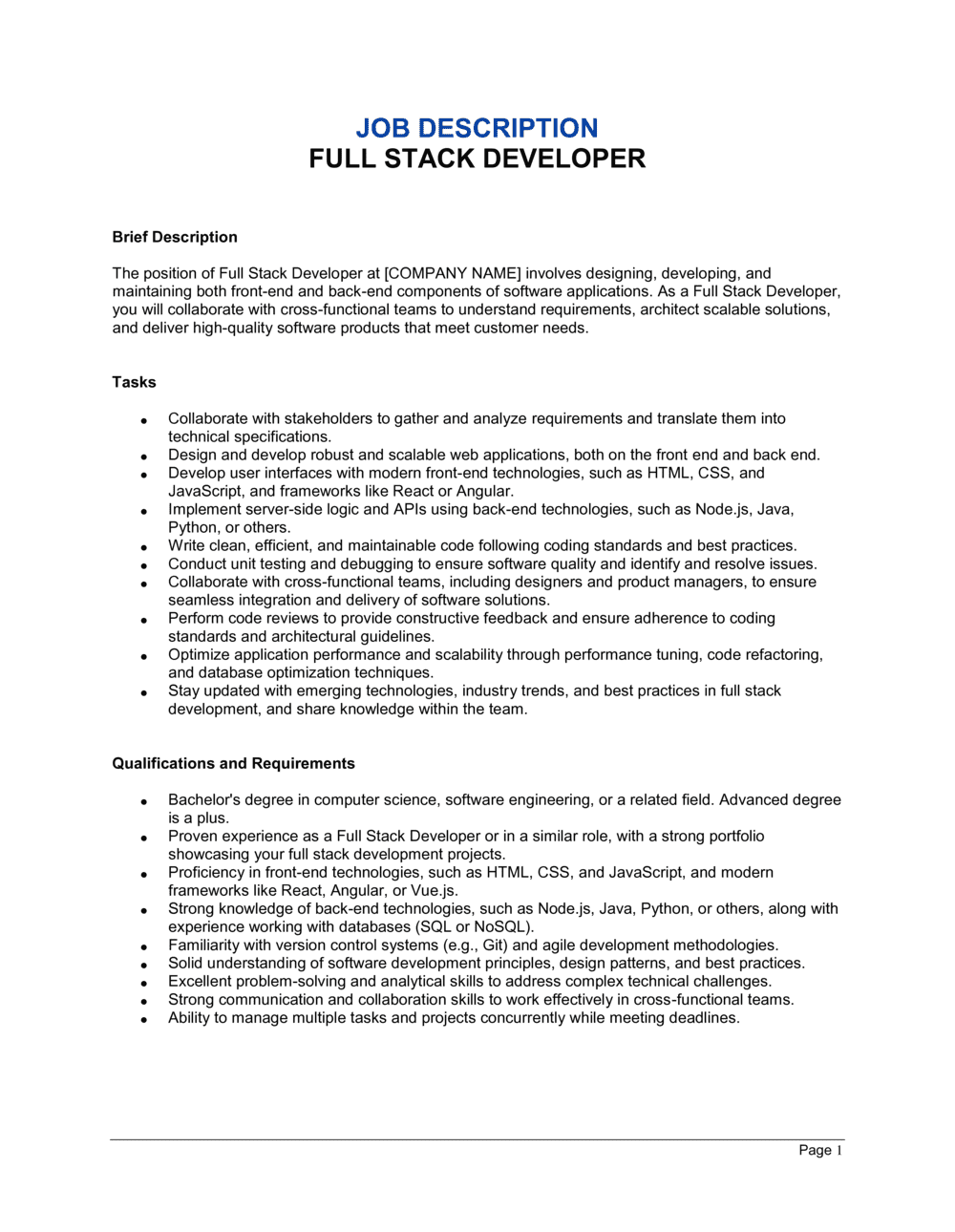
Full Stack Developer Job Description Template

Free Word download β€’ Edit online β€’ Save & share with Drive β€’ Export to PDF

2 pagesβ€’20–30 min to fillβ€’Difficulty: Standardβ€’Signature requiredβ€’Legal review recommended
Learn more ↓
FreeFull Stack Developer Job Description Template

At a glance

What it is
A Full Stack Developer Job Description is a formal document that defines the scope of a full stack developer role, including technical responsibilities, required skills, compensation range, reporting structure, and employment classification. This free Word download gives you a complete, editable starting point you can tailor to your tech stack and team structure, then publish as a job posting or attach to an employment contract.
When you need it
Use it whenever you are hiring a full stack developer β€” whether for a permanent in-house role, a remote position, or a fixed-term project β€” and need a precise written record of the role's expectations before extending an offer or executing an employment agreement.
What's inside
Role summary and reporting structure, front-end and back-end technical requirements, specific tech stack expectations, soft skills and collaboration requirements, compensation and benefits overview, employment classification, IP assignment reference, and equal opportunity statement.

What is a Full Stack Developer Job Description?

A Full Stack Developer Job Description is a formal document that defines the scope, technical requirements, compensation, and employment terms for a developer role spanning both front-end and back-end layers of a web application. It identifies the specific languages, frameworks, and tools the candidate must know, states the reporting structure and team context, classifies the employment arrangement, and references the IP assignment and confidentiality obligations the developer will assume at onboarding. Unlike a generic job posting, a well-drafted full stack developer job description is precise enough to serve as the foundation of a performance management framework and consistent enough with the accompanying employment contract to avoid disputes about scope and ownership.

Why You Need This Document

Posting a vague or incomplete developer job description creates four compounding problems before the first interview even begins. Candidates self-select incorrectly, flooding your pipeline with applicants who lack the specific stack experience you need β€” or deterring strong candidates who assume the requirements are unrealistic. Once hired, a developer whose role was never clearly defined in writing pushes back on assignments outside the original posting, turning every new task into a negotiation. In pay-transparency jurisdictions including Colorado, New York, and California, a posting without a salary range is a compliance violation that triggers regulatory attention. And without an IP assignment reference, code written by a developer who was never formally told their work product belongs to the company can become a genuine ownership dispute at acquisition or funding. This template gives you a precise, legally consistent starting point β€” covering technical scope, compensation transparency, employment classification, and IP obligations β€” that reduces hiring risk, accelerates candidate qualification, and connects directly to the employment contract your developer will sign before their first day.

Which variant fits your situation?

If your situation is…Use this template
Hiring a full stack developer as a permanent salaried employeeFull Stack Developer Job Description (Employment)
Engaging a full stack developer as an independent contractorIndependent Contractor Agreement
Hiring a developer focused exclusively on front-end workFront-End Developer Job Description
Hiring a developer focused exclusively on back-end APIs and databasesBack-End Developer Job Description
Bringing on a senior engineer to lead architectural decisionsSoftware Engineer Job Description
Hiring a developer for a fixed-term product buildFixed-Term Employment Contract
Onboarding a remote developer in a different countryRemote Work Employment Agreement

Common mistakes to avoid

❌ Listing every known framework as required

Why it matters: Requiring simultaneous proficiency in React, Vue, Angular, Node, Python, and Java in a single role is statistically rare and signals to experienced developers that the hiring team doesn't understand the role β€” they stop applying.

Fix: Identify the two or three front-end and two or three back-end technologies used in your actual codebase and mark those as required. Everything else is preferred.

❌ Omitting a salary range in a pay-transparency jurisdiction

Why it matters: Colorado (EPEWA), New York, California, and Washington require salary ranges in job postings. Violations carry fines and can trigger enforcement actions, particularly for remote roles open to residents of those states.

Fix: Include a specific salary range in the compensation section, even if it is broad. For roles that could be filled by candidates in multiple states, include the range that covers all applicable jurisdictions.

❌ Misclassifying the developer as a contractor

Why it matters: If the developer works set hours, uses company equipment, and receives direct supervision, most jurisdictions β€” including California under AB5 and HMRC in the UK β€” will treat the relationship as employment regardless of the contract's label, triggering back taxes, penalties, and benefit liability.

Fix: Apply the economic reality test or the ABC test for the applicable jurisdiction before classifying the role as contractor. When in doubt, engage employment counsel.

❌ Using the job description as a substitute for an employment contract

Why it matters: Job descriptions are public marketing documents. They do not create enforceable IP assignment, confidentiality, or non-solicitation obligations β€” those require a signed employment agreement with fresh consideration.

Fix: Reference the employment agreement in the job description and ensure a formal contract is signed before the developer's first day, covering IP assignment, confidentiality, and termination terms in full legal detail.

The 10 key clauses, explained

Role Summary and Reporting Structure

In plain language: Describes the position in one to three sentences and identifies who the developer reports to β€” typically a CTO, VP of Engineering, or Engineering Manager.

Sample language
[COMPANY NAME] is seeking a Full Stack Developer to design, build, and maintain scalable web applications across the full technology stack. This role reports directly to the [TITLE] and collaborates closely with [PRODUCT / DESIGN / QA TEAM].

Common mistake: Omitting the reporting line entirely. Candidates cannot evaluate seniority, decision-making authority, or career trajectory without knowing where the role sits in the org chart.

Core Responsibilities

In plain language: A specific list of what the developer will own day-to-day β€” features, systems, code reviews, deployments, and cross-functional collaboration.

Sample language
Design and implement front-end interfaces using [FRAMEWORK]; develop and maintain RESTful APIs in [LANGUAGE]; participate in code reviews; contribute to sprint planning and retrospectives; maintain documentation for all deployed systems.

Common mistake: Using generic bullet points like 'develop software' or 'write clean code.' Vague responsibilities make performance management nearly impossible and attract candidates who expect a narrower scope than the role requires.

Technical Skills β€” Front End

In plain language: Enumerates the specific front-end languages, frameworks, and tools the developer must know, distinguishing between required and preferred skills.

Sample language
Required: [HTML5 / CSS3 / JavaScript (ES6+) / FRAMEWORK]. Preferred: [TypeScript / GraphQL / Responsive design / Cross-browser compatibility / Accessibility (WCAG 2.1)].

Common mistake: Listing every mainstream framework as 'required.' Requiring proficiency in React, Vue, and Angular simultaneously signals an unrealistic spec that discourages strong candidates from applying.

Technical Skills β€” Back End

In plain language: Specifies the server-side languages, frameworks, databases, and infrastructure tools required for the role.

Sample language
Required: [Node.js / Python / Ruby / Java] with [EXPRESS / DJANGO / RAILS / SPRING]. Database experience: [PostgreSQL / MySQL / MongoDB]. Cloud platform: [AWS / GCP / Azure]. Containerization: [Docker / Kubernetes] preferred.

Common mistake: Failing to distinguish between back-end languages the team uses versus languages the candidate needs on day one. Conflating the two inflates the requirement list and narrows the candidate pool unnecessarily.

Qualifications and Experience

In plain language: States minimum years of experience, education requirements, and any certifications or portfolio expectations the role requires.

Sample language
[X]+ years of professional full stack development experience. Bachelor's degree in Computer Science, Software Engineering, or a related field, or equivalent practical experience. GitHub portfolio or work samples demonstrating shipped, production-quality code preferred.

Common mistake: Requiring a four-year degree as an absolute prerequisite when the actual requirement is demonstrated competency. Degree requirements that aren't genuinely necessary reduce candidate diversity and may expose the company to disparate-impact claims in some jurisdictions.

Employment Classification and Work Arrangement

In plain language: States whether the role is full-time or part-time, employee or contractor, on-site, hybrid, or remote β€” and the expected hours or schedule.

Sample language
This is a [full-time / part-time] [employee / contractor] position. Work arrangement: [remote / hybrid β€” [X] days in [OFFICE CITY] / on-site]. Standard hours: [9am–5pm [TIMEZONE]] with flexibility for cross-timezone collaboration.

Common mistake: Describing a role as 'contractor' when the actual working arrangement β€” set hours, required tools, direct supervision β€” meets the legal definition of employment. Misclassification exposes the company to back taxes, penalties, and benefit liability.

Compensation, Benefits, and Equity

In plain language: States the salary range or hourly rate, bonus eligibility, equity offer, and benefits package so candidates can self-qualify before applying.

Sample language
Base salary: $[MIN]–$[MAX] USD annually, depending on experience. Benefits: [health / dental / vision / 401(k) match]. Annual discretionary bonus: up to [X]% of base. Equity: [stock options / RSUs] per separate option agreement.

Common mistake: Omitting the compensation range entirely. In jurisdictions that mandate pay transparency β€” including Colorado, New York, California, and Washington β€” posting without a range violates state law and triggers fines.

IP Assignment and Confidentiality Reference

In plain language: Signals that all code, systems, and work product created during employment belong to the company and that confidentiality obligations will apply, with full terms set out in the accompanying employment agreement.

Sample language
All work product, code, algorithms, and intellectual property developed in connection with this role are the sole property of [COMPANY NAME] and are subject to the IP Assignment and Confidentiality provisions of the Employment Agreement signed at onboarding.

Common mistake: Treating the job description as the sole IP document. The description signals the obligation; the enforceable assignment belongs in the signed employment contract. Relying on the job description alone creates a gap that developers can exploit.

Non-Solicitation and Post-Employment Restrictions

In plain language: Briefly notes that restrictive covenants β€” including non-solicitation of staff and clients β€” will apply and are detailed in the employment agreement.

Sample language
As a condition of employment, the selected candidate will execute an Employment Agreement that includes non-solicitation and confidentiality obligations effective for [X] months following separation.

Common mistake: Including a full non-compete clause in the job description before an offer is made. Job descriptions are public documents; detailed restriction language in a posting can deter candidates and creates an unintended contractual record before any offer is extended.

Equal Opportunity and Accommodation Statement

In plain language: States the company's commitment to non-discriminatory hiring and its willingness to provide reasonable accommodations to applicants with disabilities.

Sample language
[COMPANY NAME] is an equal opportunity employer. We do not discriminate on the basis of race, color, religion, sex, national origin, age, disability, or any other characteristic protected by applicable law. Applicants requiring accommodation in the hiring process should contact [HR EMAIL / CONTACT].

Common mistake: Omitting the EEO statement entirely or using a generic boilerplate that doesn't include a contact for accommodation requests. In the US, EEOC guidance requires that applicants with disabilities have a clear path to request adjustments in the hiring process.

How to fill it out

  1. 1

    Define the reporting structure and team context

    Enter the job title, the direct manager's title, and the teams the developer will collaborate with. This anchors seniority and scope for both candidates and hiring managers.

    πŸ’‘ If the role is a new position, write the reporting line to match the org structure you expect within 6 months β€” not the one that exists today.

  2. 2

    Draft specific, measurable core responsibilities

    List 6–10 concrete responsibilities using action verbs and naming the actual systems, features, or processes involved. Avoid generic phrases and instead reference your product, stack, or delivery methodology.

    πŸ’‘ Rank responsibilities by the percentage of time the developer will actually spend on them. It forces internal alignment and helps candidates assess fit.

  3. 3

    Separate required from preferred technical skills

    Split the tech stack into two tiers: skills the developer must have on day one versus skills that are a bonus or trainable. Apply this discipline to both front-end and back-end sections.

    πŸ’‘ Keep the required list to the four or five technologies the developer will use in their first 30 days. Everything else goes in preferred.

  4. 4

    Set the experience and qualification threshold honestly

    Enter the minimum years of experience that reflect the actual complexity of the role. Consider whether a degree is genuinely required or whether demonstrated competency β€” a portfolio, open-source contributions, or a take-home test β€” is a better signal.

    πŸ’‘ Each year of experience added to the minimum requirement typically reduces the qualified applicant pool by 20–30%. Set the floor at the true minimum, not the ideal.

  5. 5

    State the employment classification and work arrangement

    Choose employee or contractor, full-time or part-time, and remote, hybrid, or on-site. For hybrid roles, specify the minimum in-office days and location. For remote roles, specify whether the company can employ in the candidate's country or state.

    πŸ’‘ If the role is contractor-classified but involves daily stand-ups, set hours, and company-provided equipment, consult employment counsel before posting β€” the arrangement may legally qualify as employment.

  6. 6

    Add the compensation range and benefits

    Enter the base salary range, bonus structure, equity details, and benefits. For roles posted in pay-transparency jurisdictions, including this information is legally required.

    πŸ’‘ Publishing a salary range reduces time-to-fill by an average of 30% by filtering out candidates whose expectations are significantly misaligned before the first call.

  7. 7

    Add the IP, confidentiality, and EEO statements

    Paste in the IP assignment reference, non-solicitation notice, and equal opportunity statement. These signal legal seriousness without overloading the posting with contract language.

    πŸ’‘ Link the EEO statement to a named HR contact or email address so accommodation requests have a clear path β€” this is required under US EEOC guidance.

  8. 8

    Review the posting with the hiring manager before publishing

    Have the engineering manager or CTO read the final description and confirm that every technical requirement is accurate and that the responsibilities reflect the actual role β€” not an aspirational version of it.

    πŸ’‘ If the hiring manager would not be able to verify the technical requirements in an interview, they are too specific and should be generalized or removed.

Frequently asked questions

What does a full stack developer job description template include?

A complete full stack developer job description covers the role summary and reporting structure, front-end and back-end technical requirements, specific tech stack expectations, years of experience and education requirements, employment classification and work arrangement, compensation range, and an IP assignment and EEO statement. The template provides a structured starting point you customize to match your actual codebase, team structure, and jurisdiction.

Is a job description a legally binding document?

A job description is generally not a standalone binding contract, but its language can create legal exposure. Courts in several jurisdictions have found that specific promises in job postings β€” guaranteed bonuses, specific work arrangements, or defined compensation structures β€” can be construed as contractual commitments. The enforceable terms of employment belong in a signed employment agreement, but the job description should be consistent with that agreement to avoid disputes.

Do I need to include a salary range in a full stack developer job posting?

In a growing number of US states β€” including Colorado, New York, California, and Washington β€” salary ranges are legally required in job postings. For remote roles that are open to applicants in any US state, most employment attorneys recommend including a range to avoid inadvertently violating pay transparency laws in states where candidates reside. Outside the US, the UK and EU are increasingly moving toward pay transparency requirements as well.

What is the difference between a full stack developer job description and an employment contract?

A job description defines the role, responsibilities, and qualifications for recruiting purposes and is typically a public document. An employment contract is the legally binding agreement signed by both parties that governs compensation, IP ownership, confidentiality, non-solicitation, and termination. The job description initiates the hiring process; the employment contract governs the working relationship. Both are needed β€” one without the other creates gaps.

Can I use this template for a contractor rather than an employee?

You can adapt the template for a contractor posting, but the classification must be accurate under the law of the jurisdiction where the developer works. If the arrangement involves set hours, direct supervision, and company-provided tools, it likely qualifies as employment under most jurisdictions' tests β€” including California's ABC test and the UK's HMRC employment status criteria. Misclassification carries significant tax and benefit liability.

What technical skills should a full stack developer job description require?

Required skills should reflect the specific languages, frameworks, and tools used in your actual codebase on day one β€” typically two to three front-end technologies (e.g., JavaScript, React, CSS) and two to three back-end technologies (e.g., Node.js, PostgreSQL, AWS). Everything else should be listed as preferred or trainable. Overloading the required section with every popular framework reduces your applicant pool and signals unrealistic expectations to experienced developers.

Should a full stack developer job description include an IP assignment clause?

The job description should reference that an IP assignment will apply and is detailed in the employment agreement. The enforceable IP assignment clause belongs in the signed employment contract, not the public job posting. Without a signed IP assignment executed before day one, the developer may retain rights to code written during employment β€” a critical risk for any tech company building proprietary software.

How specific should the duties section be in a developer job description?

Specific enough that the hiring manager could use it as the basis for a performance review, but not so granular that every task change requires a contract amendment. A well-written duties section lists 6–10 concrete responsibilities using specific technology names and delivery expectations β€” for example, 'build and maintain RESTful APIs in Node.js' rather than 'write backend code.' Including a clause allowing the employer to assign reasonable additional duties preserves flexibility.

What EEO statement should be included in a developer job posting?

In the US, an EEO statement should affirm that the company does not discriminate on the basis of any characteristic protected by applicable federal, state, or local law, and should include a named contact or email address for accommodation requests under the Americans with Disabilities Act. In the UK, the Equality Act 2010 requires similar non-discrimination commitments. A generic statement without an accommodation contact does not satisfy EEOC guidance for companies with 15 or more employees.

How this compares to alternatives

vs Independent Contractor Agreement

An independent contractor agreement engages a developer for project-based work with no employment entitlements β€” no benefits, no tax withholding, and different IP ownership defaults. A full stack developer job description is designed for an employee hire and pairs with an employment contract. Misclassifying an employee as a contractor by using the wrong document triggers back taxes and penalties.

vs Software Developer Job Description

A general software developer job description covers a broader range of roles β€” front end, back end, mobile, or embedded systems. The full stack variant specifically requires combined front-end and back-end proficiency and typically names a unified tech stack across both layers. Use the general template when the role is not stack-specific; use this one when you need a developer who can own both sides.

vs Employment Contract

A job description defines the role for recruiting and is typically a public document. An employment contract is the binding agreement signed at offer acceptance, covering IP assignment, confidentiality, non-solicitation, termination, and severance in enforceable legal detail. The job description initiates the hiring process; the employment contract governs the relationship. Both documents are needed.

vs Remote Work Employment Agreement

A remote work employment agreement governs the logistical and legal terms of a distributed working arrangement β€” equipment, expense reimbursement, data security, and jurisdiction. A full stack developer job description defines the role itself. For a remote developer hire, you need both: the job description to recruit and the remote work agreement to govern the ongoing relationship.

Industry-specific considerations

SaaS / Technology

Full stack roles in SaaS companies typically require cloud-native experience (AWS, GCP, or Azure), CI/CD pipeline familiarity, and comfort with microservices or serverless architecture alongside core front-end and back-end skills.

E-commerce and Retail

E-commerce developers need deep experience with payment gateway integrations, shopping cart performance optimization, and third-party API connections to inventory, shipping, and CRM platforms.

Financial Services / Fintech

Fintech roles add requirements for PCI-DSS compliance, secure coding practices, data encryption standards, and familiarity with regulatory reporting systems β€” often with background-check and licensing conditions.

Healthcare and MedTech

Healthcare developer roles require HIPAA-compliant data handling, experience with HL7/FHIR standards for health data interoperability, and familiarity with audit logging requirements specific to electronic health record systems.

Jurisdictional notes

United States

Pay transparency laws in Colorado, New York, California, and Washington require salary ranges in job postings β€” including remote roles open to residents of those states. California also applies the ABC test for contractor classification, making it extremely difficult to classify a supervised developer as a contractor. At-will language is appropriate in most states but should be omitted for Montana hires.

Canada

Canadian provinces do not recognize at-will employment; job descriptions referencing employment should align with provincial Employment Standards Act minimums. Ontario's Working for Workers Acts (2021–2024) require pay transparency for publicly advertised roles. Quebec-based postings must be available in French under the Charter of the French Language. Non-solicitation clauses must be reasonable in scope to be enforceable.

United Kingdom

UK employers must provide a written statement of employment particulars on or before the first day of work. IR35 rules apply if a developer is engaged through a personal service company β€” misclassification exposes the hiring company to HMRC liability for income tax and National Insurance. The Equality Act 2010 prohibits discriminatory requirements; degree requirements not genuinely necessary for the role may constitute indirect discrimination.

European Union

The EU Pay Transparency Directive (effective 2026 in most member states) will require salary information in job postings for companies with 100 or more employees. GDPR applies to personal data collected during the hiring process β€” candidate CVs and contact details must be handled under a lawful basis and deleted when no longer needed. Non-compete clauses post-employment must typically be compensated financially to be enforceable, with requirements varying by member state.

Template vs lawyer β€” what fits your deal?

PathBest forCostTime
Use the templateDomestic hires in a single US state or Canadian province for standard full-time or remote developer rolesFree30–60 minutes
Template + legal reviewRoles in pay-transparency jurisdictions, contractor-classified positions, or hires in California, Ontario, or the UK$200–$500 for an employment counsel review1–2 days
Custom draftedMulti-jurisdiction remote roles, heavily regulated industries (fintech, healthcare), or senior hires with equity and material IP concerns$500–$2,000+3–7 days

Glossary

Full Stack Developer
A software developer who works across both the client-facing front end and the server-side back end of a web application.
Tech Stack
The specific combination of programming languages, frameworks, libraries, and infrastructure tools a developer is expected to use in a given role.
Front-End Development
The layer of an application that runs in the user's browser, typically built with HTML, CSS, JavaScript, and a framework such as React, Vue, or Angular.
Back-End Development
The server-side logic, databases, and APIs that power an application's data processing, authentication, and business rules.
Employment Classification
The legal designation of a worker as an employee (W-2 in the US) or independent contractor (1099), which determines tax treatment, benefits eligibility, and IP ownership.
IP Assignment
A contractual clause that transfers ownership of code, systems, and other work product created by the developer to the employer during the engagement.
At-Will Employment
An employment arrangement in which either party may terminate the relationship at any time for any lawful reason without advance notice β€” standard in most US states.
Non-Solicitation Clause
A post-employment restriction preventing a departing developer from recruiting the employer's staff or soliciting its clients for a defined period.
Agile / Scrum
An iterative software development methodology in which work is organized into short sprints with daily stand-ups, sprint reviews, and retrospectives.
CI/CD Pipeline
Continuous Integration and Continuous Deployment β€” automated workflows that build, test, and deploy code changes without manual intervention.
Scope Creep
The gradual, uncontrolled expansion of a role's or project's responsibilities beyond what was originally defined, leading to misaligned expectations and performance disputes.

Part of your Business Operating System

This document is one of 3,000+ business & legal templates included in Business in a Box.

  • Fill-in-the-blanks β€” ready in minutes
  • 100% customizable Word document
  • Compatible with all office suites
  • Export to PDF and share electronically

Create your document in 3 simple steps.

From template to signed document β€” all inside one Business Operating System.
1
Download or open template

Access over 3,000+ business and legal templates for any business task, project or initiative.

2
Edit and fill in the blanks with AI

Customize your ready-made business document template and save it in the cloud.

3
Save, Share, Send, Sign

Share your files and folders with your team. Create a space of seamless collaboration.

Save time, save money, and create top-quality documents.

β˜…β˜…β˜…β˜…β˜…

"Fantastic value! I'm not sure how I'd do without it. It's worth its weight in gold and paid back for itself many times."

Managing Director Β· Mall Farm
Robert Whalley
Managing Director, Mall Farm Proprietary Limited
β˜…β˜…β˜…β˜…β˜…

"I have been using Business in a Box for years. It has been the most useful source of templates I have encountered. I recommend it to anyone."

Business Owner Β· 4+ years
Dr Michael John Freestone
Business Owner
β˜…β˜…β˜…β˜…β˜…

"It has been a life saver so many times I have lost count. Business in a Box has saved me so much time and as you know, time is money."

Owner Β· Upstate Web
David G. Moore Jr.
Owner, Upstate Web

Run your business with a system β€” not scattered tools

Stop downloading documents. Start operating with clarity. Business in a Box gives you the Business Operating System used by over 250,000 companies worldwide to structure, run, and grow their business.

Start freeΒ Β·Β No credit card required