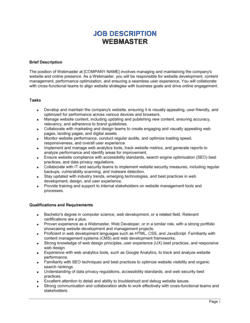
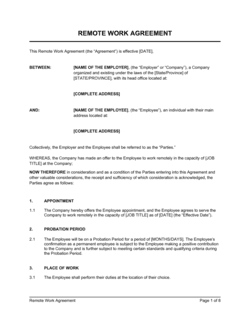
Web Developer Job Description Template

Free Word download • Edit online • Save & share with Drive • Export to PDF

2 pages20–30 min to fillDifficulty: StandardSignature requiredLegal review recommended
Learn more ↓
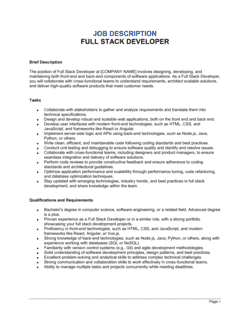
FreeWeb Developer Job Description Template

At a glance

What it is
A Web Developer Job Description is a formal document that defines the responsibilities, technical requirements, reporting structure, compensation range, and employment terms for a web developer role. This free Word download gives you an editable, legally grounded starting point you can tailor for full-time, part-time, or contract web development hires and export as PDF to post on job boards or attach to an offer package.
When you need it
Use it whenever you are opening a web developer position — whether hiring a junior front-end developer, a senior full-stack engineer, or a contract developer for a defined project. It is also useful when restructuring an existing role or formalizing duties that have grown organically without documentation.
What's inside
Role title and department, reporting structure, core duties and responsibilities, required and preferred technical skills, qualifications and experience thresholds, compensation and benefits summary, employment type, IP and confidentiality expectations, and equal-opportunity statement.

What is a Web Developer Job Description?

A Web Developer Job Description is a formal employment document that defines the title, duties, technical skill requirements, qualifications, compensation, employment type, and legal obligations — including IP assignment and confidentiality — for a web development role. Unlike a casual posting drafted in minutes for a job board, a properly structured job description creates a documented baseline that governs the developer's performance reviews, role-change discussions, and, when signed, the legal expectations of the employment relationship. It sits between a job posting and a full employment contract: more detailed than a posting, more role-specific than a general contract.

Why You Need This Document

Operating without a formal, signed web developer job description creates exposure at every stage of the employment lifecycle. During hiring, an undocumented or vague description increases the risk of disparate-impact discrimination claims when screening candidates against inconsistently applied requirements. After hire, an unsigned description leaves you without a documented performance baseline when managing a developer who stops meeting expectations or needs to be placed on an improvement plan. At departure, a job description that never included IP assignment or confidentiality language can leave your production codebase, proprietary algorithms, and client data in legal ambiguity — particularly for developers who worked remotely on personal devices. This template gives you a complete, jurisdiction-aware starting point that closes each of those gaps in under an hour, with clear placeholders for the technical, compensation, and legal specifics that make the document enforceable and useful throughout the full employment relationship.

Which variant fits your situation?

If your situation is…Use this template
Hiring a developer focused exclusively on user interfaces and browser-side codeFront-End Developer Job Description
Hiring a developer for server-side logic, APIs, and databasesBack-End Developer Job Description
Hiring a developer who handles both front-end and back-end workFull-Stack Developer Job Description
Engaging a developer on a project basis rather than as an employeeIndependent Contractor Agreement
Hiring a developer in a senior or lead capacity with team management dutiesSenior Web Developer Job Description
Onboarding a remote developer working across different time zonesRemote Work Employment Agreement
Hiring a developer specifically for e-commerce platform workE-Commerce Developer Job Description

Common mistakes to avoid

❌ Omitting the salary range in pay-transparency jurisdictions

Why it matters: Colorado, California, New York, and Washington require salary ranges in job postings. Publishing without one exposes the company to regulatory fines and disqualifies the posting from appearing on major job boards in those states.

Fix: Research the pay-transparency laws in every state where the role will be posted or filled, and include a salary band that reflects your genuine offer range.

❌ Conflating required and preferred qualifications

Why it matters: When required and preferred skills are mixed in a single list, you either filter out qualified candidates or create a legally ambiguous screening standard that cannot withstand a disparate-impact challenge.

Fix: Use two clearly labeled sections — 'Required qualifications' and 'Preferred qualifications' — and apply them consistently throughout the screening process.

❌ No IP assignment or confidentiality clause

Why it matters: A developer who writes production code with no IP assignment in their documentation may retain rights to that code, particularly if they used personal equipment or worked outside business hours.

Fix: Include explicit IP assignment and confidentiality language in the job description and mirror it in the employment contract signed before the start date.

❌ Setting unrealistic years-of-experience requirements

Why it matters: Requiring experience that exceeds the actual age of the technology — or that disproportionately excludes younger or historically underrepresented candidates — creates disparate-impact exposure under Title VII and the ADEA.

Fix: Benchmark experience requirements against the release history of the specific tools and frameworks listed, and use skill-based assessments to supplement experience thresholds.

❌ No acknowledgment or signature block

Why it matters: An unsigned job description cannot be used as a performance baseline, referenced in a termination for cause, or cited to enforce role-specific confidentiality expectations.

Fix: Add a signature block and obtain a signed copy before or on the employee's first day, storing the executed document in the employee's personnel file.

❌ Applying an at-will clause without jurisdiction review

Why it matters: At-will employment is a US-only doctrine. Applying it to developers in Canada, the UK, or the EU creates unenforceable terms and may leave the company without a valid termination framework in those jurisdictions.

Fix: Remove at-will language for non-US roles and replace it with a notice-period clause meeting the statutory minimum in the developer's work location.

The 10 key clauses, explained

Role title, department, and reporting line

In plain language: States the official job title, the team or department the developer belongs to, and who they report to directly.

Sample language
Job Title: [WEB DEVELOPER / SENIOR WEB DEVELOPER]. Department: [ENGINEERING / PRODUCT / IT]. Reports to: [ENGINEERING MANAGER / CTO / DIRECTOR OF TECHNOLOGY].

Common mistake: Using an informal working title that differs from the payroll title — this creates discrepancies in HR records and can complicate classification audits.

Employment type and work location

In plain language: Specifies whether the role is full-time, part-time, or fixed-term, whether it is on-site, hybrid, or fully remote, and the primary work location.

Sample language
Employment Type: [Full-Time / Part-Time / Contract]. Work Location: [ON-SITE at CITY, STATE / HYBRID — [X] days on-site / FULLY REMOTE]. This position is [at-will / subject to a fixed term ending DATE].

Common mistake: Omitting the work location designation and later applying a different remote-work policy — creating a constructive dismissal claim in jurisdictions that treat work location as a core employment term.

Core duties and responsibilities

In plain language: Lists the day-to-day tasks the developer is expected to perform, with enough specificity to support performance management.

Sample language
Key responsibilities include: (a) designing, developing, and maintaining [COMPANY NAME]'s web applications using [TECH STACK]; (b) collaborating with [PRODUCT / DESIGN / QA] teams; (c) writing clean, documented, and testable code; (d) participating in code reviews; (e) troubleshooting and resolving production issues within [SLA TIMEFRAME].

Common mistake: Writing duties so narrowly that any project reassignment requires a contract amendment, or so broadly that there is no basis for a performance improvement plan.

Required technical skills and qualifications

In plain language: Identifies the non-negotiable technical skills, languages, frameworks, and years of experience required for the role.

Sample language
Required: [X]+ years of professional experience in web development; proficiency in [HTML, CSS, JavaScript]; experience with [REACT / VUE / ANGULAR]; familiarity with [REST APIs / GraphQL]; and a [bachelor's degree in Computer Science or equivalent practical experience].

Common mistake: Setting qualifications so high — e.g., 10 years of experience with a framework that is only 5 years old — that the posting becomes legally vulnerable to disparate-impact hiring discrimination claims.

Preferred skills and experience

In plain language: Lists desirable but not mandatory qualifications that distinguish stronger candidates without excluding otherwise qualified applicants.

Sample language
Preferred: experience with [TECH STACK ITEM]; familiarity with [CI/CD PIPELINE TOOL]; exposure to [CLOUD PLATFORM]; prior work in [INDUSTRY VERTICAL]; open-source contributions demonstrating [SKILL].

Common mistake: Listing preferred skills in the same sentence as required skills, making it impossible for candidates — or courts — to determine which qualifications are truly mandatory.

Compensation, benefits, and FLSA classification

In plain language: States the salary range or hourly rate, pay frequency, bonus eligibility, benefits, and confirms whether the role is exempt or non-exempt under applicable wage law.

Sample language
Compensation: $[MIN]–$[MAX] per year / $[RATE] per hour, paid [bi-weekly]. FLSA Status: [Exempt / Non-Exempt]. Benefits include [health, dental, vision, 401(k), PTO]. Discretionary annual bonus of up to [X]% of base salary.

Common mistake: Omitting the salary range in jurisdictions — including Colorado, California, New York, and Washington — where pay transparency laws require it in all job postings.

Intellectual property assignment

In plain language: Assigns ownership of all code, designs, and work product created by the developer in connection with their employment to the employer.

Sample language
All code, software, systems, designs, and other work product developed by Employee in the course of employment or in connection with [COMPANY NAME]'s business are the sole property of [COMPANY NAME] and are hereby irrevocably assigned to [COMPANY NAME].

Common mistake: No IP assignment clause at all, or one limited to work performed on company equipment — leaving code developed remotely or after hours potentially owned by the developer.

Confidentiality and data security obligations

In plain language: Prohibits the developer from disclosing proprietary source code, client data, system architecture, or business logic during and after employment.

Sample language
Employee shall not, during or after employment, disclose or use any Confidential Information — including source code, system architecture, client data, API keys, or business logic — without prior written consent from [COMPANY NAME].

Common mistake: Failing to define 'Confidential Information' precisely enough to include source code, API credentials, and database schemas — the assets most at risk when a developer departs.

Equal opportunity and non-discrimination statement

In plain language: Confirms the employer complies with federal and state equal opportunity laws and does not discriminate on the basis of protected characteristics.

Sample language
[COMPANY NAME] is an equal opportunity employer. We do not discriminate on the basis of race, color, religion, gender, national origin, age, disability, veteran status, sexual orientation, or any other characteristic protected by applicable law.

Common mistake: Using a generic EEO boilerplate that omits protected characteristics added by state law — such as gender identity in California or pregnancy status in New York — creating compliance gaps.

Acknowledgment and signature block

In plain language: Records that the candidate or employee has read, understood, and accepted the job description as part of their employment terms.

Sample language
By signing below, Employee acknowledges receipt and acceptance of this Job Description as of [DATE]. Employee: ___________________ [EMPLOYEE NAME] | Date: _____ | Employer Representative: ___________________ [NAME, TITLE] | Date: _____

Common mistake: Treating the job description as an informational flyer rather than a signed document — losing the ability to hold the developer accountable to documented role expectations during performance reviews or termination.

How to fill it out

  1. 1

    Define the role title and seniority level

    Decide whether the hire is junior, mid-level, senior, or lead. The seniority level determines the required qualifications, compensation range, and IP exposure — and affects FLSA classification analysis.

    💡 Use the same title in the job description, offer letter, employment contract, and payroll system — inconsistencies create compliance headaches during audits.

  2. 2

    Specify employment type and work location

    Choose full-time, part-time, or fixed-term, and state whether the role is on-site, hybrid, or remote. For remote or hybrid roles, name the states or countries from which the developer is permitted to work.

    💡 Restricting remote work to specific states limits your employer tax registration and withholding obligations — list only the states where you are prepared to operate as an employer.

  3. 3

    Write specific, measurable core duties

    List 6–10 responsibilities that are concrete enough to use in a performance review. Include the tech stack, collaboration partners, and any SLA or quality standards expected.

    💡 Move granular project assignments to a separate Schedule or onboarding document so the job description stays stable across role iterations.

  4. 4

    Separate required from preferred qualifications

    Put truly non-negotiable skills — languages, frameworks, years of experience — in the required block. Place stretch skills in a clearly labeled preferred block. This protects you from disparate-impact hiring claims.

    💡 Audit years-of-experience requirements against the actual age of the technologies involved before posting. Requiring 8 years of React experience in 2026 is legally and practically indefensible.

  5. 5

    Include the compensation range and FLSA classification

    State the salary band or hourly rate, pay frequency, and bonus eligibility. Confirm whether the role is FLSA-exempt. In pay-transparency states, the full posted range is legally required.

    💡 Check Colorado, California, New York, and Washington posting requirements before publishing — fines for non-disclosure can reach $2,500 per violation in some jurisdictions.

  6. 6

    Add IP assignment and confidentiality language

    Insert the IP assignment clause assigning all work product to the company and a confidentiality provision covering source code, API keys, client data, and architecture. Define 'Confidential Information' explicitly.

    💡 For developers working on personal devices or after hours, ensure IP assignment language covers work 'related to the company's business' regardless of where or when it was performed.

  7. 7

    Include the EEO statement and acknowledgment block

    Paste in your equal-opportunity statement, ensuring it covers all protected characteristics in your operating jurisdictions. Add a signature line for both the employee and an authorized company representative.

    💡 Have the developer sign the job description on or before their first day — the same fresh-consideration rule that applies to employment contracts applies here.

  8. 8

    Review against applicable pay-transparency and classification laws

    Before posting or presenting to the candidate, cross-check the document against the pay-transparency laws of every state in which you will advertise the role and the FLSA computer-employee exemption criteria.

    💡 A 30-minute employment counsel review at this stage typically costs $100–$200 and eliminates the most common compliance risks before they become enforcement actions.

Frequently asked questions

What is a web developer job description?

A web developer job description is a formal document that defines the title, duties, required technical skills, qualifications, compensation, employment type, and legal obligations — including IP assignment and confidentiality — for a web development role. It serves as a recruiting tool, a performance baseline, and a component of the broader employment agreement. When signed by both parties, it creates documented expectations enforceable throughout the employment relationship.

What should a web developer job description include?

At minimum: job title and seniority level, department and reporting line, employment type and work location, core duties and responsibilities, required and preferred technical skills, compensation range and FLSA classification, IP assignment, confidentiality obligations, an equal-opportunity statement, and a signed acknowledgment block. Missing the IP and confidentiality provisions is the single costliest omission for technology employers.

Is a job description a legally binding document?

A job description is generally not a standalone contract, but when incorporated by reference into an employment contract or signed as part of an offer package, it creates enforceable obligations. Courts have used job descriptions as evidence in wrongful termination, discrimination, and IP ownership disputes. Including a signature block and retaining executed copies significantly strengthens their evidentiary weight.

What technical skills should I list for a web developer role?

Separate required skills from preferred skills. Required skills typically include the core languages and frameworks your codebase actually uses — HTML, CSS, JavaScript, and one or more frameworks such as React, Vue, or Angular for front-end roles, or Node.js, Python, Ruby, or PHP for back-end roles. Preferred skills might include CI/CD tools, cloud platforms, or testing frameworks. Be specific: 'proficiency in React 18 and TypeScript' is more defensible and useful than 'experience with modern JavaScript.'

Do I need to include a salary range in a web developer job posting?

In Colorado, California, New York, Washington, and several other jurisdictions, yes — pay-transparency laws require a salary range in any job posting visible to residents of those states. Even where not legally required, including a salary range significantly increases application volume and reduces time spent screening candidates whose salary expectations don't align. Most major job boards now display salary ranges prominently, and postings without them rank lower in search results.

What is the difference between a web developer job description and an employment contract?

A job description defines the role — what the developer will do, what skills they need, and what compensation they will receive. An employment contract governs the legal relationship — confidentiality, IP assignment, non-compete, termination notice, severance, and governing law. Both documents are needed: the job description sets performance expectations; the contract protects the company's legal interests. Using a job description alone, without a signed employment contract, leaves significant legal gaps.

Can I use the same job description for a contractor and an employee?

No. The distinction between an employee and an independent contractor is a legal classification that affects tax withholding, benefits eligibility, IP ownership defaults, and overtime requirements. A job description written for an employee — with fixed hours, a specific reporting structure, and employer- provided equipment — can be used as evidence of misclassification if applied to a contractor. Use a separate Independent Contractor Agreement for project- based developers.

What FLSA classification applies to web developers?

Most full-time salaried web developers qualify as exempt under the FLSA computer employee exemption, provided they are paid at least $684 per week (the 2024 federal threshold) and their primary duty involves the application of systems-analysis techniques, programming, software engineering, or similar work. Developers paid hourly below the threshold, or whose duties are primarily IT support rather than development, are likely non-exempt and entitled to overtime. State law may set a higher salary threshold — California's is significantly above the federal floor.

How do I handle IP ownership when a developer uses personal equipment?

Without explicit contractual language, IP ownership for code written on personal equipment or after hours is genuinely ambiguous in most jurisdictions. The job description and employment contract should both include IP assignment language covering all work product 'created in connection with the company's business,' regardless of the device or location used. California Labor Code §2870 carves out inventions unrelated to the employer's business — which is the correct balance and a useful drafting model for all jurisdictions.

How often should a web developer job description be updated?

Review the document whenever the role's tech stack changes significantly, the developer's responsibilities expand materially, or the company's legal obligations shift — such as when operating in a new jurisdiction or when pay-transparency laws take effect. As a baseline, an annual review aligned to performance cycles ensures the document stays current. A job description that is two or more years out of date is unlikely to reflect actual duties and may create inconsistency if cited in a performance or legal dispute.

How this compares to alternatives

vs Employment Contract

A job description defines what the developer will do and what qualifications they need. An employment contract governs the legal relationship — including IP assignment, non-compete, termination notice, and severance — in binding detail. Both documents are necessary: the job description cannot substitute for a signed employment contract, and an employment contract without a role definition leaves performance management without a documented baseline.

vs Independent Contractor Agreement

A job description is written for an employee with fixed duties, a reporting structure, and employer-controlled working conditions. An independent contractor agreement engages a self-employed developer for project-based work with no overtime entitlements, no employer tax withholding, and different IP ownership defaults. Using a job description for a contractor is itself evidence of misclassification and can trigger back-tax liability and benefit obligations.

vs Offer Letter

An offer letter summarizes compensation and start date to secure the candidate's acceptance. A job description provides the full scope of duties, qualifications, and legal obligations that govern the role throughout employment. Relying on the offer letter alone — without a signed job description or employment contract — leaves the company without enforceable documentation of IP, confidentiality, or performance expectations.

vs Remote Work Agreement

A job description establishes what the developer does and the baseline employment terms. A remote work agreement supplements it by addressing home-office equipment policy, cybersecurity requirements, multi-state tax obligations, and the conditions under which remote status can be changed. For any remote web developer hire, both documents should be executed together.

Industry-specific considerations

SaaS / Technology

Tech stack specificity is critical — SaaS employers list exact frameworks, cloud platforms, and CI/CD tools; IP assignment and confidentiality provisions carry the highest legal weight given the company's core asset is code.

E-commerce / Retail

Roles typically require platform-specific experience (Shopify, Magento, WooCommerce), PCI-DSS awareness, and performance optimization skills for high-traffic environments.

Healthcare / MedTech

HIPAA compliance obligations must appear explicitly in the confidentiality clause, and any developer handling patient data needs documented acknowledgment of security training requirements.

Financial Services

Regulatory data-handling obligations (SOX, PCI-DSS, GLBA) and enhanced confidentiality provisions are standard; compensation structures often include clawback provisions tied to regulatory compliance failures.

Jurisdictional notes

United States

At-will employment is the default in 49 states. Most salaried web developers qualify as exempt under the FLSA computer-employee exemption at the $684/week federal threshold, though California sets a higher state threshold. Pay-transparency laws in Colorado, California, New York, and Washington require salary ranges in job postings. Non-compete enforceability for developers varies sharply by state — California bans them almost entirely; Minnesota and Oklahoma follow similar restrictions.

Canada

At-will employment does not exist in Canada. Job descriptions used as part of an offer package must be paired with employment contracts providing notice periods meeting provincial Employment Standards Act minimums. In Ontario, common-law reasonable notice for developers can significantly exceed statutory floors for tenured employees. Quebec employers must provide documentation in French for provincially regulated roles. IP assignment language should be reviewed against provincial limitations on assignment of off-duty inventions.

United Kingdom

UK employers must provide a written statement of employment particulars on or before day one, and the job description typically forms part of that statement. The IR35 off-payroll rules are critical for web developers engaged through personal service companies — a detailed job description specifying supervision, hours, and integration into the team can be used as evidence of deemed employment. Non-compete restrictions must be reasonable in duration and scope to be enforceable and are scrutinized more strictly for junior roles.

European Union

The EU Transparent and Predictable Working Conditions Directive requires written terms within 7 days of the start date. Data protection obligations under GDPR must be reflected in the confidentiality clause — developers handling personal data are considered processors and must be documented as such. Post-employment non-competes typically require compensation to the employee (ranging from 25–100% of salary depending on the member state) to be enforceable. Germany, France, and the Netherlands each impose statutory minimum notice periods that contractual terms cannot undercut.

Template vs lawyer — what fits your deal?

PathBest forCostTime
Use the templateStandard domestic web developer hires at junior to mid-level seniority in a single US state or Canadian provinceFree30–45 minutes
Template + legal reviewSenior or lead developer hires, multi-state remote roles, or positions in pay-transparency jurisdictions$150–$400 for an employment counsel review1–2 business days
Custom draftedExecutive-level technical hires, cross-border arrangements, heavily regulated industries such as healthcare or fintech, or roles requiring bespoke IP and non-compete terms$800–$2,500+1–2 weeks

Glossary

Job Description
A formal document that outlines a role's title, duties, required qualifications, and employment terms, used for recruiting and performance management.
At-Will Employment
An employment arrangement — standard in most US states — where either the employer or employee can end the relationship at any time for any lawful reason.
IP Assignment
A contractual provision transferring ownership of code, designs, or other work product created by the employee to the employer.
FLSA Classification
The Fair Labor Standards Act designation determining whether an employee is exempt from overtime requirements (salaried exempt) or entitled to 1.5× pay for hours over 40 per week (non-exempt).
Non-Solicitation Clause
A post-employment restriction preventing a departing developer from recruiting the employer's other employees or soliciting its clients.
Probationary Period
A defined initial employment period — typically 30 to 90 days — during which performance is evaluated with simplified termination procedures.
EEO Statement
An Equal Employment Opportunity statement declaring the employer does not discriminate on the basis of protected characteristics such as race, gender, age, or disability.
Tech Stack
The specific combination of programming languages, frameworks, libraries, and tools a developer is expected to use in the role.
Exempt vs. Non-Exempt
US FLSA classification that determines overtime eligibility; most salaried web developers qualify as exempt under the computer employee exemption if paid above the regulatory threshold.
Confidentiality Obligation
A binding requirement prohibiting the employee from disclosing proprietary code, client data, business logic, or trade secrets during and after employment.
Scope of Work
A description of the specific tasks, deliverables, and responsibilities expected of the developer in day-to-day operations.

Part of your Business Operating System

This document is one of 3,000+ business & legal templates included in Business in a Box.

  • Fill-in-the-blanks — ready in minutes
  • 100% customizable Word document
  • Compatible with all office suites
  • Export to PDF and share electronically

Create your document in 3 simple steps.

From template to signed document — all inside one Business Operating System.
1
Download or open template

Access over 3,000+ business and legal templates for any business task, project or initiative.

2
Edit and fill in the blanks with AI

Customize your ready-made business document template and save it in the cloud.

3
Save, Share, Send, Sign

Share your files and folders with your team. Create a space of seamless collaboration.

Save time, save money, and create top-quality documents.

★★★★★

"Fantastic value! I'm not sure how I'd do without it. It's worth its weight in gold and paid back for itself many times."

Managing Director · Mall Farm
Robert Whalley
Managing Director, Mall Farm Proprietary Limited
★★★★★

"I have been using Business in a Box for years. It has been the most useful source of templates I have encountered. I recommend it to anyone."

Business Owner · 4+ years
Dr Michael John Freestone
Business Owner
★★★★★

"It has been a life saver so many times I have lost count. Business in a Box has saved me so much time and as you know, time is money."

Owner · Upstate Web
David G. Moore Jr.
Owner, Upstate Web

Run your business with a system — not scattered tools

Stop downloading documents. Start operating with clarity. Business in a Box gives you the Business Operating System used by over 250,000 companies worldwide to structure, run, and grow their business.

Free Forever Plan · No credit card required