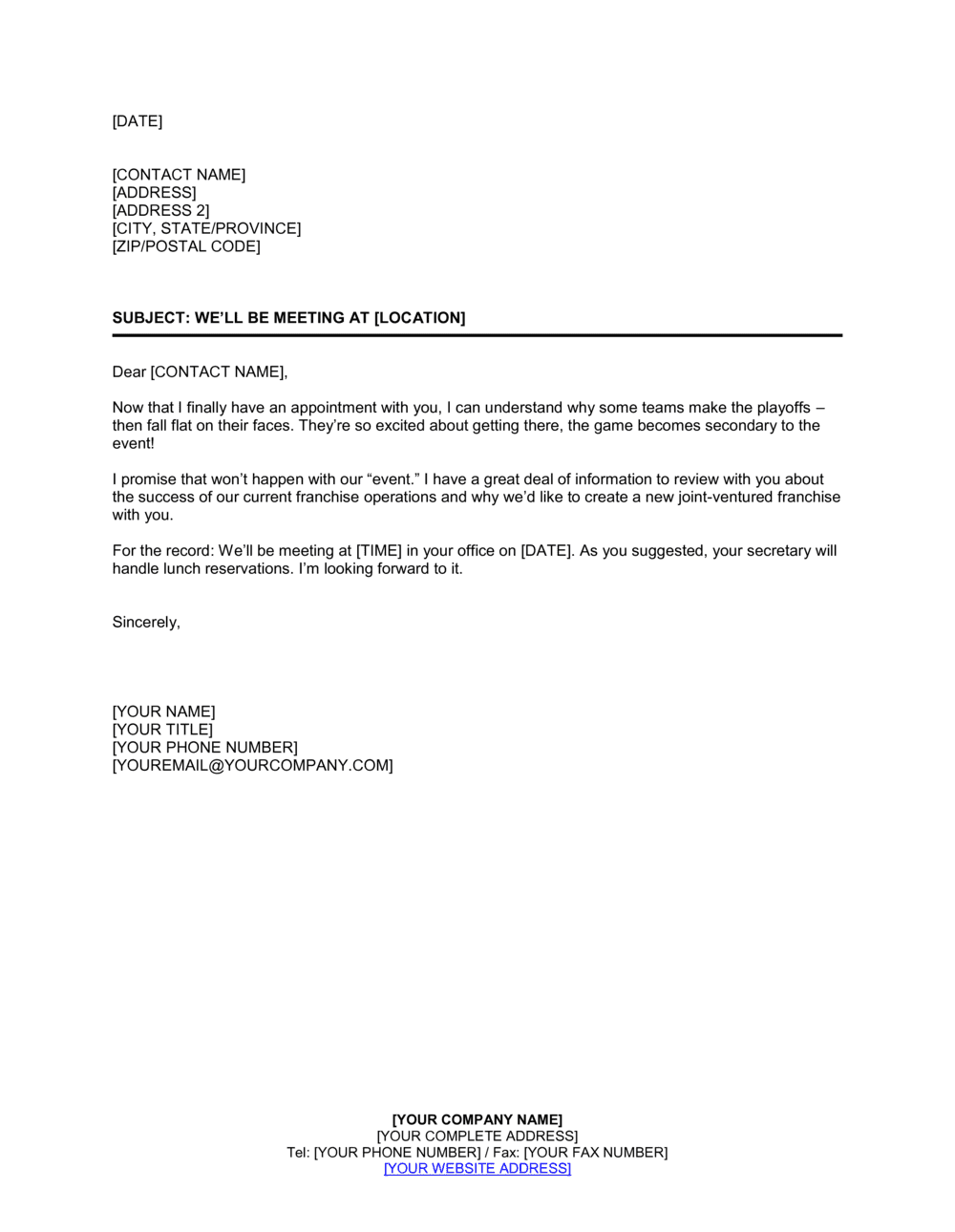
For the Record, We'll Be Meeting at (Location) Template

Free Word download β€’ Edit online β€’ Save & share with Drive β€’ Export to PDF

1 pageβ€’20–30 min to fillβ€’Difficulty: Standardβ€’Signature requiredβ€’Legal review recommended
Learn more ↓
FreeFor the Record, We'll Be Meeting at (Location) Template

At a glance

What it is
A Meeting Location Notice is a formal written record that officially documents and communicates the confirmed venue, address, date, and time for a scheduled board, shareholder, committee, or corporate meeting. This free Word download provides a structured, legally defensible template you can edit online and export as PDF to distribute to all required parties ahead of the meeting.
When you need it
Use it whenever a meeting's location must be formally confirmed in writing β€” particularly for board of directors meetings, annual general meetings, special shareholder meetings, or any corporate gathering where proper notice of location is a statutory or bylaw requirement. It is especially important when the meeting venue changes from a previously announced site.
What's inside
Identifying information for all parties, the confirmed meeting location and address, date and time details, the meeting's stated purpose, confirmation of proper notice delivery, acknowledgment provisions, and a governing law clause. The template covers both in-person and hybrid meeting scenarios.

What is a Meeting Location Notice?

A Meeting Location Notice is a formal written record that officially documents and communicates the confirmed venue, full address, date, and time for a scheduled corporate, board, shareholder, or committee meeting. Its purpose is twofold: it satisfies the statutory and bylaw obligation to give all entitled parties adequate written notice of where a meeting will be held, and it creates a contemporaneous paper trail that the meeting was validly convened at a documented location. In most jurisdictions, the location is a required element of a valid meeting notice β€” an incomplete or missing address can render the notice defective and expose any resolutions passed at the meeting to legal challenge.

Why You Need This Document

Failing to formally document a meeting's location is one of the most common β€” and most avoidable β€” sources of corporate governance disputes. If a shareholder, director, or regulator later questions whether a resolution was validly passed, the first evidence they will demand is proof that proper written notice, including a stated location, was delivered to every entitled party within the required timeframe. A verbal or informal notification offers no protection in that scenario. Beyond legal defensibility, a formally issued location notice protects quorum: participants who receive ambiguous or incomplete location information simply do not show up, and a meeting that fails quorum cannot pass binding resolutions. This template gives you a structured, jurisdiction-aware document that captures every required element β€” from the full civic address and time zone to proxy instructions and proof of delivery β€” so your meeting record is complete before the first participant walks through the door.

Which variant fits your situation?

If your situation is…Use this template
Notifying shareholders of an annual general meeting locationAnnual General Meeting Notice
Documenting a special or emergency board meeting location changeSpecial Board Meeting Notice
Confirming the location of a formal disciplinary or HR hearingDisciplinary Hearing Notice
Recording the agreed location for a committee or subcommittee meetingCommittee Meeting Notice
Setting the venue for a creditors' or restructuring meetingCreditors Meeting Notice
Notifying parties of the location for a formal mediation sessionMediation Session Notice
Confirming the venue for a formal contract negotiation meetingMeeting Confirmation Letter

Common mistakes to avoid

❌ Providing an incomplete meeting address

Why it matters: A notice that lists only a building name or general area fails the statutory requirement for a stated location in most jurisdictions and leaves participants unable to find the meeting.

Fix: Always include the full civic address β€” street number, street name, suite or room, city, state or province, and postal code β€” in the body of the notice, not just in an attached map.

❌ Miscounting the required notice period

Why it matters: Delivering notice one day short of the statutory or bylaw minimum can invalidate the meeting entirely, forcing a reschedule and potentially exposing the organization to liability for decisions made at the defective meeting.

Fix: Count the notice period from the day after delivery to the day before the meeting, exclusive of both endpoints, and cross-check against both the governing statute and your bylaws β€” whichever requires the longer period controls.

❌ Omitting the time zone from the meeting time

Why it matters: A notice that states '9:00 AM' without a time zone is unambiguous only to people in the same location. Participants in other time zones may arrive an hour early or an hour late, destroying quorum.

Fix: Always include the abbreviated time zone designation β€” EST, CST, GMT, CET β€” and note any daylight saving time considerations for meetings held near a clock-change date.

❌ Sending notice without retaining proof of delivery

Why it matters: If a shareholder or director later claims they did not receive notice and seeks to void a resolution, an undocumented email send is insufficient evidence of proper service.

Fix: Use registered mail, courier with tracking confirmation, or a registered email service that generates a delivery and read timestamp. Collect signed acknowledgments of receipt where the decision involved is material.

The 10 key clauses, explained

Parties and Identifying Information

In plain language: Identifies the organization holding the meeting, the body or group convening (e.g., board of directors, shareholders), and the authorized officer issuing the notice.

Sample language
This Notice is issued by [AUTHORIZED OFFICER NAME], [TITLE], on behalf of [COMPANY LEGAL NAME], a [STATE/PROVINCE] [ENTITY TYPE], to all [BOARD MEMBERS / SHAREHOLDERS / COMMITTEE MEMBERS] of record as of [RECORD DATE].

Common mistake: Using a trade name or brand name instead of the full registered legal entity name. If the entity name on the notice does not match the corporate registry, the notice may be challenged as defective.

Meeting Type and Purpose

In plain language: States whether the meeting is an annual general meeting, special meeting, board meeting, or committee session, and summarizes the business to be transacted.

Sample language
This notice pertains to the [ANNUAL / SPECIAL / REGULAR BOARD] meeting of [COMPANY NAME], convened for the purpose of [PURPOSE β€” e.g., approving the annual financial statements, electing directors, considering the proposed resolution at Schedule A].

Common mistake: Stating the purpose too vaguely β€” for example, 'to discuss company matters.' Many jurisdictions and bylaws require sufficient particularity so that attendees can determine whether a matter affects them directly.

Confirmed Meeting Location

In plain language: Provides the full civic address of the meeting venue, including building name, floor, room number, and any access instructions, so that all participants can locate the meeting without ambiguity.

Sample language
For the record, the meeting described herein will be held at [VENUE NAME], [STREET ADDRESS], [SUITE / FLOOR / ROOM NUMBER], [CITY], [STATE / PROVINCE], [POSTAL CODE]. Parking and access instructions are set out at Schedule [B].

Common mistake: Providing only a building name without a full civic address. Attendees who are unfamiliar with the venue cannot locate it from a name alone, and an incomplete address may fail the statutory notice requirement.

Date and Time

In plain language: States the precise calendar date and start time of the meeting, including the time zone where the meeting is held.

Sample language
The meeting will commence at [TIME] [TIMEZONE β€” e.g., Eastern Standard Time / GMT] on [DAY], [DATE], [YEAR]. Doors will open at [EARLY ACCESS TIME] for registration.

Common mistake: Omitting the time zone when participants are located in multiple jurisdictions. A meeting notice that says '10:00 AM' without a time zone leads to missed attendance and can invalidate quorum.

Remote and Hybrid Participation Details

In plain language: Where the meeting permits or requires remote attendance, sets out the dial-in number, videoconference link, access code, and the rules governing participation and voting by remote means.

Sample language
Participants who are unable to attend in person may join via [PLATFORM β€” e.g., Zoom / Microsoft Teams] at [URL] (Meeting ID: [XXXXXXXX], Passcode: [XXXXXX]). Remote participants shall have the same rights to speak and vote as those present in person, subject to [PLATFORM] availability.

Common mistake: Treating remote participation as a courtesy rather than a right without checking whether the governing statute or bylaws permit hybrid meetings and electronic voting. In several jurisdictions, electronic votes at hybrid meetings must be separately authorized.

Notice Period Confirmation

In plain language: Certifies that this notice is being delivered within the time period required by the applicable statute and the organization's governing documents.

Sample language
This notice is delivered [X] days in advance of the meeting, in compliance with [STATUTE β€” e.g., the [STATE] Business Corporation Act / the Company's Bylaws, Article [X], Section [Y]], which requires a minimum of [X] days' written notice.

Common mistake: Counting calendar days rather than business days when the statute requires business days β€” or vice versa. A one-day miscalculation can invalidate the notice and require the meeting to be rescheduled.

Method of Delivery and Acknowledgment

In plain language: Documents how the notice was or will be delivered to each entitled party β€” email, registered mail, hand delivery, or courier β€” and provides a mechanism for recipients to confirm receipt.

Sample language
This notice has been delivered to all entitled parties by [METHOD β€” e.g., email to the address of record / registered mail] on [DELIVERY DATE]. Recipients are requested to confirm receipt by signing and returning the attached Acknowledgment of Receipt by [CONFIRMATION DEADLINE DATE].

Common mistake: Delivering notice only by email without retaining proof of delivery. If attendance or a resolution is later disputed, a server-generated send confirmation is insufficient β€” use read receipts, registered email services, or follow up with a signed acknowledgment.

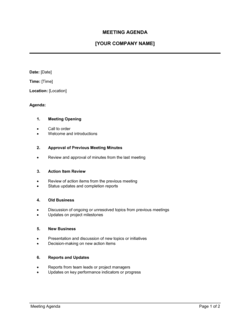
Agenda and Documents for Review

In plain language: Lists the items of business to be addressed at the meeting and identifies any documents or materials that participants should review in advance.

Sample language
The agenda for the meeting is attached as Schedule [A]. The following documents are provided for review prior to the meeting: [DOCUMENT 1 β€” e.g., Draft Financial Statements for FY[YEAR]], [DOCUMENT 2 β€” e.g., Proposed Resolution re: [MATTER]]. Additional materials will not be introduced without prior written consent of [X]% of entitled participants.

Common mistake: Circulating an agenda that lists only item headings without attaching supporting materials. Participants who arrive without context cannot meaningfully vote on resolutions, which exposes decisions to challenge after the fact.

Proxy and Voting Instructions

In plain language: Informs entitled participants of their right to appoint a proxy, provides the deadline for submitting proxy instruments, and explains the voting procedure to be used at the meeting.

Sample language
Entitled parties who are unable to attend may appoint a proxy by completing the attached Proxy Form and returning it to [NAME / EMAIL] no later than [PROXY DEADLINE β€” e.g., 48 hours before the meeting]. Voting will be conducted by [METHOD β€” e.g., show of hands / secret ballot / electronic polling].

Common mistake: Setting a proxy deadline that is shorter than the minimum period required by statute. Many corporate statutes require proxy instruments to be received at least 24 or 48 hours before the meeting; a shorter deadline renders those proxies invalid.

Governing Law and Severability

In plain language: States which jurisdiction's law governs the interpretation and validity of the notice, and confirms that if any provision is found invalid, the remainder of the notice stands.

Sample language
This Notice shall be governed by and construed in accordance with the laws of [STATE / PROVINCE / COUNTRY]. If any provision of this Notice is found to be invalid or unenforceable, it shall be severed without affecting the validity of the remaining provisions.

Common mistake: Omitting a governing law clause entirely. When an organization has members or shareholders in multiple jurisdictions, the absence of a governing law designation creates ambiguity about which notice-period and location-disclosure requirements apply.

How to fill it out

  1. 1

    Enter the organization's full legal name and issuing officer

    Use the exact registered corporate name β€” not a trading name or abbreviation. Identify the officer authorized to issue meeting notices under your bylaws or governing statute, typically the Corporate Secretary or Chief Executive Officer.

    πŸ’‘ Cross-check the entity name against your most recent annual return or certificate of incorporation to ensure the name matches exactly.

  2. 2

    Identify the meeting type and state the purpose with specificity

    Select the meeting type (annual general, special, regular board, or committee) and draft a purpose statement that is specific enough for participants to assess whether the matters affect them. Reference any attached resolutions or agenda items by schedule number.

    πŸ’‘ If the meeting involves a contentious resolution β€” such as a director removal or a major transaction β€” add a brief explanatory paragraph summarizing the resolution so participants can prepare informed questions.

  3. 3

    Enter the full civic address of the meeting venue

    Include the building name, street address, suite or floor number, city, state or province, and postal code. If the location is difficult to find, attach a map or access instructions as a schedule.

    πŸ’‘ Call the venue the day before the meeting to confirm the room booking is still in place. A last-minute venue change after notice has been issued requires a supplemental notice and may restart the notice period.

  4. 4

    Set the date, time, and time zone

    Enter the exact start date and time, including the applicable time zone. If participants are distributed across multiple time zones, list the meeting time in each relevant zone.

    πŸ’‘ For international meetings, use UTC as the reference time alongside local times β€” it removes ambiguity regardless of daylight saving time transitions.

  5. 5

    Confirm the notice period and delivery method

    Calculate the number of days between the delivery date and the meeting date. Confirm this meets or exceeds the minimum notice period under your governing statute and bylaws. Select the delivery method β€” email with read receipts, registered mail, or courier β€” and document the delivery date.

    πŸ’‘ Build a notice calendar that maps your meeting schedule against statutory notice periods for the full year. Scrambling to count days the week before a meeting is how notice defects happen.

  6. 6

    Attach the agenda and pre-meeting materials

    Finalize the meeting agenda and attach it as Schedule A. Include any documents participants need to review β€” financial statements, proposed resolutions, or reports β€” as numbered schedules. Confirm the schedules are complete before sending the notice.

    πŸ’‘ If materials are not yet ready, send the notice on time with a placeholder reference and distribute the materials separately no later than two business days before the meeting.

  7. 7

    Complete the proxy and voting instructions section

    Attach the proxy form if proxy voting is permitted. Set the proxy submission deadline at least 48 hours before the meeting unless statute requires more. Specify the voting method β€” show of hands, secret ballot, or electronic poll.

    πŸ’‘ State explicitly whether remote participants may vote and, if so, how their votes will be verified and counted. Ambiguity here is a leading cause of post-meeting resolution challenges.

  8. 8

    Obtain authorized signature and distribute

    Have the authorized officer sign the notice before distribution. Retain a complete copy of the signed notice, all schedules, and proof of delivery for each recipient in your corporate minute book.

    πŸ’‘ Use Business in a Box eSign to timestamp execution and store the fully distributed notice package alongside the meeting minutes in your corporate records.

Frequently asked questions

What is a meeting location notice?

A meeting location notice is a formal written document that officially records and communicates the confirmed venue, full address, date, and time for a scheduled corporate, board, shareholder, or committee meeting. It creates a contemporaneous paper trail confirming that all required parties were informed of where the meeting would be held, which is a legal requirement under most corporate statutes and organizational bylaws.

When is a written meeting location notice legally required?

Written notice of meeting location is required whenever the applicable corporate statute, nonprofit law, or the organization's bylaws mandate formal advance notice of meetings. This includes annual general meetings, special shareholder meetings, and board meetings in most jurisdictions. Even when not strictly required by statute, a written location notice creates a defensible record that proper notice was given β€” which is critical if any resolution passed at the meeting is later challenged.

How much advance notice is typically required for a corporate meeting?

Notice periods vary by jurisdiction and meeting type. In the United States, most state corporate statutes require between 10 and 60 days' written notice for shareholder meetings. In Canada, provincial business corporation acts typically require 21 days for shareholder meetings. In the UK, the Companies Act 2006 requires 14 days for most general meetings and 21 days for AGMs. Always check both the applicable statute and your own bylaws, as bylaws may require a longer period than the statutory minimum.

What happens if the meeting location changes after notice has been issued?

If the meeting venue changes after the original notice has been sent, a supplemental or amended notice must be issued to all entitled parties as soon as possible. Depending on the jurisdiction and the timing of the change, the notice period may need to restart entirely. Proceeding with a meeting at a location different from the one stated in the notice β€” without issuing a corrective notice β€” can render any resolutions passed at that meeting voidable or unenforceable.

Does a meeting location notice need to be signed?

Yes. In most corporate governance frameworks, the meeting notice must be signed or authorized by the officer designated in the bylaws to issue notices β€” typically the Corporate Secretary or, in their absence, the Chief Executive Officer. An unsigned or unauthorized notice may be treated as defective. For material meetings involving significant resolutions, collecting signed acknowledgments of receipt from each participant adds an additional layer of protection.

Can a meeting be held at a location different from the registered office?

In most jurisdictions, yes β€” meetings are not required to be held at the registered office unless the bylaws specify otherwise. However, some statutes require that shareholder meetings be held within the jurisdiction of incorporation unless the articles or all shareholders agree otherwise. Always review your bylaws and the governing statute before selecting an off-site or out-of-jurisdiction venue.

Are hybrid or virtual meeting locations valid for formal corporate meetings?

Whether electronic or hybrid meetings are valid depends on the governing statute and the organization's bylaws. Many jurisdictions β€” including most US states, Canadian provinces, and the UK β€” now permit fully virtual or hybrid meetings for corporations that have adopted enabling language in their bylaws or where the statute expressly allows it. The notice must state both the physical address (for in-person attendees) and the electronic access details with equal specificity.

What records should be kept after issuing a meeting location notice?

Retain a signed copy of the notice, all schedules and attachments, proof of delivery for each recipient (email timestamps, registered mail receipts, or courier tracking confirmations), and any signed acknowledgments of receipt. These records should be filed in the corporate minute book alongside the meeting minutes. In the event of a dispute over the validity of a meeting or a resolution, complete notice documentation is the first thing an auditor or court will request.

Do I need a lawyer to prepare a meeting location notice?

For routine board or committee meetings at a well-established organization with clear bylaws, a professionally drafted template is generally sufficient. Consider engaging a corporate lawyer when the meeting involves significant or contentious resolutions β€” such as a director removal, merger approval, or major equity transaction β€” when participants are located in multiple jurisdictions with different notice requirements, or when the organization's governance documents are outdated or ambiguous.

How this compares to alternatives

vs General Meeting Minutes

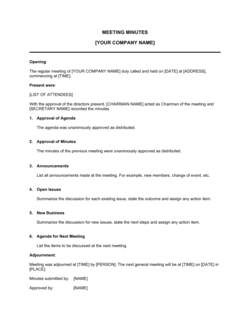
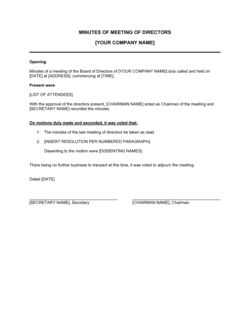
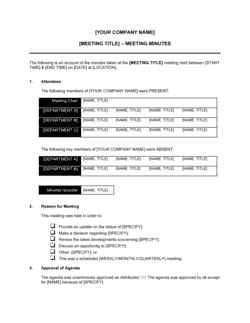
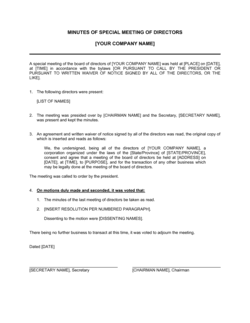
Meeting minutes are a record of what was discussed, decided, and resolved during a meeting β€” they are written after the meeting occurs. A meeting location notice is issued before the meeting and documents where the meeting will be held. Both documents are required in a complete corporate minute book; the notice creates the obligation to attend, and the minutes record what happened.

vs Notice of Annual General Meeting

A notice of annual general meeting is a comprehensive pre-meeting document covering the full agenda, financial disclosures, and shareholder voting rights for the mandatory yearly general meeting. A meeting location notice is a more focused document confirming the specific venue details β€” it may be issued as a standalone supplement when a location is confirmed or changed after the main AGM notice has already been sent.

vs Consent to Action Without Meeting

A consent to action without meeting allows directors or shareholders to pass resolutions without physically gathering at a location, using written signatures in lieu of a meeting. A meeting location notice is the opposite scenario β€” it formalizes the requirement that participants attend at a specific place and time. Use a consent resolution when scheduling a physical meeting is impractical; use a location notice when a formal meeting must be held.

vs Waiver of Notice of Meeting

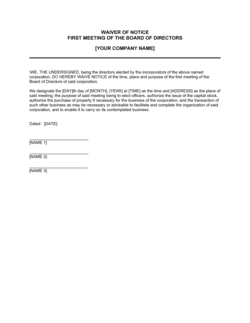
A waiver of notice is signed by participants to confirm they received adequate notice β€” or to waive any defects in notice β€” so that a meeting can proceed validly. It is typically used as a remedial document when the formal notice process was not followed correctly. A meeting location notice is the proactive document that, when properly issued, makes a waiver unnecessary.

Industry-specific considerations

Corporate and Financial Services

Board and shareholder meeting notices must satisfy strict statutory requirements and are scrutinized in M&A due diligence; incomplete records can delay or block transactions.

Nonprofit and Associations

Governance regulations for nonprofits and membership associations often require specific notice periods and location disclosures to maintain charitable status and member voting rights.

Healthcare

Hospitals, medical practice corporations, and healthcare boards require formally documented meeting notices to satisfy accreditation, licensing, and regulatory governance standards.

Real Estate

Condominium corporations, strata councils, and real estate investment trusts have statutory notice obligations for owner and unitholders' meetings with location-specific disclosure requirements.

Jurisdictional notes

United States

Notice requirements for corporate meetings are governed by individual state business corporation acts. Most states require 10 to 60 days' written notice for shareholder meetings. Delaware β€” the most common state of incorporation β€” requires at least 10 and no more than 60 days' notice under the DGCL. Virtual and hybrid meetings are broadly permitted in most states following pandemic-era legislative updates, but bylaws must typically be amended to enable electronic participation.

Canada

Under the Canada Business Corporations Act and most provincial equivalents, shareholders are entitled to at least 21 days' written notice of annual and special meetings. Quebec corporations must provide notice in French for provincially-regulated entities. Many provincial acts now permit virtual or hybrid shareholder meetings without requiring a physical location, provided the articles or bylaws are updated accordingly. Meeting location requirements must be cross-checked against both the federal or provincial statute and the corporation's articles.

United Kingdom

Under the Companies Act 2006, private companies must give at least 14 days' notice of general meetings, while public companies must give 21 days for AGMs and 14 days for other general meetings. Notice must state the time, date, and place of the meeting. The CA 2006 also permits electronic communications and web-based notices where shareholders have consented. Virtual-only meetings remain a developing area β€” check current guidance from the Financial Reporting Council and the company's articles.

European Union

Meeting notice requirements vary significantly by member state. The EU Shareholder Rights Directive II (SRD II) sets minimum standards for listed companies, including advance notice of AGM location. Germany typically requires at least 30 days' notice for AGMs; France requires 15 days for most shareholder meetings. Electronic general meetings are permitted under SRD II for listed companies, and many member states extended virtual meeting permissions following COVID-era legislation. Local counsel should be consulted for any cross-border meeting involving EU-domiciled entities.

Template vs lawyer β€” what fits your deal?

PathBest forCostTime
Use the templateRoutine board, committee, or shareholder meetings at established organizations with clear, current bylawsFree15–30 minutes
Template + legal reviewMeetings involving significant resolutions, participants in multiple jurisdictions, or bylaws that have not been reviewed recently$150–$400 for a corporate lawyer review1–2 business days
Custom draftedHigh-stakes meetings involving mergers, director removals, major equity transactions, or organizations under regulatory scrutiny$500–$2,000+3–7 business days

Glossary

Notice of Meeting
A formal written communication sent to all entitled parties informing them of the time, date, place, and purpose of an upcoming meeting.
Quorum
The minimum number of entitled participants who must be present at a meeting for the proceedings and any resolutions passed to be legally valid.
Registered Office
The official legal address of a corporation on file with the relevant government authority, which often serves as the default meeting location under statute.
Proxy
Written authorization allowing one person to attend and vote at a meeting on behalf of another entitled party who cannot be physically present.
Annual General Meeting (AGM)
A mandatory yearly meeting of a company's shareholders at which financial statements are presented and directors may be elected or removed.
Special Meeting
A meeting called outside the regular schedule to address a specific urgent matter, requiring separate notice to all entitled parties.
Corporate Bylaws
The internal rules governing a corporation's operations, including requirements for meeting notice periods, location, and quorum.
Hybrid Meeting
A meeting format that allows some participants to attend in person at the stated physical location while others join remotely via a specified video or teleconference platform.
Notice Period
The minimum number of days' advance written notice required by statute or bylaws before a meeting may be validly held.
Minutes
The official written record of a meeting's proceedings, decisions, and resolutions, which must accurately reflect the meeting's confirmed time and location.
Waiver of Notice
A signed document in which an entitled party confirms they received adequate notice β€” or formally waives their right to notice β€” for a particular meeting.

Part of your Business Operating System

This document is one of 3,000+ business & legal templates included in Business in a Box.

  • Fill-in-the-blanks β€” ready in minutes
  • 100% customizable Word document
  • Compatible with all office suites
  • Export to PDF and share electronically

Create your document in 3 simple steps.

From template to signed document β€” all inside one Business Operating System.
1
Download or open template

Access over 3,000+ business and legal templates for any business task, project or initiative.

2
Edit and fill in the blanks with AI

Customize your ready-made business document template and save it in the cloud.

3
Save, Share, Send, Sign

Share your files and folders with your team. Create a space of seamless collaboration.

Save time, save money, and create top-quality documents.

β˜…β˜…β˜…β˜…β˜…

"Fantastic value! I'm not sure how I'd do without it. It's worth its weight in gold and paid back for itself many times."

Managing Director Β· Mall Farm
Robert Whalley
Managing Director, Mall Farm Proprietary Limited
β˜…β˜…β˜…β˜…β˜…

"I have been using Business in a Box for years. It has been the most useful source of templates I have encountered. I recommend it to anyone."

Business Owner Β· 4+ years
Dr Michael John Freestone
Business Owner
β˜…β˜…β˜…β˜…β˜…

"It has been a life saver so many times I have lost count. Business in a Box has saved me so much time and as you know, time is money."

Owner Β· Upstate Web
David G. Moore Jr.
Owner, Upstate Web

Run your business with a system β€” not scattered tools

Stop downloading documents. Start operating with clarity. Business in a Box gives you the Business Operating System used by over 250,000 companies worldwide to structure, run, and grow their business.

Free Forever PlanΒ Β·Β No credit card required