Mediation Policy Template

Free Word download β€’ Edit online β€’ Save & share with Drive β€’ Export to PDF

3 pagesβ€’20–25 min to fillβ€’Difficulty: Standard
Learn more ↓
FreeMediation Policy Template

At a glance

What it is
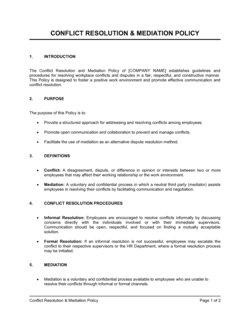
A Mediation Policy is a structured internal document that defines how an organization handles workplace disputes through a voluntary, confidential mediation process before escalating to formal grievance procedures or litigation. This free Word download provides a complete, editable framework you can tailor to your organization's size and structure, then export as PDF and distribute to all staff.
When you need it
Use it when your organization wants a defined, consistent process for resolving interpersonal conflicts, team disagreements, or employment disputes informally. It is especially valuable when onboarding new employees, updating your employee handbook, or after a workplace conflict has exposed a gap in your existing HR procedures.
What's inside
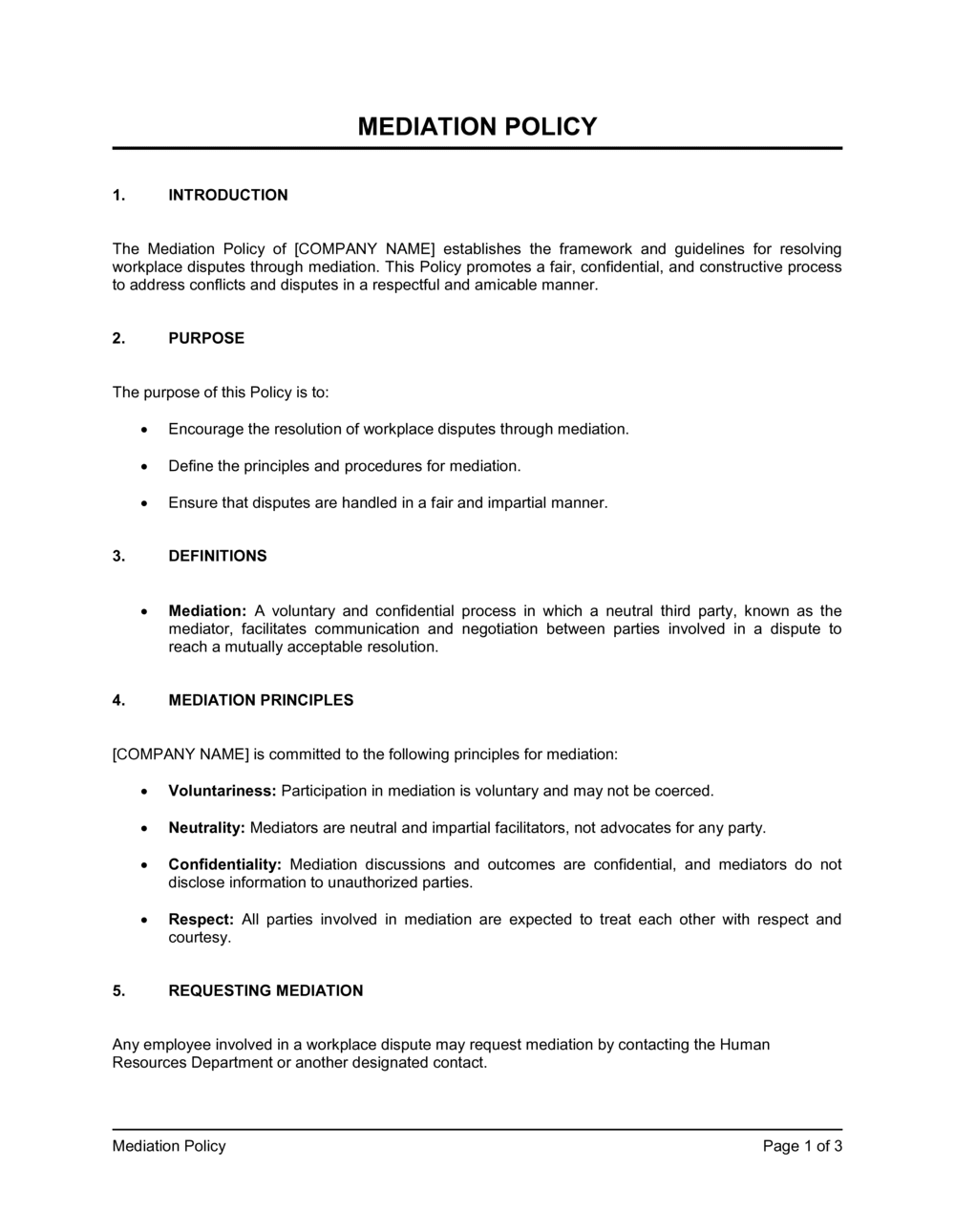
The policy covers purpose and scope, definitions of mediation and key roles, eligibility criteria, the step-by-step mediation process, mediator selection and qualifications, confidentiality rules, participant rights and responsibilities, and guidance on recording outcomes and follow-up.

What is a Mediation Policy?

A Mediation Policy is an internal organizational document that defines the process by which workplace disputes between employees β€” or between employees and managers β€” are resolved through voluntary, confidential, facilitated mediation before escalating to formal grievance procedures or legal action. It identifies which disputes are eligible, who can act as mediator, how sessions are structured, and how outcomes are recorded. Unlike a grievance or disciplinary policy, mediation is not an employer-led investigation: it is a facilitated conversation in which the parties themselves reach a mutually acceptable resolution, guided by a neutral mediator who has no authority to impose a decision.

Why You Need This Document

Without a documented mediation policy, workplace disputes follow an informal and inconsistent path β€” one manager refers a conflict to HR immediately, another ignores it, and a third attempts to broker a resolution without any structured process or confidentiality safeguards. The result is slower resolution, damaged working relationships, and an organization that cannot demonstrate procedural fairness if a dispute reaches a tribunal or labor board. Employment courts in most jurisdictions look at whether the employer offered a reasonable informal resolution process before formal action was taken; the absence of one can worsen liability exposure or cost awards. A clear mediation policy also removes the ambiguity that stops employees from coming forward early β€” when conflicts are still resolvable β€” by confirming that participation is voluntary, communications are without-prejudice, and the process will not affect their employment status. This template gives you a complete, structured policy you can tailor and publish in under two hours.

Which variant fits your situation?

If your situation is…Use this template
Resolving disputes between employees at the same levelPeer Mediation Policy
Handling conflicts between a manager and a direct reportWorkplace Grievance Policy
Documenting the outcome of a completed mediation sessionMediation Agreement
Setting out the full formal grievance and appeal processEmployee Grievance Policy
Addressing disputes in a unionized workplaceCollective Dispute Resolution Procedure
Resolving commercial disputes between business partners or vendorsCommercial Mediation Policy
Providing a one-page quick-reference for staff on dispute stepsConflict Resolution Process Summary

Common mistakes to avoid

❌ Failing to exclude disciplinary cases from mediation scope

Why it matters: Managers may try to route formal misconduct cases through mediation to avoid a difficult disciplinary process, creating procedural unfairness and potential legal exposure.

Fix: Add an explicit exclusion list in the eligibility section and include a decision flowchart appendix to guide managers to the right process.

❌ Using a mediator with a direct relationship to one of the parties

Why it matters: Perceived bias β€” even where none exists β€” immediately undermines trust in the process and gives the disadvantaged party grounds to challenge the outcome.

Fix: Require all mediators to complete a conflict-of-interest declaration before accepting a referral, and maintain an alternative mediator on standby for each case.

❌ No confidentiality exception for safeguarding disclosures

Why it matters: If a participant discloses harm or risk during a session and the mediator has no authority to act, the organization faces serious duty-of-care liability.

Fix: Include an explicit carve-out stating that the mediator may disclose information to prevent serious harm, and brief mediators on the reporting pathway before they begin any session.

❌ Treating the mediation agreement's enforceability as ambiguous

Why it matters: When neither party knows if the agreement is binding, the party who got the less favorable outcome often ignores it β€” making the entire process pointless and requiring a formal grievance anyway.

Fix: State clearly in the outcome section whether the agreement is a binding commitment or a good-faith record, and if binding, specify what 'non-compliance' triggers in terms of next steps.

The 10 key sections, explained

Purpose and scope

Definitions

Eligibility and circumstances for use

Referral process

Mediator selection and qualifications

The mediation process

Confidentiality

Participant rights and responsibilities

Outcome and mediation agreement

Review and record-keeping

How to fill it out

  1. 1

    Confirm the policy's scope and exclusions

    Define which employee groups, locations, and dispute types the policy covers. Explicitly exclude disciplinary cases, formal legal claims, and criminal conduct allegations.

    πŸ’‘ Cross-reference your existing grievance and disciplinary procedures to ensure mediation sits clearly as a pre-formal step β€” not an alternative to either.

  2. 2

    Name the mediation coordinator and referral route

    Insert the name or role title of the person who receives mediation referrals (typically an HR Business Partner or a dedicated coordinator). Add the referral form link or attachment reference.

    πŸ’‘ If your organization is small, name a backup coordinator in case the primary is involved in the dispute or unavailable.

  3. 3

    Specify mediator qualifications and panel

    State whether you will use internal mediators, an external provider, or both. List the minimum qualification standard (e.g., accredited by the Civil Mediation Council or CEDR) and any conflict-of-interest rules.

    πŸ’‘ If you don't yet have trained internal mediators, name your preferred external provider now so managers know who to contact immediately.

  4. 4

    Define the process timeline

    Set realistic timeframes: how quickly a referral is acknowledged (e.g., within 5 working days), when the initial meeting with each party takes place, and the maximum time before a session is scheduled.

    πŸ’‘ Timeliness matters β€” disputes left unaddressed for weeks escalate. A 10-working-day target from referral to first session is a widely used benchmark.

  5. 5

    Complete the confidentiality and without-prejudice clauses

    Confirm the scope of confidentiality, the without-prejudice designation, and the limited exceptions (safeguarding, legal requirement, written consent). Name the role responsible for handling exception disclosures.

    πŸ’‘ Employees read the confidentiality section first. Clear, plain-English language here drives participation rates more than any other section.

  6. 6

    Draft the outcome and agreement section

    Decide whether a mediation agreement will be treated as binding on both parties or as a good-faith commitment, and state this explicitly. Describe the escalation route if mediation fails.

    πŸ’‘ Attach a blank Mediation Agreement template as an appendix so managers and mediators have a ready-to-use format at the conclusion of a session.

  7. 7

    Set the review schedule and record-keeping rules

    Name the role responsible for annual policy review, specify the retention period for outcome records, and confirm that session content will not be retained.

    πŸ’‘ Add a version control table at the top of the document showing the policy date, review date, and the name of the approving manager β€” this is essential for audit purposes.

  8. 8

    Distribute and communicate the policy

    Publish the finalized policy in your employee handbook and intranet, brief line managers on the referral process, and provide a short FAQ for employees to answer common concerns about confidentiality and voluntariness.

    πŸ’‘ A policy that employees can't find or have never heard of provides no protection. Document the distribution date and method alongside the version control record.

Frequently asked questions

What is a mediation policy?

A mediation policy is an internal organizational document that defines how workplace disputes will be resolved through a structured, voluntary, and confidential mediation process. It sets out who can use mediation, what types of disputes are eligible, how a mediator is selected, what happens during a session, and how outcomes are recorded. The policy gives employees and managers a clear, consistent pathway to resolve conflicts before they escalate to formal grievance or legal proceedings.

Is a mediation policy legally required?

No law in most jurisdictions mandates that employers adopt a written mediation policy. However, many employment tribunals and labor boards look favorably on organizations that can demonstrate a good-faith informal dispute resolution process was available and offered before formal action was taken. In the UK, the ACAS Code of Practice on disciplinary and grievance procedures encourages mediation as a pre-grievance option. Having a documented policy strengthens your procedural defense in any subsequent claim.

What types of disputes can be handled through a mediation policy?

Workplace mediation policies typically cover interpersonal conflicts, communication breakdowns between colleagues, team relationship issues, disputes about working arrangements, and low-level complaints about behavior that do not amount to formal misconduct. They do not cover formal disciplinary matters, allegations of criminal conduct, harassment or discrimination complaints that require an investigation, or disputes where a formal legal claim has already been filed.

Does an employee have to participate in mediation?

No. Participation in mediation is voluntary, and no employee can be compelled to attend. A mediation policy should state this clearly. If one party declines mediation, the dispute typically proceeds to the organization's formal grievance or disciplinary procedure. Courts and tribunals generally do not penalize an employee for declining mediation, but an unreasonable refusal without good reason can sometimes be taken into account in cost awards.

Who acts as mediator under a workplace mediation policy?

Mediators can be trained internal employees (typically from HR or a separate department), external professional mediators, or a combination. Internal mediators are cost-effective for lower-stakes disputes but must have no prior involvement with the parties or the issue. External mediators are preferred for senior-level conflicts, cases involving sensitive allegations, or where perceived impartiality is critical. Most policies require mediators to hold a recognized accreditation from a body such as CEDR, the Civil Mediation Council, or a national equivalent.

What happens if mediation fails to resolve the dispute?

If mediation does not result in an agreement, or if one party withdraws, the policy should direct the dispute to the organization's formal escalation pathway β€” typically the grievance procedure, a management investigation, or an external arbitration process. The fact that mediation was attempted and failed is not admissible in any subsequent formal proceedings, since all mediation communications are treated as without-prejudice. Neither party is penalized for the failure to agree.

How is confidentiality protected under a mediation policy?

Everything said during a mediation session is treated as confidential and without-prejudice, meaning it cannot be used as evidence in formal proceedings. Participants agree not to disclose the content of sessions to third parties. The mediator also keeps session content confidential. The only exceptions are typically disclosures required by law, disclosures needed to prevent serious harm, or disclosures both parties consent to in writing. HR retains only the outcome record β€” not session notes.

How does a mediation policy differ from a grievance policy?

A mediation policy governs an informal, voluntary, facilitated process where the parties themselves reach an agreement with the mediator's help. A grievance policy governs a formal, employer-led investigation process where management hears a complaint, investigates, and issues a decision. Mediation is typically faster, less adversarial, and preserves working relationships better. Most organizations position mediation as a pre-grievance option β€” if it fails or is declined, the grievance procedure begins.

How often should a mediation policy be reviewed?

Annual review is standard practice for most HR policies, including mediation policies. You should also review the policy after any significant employment law change in your jurisdiction, following a mediation case that exposed a gap in the process, or after organizational restructuring that affects the roles named in the policy. Document each review in a version control table at the top of the document.

How this compares to alternatives

vs Employee Grievance Policy

A grievance policy is a formal, employer-led investigation process with defined timelines, rights of appeal, and a management decision at the end. A mediation policy is informal and voluntary β€” the parties themselves reach the outcome with a facilitator's help. Mediation is typically faster and less adversarial; use it as a first step before the grievance procedure begins.

vs Disciplinary Policy

A disciplinary policy governs employer-initiated action against an employee for misconduct or performance failure, with potential sanctions up to and including dismissal. A mediation policy covers bilateral disputes where neither party is accused of formal wrongdoing. The two processes must be explicitly kept separate β€” a disciplinary case should never be redirected to mediation.

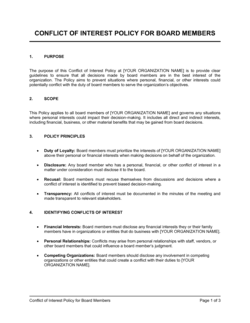
vs Conflict of Interest Policy

A conflict of interest policy prevents employees from acting in ways that put personal gain above organizational interests β€” it is a governance and ethics document. A mediation policy is an interpersonal dispute resolution mechanism. The two address entirely different risks and are both needed in a complete HR policy suite.

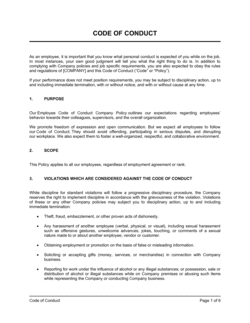
vs Code of Conduct

A code of conduct sets behavioral standards all employees must meet. A mediation policy provides the mechanism for resolving disputes when those standards β€” or other workplace tensions β€” create conflict. The code of conduct defines the rules; the mediation policy provides the structured remedy when relationships break down.

Industry-specific considerations

Professional Services

High-pressure billing environments and close team structures make interpersonal disputes common; mediation preserves client-facing team cohesion without disrupting billable work.

Healthcare

Conflicts between clinical staff must be resolved quickly to protect patient safety; a mediation policy provides a structured, documented pathway that satisfies regulatory expectations for staff wellbeing.

Education

Disputes between faculty, between staff and administrators, or involving student welfare require an impartial process that protects all parties and meets duty-of-care obligations.

Manufacturing

Shift-based environments and union relationships mean disputes can escalate quickly; a mediation policy that operates alongside the collective agreement provides a faster resolution channel before formal grievance.

Template vs pro β€” what fits your needs?

PathBest forCostTime
Use the templateSMBs and nonprofits establishing a mediation process for the first time, or updating an outdated policyFree1–2 hours
Template + professional reviewOrganizations in regulated industries, those with existing union agreements, or businesses that have faced a recent employment tribunal claim$300–$800 (HR consultant or employment lawyer review)2–5 days
Custom draftedLarge employers with complex multi-site structures, organizations subject to specific sector employment regulations, or those integrating mediation into a wider ADR framework$1,500–$4,0002–4 weeks

Glossary

Mediation
A voluntary, confidential process in which a neutral third party helps two or more disputants reach a mutually acceptable resolution without imposing a decision.
Mediator
A trained, impartial facilitator who guides the mediation session, manages communication between parties, and helps identify common ground β€” but does not decide the outcome.
Disputant
Any employee or party directly involved in the conflict who participates in the mediation process.
Grievance
A formal complaint raised by an employee under a defined organizational procedure, typically involving a manager or HR and subject to a structured investigation and response.
Caucus
A private, separate meeting a mediator holds with one party during a mediation session to discuss concerns or explore options without the other party present.
Mediation Agreement
A written record of the terms both parties agree to at the conclusion of a successful mediation session, signed by both parties and the mediator.
Without-Prejudice
A designation that prevents statements made during mediation from being used as evidence in any subsequent formal or legal proceedings.
Voluntary Participation
The principle that no employee can be compelled to participate in mediation β€” both parties must consent before a session proceeds.
Shuttle Mediation
A mediation format in which the mediator moves between parties in separate rooms rather than bringing them face-to-face, used when direct interaction is not appropriate.
Escalation Pathway
The defined sequence of steps an unresolved dispute follows after mediation is declined or fails, typically leading to a formal grievance, investigation, or disciplinary process.

Part of your Business Operating System

This document is one of 3,000+ business & legal templates included in Business in a Box.

  • Fill-in-the-blanks β€” ready in minutes
  • 100% customizable Word document
  • Compatible with all office suites
  • Export to PDF and share electronically

Create your document in 3 simple steps.

From template to signed document β€” all inside one Business Operating System.
1
Download or open template

Access over 3,000+ business and legal templates for any business task, project or initiative.

2
Edit and fill in the blanks with AI

Customize your ready-made business document template and save it in the cloud.

3
Save, Share, Send, Sign

Share your files and folders with your team. Create a space of seamless collaboration.

Save time, save money, and create top-quality documents.

β˜…β˜…β˜…β˜…β˜…

"Fantastic value! I'm not sure how I'd do without it. It's worth its weight in gold and paid back for itself many times."

Managing Director Β· Mall Farm
Robert Whalley
Managing Director, Mall Farm Proprietary Limited
β˜…β˜…β˜…β˜…β˜…

"I have been using Business in a Box for years. It has been the most useful source of templates I have encountered. I recommend it to anyone."

Business Owner Β· 4+ years
Dr Michael John Freestone
Business Owner
β˜…β˜…β˜…β˜…β˜…

"It has been a life saver so many times I have lost count. Business in a Box has saved me so much time and as you know, time is money."

Owner Β· Upstate Web
David G. Moore Jr.
Owner, Upstate Web

Run your business with a system β€” not scattered tools

Stop downloading documents. Start operating with clarity. Business in a Box gives you the Business Operating System used by over 250,000 companies worldwide to structure, run, and grow their business.

Start freeΒ Β·Β No credit card required