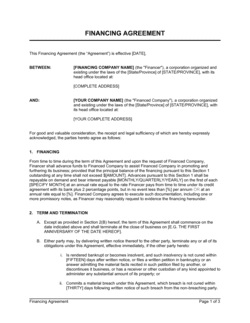
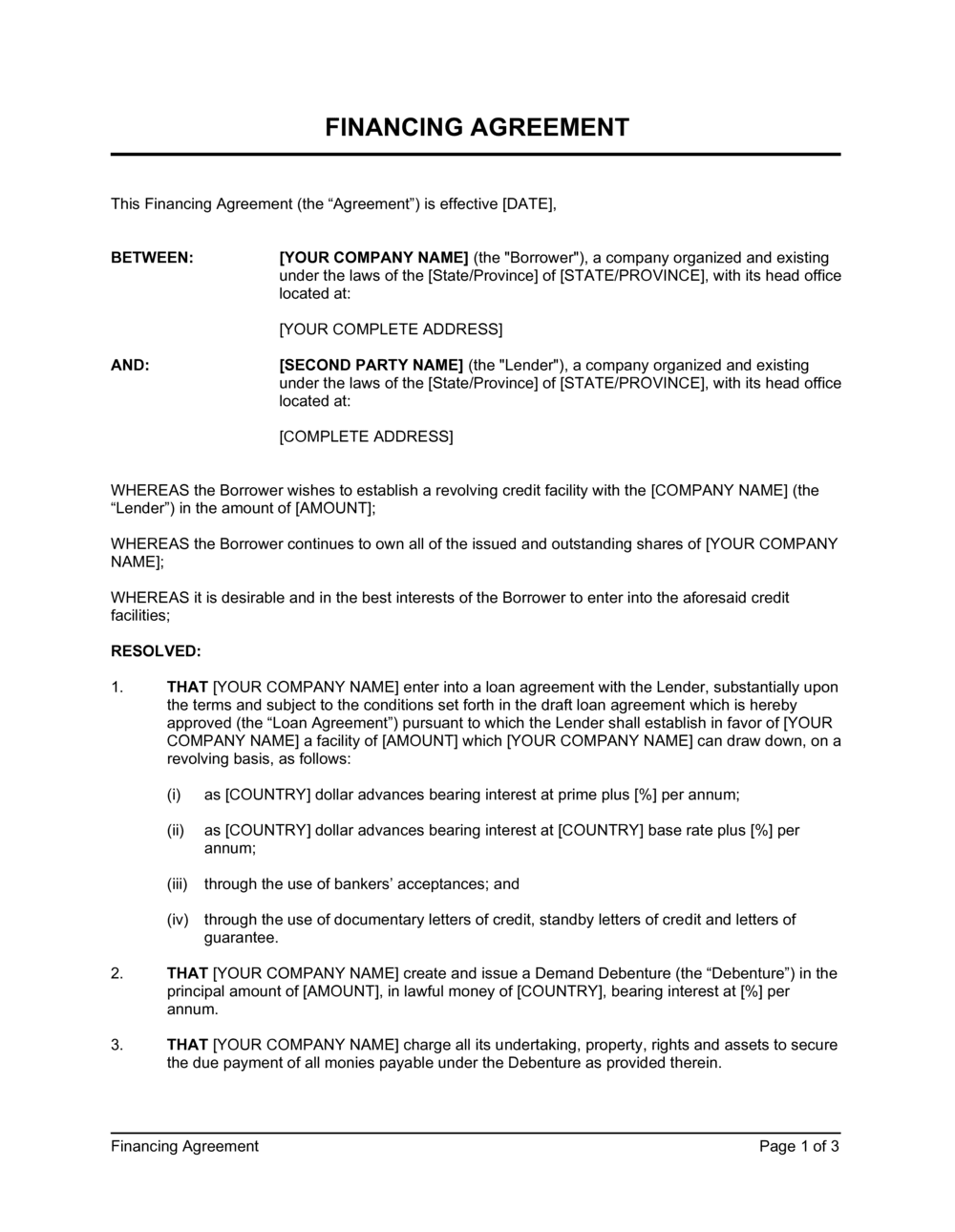
Financing Agreement Short Template

Free Word download β€’ Edit online β€’ Save & share with Drive β€’ Export to PDF

3 pagesβ€’25–30 min to fillβ€’Difficulty: Standardβ€’Signature requiredβ€’Legal review recommended
Learn more ↓
FreeFinancing Agreement Short Template

At a glance

What it is
A Financing Agreement Short is a concise legally binding contract between a lender and a borrower that documents the terms of a business or personal loan β€” including principal amount, interest rate, repayment schedule, collateral, and default remedies. This free Word download is an abbreviated form suitable for straightforward lending arrangements where a full long-form credit agreement would be excessive. Edit it online and export as PDF for immediate use.
When you need it
Use it when a business owner, private lender, or investor extends a loan and needs a written, signed record of the terms β€” particularly for shareholder loans, inter-company financing, equipment purchases, or private lending arrangements where a bank-issued credit facility is not involved.
What's inside
Parties and loan amount, interest rate and calculation method, repayment schedule, collateral or security interest, representations and warranties, events of default and remedies, and governing law.

What is a Financing Agreement Short?

A Financing Agreement Short is a concise, legally binding contract between a lender and a borrower that records the material terms of a loan β€” including the principal amount advanced, the interest rate and compounding method, the repayment schedule, any collateral pledged as security, the conditions to advance, and the remedies available if the borrower defaults. It is the short-form equivalent of a full commercial credit agreement, designed for private lending arrangements, shareholder advances, inter-company loans, and seller-financed transactions where a bank-issued facility is not involved. Unlike a promissory note β€” which is a unilateral promise to pay β€” a financing agreement is a bilateral contract that creates obligations on both parties and provides the lender with a structured enforcement framework.

Why You Need This Document

Without a signed financing agreement, a private loan exists only as an oral understanding β€” and courts regularly characterize undocumented transfers of money between business associates or related parties as gifts, capital contributions, or equity, not debt. The practical consequences are severe: no enforceable repayment schedule, no security interest to register, no acceleration right if the borrower becomes insolvent, and no governing law to determine which court has jurisdiction. A missed payment with no written agreement means starting an expensive lawsuit to prove the basic terms before you can even pursue the balance. This short-form template gives lenders a signed, enforceable record of what was lent, when it must be repaid, what collateral secures it, and what happens if the borrower defaults β€” in a format that takes under 30 minutes to complete and is ready for execution on the same day.

Which variant fits your situation?

If your situation is…Use this template
Simple loan between two private parties with no collateralFinancing Agreement Short
Larger or more complex commercial credit facility with multiple covenantsFinancing Agreement (Long Form)
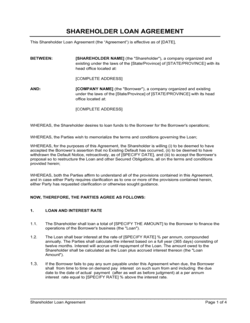
Shareholder advancing funds to their own companyShareholder Loan Agreement
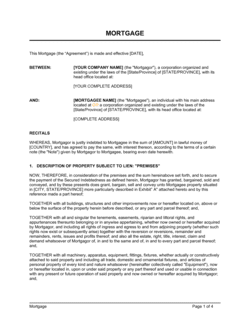
Loan secured against real propertyMortgage Agreement
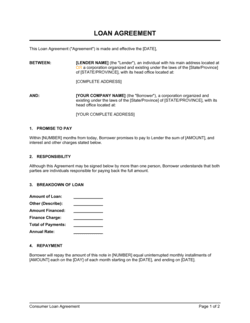
Peer-to-peer personal loan between individualsPersonal Loan Agreement
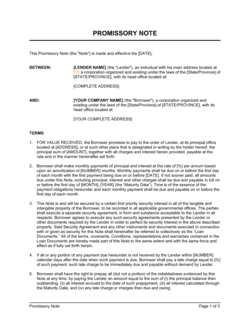
Deferred payment for goods or services sold on creditPromissory Note
Short-term loan with asset pledged as securitySecured Loan Agreement

Common mistakes to avoid

❌ Advancing funds before the agreement is signed

Why it matters: A loan advanced without a signed agreement may be characterized as a gift or equity contribution, particularly in shareholder or family lending situations. Recovering the funds then requires proving an implied agreement in court.

Fix: Execute the agreement, satisfy all advance conditions, and transfer funds only after receiving a fully signed copy. Never wire money and then follow up with paperwork.

❌ Omitting the interest compounding frequency

Why it matters: A 12% annual rate compounded monthly produces an effective annual rate of approximately 12.68%. Without specifying compounding, disputes arise over how much is actually owed, particularly on loans that run for several years.

Fix: State both the nominal annual rate and the compounding period explicitly β€” e.g., '12% per annum, compounded monthly, calculated on a 365-day year.'

❌ Using vague collateral descriptions

Why it matters: A security interest registered against 'all assets' without specific identifiers may be challenged by a bankruptcy trustee or a competing creditor who filed a more precise registration β€” potentially losing priority entirely.

Fix: Describe collateral with identifiers: serial numbers, VIN, account numbers, or a precise legal description for real property. When in doubt, attach a Schedule A listing each item.

❌ No cure period before acceleration

Why it matters: Automatic acceleration on a first missed payment β€” without notice or a cure window β€” has been characterized by courts as an unenforceable penalty clause, particularly for consumer or small-business borrowers.

Fix: Include a written-notice requirement and a 5–10 business day cure period before the lender may accelerate. This is also better practice for preserving a lending relationship.

❌ Setting an interest rate above the jurisdictional usury cap

Why it matters: A rate that exceeds the statutory maximum is either void, reduced to the legal cap, or triggers regulatory penalties β€” depending on the jurisdiction. In some US states the entire agreement becomes unenforceable.

Fix: Verify the applicable usury ceiling before finalizing the rate. In the US this varies by state and loan type; in Canada the criminal rate of interest is capped at 60% per annum (35% as of 2025 amendments β€” confirm current status).

❌ Skipping governing law when the parties are in different jurisdictions

Why it matters: Without a governing-law clause, courts apply conflict-of-laws rules to determine which jurisdiction governs β€” an expensive and unpredictable process that can unwind what seemed like a simple agreement.

Fix: Always specify a single governing jurisdiction. Choose the lender's home jurisdiction or the location of the collateral, and confirm the choice is enforceable in both parties' locations.

The 9 key clauses, explained

Parties, Loan Amount, and Purpose

In plain language: Identifies the lender and borrower as legal entities, states the exact principal amount being advanced, and (optionally) describes the permitted purpose of the loan.

Sample language
This Financing Agreement is entered into as of [DATE] between [LENDER LEGAL NAME] ('Lender') and [BORROWER LEGAL NAME] ('Borrower'). Lender agrees to advance to Borrower the principal sum of $[AMOUNT] for the purpose of [PURPOSE / 'general working capital'].

Common mistake: Using a trade name instead of the registered legal entity name for either party. If the borrower entity is wrong, enforcing repayment or seizing collateral becomes procedurally complex.

Interest Rate and Calculation

In plain language: States the annual interest rate, whether it is fixed or variable, how it accrues (daily, monthly, or compound), and the basis for calculation.

Sample language
The outstanding principal shall bear interest at the rate of [X]% per annum, calculated daily on the basis of a 365-day year and compounded [monthly / annually], from the Advance Date until repayment in full.

Common mistake: Stating a rate without specifying the compounding frequency. Monthly compounding on a 10% annual rate produces a materially different cost than annual compounding β€” ambiguity creates disputes.

Repayment Schedule

In plain language: Defines how and when the borrower must repay β€” whether in installments, a lump sum at maturity, or on demand β€” and the method of payment.

Sample language
Borrower shall repay the loan in [X] equal monthly installments of $[AMOUNT], commencing on [DATE], with a final balloon payment of $[AMOUNT] due on [MATURITY DATE]. All payments shall be made by wire transfer to [LENDER BANK DETAILS].

Common mistake: Setting a repayment schedule without confirming the borrower's cash-flow capacity. An unworkable schedule leads to immediate default β€” in private lending this is often an oversight rather than intent.

Advance Conditions

In plain language: Lists the conditions the borrower must satisfy before the lender is obligated to advance the funds β€” such as delivery of executed documents, evidence of insurance, or board resolutions.

Sample language
The obligation of Lender to advance the Loan Amount is conditional upon receipt of: (a) this Agreement executed by Borrower; (b) [COLLATERAL DOCUMENT]; and (c) [BOARD RESOLUTION / OFFICER CERTIFICATE] dated no earlier than [DATE].

Common mistake: Advancing funds before all conditions are satisfied and then trying to document them retroactively. A retroactive advance condition is effectively waived β€” the lender loses the protection it was designed to provide.

Collateral and Security Interest

In plain language: Describes any asset pledged as security, how the security interest is created and perfected, and the lender's rights against the collateral if the borrower defaults.

Sample language
As security for the repayment of all amounts owing under this Agreement, Borrower hereby grants Lender a first-ranking security interest in [DESCRIPTION OF COLLATERAL] (the 'Collateral'). Borrower authorizes Lender to register a financing statement in respect of the Collateral under applicable law.

Common mistake: Describing collateral vaguely β€” 'all business assets' without a specific description β€” which can make the security interest difficult to enforce or subordinate to a later creditor who files a more precise registration.

Representations and Warranties

In plain language: Statements the borrower makes as of the signing date confirming it has legal authority to borrow, is not in default elsewhere, and has disclosed all material information.

Sample language
Borrower represents and warrants that: (a) it is duly incorporated and has full authority to enter into this Agreement; (b) this Agreement does not violate any other agreement to which Borrower is a party; and (c) there is no pending litigation that would materially affect Borrower's ability to repay.

Common mistake: Omitting a representation that the borrower is not already in default under other financing arrangements. A lender who advances funds into a borrower with undisclosed existing defaults has significantly weakened priority.

Events of Default and Acceleration

In plain language: Defines the specific actions or omissions that constitute default β€” missed payments, breach of representations, insolvency β€” and the lender's right to accelerate all amounts owing.

Sample language
Each of the following constitutes an Event of Default: (a) Borrower fails to make any payment within [X] business days of its due date; (b) any representation proves materially false; (c) Borrower becomes insolvent or makes an assignment for the benefit of creditors. Upon an Event of Default, Lender may, on written notice, declare all amounts immediately due and payable.

Common mistake: Triggering acceleration automatically on any breach, including minor technical defaults. Courts may treat automatic acceleration as a penalty β€” including a cure period of 5–10 business days for payment defaults is more defensible.

Prepayment

In plain language: States whether the borrower may repay the loan early, whether a fee applies, and how prepayments are applied β€” to interest first, then principal, or vice versa.

Sample language
Borrower may prepay the outstanding principal, in whole or in part, at any time upon [X] business days' written notice, [without penalty / subject to a prepayment fee of [X]% of the amount prepaid]. Prepayments shall be applied first to accrued interest, then to principal.

Common mistake: Omitting prepayment terms entirely. Without them, courts in some jurisdictions treat the loan as prepayable on demand β€” depriving the lender of the full interest income it expected.

Governing Law and Dispute Resolution

In plain language: Specifies which jurisdiction's law governs interpretation and enforcement, and how disputes will be resolved β€” litigation, arbitration, or mediation.

Sample language
This Agreement shall be governed by the laws of [STATE / PROVINCE / COUNTRY]. Any dispute arising under this Agreement shall be submitted to the exclusive jurisdiction of the courts of [JURISDICTION], except that Lender may seek injunctive or enforcement relief in any court of competent jurisdiction.

Common mistake: Choosing a governing law with no connection to where either party operates or the collateral is located. Several jurisdictions β€” including some US states and Canadian provinces β€” will apply local law to security interests in local property regardless of the contractual choice.

How to fill it out

  1. 1

    Identify both parties with their full legal entity names

    Enter the lender's and borrower's registered legal names, jurisdiction of incorporation or organization, and principal business addresses. For individuals, use full legal names as they appear on government-issued ID.

    πŸ’‘ Confirm the borrower's legal name against a current corporate registry search before signing β€” dissolved or incorrectly named entities create enforcement gaps.

  2. 2

    State the principal amount and the advance date

    Enter the exact dollar amount being lent and the date on which funds will be transferred. If the loan is advanced in tranches, list each tranche amount and trigger condition separately.

    πŸ’‘ Express the amount in both numerals and words β€” e.g., '$50,000 (fifty thousand dollars)' β€” to prevent any alteration dispute.

  3. 3

    Set the interest rate and compounding method

    Specify whether the rate is fixed or variable. For variable rates, identify the reference rate (e.g., prime rate plus 2%) and the adjustment frequency. State whether interest compounds monthly, quarterly, or annually.

    πŸ’‘ Check the usury ceiling in the governing jurisdiction before setting the rate. In some US states and Canadian provinces, rates above a statutory cap are void or reduced by a court.

  4. 4

    Define the repayment schedule

    Choose between equal installments, interest-only with a balloon, or a single bullet repayment at maturity. Enter each payment date, amount, and the maturity date. Link the schedule to the amortization table in the appendix if applicable.

    πŸ’‘ Build the payment schedule in a spreadsheet first to confirm the math is correct β€” a rounding error in the final payment is one of the most common issues found on execution.

  5. 5

    Describe the collateral and register a security interest if required

    If the loan is secured, describe the collateral with enough specificity to identify it (serial numbers for equipment, legal description for real property, account numbers for financial assets). Note any filing requirements under PPSA, UCC Article 9, or equivalent legislation.

    πŸ’‘ File your security interest registration before advancing funds β€” priority is generally determined by registration date, not agreement date.

  6. 6

    Tailor the events of default and include a cure period

    List the specific defaults relevant to this loan β€” missed payments, breach of representations, insolvency, change of control. Add a cure period of at least 5 business days for payment defaults to reduce the risk of a court treating acceleration as a penalty.

    πŸ’‘ For private loans between related parties, a longer cure period (10–15 days) can prevent a technical default from damaging the relationship unnecessarily.

  7. 7

    Confirm governing law and sign before funds are advanced

    Select the jurisdiction where both parties operate, or where the collateral is located if secured. Ensure both parties sign the agreement β€” with witnesses or notarization if required locally β€” before the lender transfers any funds.

    πŸ’‘ Use a dated signature block and retain a fully executed copy in a secure, accessible location. An undated or unsigned agreement may be treated as a draft rather than a binding contract.

Frequently asked questions

What is a financing agreement?

A financing agreement is a legally binding contract between a lender and a borrower that documents the terms on which money is advanced and repaid. It sets out the principal amount, interest rate, repayment schedule, collateral (if any), events of default, and the remedies available to the lender if the borrower fails to perform. A short-form financing agreement covers the same essential terms as a long-form credit agreement but in a more concise format suited to straightforward lending arrangements.

When should I use a short financing agreement instead of a long-form one?

A short financing agreement is appropriate when the loan is between two parties who know each other β€” such as a shareholder and their company, two related businesses, or a private investor and a small business β€” and the transaction is relatively straightforward with no complex covenants, multiple tranches, or syndicated lenders. Use a long-form agreement when the loan is large, involves ongoing financial maintenance covenants, multiple security documents, or a bank as the lender.

Does a financing agreement need to be notarized?

In most jurisdictions, a financing agreement does not require notarization to be legally binding β€” signatures of both parties are generally sufficient. However, if the agreement is secured by real property or the lender intends to register a mortgage or deed of trust, notarization or witnessing requirements may apply under local property law. Check the specific requirements of the governing jurisdiction before execution.

What is the difference between a financing agreement and a promissory note?

A promissory note is a standalone written promise by the borrower to repay a specific sum β€” it is a negotiable instrument that can be transferred to a third party. A financing agreement is a bilateral contract that includes the lender's obligations, conditions to advance, representations, covenants, and detailed default provisions. A promissory note is often attached to a financing agreement as an exhibit to provide a negotiable record of the debt, while the agreement governs all other terms.

How is interest calculated in a financing agreement?

Interest is typically calculated as a percentage of the outstanding principal per annum, accruing daily and compounded at the agreed frequency β€” monthly, quarterly, or annually. The agreement should state the nominal annual rate, the compounding period, and the day-count convention (365-day or 360-day year). Failing to specify these parameters creates ambiguity about the total amount owed, particularly for loans running more than 12 months.

What happens if the borrower misses a payment?

A missed payment typically triggers a default under the agreement. Most well-drafted agreements include a cure period β€” usually 5–10 business days after written notice β€” before the lender may declare the full balance immediately due and payable through an acceleration clause. The lender may also charge a default interest rate (typically 2–5% above the contract rate) on overdue amounts and, if the loan is secured, may enforce the security interest against the collateral.

Can a financing agreement be unsecured?

Yes. Many short-form financing agreements between related parties β€” shareholder loans, inter-company advances, or family loans β€” are unsecured, meaning the lender has no claim against specific assets beyond a general right to sue for the outstanding balance. Secured agreements give the lender a priority claim against identified collateral in the event of insolvency, making them significantly stronger from a credit risk perspective.

Do I need a lawyer to prepare a financing agreement?

For a straightforward private loan between parties who know each other, a high-quality short-form template is typically sufficient, particularly for amounts under $50,000. Consider engaging a lawyer when the loan exceeds $100,000, involves real property as collateral, crosses international borders, or is part of a structured financing with other lenders. A 1–2 hour lawyer review typically costs $300–$600 and is warranted whenever the lender cannot afford to lose the principal.

What is an acceleration clause and why does it matter?

An acceleration clause makes the entire unpaid loan balance immediately due and payable when the borrower commits a specified event of default β€” rather than allowing the borrower to continue missing payments until the maturity date. Without it, a lender whose borrower stops paying must wait until each installment becomes individually due before suing for it, which can take years. Acceleration is the mechanism that allows the lender to act decisively and pursue the full debt at once.

How this compares to alternatives

vs Financing Agreement (Long Form)

A long-form financing agreement covers the same core terms but adds detailed financial maintenance covenants, multiple events of default with graduated remedies, representations surviving closing, and provisions for syndicated or multi-lender facilities. Use the short form for straightforward private lending; use the long form when the lender is an institutional creditor, the amount is material, or ongoing compliance reporting is required.

vs Promissory Note

A promissory note is a negotiable instrument β€” a unilateral promise by the borrower to repay β€” without the bilateral contractual structure of a financing agreement. It can be transferred to a third party and has a specific legal status in commercial law. A financing agreement is more comprehensive, covering the lender's conditions, covenants, and security. For any secured or complex loan, use a financing agreement rather than a standalone note.

vs Shareholder Loan Agreement

A shareholder loan agreement is specifically designed for advances from a shareholder to their own company, often at below-market rates and with subordination to third-party creditors built in. It typically addresses corporate formalities β€” board approval, related-party disclosure β€” that a general financing agreement does not. Use the shareholder loan template when the lender is also an equity holder; use the general financing agreement for arm's-length private lending.

vs Personal Loan Agreement

A personal loan agreement is tailored for lending between individuals β€” often family members or friends β€” and uses plain-language consumer-oriented terms. A short financing agreement is drafted for business-to-business or investor-to-business lending and includes commercial provisions such as representations, security interests, and cross-default. Use the personal loan template for individual borrowers; use this template when at least one party is a business entity.

Industry-specific considerations

Technology / SaaS

Shareholder bridge loans before a formal equity round, inter-company advances between group entities, and short-term working capital facilities pending revenue milestones.

Real estate

Short-term bridge financing between private parties ahead of permanent mortgage funding, with the property or a related asset pledged as collateral.

Manufacturing

Equipment purchase financing where the seller extends credit to the buyer, with a security interest registered against the specific equipment financed.

Professional services

Partner capital contributions treated as loans to the firm, or short-term working capital advances from principals pending client payment cycles.

Retail / E-commerce

Inventory financing advances from a major supplier or investor, with repayment tied to product sell-through and a security interest in the inventory.

Construction

Project-specific draw facilities between a developer and a private lender, with advances conditional on construction milestones and security registered against the project site.

Jurisdictional notes

United States

Interest rate limits vary sharply by state β€” some states cap consumer loans at 10–16% while others (Delaware, South Dakota) impose no statutory ceiling for business loans. UCC Article 9 governs security interests in personal property; registration is filed with the Secretary of State in the debtor's jurisdiction. State lender licensing laws may apply even to private business lenders above certain thresholds.

Canada

The Criminal Code sets a national criminal interest rate cap (60% per annum historically; amendments effective 2025 propose 35% β€” confirm current status before setting a rate). Each province has its own Personal Property Security Act (PPSA) governing registration of security interests. Quebec is a civil law jurisdiction β€” security over movable property is governed by the Civil Code, and hypothec registration replaces PPSA filings.

United Kingdom

Consumer credit agreements are regulated by the Consumer Credit Act 1974 and FCA rules β€” business-to-business lending is generally exempt. Security over company assets is typically taken by way of fixed or floating charge registered at Companies House within 21 days of creation. Post-Brexit, EU financial services passport rights no longer apply to UK lenders operating in EU member states.

European Union

The Consumer Credit Directive and Mortgage Credit Directive impose disclosure and cooling-off requirements for loans to natural persons; business loans are largely outside their scope. Security interest registration and enforcement rules vary significantly by member state β€” German, French, and Spanish security law differs materially. Where personal data is processed in connection with credit assessment, GDPR requirements apply.

Template vs lawyer β€” what fits your deal?

PathBest forCostTime
Use the templatePrivate loans under $100,000 between parties who know each other, shareholder loans, and straightforward inter-company advancesFree20–30 minutes
Template + legal reviewLoans above $50,000, secured lending with collateral registration, or any cross-border arrangement$300–$6001–3 days
Custom draftedLarge secured facilities, multi-lender arrangements, real-property security, or regulated financial institutions as lender$1,500–$5,000+1–3 weeks

Glossary

Principal
The original amount of money lent, before interest or fees are added.
Interest Rate
The percentage charged on the outstanding principal per year (per annum), used to calculate the cost of borrowing.
Amortization Schedule
A table showing each payment due date, the portion applied to interest, the portion applied to principal, and the remaining balance after each payment.
Maturity Date
The date on which the entire outstanding loan balance, including all accrued interest, must be repaid in full.
Collateral
An asset pledged by the borrower to secure the loan β€” the lender may seize it if the borrower defaults.
Security Interest
A legal right the lender holds in the borrower's collateral, typically registered under applicable personal property security legislation.
Default
A failure by the borrower to fulfill a material obligation under the agreement β€” most commonly a missed payment or a breach of a representation.
Acceleration Clause
A provision that makes the entire unpaid loan balance immediately due and payable upon a defined event of default.
Prepayment
Repayment of all or part of the loan before the scheduled due date, which may or may not attract a penalty depending on the agreement.
Usury
The charging of interest at a rate exceeding the legal maximum set by applicable law β€” a financing agreement with a usurious rate may be void or reduced by a court.
Promissory Note
A standalone written promise by the borrower to repay a specific sum on demand or on a defined date, sometimes attached to a financing agreement as an exhibit.
Cross-Default
A clause that triggers default under this agreement if the borrower defaults under any other financing arrangement, protecting the lender from selective non-payment.

Part of your Business Operating System

This document is one of 3,000+ business & legal templates included in Business in a Box.

  • Fill-in-the-blanks β€” ready in minutes
  • 100% customizable Word document
  • Compatible with all office suites
  • Export to PDF and share electronically

Create your document in 3 simple steps.

From template to signed document β€” all inside one Business Operating System.
1
Download or open template

Access over 3,000+ business and legal templates for any business task, project or initiative.

2
Edit and fill in the blanks with AI

Customize your ready-made business document template and save it in the cloud.

3
Save, Share, Send, Sign

Share your files and folders with your team. Create a space of seamless collaboration.

Save time, save money, and create top-quality documents.

β˜…β˜…β˜…β˜…β˜…

"Fantastic value! I'm not sure how I'd do without it. It's worth its weight in gold and paid back for itself many times."

Managing Director Β· Mall Farm
Robert Whalley
Managing Director, Mall Farm Proprietary Limited
β˜…β˜…β˜…β˜…β˜…

"I have been using Business in a Box for years. It has been the most useful source of templates I have encountered. I recommend it to anyone."

Business Owner Β· 4+ years
Dr Michael John Freestone
Business Owner
β˜…β˜…β˜…β˜…β˜…

"It has been a life saver so many times I have lost count. Business in a Box has saved me so much time and as you know, time is money."

Owner Β· Upstate Web
David G. Moore Jr.
Owner, Upstate Web

Run your business with a system β€” not scattered tools

Stop downloading documents. Start operating with clarity. Business in a Box gives you the Business Operating System used by over 250,000 companies worldwide to structure, run, and grow their business.

Free Forever PlanΒ Β·Β No credit card required