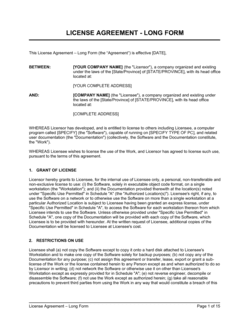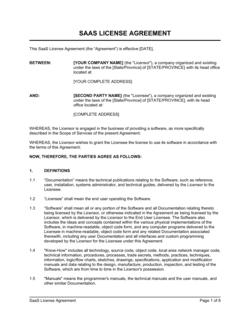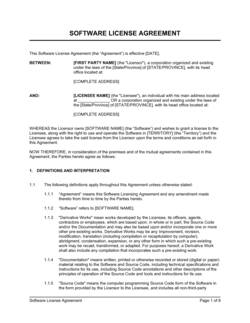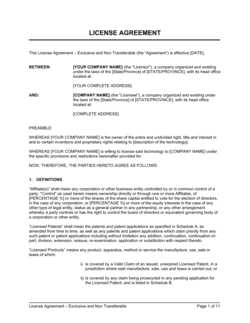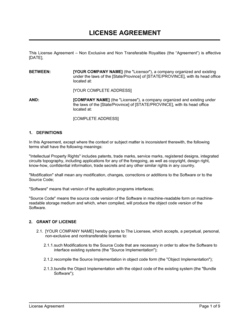
License Agreement Short Form Template

Free Word download β€’ Edit online β€’ Save & share with Drive β€’ Export to PDF

4 pagesβ€’20–30 min to fillβ€’Difficulty: Standard
Learn more ↓
FreeLicense Agreement Short Form Template

At a glance

What it is
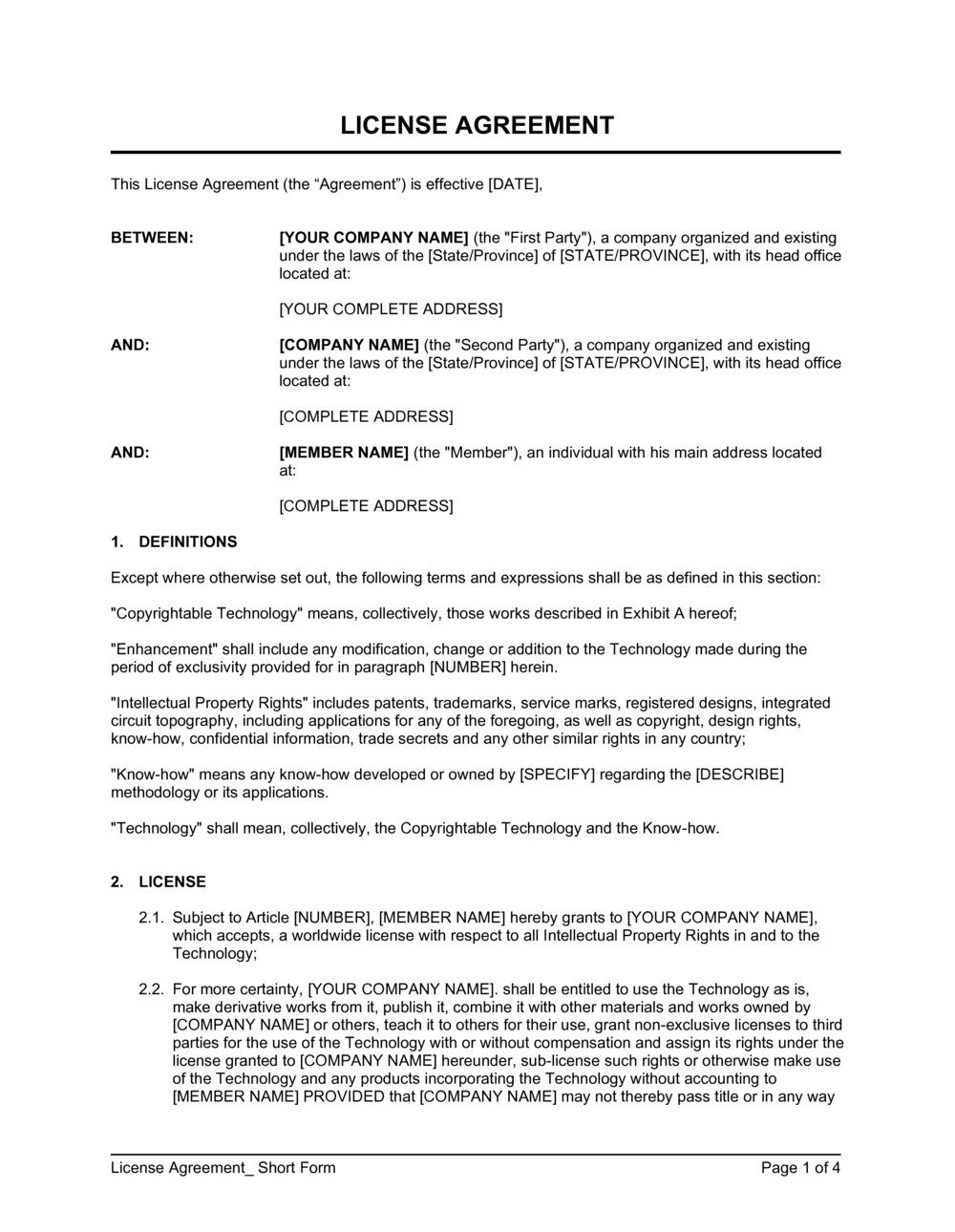
A License Agreement Short Form is a concise, structured document that grants one party (the Licensee) limited rights to use an asset β€” software, creative work, trademark, or other intellectual property β€” owned by another party (the Licensor). This free Word download gives you a ready-to-fill form you can edit online and export as PDF to document the scope, duration, and terms of any straightforward licensing arrangement.
When you need it
Use it when granting or receiving a one-time, limited-scope license where a multi-page formal agreement would be disproportionate to the transaction β€” such as licensing a logo for a campaign, a photo for a publication, or a software module for internal use.
What's inside
Licensor and licensee details, a description of the licensed asset, scope of permitted use, territory, term, fees and payment schedule, ownership acknowledgment, and termination conditions β€” all on a single structured form.

What is a License Agreement Short Form?

A License Agreement Short Form is a concise, structured document that grants one party β€” the Licensee β€” limited, defined rights to use an intellectual property asset owned by another party β€” the Licensor. It captures the essential terms of any straightforward licensing arrangement β€” what is being licensed, how it may be used, for how long, in which territory, and at what cost β€” without the extended clauses found in a full long-form license. Common applications include granting a client rights to use a logo for a specific campaign, permitting a business partner to deploy a software module for internal operations, or licensing a photograph for a defined publication run.

Why You Need This Document

Allowing someone to use your intellectual property without a written license leaves the scope of that permission entirely undefined β€” creating disputes over exclusivity, territory, and permitted use that are expensive to resolve after the fact. A completed short-form license establishes the exact boundaries of what the Licensee may and may not do, confirms that you retain ownership, and gives you clear grounds to terminate if those boundaries are crossed. Without it, a Licensee who continues using your asset after the agreed period has technically infringed your rights, but proving the original terms becomes a credibility contest rather than a contract dispute. This template lets you document any routine licensing arrangement in under 15 minutes, protecting both parties and eliminating ambiguity before it becomes a problem.

Which variant fits your situation?

If your situation is…Use this template
Licensing complex software with support, warranty, and SLA termsSoftware License Agreement
Granting ongoing franchise-style rights to use a brand across multiple locationsTrademark License Agreement
Licensing music, video, or audio content for commercial useMusic / Media License Agreement
Granting exclusive rights to manufacture or distribute a patented productExclusive License Agreement
Licensing technology between two companies under an NDA frameworkTechnology License Agreement
Granting a one-time right to reproduce a single image or photographImage / Photo License Form
Documenting open-source or royalty-free usage rightsNon-Exclusive License Agreement

Common mistakes to avoid

❌ Vague description of the licensed asset

Why it matters: If the asset is described as 'our brand materials,' a dispute over which specific files or versions are covered becomes nearly impossible to resolve.

Fix: Name the asset precisely β€” title, file name, registration number, or exhibit reference β€” so there is no ambiguity about what is and is not licensed.
❌ Omitting prohibited uses

Why it matters: Licensees routinely interpret silence as permission β€” an asset licensed for 'marketing purposes' may end up in contexts the Licensor never intended.

Fix: Add an explicit list of prohibited uses alongside the permitted uses so the boundaries are unambiguous.

❌ Leaving exclusivity unstated

Why it matters: A Licensee who paid a premium expecting exclusivity and later discovers competitors received the same license has grounds for a claim and will almost certainly not renew.

Fix: Always mark the exclusivity checkbox explicitly β€” non-exclusive by default if the Licensor intends to grant the rights to multiple parties.

❌ No post-expiry obligations on the Licensee

Why it matters: Without a clause requiring the Licensee to stop using the asset when the term ends, they may continue using it indefinitely after expiry β€” in good faith or otherwise.

Fix: Add a field stating that upon termination or expiry the Licensee must immediately cease all use and, if applicable, destroy or return any copies of the asset.

The 9 key fields, explained

Licensor and Licensee Details

Description of Licensed Asset

Scope of Permitted Use

Exclusivity

Territory

Term and Renewal

License Fee and Payment Terms

Ownership and Attribution

Termination Conditions

How to fill it out

  1. 1

    Enter both parties' legal details

    Fill in the full registered legal name and address of the Licensor and Licensee. If either party is an individual rather than an entity, include their full legal name and address.

    πŸ’‘ Match the name exactly to the entity's official registration β€” using a shortened or trade name can create ownership ambiguity.

  2. 2

    Describe the licensed asset precisely

    Name the specific asset being licensed β€” include title, file name, registration number, or any other unique identifier. Attach a copy or link as an exhibit if possible.

    πŸ’‘ For logos or images, attach the specific file version to the agreement so there is no dispute about which version is covered.

  3. 3

    Define the scope, exclusivity, and territory

    Check whether the license is exclusive or non-exclusive, list every permitted use, list every prohibited use, and name the geographic territory explicitly.

    πŸ’‘ When in doubt, be more specific β€” 'display on Licensee's public-facing website at [URL]' is better than 'online use'.

  4. 4

    Set the term and renewal terms

    Enter a start date and a specific end date or duration. Decide whether the license auto-renews and what notice period is required to cancel renewal.

    πŸ’‘ A 30-day non-renewal notice is standard for short-term licenses β€” shorter windows create administrative risk for both parties.

  5. 5

    Complete the fee and payment schedule

    Enter the license fee amount, fee type (flat, royalty, or free), royalty base if applicable, and payment due date or schedule.

    πŸ’‘ For royalty-based fees, define the royalty base and reporting period in the same field β€” monthly reporting with quarterly payment is a common arrangement.

  6. 6

    Add attribution and ownership language

    Confirm the Licensor retains full ownership and include the exact credit line or attribution text the Licensee must use when displaying the asset.

    πŸ’‘ For brand assets, paste the exact approved attribution text to avoid inconsistent crediting in the Licensee's materials.

  7. 7

    Review termination conditions and distribute

    Confirm the notice period for early termination and the specific triggers that allow immediate termination. Both parties should receive a completed copy of the signed form for their records.

    πŸ’‘ Store a PDF copy alongside the asset files being licensed so both the agreement and the licensed material are in the same place for future reference.

Frequently asked questions

What is a license agreement short form?

A license agreement short form is a concise, single-page or two-page document that grants one party (the Licensee) limited rights to use an intellectual property asset owned by another party (the Licensor). It covers the essential terms β€” scope, territory, term, and fee β€” without the extended representations, warranties, and indemnification sections found in long-form agreements. It is appropriate for straightforward, lower-stakes licensing transactions.

When should I use a short form license agreement instead of a full license agreement?

Use a short form when the transaction is straightforward β€” a single asset, a defined limited use, and a relatively low fee or royalty. If the license involves complex IP like patented technology, software with SLA and support obligations, or a high-value brand with detailed sublicensing rights, a full-length agreement drafted with legal input is more appropriate. The short form is best for one-time or short-term grants between parties who have an existing relationship.

Does a license agreement need to be signed to be enforceable?

In most jurisdictions, a written license agreement is generally enforceable once both parties have agreed to its terms, whether by signature, electronic acceptance, or conduct. However, having both parties sign and date the document creates the clearest evidence of mutual agreement and is strongly recommended β€” especially if fees are involved or the asset is commercially sensitive.

What is the difference between a license and an assignment?

A license grants the right to use an asset while the Licensor retains ownership. An assignment permanently transfers ownership of the IP to the other party. If you want to retain your intellectual property and simply permit someone else to use it under defined conditions, a license is the correct instrument. If you are selling the IP outright, you need an assignment agreement, not a license.

Can a licensee sublicense the rights they receive?

Only if the license agreement explicitly permits it. By default, sublicensing is prohibited β€” meaning the Licensee cannot grant the same rights to a third party without the Licensor's consent. If sublicensing is required, add an express sublicense permission to the scope-of-use field and consider requiring the Licensor's written approval for each sublicense granted.

What happens to the licensed rights when the agreement expires?

When the term ends, the Licensee's right to use the asset ends automatically unless the agreement includes an auto-renewal clause. Any ongoing use after expiry is typically treated as infringement. A well-drafted short form will include a post-expiry clause requiring the Licensee to immediately cease use and, where applicable, delete or return any copies of the licensed asset.

Do I need a lawyer to complete a short form license agreement?

For low-value, clearly scoped licenses between parties with an existing business relationship, a template is typically sufficient. Consider professional review when the licensed asset is central to your business model, the fee is significant, exclusivity is involved, or the Licensee operates across multiple jurisdictions. A brief 30-to-60-minute review by an IP attorney typically costs $150–$400 and is worthwhile when the stakes justify it.

Is a license agreement the same as a terms-of-use or EULA?

Not exactly. A terms-of-use or EULA (End User License Agreement) is a standardized license applied to software or digital products accepted by many users at once, usually through a click-to-accept mechanism. A license agreement short form is a negotiated, bilateral document between two identified parties covering a specific asset under specific terms. They serve different purposes β€” the short form is appropriate for B2B or creator-to- client arrangements, not consumer-facing software products.

How this compares to alternatives

vs License Agreement (Long Form)

A long-form license agreement includes detailed representations, warranties, indemnification, dispute resolution, and jurisdiction clauses suited to complex or high-value IP transactions. The short form covers the core terms only and is appropriate when the asset, scope, and relationship are straightforward. Use the long form when significant money, exclusivity, or commercially sensitive IP is involved.

vs Non-Exclusive License Agreement

A non-exclusive license agreement is a stand-alone document specifically structured around non-exclusive rights, often with multiple licensees in mind. The short form is format-neutral β€” it accommodates both exclusive and non-exclusive arrangements in a single fillable form. Choose the dedicated non-exclusive template when you plan to issue the same license to many parties under identical terms.

vs Software License Agreement

A software license agreement covers software-specific provisions such as installation limits, update and maintenance obligations, source code restrictions, and SLA terms. The short form is appropriate for licensing a single software module or tool under simple terms. Use the dedicated software agreement when the license involves ongoing support, maintenance, or complex technical obligations.

vs Technology License Agreement

A technology license agreement is purpose-built for licensing patented processes, proprietary technologies, or technical know-how β€” often with milestone payments, development obligations, and sublicensing provisions. The short form is suitable for simple, defined technology uses with no development or sublicensing component. Use the technology agreement when the licensed IP is a core competitive asset.

Industry-specific considerations

Creative and Design

Photographers, illustrators, and designers use short-form licenses to grant clients limited print or digital reproduction rights while retaining copyright ownership.

Technology / Software

Developers license plug-ins, modules, or APIs to business clients with defined integration scope, usage limits, and version restrictions.

Marketing and Advertising

Agencies document image, video, and copy usage rights granted to clients for specific campaigns, channels, and time windows.

Education and Publishing

Publishers and course creators license curriculum content, textbook excerpts, or recorded lectures to institutions for a defined enrollment period.

Template vs pro β€” what fits your needs?

PathBest forCostTime
Use the templateFreelancers, small businesses, and creators granting limited, clearly scoped licenses for low-to-mid-value assetsFree10–15 minutes
Template + professional reviewLicenses involving exclusivity, significant fees, or assets central to the business's commercial model$150–$400 (IP attorney review)1–2 days
Custom draftedComplex multi-jurisdiction licenses, patented technology, or high-value brand licensing with sublicensing rights$800–$3,000+1–2 weeks

Glossary

Licensor
The party who owns the intellectual property and grants limited usage rights to the Licensee.
Licensee
The party who receives the right to use the licensed asset under the conditions set out in the agreement.
Licensed Asset
The specific IP β€” software, logo, image, content, or other work β€” that is the subject of the license.
Scope of Use
The defined boundaries of how, where, and for what purpose the Licensee may use the licensed asset.
Exclusive vs. Non-Exclusive License
An exclusive license grants rights to one licensee only; a non-exclusive license allows the licensor to grant the same rights to multiple parties simultaneously.
Territory
The geographic region within which the Licensee is permitted to exercise the licensed rights.
Term
The period during which the license is active, stated as a start date and either an end date or a duration.
Royalty
A usage-based fee paid by the Licensee to the Licensor, typically calculated as a percentage of revenue or a fixed amount per unit sold.
Sublicense
The right of the Licensee to grant some or all of the licensed rights to a third party β€” prohibited unless the agreement explicitly permits it.
Termination for Cause
The right to end the license immediately if the other party breaches a material term and fails to cure the breach within a stated notice period.

Part of your Business Operating System

This document is one of 3,000+ business & legal templates included in Business in a Box.

  • Fill-in-the-blanks β€” ready in minutes
  • 100% customizable Word document
  • Compatible with all office suites
  • Export to PDF and share electronically

Create your document in 3 simple steps.

From template to signed document β€” all inside one Business Operating System.
1
Download or open template

Access over 3,000+ business and legal templates for any business task, project or initiative.

2
Edit and fill in the blanks with AI

Customize your ready-made business document template and save it in the cloud.

3
Save, Share, Send, Sign

Share your files and folders with your team. Create a space of seamless collaboration.

Save time, save money, and create top-quality documents.

β˜…β˜…β˜…β˜…β˜…

"Fantastic value! I'm not sure how I'd do without it. It's worth its weight in gold and paid back for itself many times."

Managing Director Β· Mall Farm
Robert Whalley
Managing Director, Mall Farm Proprietary Limited
β˜…β˜…β˜…β˜…β˜…

"I have been using Business in a Box for years. It has been the most useful source of templates I have encountered. I recommend it to anyone."

Business Owner Β· 4+ years
Dr Michael John Freestone
Business Owner
β˜…β˜…β˜…β˜…β˜…

"It has been a life saver so many times I have lost count. Business in a Box has saved me so much time and as you know, time is money."

Owner Β· Upstate Web
David G. Moore Jr.
Owner, Upstate Web

Run your business with a system β€” not scattered tools

Stop downloading documents. Start operating with clarity. Business in a Box gives you the Business Operating System used by over 250,000 companies worldwide to structure, run, and grow their business.

Free Forever PlanΒ Β·Β No credit card required