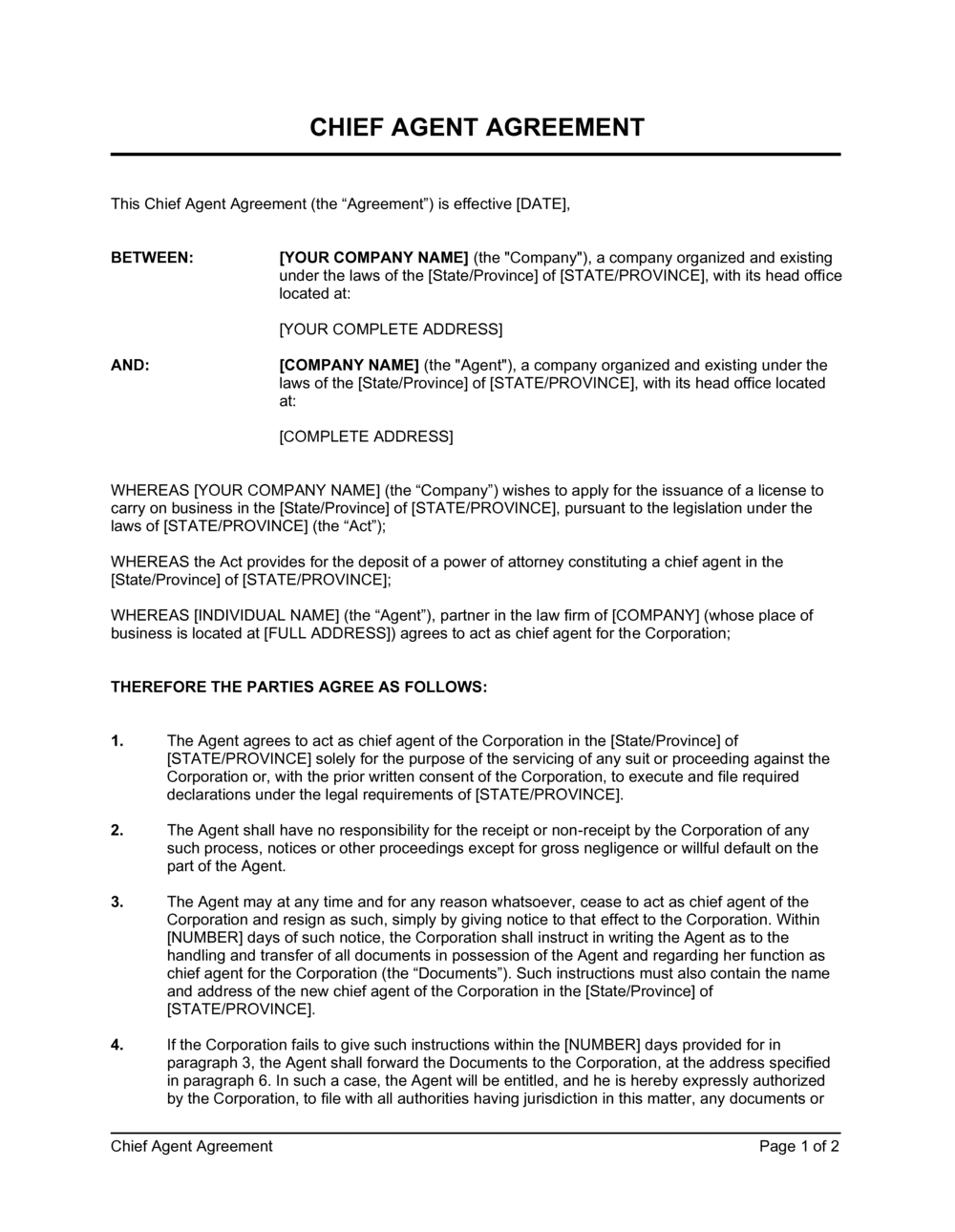
Chief Agent Agreement Short Form Template

Free Word download β€’ Edit online β€’ Save & share with Drive β€’ Export to PDF

2 pagesβ€’20–25 min to fillβ€’Difficulty: Standard
Learn more ↓
FreeChief Agent Agreement Short Form Template

At a glance

What it is
A Chief Agent Agreement Short Form is a concise appointment document that designates an individual or entity as the chief agent of a principal β€” typically a corporation, insurance company, or commercial organization β€” defining the scope of authority, territory, and key responsibilities in a single-page format. This free Word download lets you fill in the required fields and export as PDF in minutes.
When you need it
Use it when formally appointing a chief agent to act on behalf of your organization in a specific territory or capacity, particularly when a full long-form agency agreement is not required or when a streamlined record of appointment is sufficient.
What's inside
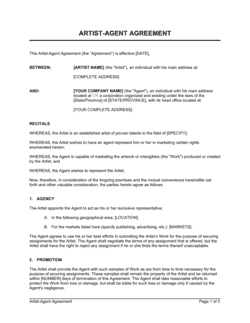
Principal and agent identification, appointment date and territory, scope of authority, compensation or commission terms, duration of appointment, and acknowledgment signatures from both parties.

What is a Chief Agent Agreement Short Form?

A Chief Agent Agreement Short Form is a concise appointment document that formally designates an individual or entity as the chief agent of a principal β€” typically a corporation, insurer, or commercial organization. It records the essential terms of the agency relationship in a single structured form: who is appointed, what they are authorized to do, where they may operate, how they are compensated, and how long the appointment lasts. Unlike a full multi-page agency contract, the short form is designed for appointments where the scope of authority is clear and a streamlined record is operationally sufficient.

Why You Need This Document

Operating with an informal or undocumented agent relationship creates three immediate risks: the principal cannot clearly limit the agent's authority to third parties, the agent has no written record of what they are entitled to be paid, and neither party has a defined exit path when the relationship ends. A completed chief agent agreement short form closes all three gaps in under 15 minutes. It gives regulators β€” particularly in insurance and financial services β€” the documented appointment they require, gives the agent a clear statement of their territory and commission terms, and gives the principal a revocation mechanism if the relationship breaks down. This template provides the standard fields used in real-world chief agent appointments, formatted for immediate use and export as PDF.

Which variant fits your situation?

If your situation is…Use this template
Appointing an agent with broad ongoing authority and detailed performance termsAgency Agreement (Long Form)
Engaging a sales representative on commission for a defined territorySales Representative Agreement
Granting a specific individual legal authority to sign documents on your behalfPower of Attorney
Appointing an independent contractor rather than a formal agentIndependent Contractor Agreement
Formalizing a referral or commission-only agent relationshipCommission Agreement
Designating a registered agent for corporate service of processRegistered Agent Designation Form

Common mistakes to avoid

❌ Appointing an unlicensed or lapsed-license agent

Why it matters: In regulated industries such as insurance, securities, and real estate, appointing an agent without a current valid license exposes the principal to fines and the appointment to automatic invalidity.

Fix: Run a license verification through the applicable regulatory authority before completing the form, and add a condition that the appointment terminates automatically if the license lapses.
❌ Leaving territory exclusivity undefined

Why it matters: Agents almost universally assume exclusivity unless told otherwise β€” this assumption leads to disputes when the principal appoints a second agent in the same region.

Fix: Add a single explicit line stating 'Territory is [EXCLUSIVE / NON-EXCLUSIVE]' and ensure both parties initial it.

❌ Using vague scope-of-authority language

Why it matters: Phrases like 'all actions necessary' expose the principal to liability for agent actions it never intended to authorize, including binding the company to unauthorized contracts.

Fix: List each authorized action specifically β€” bind policies, collect payments, execute contracts up to $[X] β€” and include a line stating that all other actions require prior written approval.

❌ No termination or revocation clause

Why it matters: Without a termination provision, ending an agency relationship requires either mutual consent or expensive litigation, leaving the principal bound even after a breakdown in the relationship.

Fix: Include a standard notice period (30 days is typical) and an immediate-revocation clause triggered by material breach, license revocation, or insolvency.

The 9 key fields, explained

Principal Identification

Agent Identification

Appointment Date and Effective Period

Territory

Scope of Authority

Compensation or Commission Terms

Duties and Obligations of the Agent

Termination and Revocation

Acknowledgment and Authorization

How to fill it out

  1. 1

    Enter the principal's legal entity details

    Fill in the full registered name, business address, and contact information for the appointing organization. Use the exact name from your corporate registration documents.

    πŸ’‘ Cross-check the entity name against your state or provincial corporate registry before printing β€” a single-word discrepancy can create compliance problems.

  2. 2

    Identify the agent with full name and license number

    Enter the agent's legal name, address, and any applicable professional license or registration number. If the industry requires a specific license class, note it explicitly.

    πŸ’‘ Verify the agent's license is active and in good standing before completing this field β€” appointing an unlicensed agent can expose the principal to regulatory penalties.

  3. 3

    Set the appointment date and term

    Record the effective date and choose a fixed expiration date or a rolling term with a defined renewal notice period. Avoid open-ended terms with no expiry.

    πŸ’‘ A one-year initial term with a 30-day auto-renewal notice is the most common and easiest to administer.

  4. 4

    Define the territory and exclusivity

    Specify the exact geographic area or market segment and explicitly state whether the agent's territory is exclusive or non-exclusive.

    πŸ’‘ If the territory is non-exclusive, say so clearly β€” silence on this point is routinely interpreted by agents as an implied exclusive.

  5. 5

    List the specific scope of authority

    Use a checklist or numbered list to identify exactly what the agent can and cannot do on the principal's behalf. Avoid catch-all language.

    πŸ’‘ If you need to add authority later, issue a written addendum rather than relying on verbal expansion β€” oral grants of authority are difficult to track and limit.

  6. 6

    State the compensation terms precisely

    Enter the commission rate, the basis for calculation (e.g., net collected premiums), the payment schedule, and the payment method.

    πŸ’‘ Attach a one-page commission schedule as an exhibit if the structure is tiered β€” keeping it separate makes future rate updates straightforward without amending the main form.

  7. 7

    Complete the acknowledgment block

    Have an authorized representative of the principal and the agent each print their name, sign, and date the acknowledgment section. Both signatures are required.

    πŸ’‘ Keep a fully completed copy on file for each party immediately after completion β€” do not circulate unsigned drafts as working documents.

Frequently asked questions

What is a chief agent agreement short form?

A chief agent agreement short form is a concise appointment document that designates an individual or entity as the primary agent of a principal β€” typically a corporation or insurer β€” and records the key terms of the appointment: territory, scope of authority, compensation, and term. It is used when a full multi-page agency agreement is not required and a streamlined record is sufficient for operational or regulatory purposes.

When should I use a short form rather than a full agency agreement?

Use the short form when the relationship is straightforward, the authority granted is clearly bounded, and both parties are comfortable with a summary-level record rather than an exhaustive contract. It is particularly common in insurance distribution, commercial brokerage, and franchise contexts where regulatory forms already set minimum content requirements. For complex, high-value, or long-term arrangements, a full agency agreement with detailed representations, warranties, and dispute-resolution clauses is more appropriate.

Does a chief agent agreement need to be notarized?

Notarization is not required for most chief agent agreements in standard business contexts. Some regulated industries β€” particularly insurance in certain jurisdictions β€” may require a notarized appointment form for regulatory filing. Check the requirements of the applicable regulatory authority before submitting the completed form.

What is the difference between a chief agent and a power of attorney?

A chief agent agreement appoints someone to represent a business entity in a commercial capacity β€” selling products, binding agreements, or managing a territory. A power of attorney grants legal authority to act on behalf of an individual or entity for specific legal or financial transactions. The chief agent role is typically ongoing and commercial; a power of attorney is often transactional and may cover personal legal matters as well.

Can a chief agent agreement be terminated early?

Yes. Most chief agent agreements include a notice period β€” typically 30 days β€” for voluntary termination by either party, as well as an immediate revocation clause for cause. Cause typically includes material breach of the agreement, revocation of the agent's professional license, or insolvency. The specific grounds and notice requirements should be spelled out clearly in the termination field of the form.

Is the principal liable for the agent's actions under this agreement?

Generally, a principal is liable for the authorized actions of its agent taken within the defined scope of authority. This is why precisely defining the scope of authority is critical β€” actions outside the defined scope may not bind the principal, but third parties who relied reasonably on apparent authority can still create liability. Consult a legal professional if the scope of authority is complex or the potential liability is significant.

How is a chief agent agreement different from an independent contractor agreement?

A chief agent agreement establishes a formal agency relationship, meaning the agent acts on behalf of and in the name of the principal and can bind the principal within the scope of authority. An independent contractor agreement engages a person to perform services for the principal but typically does not grant authority to bind the principal to third-party agreements. The distinction has significant legal and tax implications.

How long should a chief agent appointment last?

A one-year initial term with an automatic renewal provision is the most common structure for chief agent appointments. Shorter terms of 6 months are used in probationary arrangements or pilot programs. Always include a renewal notice period β€” 30 to 60 days before expiry β€” so either party can choose not to renew without defaulting to an indefinite arrangement.

How this compares to alternatives

vs Agency Agreement (Long Form)

A long-form agency agreement covers the same appointment but adds detailed representations, warranties, indemnification, dispute resolution, intellectual property clauses, and extensive operational schedules. Use the short form for straightforward, clearly bounded appointments; use the long form when the scope is complex, the financial exposure is high, or the relationship is expected to be long-term.

vs Sales Representative Agreement

A sales representative agreement focuses specifically on product sales β€” quotas, commission tiers, reporting, and territory protection for a sales function. A chief agent agreement is broader, covering the agent's authority to act on behalf of the principal beyond sales, including regulatory representation and contract binding. Use a sales rep agreement when the role is purely commercial; use the chief agent form when formal authority to represent the principal is required.

vs Power of Attorney

A power of attorney grants broad or specific legal authority to act on behalf of an individual or entity for defined transactions, often in personal or legal matters. A chief agent agreement is a commercial appointment document that defines an ongoing business relationship with operational scope, compensation, and territory. The two documents serve different legal functions and are not interchangeable.

vs Independent Contractor Agreement

An independent contractor agreement engages a person to perform services without granting authority to bind the principal to third parties. A chief agent agreement explicitly grants that binding authority within the defined scope. The legal and tax treatment of the relationship differs significantly β€” an agent can create obligations for the principal in a way a contractor typically cannot.

Industry-specific considerations

Insurance

Insurers use chief agent appointment forms to satisfy state and provincial regulatory filing requirements when authorizing agents to bind policies and collect premiums in a specific territory.

Commercial Real Estate

Brokerages designate chief agents to manage territory-level deal flow, represent the firm before clients, and oversee licensed associates operating under the principal broker.

Franchise and Distribution

Franchise networks appoint chief agents to coordinate territory operations, enforce brand standards, and serve as the primary point of contact between the franchisor and local operators.

Financial Services

Banks, investment dealers, and lending institutions use chief agent designations to authorize representatives to act on their behalf in branch or regional markets, often with regulatory reporting obligations.

Template vs pro β€” what fits your needs?

PathBest forCostTime
Use the templateBusinesses making straightforward, clearly bounded agent appointments in a single territoryFree10–15 minutes
Template + professional reviewAppointments in regulated industries, exclusive territory arrangements, or where commission structures are tiered$100–$300 (paralegal or compliance officer review)1–2 days
Custom draftedHigh-value or multi-territory chief agent relationships with complex authority, indemnification, or regulatory filing requirements$500–$2,000+1–2 weeks

Glossary

Principal
The individual or organization that appoints an agent and grants them authority to act on its behalf.
Chief Agent
The primary appointed representative of a principal, authorized to act within a defined scope and territory.
Scope of Authority
The specific actions, decisions, and transactions the agent is permitted to undertake on behalf of the principal.
Territory
The geographic area or market segment within which the agent's appointment and authority are valid.
Appointment Date
The effective date on which the agent's authority formally begins, as recorded in the agreement.
Commission
A fee or percentage of sales or transactions paid to the agent in exchange for their services.
Fiduciary Duty
The agent's legal obligation to act in the best interests of the principal, avoiding conflicts of interest.
Term of Appointment
The defined period for which the agent is appointed, after which the agreement expires or must be renewed.
Revocation
The principal's right to cancel or withdraw the agent's authority before the end of the appointment term.

Part of your Business Operating System

This document is one of 3,000+ business & legal templates included in Business in a Box.

  • Fill-in-the-blanks β€” ready in minutes
  • 100% customizable Word document
  • Compatible with all office suites
  • Export to PDF and share electronically

Create your document in 3 simple steps.

From template to signed document β€” all inside one Business Operating System.
1
Download or open template

Access over 3,000+ business and legal templates for any business task, project or initiative.

2
Edit and fill in the blanks with AI

Customize your ready-made business document template and save it in the cloud.

3
Save, Share, Send, Sign

Share your files and folders with your team. Create a space of seamless collaboration.

Save time, save money, and create top-quality documents.

β˜…β˜…β˜…β˜…β˜…

"Fantastic value! I'm not sure how I'd do without it. It's worth its weight in gold and paid back for itself many times."

Managing Director Β· Mall Farm
Robert Whalley
Managing Director, Mall Farm Proprietary Limited
β˜…β˜…β˜…β˜…β˜…

"I have been using Business in a Box for years. It has been the most useful source of templates I have encountered. I recommend it to anyone."

Business Owner Β· 4+ years
Dr Michael John Freestone
Business Owner
β˜…β˜…β˜…β˜…β˜…

"It has been a life saver so many times I have lost count. Business in a Box has saved me so much time and as you know, time is money."

Owner Β· Upstate Web
David G. Moore Jr.
Owner, Upstate Web

Run your business with a system β€” not scattered tools

Stop downloading documents. Start operating with clarity. Business in a Box gives you the Business Operating System used by over 250,000 companies worldwide to structure, run, and grow their business.

Start freeΒ Β·Β No credit card required