Equipment Lease Agreement Short Template

Free Word download β€’ Edit online β€’ Save & share with Drive β€’ Export to PDF

2 pagesβ€’25–30 min to fillβ€’Difficulty: Standardβ€’Signature requiredβ€’Legal review recommended
Learn more ↓
FreeEquipment Lease Agreement Short Template

At a glance

What it is
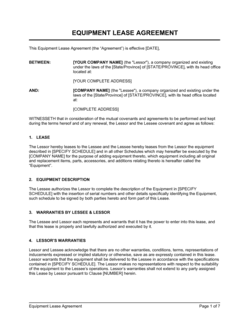
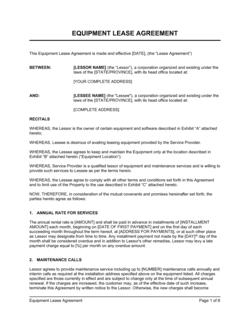
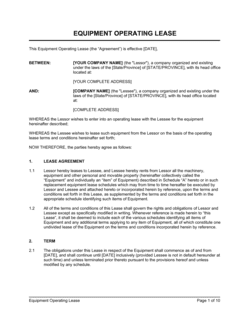
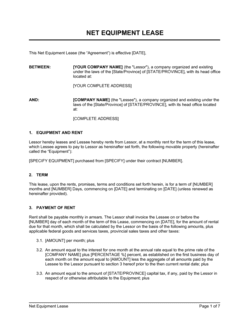
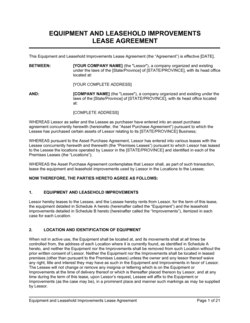
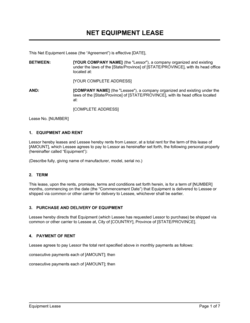
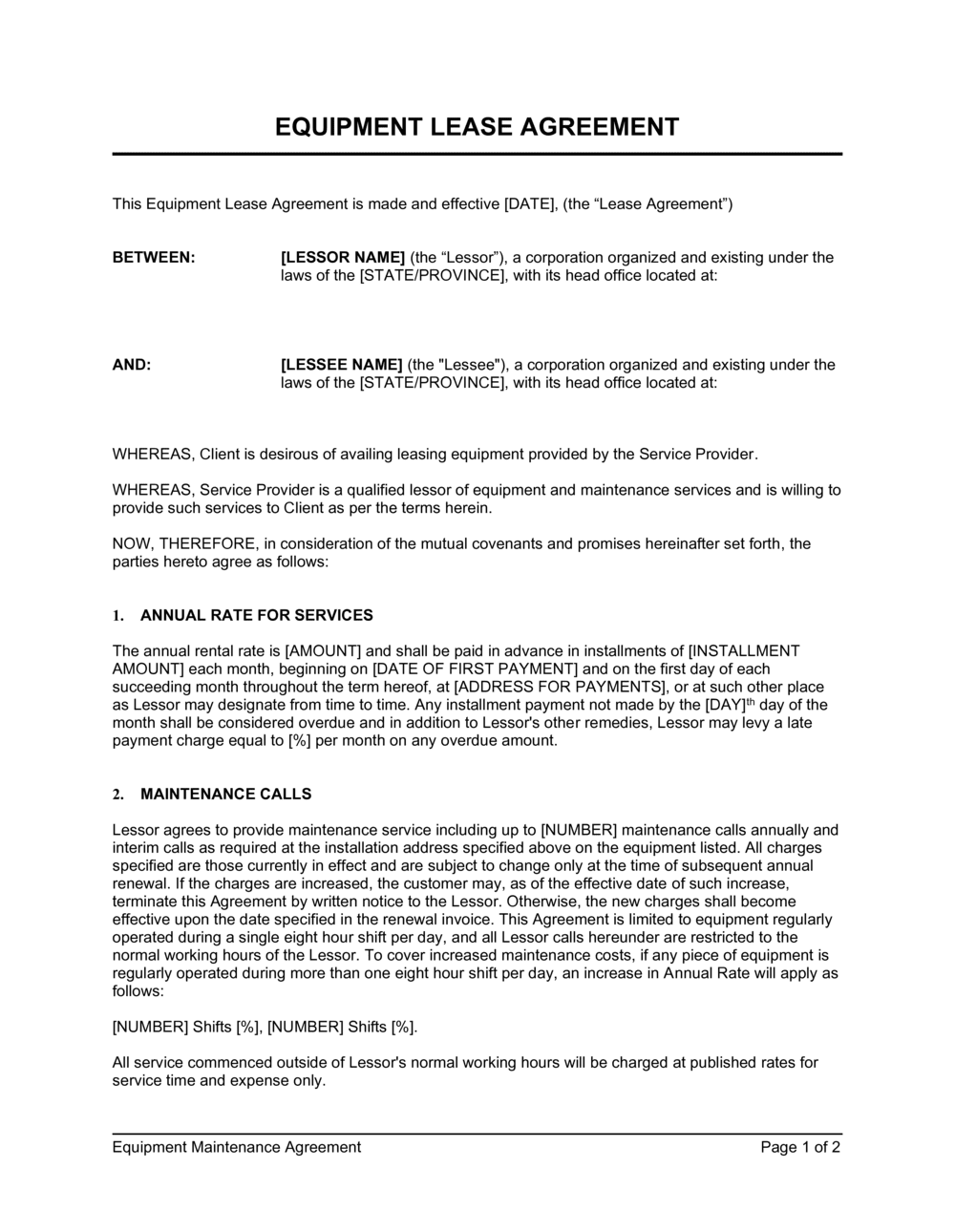
An Equipment Lease Agreement (Short Form) is a legally binding contract between an equipment owner (the lessor) and a business or individual renting that equipment (the lessee) for a defined period in exchange for periodic payments. This free Word download covers the essential terms β€” equipment description, lease term, payment schedule, permitted use, maintenance obligations, liability, and return conditions β€” in a concise, easy-to-execute format you can edit online and export as PDF.
When you need it
Use it whenever you are renting out equipment to another party or leasing equipment from an owner for a fixed term, and you need a clear written record of each party's obligations before the equipment changes hands. It is especially appropriate for straightforward, short-duration leases where a lengthy multi-page commercial lease would be disproportionate to the transaction.
What's inside
Identification of the parties and equipment, lease term and payment schedule, permitted use and geographic restrictions, maintenance and repair responsibilities, insurance requirements, liability and indemnification, default and remedies, and conditions for return or early termination.

What is an Equipment Lease Agreement?

An Equipment Lease Agreement is a legally binding contract between an equipment owner (the lessor) and a party renting that equipment (the lessee) that governs possession, use, and return of the equipment for a defined period in exchange for periodic rent payments. The short-form version captures every essential term β€” equipment identification, lease duration, payment schedule, permitted use, maintenance responsibilities, insurance requirements, liability allocation, default remedies, and return conditions β€” in a concise document designed for straightforward transactions where a lengthy commercial lease would be disproportionate to the deal. In the United States, equipment leases are primarily governed by UCC Article 2A; in Canada, the PPSA framework applies; and in the UK and EU, accounting and VAT rules under IFRS 16 affect how lease obligations are recorded and reported.

Why You Need This Document

Without a signed equipment lease agreement in place before the equipment is handed over, both parties are exposed to disputes that are difficult and expensive to resolve. The lessor has no documented basis to recover for damage beyond ordinary wear, no enforceable right to repossess on default, and no agreed insurance requirements to ensure the asset is covered while out of their control. The lessee has no clear record of their maintenance obligations, no protection against arbitrary deposit deductions, and no proof of the equipment's condition at delivery. A single missed payment or a scratch on a $40,000 piece of machinery quickly escalates from a business disagreement into a legal claim when there is nothing in writing. This template gives both parties a clear, enforceable framework β€” agreed before any equipment moves β€” that protects the asset, defines each party's obligations, and provides a practical resolution path if something goes wrong.

Which variant fits your situation?

If your situation is…Use this template
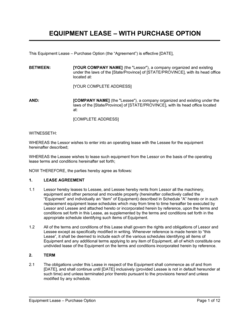
Leasing high-value equipment with an option to purchase at term endEquipment Lease Agreement with Purchase Option
Renting a commercial vehicle or fleet of vehiclesVehicle Lease Agreement
Long-term capital lease of manufacturing equipment over several yearsEquipment Lease Agreement (Long Form)
Lending equipment between parties at no costEquipment Loan Agreement
Renting commercial real property along with installed equipmentCommercial Lease Agreement
Short-term personal property rental between individualsPersonal Property Rental Agreement
Financing equipment through a lender rather than leasing directlyEquipment Financing Agreement

Common mistakes to avoid

❌ Skipping the equipment condition report at delivery

Why it matters: Without a signed baseline record of the equipment's condition on day one, the lessee can dispute every damage deduction at return β€” and courts often side with the lessee in the absence of evidence.

Fix: Conduct a joint inspection at handover, photograph any pre-existing damage, and attach the condition report as a signed exhibit to the agreement.

❌ Using a vague permitted-use clause

Why it matters: An open-ended permitted use prevents the lessor from establishing that damage was caused by unauthorized or excessive use β€” undercutting both insurance claims and damage recovery.

Fix: State the specific task, industry application, and worksite where the equipment is authorized to be used, and explicitly prohibit subletting or lending to third parties.

❌ No insurance certificate required before delivery

Why it matters: If the lessee damages the equipment or causes a third-party injury, and has no active insurance policy, the lessor bears the loss with no recovery path.

Fix: Make delivery conditional on receipt of a valid certificate of insurance naming the lessor as an additional insured β€” physically hold the equipment until the certificate is in hand.

❌ Omitting a cure period in the default clause

Why it matters: Immediate-repossession clauses with no notice period are challenged as commercially unreasonable in most jurisdictions and may void the lessor's right to recover unpaid rent.

Fix: Provide a written notice of default and a minimum 5-business-day cure window before any repossession right is triggered.

❌ Not allocating return transportation costs

Why it matters: For heavy machinery or specialized equipment, transport costs can exceed several thousand dollars; both parties assuming the other will pay creates a standoff that delays return and increases exposure.

Fix: State explicitly in the return conditions clause which party is responsible for transport and packaging costs, and to which address the equipment must be returned.

❌ Executing the agreement after equipment has already been delivered

Why it matters: A contract signed after the lessee has already taken possession may lack fresh consideration in some jurisdictions, and the lessor has no signed agreement to rely on for the period already elapsed.

Fix: Always execute the agreement β€” with both signatures β€” before the equipment leaves the lessor's premises or is collected by the lessee.

The 10 key clauses, explained

Parties and equipment identification

In plain language: Identifies the lessor and lessee by full legal name and address, and describes the equipment being leased with enough specificity to distinguish it from similar items.

Sample language
This Equipment Lease Agreement is entered into as of [DATE] between [LESSOR FULL LEGAL NAME], a [STATE/PROVINCE] [ENTITY TYPE] ('Lessor'), and [LESSEE FULL LEGAL NAME], a [STATE/PROVINCE] [ENTITY TYPE] ('Lessee'). The equipment subject to this Agreement is described as: [MAKE / MODEL / SERIAL NUMBER / DESCRIPTION] ('Equipment').

Common mistake: Describing equipment by category only (e.g., 'one forklift') without a serial number or model. If the item is damaged or disputed, vague descriptions make it impossible to prove which specific unit was leased.

Lease term and commencement

In plain language: States the start date, end date, and total duration of the lease, and clarifies what happens if the lessee continues to use the equipment after the term expires.

Sample language
The lease term commences on [START DATE] and expires on [END DATE] ('Lease Term'). If Lessee retains possession after expiration without written renewal, the lease shall convert to a month-to-month tenancy terminable by either party on [30] days' written notice.

Common mistake: Omitting a holdover clause. Without one, a lessee who keeps the equipment past the end date has no clear legal basis for continued possession β€” or liability β€” creating disputes over whether a new lease was formed.

Rent, payment schedule, and late fees

In plain language: Specifies the base rent amount, payment frequency, due date, accepted payment methods, and any penalty applied to overdue payments.

Sample language
Lessee shall pay Lessor a base rent of $[AMOUNT] per [month/week], due on the [DAY] of each [month/week], commencing [FIRST PAYMENT DATE]. Payments more than [5] days overdue shall accrue a late fee of [1.5]% per month on the outstanding balance.

Common mistake: Setting a late fee percentage without specifying how it compounds. A lessee who reads '1.5% per month' as 1.5% of the total original rent rather than the outstanding balance will dispute every overdue invoice.

Security deposit

In plain language: Establishes the deposit amount, conditions under which it can be retained, and the timeline for returning it after lease end.

Sample language
Lessee shall deposit $[AMOUNT] with Lessor as a security deposit upon execution. Lessor shall return the deposit within [30] days of lease expiration, less any amounts applied to unpaid rent, damage beyond fair wear and tear, or cleaning costs.

Common mistake: Failing to specify the return timeline and deduction conditions. Vague deposit terms are the single most litigated provision in equipment and property leases β€” a specific number of days and an itemized-deduction requirement resolve most disputes.

Permitted use and location

In plain language: Restricts the lessee to specific authorized uses of the equipment and, where relevant, limits the geographic location where the equipment may be operated.

Sample language
Lessee shall use the Equipment solely for [PERMITTED PURPOSE] at [ADDRESS / SITE] and shall not remove the Equipment from that location without prior written consent from Lessor. Lessee shall not modify, alter, or attach any component to the Equipment without Lessor's written approval.

Common mistake: Using an open-ended permitted-use clause such as 'commercial purposes.' If equipment is damaged through misuse, the lessor needs a specific agreed use to establish that the lessee exceeded the authorized scope.

Maintenance, repairs, and condition

In plain language: Allocates responsibility for routine maintenance (typically the lessee) and major mechanical repairs (often the lessor), and sets the condition standard the equipment must meet at return.

Sample language
Lessee shall maintain the Equipment in good working order, perform routine maintenance per the manufacturer's schedule, and promptly notify Lessor of any mechanical failure or damage. Major repairs caused by normal wear shall be the responsibility of Lessor; damage caused by Lessee's negligence or misuse shall be repaired at Lessee's expense.

Common mistake: Assigning all repairs to the lessee without distinguishing between wear-related and negligence-caused damage. Courts frequently override overbroad lessee-pays-all clauses as unconscionable β€” a clear allocation is more enforceable and fairer to both parties.

Insurance requirements

In plain language: Requires the lessee to maintain adequate insurance covering the equipment against loss, theft, and damage for the duration of the lease, and to name the lessor as an additional insured.

Sample language
Lessee shall, at its own expense, maintain commercial general liability insurance of at least $[AMOUNT] per occurrence and property insurance covering the Equipment at its full replacement value of $[VALUE]. Lessor shall be named as an additional insured on all such policies. Lessee shall provide certificates of insurance within [5] business days of execution.

Common mistake: Specifying an insurance minimum in dollar terms without requiring the lessee to provide a certificate of insurance before delivery. The lessor has no way to confirm coverage exists without the certificate.

Liability and indemnification

In plain language: Allocates risk between the parties β€” the lessee typically indemnifies the lessor against third-party claims arising from the lessee's use, while the lessor's liability for equipment failure may be capped.

Sample language
Lessee shall indemnify, defend, and hold harmless Lessor from any claims, damages, or expenses arising out of Lessee's possession, use, or operation of the Equipment. Lessor's liability for any defect or failure of the Equipment shall not exceed the total rent paid in the [3] months preceding the claim.

Common mistake: A one-sided indemnification that holds the lessee responsible for defects that were the lessor's fault β€” for example, pre-existing mechanical failures. This is frequently struck down by courts; carving out the lessor's own negligence produces a more enforceable clause.

Default and remedies

In plain language: Defines what constitutes a default, requires notice and a cure period, and gives the lessor the right to repossess the equipment and seek unpaid rent on default.

Sample language
An Event of Default occurs if Lessee (a) fails to pay rent within [10] days of its due date, (b) uses the Equipment in violation of Section [X], or (c) becomes insolvent. Lessor shall provide [5] business days' written notice to cure. Upon uncured default, Lessor may repossess the Equipment and recover all unpaid rent and reasonable costs.

Common mistake: No cure period before repossession. Immediate-repossession clauses with no notice window are challenged as commercially unreasonable in most jurisdictions and may be unenforceable against a lessee who missed a single payment in good faith.

Return conditions and end of term

In plain language: States the exact condition in which equipment must be returned, who bears the cost of return shipping or transport, and what happens if the lessee fails to return on time.

Sample language
Upon expiration or earlier termination, Lessee shall return the Equipment to Lessor at [RETURN ADDRESS] in the same condition as received, subject to fair wear and tear, at Lessee's expense. Failure to return within [5] days of expiration shall entitle Lessor to charge holdover rent at [150]% of the base monthly rate.

Common mistake: Not specifying who pays for return transport. For heavy or high-value equipment, transportation costs can run into thousands of dollars β€” a missing clause means both parties assume the other will pay.

How to fill it out

  1. 1

    Enter both parties' full legal information

    Enter the lessor's and lessee's full registered legal names, entity types, and addresses. For individuals, use the name as it appears on government-issued ID.

    πŸ’‘ Verify the lessee's legal entity name against a corporate registry before execution β€” a wrong name makes enforcement against the correct entity much harder.

  2. 2

    Describe the equipment precisely

    Include the manufacturer, model, serial number, year, and any unique identifiers. Attach a photograph or spec sheet as an exhibit if the equipment is high-value or one of several identical units.

    πŸ’‘ A serial number is the single most important identifier β€” it eliminates any argument about which specific unit was leased if a dispute arises.

  3. 3

    Set the lease term and holdover terms

    Enter the exact start and end dates. Decide whether a holdover converts to month-to-month or triggers a penalty rate, and state the applicable notice period for termination.

    πŸ’‘ Use specific calendar dates rather than 'commencing upon delivery' β€” delivery delays create ambiguity about when the term and payment obligations begin.

  4. 4

    Define rent, payment schedule, and late fees

    Enter the base rent amount, frequency, first due date, and accepted payment methods. Add a late-fee rate and specify the grace period β€” typically 5 business days β€” before the fee applies.

    πŸ’‘ State the currency explicitly if either party operates in a different jurisdiction. USD and CAD confusion is common in cross-border equipment leases.

  5. 5

    Set the security deposit terms

    Enter the deposit amount (typically one to two months' rent for equipment), the conditions under which deductions can be made, and the number of days after lease expiry by which it must be returned.

    πŸ’‘ Require the lessee to conduct and sign an equipment condition inspection at delivery β€” this becomes your baseline for any deposit deduction dispute at return.

  6. 6

    Specify permitted use and location

    Write a specific description of the authorized use (e.g., 'excavation on the construction site at [ADDRESS]') and restrict removal from that location without prior written approval.

    πŸ’‘ If the equipment will be used across multiple sites, list each address or define the permitted geographic area β€” otherwise the restriction is unenforceable.

  7. 7

    Confirm insurance minimums and certificate requirements

    Enter the required coverage amounts for liability and property insurance. Require the lessee to provide a certificate of insurance before the equipment is handed over.

    πŸ’‘ Set the property insurance minimum at the equipment's current replacement cost β€” not original purchase price β€” especially for older equipment that would be expensive to replace.

  8. 8

    Sign before equipment is handed over

    Both parties must sign the agreement before the equipment is delivered or collected. Attach a completed equipment condition report signed by both parties at the same time.

    πŸ’‘ Use Business in a Box eSign to timestamp execution and store the fully executed copy digitally β€” this is critical evidence if the lessee later disputes the agreement's terms or the equipment's initial condition.

Frequently asked questions

What is an equipment lease agreement?

An equipment lease agreement is a legally binding contract between the owner of equipment (the lessor) and a party that rents and uses it (the lessee) for a defined period in exchange for periodic payments. It sets out each party's rights and obligations β€” covering payment terms, permitted use, maintenance, insurance, liability, default, and return conditions β€” so that both sides have a clear, enforceable record of what was agreed before the equipment changes hands.

What is the difference between a short-form and a long-form equipment lease?

A short-form lease covers the essential commercial terms in a concise document β€” typically 2–5 pages β€” and is appropriate for straightforward, short-duration leases of standard equipment where the transaction value does not justify a lengthy contract. A long-form lease adds detailed representations and warranties, force majeure provisions, UCC Article 2A compliance clauses, step-in rights, and complex default mechanics. Use the short form for routine rentals; use the long form for multi-year leases of high-value capital equipment.

Who is the lessor and who is the lessee?

The lessor is the party that owns the equipment and grants the right to use it in exchange for rent. The lessee is the party that rents, possesses, and uses the equipment during the lease term and is responsible for payments, care, and return. In a rental company context, the rental company is always the lessor; the business renting the excavator or generator is always the lessee.

Is an equipment lease agreement legally binding?

Yes β€” an equipment lease agreement is generally enforceable as a binding contract when both parties have signed, the essential terms (parties, equipment, term, and rent) are present, and lawful consideration exists. In the US, equipment leases are typically governed by UCC Article 2A, which sets default rules when the contract is silent. Always execute before the equipment is handed over to avoid consideration disputes.

Who is responsible for maintaining leased equipment?

Responsibility is determined by the agreement. In most short-form leases, the lessee is responsible for routine maintenance per the manufacturer's schedule β€” oil changes, filter replacements, calibration β€” while the lessor covers major mechanical repairs caused by normal wear. Damage caused by the lessee's negligence or use outside permitted scope is almost universally the lessee's liability. The agreement should make this split explicit rather than relying on implied terms.

What insurance does a lessee need for leased equipment?

At minimum, the lessee should carry property insurance covering the equipment at its full replacement cost and commercial general liability insurance for any third-party injury or damage arising from operating the equipment. The lessor should be named as an additional insured on both policies. Required minimums vary by equipment type and value β€” a $50,000 generator warrants different limits than a $500 projector. Always provide the lessor with a certificate of insurance before delivery.

Can a lessee sublet or lend the equipment to a third party?

Only if the agreement explicitly permits it. In most standard equipment leases, the lessee is prohibited from subletting, lending, or assigning rights to the equipment without the lessor's prior written consent. Unauthorized subletting is a common ground for default and immediate repossession. If the lessee needs to share the equipment with a partner or subcontractor, they should request a written consent or sublease addendum from the lessor before doing so.

What happens if the lessee damages the equipment?

The lessee is generally liable for damage beyond fair wear and tear. The lessor may apply the security deposit to repair costs and pursue the lessee for any excess. If the damage clause and condition report are properly documented, the lessor has a straightforward claim. Without a signed delivery condition report, proving the damage occurred during the lease β€” and not before β€” becomes much harder. Insurance coverage should be the primary recovery path for major damage.

What should I do if the lessee returns the equipment late?

If the agreement includes a holdover clause β€” typically charging rent at 150% of the base rate for each day or week after the expiry date β€” invoice that amount immediately and document the late return in writing. Send a written demand for return and back-rent simultaneously. If the lessee refuses to return the equipment, most jurisdictions allow the lessor to apply for a court order for possession, particularly where the lease is clearly expired and in default.

How this compares to alternatives

vs Vehicle Lease Agreement

A vehicle lease agreement is specifically tailored to motor vehicles β€” covering mileage limits, registration and licensing, road insurance requirements, and roadworthiness standards. An equipment lease covers non-vehicle assets such as machinery, tools, and technology. Use the vehicle lease for any leased car, truck, or van; use the equipment lease for everything else.

vs Commercial Lease Agreement

A commercial lease governs the rental of physical real property β€” offices, warehouses, and retail spaces. An equipment lease governs the rental of movable personal property. The two documents cover different asset classes with different legal frameworks; real property leases are subject to landlord-tenant statutes that do not apply to equipment.

vs Equipment Loan Agreement

An equipment loan agreement transfers possession for a defined period at no charge β€” typically between affiliated entities or as a goodwill arrangement. An equipment lease requires periodic rent payments and creates a formal lessor-lessee relationship. Use the loan agreement only when no money will change hands; any arrangement involving payment should use a lease.

vs Independent Contractor Agreement

An independent contractor agreement governs a services relationship β€” one party performs work for another. An equipment lease governs an asset relationship β€” one party rents property to another. If a contractor brings their own equipment to a job, the services are covered by the contractor agreement; if the client provides the equipment, a separate equipment lease should document those terms.

Industry-specific considerations

Construction and infrastructure

Site-specific permitted-use clauses, daily or weekly rent cycles, and lessee responsibility for fuel, operator certification, and on-site damage are standard in construction equipment leases.

Healthcare and life sciences

Medical equipment leases typically require the lessee to maintain calibration records, restrict use to licensed personnel, and comply with FDA or Health Canada device regulations as conditions of permitted use.

Technology and AV production

Short-term AV and production equipment leases commonly require the lessee to insure at replacement cost, prohibit firmware modifications, and return equipment in original packaging with all accessories accounted for.

Manufacturing and industrial

Industrial equipment leases often include operator training requirements, shift-limit restrictions on daily usage hours, and scheduled lessor inspection rights to protect high-value machinery from excessive wear.

Jurisdictional notes

United States

Equipment leases in the US are primarily governed by UCC Article 2A (Leases), which sets default rules for finance leases and operating leases when the contract is silent. State law variations apply β€” some states require specific language to distinguish a true lease from a secured transaction under Article 9. In California, lessors must comply with consumer lease disclosure rules for leases where the lessee is an individual.

Canada

Personal property security legislation (PPSA) governs equipment leases in all Canadian provinces and territories. A lessor leasing equipment for more than one year must register a financing statement under the applicable PPSA to protect their interest against third-party claims. In Quebec, civil law rules under the Civil Code govern equipment leasing rather than common-law principles. French-language contracts are required for provincially regulated businesses in Quebec.

United Kingdom

UK equipment leases are governed primarily by the Supply of Goods and Services Act 1982 and the Consumer Rights Act 2015 where the lessee is a consumer. The Sale of Goods Act implied terms of satisfactory quality apply to the equipment at the start of the lease. Finance leases and operating leases are treated differently for VAT and accounting purposes under IFRS 16, which requires lessees to capitalize operating leases on the balance sheet.

European Union

IFRS 16 applies across EU member states for entities reporting under international accounting standards, requiring most equipment leases to appear on the lessee's balance sheet regardless of legal form. VAT treatment on equipment rentals varies by member state β€” some classify ongoing lease payments as a supply of services rather than goods, affecting input tax recovery. Cross-border leases within the EU should specify the governing law and jurisdiction explicitly to avoid conflict-of-laws disputes.

Template vs lawyer β€” what fits your deal?

PathBest forCostTime
Use the templateStandard short-term leases of equipment under $25,000 in value between domestic partiesFree20–30 minutes
Template + legal reviewEquipment valued above $25,000, cross-border leases, or leases with purchase options$300–$700 (one-hour lawyer review)1–3 days
Custom draftedLong-term capital leases of high-value industrial equipment, regulated industries, or complex multi-party arrangements$1,500–$5,000+1–3 weeks

Glossary

Lessor
The party that owns the equipment and grants the right to use it in exchange for lease payments.
Lessee
The party that rents and uses the equipment during the lease term and is responsible for payments and care.
Lease Term
The defined period during which the lessee has the right to possess and use the equipment.
Base Rent
The fixed periodic payment β€” weekly, monthly, or otherwise β€” the lessee owes the lessor for use of the equipment.
Security Deposit
An upfront sum held by the lessor to cover damage, unpaid rent, or other lessee defaults, returned at lease end if conditions are met.
Permitted Use
A clause restricting the lessee to specific authorized uses of the equipment, prohibiting modifications or use outside the agreed scope.
Fair Wear and Tear
Normal, expected deterioration from ordinary use over time β€” typically excluded from the lessee's damage liability at return.
Default
A failure by either party to fulfill a material obligation under the agreement, such as missed payments or unauthorized use.
Indemnification
A contractual obligation for one party to compensate the other for losses, claims, or damages arising from specified events.
Early Termination
A provision allowing either or both parties to end the lease before the scheduled expiry date, typically subject to a fee or notice requirement.
Force Majeure
A clause excusing performance obligations when a party is prevented from acting by unforeseeable events outside their control, such as natural disasters.

Part of your Business Operating System

This document is one of 3,000+ business & legal templates included in Business in a Box.

  • Fill-in-the-blanks β€” ready in minutes
  • 100% customizable Word document
  • Compatible with all office suites
  • Export to PDF and share electronically

Create your document in 3 simple steps.

From template to signed document β€” all inside one Business Operating System.
1
Download or open template

Access over 3,000+ business and legal templates for any business task, project or initiative.

2
Edit and fill in the blanks with AI

Customize your ready-made business document template and save it in the cloud.

3
Save, Share, Send, Sign

Share your files and folders with your team. Create a space of seamless collaboration.

Save time, save money, and create top-quality documents.

β˜…β˜…β˜…β˜…β˜…

"Fantastic value! I'm not sure how I'd do without it. It's worth its weight in gold and paid back for itself many times."

Managing Director Β· Mall Farm
Robert Whalley
Managing Director, Mall Farm Proprietary Limited
β˜…β˜…β˜…β˜…β˜…

"I have been using Business in a Box for years. It has been the most useful source of templates I have encountered. I recommend it to anyone."

Business Owner Β· 4+ years
Dr Michael John Freestone
Business Owner
β˜…β˜…β˜…β˜…β˜…

"It has been a life saver so many times I have lost count. Business in a Box has saved me so much time and as you know, time is money."

Owner Β· Upstate Web
David G. Moore Jr.
Owner, Upstate Web

Run your business with a system β€” not scattered tools

Stop downloading documents. Start operating with clarity. Business in a Box gives you the Business Operating System used by over 250,000 companies worldwide to structure, run, and grow their business.

Start freeΒ Β·Β No credit card required