Term Sheet for Series A Round of Financing Template

Free Word download β€’ Edit online β€’ Save & share with Drive β€’ Export to PDF

5 pagesβ€’20–30 min to fillβ€’Difficulty: Standard
Learn more ↓
FreeTerm Sheet for Series A Round of Financing Template

At a glance

What it is
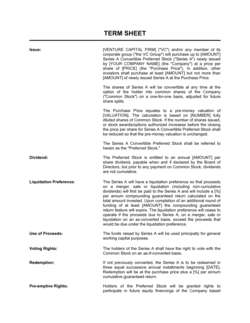
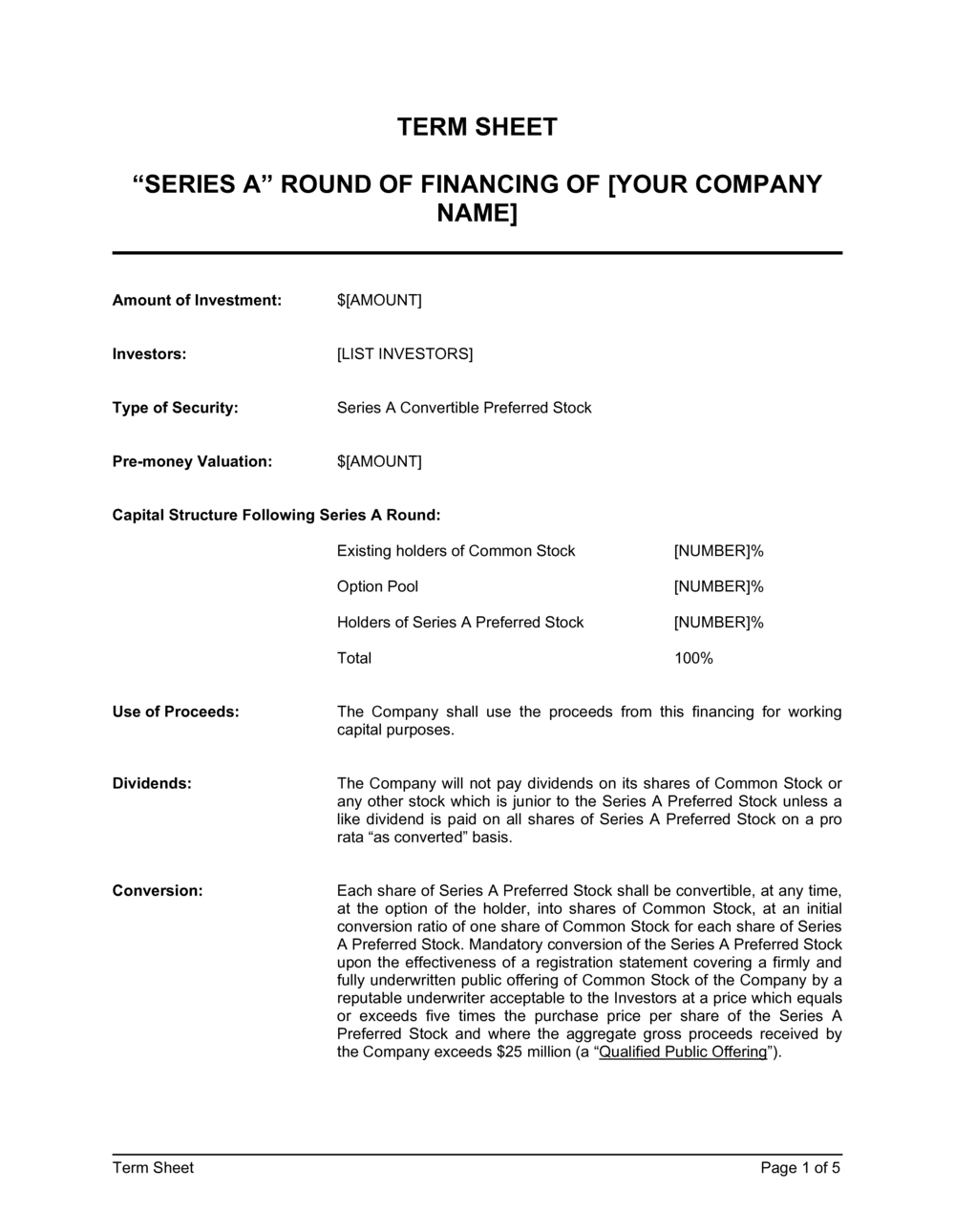
A Term Sheet for Series A Round of Financing is a non-binding summary document that outlines the key economic and governance terms under which a venture capital investor agrees to invest in a startup. This free Word download gives founders and investors a structured starting point to align on deal terms before engaging legal counsel to draft definitive agreements.
When you need it
Use it once an investor has expressed a concrete interest in leading or participating in a Series A round and both parties are ready to negotiate specific deal terms. It is the first formal document exchanged before a Stock Purchase Agreement, Investor Rights Agreement, and related closing documents are drafted.
What's inside
Pre-money and post-money valuation, investment amount and share class, liquidation preferences, anti-dilution provisions, board composition, pro-rata rights, information rights, and standard closing conditions.

What is a Term Sheet for Series A Round of Financing?

A Term Sheet for Series A Round of Financing is a structured, non-binding document that summarizes the key economic and governance terms under which a venture capital investor agrees to invest in a startup through the purchase of Series A Preferred Stock. It defines the pre-money valuation, investment amount, share price, liquidation preferences, anti-dilution protections, board composition, and investor rights that both parties agree on before attorneys begin drafting the binding definitive agreements. Because it precedes the Stock Purchase Agreement and related closing documents, the term sheet is the document where the most consequential deal terms are actually negotiated β€” making it far more important than its non-binding status suggests.

Why You Need This Document

Without a written term sheet, Series A negotiations proceed informally, creating misaligned expectations that surface β€” expensively β€” during legal drafting. Founders who agree verbally on valuation but never commit the option pool treatment, liquidation preference structure, or board composition to paper routinely discover that their attorney and the investor's attorney have drafted documents reflecting entirely different understandings. A clear, complete term sheet compresses that ambiguity before the legal meter starts running. It also gives founders a structured document to model against β€” the cap table impact of the proposed option pool, the exit economics of participating versus non-participating preferred, and the governance consequences of each proposed board configuration are all visible on paper before any commitment is made. This template gives founders and investors a professional, complete starting point that reflects current NVCA-standard market terms.

Which variant fits your situation?

If your situation is…Use this template
Very early-stage round before a priced equity roundSAFE Agreement
Convertible debt bridge before a Series AConvertible Note Term Sheet
Seed-stage priced equity roundSeed Round Term Sheet
Later-stage growth financing after Series ASeries B Term Sheet
Debt financing rather than equityLoan Agreement
Strategic corporate investment alongside VCStrategic Investment Agreement
Acquisition offer summary before a full LOILetter of Intent (Acquisition)

Common mistakes to avoid

❌ Ignoring the option pool shuffle

Why it matters: When the option pool increase is included in the pre-money valuation, it dilutes founders rather than investors β€” a 15% pool carved from a $10M pre-money deal can reduce founder ownership by 4–6 percentage points before the investor even writes a check.

Fix: Model both scenarios β€” pool included in pre-money vs. pool added post-money β€” and negotiate the pre-money valuation with a clear written definition of what 'fully diluted' means.

❌ Accepting participating preferred without modeling the exit

Why it matters: Participating preferred lets investors collect their liquidation preference and then share in remaining proceeds as if they converted β€” in a $30M exit on a $10M raise, founders can receive significantly less than expected.

Fix: Request non-participating preferred as the default; if the investor insists on participating, negotiate a cap (typically 3Γ—) above which the preference converts automatically.

❌ Agreeing to full-ratchet anti-dilution

Why it matters: Full-ratchet resets the investor's conversion price to the price of any new down-round share, regardless of how small the new issuance is β€” a single bridge note can trigger catastrophic dilution for founders.

Fix: Counter with broad-based weighted average anti-dilution, the NVCA standard β€” it adjusts the conversion price proportionally to the size of the down round rather than to its price alone.

❌ Accepting an open-ended exclusivity period

Why it matters: A 60- or 90-day exclusivity window locks founders out of competing conversations while the investor conducts diligence with no obligation to close, giving all the leverage to the investor.

Fix: Limit exclusivity to 30 days and include a reciprocal milestone β€” investor must deliver a markup of the purchase agreement within 15 business days or exclusivity terminates.

The 9 key fields, explained

Parties and transaction summary

Investment amount and valuation

Share price and capitalization

Liquidation preference

Anti-dilution provision

Board composition

Pro-rata rights and information rights

Vesting and founder lockup

Closing conditions and exclusivity

How to fill it out

  1. 1

    Enter company and investor details

    Fill in the company's full registered legal name, state of incorporation, and the lead investor's fund name and entity type. Add co-investors if known.

    πŸ’‘ Confirm the exact legal entity name against your certificate of incorporation before sending β€” mismatches delay the definitive documents.

  2. 2

    Set the valuation and round size

    Enter the agreed pre-money valuation and the total amount being raised. The template calculates post-money valuation and investor ownership percentage automatically.

    πŸ’‘ Decide upfront whether the option pool increase is included in the pre-money valuation β€” this is the single most founder-dilutive term in most Series A deals.

  3. 3

    Define the share price and capitalization table

    Enter the fully diluted share count at close, including the expanded option pool. The per-share price flows from the pre-money valuation divided by this number.

    πŸ’‘ Ask your attorney or CFO to model the cap table impact before you agree to any specific pool size β€” even a 2% difference in pool size changes founder ownership meaningfully.

  4. 4

    Select the liquidation preference structure

    Choose 1Γ— non-participating as the standard founder-friendly baseline. If the investor requests participating preferred, model the outcome at 1Γ—, 2Γ—, and 3Γ— exit multiples before agreeing.

    πŸ’‘ Non-participating preferred with a 1Γ— preference is the NVCA standard and the most common outcome in competitive Series A processes.

  5. 5

    Specify board composition

    Enter the total number of board seats and how they are allocated among investor designees, founder designees, and independent directors.

    πŸ’‘ A 5-seat board (2 investors, 2 founders, 1 independent) is the most balanced post-Series A structure β€” avoid agreeing to a 3-seat board where the investor holds 2 seats.

  6. 6

    Set the exclusivity period and closing conditions

    Enter the number of exclusivity days (typically 30) and list the specific conditions required to close β€” due diligence completion, board approval, and execution of definitive documents.

    πŸ’‘ Keep exclusivity at 30 days or less; include a provision that exclusivity terminates automatically if the investor fails to deliver a markup of the definitive documents within 15 business days.

Frequently asked questions

What is a Series A term sheet?

A Series A term sheet is a non-binding document that summarizes the key economic and governance terms of a venture capital investment in a startup's Series A preferred stock round. It covers valuation, investment amount, liquidation preferences, anti-dilution, board composition, and investor rights. It is the starting point for negotiation before attorneys draft the binding definitive agreements.

Is a term sheet legally binding?

Most provisions of a term sheet are non-binding β€” they represent an agreement in principle rather than an enforceable obligation. However, two clauses are typically binding: the exclusivity period (preventing the company from soliciting other investors) and the confidentiality provision. Founders should read these carefully before signing.

What is a typical Series A valuation?

Series A pre-money valuations vary widely by sector, geography, and market conditions. In the US, pre-money valuations for Series A rounds have historically ranged from $10M to $30M, with median rounds of $10M–$15M in investment. SaaS companies with $1M–$3M ARR and strong growth typically command valuations at the higher end of this range.

What is the option pool shuffle and why does it matter?

The option pool shuffle occurs when investors require the company to expand the employee option pool before the Series A closes, and the expansion is calculated as part of the pre-money valuation rather than added post-close. This means the dilution from the new pool comes entirely from founders and existing shareholders rather than being shared with the new investor. On a $10M pre-money deal with a 15% pool requirement, founders can lose 4–6 percentage points of ownership before the investor invests a dollar.

What is the difference between participating and non-participating preferred?

Non-participating preferred holders collect their liquidation preference (typically 1Γ— their investment) and then choose to either take that amount or convert to common stock and share in remaining proceeds. Participating preferred holders collect the preference and then also share in remaining proceeds as common stockholders β€” effectively getting paid twice. Non-participating preferred is the founder-friendly standard in competitive Series A processes.

How long does it take to close a Series A after the term sheet?

Closing typically takes 6–10 weeks after a signed term sheet. The process includes legal due diligence (2–3 weeks), drafting and negotiating definitive documents β€” Stock Purchase Agreement, Investor Rights Agreement, Right of First Refusal and Co-Sale Agreement, and Voting Agreement β€” (2–4 weeks), and final closing mechanics and wire transfers (1 week). Complex cap tables, IP issues, or multiple co-investors can extend the timeline.

What is a drag-along right and is it standard in Series A term sheets?

A drag-along right allows majority shareholders to compel minority shareholders to vote in favor of a sale of the company on the same terms. It is standard in Series A term sheets and protects investors from a small group of minority common stockholders blocking an otherwise-approved exit. Founders should ensure the drag-along requires approval by both the investor majority and a founder-designated threshold to prevent investors from forcing a sale founders oppose.

Do I need a lawyer to negotiate a term sheet?

For most founders, engaging a startup-experienced attorney before returning a markup of the term sheet is strongly advisable β€” even though the document itself is non-binding. The terms set in the sheet directly drive the definitive documents, and concepts like participating preferred, full-ratchet anti-dilution, and board control have significant long-term consequences. A one- to two-hour attorney review ($400–$800) before countering is typically worthwhile.

How this compares to alternatives

vs SAFE Agreement

A SAFE (Simple Agreement for Future Equity) is a simpler, non-priced instrument used at pre-seed or seed stage that converts to equity at a future round. A Series A term sheet governs a priced preferred stock round with full economic and governance terms. SAFEs are faster to execute but defer all valuation negotiation; a Series A term sheet resolves valuation and rights definitively.

vs Letter of Intent

A Letter of Intent (LOI) is typically used in M&A transactions to summarize acquisition terms before a purchase agreement. A Series A term sheet is its functional equivalent in venture financing β€” both are non-binding summaries that precede definitive documents. The key difference is that an LOI contemplates a full purchase of the company, while a term sheet governs a minority equity investment.

vs Convertible Note Agreement

A convertible note is a short-term debt instrument that converts to equity at a future priced round, typically used for bridge financing. A Series A term sheet governs a priced equity round where valuation and share class are set at the time of investment. Convertible notes are faster to close but accrue interest and create cap table complexity at conversion.

vs Shareholder Agreement

A shareholder agreement is a binding definitive document governing the ongoing rights and obligations of all shareholders after a round closes. A Series A term sheet is the non-binding precursor that sets the terms negotiated into the shareholder agreement and related definitive documents. The term sheet is agreed first; the shareholder agreement is signed at closing.

Industry-specific considerations

SaaS / Technology

ARR multiples drive valuation; option pool sizing for engineering talent is a key negotiating point alongside standard Series A terms.

Healthcare / MedTech

Regulatory milestones (FDA clearance, clinical trial completion) are often included as closing conditions or post-close covenants in the term sheet.

Consumer / E-commerce

Revenue-based valuation multiples and inventory financing considerations may require custom definitions of liquidation events and working capital covenants.

Fintech

Regulatory licensing requirements (money transmitter, broker-dealer) are typically listed as closing conditions, and information rights often include compliance reporting.

Template vs pro β€” what fits your needs?

PathBest forCostTime
Use the templateFounders preparing an initial draft or reviewing an investor-issued term sheet for the first timeFree1–2 hours
Template + professional reviewFounders ready to counter a term sheet or align on terms before attorney drafting begins$400–$800 (1–2 hour attorney review)1–3 days
Custom draftedLead investors drafting bespoke terms for complex deals, or rounds with multiple co-investors and non-standard governance structures$2,000–$5,000+1–2 weeks

Glossary

Pre-Money Valuation
The agreed value of the company immediately before the new investment is made, used to calculate how much of the company the investor receives.
Post-Money Valuation
The company's value immediately after the investment closes, equal to the pre-money valuation plus the total amount invested.
Preferred Stock
A share class issued to investors that carries rights superior to common stock β€” typically liquidation preferences, dividends, and anti-dilution protections.
Liquidation Preference
A right that entitles preferred stockholders to receive a specified amount back before common stockholders in a sale, merger, or wind-down.
Anti-Dilution Protection
A provision adjusting an investor's conversion price downward if the company later issues shares at a lower price, protecting the investor's percentage ownership.
Pro-Rata Rights
An investor's right to participate in future funding rounds to maintain their ownership percentage.
Option Pool
A block of shares reserved for future grants to employees, advisors, and directors β€” typically carved out before the Series A closes, diluting founders rather than investors.
Board Seat
A position on the company's board of directors granted to the lead investor as part of the Series A terms, giving them governance rights alongside founders.
Drag-Along Right
A clause allowing majority shareholders to require minority shareholders to approve or participate in a sale of the company on the same terms.
Information Rights
Contractual entitlements giving investors access to financial statements, budgets, and other company data on a regular schedule.

Part of your Business Operating System

This document is one of 3,000+ business & legal templates included in Business in a Box.

  • Fill-in-the-blanks β€” ready in minutes
  • 100% customizable Word document
  • Compatible with all office suites
  • Export to PDF and share electronically

Create your document in 3 simple steps.

From template to signed document β€” all inside one Business Operating System.
1
Download or open template

Access over 3,000+ business and legal templates for any business task, project or initiative.

2
Edit and fill in the blanks with AI

Customize your ready-made business document template and save it in the cloud.

3
Save, Share, Send, Sign

Share your files and folders with your team. Create a space of seamless collaboration.

Save time, save money, and create top-quality documents.

β˜…β˜…β˜…β˜…β˜…

"Fantastic value! I'm not sure how I'd do without it. It's worth its weight in gold and paid back for itself many times."

Managing Director Β· Mall Farm
Robert Whalley
Managing Director, Mall Farm Proprietary Limited
β˜…β˜…β˜…β˜…β˜…

"I have been using Business in a Box for years. It has been the most useful source of templates I have encountered. I recommend it to anyone."

Business Owner Β· 4+ years
Dr Michael John Freestone
Business Owner
β˜…β˜…β˜…β˜…β˜…

"It has been a life saver so many times I have lost count. Business in a Box has saved me so much time and as you know, time is money."

Owner Β· Upstate Web
David G. Moore Jr.
Owner, Upstate Web

Run your business with a system β€” not scattered tools

Stop downloading documents. Start operating with clarity. Business in a Box gives you the Business Operating System used by over 250,000 companies worldwide to structure, run, and grow their business.

Start freeΒ Β·Β No credit card required