Film Production Agreement Template

Free Word download • Edit online • Save & share with Drive • Export to PDF

2 pages25–30 min to fillDifficulty: ComplexSignature requiredLegal review recommended
Learn more ↓
FreeFilm Production Agreement Template

At a glance

What it is
A Film Production Agreement is a legally binding contract between a producer and a financier, distributor, or service provider that governs every material aspect of producing a film — from budget approval and shooting schedule to IP ownership, screen credits, distribution rights, and force majeure. This free Word download gives you a structured, professionally formatted starting point you can edit online and export as PDF for execution before principal photography begins.
When you need it
Use it whenever a producer engages an outside party — investor, co-producer, distributor, or production services company — who has financial, creative, or legal interests in the finished film. It should be executed before any production spending begins.
What's inside
The agreement covers the production budget and approval process, shooting schedule and delivery milestones, intellectual property ownership and chain of title, on-screen credit obligations, distribution rights by territory and medium, completion bond requirements, force majeure provisions, and termination and dispute resolution procedures.

What is a Film Production Agreement?

A Film Production Agreement is a legally binding contract between a producer and a counterparty — typically a financier, distributor, or production services company — that governs every material aspect of producing a motion picture. It establishes the approved budget and the controls around it, sets the shooting schedule and delivery milestones, determines who owns the copyright in the finished film and all underlying materials, defines on-screen credit obligations, allocates distribution rights by territory and medium, requires a completion bond to protect the financier's capital, and addresses force majeure events and termination rights. Unlike a simple letter of intent or deal memo, a properly executed film production agreement creates enforceable obligations on both sides from the moment signatures are exchanged — before any production spending begins.

Why You Need This Document

Without a signed film production agreement in place before principal photography, every party to the production is exposed simultaneously. A financier who has wired funds without a contract has no enforceable right to recoupment, no completion bond protection, and no mechanism to intervene if the producer goes over budget or abandons the project. A producer without a signed agreement has no protection against a financier withdrawing funding mid-shoot or a distributor claiming broader rights than were discussed. Chain-of-title gaps discovered after production wraps can block distribution deals, streaming platform licensing, and E&O insurance issuance — turning a finished film into an unsellable asset. Credits, profit participation, and territory disputes that are not resolved in writing before production almost always result in costly arbitration after delivery. This template gives every party a structured, professionally formatted starting point that closes those gaps — covering budget controls, IP ownership, completion bond requirements, and distribution rights in a single document you can adapt and execute in hours rather than weeks.

Which variant fits your situation?

If your situation is…Use this template
Engaging a third-party crew or facilities company for production services onlyProduction Services Agreement
Splitting equity, costs, and creative control between two production companiesCo-Production Agreement
Licensing the finished film to a distributor in a specific territoryFilm Distribution Agreement
Commissioning an original screenplay for the projectScreenwriting Agreement
Engaging a director under a work-for-hire arrangementDirector Services Agreement
Securing on-screen talent for a principal acting roleActor Agreement
Licensing pre-existing music for use on the film's soundtrackMusic Synchronization License

Common mistakes to avoid

❌ Executing the agreement before chain of title is confirmed

Why it matters: If the producer does not own or control the underlying rights, the financier's investment is exposed to an injunction that can halt production and trigger repayment obligations — with no finished film to recoup from.

Fix: Make delivery of a chain-of-title memo from an entertainment lawyer a condition precedent to the agreement's effectiveness and the first funding disbursement.

❌ Agreeing to net profits participation without defining 'net'

Why it matters: Distribution fees, overhead allocations, marketing reserves, and interest charges can reduce 'net profits' to zero even on a film that earns $50M — a pattern so common in Hollywood it has generated its own litigation.

Fix: Define every permitted deduction in a numbered list in the contract. If gross participation is available, negotiate for it — even a small gross percentage is worth more than a large net percentage in most scenarios.

❌ No completion bond requirement for outside capital

Why it matters: Without a completion bond, a financier has no contractual remedy if the producer runs out of money mid-production — the investment is at risk with no finished film and no insurance to trigger recoupment.

Fix: Require the producer to deliver an executed completion bond from a named, approved guarantor as a condition precedent to the first funding installment, and name the financier as co-obligee.

❌ Omitting a cure period before termination rights arise

Why it matters: Production delays and minor budget overruns are nearly inevitable — a contract that allows immediate termination on the first breach gives one party an opportunistic exit at the worst possible moment for the other.

Fix: Include a 10-to-15-business-day written cure period for all material breaches other than fraud, insolvency, and abandonment of production, which can remain immediate-termination events.

❌ Using vague territory definitions like 'worldwide' without carve-outs

Why it matters: A worldwide grant may inadvertently convey rights the producer has already licensed to another party, or rights that are reserved for a co-producer under a separate agreement — triggering competing claims.

Fix: List every granted territory by country or region, expressly enumerate reserved rights, and cross-reference any pre-existing licenses or co-production agreements.

❌ Setting credit obligations that conflict with guild minimums

Why it matters: If the contract promises a credit position that a guild or union agreement requires be given to a different party, the producer faces simultaneous breach claims from both the guild and the counterparty.

Fix: Include a standard guild-supremacy clause stating that credit obligations are subject to and shall be deemed satisfied by compliance with applicable guild or union minimums, and consult a union signatory advisor before finalizing the credit block.

The 10 key clauses, explained

Parties, Recitals, and Defined Terms

In plain language: Identifies the producer and counterparty as legal entities, describes the film project, and defines the key terms used throughout the agreement.

Sample language
This Film Production Agreement is entered into as of [DATE] by and between [PRODUCER ENTITY NAME], a [STATE/COUNTRY] [ENTITY TYPE] ('Producer'), and [FINANCIER / DISTRIBUTOR / SERVICE PROVIDER NAME], a [STATE/COUNTRY] [ENTITY TYPE] ('Counterparty'), in connection with the production of the motion picture currently titled '[WORKING TITLE]' (the 'Picture').

Common mistake: Using working titles without a clause confirming the agreement survives a title change — disputes arise when the film is released under a different name and a party claims the contract no longer applies.

Production Budget and Approval

In plain language: States the approved production budget, defines what requires the counterparty's consent to modify, and establishes the contingency reserve and cost-reporting obligations.

Sample language
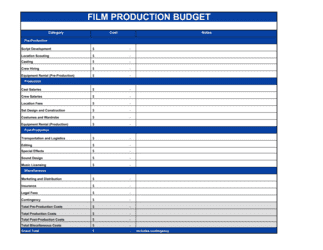
The total approved budget for the Picture is $[AMOUNT] (the 'Approved Budget'), attached as Schedule A. Producer shall not exceed any line item by more than [X]% without Counterparty's prior written consent. Producer shall provide weekly cost reports in the form set out in Schedule B.

Common mistake: Setting line-item approval thresholds too low — requiring sign-off on every $500 overrun creates operational gridlock on set and delays production decisions.

Production Schedule and Delivery Milestones

In plain language: Sets the start date for principal photography, the expected wrap date, post-production timeline, and the final delivery date, with defined consequences for missing each milestone.

Sample language
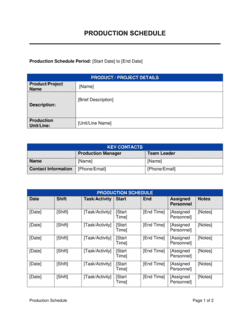
Principal Photography shall commence on or before [START DATE] and is scheduled to wrap by [WRAP DATE]. Producer shall deliver the Approved Cut to Counterparty no later than [DELIVERY DATE]. Each week of delay beyond [GRACE PERIOD] days shall result in a per-diem reduction of $[AMOUNT] from the final payment.

Common mistake: No grace period before delay penalties kick in — production overruns of a few days are nearly universal, and a zero-tolerance schedule triggers disputes that distract from finishing the film.

Intellectual Property Ownership and Chain of Title

In plain language: Establishes who owns the copyright in the finished film, underlying rights, and all production materials, and requires the producer to deliver a clean chain of title.

Sample language
Producer represents and warrants that it owns or controls all rights necessary to produce the Picture, including rights to the underlying [SCREENPLAY / NOVEL / LIFE RIGHTS] described in Schedule C. The copyright in the Picture shall be owned by [OWNER ENTITY] upon creation as a work made for hire, or by assignment.

Common mistake: Failing to confirm the chain of title before signing — if the producer doesn't have cleared rights to the underlying material, the entire production can be enjoined mid-shoot.

Screen Credits

In plain language: Specifies the on-screen and paid-advertising credit obligations for the producer, director, key cast, and the financing or distributing entity — including size, placement, and guild requirements.

Sample language
Producer shall accord Counterparty a credit in the form '[CREDIT TEXT]' in the main titles of the Picture, in a size not less than [X]% of the title card. All credits are subject to applicable guild or union requirements, and Producer's obligations hereunder shall be deemed satisfied by compliance with applicable guild minimums.

Common mistake: Drafting credit obligations that conflict with DGA, WGA, or SAG-AFTRA minimums — guild rules govern where applicable and contractual promises that exceed guild standards can create separate breach claims.

Distribution Rights and Territory

In plain language: Defines which distribution rights are granted or retained — by territory, medium (theatrical, streaming, broadcast, home video), and window — and any holdback or exclusivity obligations.

Sample language
Producer hereby grants to Counterparty the exclusive right to distribute the Picture in the [TERRITORY] by all media including theatrical, SVOD, AVOD, broadcast television, and home video, for a period of [X] years from the Delivery Date. The following rights are expressly reserved by Producer: [LIST RESERVED RIGHTS].

Common mistake: Omitting a definition of 'all media' — streaming rights, AVOD, and virtual cinema rights have evolved faster than contract language, leaving disputes about whether legacy 'all media' grants cover newer platforms.

Completion Bond

In plain language: Requires the producer to obtain a completion guarantee from an approved guarantor, defines the guarantor's rights to take over production if budget or schedule is breached, and states the bonding fee allocation.

Sample language
Producer shall obtain a completion bond from [APPROVED GUARANTOR] covering [X]% of the Approved Budget within [X] days of the execution of this Agreement, naming Counterparty as a co-obligee. The bonding fee, estimated at [X]% of the Approved Budget, shall be treated as a production cost.

Common mistake: Not specifying an approved guarantor list — an unknown or under-capitalized guarantor provides no real protection, and financiers who discover this mid-production can legitimately withhold funding installments.

Payment Schedule and Recoupment Waterfall

In plain language: States when the counterparty's financial contributions are disbursed to the producer, and sets out the order in which revenues are applied — recoupment of investment, distribution fees, and profit participation.

Sample language
Counterparty shall fund the Approved Budget in installments: [X]% on execution, [X]% on commencement of principal photography, [X]% on picture lock, and [X]% on delivery. Revenues shall be applied in the following order: (1) recoupment of Counterparty's investment in full; (2) [X]% distribution fee to [PARTY]; (3) net profits split [X]% Counterparty / [X]% Producer.

Common mistake: Agreeing to a net profits participation without defining 'net' — the deduction list (overhead, interest, marketing reserves) can effectively reduce net to zero on a commercially successful film.

Force Majeure

In plain language: Excuses both parties from performance obligations caused by events beyond their control, defines what qualifies, sets a maximum suspension period, and states termination rights if the event continues.

Sample language
Neither party shall be in breach of this Agreement to the extent performance is prevented by fire, flood, earthquake, epidemic, pandemic, war, terrorism, strike, or governmental action ('Force Majeure Event'). If a Force Majeure Event continues for more than [X] days, either party may terminate this Agreement on [X] days' written notice, subject to settlement of costs incurred to date.

Common mistake: Failing to specify what happens to costs already incurred when force majeure terminates the agreement — without this, both parties claim the other owes reimbursement and the dispute outlasts the production.

Termination, Default, and Dispute Resolution

In plain language: Sets out the events of default for both parties, the cure period, the remedies available upon termination, and whether disputes go to arbitration or litigation.

Sample language
Either party may terminate for the other's uncured material breach upon [X] days' written notice. In the event of Producer's default, Counterparty may engage a replacement producer and offset replacement costs against Producer's profit participation. All disputes shall be resolved by binding arbitration before [JAMS / ICC] in [CITY, STATE/COUNTRY] under the rules then in effect.

Common mistake: Choosing litigation instead of arbitration for international co-productions — cross-border court proceedings can take 5–10 years, by which time any film revenues have been exhausted in legal fees.

How to fill it out

  1. 1

    Identify the parties and the project

    Enter the full registered legal name of the producer entity and the counterparty — financier, distributor, or service provider. Attach the film's working title and a one-paragraph project description as a recital.

    💡 Confirm the counterparty's exact legal entity name against a current company registry search before signing — film deals frequently involve SPVs and the entity on the contract determines which assets back any claim.

  2. 2

    Attach the approved budget as Schedule A

    Complete the production budget in line-item detail before executing the agreement. Enter the total approved budget amount in the body of the contract and reference Schedule A. Set the line-item variance threshold that triggers approval rights.

    💡 A 10% line-item variance threshold is a common industry standard — lower than this creates approval bottlenecks; higher than this gives the producer unchecked flexibility with the financier's money.

  3. 3

    Set the production schedule and delivery milestones

    Enter the principal photography start date, estimated wrap date, post-production end date, and contractual delivery date. Attach the full production schedule as Schedule B if available.

    💡 Build at least two weeks of buffer between your realistic delivery estimate and the contractual delivery date — post-production almost always runs longer than planned.

  4. 4

    Confirm chain of title and IP ownership

    List all underlying rights (screenplay, novel, life rights, musical compositions) in Schedule C with the acquisition date and rights holder. State explicitly whether copyright in the finished film vests in the producer or counterparty, and whether the arrangement is work-for-hire or assignment.

    💡 Order a copyright search on the underlying material before execution — unresolved prior claims discovered mid-production can shut down the entire project.

  5. 5

    Define distribution rights by territory and medium

    List each territory granted and reserved, the specific media included (theatrical, SVOD, AVOD, broadcast, home video), the license term, and any holdback windows between theatrical and subsequent platforms.

    💡 Explicitly address whether the grant includes AI-generated derivative works and generative AI training use — courts have not yet settled whether legacy 'all media' grants cover these uses.

  6. 6

    Complete the payment schedule and recoupment waterfall

    Enter each funding installment as a percentage of the approved budget tied to a production milestone. Then draft the recoupment waterfall in numbered priority order, defining 'net profits' by listing every permitted deduction.

    💡 If the counterparty is an equity investor rather than a lender, the recoupment waterfall is the most negotiated section — model several scenarios in a spreadsheet before agreeing to percentages.

  7. 7

    Specify the completion bond requirements

    Name the approved guarantor or provide a short list of acceptable guarantors. Enter the bond coverage percentage, the bonding fee allocation, and the deadline by which the bond must be delivered.

    💡 Require delivery of the executed completion bond as a condition precedent to the first funding installment — never fund production before the bond is in place.

  8. 8

    Tailor force majeure and dispute resolution

    Review the force majeure list and add any jurisdiction-specific risks (e.g., local labor strikes, political instability in the shooting location). Choose arbitration over litigation for any cross-border arrangement and specify the seat, rules, and governing law.

    💡 For international co-productions, neutral arbitral seats — London, Singapore, or New York — are preferred because awards are enforceable across more jurisdictions under the New York Convention.

Frequently asked questions

What is a film production agreement?

A film production agreement is a legally binding contract between a producer and a financier, distributor, or production services company that governs the production of a motion picture. It defines the approved budget, shooting schedule, IP ownership, screen credits, distribution rights by territory and medium, completion bond requirements, and force majeure provisions. It is the foundational document that protects all parties before a single dollar of production spending occurs.

Who are the parties to a film production agreement?

The most common configuration is a producer — the entity responsible for physically making the film — and a counterparty that is either a financier providing the budget, a distributor committing to release the finished film, or a production services company delivering specific production resources. Co-production arrangements may involve two producers sharing costs, rights, and creative control under the same agreement or a companion co-production deed.

What is a completion bond and why do financiers require it?

A completion bond is a financial guarantee issued by a specialist completion guarantor — not a standard insurance company — that ensures the film will be completed on budget and delivered on schedule, or the financier will be repaid their investment. Financiers require it because film production is inherently unpredictable; the bond transfers the risk of a failed production to the guarantor rather than leaving the investor exposed. Bonding fees typically run 2–6% of the approved budget and are treated as a production cost.

What rights should a producer retain in a film production agreement?

Producers typically seek to retain sequel and remake rights, theatrical rights in territories not covered by the counterparty's distribution deal, merchandising and licensing rights, format rights, and any new media platforms not explicitly granted. The specific retained rights depend on the leverage of each party and the financing structure. Every right not explicitly granted in the contract should be addressed — ambiguity in rights grants is the most litigated issue in entertainment law.

What does 'chain of title' mean in a film contract?

Chain of title is the documented sequence of ownership agreements — option agreements, assignment agreements, work-for-hire contracts, and copyright registrations — that proves the producer holds clear rights to make the film based on the underlying material. A gap in the chain, such as an unregistered assignment or an expired option, can block distribution deals, distribution platform licensing, and E&O insurance issuance. Distributors and completion guarantors review chain-of-title documentation before committing to any deal.

Does a film production agreement need to go through arbitration or can it go to court?

Both are valid, but arbitration is strongly preferred for international co-productions and any agreement where the parties are in different countries. Arbitral awards issued under the New York Convention are enforceable in over 170 countries, making cross-border recovery far more practical than pursuing a foreign court judgment. Domestic productions may choose litigation if both parties are in the same jurisdiction and confidentiality is less critical, but entertainment arbitration before JAMS, ICC, or BAFTA dispute resolution panels is the industry standard for high-value productions.

When should I engage an entertainment lawyer rather than use a template?

A template is sufficient for straightforward domestic productions with a single financier and a clearly defined rights package. Engage an entertainment lawyer when the budget exceeds $500,000, when the production involves a publicly listed company, broadcaster, or streaming platform as counterparty, when the agreement crosses multiple jurisdictions, when guild signatory status is required, or when the IP includes underlying rights with contested ownership. A 3–6 hour review by a qualified entertainment lawyer typically costs $900–$3,000 and can prevent disputes worth multiples of that cost.

What happens if force majeure causes production to shut down?

A well-drafted force majeure clause suspends performance obligations for the duration of the event and gives both parties termination rights if the event exceeds a defined period — typically 30 to 90 days. The key issue is what happens to costs already incurred: the contract should specify whether the financier's invested funds to date are credited against any future production restart, reimbursed in full, or treated as a lost advance. Without this language, force majeure terminations routinely result in litigation over sunk costs that can equal 20–40% of the total budget.

How this compares to alternatives

vs Co-Production Agreement

A co-production agreement is used when two production companies share creative control, budget contributions, and rights ownership as equal or proportionate partners. A film production agreement is used when one party is the primary producer and the other is a financier, distributor, or service provider with defined but subordinate rights. Use a co-production agreement when both parties have ongoing creative and financial obligations; use a film production agreement when roles are clearly separated.

vs Film Distribution Agreement

A film distribution agreement is executed after the film is complete or near completion and focuses exclusively on how the finished film will be licensed, marketed, and exploited across territories and platforms. A film production agreement governs the making of the film and may include a distribution rights grant as one of its clauses, but its primary scope is production obligations, budget control, and IP ownership. Both documents are often needed — the production agreement first, the distribution agreement on delivery.

vs Independent Contractor Agreement

An independent contractor agreement covers a single individual — a director of photography, editor, or VFX supervisor — providing specific services to the production for a fee. A film production agreement governs the entire production arrangement between the producer entity and a major counterparty. Contractor agreements are used in volume for individual crew; the production agreement is the single governing document for the project as a whole.

vs Option and Purchase Agreement

An option and purchase agreement secures the producer's right to acquire underlying source material — a novel, screenplay, or life story — for development and production. It must be executed and the option exercised before the film production agreement is signed, because the production agreement will represent and warrant that underlying rights have been cleared. The two documents work in sequence: option and purchase first, production agreement second.

Industry-specific considerations

Independent Film and Documentary

Private equity or grants-based financing structures, co-production arrangements with public broadcasters, and festival delivery requirements alongside commercial distribution terms.

Streaming and Digital Media

Platform-specific technical delivery specifications, SVOD exclusivity windows, territorial holdbacks negotiated against day-and-date global releases, and data-use provisions covering viewer analytics.

Advertising and Branded Content

Brand approval rights over creative content, compressed production schedules with hard broadcast deadlines, talent usage rights limited to specific campaign windows and media channels.

Animation and Visual Effects

Milestone-based payment tied to animation deliverable approvals, work-for-hire clauses covering all original character designs and VFX assets, and software license cost allocations within the production budget.

Jurisdictional notes

United States

US film contracts are governed by state law — California and New York are the dominant jurisdictions. California's Labor Code imposes strict limits on personal service contracts over seven years and affects long-term production deals. Guild agreements with the DGA, WGA, and SAG-AFTRA are binding on signatory producers regardless of contract terms and supersede conflicting provisions. Copyright registration with the US Copyright Office is strongly recommended before principal photography to preserve statutory damages and attorney fee recovery.

Canada

Canadian productions seeking federal or provincial tax credits must satisfy Canadian Content (CAVCO) certification requirements, which impose ownership and creative control conditions that must be reflected in the production agreement. Co-productions under Canada's official treaty network require that the Canadian producer hold a genuine majority interest in copyright and creative control. Quebec productions involving French-language content face additional obligations under the Charter of the French Language. Provincial broadcasters and the Canada Media Fund have their own production agreement requirements for funded projects.

United Kingdom

UK productions seeking BFI certification as British qualifying films must satisfy Cultural Test criteria that affect creative control and copyright ownership terms in the production agreement. The Copyright, Designs and Patents Act 1988 grants the director a statutory moral right of paternity that cannot be fully waived in consumer contracts — credit obligations must be carefully drafted. Post-Brexit, UK productions no longer qualify automatically for EU co-production treaty benefits and must rely on bilateral agreements. PACT standard agreements are widely used as industry templates for broadcaster-commissioned productions.

European Union

EU co-productions qualifying under the European Convention on Cinematographic Co-Production require genuine creative and financial contribution from each co-producing country, reflected in the production agreement's rights allocation. The EU Audiovisual Media Services Directive imposes prominence obligations on streaming platforms that affect territorial licensing windows negotiated in production agreements. GDPR applies to any personal data processed during production — including talent data and audience research — and relevant data processing terms should be addressed. Several member states (France, Germany, Italy) maintain droit moral or moral rights protections for directors and writers that survive any contractual waiver attempt.

Template vs lawyer — what fits your deal?

PathBest forCostTime
Use the templateLow-budget independent productions under $150,000 with a single domestic financier and a straightforward rights packageFree1–2 hours to complete
Template + legal reviewProductions between $150,000 and $1M, co-productions with a broadcaster or sales agent, or any agreement crossing US state lines or international borders$900–$3,000 for an entertainment lawyer review3–7 days
Custom draftedStudio or streaming platform co-productions, guild signatory productions, international co-productions with treaty implications, or budgets above $1M$5,000–$25,000+2–6 weeks

Glossary

Chain of Title
The documented sequence of ownership transfers — from original source material through to the producer — proving the producer has clear rights to make the film.
Completion Bond
An insurance-like instrument issued by a completion guarantor that ensures the film will be finished on budget and on schedule, or the financier will be repaid.
Principal Photography
The primary phase of filming in which the main scenes are captured with the lead cast — the most expensive and time-critical stage of production.
Recoupment
The contractual process by which an investor or financier recovers their capital from film revenues before profits are shared with other participants.
Profit Participation
A share of net or gross profits payable to a producer, director, writer, or investor after defined recoupment and distribution fees are deducted.
Force Majeure
A clause that excuses a party from performance obligations caused by events outside their control — natural disasters, strikes, pandemics, or government action.
Screen Credit
The on-screen attribution given to individuals or companies that contributed to the film, governed by guild rules and contract — disputes over credit can trigger arbitration.
Delivery Requirements
The technical and legal materials — master files, E&O insurance certificates, music cue sheets, clearances — a producer must deliver to a distributor for a film to be released.
E&O Insurance
Errors and Omissions insurance covering claims that the film infringes third-party intellectual property rights — required by virtually every distributor and broadcaster.
Work for Hire
A copyright arrangement under which creative work produced by an employee or commissioned contributor is owned by the hiring party from the moment of creation.
Turnaround
The right of a producer to take a project to another financier or studio if the original party passes, typically by repaying development costs.
Gross vs. Net Profits
Gross profits are calculated before most deductions; net profits are calculated after distribution fees, marketing costs, and overhead — notorious in the industry for rarely being positive even on commercially successful films.

Part of your Business Operating System

This document is one of 3,000+ business & legal templates included in Business in a Box.

  • Fill-in-the-blanks — ready in minutes
  • 100% customizable Word document
  • Compatible with all office suites
  • Export to PDF and share electronically

Create your document in 3 simple steps.

From template to signed document — all inside one Business Operating System.
1
Download or open template

Access over 3,000+ business and legal templates for any business task, project or initiative.

2
Edit and fill in the blanks with AI

Customize your ready-made business document template and save it in the cloud.

3
Save, Share, Send, Sign

Share your files and folders with your team. Create a space of seamless collaboration.

Save time, save money, and create top-quality documents.

★★★★★

"Fantastic value! I'm not sure how I'd do without it. It's worth its weight in gold and paid back for itself many times."

Managing Director · Mall Farm
Robert Whalley
Managing Director, Mall Farm Proprietary Limited
★★★★★

"I have been using Business in a Box for years. It has been the most useful source of templates I have encountered. I recommend it to anyone."

Business Owner · 4+ years
Dr Michael John Freestone
Business Owner
★★★★★

"It has been a life saver so many times I have lost count. Business in a Box has saved me so much time and as you know, time is money."

Owner · Upstate Web
David G. Moore Jr.
Owner, Upstate Web

Run your business with a system — not scattered tools

Stop downloading documents. Start operating with clarity. Business in a Box gives you the Business Operating System used by over 250,000 companies worldwide to structure, run, and grow their business.

Start free · No credit card required