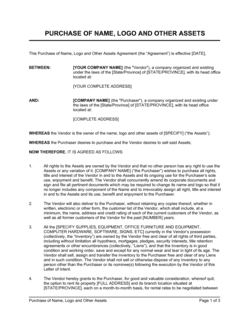
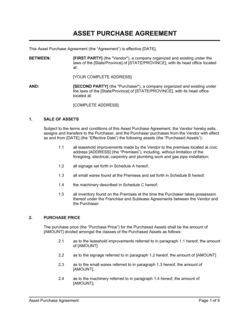
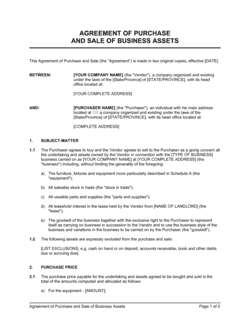
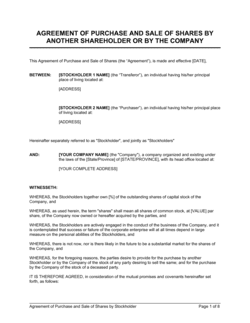
Asset Sale and Purchase Agreement Film & Television Template

Free Word download • Edit online • Save & share with Drive • Export to PDF

21 pages35–45 min to fillDifficulty: ComplexSignature requiredLegal review recommended
Learn more ↓
FreeAsset Sale and Purchase Agreement Film & Television Template

At a glance

What it is
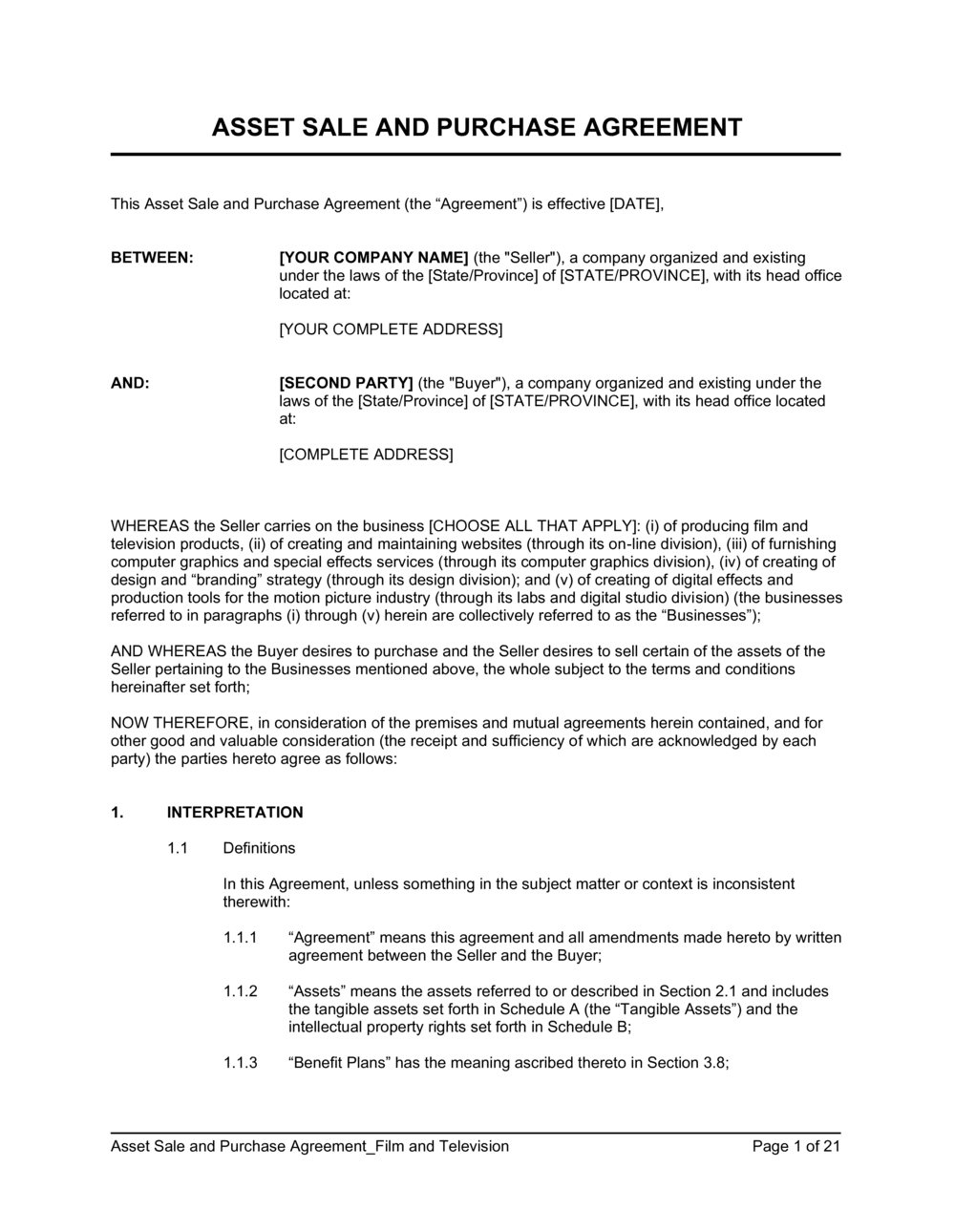
An Asset Sale and Purchase Agreement for Film and Television is a legally binding contract between a seller and a buyer for the transfer of specific film or television assets — including intellectual property rights, physical production materials, distribution agreements, and associated liabilities. This free Word download gives you a structured, professionally drafted starting point you can edit online and export as PDF, covering everything from IP chain of title to closing conditions in a single document.
When you need it
Use it when acquiring or divesting a completed film, television series, format rights, library titles, or a bundle of production assets — any transaction where specific entertainment assets, rather than an entire company, are changing hands. It is also used when a production company acquires underlying rights to adapt a book, script, or other property for screen.
What's inside
Identification of the purchased assets and excluded assets, purchase price and payment mechanics, representations and warranties on chain of title and IP ownership, closing conditions, indemnification obligations, and governing law. The agreement also covers assignment of existing distribution and licensing agreements, talent and guild obligations transferred with the assets, and any holdback or revenue-sharing terms.

What is an Asset Sale and Purchase Agreement for Film and Television?

An Asset Sale and Purchase Agreement for Film and Television is a legally binding contract under which a seller transfers defined entertainment assets — completed films, television series, format rights, physical production elements, distribution contracts, and associated intellectual property — to a buyer for an agreed purchase price. Unlike a company acquisition, only the specified assets change hands; the selling entity and its remaining liabilities stay behind. The agreement establishes exactly what is included, confirms that the seller holds clean chain of title to every right being transferred, allocates pre- and post-closing liabilities including guild residual obligations, and sets the conditions that must be satisfied before the transaction is legally complete.

Why You Need This Document

Buying or selling film and television assets without a properly structured written agreement exposes both parties to serious and often irreversible risk. Without an exhaustive asset schedule and chain-of-title representations, a buyer may discover after closing that the seller did not own the underlying screenplay rights, that a distributor holds a right of first refusal in a key territory, or that SAG-AFTRA residuals running into six figures were never disclosed. Without a defined indemnification structure, the seller has no contractual ceiling on post-closing liability and the buyer has no contractual remedy when a defect surfaces years later. A well-drafted agreement makes the scope of the transaction undeniable, allocates known risks to the party best positioned to manage them, and gives both parties a clear path to closing and a clear set of obligations once the deal is done. This template gives you a professionally structured starting point that covers every material clause in a standard film and television asset sale — saving significant legal drafting time while flagging the issues that require jurisdiction-specific counsel review.

Which variant fits your situation?

If your situation is…Use this template
Acquiring all assets of an entire production companyBusiness Asset Purchase Agreement
Licensing film rights without transferring ownershipFilm Distribution Agreement
Acquiring underlying literary or script rights before productionOption and Purchase Agreement
Selling a partial interest or co-production stakeCo-Production Agreement
Transferring rights as part of a company share saleShare Purchase Agreement
Buying format rights for a TV show remake or adaptationFormat Rights License Agreement
Transferring rights after a production company wind-downAssignment of Intellectual Property Agreement

Common mistakes to avoid

❌ Accepting unverified chain-of-title representations

Why it matters: A seller's warranty is only as good as their ability to satisfy a judgment. If the chain of title has a gap — an unsigned writer agreement, an unrecorded copyright assignment — the buyer may own nothing enforceable, and the seller may be insolvent by the time the defect surfaces.

Fix: Require delivery of all chain-of-title documents at or before closing, and commission an independent chain-of-title opinion from entertainment counsel as a closing condition.

❌ Omitting an exhaustive excluded-assets schedule

Why it matters: Without a defined list of excluded assets, the seller may assert that related sequel rights, social media accounts, or archived production materials were never sold — and the buyer has no contractual basis to dispute it.

Fix: Draft both schedules simultaneously: every asset the buyer expects to receive in Schedule A, and every asset the seller is retaining in Schedule C, reviewed and initialed by both parties.

❌ No indemnification cap or survival period

Why it matters: Unlimited indemnity with no time limit turns every post-closing third-party claim into open-ended exposure. A copyright infringement suit filed three years after closing can exceed the purchase price in legal fees alone.

Fix: Negotiate a cap (typically equal to the purchase price), a deductible basket, and a survival period of 18–36 months for general representations. Carve out fraud and title defects for unlimited survival.

❌ Ignoring guild residual obligations

Why it matters: Residual obligations run with the content, not the seller. SAG-AFTRA and WGA will pursue the current rights holder — the buyer — for unpaid residuals accrued before the sale, regardless of what the purchase agreement says.

Fix: Obtain a residuals audit from each applicable guild before closing, require the seller to bring all arrears current, and include a specific indemnity covering pre-closing residual claims.

❌ No third-party consent process for distribution agreements

Why it matters: Most distribution agreements include anti-assignment clauses. A buyer who closes without obtaining required consents may find their key revenue agreements are voidable, leaving them with assets they cannot monetize.

Fix: Map every agreement in the purchased assets against its assignment consent requirement at least 30 days before the target closing date, and make receipt of all required consents a closing condition.

❌ Failing to specify territory and media in the asset definition

Why it matters: Film rights are fractured across territories and platforms — a buyer who does not specify which territories and media formats are included may discover the seller retained streaming rights for major markets, destroying the asset's primary revenue stream.

Fix: Define territory and permitted media explicitly in the agreement body and in Schedule A. If the sale is worldwide all-media, state that expressly rather than relying on implication.

The 9 key clauses, explained

Identification of purchased and excluded assets

In plain language: Defines exactly which assets are being sold — completed film negatives, deliverables, copyright registrations, distribution contracts, trademarks, and physical production materials — and explicitly lists what stays with the seller.

Sample language
The 'Purchased Assets' shall include all right, title, and interest of Seller in and to: (a) the Film [TITLE], including all physical and digital masters; (b) all copyrights and trademarks listed in Schedule A; (c) all Distribution Agreements listed in Schedule B; and (d) all related promotional materials. The 'Excluded Assets' are listed in Schedule C.

Common mistake: Defining purchased assets broadly as 'all assets related to the Film' without an exhaustive schedule. Disputes over whether a specific contract, social media account, or physical element is included are common and expensive to resolve after closing.

Purchase price and payment mechanics

In plain language: States the total consideration, how and when it is paid — upfront, in tranches, or contingent on performance — and the currency and wire instructions.

Sample language
The aggregate purchase price for the Purchased Assets is [CURRENCY] $[AMOUNT] ('Purchase Price'), payable as follows: (a) $[DEPOSIT AMOUNT] within [X] business days of execution; (b) $[BALANCE] at Closing by wire transfer to [SELLER BANK DETAILS]; and (c) a Holdback of $[HOLDBACK AMOUNT] to be released on [DATE / CONDITION].

Common mistake: Failing to specify the currency when parties are in different countries. USD and CAD look identical on a wire instruction form and the error can take weeks to unwind.

Chain of title and IP representations

In plain language: The seller represents that it owns all intellectual property in the assets free and clear of encumbrances, that the chain of title is complete and unbroken, and that no third party has a superior claim to any rights being transferred.

Sample language
Seller represents and warrants that: (a) Seller is the sole and exclusive owner of all copyright in the Film; (b) the chain of title documentation in Schedule D is complete, accurate, and unencumbered; (c) no third party holds any lien, claim, or security interest in the Purchased Assets; and (d) all agreements with writers, directors, and cast members are listed in Schedule E and are in full force.

Common mistake: Accepting a seller's representation without requiring delivery of the actual chain-of-title documents at closing. A warranty is worthless if the buyer cannot independently verify the title is clean.

Assumed liabilities

In plain language: Specifies which existing obligations — guild residuals, distribution advances, financing liens — the buyer agrees to take on, and excludes all liabilities not expressly listed.

Sample language
Buyer assumes only those liabilities of Seller expressly listed in Schedule F ('Assumed Liabilities'), including residual payment obligations under the [GUILD] Basic Agreement. Buyer does not assume, and Seller shall retain, all other liabilities, including any liabilities arising prior to the Closing Date.

Common mistake: Vaguely assuming 'all liabilities related to the Film' without a schedule. This can expose the buyer to undisclosed debts, guild claims, and third-party lawsuits that were never contemplated in the deal economics.

Representations and warranties of the seller

In plain language: The seller's factual commitments about corporate authority to sell, absence of litigation, accuracy of disclosed information, and compliance with all applicable guild and union agreements.

Sample language
Seller represents and warrants that: (a) Seller has full corporate authority to enter into and perform this Agreement; (b) there is no pending or threatened litigation relating to the Purchased Assets; (c) all guild and union obligations relating to the Film have been paid current as of the Closing Date; and (d) the Film does not infringe any third-party copyright, trademark, or right of publicity.

Common mistake: Omitting guild compliance representations. Undisclosed residual arrears transfer with the assets in many jurisdictions — a buyer who inherits unpaid SAG-AFTRA or WGA obligations can face liability running into six figures.

Closing conditions

In plain language: Lists the deliverables and confirmations — signed assignments, cleared liens, guild consents, E&O insurance certificates — that must be in place before either party is obligated to complete the transaction.

Sample language
The obligation of Buyer to consummate the transactions contemplated herein is conditioned upon: (a) delivery of executed copyright assignment instruments for all works listed in Schedule A; (b) delivery of a current E&O insurance certificate naming Buyer as additional insured; (c) written consents from all distributors listed in Schedule B to the assignment of their agreements; and (d) release of all liens on the Purchased Assets.

Common mistake: No closing conditions at all — treating signing and closing as simultaneous. If the seller cannot deliver a clean title or guild consent, the buyer has no contractual basis to delay or cancel the transaction without triggering a breach claim.

Indemnification

In plain language: Sets out each party's obligation to compensate the other for losses caused by a breach of their representations or for third-party claims arising from pre- or post-closing acts.

Sample language
Seller shall indemnify, defend, and hold harmless Buyer from any losses, claims, damages, or expenses arising out of: (a) any breach of Seller's representations and warranties; (b) any Excluded Liability; or (c) any third-party claim that the Film infringes any intellectual property right. Buyer shall indemnify Seller for losses arising from Buyer's operation of the Purchased Assets after the Closing Date.

Common mistake: No cap on indemnification liability. Without a negotiated cap — typically tied to the purchase price — the indemnity exposure can exceed the deal value many times over, particularly for IP infringement claims.

Non-competition and non-solicitation

In plain language: Prevents the seller from re-entering the same competitive space using retained assets, or from soliciting key talent and distribution relationships acquired by the buyer.

Sample language
For a period of [X] years following Closing, Seller shall not (a) produce, finance, or distribute any film or television project that directly competes with the Purchased Assets in [TERRITORY]; or (b) solicit or hire any individual who was employed in connection with the Film within the [X] months preceding Closing.

Common mistake: Omitting this clause entirely in film library acquisitions. A seller who retains a related sequel right or a competing format can immediately undercut the value of the assets sold without a restriction in place.

Governing law and dispute resolution

In plain language: Identifies the jurisdiction whose laws govern the agreement and the mechanism — arbitration, mediation, or litigation — for resolving disputes, along with the seat and language of proceedings.

Sample language
This Agreement is governed by the laws of [STATE / PROVINCE / COUNTRY], without regard to conflict-of-law principles. Any dispute arising under this Agreement shall be resolved by binding arbitration before [ARBITRATION BODY] in [CITY], conducted in [LANGUAGE], except that either party may seek injunctive relief in any court of competent jurisdiction.

Common mistake: Choosing a governing law with no connection to either party's location or the assets' primary exploitation territory. Courts in the governing jurisdiction may apply local rules — such as California's entertainment law provisions — that override contract terms neither party intended.

How to fill it out

  1. 1

    Identify and schedule all purchased assets

    Draft an exhaustive Schedule A listing every asset being transferred — copyright registrations, film elements, distribution contracts, trademarks, domain names, and social media accounts. Attach a separate Schedule C for excluded assets.

    💡 Walk through every deliverable listed in the original production's completion bond or sales agent agreement — those are the assets the market expects to come with a film sale.

  2. 2

    Confirm and document the chain of title

    Collect all underlying rights agreements, writer and director agreements, chain-of-title opinion letters, and copyright registration certificates. Attach these as Schedule D and reference them in the representations clause.

    💡 Request a chain-of-title opinion from an entertainment lawyer before signing — gaps discovered post-closing can invalidate the entire transaction.

  3. 3

    Define the purchase price and payment structure

    Enter the total consideration, the deposit amount, the closing payment, any holdback amount and release conditions, and full wire details for each payment. State the currency explicitly.

    💡 If a holdback is tied to a performance condition — such as a minimum box office threshold — define the measurement period and data source precisely to avoid disputes.

  4. 4

    Schedule assumed liabilities and guild obligations

    List every assumed liability in Schedule F, including residual obligations under SAG-AFTRA, WGA, DGA, or equivalent guild agreements. Confirm all residual payments are current as of the closing date.

    💡 Contact the relevant guilds directly to request a residuals audit before closing — sellers occasionally underestimate arrears.

  5. 5

    Obtain and attach third-party consents

    Identify all distribution agreements, co-production agreements, and financing arrangements that require consent to assign. Send assignment-consent requests to all counterparties and collect signed consents before the closing date.

    💡 Some distribution agreements prohibit assignment without consent and include termination rights if assignment occurs without it — check every contract, not just the major ones.

  6. 6

    Set indemnification caps and survival periods

    Negotiate and enter the indemnification cap (typically 100% of the purchase price for general claims, uncapped for fraud and IP title defects), the basket or deductible threshold, and the survival period for representations (typically 18–36 months).

    💡 IP title representations and fraud should survive indefinitely — limit the survival cap only to general operating representations.

  7. 7

    Confirm E&O insurance requirements

    Specify the minimum E&O coverage amount required (typically $1–3M per claim, $3M aggregate for a feature film), the policy term, and the requirement to name the buyer as an additional insured.

    💡 Require the seller to deliver a binder showing coverage at or before closing, not just an undertaking to obtain it — the policy can take weeks to issue.

  8. 8

    Execute before the closing date with legal review

    Have both parties sign the agreement and all schedules before the agreed closing date. Deliver all closing deliverables simultaneously or through a closing escrow to protect both parties.

    💡 Use a closing checklist circulated to both parties' counsel at least five business days before closing — last-minute surprises on deliverables are the most common cause of delayed or failed film asset closings.

Frequently asked questions

What is a film and television asset sale and purchase agreement?

A film and television asset sale and purchase agreement is a legally binding contract for the transfer of specific entertainment assets — typically a completed film, TV series, format rights, or library titles — from a seller to a buyer. Unlike a company sale, only the defined assets change hands, not the corporate entity. The agreement specifies exactly what is transferred, the price and payment mechanics, representations about IP ownership, and the conditions that must be met before closing.

What assets are typically included in a film asset sale?

A typical film asset sale includes the copyright in the completed work and all underlying rights, physical and digital master elements, existing distribution and sales agent agreements, trademark registrations, domain names, and promotional materials. It may also include production materials such as the screenplay, director's cut, and localized versions. The precise scope is always defined in a schedule attached to the agreement — relying on a general description is one of the most common sources of post-closing disputes.

What is chain of title and why does it matter in a film sale?

Chain of title is the documented sequence of ownership transfers establishing that the seller has clear, unencumbered rights to every element of the film — from the underlying screenplay and music rights to the actors' releases and copyright registrations. A gap in the chain means a third party may have a superior claim to part of the rights being sold. Buyers should obtain an independent chain-of-title opinion from entertainment counsel before closing, because a warranty from an insolvent seller is no substitute for a clean title.

Are guild residuals transferred with the film assets?

Yes — in most major entertainment markets, residual obligations under guild agreements (SAG-AFTRA, WGA, DGA in the US; equivalent guilds in Canada and the UK) follow the content, not the original producer. The current rights holder is responsible for residual payments when the content is re-aired, sold, or distributed in new formats. Buyers should obtain a pre-closing residuals audit from each applicable guild and require the seller to cure any arrears before the closing date.

Do I need E&O insurance to buy film or TV assets?

Yes, in almost all commercial contexts. Errors and Omissions insurance protects against third-party claims of copyright infringement, defamation, right of publicity violations, and similar IP-related liabilities arising from the content. Most distributors, broadcasters, and streaming platforms require an active E&O policy as a condition of any distribution agreement. The agreement should specify minimum coverage levels — typically $1–3M per claim — and require the seller to deliver a policy certificate at closing.

What is a holdback in a film asset purchase?

A holdback is a portion of the purchase price withheld at closing and released to the seller after a defined period or event — most commonly when the seller's indemnification obligations survive without a claim being made, or when a specified performance milestone is achieved. It protects the buyer against post-closing claims arising from the seller's representations. The holdback amount, release conditions, and any escrow arrangement should be specified precisely in the payment mechanics clause.

How is a film asset sale different from a share purchase?

In a share purchase, the buyer acquires the corporate entity that owns the film, inheriting all of its assets and liabilities — including ones not disclosed in the deal. In an asset sale, the buyer selects and acquires only the defined assets, leaving behind corporate liabilities, tax obligations, and contracts not included in the schedules. Most film buyers prefer asset sales because they can ring-fence what they are acquiring, though the seller typically faces a higher tax cost as a result.

Can a distribution agreement be assigned to the buyer?

Only if the distribution agreement permits assignment or the distributor provides written consent. Most distribution agreements include anti-assignment clauses that make any unauthorized assignment void or give the distributor the right to terminate. Buyers must review every existing distribution agreement before closing and build consent collection into the closing conditions. Failure to obtain a required consent can leave the buyer without the revenue agreements that drove the acquisition economics in the first place.

Is this agreement valid for cross-border film transactions?

A well-drafted agreement is a valid starting point for cross-border transactions, but jurisdiction-specific issues — copyright registration requirements, mandatory guild consents, tax withholding on purchase price payments, and territory-specific content regulations — vary significantly between the US, Canada, the UK, and EU member states. For any cross-border film or television asset sale, review by entertainment counsel in each relevant jurisdiction is strongly recommended before signing.

How this compares to alternatives

vs Film Distribution Agreement

A distribution agreement licenses the right to distribute a film in a defined territory and media for a fixed term — ownership of the underlying IP stays with the producer. An asset sale and purchase agreement transfers ownership permanently. Use a distribution agreement when you want to monetize content without giving up title; use this agreement when the buyer needs full ownership of the IP and physical assets.

vs Option and Purchase Agreement

An option agreement grants a buyer the exclusive right to purchase underlying rights — typically a book or screenplay — within a defined period, before committing to the full purchase price. This asset sale agreement is used after development, when a completed or near-completed film or TV asset is being transferred. The option comes first in the production lifecycle; the asset sale comes at the end.

vs Share Purchase Agreement

A share purchase transfers ownership of the corporate entity that holds the assets, including all undisclosed liabilities. An asset sale transfers only the defined assets, leaving corporate liabilities behind. Buyers prefer asset sales for the liability ring-fencing; sellers often prefer share sales for tax efficiency. Both require careful due diligence, but the risk profiles differ significantly.

vs IP Assignment Agreement

An IP assignment agreement transfers specific intellectual property rights — copyright, trademark — without the broader commercial framework of an asset purchase. It contains no purchase price mechanics, no representations about guild obligations, and no closing conditions. An asset sale and purchase agreement is the appropriate instrument when the transaction involves multiple asset classes, a material purchase price, and ongoing liabilities such as residuals and distribution contracts.

Industry-specific considerations

Film and Television Production

Library consolidation, slate acquisitions, and distressed asset purchases from producers exiting the market require detailed IP schedules and guild compliance provisions.

Streaming and Digital Media

Streaming platforms acquiring exclusive rights to completed content must specify media and territory scope precisely, and confirm that no conflicting holdback periods exist in prior distribution agreements.

Private Equity and Media Finance

Investment funds acquiring content libraries as financial assets focus heavily on E&O coverage continuity, residuals liability caps, and revenue participation carve-outs tied to pre-existing profit-participation agreements.

Broadcasting and Cable Networks

Broadcasters purchasing completed series typically require clearances for music synchronization rights, format rights, and talent re-use rights across all intended broadcast territories.

Jurisdictional notes

United States

US copyright law requires written assignments signed by the copyright owner to be legally valid under 17 U.S.C. § 204. Guild agreements with SAG-AFTRA, WGA, and DGA impose residual obligations that follow the content and bind successor rights holders. California courts apply a disfavored treatment to broad non-compete clauses, and entertainment-specific case law on IP ownership and credits is heavily developed in the Central District of California.

Canada

Canadian copyright assignments must be in writing under the Copyright Act. Transactions involving content that received Canadian government financing through Telefilm Canada or provincial funds may require funder consent to assignment. Quebec requires French-language contracts for provincially regulated transactions. ACTRA and WGC residual obligations apply to Canadian productions and transfer with the rights.

United Kingdom

UK copyright assignments must be in writing and signed by or on behalf of the assignor under the Copyright, Designs and Patents Act 1988. The UK has a robust moral rights regime — authors of literary and dramatic works retain the right of paternity and integrity even after copyright assignment, which should be addressed in the agreement. PACT and Equity guild residual obligations apply to UK productions and transfer with the content.

European Union

EU member states each have national copyright laws implementing the InfoSoc Directive, and assignment requirements vary — German law in particular places strong restrictions on broad copyright assignments and includes an author's right to equitable remuneration that cannot be waived. GDPR considerations arise when personal data of cast, crew, or audience members is transferred as part of the asset bundle. Cross-border VAT on IP transfers requires careful structuring to avoid double taxation.

Template vs lawyer — what fits your deal?

PathBest forCostTime
Use the templateStraightforward single-title transfers between experienced industry parties with clean chain of title and no existing distribution encumbrancesFree2–4 hours to complete and review
Template + legal reviewAny transaction involving existing distribution agreements, guild obligations, or a purchase price above $50,000$1,500–$4,000 for entertainment counsel review and negotiation support3–7 business days
Custom draftedMulti-title library acquisitions, cross-border transactions, complex profit-participation carve-outs, or studio-level deals above $500,000$5,000–$25,000+ depending on deal complexity and counsel market2–6 weeks

Glossary

Chain of Title
The documented sequence of ownership transfers proving that the seller holds clear, unencumbered rights to all intellectual property included in the assets.
Purchased Assets
The specific assets being transferred under the agreement, defined exhaustively to avoid disputes over what is and is not included in the sale.
Excluded Assets
Assets owned by the seller that are explicitly carved out of the transaction and remain with the seller after closing.
Assumed Liabilities
Existing obligations — such as distribution agreements, talent residuals, or guild obligations — the buyer agrees to take over as part of the purchase.
Representations and Warranties
Factual statements each party makes about themselves and the assets as of the closing date, breach of which triggers indemnification obligations.
Holdback
A portion of the purchase price withheld at closing and released to the seller after a defined period or upon satisfaction of specific conditions.
Indemnification
An obligation by one party to compensate the other for losses arising from a breach of the agreement or a third-party claim related to the transaction.
Closing Conditions
Specific actions or confirmations — such as delivery of chain-of-title documents and guild clearances — that must occur before the transaction is legally complete.
Residuals
Payments owed to guild members (writers, directors, actors) under union agreements when content is re-aired, sold, or distributed in new media formats.
E&O Insurance
Errors and Omissions insurance that protects against claims of copyright infringement, defamation, or other IP-related liabilities arising from the content.
Underlying Rights
Rights to the source material — book, script, life story, or format — on which a film or television project is based.
Territory
The geographic scope within which the buyer is authorized to exploit the purchased assets, which may be worldwide or limited to specific countries or regions.

Part of your Business Operating System

This document is one of 3,000+ business & legal templates included in Business in a Box.

  • Fill-in-the-blanks — ready in minutes
  • 100% customizable Word document
  • Compatible with all office suites
  • Export to PDF and share electronically

Create your document in 3 simple steps.

From template to signed document — all inside one Business Operating System.
1
Download or open template

Access over 3,000+ business and legal templates for any business task, project or initiative.

2
Edit and fill in the blanks with AI

Customize your ready-made business document template and save it in the cloud.

3
Save, Share, Send, Sign

Share your files and folders with your team. Create a space of seamless collaboration.

Save time, save money, and create top-quality documents.

★★★★★

"Fantastic value! I'm not sure how I'd do without it. It's worth its weight in gold and paid back for itself many times."

Managing Director · Mall Farm
Robert Whalley
Managing Director, Mall Farm Proprietary Limited
★★★★★

"I have been using Business in a Box for years. It has been the most useful source of templates I have encountered. I recommend it to anyone."

Business Owner · 4+ years
Dr Michael John Freestone
Business Owner
★★★★★

"It has been a life saver so many times I have lost count. Business in a Box has saved me so much time and as you know, time is money."

Owner · Upstate Web
David G. Moore Jr.
Owner, Upstate Web

Run your business with a system — not scattered tools

Stop downloading documents. Start operating with clarity. Business in a Box gives you the Business Operating System used by over 250,000 companies worldwide to structure, run, and grow their business.

Start free · No credit card required