- Structured Interview
- An interview format in which every candidate is asked the same predetermined questions in the same order, scored against a fixed rubric to reduce evaluator bias.
- Behavioral Question
- A question that asks candidates to describe a specific past situation, action, and result — typically framed as 'Tell me about a time when...'
- Situational Question
- A hypothetical scenario question that asks a candidate what they would do in a defined future situation, used to assess judgment and problem-solving.
- Competency Framework
- A defined set of skills, behaviors, and knowledge areas against which every candidate for a given role is evaluated.
- Scoring Rubric
- A scale — typically 1 to 5 — with defined behavioral anchors at each level, used to rate candidate responses consistently across interviewers.
- STAR Method
- A response structure — Situation, Task, Action, Result — used by candidates to answer behavioral questions and by interviewers to probe for complete answers.
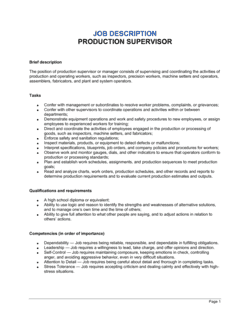
- OEE (Overall Equipment Effectiveness)
- A composite manufacturing KPI measuring availability, performance, and quality as a percentage of fully productive time.
- Adverse Impact
- A legal and statistical concept describing a hiring practice that disproportionately excludes a protected class, even when unintentional — structured guides help document neutrality.
- Panel Interview
- An interview format in which two or more evaluators assess the same candidate simultaneously, reducing individual bias and speeding consensus.
- Takt Time
- The average rate at which a production unit must be completed to meet customer demand — a core metric production supervisors are expected to manage.